The average B2B deal in 2026 involves six to ten stakeholders on the buying side.
That means lead generation is no longer about finding one name at a company. You have to find the right accounts, map the right people inside them, and build enough surface area to move a decision.
This guide takes a different approach.
I built it around how B2B lead generation actually works in 2026, from finding your ideal customer to signal-based prospecting to running an AI SDR. You will find something here you can apply this week.
If you are new to lead generation, read this from front to back. If you already run outbound and want to sharpen a specific stage, jump straight to that section.
Let us get into it.
Lead generation is the process of attracting people who might buy from you and starting a real conversation with them.
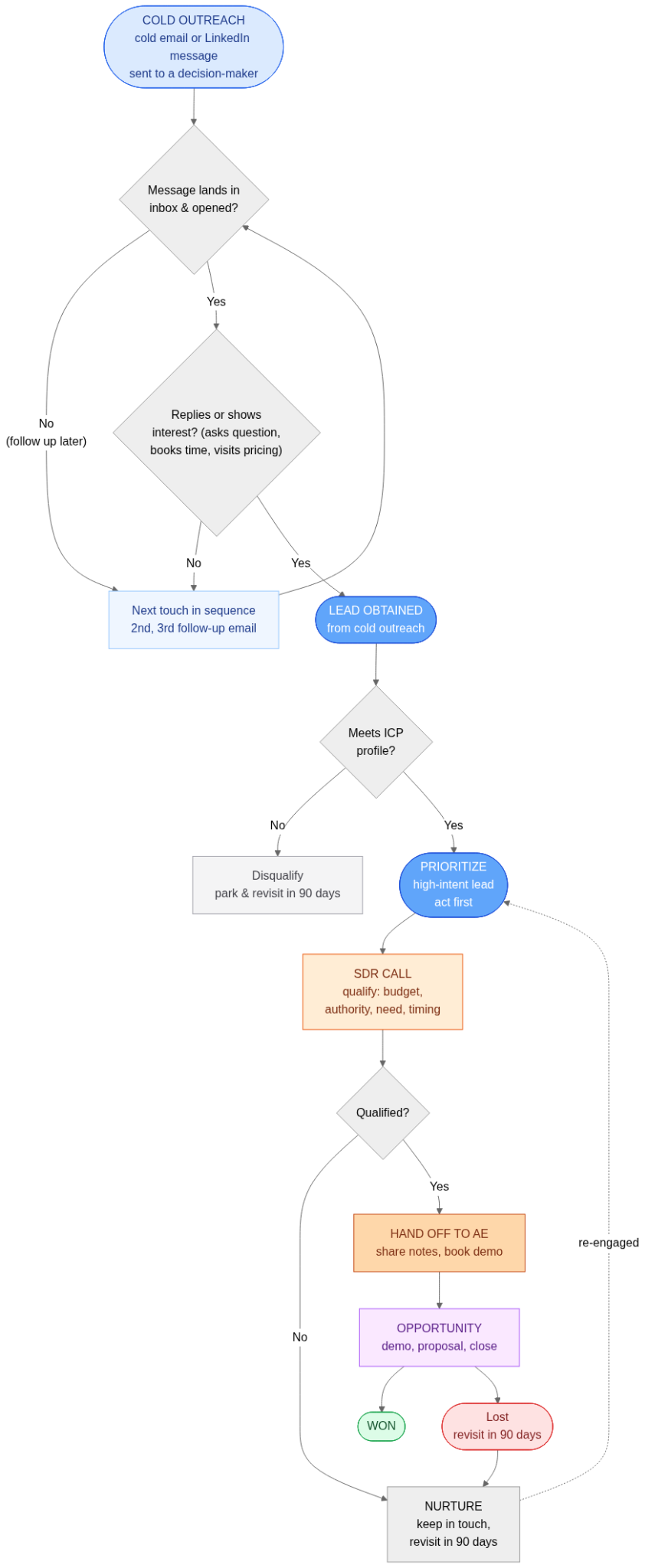
A lead is any person or company that has shown some sign of interest or fit. That signal can be small, like visiting your pricing page. Or it can be direct, like requesting a demo. Either way, the goal is the same. You are trying to move a stranger into a conversation and, eventually, into a customer.
In B2B, leads are usually sorted into categories based on how ready they are to buy. Understanding these categories helps you decide who to prioritize.
You will hear four terms used constantly. Getting them straight saves a lot of confusion later.
Every B2B sale starts with a lead. Without a steady flow of them, your pipeline dries up, and your revenue follows. That is the short version.
The longer version is that lead generation shapes the quality of every downstream conversation. If you generate leads that fit your ideal customer profile, your close rates go up. If you generate weak leads, your sales team burns hours on conversations that go nowhere.
For B2B teams, lead generation also shapes marketing spend, hiring plans, and how quickly you can grow. Getting it right is the difference between a company that scales predictably and one that limps from quarter to quarter. If you want a deeper look at how leads move through each stage, my breakdown of the B2B lead generation funnel covers the six-stage model I use.
Not all lead generation looks the same. The type you choose depends on your product, your market, your team, and your budget. Most B2B teams end up using two or three of the following in combination.
Inbound is when the lead comes to you. Someone finds your blog post, reads your case study, watches your webinar, or lands on your pricing page. Then they hand over their contact details in exchange for something valuable.
The engine behind inbound is content. Search-optimized blog posts, YouTube videos, LinkedIn posts, and podcast appearances all pull people into your world. Once they engage, you nurture them with more content until they are ready for a sales conversation.
Inbound has one big advantage. The leads come pre-warmed because they found you on their own. But it also has a downside. It takes months to build the content library and search authority that produces consistent volume. If you need pipeline this quarter, inbound alone will not get you there. That is where outbound comes in, and I broke down why the inbound sales strategy that worked in 2018 is losing deals in 2026 in more detail.
Outbound flips the model. Instead of waiting for buyers to find you, you go find them. You build a list of accounts and contacts that match your ideal customer profile, then you reach out through cold email, LinkedIn, cold calls, or ads.
The strength of outbound is control. You choose who you talk to, when you reach out, and what you say. You can start generating pipeline in weeks, not months. That makes it the default motion for most B2B teams under 100 employees.
The tradeoff is that outbound demands craft. Bad outbound is spam. Good outbound looks like a well-researched, well-timed, personally relevant message that a real prospect actually wants to open. If you want the full breakdown of how B2B teams run modern outbound, my B2B lead generation guide covers the tactics I trust.
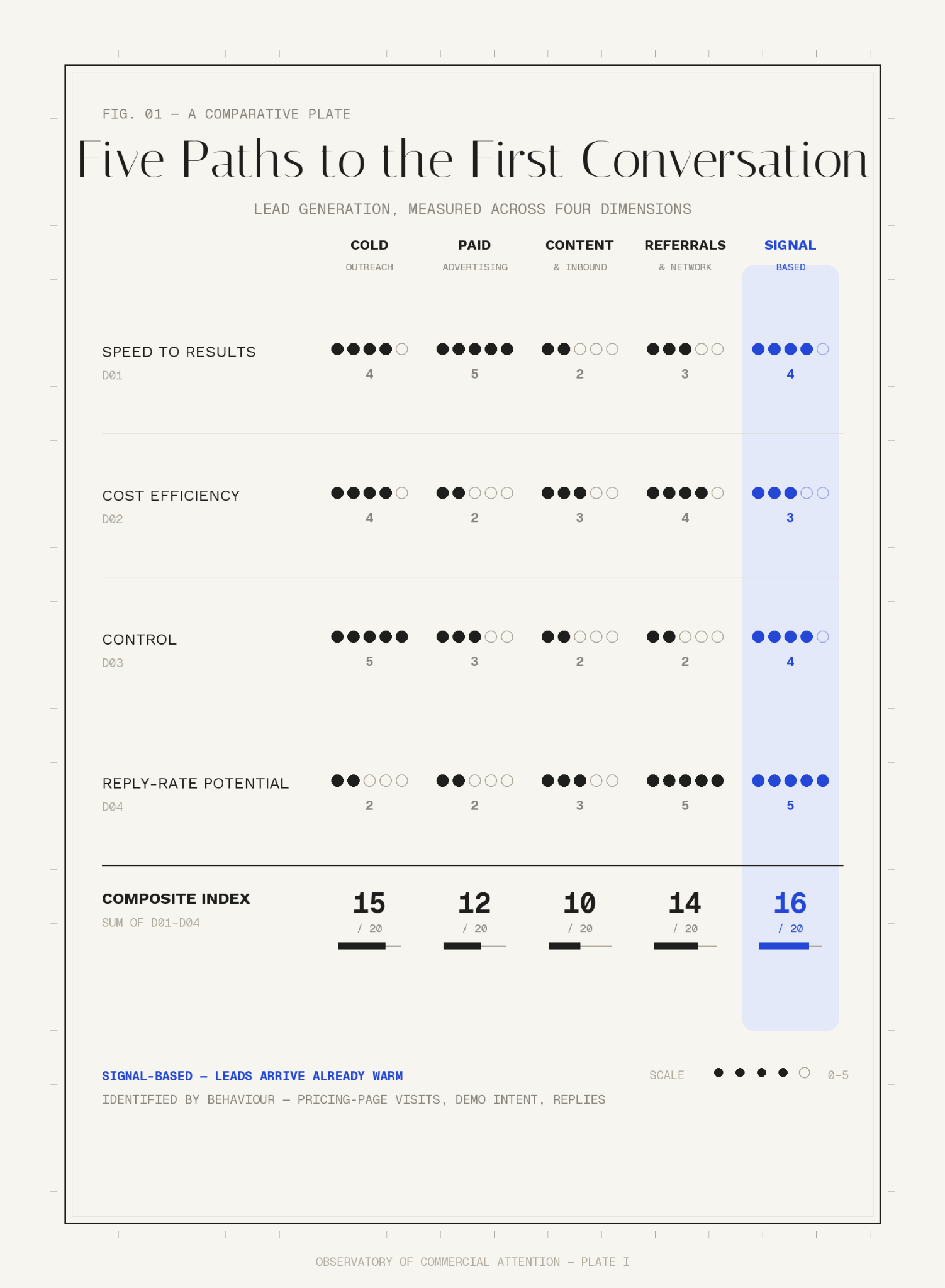
Signal-based lead generation is the third type most guides skip. It sits between inbound and outbound. Instead of guessing when a prospect might be ready to buy, you watch for signals that suggest they are ready right now.
Signals can be anything from a company hiring for a role your product supports, to a new funding round, to a leadership change, to a competitor tag on their website. When you see one, you reach out with a message tied directly to what just happened.
This changes everything. Reply rates go up because the message is timely. Meeting rates go up because the prospect is already thinking about the problem you solve. And your sales team spends less time chasing cold accounts.
Signal-based selling has quietly become the most reliable outbound motion in 2026. I explained why in my breakdown of signal-based selling as the new outbound playbook.
Multi-channel means running lead generation across more than one channel at once. The most common combination is cold email plus LinkedIn, but you can add cold calls, retargeting ads, direct mail, or webinar invites into the mix.
The reason multi-channel works is simple. Buyers do not live in one channel. Some open every email, some ignore email but engage on LinkedIn, and some only respond after a fifth touch on a third channel. If you only run one channel, you miss most of your addressable market.
The catch is coordination. Running the same message across three channels without a plan just annoys people. Good multi-channel sequences plan the order, the gap between touches, and the specific role each channel plays. I walked through what works and what falls flat in my post on multichannel lead generation strategies.
AI-driven lead generation uses AI to run parts of the process that used to require human effort. That covers everything from finding prospects to writing personalized messages, to following up automatically, to booking meetings.
The most visible example in 2026 is the AI SDR. This is a fully autonomous agent that prospects, writes, sends, and follows up on its own. Teams use them to run outbound at a volume that would take five human SDRs to match.
But AI shows up in smaller ways too. AI can enrich a lead list, score prospects by fit, draft first-touch messages, and clean up your CRM. The best teams treat AI as a layer that sits underneath everything else, not as a separate strategy. If you want a fuller picture of how it works, my write-up on AI lead generation and how it helps covers the tools and workflows I trust.
Every B2B lead generation motion I run follows the same seven-step process. The tools change, the channels change, and the messaging changes based on the ICP.
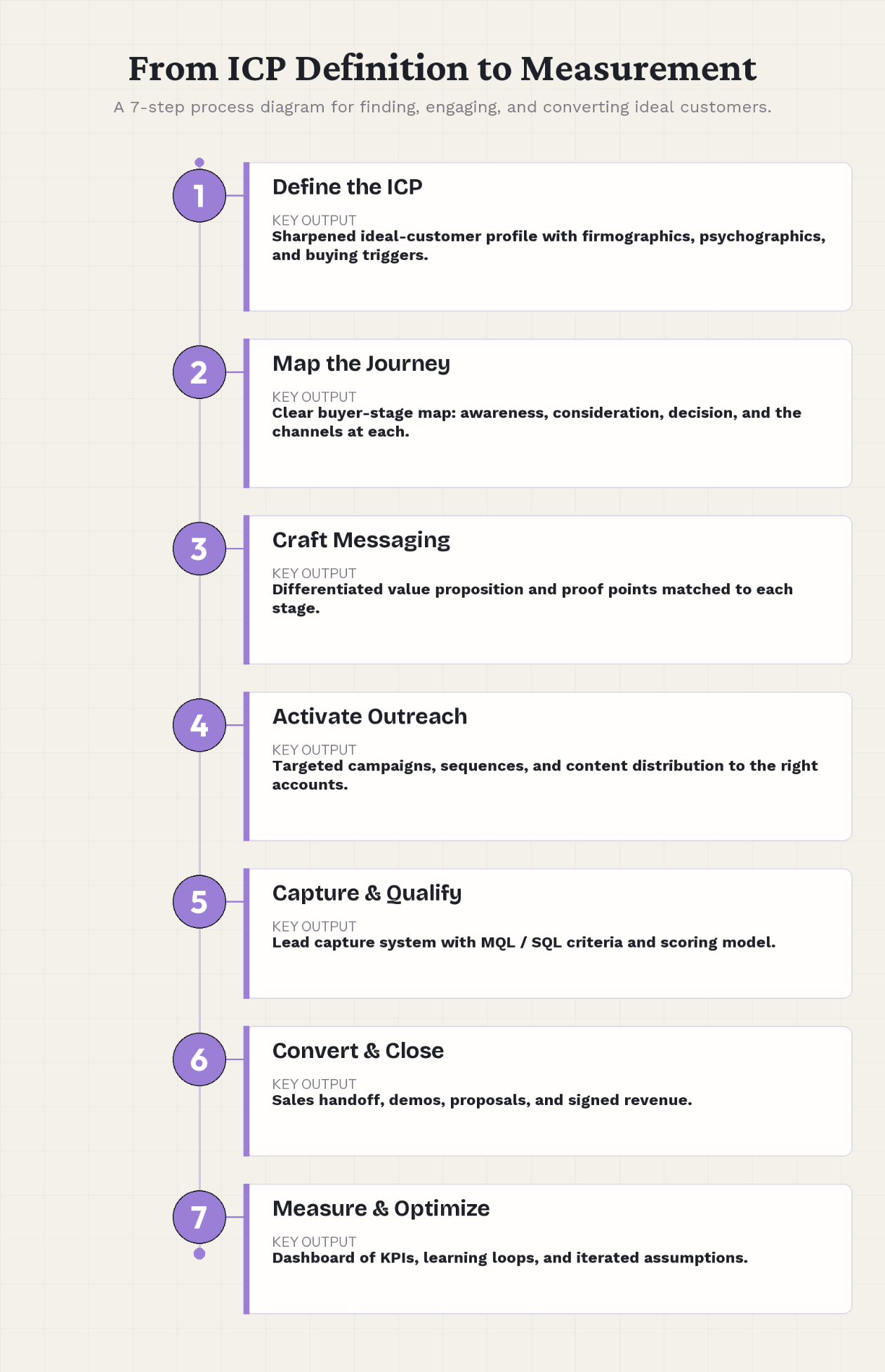
But the sequence stays the same. If you skip a step, something downstream breaks.
Your Ideal Customer Profile (ICP) is the description of the perfect-fit company for your product. Your buyer personas are the specific people inside those companies who make the buying decision. Getting both right is the single highest-leverage move in lead generation.
A strong ICP includes firmographic details like industry, company size, revenue, geography, and funding stage. It also includes technographic signals, like what tools they already use. And it includes behavioral triggers, like recent hiring patterns or a leadership change.
Buyer personas go one level deeper. You define the job titles, seniority levels, and departments that actually make the decision. In B2B, this is usually more than one person. The average B2B deal now involves six to ten stakeholders on the buying side. Your persona work has to cover the whole committee.

Once your ICP is defined, everything downstream gets easier. Your lead list quality improves. Your copy sharpens. Your reply rates go up. If you want to sharpen this stage further, I covered how to spot sales trigger events that turn a generic ICP into a highly targeted list.
Once your ICP is locked, the next step is building an actual list of accounts and contacts that match it. This is where lead generation gets tactical.
You have several sources to pull from:
The quality of your list matters more than the size. A tight list of 500 well-matched contacts will outperform a bloated list of 50,000 mismatched ones every time. If you want a step-by-step walkthrough, I put together a guide on how to build a strong lead list for sales.
For very local or geographically specific outreach, scraping can work well.
I documented how to scrape leads from Google Maps in another post if that fits your motion.
A lead list is only useful if the data is accurate. Every incorrect email you send hurts your deliverability. Every wrong phone number wastes your sales team's time. This step often gets skipped, and it always shows up later as bounced emails, blocked domains, and low reply rates.
Verification means checking that each email address is valid and deliverable. Most lead databases include verification, but it is worth running a second pass with a dedicated tool. Aim for a bounce rate under 3%.
Enrichment goes one step further. It fills in missing details on each lead, like job title, company size, tech stack, LinkedIn URL, and mobile number. The most reliable approach is waterfall enrichment. This method pulls data from multiple sources in sequence until it finds a match. That gives you much higher hit rates than relying on a single provider.
If your team wants to run enrichment automatically, data enrichment agents can handle the workflow for you. And if you build custom pipelines, the Leadsforge API lets you plug enrichment directly into your GTM stack.
This is the stage most teams underestimate. Your outreach infrastructure is the technical foundation that decides whether your emails land in the inbox or in spam. If it is set up wrong, no amount of copy or personalization can save your reply rate.
There are four pieces to get right:
The setup gets complicated when you are running at scale. If you are sending from 20 or 200 mailboxes, you need infrastructure that can handle it. Cold email infrastructure tools like Mailforge give you shared IPs at a low cost. Infraforge gives you dedicated IPs for full sender control. Primeforge gives you real Google Workspace and Microsoft 365 mailboxes if you want the most trusted sender profiles. And Warmforge handles the warm-up and deliverability monitoring so you know your mailboxes stay healthy.
I broke this down further in my full system for cold email lead generation in 2026.
Once your infrastructure is live and your list is clean, you launch. This is the visible part of lead generation, the part most guides jump straight to. But everything before this step is what makes this step work.
A sequence is a planned series of touches you send to each prospect over a set period. A typical B2B sequence runs for two to three weeks and includes:
The best sequences do not just send more messages. They vary the angle, the length, and the ask across touches. The first email might be a short pattern-interrupt. The third might offer a piece of research. The fifth might be a simple breakup message that gets a surprising number of replies.

Personalization is what separates a sequence from spam. Every prospect should get at least one line that could only have been written for them. That might be a reference to their recent post, a comment on their latest hire, or a question tied to a signal you spotted.
I collected the seven sales sequence frameworks that actually book meetings in a separate post if you want templates to start from.
Getting a reply is not the finish line. It is where the real work starts. A fast, useful reply from your side is what turns a positive response into a booked meeting.
Response speed matters more than most teams realize. If you take 24 hours to reply to a positive response, you cut your conversion rate in half. If you take three days, you lose the meeting entirely. Aim to reply within an hour during your buyer's working hours.
Reply management gets harder as you scale. If you are running 20 mailboxes, you have replies coming into 20 different inboxes. A unified inbox tool that pulls every reply into one place solves this. You want to see and respond to every reply from a single view, not jump between 20 browser tabs.
Once a prospect agrees to talk, the goal is to book the meeting immediately. Send a calendar link, propose two or three specific times, and confirm within the same email thread. Do not let the conversation drift into a fourth or fifth back-and-forth. Every extra reply is another chance for the lead to go cold.
If you are still deciding between cold email and cold calls, check my head-to-head comparison of the two channels for B2B meetings.
Lead generation is not a set-it-and-forget-it activity. It is a continuous loop. You measure what happened, you find what worked and what did not, and you adjust the next round.
The metrics that matter change depending on where you are in the funnel. Here is what I track at each stage:
Once you have these numbers, look for the single weakest step in the funnel and fix that first. If your reply rate is strong but meetings are low, your qualification is off. If your open rate is fine but replies are low, your copy is the problem. If deliverability is low, you have a warm-up or infrastructure issue to fix before you touch anything else.
For a full breakdown, my post on how to generate 10 to 20 B2B meeting-ready leads every day walks through the exact system.
The step-by-step process gets you a working motion. Best practices get you a great one. These are the patterns I see across every high-performing team I have worked with, regardless of industry.
Sending 10,000 cold emails to a broad list is the fastest way to burn your domain and demoralize your sales team. Sending 500 highly targeted emails to accounts that just showed a buying signal is where meetings actually come from.
A buying signal is any observable event that suggests a company is closer to buying. That might be a new funding round, a leadership hire, a job posting, or a competitor tag on their site. When you reach out tied to a signal, your message becomes relevant instead of intrusive.
I covered how to spot and use these in my guides on B2B buying signals.
This one repeats itself for a reason. Most cold email failures are not copy failures. They are infrastructure failures.
Before you send a single email, make sure your domains are configured with SPF, DKIM, and DMARC. Make sure your mailboxes are warmed up for at least 14 days. Make sure you have a monitoring tool that tells you when a mailbox's health drops. Skip any of these, and your campaign is running on borrowed time.
Adding a first-name variable to your email opener does not count as personalization. Every prospect knows what that looks like, and it signals a template.
Real personalization is one sentence that could only have been written for that specific prospect. It ties directly to something they did, said, or announced recently. If you cannot write that sentence, do not send the email. Move on to the next lead where you can.
Single-channel outreach has a cap. If you only run cold email, you miss the buyers who ignore email. If you only run LinkedIn, you miss the ones who never log in. The best-performing teams touch every prospect on at least two channels.
The most reliable combination in 2026 is cold email plus LinkedIn. Email carries the primary offer. LinkedIn carries the trust-building and warm-touch layer. If you want to go deeper on how the two channels work together, I compared multi-channel versus omnichannel sales approaches in another post.
Reply rate is a vanity metric on its own. It counts every "stop emailing me" as a reply. The metric that actually correlates with pipeline is positive reply rate, which is the percentage of replies that show real interest.
A campaign with a 6% reply rate and a 40% positive reply rate is stronger than one with a 12% reply rate and a 10% positive reply rate. Always look at both numbers together.
A new mailbox needs 14 days of warm-up before it sends real cold emails. During warm-up, the mailbox sends and receives small volumes of email with other real mailboxes to build sender reputation.
Skipping warmup is the single most common reason cold email campaigns fail out of the gate. Even if your infrastructure is perfect, a cold mailbox will get flagged by Google and Microsoft within the first week.
Not every account in your ICP deserves the same treatment. Tier your list into three groups:
Different tiers get different messages, different channels, and different follow-up depths. Treating every account the same either wastes effort on low-fit leads or under-invests in your best prospects.
Most first cold emails do not book meetings. The second, third, and fourth emails in the sequence do. Follow-ups produce more replies than the initial send in almost every campaign I have seen.
If your sequence stops at one or two emails, you are leaving most of your pipeline on the table. Plan for at least four to six touches across email and LinkedIn before you drop the prospect. And if a prospect ignores an email but engages with your LinkedIn comment, switch channels. Do not give up.
My guide on LinkedIn prospecting in 2026 covers how to build follow-up sequences that get replies.
Every failing lead generation motion I have seen shares one or more of the same mistakes. Fix these first, and most of your problems disappear.
A list of 500,000 unverified contacts feels productive. It is not. High bounce rates from unverified emails will destroy your sender reputation in days. And most of those contacts do not fit your ICP anyway.
Always verify before you send. And always start with a tighter, higher-quality list rather than a bloated one.
If you would rather have someone else handle the list-building and outreach for you, browse my directory of top-rated B2B lead generation agencies to see the vetted options.
Warmup takes 14 days, and most people want to skip it because they want results now. But every mailbox that skips warmup gets flagged fast. You save 14 days at the front and lose months of sending reputation on the back.
If your entire outbound motion is email, you are missing every prospect who does not read cold email. Same for LinkedIn only. Same for cold calling only. The teams pulling ahead in 2026 run three or four channels in a coordinated sequence.
For SaaS teams specifically, I broke down what a multi-channel motion looks like in my guide on B2B SaaS lead generation.
Cold outreach without signals is a numbers game. You send more, you get more, but the reply rate stays flat. Adding a signal layer transforms the math. Reply rates go up, meeting rates go up, and your sales team spends less time on unqualified conversations. If you are ignoring signals in 2026, you are competing with one hand tied behind your back.
Open rate does not pay the bills. Reply rate alone does not either. The only metrics that matter are positive reply rate, meetings booked, and pipeline generated. Track those. Ignore the rest.
A few shifts have quietly changed how B2B lead generation works in 2026. Ignoring them will not sink your motion, but pairing them together will pull you well ahead of teams still running the 2022 playbook.
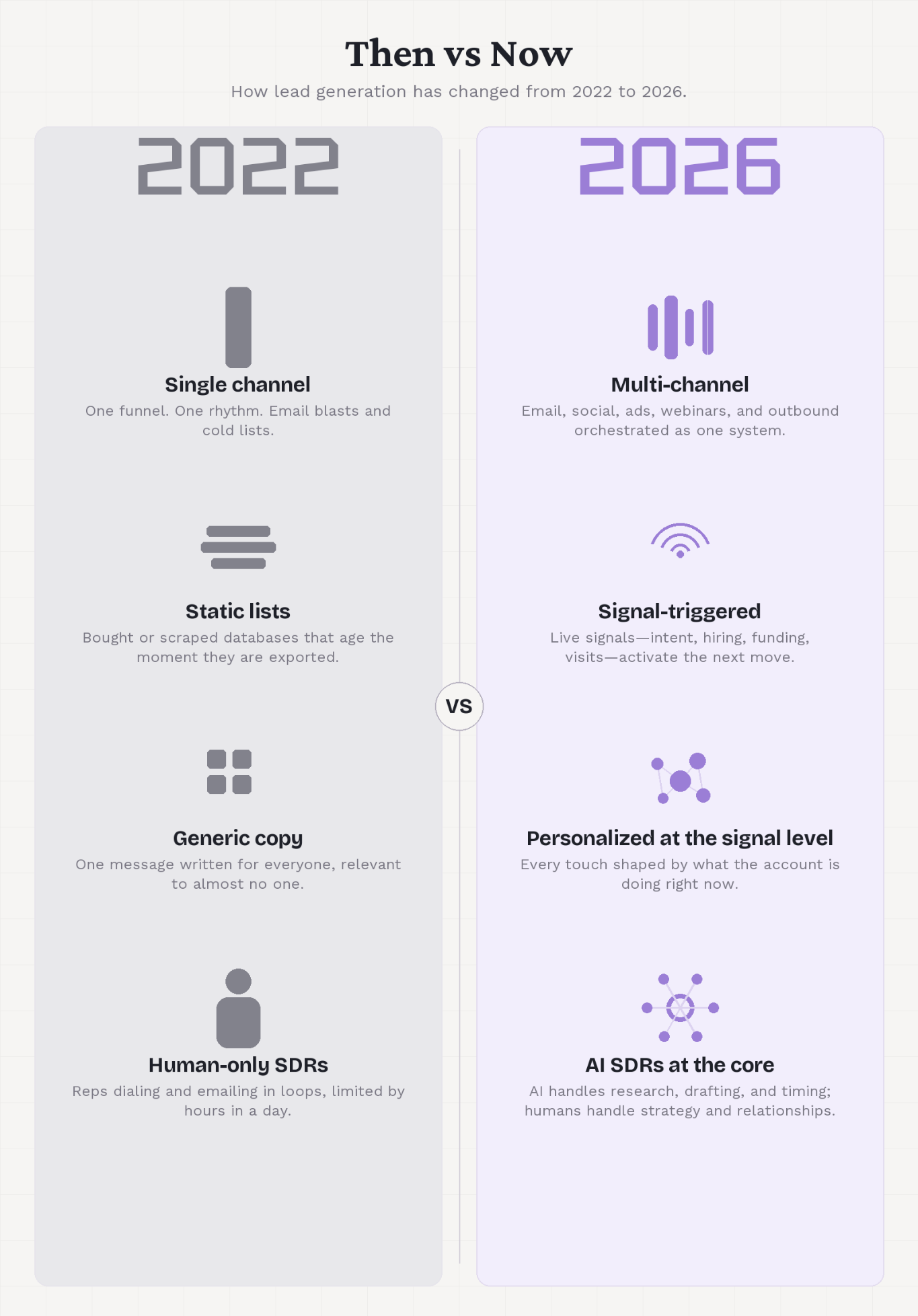
In 2023, AI SDRs were experimental. In 2026, they are running real outbound at real companies. The AI SDR handles the full workflow autonomously, from prospecting to writing to sending to booking. Teams use them to scale outbound to a level that would take a five-person SDR team to match.
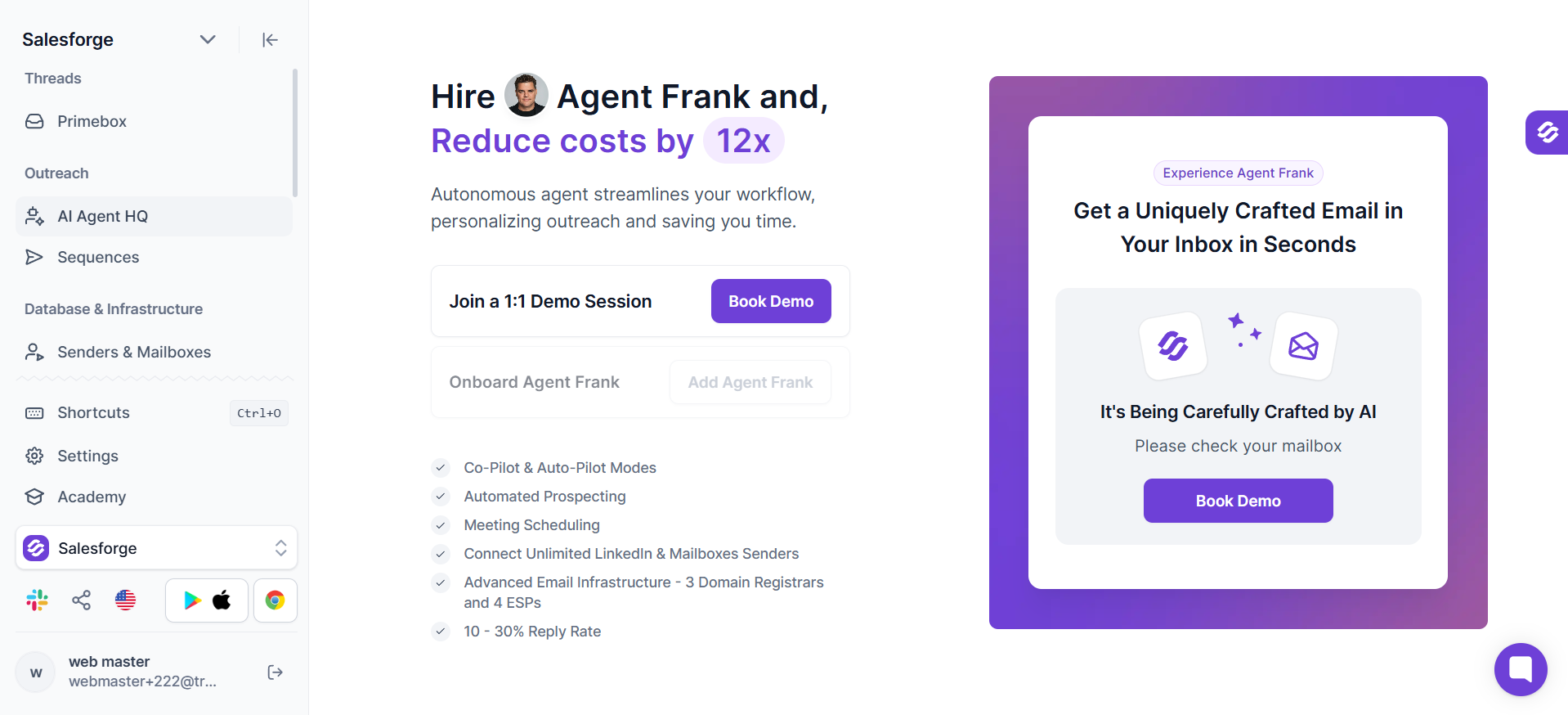
The best AI SDRs on the market include Agent Frank, Artisan, and 11x. If you want the full comparison, I ranked the top AI prospecting tools for driving sales.
For years, outbound was a volume game. Send more, book more. That model is broken in 2026 because inboxes are saturated and buyers are actively filtering.
Signal-based selling replaces volume with timing. Instead of sending 10,000 cold emails to a broad ICP, you send 500 targeted emails to accounts that just showed a buying signal. The reply rates are dramatically higher.
For teams looking at how to act on signals in real time, my post on signal-based outbound walks through the framework.
The average B2B deal now involves six to ten stakeholders on the buying side. That means your outreach cannot target one contact at an account and hope for the best. You need to map the buying committee, reach out to multiple stakeholders, and time your touches so decisions can actually move forward.
For teams selling into recently funded companies, timing matters even more. I covered how to sell to recently funded companies in a separate post because the playbook there is specific.
Google and Yahoo's new sender rules made cold email harder for everyone in 2024 and 2025. In 2026, the enforcement is stricter. If your DNS is set up wrong, your emails do not land. If your warm-up is skipped, your mailbox gets flagged fast. And if your list quality is bad, your bounce rate kills your sender reputation.
The teams pulling ahead are the ones that treat deliverability as a discipline, not a checkbox. They monitor heat scores daily. They run placement tests every week. They rotate mailboxes at the first sign of trouble.
Running cold email alone is no longer enough. Running LinkedIn alone is no longer enough. In 2026, the baseline is email plus LinkedIn, and the strongest teams add cold calls and retargeting into the mix.
I covered the top AI tools for cross-channel prospecting if you want to see what a modern cross-channel stack looks like.
Relying on one lead database for all your data is a losing strategy. No single provider has complete coverage of every industry, region, or role. Waterfall enrichment pulls from multiple sources in sequence until it finds a match. This is what modern lead generation stacks look like in 2026. Hit rates have gone up while list-building time has gone down.
A good lead generation motion needs a tool at every step of the process.
The categories that matter most for B2B are lead databases, enrichment tools, cold email infrastructure, warm-up and deliverability monitoring, sending platforms, and AI SDRs.
Everything I covered above works whether you use Salesforge or not. The reason I use Salesforge is that it connects every stage of the process into a single stack.
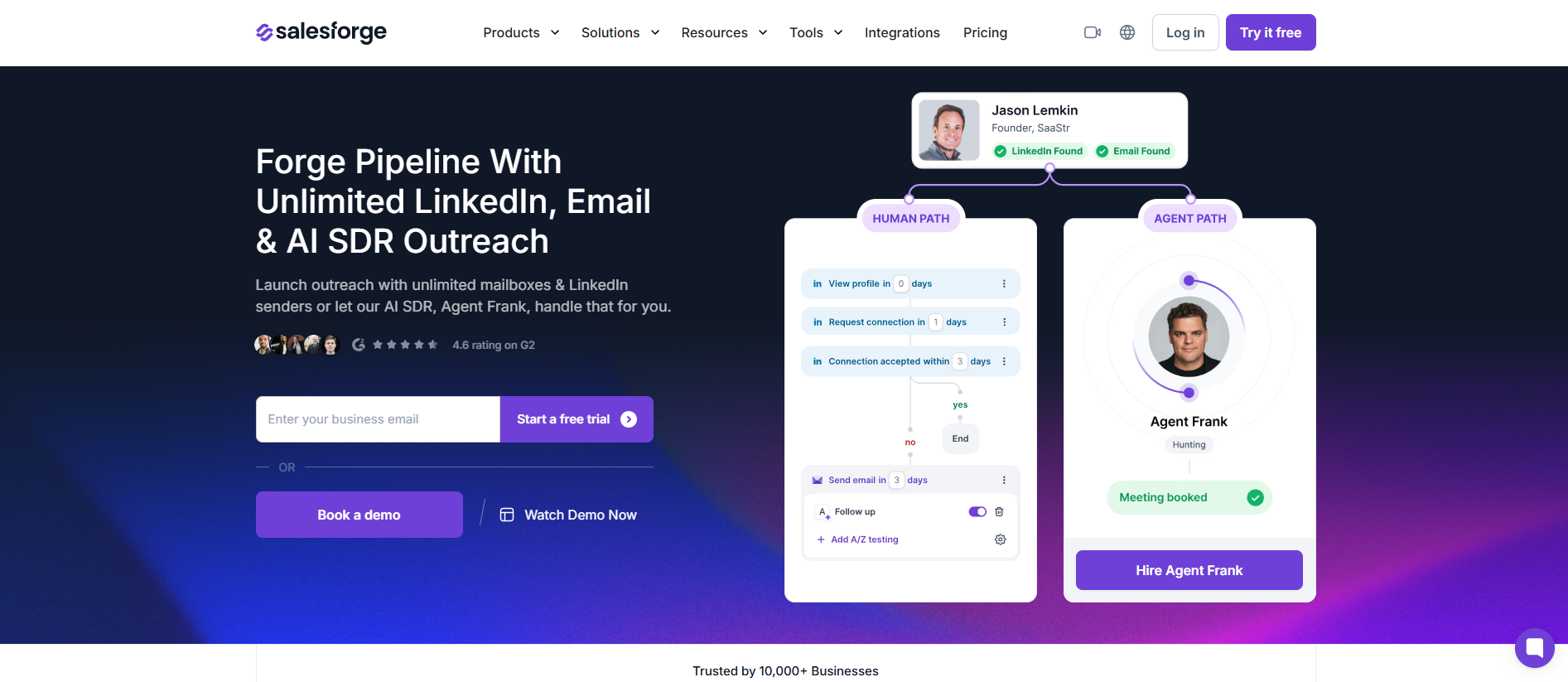
Here is how the Forge stack maps to the process I walked through:
If you want to see how I ranked the leading tools across each of these categories in more detail, I broke it all down in my guide to the best lead generation tools.
Lead generation in B2B is the process of finding companies and decision-makers who might buy your product, and starting a real sales conversation with them. Unlike B2C, where you might reach millions of individual buyers, B2B lead generation focuses on smaller volumes of high-value accounts with multi-stakeholder buying committees.
The five main types are inbound, outbound, signal-based, multi-channel, and AI-driven lead generation. Most B2B teams combine outbound with signal-based and multi-channel to get the best results.
The full process has seven steps. First, define your ICP and buyer personas. Then build your lead list and verify the data. Set up your outreach infrastructure. Launch multi-channel sequences. Manage replies and book meetings. And measure results so you can iterate.
Signal-based lead generation is the practice of reaching out to prospects when they show an observable buying signal. Signals include new funding rounds, leadership hires, job postings for roles your product supports, competitor mentions, and product usage patterns. Reply rates and meeting rates are significantly higher because the outreach is timely.
Inbound lead generation usually takes 3 to 6 months to produce consistent volume because you need to build content authority. Outbound lead generation can produce meetings in 4 to 6 weeks if your infrastructure, list, and copy are in place from day one. AI SDR setups can compress that timeline further because the workflow runs 24/7.
Waterfall enrichment pulls data from multiple providers in sequence until it finds a match. If the first provider does not have the data you need, the query moves to the next one. This gives much higher hit rates than relying on a single database.
An AI SDR runs 24/7 and does not need onboarding. It can process thousands of leads per week at a cost far lower than a human SDR. A human SDR brings judgment, relationship-building, and handling of complex situations. Most teams in 2026 use both. The AI SDR handles top-of-funnel prospecting and initial outreach, and the human SDR takes over once a prospect replies.

.jpg)