Every SDR has heard the same advice: go after recently funded companies. It makes sense. They have fresh budgets, they're hiring, and they're usually more open to buying new tools.
The problem is that most teams stop at finding the funding announcement. They end up with outdated contact lists, generic outreach, and emails that arrive weeks after everyone else has already pitched them.
The opportunity is real. The workflow is what usually falls apart.
In this guide, I'll show you the exact process I use with Leadsforge to find recently funded companies and Salesforge to reach the right decision-makers while the funding news is still fresh.
Let's get into it.
The workflow has five steps. Each one is doable manually, but at any real scale, you need a tool built for tracking funding signals.
That tool is Leadsforge. Here's the full map:
Steps 1 through 3 happen inside Leadsforge. Steps 4 and 5 run through Salesforge.
Together, they turn a funding announcement into a booked meeting inside 90 days.
A funding announcement is not just news. It's a company-wide change event that opens four things at once.
The money hits the account and stops being theoretical. CFOs sit down with department heads to plan how it gets spent. Sales tools, marketing tools, hiring platforms, dev infrastructure. Every category is up for review. If your product fits a line item in that plan, this is the highest-intent window you will ever get.
Post-funding, headcount usually grows 2 to 3x in 18 months. New execs come in with authority to change the vendor mix. A new VP of Sales might switch out the entire outreach stack in month one. If you sell to a role that's currently being hired, you're not selling to a company. You're selling to a person who is defining their own tool budget.
Investors don't hand over $10M and wait. They put a growth target on the wall, usually a 3x revenue jump inside 18 months. That target flows down to every department. And every department starts looking for tools that make it happen faster. Urgency is baked into the deal.
A lot of funding gets spent on new products, new geographies, or new customer segments. Those bets need tools to execute. If your product supports category expansion, funding rounds are the exact moment budget clears for that specific initiative.
Studies show intent-driven outreach converts 78% higher than static lists. Funding rounds are one of the strongest intent signals you can act on. This is why more teams are moving toward signal-based outbound as the default approach.
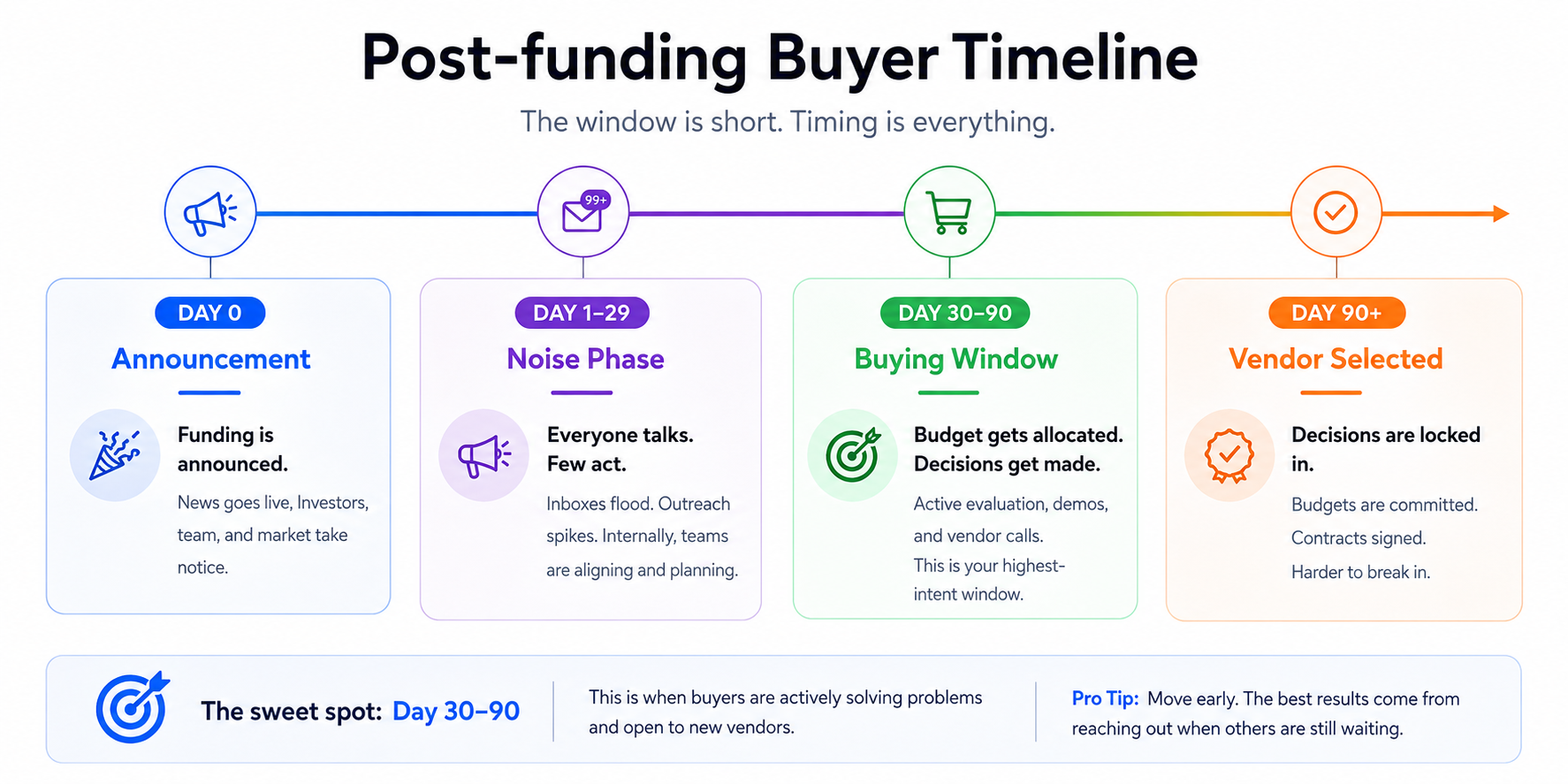
The catch: this window closes fast. Most of the buying decisions triggered by a raise happen inside the first 30 to 90 days. Miss that, and you're another cold email to someone who already picked a vendor.
Not every funding announcement is worth chasing. And not every strong signal is a formal round.
Here are the funding events I track, ranked by conversion potential:
Seed gets overlooked because the checks are small. That's a mistake. Founders raising seed are making their first vendor decisions, budgets are being defined for the first time, and competition is low. Response rates are the highest in my experience. Just match the ACV. If you sell $50K contracts, seed is not your window.
This is where most SaaS teams find product-market fit and start scaling. New sales hires come in, marketing budget shows up, and the founder stops being the head of every function. Series A companies are the sweet spot for tools priced between $10K and $50K annually.
Growth mode. Headcount triples in 18 months, revenue targets are aggressive, and every department is looking for tools to hit their number. Buying committees are still small enough to move fast. Best fit for $30K to $100K deal sizes.
Enterprise procurement starts kicking in. Real evaluation processes, security reviews, longer cycles. The upside is deal size. Series C companies sign $75K+ contracts without blinking. The downside is speed. Plan for 90-day cycles minimum.
These usually signal a specific expansion motion, like new geography, new product line, or acquisition prep. If your product supports the specific bet the round is funding, conversion rates are very high.
Bridge rounds mean the company is buying time to hit a milestone. If your product helps hit that milestone, you have leverage. Extension rounds signal that the last round wasn't enough to reach the next stage. Both are underrated trigger windows.
Beyond formal rounds, three adjacent signals stack well with funding data:
Here's the quick match by ACV:
Match the round to your deal size. A seed founder is not signing a $75K contract in week one. A Series C CFO is not signing off on a $5K trial without ROI proof. Get this mapping wrong and every other step in the workflow fails.
If you want the deeper breakdown of every signal type worth tracking, my complete guide to B2B buying signals covers the categories and response windows in detail.
The workflow has five steps. You could try to run it manually with browser tabs, Crunchbase alerts, and spreadsheets. I've tried. It works for the first 20 signals a week, then falls apart.
At any real outbound volume, you need a tool built for this. Leadsforge is the one I use because it combines funding signals, ICP filtering, and prospect enrichment in one workspace. Here's how each step works.
Every workflow starts with the source. If you don't see the signal, you can't act on it.
The manual approach uses free tools: Crunchbase News, TechCrunch, LinkedIn founder posts, and PitchBook alerts.
This works for the first 10 to 20 signals a week. It breaks the moment you try to scale.
Here's why.
The manual stack forces you to jump between four to six tools per signal. Read the announcement on Crunchbase. Cross-reference on LinkedIn to find execs. Export to a spreadsheet.
Enrich in a data tool. Import to your sending platform. Every step adds hours. By the time you hit send, another vendor already booked the meeting.
At scale, you need one tool. Leadsforge Signals tracks funding rounds inside the same platform where your prospect database and enrichment already live. Instead of the four-to-six-tool loop, it's one workspace.
Here's exactly how I set up funding signals inside Leadsforge.
1. Log In and Open the Signals Section
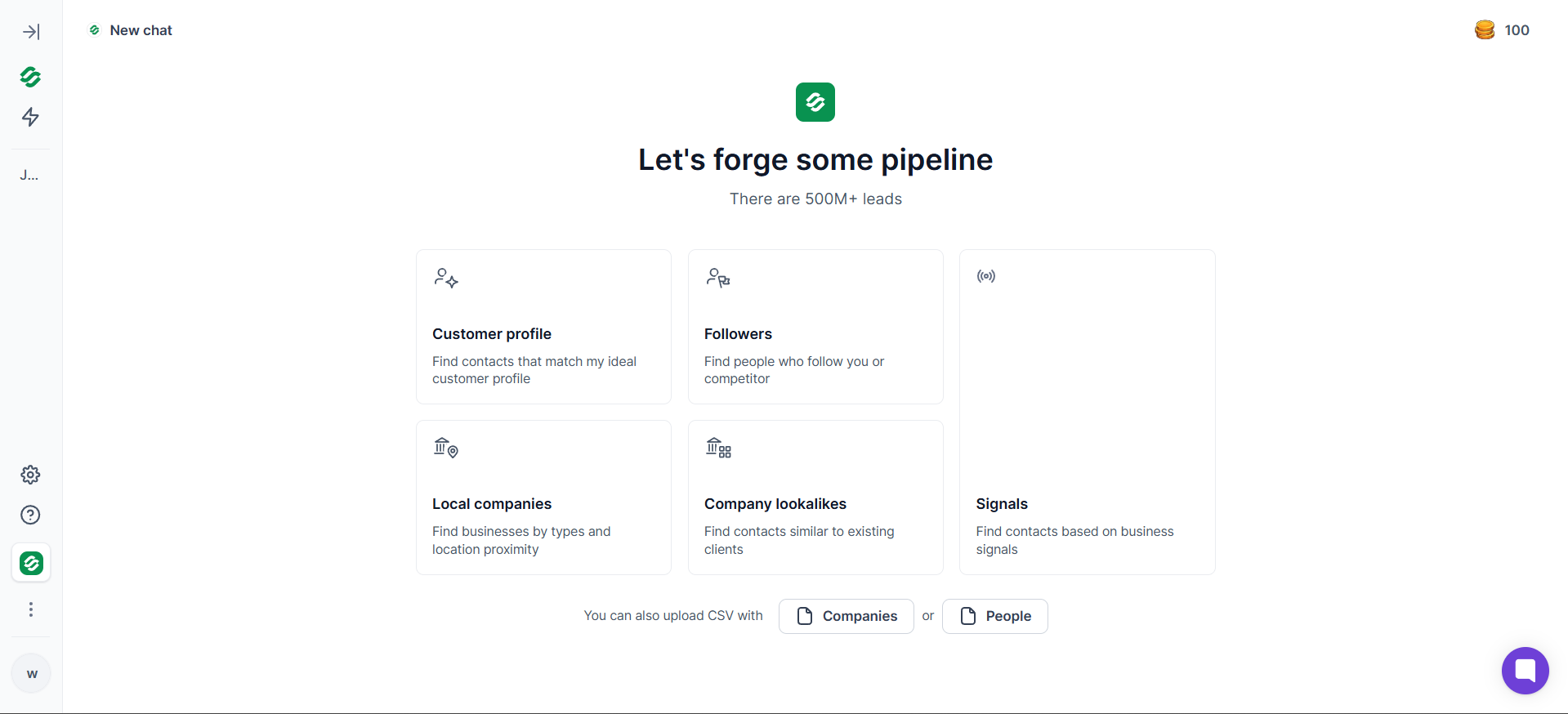
After logging in, you'll land on the main "Let's forge some pipeline" dashboard. You'll see the core search options: Customer profile, Followers, Local companies, Company lookalikes, and Signals.
Click the Signals card on the right side.
2. Choose Funding Signals
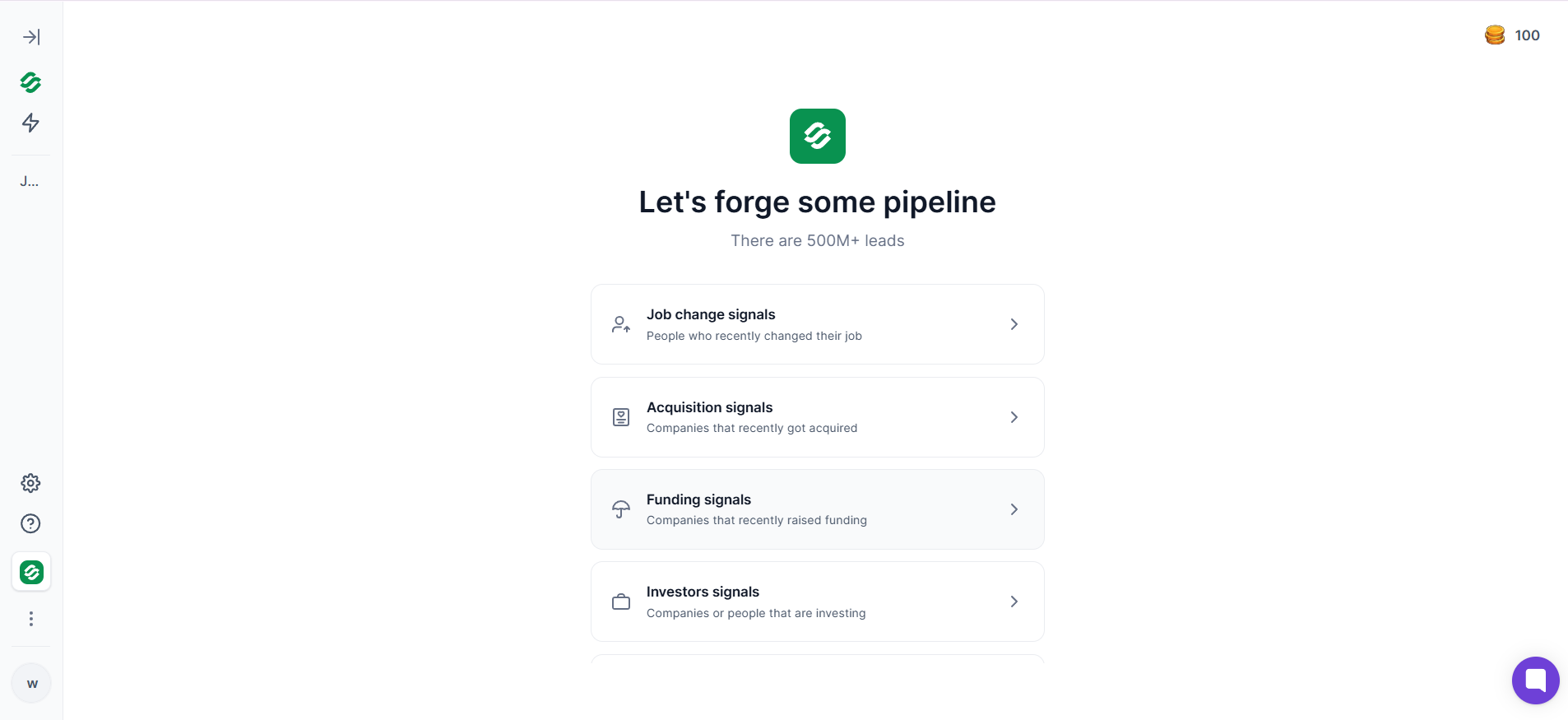
Inside the Signals section, you'll see four signal types you can act on. These are Job change signals, Acquisition signals, Funding signals, and Investors signals.
For this workflow, click Funding signals.
That's the option labeled "Companies that recently raised funding."
Each of the other signals is worth exploring separately.
But funding is the one with the tightest budget-to-outreach window, which is why it's my default.
3. Apply Your Filters
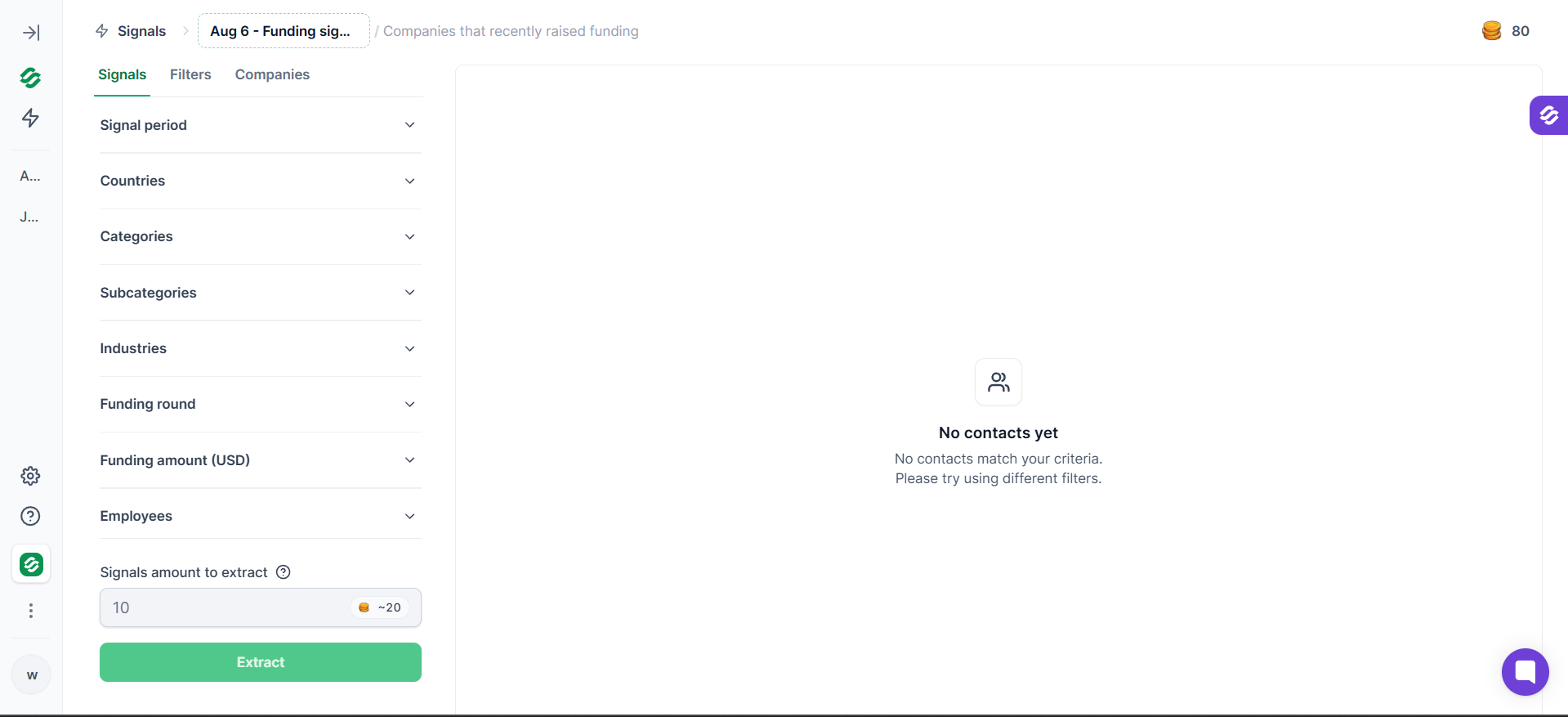
This is where you tune the signal to your ICP. Leadsforge gives you the filters that actually matter for funding-based outreach:
Set the "Signals amount to extract" at the bottom (10 signals costs about 20 credits) and click Extract.
4. Review Extracted Companies and Enrich Contacts
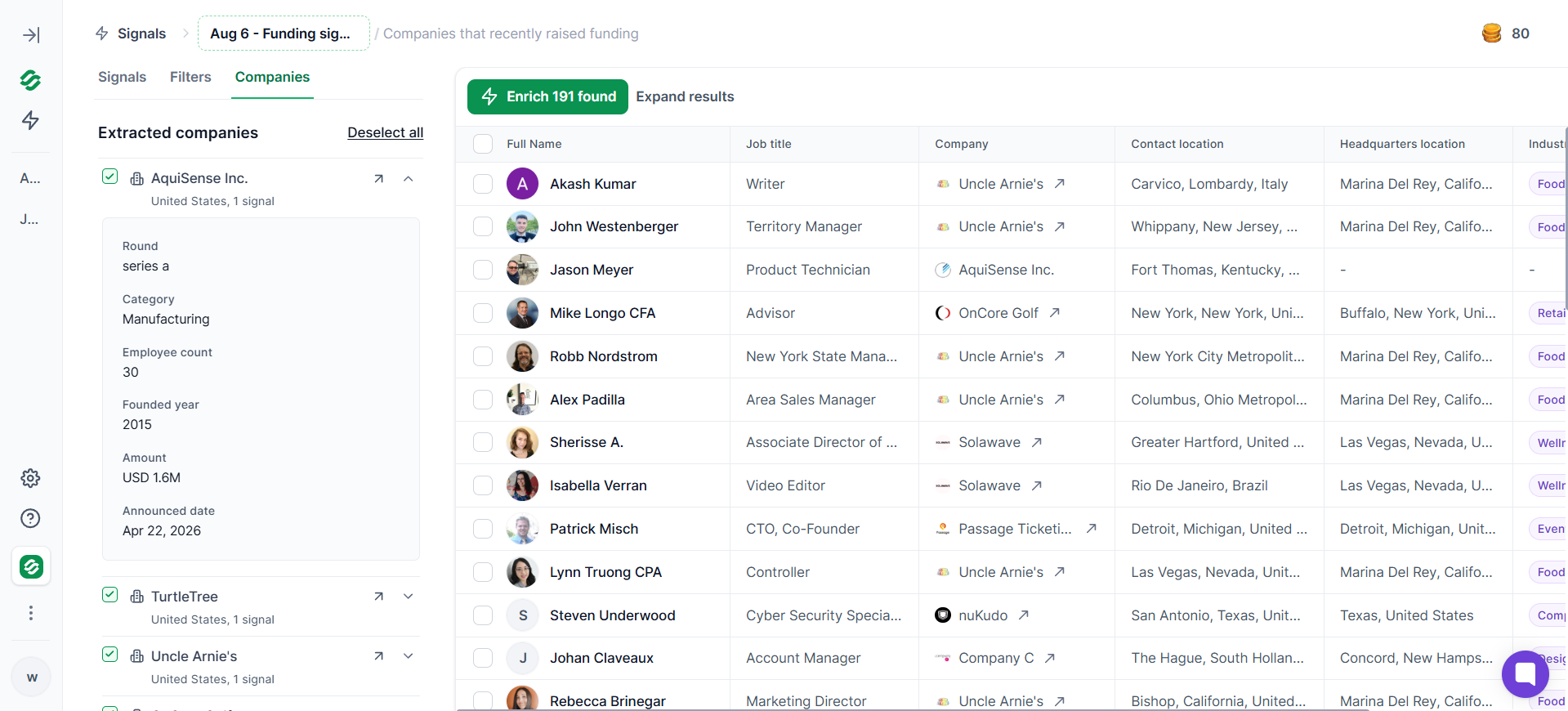
Once you extract, Leadsforge returns a list of funded companies matching your filters. For each one, the left panel shows the round details. That includes round type, category, employee count, founded year, amount raised, and announced date.
On the right, Leadsforge pulls the contacts at each of those companies. When I ran a Series A funding pull, it returned 191 contacts I could enrich in one click. That's the entire prospect list ready for outreach in a single workflow.
Click on Enrich to pull verified emails, LinkedIn URLs, and where available, mobile numbers for every contact.
That's the whole loop. Log in, click Signals, pick Funding, filter, extract, enrich. Total time: under 5 minutes.
Here's where most teams mess up.
They see a Series B announcement, get excited, and add every company to the sequence. Two weeks later, reply rates are low and everyone blames the messaging. But the messaging was never the problem. The list was.
Funded does not mean fit.
Before a company hits your outreach list, it needs to clear your ICP filters:
That last filter is the one most people skip. A pre-seed startup that raised $500K is not buying a $30K annual contract, no matter how good your product is. Match the round size to the budget you need them to sign off on.
Inside Leadsforge, this is a natural filter step. You define your ICP once (job titles, seniority, industry, headcount, geo), and every incoming funding signal automatically checks against those criteria.
Companies that don't clear the filter never enter your workflow. That's the difference between a funded lead and a funded lead that's actually a fit.
If your ICP definition is loose or missing, fix that first.
My breakdown of ICP for cold email walks through how to tighten it.
The intersection of your ICP and a recent funding signal is your actual target list. Everything else is a distraction.
A funded company is not one lead. It's a group of decision-makers, and picking the wrong one wastes the signal.
Which role you target depends on what you sell:
New funding usually means new hires. Some of those hires are exactly the people you want to reach. Which is why the enrichment part matters more here than in a standard cold campaign.
You need email, LinkedIn, and ideally a mobile number for every prospect. And you need it fresh. If a VP of Sales just joined three weeks ago, their contact info might not be in older databases yet.
Waterfall enrichment fixes this. Instead of relying on a single provider, the workflow queries multiple data sources in sequence, taking the first verified match. Hit rates on newly onboarded execs are much higher this way, usually 85%+ vs. 40-50% with a single-provider tool.
Leadsforge runs this waterfall by default. You pick your list of funded target companies, define the roles you want, and Leadsforge pulls the contacts with verified email, LinkedIn URL, and mobile number where available.
Once your list is enriched, verify emails before sending. A bounce on a warm signal like this hurts twice: once for the deliverability hit, and once for the lost opportunity.
This is where most teams undo all the work from Steps 1 through 3.
They open with "Congrats on the raise!" and pivot into a generic pitch. The prospect has seen this exact email 40 times in the last two weeks. It goes straight to archive.
The signal is the reason for the outreach. It is not the outreach itself.
A better structure ties the round to a specific post-funding pain. If you sell a hiring tool, don't congratulate the round. Reference the fact that Series B companies triple headcount in 18 months.
Ask how they're planning to source that talent. If you sell dev tools, reference the tech debt that surfaces when a small team suddenly onboards 10 more devs.
Here are three openers I use, ordered from soft to direct.
Opener 1: Soft (build curiosity)
Why it works: You reference the round through the hire, not the round itself. Feels like research, not scraping.
Opener 2: Direct (lead with the specific pain)
Why it works: You skip the congratulations, prove you know the segment, and offer social proof up front.
Opener 3: Contrarian (challenge the default)
Why it works: You take a position instead of asking a question. Founders respond to opinions.
Pick one shape, personalize the details, and layer LinkedIn touches on top.
A three-email plus two-LinkedIn cadence usually outperforms email-only for post-funding outreach. The prospect is getting hit from every angle in that window.
For more opener structures, these cold email frameworks work well when adapted to signal-triggered outreach.
To run this at scale, I use Salesforge. I build email and LinkedIn touches into the same sequence.
And the sequence fires when a new signal drops. That's the piece that turns a good outreach idea into consistent pipeline.
Timing is where good workflows fall apart.
The 30 to 90 day window after a funding announcement is the sweet spot. Here's why each end matters:
There is one exception. If a signal fires in a specific role you sell to, like a VP of Sales joining in week two, respond fast. New execs make their vendor decisions inside the first 60 to 90 days of the job. Being early on that specific person is different from being early on the company as a whole.
Follow-up cadence matters here too. A three to five touch sequence spread across email and LinkedIn is my baseline. If they open but don't reply, add a second touch faster. If they ghost completely, the right follow-up timing matters more than the message.
Every mistake below is one I've made, watched a team make, or found in a campaign audit. Fix these six and your reply rate on funded prospects will double.
1. Opening With "Congrats on the Raise!"
Every vendor sends this opener the day the round is announced. Your prospect's inbox gets 40+ variations of it in the first week. They've trained themselves to delete anything that starts with congratulations. Reference the funding indirectly instead, through a new hire, an expansion move, or a specific pain that the round creates. The signal should be your reason to reach out, not your opener line.
2. Skipping Seed Rounds
Seed rounds have the highest response rates in my experience. Founders are actively picking vendors, budgets are being defined for the first time, and competition is low because most SDRs chase Series A and above. If your product fits a seed-stage budget (usually under $20K annual contracts), don't skip these. Just make sure your ACV matches their check size. A $50K contract is not closing on a $2M seed round.
3. Treating "Funded" as a Substitute for Fit
Funding is a trigger, not a qualifier. A funded company that doesn't match your ICP is still a bad-fit lead. It doesn't matter that they just raised. If they don't sell to your buyer type, don't have the role you sell to, or aren't in a geo you can serve, they will not convert. Run every signal through your ICP filter before it hits a sequence. Otherwise your funded outreach becomes cold outreach with extra steps.
4. Waiting for the "Perfect" Moment to Reach Out
Some teams sit on a signal for a week because they want to research more, personalize deeper, or write the perfect message. By then, another vendor has already booked the meeting. Speed is a feature in signal-based outreach. A decent email sent on day two beats a perfect email sent on day fifteen. Aim for 48 hours from signal to first touch.
5. Blasting the Entire Company
Sending to every director, VP, and manager on LinkedIn feels thorough. It actually looks like spam and gets flagged internally within a week. When multiple people at the same company get the same email from the same sender, they start comparing notes. The message gets forwarded around, someone escalates it, and your whole company gets blocklisted. Pick one primary role, one backup, and stop there.
6. Ignoring the Follow-Up Window
The first email is only the start. Most replies come from touch three or four, especially in the post-funding window when your prospect is drowning in outreach. If you send once and stop, you're wasting the signal you worked to identify. Build a three-to-five touch cadence across email and LinkedIn, and stick to it. The signal window closes at day 90 whether you follow up or not.
Funding signals are the strongest outbound trigger available today. Companies that just raised have fresh budget, active hiring, and pressure to show results. If your ACV sits between $5K and $100K and your sales cycle is under six months, this workflow will produce pipeline inside 30 days.
The move is not to try harder on the same cold list. It's to change what triggers your outreach. Instead of "who fits my ICP," ask "who fits my ICP AND just raised in the last 60 days." That single shift is the difference between average outbound and outbound that actually hits quota.
To run this at any real scale, you need to Sign up for Leadsforge for tracking funding signals, filtering them against your ICP, and enriching your prospect list. You get 100 free credits at signup.
A funding signal is a public announcement that a company has raised new capital. The most common types are seed, Series A, Series B, and Series C rounds. In outbound sales, funding signals matter for three reasons. The company has fresh budget. Hiring plans are active. And the team is under pressure to show growth to new investors. All three make the buying window unusually open.
The best rounds to target depend on your ACV. For deals under $20K, seed and Series A companies convert best. For deals between $20K and $50K, Series A and B are the sweet spot. For deals over $50K, Series B, C, and growth equity rounds are the strongest match. Skipping seed rounds is a common mistake, since they often have the highest response rates.
The strongest window is 30 to 90 days after the announcement. The first 30 days are usually too noisy, since every vendor and recruiter is hitting the same inbox. After 90 days, initial vendor decisions are made and urgency fades. If a specific decision-maker just joined the company, reach out inside their first 60 to 90 days.
Crunchbase News, TechCrunch, and LinkedIn are the strongest free sources. Founders often announce rounds on LinkedIn before the press picks it up, which is a real speed advantage. PitchBook and Crunchbase both offer basic free tiers with alerts. Paid tools like Leadsforge Signals combine funding data with your existing contact list, which cuts hours off the workflow.
The intersection is your target list. Start by defining ICP criteria: industry, geography, employee count, and funding round size vs. your ACV. Then pull the funding announcement list. Filter the funding list through your ICP criteria before anyone hits a sequence. Funded companies that don't match your ICP are still bad-fit leads, even with a fresh round of capital.
The strongest window is 30 to 90 days, but the signal has some value for up to six months. After six months, the budget and urgency effects usually fade. If you missed the primary window, focus on other signals from the same account. New hires or product launches reset the timing.
You need two tools at minimum. First, a signal-tracking platform like Leadsforge that surfaces new funding rounds, filters them against your ICP, and enriches the prospect list in one workspace. Second, a multi-channel outreach platform like Salesforge that runs signal-triggered sequences across email and LinkedIn. Together they collapse the workflow from four to six tools into two.

.jpg)