B2B buyers today complete 57–70% of their research before ever talking to sales.
And buying committees now involve 6–10 stakeholders, and roughly 80% of B2B interactions happen through digital channels.
Your prospects are constantly leaving signals about what they're researching, what they're changing, and what they might need next.
Most teams simply aren't looking in the right places.
In this guide, I'll break down
Let's get in.
Below is every buying signal I cover in this guide, ranked by intent strength.
Each row tells you what the signal is, how strong the buying intent behind it is, and how fast you should respond before the window closes.
A buying signal is any action, behavior, or context change that tells you a prospect is closer to buying than they were yesterday.
It can be something they say out loud on a discovery call. It can be something they do quietly on your website. It can be something that happens inside their company that has nothing to do with you.
The reason signals matter is timing. Cold outreach without a signal is a bet that the prospect is ready to hear from you today. Most of the time, that bet loses. Cold outreach with a signal is different. You are reaching out because something recent gave you a reason, and the prospect will recognize that reason inside the first line of your message.
Here is what has changed in the last three years that made signals the difference between an outbound team that hits quota and one that does not.
The takeaway is that outbound is not about volume anymore. It has quietly become a game of timing and relevance, and buying signals are the input that makes both possible.
I wrote more about how this shift is reshaping messaging in my breakdown of AI personalization trends in cold outreach, which pairs well with this pillar if you want to go deeper on the message side.
💡Pro tip: Every signal should answer one question in one sentence. Why are you reaching out today, and not last month? If you cannot answer it cleanly, the signal is weak and the message will feel forced.
Not every signal deserves the same treatment. Before you build a program around them, you need a shared way to talk about what kind of signal you are looking at.
I use three lenses.
Any signal will fit into all three, and the label you put on it changes how fast you respond and what you say.
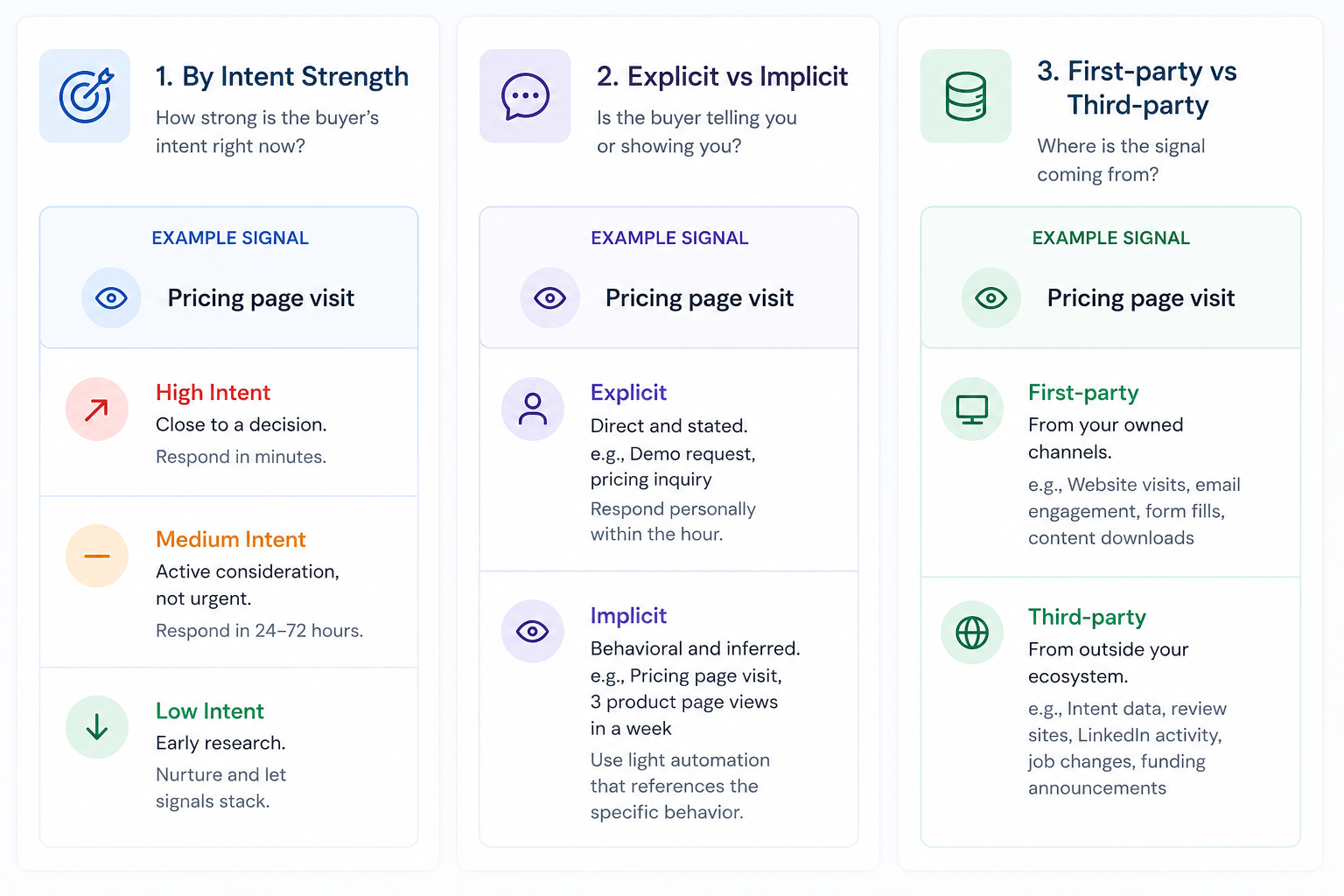
This is the lens I default to and the one I teach every SDR I onboard.
Higher strength means faster response and more direct ask. Lower strength means softer touch and longer patience.
Explicit signals are direct. The prospect is telling you what they want. A demo request or a pricing inquiry falls here.
Implicit signals are behavioral. The prospect is showing you what they want without saying it. A pricing page visit or three product page views in a week falls here.
The response format changes with the type. Explicit signals earn a personal, human reply inside the hour. Implicit signals often work better with a lightly automated nurture that references the specific behavior you saw.
First-party signals come from your own properties. Website visits, email engagement, form fills, and content downloads.
Third-party signals come from outside your ecosystem. Intent data providers, review sites, LinkedIn activity, job change alerts, funding announcements, and technographic changes.
The best outbound teams run both. First-party tells you which known accounts are moving. Third-party tells you which unknown accounts are in-market before they ever land on your site.
I have grouped these into three tiers. Response windows are what I have seen work in practice, tested across dozens of outbound programs, not theoretical benchmarks.
If you are new to signal-based selling, start with the top 5.
Master those, then layer in the trigger events, then add the behavioral signals last.
These are the signals where speed is a structural advantage. Research on lead response times has shown that responding inside 5 minutes makes you 21 times more likely to qualify the lead than waiting 30 minutes.
This is where most outbound teams leave money on the table.
1. Demo or free trial request — Strength: Very high
A demo request is the strongest signal you will ever get. The average B2B buyer sits through only 3 demos before deciding, so if they asked for yours, you are on the shortlist and probably against 2 competitors.
The mistake most reps make is treating this like a scheduled task. You do not have days. The first vendor to respond wins the tone of the evaluation, so I treat every demo request as a fire drill. My rule: acknowledge inside 5 minutes with a personalized note referencing what they submitted, then get a calendar link in front of them inside the hour.
If your calendar link goes out 4 hours later, you have already lost the tempo advantage.
2. Direct pricing inquiry — Strength: Very high
When a prospect asks about pricing, they are stress-testing budget fit against your product. This almost never happens in the awareness stage. By the time someone asks "how much does this cost," they have already decided the problem is worth solving.
If you have public pricing, they still want to hear it from a human. If you do not, this is your chance to qualify and anchor.
The trap here is over-qualifying. A rep who spends 20 minutes uncovering pain before answering the pricing question feels evasive. Answer the question in the first 60 seconds, then qualify. The order matters.
3. Pricing page visit from a known account — Strength: High
A random visitor spending 30 seconds on your pricing page is nothing. A tracked account spending 3 minutes on your pricing page and then navigating to your integrations page is a full-blown buying motion.
The difference is context. When the visit ties to a company already in your CRM, you know the account, the deal stage, and the right AE to route the alert to. When it does not, you have anonymous traffic that means very little on its own.
I set alerts for known-account pricing visits during business hours. Those get called inside 60 minutes. Overnight pricing visits get a personalized email first thing next morning, referencing the specific pages they viewed.
4. RFP submission — Strength: Very high
An RFP means the buyer has moved from research into procurement. A formal selection is running, budget is either approved or close to it, and the timeline is measured in weeks.
Being invited to an RFP is a signal even if you did not know the account existed. Someone on the buying committee added you to the list, which means you have an internal advocate before the process even starts.
The counter-intuitive move: do not treat every RFP as a serious opportunity. Some are checkbox exercises where the winner is already picked. Ask two qualifying questions in your first reply. If the answers feel scripted, deprioritize.
5. Multiple stakeholders from the same account engaging — Strength: High
When 3 or 4 people from the same company start opening your emails, visiting your site, or engaging with your LinkedIn content inside a 14-day window, a buying committee is forming in real time.
This is the point where account-based outreach beats one-to-one every time. Instead of doubling down on your primary contact, expand the reach. Map the org chart. Identify who is likely the economic buyer, who is the champion, and who is the technical evaluator.
I flag any account showing 3+ engaged contacts and shift them into a multi-threaded sequence. First-party engagement across multiple stakeholders is the closest signal you get to "this deal is real."
💡Pro tip: On high-intent signals, an 80 percent complete same-hour response beats a 100 percent complete next-day one. Speed is worth more than polish here.
Trigger events are context changes inside the prospect's world. They are not always about your category, but they crack open a window for outreach that felt closed the day before.
The reason these signals work is that people are more open to change when their world just changed. A new hire wants to prove themselves. A newly funded company wants to spend. A recent acquirer wants to consolidate.
6. Job change of a former champion — Strength: High
This is the highest-converting signal I have ever run outbound against. When someone who bought your product, or championed your product, moves to a new company, you have a warm opportunity that you did not have to manufacture.
New leaders spend around 70 percent of their budget in their first 100 days. They are looking to make an impact, and if your product already lives in their head as something that worked, you are on the mental shortlist before you send the first email.
The window matters. Reach out inside 48 hours of the announcement, before they get buried in onboarding. Congratulate the role first, connect the problem you solved together before, and offer a light 15-minute reconnect. Not a demo.
7. Recent funding round — Strength: Medium
Companies that just closed a round are around 2.5 times more likely to buy new solutions in the following 90 days. The budget just changed, the buying committee is often expanding, and there is fresh pressure to show growth.
Not every funding round is equal. A seed round rarely means new budget for your category. A Series B or later is where the tech stack expansion happens.
I filter funding signals by round size and stage. Sub-$5M rounds go into nurture. $10M+ rounds get direct outreach inside 3 days, tied to whatever their announcement said they were going to invest in.
8. Leadership hire or reorg — Strength: Medium
A new VP of Sales, Head of Marketing, or CFO almost always reviews the tech stack in their first 90 days. Same logic as the job change signal, but applied to new hires walking into the buyer role.
The framing matters more than the signal itself. Do not congratulate them on their new role and then pitch your product. Tie your outreach to the problem the new hire was brought in to solve, and let your product show up as the solution to that specific problem later in the conversation.
9. New tech install (competitor or complement) — Strength: Medium to high
When a prospect installs a competing tool, you have a displacement angle. When they install a complementary tool, you have an integration angle. Either way, you have a specific, verifiable reason to reach out that they will recognize.
Displacement plays work better in the first 90 days after install. That is when the honeymoon fades and the gaps start to show. Integration plays work almost anytime after the tool is live.
The insight most reps miss: technographic data is one of the most under-used signals in B2B. It changes slower than intent data but predicts fit more accurately.
10. Job posting for a role that buys your product — Strength: Medium
If a company is hiring an SDR, they are almost certainly reviewing outbound infrastructure. If they are hiring a Head of Marketing, they are probably reviewing the martech stack. If they are hiring a compliance officer, they need compliance tooling.
Hiring is a leading indicator. The workflow around that new hire is about to change, and the tools that support it are about to be evaluated.
The play here is patient. You are not selling to the person they are hiring, because that person does not exist yet. You are selling to the executive who signed off on the hire, framed around the outcomes they want from that new team.
11. Merger, acquisition, or reorg — Strength: Medium
M&A activity almost always triggers tech consolidation. Overlapping tools get reviewed, the smaller vendor usually loses, and procurement gets to renegotiate contracts.
The timing on this one is tricky. The announcement day is too early. Everyone is celebrating and no one is thinking about tooling. Reach out during the integration phase, usually 60 to 120 days in, when the operational reality has hit.
Behavioral signals are the softest of the three tiers. On their own, none of them justify picking up the phone. But when 2 or 3 stack together on the same account inside a short window, the picture gets sharp.
The reason these matter is that behavioral signals show up before the buyer is ready to raise a hand. If you can catch them here, you shape the evaluation criteria before your competitors even know the account is in-market.
12. Intent topic spike on your category — Strength: Medium to high
Intent data platforms track research activity across thousands of B2B sites. When an account's research on your category crosses a threshold, they are functionally in-market even if they never fill out a form.
This is the signal that separates modern outbound from cold outbound. You are reaching out to accounts that are actively researching your category right now, and your message is timed to the research, not to a random prospecting week.
The catch is signal quality. Intent data has a lot of noise, and if you do not layer it with ICP fit, you will chase accounts that look active but are never going to buy.
I wrote a full guide on how to filter and act on intent data in B2B intent data: how to use it to identify sales qualified leads, and it pairs well with this section.
13. Repeat visits to product or feature pages — Strength: Medium
One visit to a feature page is a maybe. Five visits from the same account across 2 weeks is a clear signal of active evaluation.
The pattern to watch is depth and frequency together. A prospect hitting your integrations page, your security page, and your pricing page in the same session is showing you a buying committee. Someone technical is checking integrations. Someone in security is checking compliance. Someone in finance is checking pricing.
Route these signals to the AE for the account. Reference the specific pages they visited in your outreach, not the generic "I saw you were on our site" opener that everyone uses.
14. Review site research — Strength: Medium to high
Prospects hitting G2, TrustRadius, or Capterra are actively comparing vendors. If you can see the traffic pattern (through intent data or review site attribution tools), treat these accounts as being in the shortlist phase.
The play is not to pitch your product. The play is to arm them with the information that helps you win the comparison. Send them a comparison guide, a case study from a similar customer, or an honest breakdown of where your product wins and where it loses.
Buyers researching on review sites are looking for objective input. Give them yours before your competitors do.
15. Social engagement with your content or brand — Strength: Low to medium
Likes and follows are the weakest signal on this list. Comments, DMs, and shares are stronger. Repeated engagement across weeks turns a soft signal into a warm one.
The value of social engagement is not the individual action. It is the accumulation. When a prospect has commented on your posts 3 times in a month, you have a low-friction reason to send a connection request and start a conversation.
Do not lead with the pitch. Reference what they commented on, ask a follow-up question, and let the relationship develop before you shift into outreach mode.
💡Pro tip: Isolated behavioral signals are noise. Cluster them. Three behavioral signals from the same account inside 14 days is functionally a high-intent signal, and it should trigger the same fast response as a demo request.
Here is the honest truth that no one will tell you.
You cannot track buying signals manually at scale. It is not a discipline problem. It is not a "just be more organized" problem. It is a math problem.
Think about what you would actually need to monitor.
If your ICP is 5,000 accounts with 8 potential contacts each, that is 40,000 people generating signals every day across at least 8 different sources.
Even if you spent your entire day watching LinkedIn, Crunchbase, G2, and your own website analytics, you would catch maybe 5% of the signals firing across your ICP on any given day. And by the time you noticed most of them, the window would already be closing.
Which means the choice is not "manual vs automated." The choice is "signal-based outbound vs no signal-based outbound." If you try to do this without a tool, you end up with a program that is more theatre than execution.
So the real question is what to look for in a signal detection tool.
I have tested most of the tools on the market. What I look for comes down to 4 things:
The tool I run for detection is Leadsforge.
Coverage across signal types. Leadsforge is not just a lead database. It pulls signals across the categories that matter most for outbound teams:
That covers the majority of the 15 signals I listed in the earlier section, in one place, with one login.

The reason this matters for a signal-based outbound program: your speed advantage disappears the moment the workflow slows down. If moving a signal from detection to sequence takes 20 minutes, you have already lost the response window on high-intent signals.
Detection is half the job. What you actually say when the signal fires is where most outbound teams fall apart.
I use 4 frameworks. Each one matches a signal type to a specific message architecture, response window, and CTA.
The reason to have 4, and not one universal template, is that a job change reply looks nothing like a pricing inquiry reply, and using the wrong framework on the wrong signal is worse than sending nothing.
I have tested each of these across thousands of sequences. What I share below is the version that has held up.
When to use it: Demo requests, pricing inquiries, RFP submissions, known-account pricing page visits.
The goal: Get on a call inside 48 hours. Do not let a competitor beat you on tempo.
The high-intent framework is about speed and specificity. The prospect just took a direct action. They know you saw it. Any pretense of "just reaching out" reads as robotic and buys you nothing.
Here is the structure:
The mistake I see most on this framework is over-writing. Reps try to prove themselves in the first reply and end up with a 6-paragraph email that reads like a pitch deck. Keep it under 80 words. Speed and confidence do more here than depth.
When to use it: Job changes, funding rounds, leadership hires, tech installs, M&A activity.
The goal: Open a conversation that acknowledges the event without turning it into a pitch. Book a light introductory call, not a demo.
Trigger events are the highest-converting outbound signals I have ever run, but only if you frame them right. Reps blow this one all the time by leading with congratulations and then pivoting hard into their pitch inside 3 lines.
The rule: talk about the event, and the problem it creates, before you talk about your product. If you cannot spend the first two sentences on their world, do not send the email.
Here is the structure:
The framing that works best is "trade notes." It signals that you are approaching them as a peer with relevant experience, not as a vendor with a quota. If your product is genuinely helpful for whatever they just triggered, the conversation gets there on its own.
For a deeper look at how signal-timed personalization changes reply rates, see how AI cold email outreach personalization improves engagement.
When to use it: Topic research spikes, repeat page visits, review site activity.
The goal: Be the most useful voice in the conversation while the prospect is still researching. Get them to reply with a question, not a meeting.
The intent framework is different from the first two because the prospect has not raised a hand yet. They are actively researching your category, but they are not shopping vendors, and they are definitely not ready for a demo.
Which means the message cannot pitch the product. It has to add value to the research they are already doing.
Here is the structure:
The counter-intuitive insight: intent-spike outreach converts better when it feels less commercial. A rep who sends a genuinely useful resource with no CTA in the first message often gets a reply asking for the demo. A rep who leads with the demo ask gets ignored.
When to use it: Medium-strength signals where one channel is not enough on its own. Job change plus one product page visit. Funding round plus intent spike. Multiple soft signals stacking.
The goal: Show up in 2 or 3 places over 10 to 14 days so the prospect notices without feeling stalked.
Single-channel outreach is dead for medium-strength signals. The signal is not urgent enough to justify a hard email push, and it is not weak enough to leave to a nurture sequence. Multi-channel is how you split the difference.
The cadence I run for a mid-tier signal looks like this:
The 6 touches sound heavy, but spread across two channels and 14 days, it feels natural on the receiving end. What kills multi-channel outreach is not the touch count. It is when every touch says the same thing.
I have run signal-based outbound long enough to have made every one of these at least twice. Save yourself the loop.
For a broader look at how these metrics fit into an automated workflow, my sales workflow automation tips and tricks piece covers the operational side.
Running all fifteen from day one is how signal programs stall. Pick job change alerts, pricing page visits, and demo requests. Get a repeatable playbook on those, then layer in the rest.
Leadsforge handles detection, with evidence attached to every match. Salesforge runs the sequences across email and LinkedIn and keeps replies in one inbox, so a signal firing at 9am doesn't sit until Thursday. Both are 14-day free trials, no credit card.
Start free with Salesforge | Try Leadsforge for signals
If the harder question is which three signals your market actually responds to, that's signal architecture rather than tooling. RevSculpt designs these per vertical.
Reach Artyom on LinkedIn | Book a meeting with RevSculpt
A demo or free trial request is the strongest signal in B2B outbound. The average B2B buyer sits through only 3 demos before making a purchase decision, so a demo request means you are on the shortlist. The direct pricing inquiry is a close second because it indicates active budget evaluation.
Response speed should match signal strength. High-intent signals like demo requests, pricing inquiries, and RFP submissions warrant a response inside 5 to 60 minutes. Trigger event signals like job changes and funding rounds work well inside 48 hours. Behavioral signals like intent spikes and repeat page visits can wait 24 to 72 hours if the account is not in your top ICP tier.
Buying signals is the broader category that covers every indicator of purchase interest, from demo requests to funding announcements to job changes. Intent signals are a specific subset of buying signals derived from third-party research behavior across the web. An intent spike tells you a prospect is researching your category. A demo request tells you they are ready to buy. Both are buying signals, but they come from different stages of the buying journey and require different responses.
Track engagement at the account level, not just the contact level. When 3 or more people from the same account start engaging with your site, content, or emails inside a 14-day window, the buying committee is forming. Log every touch against the account record and set alerts for stakeholder additions, drop-offs, and re-engagement. A champion going dark is itself a signal that deserves immediate attention.
Yes, and this is where the outbound category is heading fast. Autonomous AI SDRs like Agent Frank monitor signals in real time, draft personalized outreach against the signal context, and handle multi-step follow-ups without human approval. The rep still owns the account strategy and the high-value conversations. The AI handles the volume and the timing. For a deeper look at how AI SDRs handle signal-based outreach specifically, see my detailed review of 20 AI SDR demos.
They can be if the objection is specific. A prospect saying "we already use X and I do not think we would switch" is an objection with real buying context, because they have volunteered their current stack. A flat "not interested" with no reason is not a signal, just a no. The difference is whether the objection tells you something new about their situation.
Start with 3 to 5, not 15. My recommendation is to begin with job change alerts, pricing page visits, and demo requests, because the conversion rates are high and the message frameworks are the simplest to learn. Once you have a repeatable playbook on those, add funding events, then intent data, then behavioral signals. Trying to run all 15 signals from day one is how programs get stuck.
You need a detection layer that pulls firmographic, behavioral, and trigger-event signals into one place, plus an outreach layer that acts on them. Leadsforge handles the signals and enrichment side. Salesforge handles the multi-channel outreach and reply management. For a full comparison of the tool landscape, see my AI sales intelligence tools breakdown.
.jpg)


.png)