Three different Lemlist customers reached out to me in the last 30 days.
All three asked the same question: what's the best alternative to Lemlist in 2026?
Two of them had hit the wall in the same place, a growing SDR team running on Multichannel Expert. The third had burned through her Lead Finder credits in the first two weeks of a campaign.
Lemlist is good at what it does. Lemwarm has built sender reputation for thousands of accounts. Image and video personalization, custom landing pages, and a 600M+ contact database make it a solid choice when you're starting out.
What works at one seat breaks at five.
Email Pro caps senders per user, so the second SDR forces a move to Multichannel Expert at $87 per user per month (billed annually). Five reps is $435 a month, before Lead Finder credits, before a single new LinkedIn sender, before a single voice call.
I tested six Lemlist alternatives across pricing, deliverability, channel coverage, and how they hold up at scale.
Below is what I found in each, plus a feature comparison table to scan in 60 seconds.
Three pain points show up repeatedly across G2's 3-star reviews and the r/coldemail subreddit through Q1 of 2026.
They're the same three reasons most teams I've talked to end up shopping for a Lemlist alternative.
Lemlist's pricing structure rewards small teams and punishes growth, especially when compared with other cold email software and outreach tools built for cold outreach and sales engagement.
The Email Pro plan at $63 per user per month (billed annually) covers a single sender doing email-only outbound, but buyers comparing a sales engagement platform are usually teams focused on automation features, multichannel campaigns, and personalized outreach, so the moment a second rep joins or LinkedIn becomes part of the sequence, you move to Multichannel Expert at $87 per user per month (billed annually).
Two reps on Multichannel costs $174 per month. Five reps costs $435 per month. Ten reps costs $870 per month, before any add-ons or credit top-ups.
For agencies running multiple clients or growth teams adding SDRs each quarter, the cost trajectory is the problem, not the headline number, especially since modern sales teams also compare deliverability tools, technical setup, ease of managing campaigns, customer support, and fit for small businesses versus enterprise sales teams.
Lemlist's lead finder credits and signal credits run out faster than the published allocations suggest, and the starter-plan value tends to disappear faster than on other platforms once teams grow.
A verified G2 review documents burning through 1,000 credits to reach just over 100 people across two sequences.
Reddit threads through Q1 of 2026 echo the same pattern. Credit caps force teams to pay again for prospect data, company data, verified email addresses, phone numbers, and buyer intent signals, often by adding enrichment top-ups or turning to multiple data providers and other platforms, which defeats the bundled value that justified the per-user pricing in the first place.
The real cost of Lemlist isn't the seat price. It's the seat price plus enrichment overage plus a second tool for the things credits can't cover, and that pricing model is especially hard on modern sales teams that need sophisticated automation, custom workflows, and dedicated support as they scale toward enterprise sales teams.
Lemwarm works at small scale. At 10-plus sending accounts and several thousand sends per week, users report inbox placement disagreeing with Lemwarm's heat score, especially when they need inbox rotation and more advanced deliverability tools.
The gap is documented across G2's 3-star reviews and the cold email subreddit. Heat scores above 85 sit alongside campaign reports showing 30-to-40% spam placement, which is why teams pushing volume often want stronger warm up capabilities or a separate warm up tool tied to real placement data.
Teams also say they burn through credits not just on contacts, but on prospect data like company data, verified email addresses, phone numbers, and buyer intent signals.
Teams running scale outbound need warmup tied to actual placement, not a separate dashboard score that diverges from reality, and many end up supplementing Lemlist with multiple data providers or other platforms to fill those gaps.
Here are the six alternatives worth running side-by-side.

Salesforge is the most direct answer to Lemlist's per-user, per-seat pricing problem.
It is a multichannel sales outreach platform trusted by 10,000+ businesses, running cold email and LinkedIn outreach in the same sequence with unlimited mailboxes, unlimited LinkedIn senders on the Growth plan, and free unlimited warmup through Warmforge built in at no extra cost.
Lemlist treats LinkedIn as a paid upgrade behind the $87 per user per month (billed annually) Multichannel Expert tier, while Salesforge bundles it. Lemlist meters lead finder credits and signal credits, while the Forge Stack offers Leadsforge (500M+ contacts with waterfall enrichment) as a separate subscription under one shared login.
And Lemwarm is included only for paid Lemlist seats, while Warmforge runs unlimited warmup automatically in-house at no extra cost, with heat score targets above 85 and inbox placement monitoring tied to the same dashboard as your sequences.
I tested Salesforge across a 10-mailbox setup running cold email plus LinkedIn touchpoints. Setup took under an hour.
Domain authentication, SPF/DKIM/DMARC checks, and warmup scheduling were handled automatically.
The Primebox™ unified inbox showed email and LinkedIn replies for the same prospect in one thread, which is something Lemlist's Inbox view cannot match because it runs LinkedIn replies through a separate workflow.
I'll walk through the 12 features that matter most for teams switching from Lemlist to a true multichannel platform, leading with the multichannel and LinkedIn ones since that's what the comparison sits on.
1. Multichannel (conditional sequences). Email and LinkedIn in one sequence with branching logic, conditional steps, A/B testing, and advanced analytics. If a prospect opens email step 1 but doesn't reply, the sequence can branch automatically to a LinkedIn connection request. Lemlist supports multichannel on Multichannel Expert, but the branching is shallower and LinkedIn replies route to a different inbox.
2. Primebox (Unified Inbox) with Auto-Pilot and Co-Pilot modes. Co-Pilot drafts AI replies and waits for human approval before sending. Auto-Pilot continues conversations autonomously and keeps prospects moving. Primebox handles email AND LinkedIn replies across every mailbox in one view, which Lemlist's inbox does not.
3. 6 LinkedIn actions in one sequence. Connection requests, messages, InMails, post likes, follows, and withdraw requests. Each step is conditional on prior behavior, so the sequence adapts without manual rerouting. Lemlist's LinkedIn actions are narrower and gated behind the Multichannel Expert seat.
4. AI personalization in 21+ languages. Salesforge generates prospect-specific email and LinkedIn copy using LinkedIn profile data, company news, and industry context, in 21+ languages natively. Most cold email tools cap meaningful personalization at English. If buyers are in DACH, France, or LATAM, this is a real differentiator.
5. Unlimited mailboxes + unlimited users + unlimited workspaces. Salesforge has no per-seat, per-mailbox, or per-workspace pricing. The Pro plan at $40 per month (billed annually) includes unlimited mailboxes and 1 LinkedIn sender. The Growth plan at $80 per month (billed annually) includes unlimited mailboxes, unlimited LinkedIn senders, unlimited users, and unlimited shared workspaces. For agencies running multiple clients or teams adding SDRs each quarter, this is the structural pricing advantage.
6. Free unlimited warm-up via Warmforge. Warmforge runs warmup in-house at no extra cost. Heat score targets above 85, automated scheduling, and inbox placement monitoring all live in the same dashboard as the sequences. There is no separate Warmforge subscription required for Salesforge users.
7. Dynamic ESP matching. Salesforge automatically routes sends across ESPs to match the recipient's ESP for better inbox placement. Gmail-to-Gmail and Outlook-to-Outlook routing tends to land cleaner than cross-ESP sends, and this is rarely matched outside enterprise-tier cold email tools.
8. Sender rotation. Built-in rotation across mailboxes and senders distributes sending load and protects each individual mailbox's reputation. Mailbox burnout is the silent killer of cold email programs at 10-plus inboxes, and sender rotation addresses it directly.
9. Bounce Shield. Automated bounce protection pauses sends from any mailbox crossing a bounce threshold before reputation damage compounds. This matters most when running parallel campaigns across many inboxes, where a single bad list can quietly degrade the whole sending pool.
10. Text-only content. Salesforge supports plain-text-first sending, which reads cleaner in inbox placement testing than HTML-heavy templates. Lemlist's image personalization is the opposite end of the spectrum: pretty, but inbox-placement-risky at higher volumes.
11. Free LinkedIn Email Finder via Chrome Extension. Find verified emails directly from LinkedIn profiles, no paid lookup tool required. Free to install from the Chrome Web Store. For teams sourcing prospect emails without paying for a separate enrichment subscription, this removes a recurring line item.
12. MCP CLI for AI agents. The Forge MCP Server connects the entire Forge Stack to Claude and other AI agents for programmatic outbound workflows. If building custom outbound systems with AI tooling, this is a major differentiator over every other tool on this list.
These are the main pricing plans. Growth offers broader key features access for teams that need LinkedIn senders and shared workspaces.
All plans include unlimited mailboxes, free unlimited warmup via Warmforge, Primebox, and the 14-day free trial. No credit card required.
Salesforge holds a 4.6 out of 5 rating on G2 across 85+ verified reviews.
Reviewers consistently call out the unlimited mailbox model, the Primebox™ unified inbox, the responsive support team, and the consolidation of email + LinkedIn into one platform as the reasons they switched.
"I like the unlimited mailboxes and the LinkedIn senders feature, which solves a lot of problems for me. It's great that Salesforge helps keep my deliverability up to date, and I can easily call out specific numbers, compare what's working and what's not, and switch inboxes or domains as needed." — Verified G2 reviewer, Salesforge product page
"Salesforge.ai gives us the full outbound stack in one place. We can manage email infrastructure, cold email outreach, LinkedIn automation, sender rotation, reply handling, and multichannel sequences without stitching together separate tools." — Verified G2 reviewer, Salesforge product page
Unlike Lemlist, Salesforge avoids per-seat expansion costs while keeping email and LinkedIn in one system.
Start your 14-day free trial of Salesforge, no credit card required.
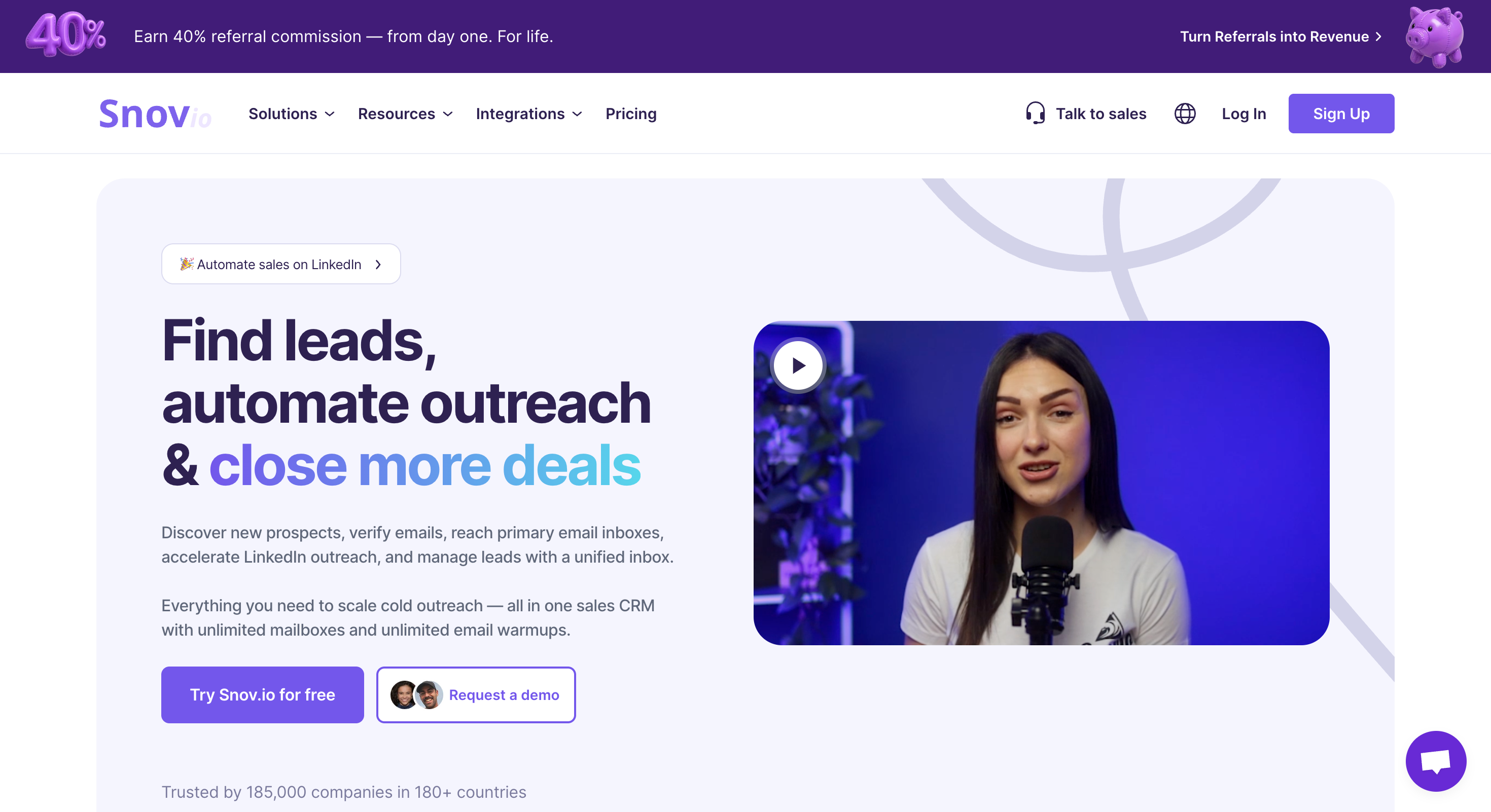
Snov.io is the cheapest credible entry point on this list.
Outreach Starter at $29.25 per month (billed annually) includes 1,000 credits, 5,000 recipients, unlimited senders, unlimited follow-ups, and 3 warmup slots.
For solo SDRs and small teams who want a Lemlist-style all-in-one (lead finder, email verifier, drip campaigns, free built-in CRM) without per-seat pricing, this is the entry point that competes hardest with Lemlist's Email Pro tier.
The trade-offs: LinkedIn automation is a separate $62 per slot per month (billed annually) add-on regardless of plan.
Credits, recipients, and warmup slots are all metered, and the shared credit pool (find + verify + search all draw from one bucket) tends to deplete mid-month for active outbound teams.
Quotas renew every 30 days even on annual plans, so you cannot stockpile unused credits.
Snov.io holds a 4.5 out of 5 rating on G2 across 479+ reviews, with a 4.7 out of 5 on Trustpilot across 1,530+ reviews. Reviewers call out the all-in-one bundling, the LinkedIn Chrome extension, and the bundled warmup as the things that pulled them off Lemlist or Apollo.
"What I like most about Snov.io is how simple and effective it is for finding and verifying email leads. The email finder, verifier, and drip campaign features are all in one place, which makes outreach much easier. The Chrome extension is especially useful for extracting leads from LinkedIn and company websites." — Kishore P., Product consultant, Small-Business, Snov.io product page
"The primary issue I've experienced with Snov.io is that, even after verification, some emails still bounce. Additionally, several features seem restricted unless you opt for a higher-tier plan." — SM, BDE, Small-Business, Snov.io product page
Critical reviews note that the shared credit pool depletes mid-month, that the LinkedIn add-on adds meaningful cost on top of the headline plan price, and that some emails still bounce after Snov.io's own verification step.

If multichannel beyond email + LinkedIn is the actual reason for shopping Lemlist alternatives, Reply.io is the closest like-for-like alternative on this list.
Email plus LinkedIn plus calls plus SMS plus WhatsApp, all inside one sequence builder, with branching logic that adjusts based on prospect behavior.
The platform has been refining this multichannel sequencer for a decade, and it shows.
The catch: Reply.io is per-user. The Multichannel plan starts at $89 per user per month (billed annually), which is roughly the same as Lemlist's Multichannel Expert at $87 per user per month (billed annually).
What does change: Reply.io's Jason AI agent handles email writing, response detection, and meeting booking, which is a meaningful upgrade over Lemlist's surface-level AI. And Reply.io's anti-spam and deliverability suite is more developed than Lemwarm at higher volumes.
Reply.io holds a 4.6 out of 5 rating on G2 across 1,535+ reviews. Reviewers praise the multichannel sequencer, Jason AI, and the integrations on Professional and above.
"Reply.io makes outbound prospecting far more efficient by automating sequences while still allowing deep personalization. The platform's multichannel capabilities (email, LinkedIn, calls, SMS) mean I can engage prospects where they're most active, without juggling multiple tools." — Verified G2 reviewer, Mid-Market, Reply.io product page
"Sometimes the UI can lag a little with larger contact lists. Would love to see more integrations out of the box." — Verified G2 reviewer, Enterprise, Reply.io product page
Critical reviews note UI slowdowns on larger contact lists, the way LinkedIn automation and cloud calling stack as paid add-ons on top of the Multichannel plan, and pricing surprises around add-on renewal.

Apollo.io is the closest alternative for teams that treat Lemlist as both a prospecting database and an outreach tool.
It bundles a 275M+ contact database with 65+ search filters, multi-step email sequences, a built-in US and international dialer, an agentic AI Assistant launched in March 2026, and a Chrome extension that turns LinkedIn profile pages into one-click sequence additions.
Apollo.io stands out beyond price: the depth of the search filters (title, tech stack, funding stage, intent), the AI Assistant that executes prospecting and message drafting from natural-language prompts, and one of the most generous free tiers in B2B SaaS.
It is the strongest answer on this list for teams who want lead data and outreach inside the same login.
However, Apollo removed automated LinkedIn actions on January 30, 2026. LinkedIn connection requests, messages, and profile views are now manual tasks marked complete inside Apollo, not automated steps.
Anyone moving from Lemlist's Multichannel Expert for LinkedIn automation needs to factor in that gap.
Native channels on Apollo today are email sequencing and the built-in dialer.
Apollo.io holds a 4.7 out of 5 rating on G2 across 9,645+ reviews, but a 2.9 out of 5 on Trustpilot across 1,122+ reviews. The gap is driven by billing disputes, credit-system surprises, and support friction on lower-tier plans, not product capability.
"What stands out most to me is the all-in-one approach: I can find leads, enrich contact data, run email sequences, and track the pipeline without having to jump between different tools. The per-user pricing model also feels transparent, and it seems to scale well for small teams. Overall, it's easily the best value in B2B prospecting right now." — Praveen K., Research Analyst, Mid-Market, Apollo.io product page
"Data coverage outside the US can be inconsistent. In APAC and the Middle East, contacts often have missing mobile numbers or job titles that are out of date. I've also noticed that older records tend to have a higher-than-expected email bounce rate, and credits are still consumed even when the data returned is incomplete or inaccurate." — Praveen K., Research Analyst, Mid-Market, Apollo.io product page
Critical reviews focus on the gap between Apollo's G2 score and its 2.9/5 Trustpilot rating, on the removal of native LinkedIn automation in January 2026, and on data accuracy outside US markets where bounce rates of 15-to-35% are commonly reported.
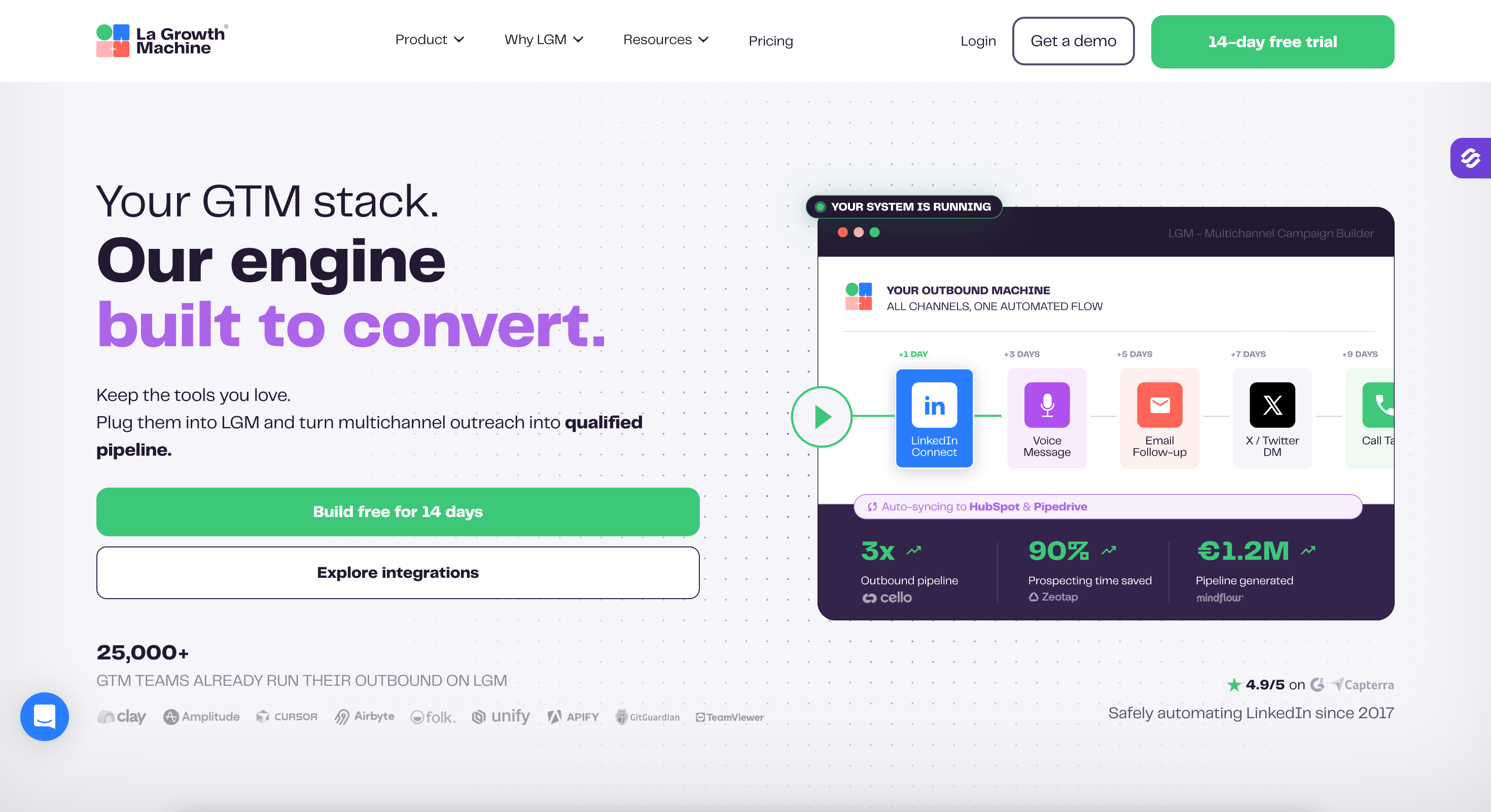
La Growth Machine (LGM) is the most genuinely multichannel-native platform on this list.
Native LinkedIn automation, native email, native X/Twitter on Ultimate, calls via in-sequence tasks, and AI-generated LinkedIn voice messages with voice cloning, all inside one visual workflow builder.
For teams running LinkedIn-first outbound with email and voice as secondary channels, LGM ships features no other tool here does.
Where LGM stands out beyond multichannel: the visual workflow builder is the most-praised feature on G2, the AI voice messages reportedly double reply rates compared to text, and the platform runs on dedicated cloud + 5G mobile proxies.
This keeps LinkedIn account safety high (users consistently report no bans). The unified multichannel inbox on Pro and Ultimate consolidates LinkedIn + email + Twitter replies for team triage.
The trade-offs: per-identity pricing (€60-€120 per identity per month, monthly rates) scales steeply, three reps on Pro lands around €4,320 per year.
There is no built-in email warmup, which means pairing LGM with an external tool like Warmforge or a similar warmup service.
Bugs and sync errors are the most cited critical-review theme on G2. And MCP integration is listed as "coming soon" on the vendor site, not shipped.
LGM bills in EUR with USD/GBP options. Annual billing applies 2 months free, which effectively reduces the monthly rate by ~17%.
La Growth Machine holds a 4.6 out of 5 rating on G2 across 56 reviews, with a 4.9 out of 5 on Capterra across 45 reviews.
"It centralizes responses from multiple channels into a single, unified inbox, which makes it much easier to track leads and reply quickly. It also supports multi-user access, so the whole team can collaborate smoothly without losing context. On top of that, it automates LinkedIn steps through a visual sequence builder, covering not only connection requests and follow-ups, but also smaller actions like profile visits and the creation of automated voice notes." — Tanya R., Web developer, Small-Business, La Growth Machine product page
"You really just can't customize your emails all that much. An insane limitation in the age of AI." — Christina P., Small-Business, La Growth Machine product page
Critical reviews flag the per-identity pricing scaling steeply at 3+ reps, the absence of built-in email warmup, and recurring software bugs and sync errors. A Trustpilot review documents a critical email-sync bug that exposed internal communication between Microsoft Office users.
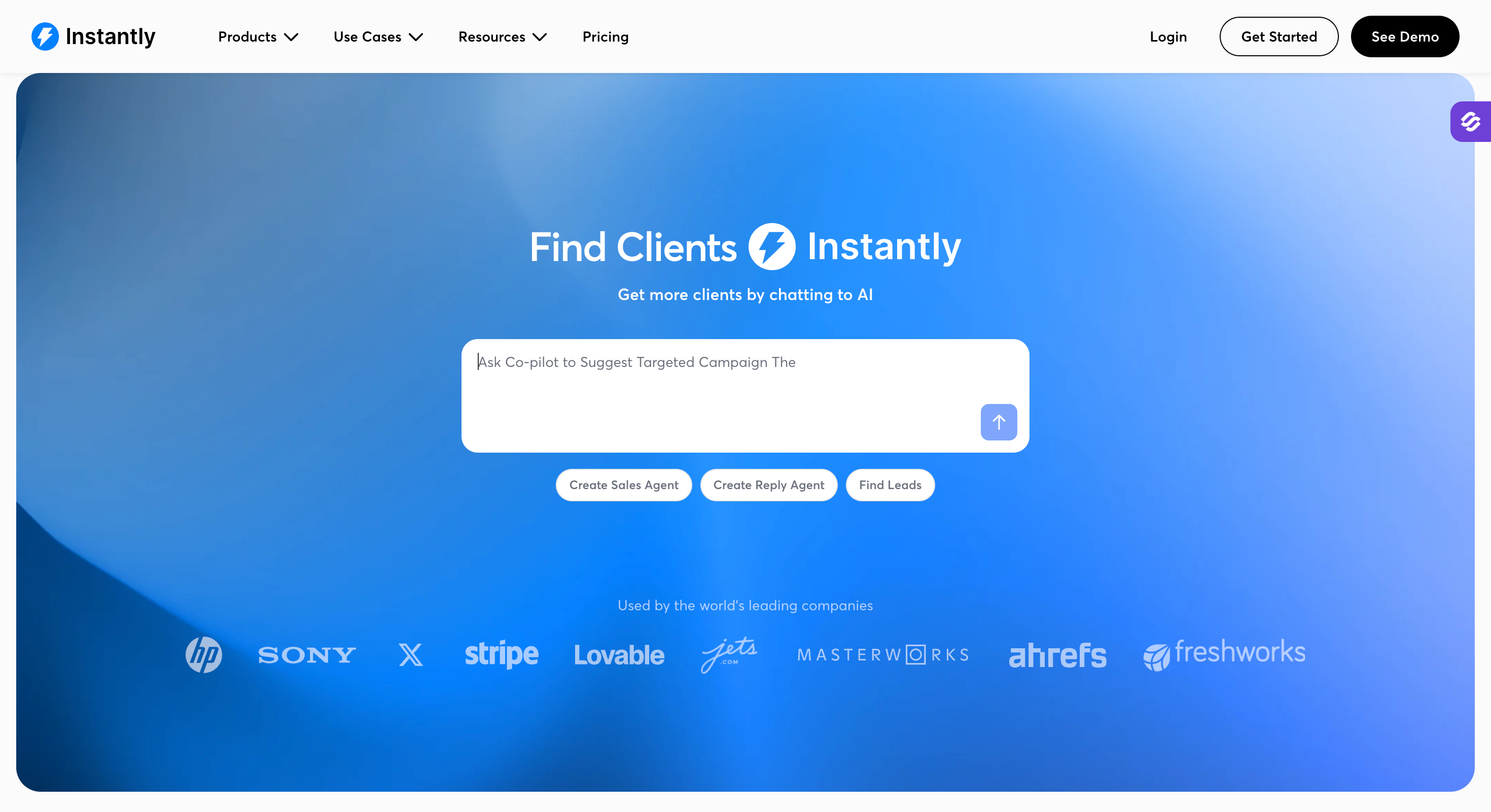
Instantly is the most visible name in cold email replacement for Lemlist users.
It's built specifically for high-volume email outreach, with unlimited mailboxes, unlimited warmup across a 4M+ account warmup network, and a sequence builder that handles cold email campaigns at scale.
Where Lemlist's strength is creative personalization (images, videos, landing pages), Instantly's strength is volume infrastructure. If the outbound motion is email-only and the goal is to push 50,000+ emails per month across many inboxes without managing each one individually, Instantly is built for that pattern.
The trade-off in 2026: Instantly has aggressively modularised pricing. The Growth plan at $37.60 per month (billed annually) is real, but a functional outbound stack typically requires adding SuperSearch (lead database), CRM, and sometimes Inbox Placement testing.
This pushes the realistic monthly cost past $100 once stacked. And the platform is email-only at every plan tier, with no native LinkedIn outreach.
Instantly holds a 4.8 out of 5 rating on G2 across 3,700+ reviews. Reviewers praise the warmup network, unlimited mailbox model, and Unibox unified inbox.
"The unlimited email accounts feature and the automated warm-up are essential for protecting domain reputation while reaching a high volume of leads. I especially value the intuitive UI and the Unibox, which consolidates replies from hundreds of inboxes into one place." — Verified G2 reviewer, Instantly product page
"I don't like that Instantly doesn't work well with Microsoft emails as it constantly disconnects, and I can never resolve this issue. Their sales page is misleading; the 'Growth' plan advertised at $47 includes search and lead credits, but it turns out there are different plans leading to confusing extra charges." — Verified G2 reviewer, Instantly product page
Critical reviews focus on the modular pricing pattern (SuperSearch, CRM, Inbox Placement adding to the base cost), Microsoft mailbox stability issues, and warmup heat scores disagreeing with real inbox placement at higher volumes.
The conversation about Lemlist alternatives in 2026 has shifted.
A year ago, the question was "what's cheaper than Lemlist." Today, buyers looking for a best Lemlist alternative in 2026 are also weighing channel coverage, scale, and pricing concerns rather than just asking what handles email and LinkedIn in one place without per-seat math.
That's the fork most outbound teams are standing at. Patch Lemlist by absorbing the $87 per user per month (billed annually) Multichannel Expert tier as the team grows, or consolidate to a platform that prices for outcomes instead of seats.
This makes Salesforge the correct Lemlist alternative.
Growth at $80 per month (billed annually) gives a five-person team unlimited mailboxes, unlimited LinkedIn senders, and unlimited workspaces.
On Lemlist Multichannel Expert, the same headcount costs $435 per month.
14-day free trial, no credit card required. Start your Salesforge trial here.
Lemlist remains a credible tool for solo founders and 2-to-3-person teams running email-first outbound with strong creative personalization. It becomes harder to justify once your team grows past three users on the Multichannel Expert plan, where per-user pricing at $87 per user per month (billed annually) compounds quickly.
For more value at a similar price, Salesforge Pro at $40 per month (billed annually) adds unlimited mailboxes, free unlimited warmup, and Primebox.
Salesforge and Reply.io both include LinkedIn outreach. Salesforge bundles unlimited LinkedIn senders on the Growth plan at $80 per month (billed annually) and covers 6 LinkedIn actions. Reply.io includes LinkedIn on the Multichannel plan at $89 per user per month (billed annually), but the per-user pricing scales similarly to Lemlist.
Salesforge includes free unlimited warmup via Warmforge as an in-house network. Instantly, Smartlead, and Woodpecker include warmup on every plan. Reply.io includes warmup at the Email Volume tier and above.
Yes, Salesforge offers unlimited mailboxes from $40 per month (billed annually), free unlimited warmup, Primebox for unified email + LinkedIn replies, and AI personalization in 21+ languages.
Salesforge's Growth plan at $80 per month (billed annually) includes unlimited workspaces, which functions similarly for client separation, and the Salesforge Whitelabel program is available for agencies wanting fully branded reseller setups.
.jpg)

.png)