If you're looking at Corebits as a potential outbound partner, the big question is pretty simple: is it actually worth hiring?
Corebits offers outbound services for B2B companies, energy companies raising capital, and firms looking for investment opportunities.
It also has some strong numbers behind it, with 50+ B2B teams served and more than 1,500 calls booked.
But those numbers only tell you so much.
Before you hire an agency, you want to know what the service is really like, how much it costs, what kind of results you can expect, and whether other clients have had a good experience.
That's what I looked at in this Corebits review.
Corebits has no independent third-party review footprint. There's no Clutch profile, no G2 listing, no Trustpilot presence, no TrustRadius entries, and no aggregator badges displayed anywhere. All social proof lives inside the case studies and testimonial pull-quotes across the two domains.
For buyers who filter agencies by third-party review presence, this is the biggest gap in the evaluation. But the case studies themselves are detailed, named, and include specific numbers, which is a stronger signal than most agencies offer even with review platform presence.
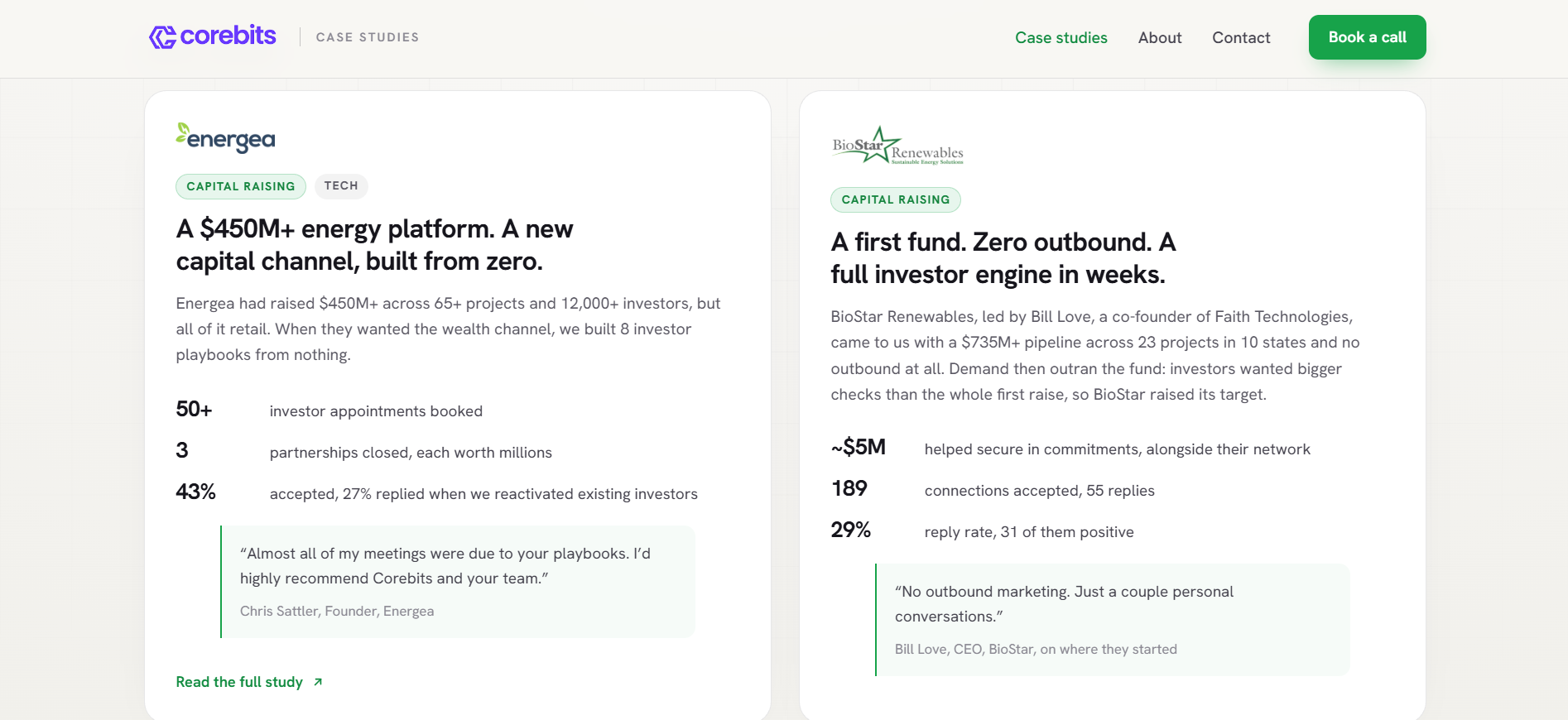
The most striking pattern is that Corebits actually operates in categories other outbound agencies avoid. The Energea case study shows detailed compliance work on Reg D 506(c) raises, including SEC database scraping to build ICP-fit investor lists. Almost no other outbound agency in the market serves this niche, which makes Corebits genuinely differentiated for capital-focused buyers.
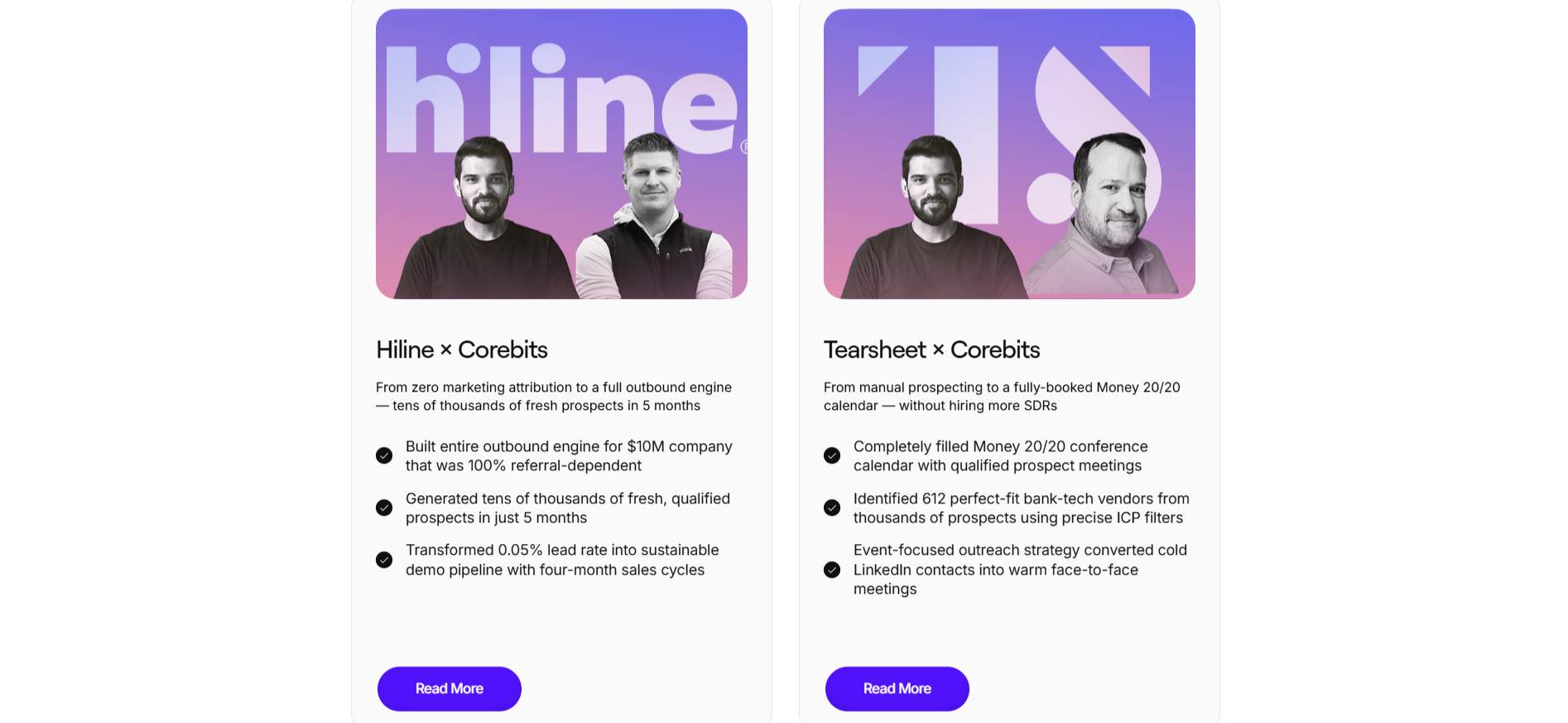
Multiple GTM case studies (Hiline, Nice Shoes, Finimize, Tearsheet) explicitly state that Corebits builds workflows inside the client's own Clay and HubSpot accounts, so the client owns the system after the engagement ends. This is a cleaner exit structure than agencies that hold infrastructure hostage.
The capital raising engine promises a fee refund if the 15-conversation floor isn't met over 90 days. The deal origination engine promises a free month if the 5-conversation monthly floor isn't hit. Both are conditioned on client cooperation, but the guarantees are documented in writing on the site.
The deal origination engine explicitly runs every target and every message through a client approval queue before anything sends. For PE firms where wrong-fit outreach could damage relationships, this quality control matters more than volume.
Case studies name real people (Chris Sattler at Energea, Toby Schumacher at Hiline, Mike Palmer at Nice Shoes, Sebastian Salina at Finimize, Aaron Singer at Tearsheet, Bill Love at BioStar) with specific results attached. The Nice Shoes engagement reports 247% pipeline growth. Finimize scaled qualified touches 5x. These are the kinds of numbers that hold up to reference-call scrutiny.
No Clutch, G2, Trustpilot, TrustRadius, Capterra, or UpCity presence. No aggregator badges displayed on the site. For an agency operating in categories with high transaction values (capital raises, PE deal origination), the absence of independent validation is a real gap buyers should weigh.
Zero dollar figures published anywhere. All three engines route to a discovery or fit call. The site does cite competitor cost benchmarks in the deal origination comparison table (in-house BD desk ~$700K/year, buy-side advisor 1-3% of the deal, databases $20K-$50K) but doesn't share where Corebits sits on that scale.
Aamir Bajwa is named as founder only via a testimonial attribution on the Energea case study and via the contact email on legal pages. There's no About page, no team roster, no bio, no LinkedIn link. For an agency selling founder-adjacent expertise, this is unusual.
During research, multiple inconsistencies surfaced. Chris Sattler at Energea is given three different titles across two pages ("Founder," "Co-founder," "Managing Partner"). Toby Schumacher at Hiline is called both "Head of Sales" and "VP Growth" on the same page. The Energea case study has a "What's Next" section that's copy-pasted from the Finimize page. Every GTM case study has a broken "related articles" widget that recommends the current page under a different company's label.
The site markets "flat fee, no commission" language across capital raising. But the Nice Shoes case study describes a switch to a 5%-of-closed-deal success fee after the initial retainer period, which directly contradicts that positioning. Also, the general Terms of Service says "all sales are final" except where a written guarantee exists, meaning GTM & Outbound (which has no written guarantee) is refund-locked once you sign.
Registered address is Boulder, Colorado. The contact phone number carries a San Francisco (415) area code. There's no explanation on the site for the mismatch, which is worth clarifying during the discovery call.
Hire Corebits if you're in one of their three specific target categories and you value genuine specialization over agency scale. That means energy developers raising 506(c) capital, PE firms or family offices sourcing off-market deals, or B2B SaaS/services teams wanting outbound built inside their own stack.
Two things support this verdict. The category specialization is real, particularly for capital raising and PE deal origination, where almost no other outbound agency operates. And the asset ownership structure on GTM engagements (workflows built in the client's own Clay and HubSpot accounts) is a cleaner exit than most competitors offer.
But treat the transparency gaps seriously. Hidden pricing, no third-party reviews, unconfirmed founder identity beyond a case study quote, contradictions between "no success fee" language and actual client arrangements, and multiple site-maintenance inconsistencies all deserve resolution before signing. The guarantees on the capital engines are legitimate, but the GTM engine has no written guarantee, and the Terms of Service locks refunds by default.
If you need traditional B2B SDR services, published pricing, or third-party review validation, this isn't the fit. Take a look at certified Forge Experts instead. Different fit for a different buyer.
I have not been a Corebits client, so this review is research-based. Everything below comes from corebits.io and gtm.corebits.io directly for pricing, services, process, case studies, and stated results. The one flagged limitation is that Corebits blocks automated fetches, so all extraction was done through rendered browsing.
I judged Corebits on four things: whether the three-engine structure actually delivers coherent value across such different buyer categories, whether the case study results are directionally believable and match the guarantee structures, whether the transparency gaps (no About page, no third-party reviews, no pricing) are dealbreakers for the target buyer, and whether the internal inconsistencies flagged during research signal deeper operational issues.
Corebits operates three distinct engines rather than a single tiered service offering. Each engine serves a different buyer, has its own comparison table, and carries its own guarantee structure.
Rather than list all three exhaustively, the ones that matter depend entirely on which category you're evaluating.
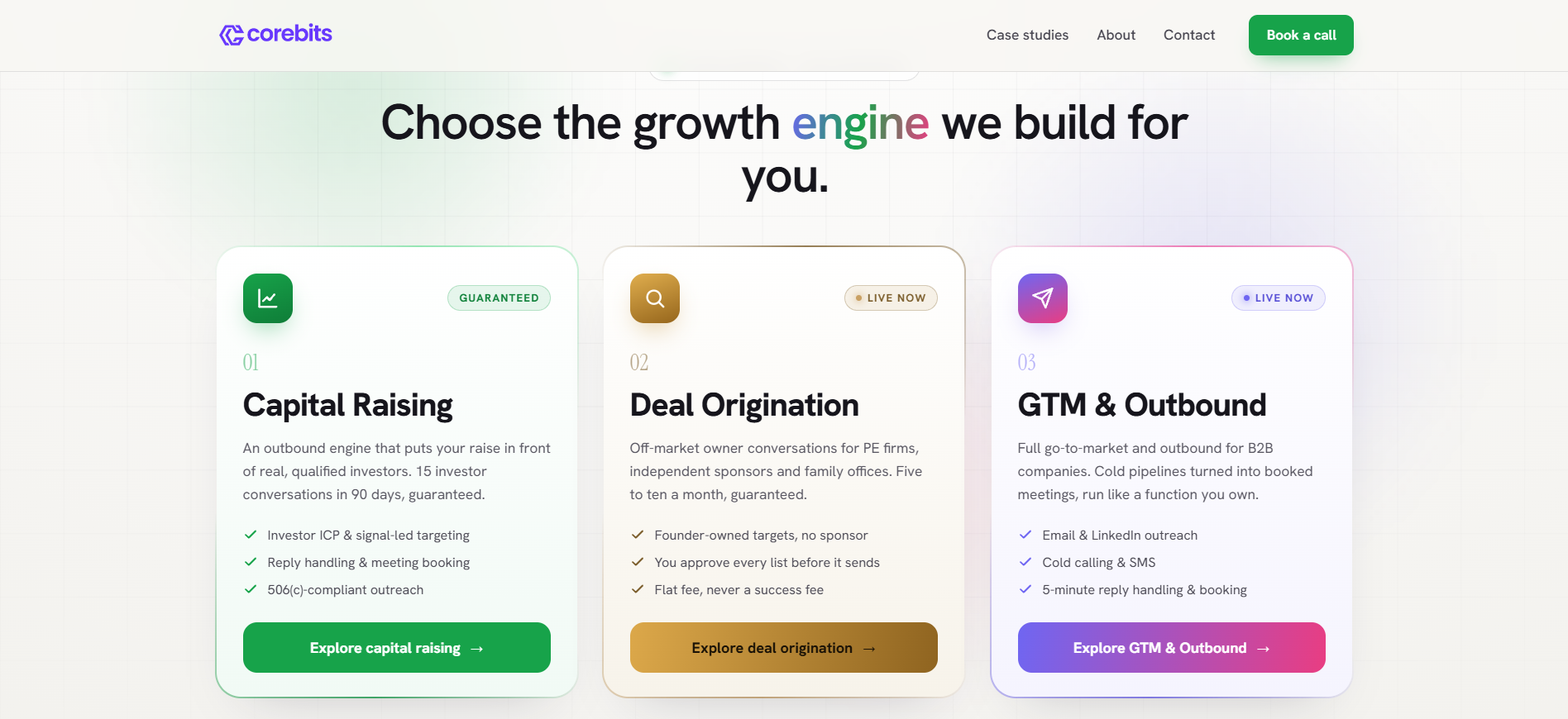
Runs on corebits.io/capital. Built for energy developers, funds, and operators (solar, wind, storage, grid, infrastructure) with real track records or assets, raising under Reg D 506(c). Scope includes investor targeting by ICP and buying signal, reactivation of Corebits' warm investor network plus any client-supplied past investors, signal-led outreach to new investors, reply handling, and meeting booking. Explicitly won't handle 506(b) raises since general solicitation isn't legal there.
Runs on corebits.io/deals. Built for PE firms, independent sponsors, and family offices sourcing off-market deals. Client supplies a "buy box" (sector, size, EBITDA, geography). Corebits finds and verifies founder-owned targets using signals like owner age, succession moves, hiring patterns, filings, and facility changes. Every target and message goes through a client approval queue before sending. Outreach runs across email, LinkedIn, and phone. Includes a free self-serve "pipeline calculator" tool that runs client-side.
Runs on gtm.corebits.io with three named packages: Done-For-You Outbound (cold email, LinkedIn prospecting, 50-70 cold calls/day via dedicated SDR, 5-minute reply response), Custom Outbound Playbooks (bespoke Clay workflows with AI-driven signal detection, full automation handed over, team training included), and Embedded GTM Engineer (Corebits engineer embedded with the client's own reps, building and optimizing workflows while the client team runs the outreach).
Corebits publishes structured 4-stage processes for the capital raising and deal origination engines, but not for GTM & Outbound. Here's how each plays out based on the site and case study patterns.
Stage 1 starts with a fit call that hands over 25 to 50 matched investors for free regardless of outcome. Stage 2 is a 1 to 2 week build and launch phase. Stage 3 lands warm conversations within weeks. Stage 4 is the day-90 checkpoint against the 15-conversation guarantee.
Stage 1 has the client submit a buy box. Stage 2 has Corebits source and verify owners against live signals. Stage 3 has the client approve every target and every message via a one-click queue before anything sends. Stage 4 has Corebits execute roughly 2,000 outreach touches per closed deal while the client takes the resulting calls. Free 72-hour turnaround on the first 5 illustrative targets. Full setup runs the first three weeks, conversations begin week four, and real performance data hits by day 45.
No numbered published process on the marketing pages. Process is only described inside individual case studies (e.g., Hiline's build order was infrastructure first weeks 1-3, then scale). Reporting is described generally as a "weekly operating cadence" with no specific format. Client tools mentioned repeatedly across case studies: Slack notifications via Make.com for hot replies, Calendly for booking. If you want to compare against agencies with more structured GTM onboarding, my Belkins review covers what a US-focused retainer competitor looks like.
Corebits publishes no dollar figures for any of the three engines. All pricing is quote-only, disclosed after a fit call or buy box submission.
What is published is the pricing structure and contract terms, which vary meaningfully across the engines.
Described only as a flat fee, no commission, no equity. Actual figures not published. Positioned as a 90-day pilot with no long-term commitment. Guarantee: fee refund if the 15-conversation floor isn't met over 90 days, conditioned on the client working leads, approving lists on time, and taking calls.
Per an FAQ answer, a flat monthly fee plus a fixed fee per delivered conversation, quoted after the client submits a buy box. Never a percentage. Includes category exclusivity (one client per sector/mandate). Guarantee: free month if the 5-conversation monthly floor isn't hit, not a refund. Client keeps their target file if the engagement ends. The comparison table cites competitor benchmarks: in-house BD desk ~$700K/year, buy-side advisor plus 1-3% deal fee, databases $20K-$50K.
Three packages (Done-For-You, Custom Playbooks, Embedded Engineer). No dollar figures. No published contract length. No written performance guarantee. The general Terms of Service states "all sales are final" except where a written guarantee exists, which means GTM engagements are refund-locked by default. Notably, the Nice Shoes case study describes a switch to a 5%-of-closed-deal success fee, which contradicts the "flat fee, no commission" language used on the other engines.
Corebits fits you well if you're in one of three specific categories.
If none of these three describe you, Corebits probably isn't your best fit. This isn't a generalist B2B SDR agency.
Skip Corebits if you're looking for a traditional B2B SDR retainer with published pricing, if you need third-party review validation before signing, or if you specifically need a large team with named account managers for enterprise procurement.
Also skip if you're raising 506(b) capital (they explicitly won't do general solicitation there), if you're pre-revenue with no assets or track record on the capital raising side, or if your GTM engagement requires a written performance guarantee (the GTM engine has none).
If your monthly outbound volume is under a few hundred emails, you may not need an agency at all. Running Salesforge yourself covers that volume with warmup included.
Corebits publishes six named case studies across the three engines, and the strongest ones are worth reading closely because they tell you what each engine actually delivers.
On the capital raising side, Energea is the flagship.
The energy platform used Corebits to reactivate its investor network and source new prospects, ending up with 50+ investor meetings booked and 3 partnerships closed. BioStar Renewables is the second capital case, credited with helping secure around $5M in investor commitments, though the specific numbers vary between the proof section and the FAQ.
The GTM engine has more depth.
Two things stand out across the library.
The engagements are multi-month, and the numbers name specific clients and specific contacts you could theoretically call to verify. That's more transparent than most agencies at this scale.
No Clutch, G2, Trustpilot, TrustRadius, Capterra, or UpCity presence. No aggregator badges displayed on the site. For an agency operating in categories with high transaction values (capital raises, PE deals), the absence of independent validation is a real gap.
Zero dollar figures published anywhere. All three engines route to discovery calls. The deal origination comparison table cites competitor cost benchmarks but not Corebits' own pricing.
Aamir Bajwa is named as founder only via a testimonial attribution on the Energea page and via the contact email on legal pages. No About page, no team roster, no bio, no LinkedIn. Unusual for an agency selling founder-adjacent expertise.
Multiple inconsistencies surface on close inspection. Chris Sattler at Energea is given three different titles across two pages. Toby Schumacher at Hiline has two titles on the same page. The Energea case study has a "What's Next" section copy-pasted from the Finimize page. All four GTM case studies have broken related-articles widgets that recommend the current page under a different company's label.
Marketing language says "flat fee, no commission" across the capital engines. The Nice Shoes case study describes a switch to a 5%-of-closed-deal success fee after the initial retainer period. If pricing consistency matters to your procurement process, this deserves clarification. My Callbox review covers a competitor with clearer pricing transparency.
Capital raising and deal origination both carry guarantees (fee refund and free month respectively). GTM & Outbound has none. Combined with the Terms of Service default of "all sales final," this means GTM engagements are refund-locked once you sign.
Registered address is Boulder, Colorado. Contact phone is a San Francisco (415) area code. No explanation on the site.
The Energea case study page includes a closing testimonial attributed to Aamir Bajwa, Founder, Corebits, styled identically to genuine client quotes. This reads as a templating error. Worth checking during your discovery call that other client testimonials are actually from clients.
If Corebits isn't the right fit, don't just Google "outbound agency" and pick the first result. Compare a few agencies whose practices you can actually verify.
The Forge Expert Network is a directory of agencies certified on the Forge ecosystem. Certification requires completing Salesforge's cold email training and meeting program eligibility requirements, so every listed agency has a disclosed, modern outbound stack.
Best for: Buyers who want Corebits' outbound execution but with a signed meeting volume guarantee across their entire engagement, not just capital raising.
Forge rating: 5/5

Outbound Pros guarantees 50 to 75 qualified meetings per month with commission-based pricing on top of a $1.5K to $10K monthly retainer. That's a signed meeting count commitment Corebits only offers on the capital engines, not on GTM. Their profile also states dedicated owned domain infrastructure with documented SPF, DKIM, and DMARC setup, plus a four to six week warm-up targeting 85 to 95% inbox placement.
Best for: $5M to $50M ARR companies that want Corebits' asset-ownership model on GTM engagements but with clearer contract terms and a stronger review footprint.
Forge rating: 5/5
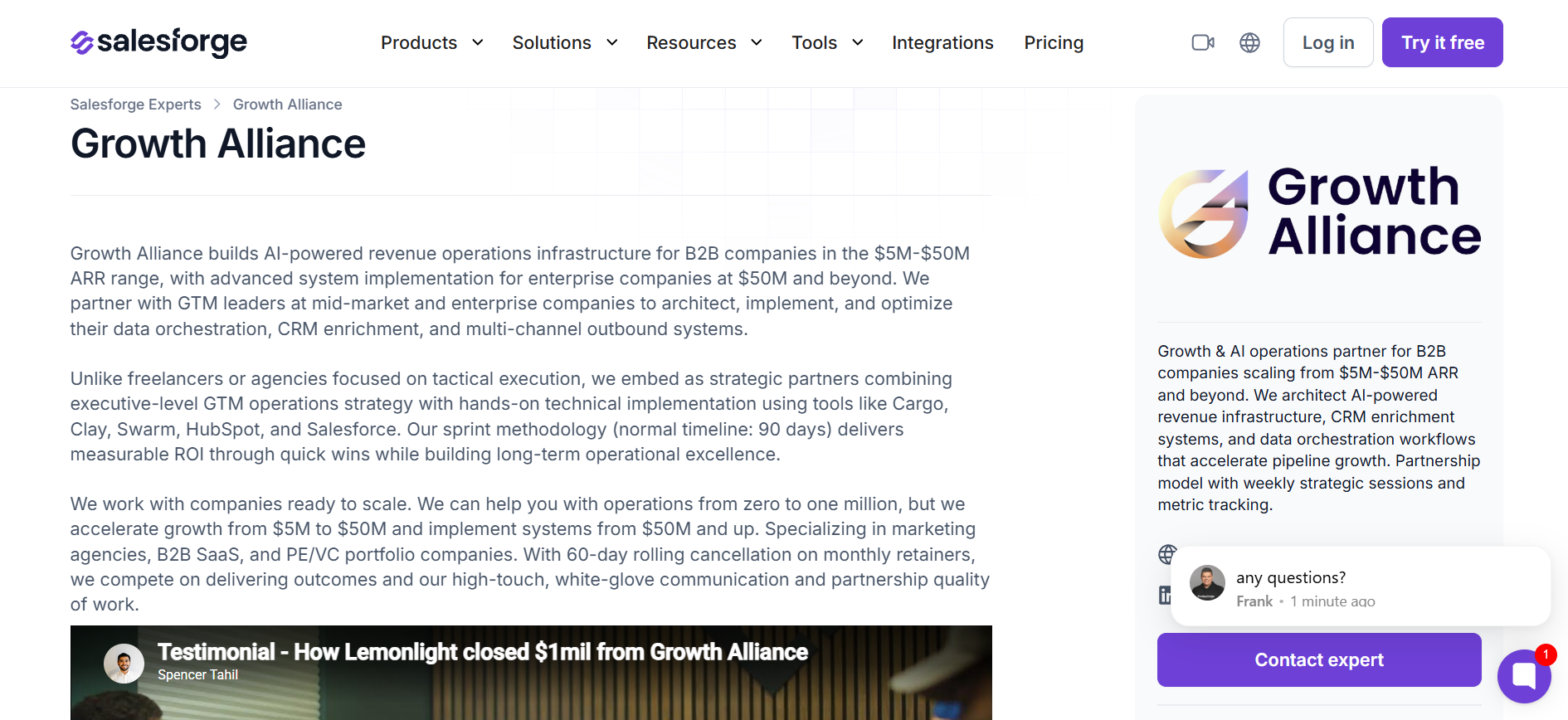
Growth Alliance offers programs from $10K per month with 60-day rolling cancellation and a 90-day sprint methodology. Their profile says systems are built to become the client's own and keep running afterwards, similar to Corebits' GTM engagements. They cap engagements at four to six clients with 100 to 120 hours each per month, and their case study reports founder Spencer Tahil running 1,000+ client domains and mailboxes above a Heat Score of 89.
Best for: Buyers who want Corebits' specialization approach but need published pricing they can benchmark and European market coverage.
Forge rating: 5/5
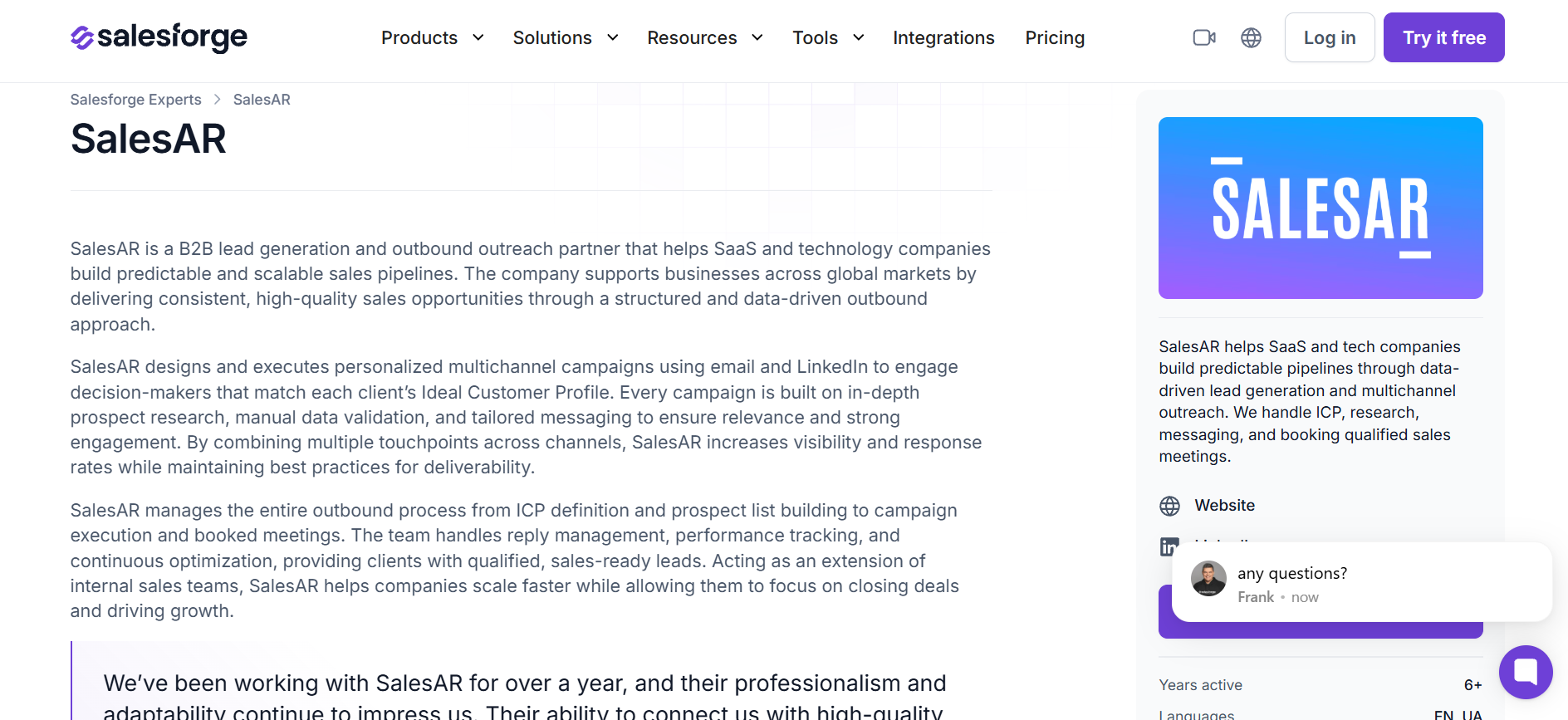
SalesAR publishes a starting price of $2,500 per month and covers EU and US markets, which is a direct contrast to Corebits' hidden pricing. Their profile reports 700+ clients served, 30,000+ appointments set, and an 80% contract renewal rate. Named case study clients include Akridata with 190+ appointments generated.
Two routes skip the agency entirely.
Run outbound yourself with Salesforge. It starts at $48 per month with unlimited mailboxes and free warmup included, plus a 14-day free trial.
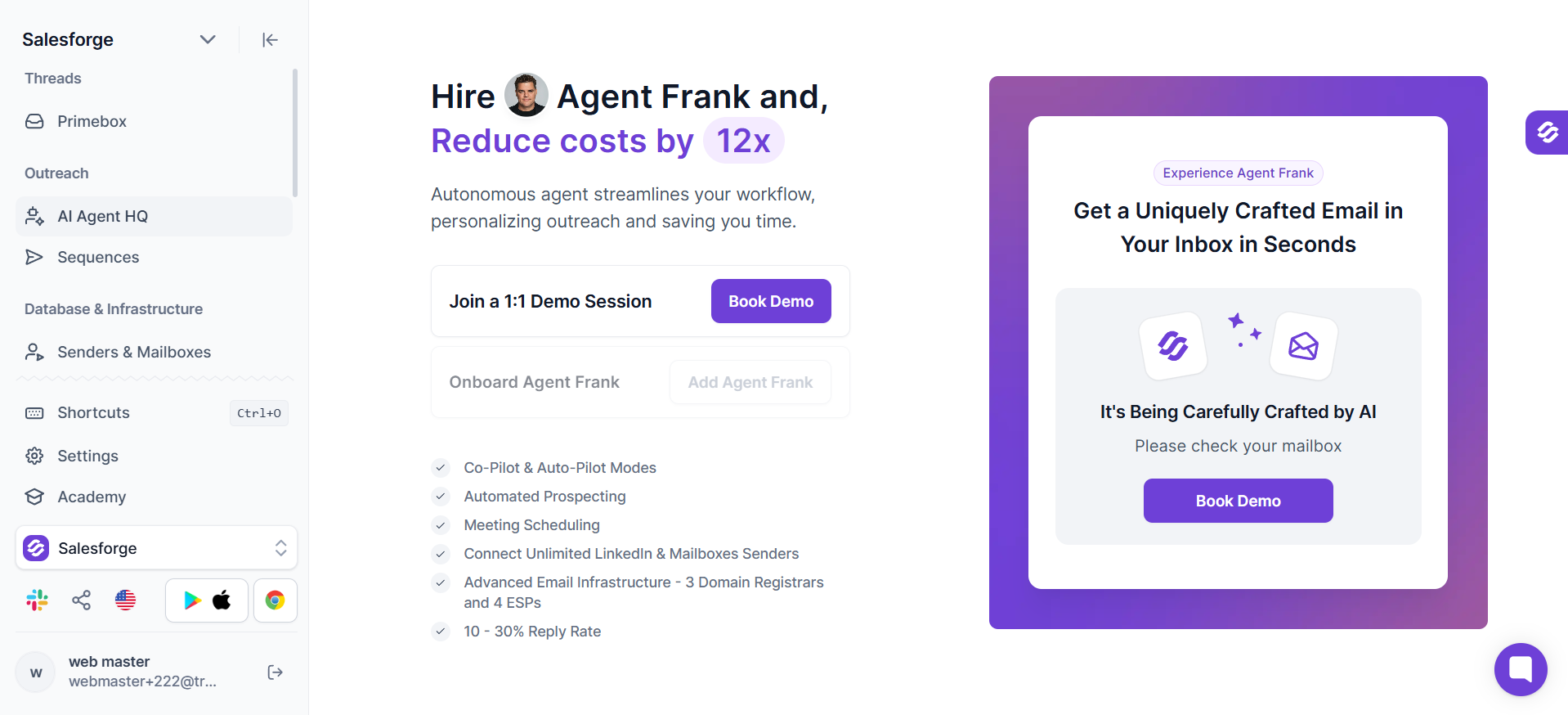
Or hire Agent Frank, Salesforge's autonomous AI SDR, from $499 per month billed quarterly. He handles prospecting, sequencing, replies, and meeting booking on his own. He is a separate subscription, and he needs a demo plus a two-week warm-up before he can send.
Take these into your discovery call. Their answers will tell you more than any review, including this one.
Corebits is worth considering if you're specifically in one of their three target categories and you value genuine specialization over agency scale. That means energy developers raising 506(c) capital, PE firms or family offices sourcing off-market deals, or B2B SaaS/services teams wanting outbound built inside their own Clay and HubSpot accounts.
The specialization is real. Capital raising for 506(c) energy raises and PE deal origination are categories almost no other outbound agency serves. The asset ownership structure on GTM engagements is a cleaner exit than most competitors offer. And the guarantees on the two capital engines are legitimate written commitments.
But treat the transparency gaps seriously. Hidden pricing, no third-party reviews, founder named only through a case study quote, contradictions between "no success fee" language and actual Nice Shoes arrangement, multiple site-maintenance inconsistencies, GTM engine with no written guarantee, and mismatched contact info all deserve clarification before signing.
If you need traditional B2B SDR services, published pricing, third-party review validation, or a written guarantee across your entire engagement, compare certified alternatives in the Forge Expert Network that already publish those terms.
Yes. Corebits operates under the legal name Corebits LLC and is registered at 1942 Broadway STE 314C, Boulder, Colorado 80302. The company runs three distinct outbound "engines" (Capital Raising, Deal Origination, GTM & Outbound) across two domains (corebits.io and gtm.corebits.io). Six case studies name real clients including Energea, BioStar Renewables, Hiline, Nice Shoes, Finimize, and Tearsheet. The founder is identified as Aamir Bajwa through a case study quote attribution and the contact email on legal pages, though no About page or team roster exists on the site.
Corebits publishes no dollar figures for any of the three engines. All pricing is quote-only. Capital raising is described as a flat fee, no commission, no equity. Deal origination is a flat monthly fee plus a fixed fee per delivered conversation. GTM & Outbound is quoted per package (Done-For-You, Custom Playbooks, Embedded Engineer). Ask for the exact figures on your discovery call.
Yes, on two of the three engines. Capital raising promises a fee refund if fewer than 15 investor conversations happen over 90 days. Deal origination promises a free month if fewer than 5 conversations happen in a month. Both are conditioned on the client working leads, approving lists on time, and taking calls. GTM & Outbound has no written performance guarantee, and the Terms of Service locks refunds by default ("all sales final unless a written guarantee says otherwise").
No. Corebits has no Clutch profile, no G2 listing, no Trustpilot presence, and no TrustRadius entries. All social proof is self-published on the site as case studies and testimonial pull-quotes. For buyers who use independent review platforms as a filtering signal, this is a real gap.
Two things. First, they run outbound for capital raising (specifically Reg D 506(c) energy raises) and PE deal origination, which almost no other outbound agency serves. Second, their GTM engagements build workflows inside the client's own Clay and HubSpot accounts, so the client keeps the infrastructure at end of engagement. Most competitors run outbound on their own tools and workflows.
Corebits is a specialized three-engine agency with strong focus on capital raising and PE deal origination, plus a GTM engine for B2B SaaS/services. Belkins is a US-focused traditional retainer SDR agency with 233 Clutch reviews and strong third-party validation. Callbox has 22 years of history and genuine APAC coverage with Campaign Pods pricing. My Belkins review and Callbox review cover both alternatives in detail.
Three certified agencies in the Forge Expert Network answer specific gaps. Outbound Pros guarantees 50 to 75 qualified meetings monthly with commission pricing (a signed volume commitment Corebits only offers on capital engines). Growth Alliance builds systems clients keep after engagement with 60-day rolling cancellation. SalesAR publishes a $2,500 monthly starting price with EU + US coverage. For smaller volumes, running Salesforge in-house from $48/month is a leaner alternative.
.png)