Workflows.io is selling something bigger than a typical agency service.
You can hire it for outbound, LinkedIn content, RevOps, or ABM, but the bigger idea is that all of these pieces can work together as one GTM system. The company combines AI workflows, tools like Clay and HubSpot, and hands-on GTM work to build that system for B2B teams.
That sounds a lot more useful than hiring four different agencies. But it also means there's more to evaluate than whether its outbound campaigns or content look good.
The real question is whether Workflows.io can actually make these systems work together in a way that creates measurable revenue growth.
So I looked at how the company works, what it offers, how its engagements are structured, the results it publishes, and the kind of companies it works with.
Here's whether Workflows.io lives up to the pitch.
Before the deep dive, here is the fast read for anyone in a hurry.
Workflows.io does not have a Clutch or G2 profile, so the customer signal lives inside its published case studies. That is a real limitation on aggregated sentiment, but the case studies themselves are dense and specific, which gives you something to work with.
I read through all ten to spot patterns worth flagging.
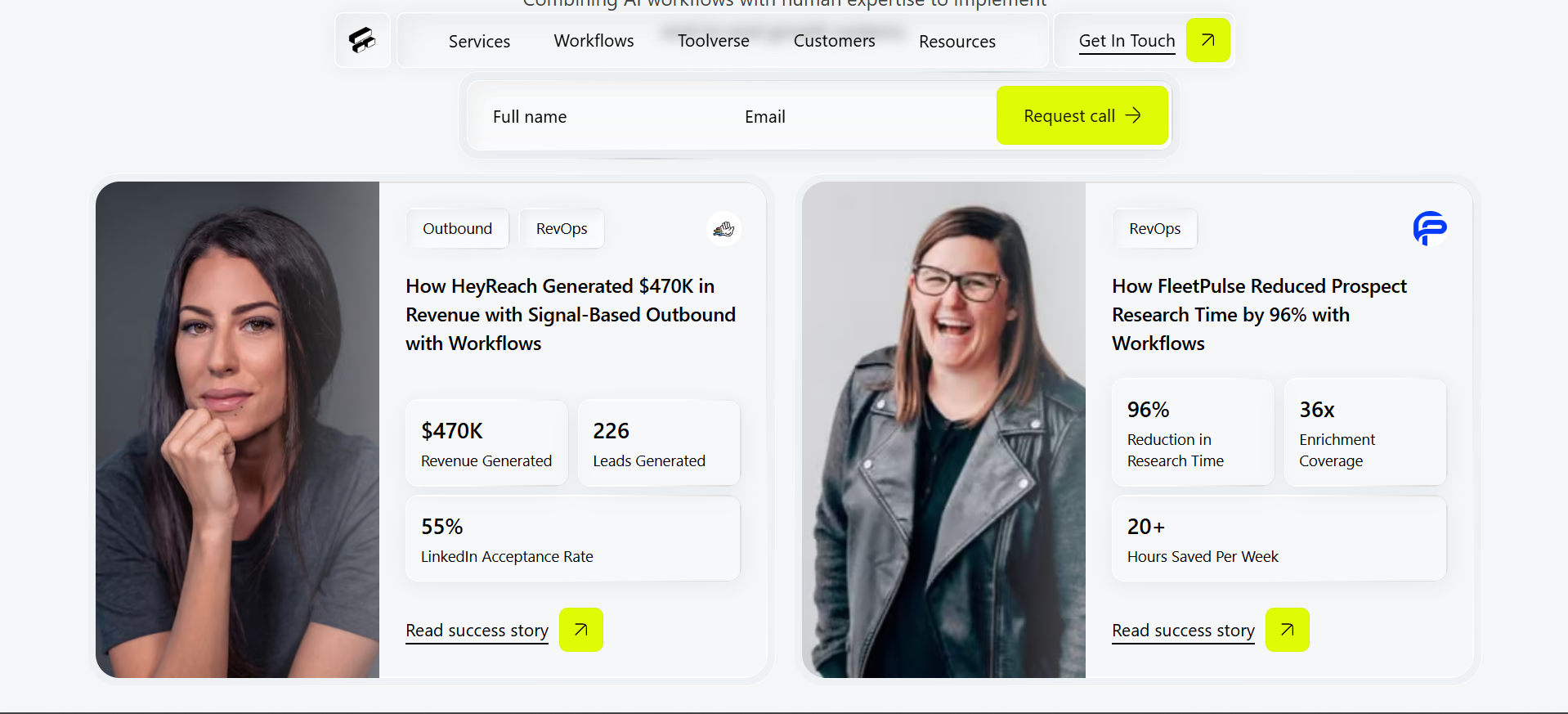
Nine out of ten published case studies report time savings, most in the range of fifteen to thirty hours per week. FleetPulse claims 96% research-time reduction and 36x enrichment coverage. Meister reports fifteen-plus hours per week saved. The consistency across accounts is the interesting part, not the individual numbers.
Reference: FleetPulse case study.
The Medrio and HeyReach case studies both center on signal detection driving outbound plays. Medrio reports 2,831 signals surfaced and $1.3M pipeline generated. HeyReach reports $470K revenue on 226 leads with 55% LinkedIn acceptance. That pattern suggests real depth on intent and trigger-based prospecting, not just email volume.
Reference: Medrio case study.
Where most agency case studies cite vanity metrics, Workflows.io leads with pipeline generated. Huzzle at $2M. Medrio at $1.3M. Seam AI at $1M. HeyReach at $470K in closed revenue. Named clients plus dollar figures is a stronger signal than reply-rate percentages alone.
Reference: Huzzle case study.
Cross-case, the pattern is Clay-plus-Apollo-plus-HubSpot as the data backbone. Caravelo reports 90%+ enrichment coverage. Meister reports 30% coverage lift and 50% software cost savings. That is a specific technical competency that not every outbound agency has.
Reference: Caravelo case study.
Every case study reports outcomes without disclosing engagement spend. A $2M pipeline result reads differently at $5K per month versus $12K per month. Without that ratio, ROI comparisons are impossible.
Some case studies mention six-month windows, others just say "over time." That makes it hard to know whether the results reflect a quarter, a year, or longer.
Nine of the ten case studies are tech-adjacent (SaaS, fintech, healthtech, GTM tech, data enrichment). If you are a traditional B2B service business, the published proof points map less directly to your use case.
Given all of that, here is the honest read.
Hire Workflows.io if you are a B2B tech company between Seed and Series C, you already know your ICP has a TAM above 20,000 companies, and you want an AI-augmented outbound and RevOps engine built for you on the Clay, Apollo, and HubSpot stack.
The pricing bands align with that profile, the case study proof points concentrate there, and the proprietary tool stack (Claude Code, MCP framework, 56 playbooks) suggests real depth on the AI-plus-human hybrid model.
Two things support this verdict.
First, the transparency on pricing and playbooks is genuinely uncommon. Most agencies gate that behind a discovery call. Workflows.io publishes ranges, minimums, and its actual approach openly. Second, the case studies lead with pipeline dollar figures attached to named clients, which is a sharper signal than generic reply-rate claims.
But the tension is real too.
The cross-service positioning (Content plus Outbound plus RevOps plus ABM) can quietly stretch scope. There is no published guarantee, only a client-selection filter. Team and founder information is essentially absent from the site. Engagement spend is never disclosed in case studies. And every service runs on quarterly commitments, which limits how quickly you can walk away if the fit is wrong.
If any of that gives you pause, compare Certified Forge Experts that publish those specifics upfront.
Before going deeper, one note on the methodology.
This is a research-based review, not a client engagement. I pulled service and pricing details directly from workflows.io itself, and confirmed no third-party review platform (Clutch, G2, Trustpilot, Sortlist, GoodFirms, DesignRush) has an aggregated profile for them as of February 2026.
The four criteria I judged them on:
That brings us to what they actually sell.
Workflows.io runs five distinct service lines, and they are structured to overlap with intention.
Under the hood, they lean on Claude Code, Claude AI, and an MCP framework across most of the workflows. Fourteen third-party integrations are named on the site, including HubSpot, Salesforce, Notion, Slack, RB2B, Nooks, and Ergo.
Every Workflows.io cell comes from their own service pages and Terms of Use. Confirm the specifics on your discovery call.
Here is how a typical engagement plays out, using the Automated Outbound service as the reference model.
You start with a strategy call to define scope, ICP, and desired outcomes. Pricing gets confirmed here based on volume and complexity. The relevant question to ask: which of the five service pages actually maps to your job, and can they run outbound as a standalone without bundling RevOps.
The engagement opens with a kickoff call and email infrastructure setup. Workflows.io provisions your sending stack across Instantly and HeyReach, connects the ESPs, and verifies deliverability. The question to ask: do you own the mailboxes and domains, or does the agency, and what happens if you leave.
They conduct positioning research and ICP definition, then build the target account list (TAL) with Clay enrichment layered on Apollo data. This is the phase where their Clay-plus-Apollo stack does the heavy lifting. Ask what enrichment sources they layer and how they handle bounce rates on the enriched list.
For more on how enrichment cascades work, see our guide to waterfall enrichment.
Weekly calls kick in during this phase. Copywriting happens against your ICP and offer, and initial sequences get drafted. Ask how many variants they test before launch and whether A/Z testing is part of the standard workflow.
If you are running multichannel plays, our multichannel outreach playbook is worth reading alongside their sequence design.
The first campaign launches with revisions based on early data. Reply routing goes into their tooling and yours, depending on setup. Ask what response volumes trigger a strategy revision and how quickly they iterate on underperforming sequences.
Weekly calls continue post-launch, with performance data reviewed and sequences adjusted. This is where the AI workflows layer supposedly adds leverage. Ask what specifically gets automated versus what still needs human review, and how you measure the AI contribution against the humans on the account.
The published number on each service page is a floor, not a price.
Workflows.io does list pricing openly, which is unusual for a GTM agency. But what you see is the minimum engagement, not the retainer you will actually pay. Final pricing is scoped on the discovery call, based on volume, complexity, and which service lines you pull in.
Every subscription service runs on the same contract model. Quarterly commitments, with each month "tied to clear outcomes" per their Automated Outbound page.
You cannot buy a single month of any subscription service. The minimum lock is a full quarter across LinkedIn Content, Automated Outbound, RevOps, and Enterprise.
Now for the practical question. Who is this actually right for?
The best-fit buyer is a B2B tech company between Seed and Series C with a TAM above 20,000 companies, an LTV above $5,000, and an existing motion that needs scaling rather than starting from scratch. Or a service-based B2B business with 50+ employees running a similar profile. In both cases, the "AI workflows plus human expertise" model earns its price when the buyer wants both the outbound execution and the RevOps plumbing sorted in the same engagement.
Two conditions make the fit especially strong. First, you already use or plan to use HubSpot, Apollo, and Clay. Their entire stack is built around those tools, so integration friction stays low. Second, you have an internal owner who can absorb weekly calls and act on strategy revisions between them. The engagement model assumes you show up.
The flip side matters just as much.
Skip Workflows.io if your monthly outbound budget is under $5K, your ICP has a TAM under 20,000 with high six-figure ACVs (their ABM Program is closer to that lane), or you want a shop that ships meetings and nothing else. The quarterly commitment structure also rules out anyone who wants to test-drive an agency month to month.
If your monthly outbound volume is under a few hundred emails, buying tools and running it yourself with Salesforge may cost less than any agency retainer.
These are structural gaps, separate from the client-experience patterns above.
The closest language is a client-selection filter. That is not a guarantee. A buyer expecting either a meeting SLA or a prorated refund path will not find one on the site.
You cannot try Workflows.io month to month. The minimum lock is a full quarter across LinkedIn Content, Automated Outbound, RevOps, and Enterprise. That is a real barrier for buyers who want to test agencies against each other.
Only two co-founder names are published (Fivos Aresti and Dan Rosenthal), with no bios, backgrounds, or team page anywhere on the site. For a service business, that is unusually thin. It puts the entire pre-signing trust burden on the case studies.
Both /pricing and /about return 404s. Pricing lives inline on each of the five service pages, which works but forces you to hunt. The About page absence is more significant, because it removes the standard place buyers look for team credentials.
Content, Outbound, RevOps, ABM, and Enterprise all sit at similar prominence. There is no explicit flagship, which means the discovery call can steer you into a bigger engagement than you needed. Ask which service the AE thinks fits, and why the others are not the answer.
Nine of ten case studies are tech-adjacent. If you are a traditional B2B service, industrial, or regulated business, the proof points map less directly. Ask for a comparable-vertical reference before you commit.
None of these should rule Workflows.io out on their own. But if two or more matter to you, compare agencies that answer these questions on their public profiles.
If the limitations above give you pause, three Certified Forge Experts address the specific gaps directly. Each is vetted through the Forge Expert Network, which surfaces agencies against a public rubric on process, results, and ICP fit.
The Forge Expert Network is Salesforge's certified partner directory. Every listed agency is verified against a standard rubric, publishes their process and pricing on the profile, and has track records buyers can pressure-test before signing.
Best for: Buyers who want done-for-you outbound without a quarterly commitment
Forge rating: 5/5
Fulcrum's positioning leads with "no minimum commitment" and a "make you independent" philosophy. That is the direct antidote to Workflows.io's quarterly-lock model across every subscription service. If you want to test outbound execution without committing three months upfront, Fulcrum is built for that shape of engagement.

Best for: Buyers who want a boutique B2B outbound specialist, not a full-service GTM shop
Forge rating: 5/5
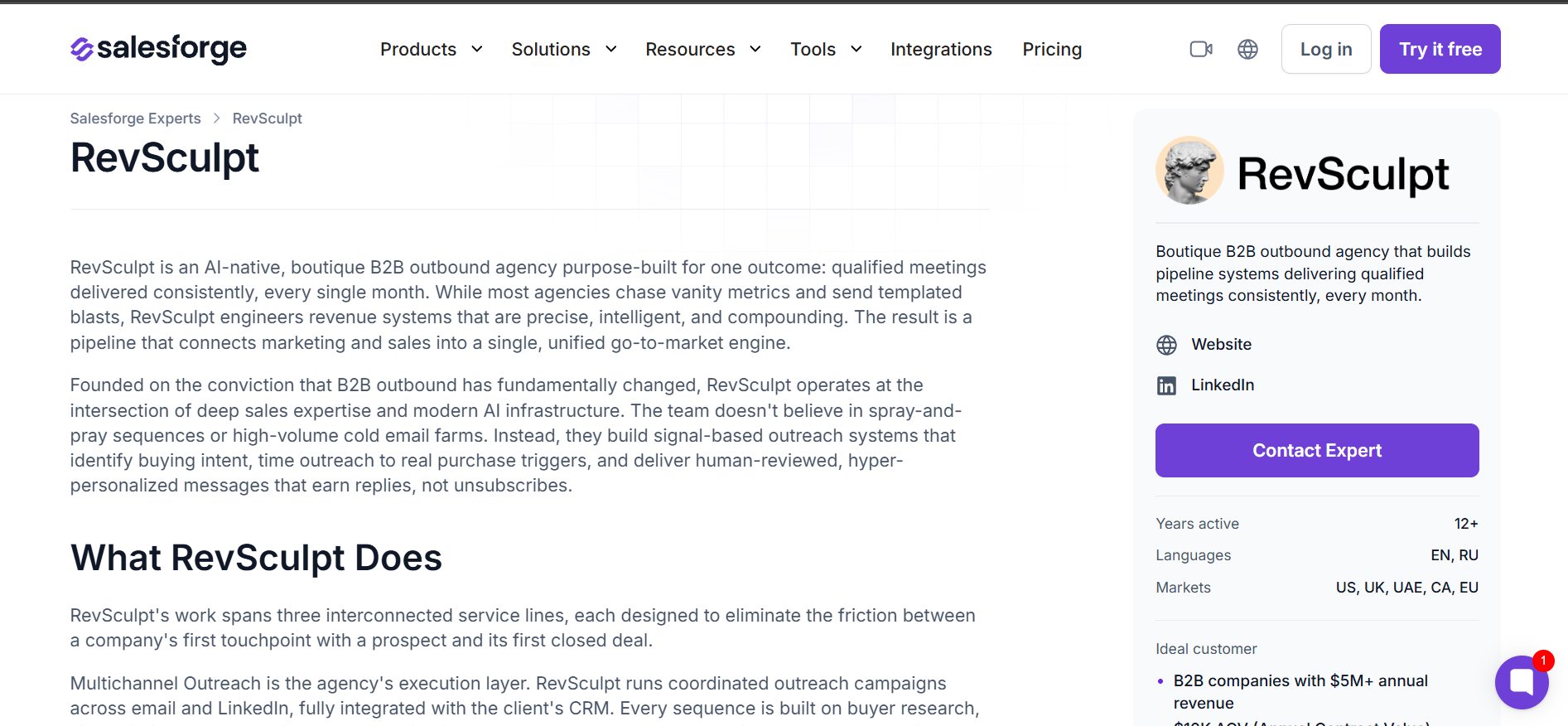
RevSculpt positions itself as a boutique B2B outbound agency delivering qualified meetings consistently. That is a sharper counter to Workflows.io's cross-service scope, where Content, ABM, and RevOps all share prominence with Outbound. If outbound is the only lever you want pulled, RevSculpt maps cleaner.
Best for: Buyers who need explicit meeting-focused outcomes and a scalable GTM system
Forge rating: 5/5
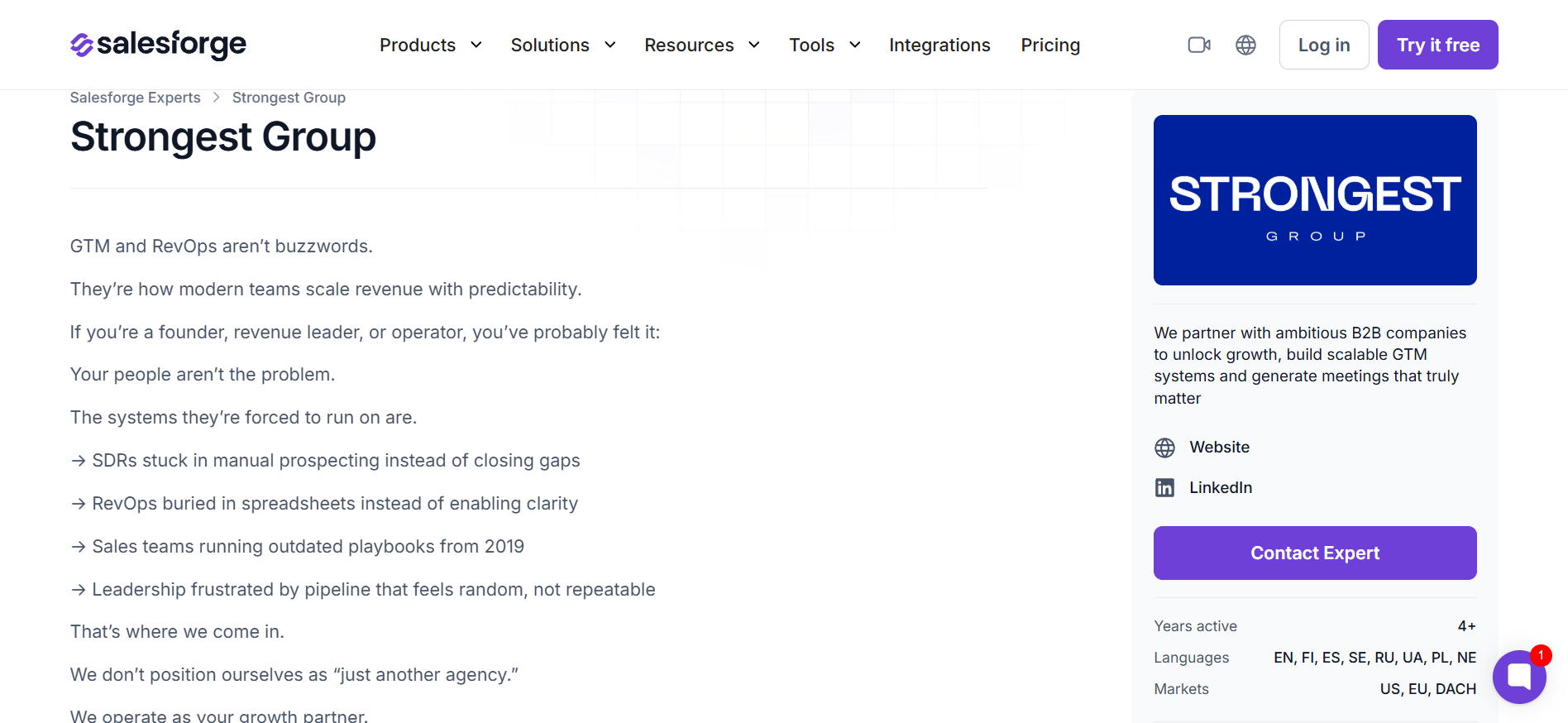
Strongest Group's positioning is "meetings that matter" and scalable GTM systems for ambitious B2B teams. That is the direct answer to the Workflows.io guarantee gap, where the closest published language is a client-selection filter rather than a meeting SLA. If you want the meeting outcome named upfront, Strongest Group publishes it.
Beyond agencies, two routes skip the outsourced model entirely.
The first is running outbound in-house with Salesforge at $48 per month. Unlimited mailboxes, unlimited LinkedIn senders, multichannel sequences, Primebox™ for unified reply management, and A/Z testing beyond A/B. The stack does the work Workflows.io would run for you, at the price of a single mailbox on their retainer.
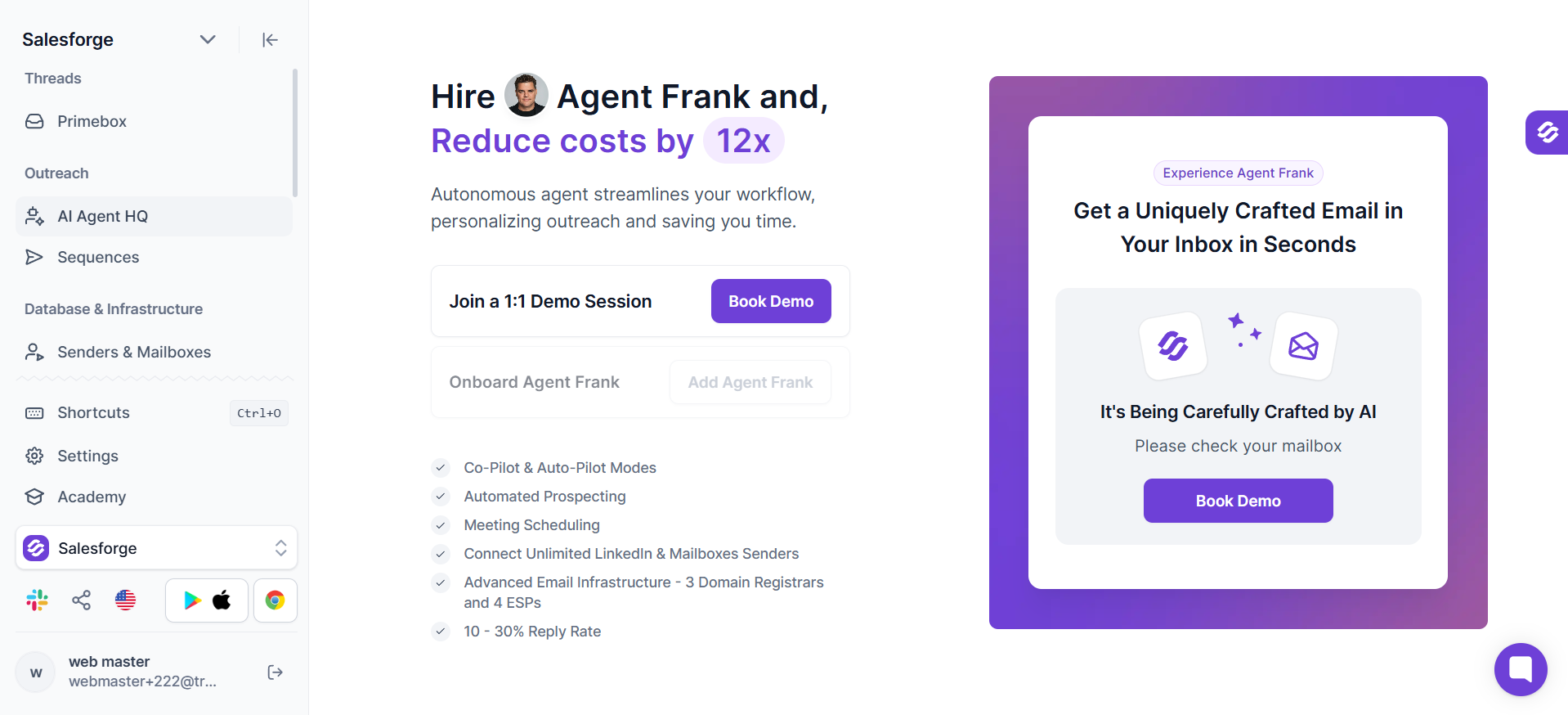
The second is Hiring Agent Frank, the AI SDR built into Salesforge. Agent Frank handles prospecting, sequencing, follow-up, and meeting booking autonomously. Pricing starts at $499 per month billed quarterly, includes a dedicated Account Manager, and gets a two-week Warmforge warmup before sending. If the appeal of Workflows.io is the AI-plus-human hybrid model, Agent Frank is the version you own instead of rent.
Whichever direction you are leaning, take these questions into your discovery call. Their answers will tell you more than any review, including this one.
Pulling it all together.
Hire Workflows.io if you are a B2B tech company between Seed and Series C, you want AI-augmented outbound and RevOps handled in the same engagement, and you can commit to a quarterly cadence and $5K per month floor. The pricing transparency, proprietary tool stack, and case study proof points make it a credible pick for that specific profile.
The caveats to nail down before signing are the missing formal guarantee, the absence of team information on the site, the undisclosed engagement spend in case studies, and the quarterly commitment lock. Get all four addressed in writing.
If you need a no-minimum outbound test, an outbound-only specialist, or an agency with published meeting-focused outcomes, compare certified alternatives in the Forge Expert Network that already publish those terms.
Yes. Workflows.io operates as Workflows Agency LLC, per its Terms of Use, and is co-founded by Fivos Aresti and Dan Rosenthal. The site publishes twenty named client logos including Apollo, Alibaba, Proton, and HeyReach, plus ten detailed case studies. No third-party review platform (Clutch, G2, Trustpilot, Sortlist, GoodFirms, DesignRush) has a listing for them as of February 2026, so buyer verification will rely on discovery-call references.
Pricing is published openly on each service page. LinkedIn Content, Automated Outbound, RevOps, and Enterprise all start at $4,000 to $5,000 per month with quarterly commitments. The ABM Program runs $6,000 to $12,000 per month across 4-month or 6-month engagements. There is no dedicated /pricing page (it returns a 404), so bands live inline on each service.
No formal guarantee is published on the site. The closest language is a client-selection filter, "We only take on clients where we're confident we can drive results," which is not the same as a meeting SLA or refund path. If a guarantee matters to your decision, ask for the exact criteria in writing before signing.
Two things. First, the tool stack: they lean on Claude Code, Claude AI, and an MCP framework across most workflows, alongside standard tools like Clay, Apollo, HubSpot, and HeyReach. Second, the cross-service structure: Content, Outbound, RevOps, ABM, and Enterprise all share equal prominence, which means most engagements pull from more than one lane.
Fivos Aresti is co-founder of Workflows.io alongside Dan Rosenthal. The site publishes their names and titles only, with no bios, backgrounds, or team pages. Buyer verification of founder credentials will require the discovery call or independent research.
Cleverly (full review here) is a lower-priced LinkedIn-first outreach agency at $397 to $997 per month with no quarterly lock. SalesHive (full review here) is a US-based full-service SDR agency with published meeting guarantees. Workflows.io sits between them: higher-touch than Cleverly, more service-diverse than SalesHive, but without SalesHive's published guarantee terms.
Three Certified Forge Experts address specific Workflows.io gaps: Fulcrum for no-minimum outbound execution, RevSculpt for boutique outbound-only specialization, and Strongest Group for meeting-focused outcomes with published GTM systems. If you would rather run outbound in-house, Salesforge at $48 per month or Agent Frank at $499 per month are the tool-based alternatives.
.jpg)

.png)