

Lemlist is a multichannel outreach platform that charges per user beyond its email-only plan. Klenty is a sales engagement platform built around the phone, with no LinkedIn automation product. Neither sells email infrastructure, and neither has an autonomous AI SDR.
For multichannel B2B outbound, Salesforge is the stronger choice. Email and LinkedIn run in one branching sequence, seats are not metered, premium warm-up is free, and replies land in Primebox™. Plans start at $48/mo monthly ($40/mo annual). An optional AI SDR (Agent Frank) is a separate subscription.
I get asked to referee this exact three-way choice a lot, usually by a founder with two or three people doing outbound and a budget that has to cover tooling and mailboxes.
Lemlist sells email, LinkedIn, SMS, WhatsApp and calling as one workflow, with data and intent signals sold as credits on top. Klenty is a sales engagement platform whose product story is the dialer: parallel dialing, call coaching, voicemail detection, all wired into a CRM. It runs its HQ in California and builds in Chennai.
The decision is rarely about features on a page. It is about what the bill looks like in month six when you add a second and third sender, and whether your outbound sales strategy survives that. That is where the three tools differ most.
Multichannel Outreach Comparison at a Glance: Lemlist vs Klenty
| Feature | Salesforge | Lemlist | Klenty |
|---|---|---|---|
| Outreach channels | Email + LinkedIn in one branching sequence (phone on roadmap) | Email, LinkedIn, SMS, in-app calling, WhatsApp as an add-on | Email, cold calling, SMS, LinkedIn "social selling" steps |
| Entry price | Salesforge Pro $48/mo monthly ($40/mo annual) | Lemlist Email plan $69/mo monthly ($55/mo annual) | Klenty Starter $50/mo billed annually ($60/mo quarterly) |
| Top self-serve plan | Salesforge Growth $96/mo monthly ($80/mo annual) | Lemlist Multichannel $109/user/mo monthly ($87/user/mo annual) | Klenty Plus $99/user/mo annually ($119/user/mo quarterly) |
| Per-seat billing | No. Unlimited users on Growth | Yes, on Multichannel and Enterprise | Yes, on Growth and Plus |
| LinkedIn senders | Unlimited on Growth (1 on Pro) | 5 senders per user on Multichannel | No LinkedIn automation product |
| Warm-up | Warmforge free and unlimited, premium-only pool, Heat Score™ monitoring | lemwarm included on all plans | No warm-up product; sending controls only |
| Email infrastructure sold | 3 options: Mailforge, Infraforge, Primeforge | In-app domain and mailbox purchase | None |
| Unified inbox | Primebox™ free, email + LinkedIn, sentiment analysis | Unified inbox on all plans | Rep360° view, no LinkedIn inbox |
| AI SDR | Agent Frank, separate subscription from $499/mo billed quarterly | lemAgent research and enrichment agents inside plans | Action AI and Agentic Cadences, no autonomous SDR |
| Security | SOC 2 compliant | SOC 2 certified | SOC 2 Type II certified, GDPR compliant |
| Free trial | 14 days, no credit card | 14 days on the Multichannel plan, no credit card | 14 days, capped at 200 emails |
| Best for | SMB and mid-market B2B, $5K-$100K ACV | Teams wanting one vendor across five channels | Call-heavy SDR teams inside a CRM-led motion |
Lemlist Overview: Features, Pricing, and Limitations
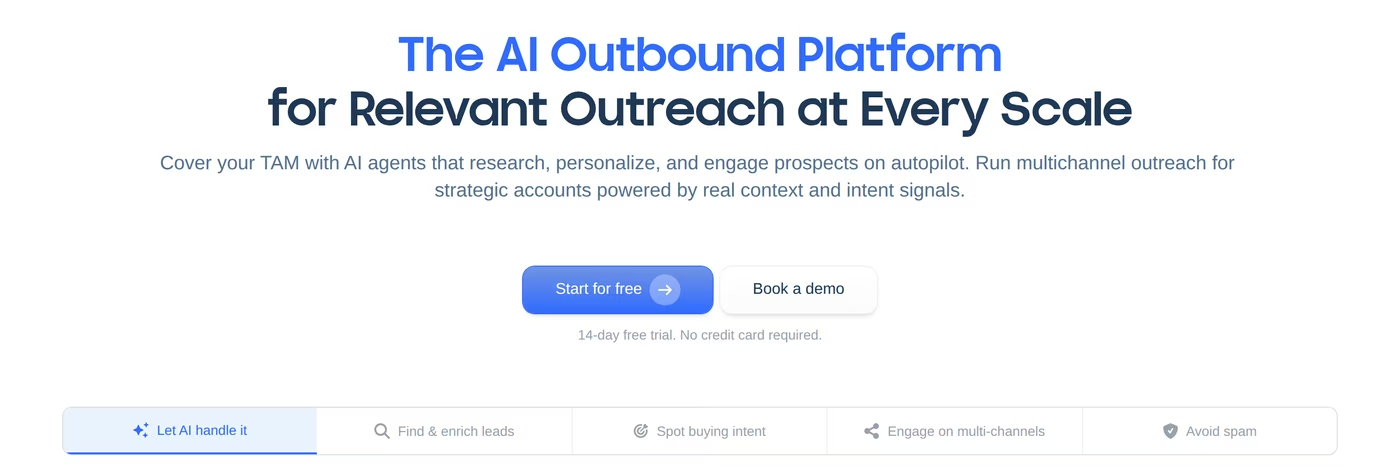
Lemlist is built by lempire and now sells itself as an AI outbound platform rather than a cold email tool.
Core features
- Multichannel sequences across email, LinkedIn, SMS, WhatsApp and in-app calling, with conditional next steps.
- 650M+ lead database with an email finder, phone number finder and verifier drawing on 25+ data providers.
- lemAgent plus intent signal agents, data enrichment agents and a URL-scraping agent.
- lemwarm and a Deliverability Hub with inbox rotation, rotating IPs, custom tracking domains and deliverability alerts.
- Unified inbox with AI reply intent detection and out-of-office detection.
- Chrome extension to work from LinkedIn, Gmail or a CRM.
- lemlist MCP and CLI plus an API, with HubSpot, Salesforce and Pipedrive integrations.
Lemlist pricing
Three tiers, with 20% off for annual billing and 10% off quarterly. The Email plan is $69/mo monthly or $55/mo annual, and it includes unlimited users and 50,000 emails a month.
Multichannel is where LinkedIn, SMS and calling appear, and the model changes: $109/user/mo monthly or $87/user/mo annual, with 5 senders per user. Enterprise is custom priced with 5 or more senders per user, SSO and a dedicated account manager.
Data is separate. Credits run at 1 credit per cent, so a verified email costs 5 credits and a phone number 20. A $10 top-up buys roughly 200 emails or 50 phone numbers. Intent signals are billed per signal, and LinkedIn engagement signals start at 400 credits each.
Who it is best for
Teams that want one vendor across five channels and are comfortable with usage-based data billing. If your outreach is email-only and you have several operators, the Email plan's unlimited-user structure is genuinely good value at $55/mo annual, because you are not paying per seat for a channel you do not use.
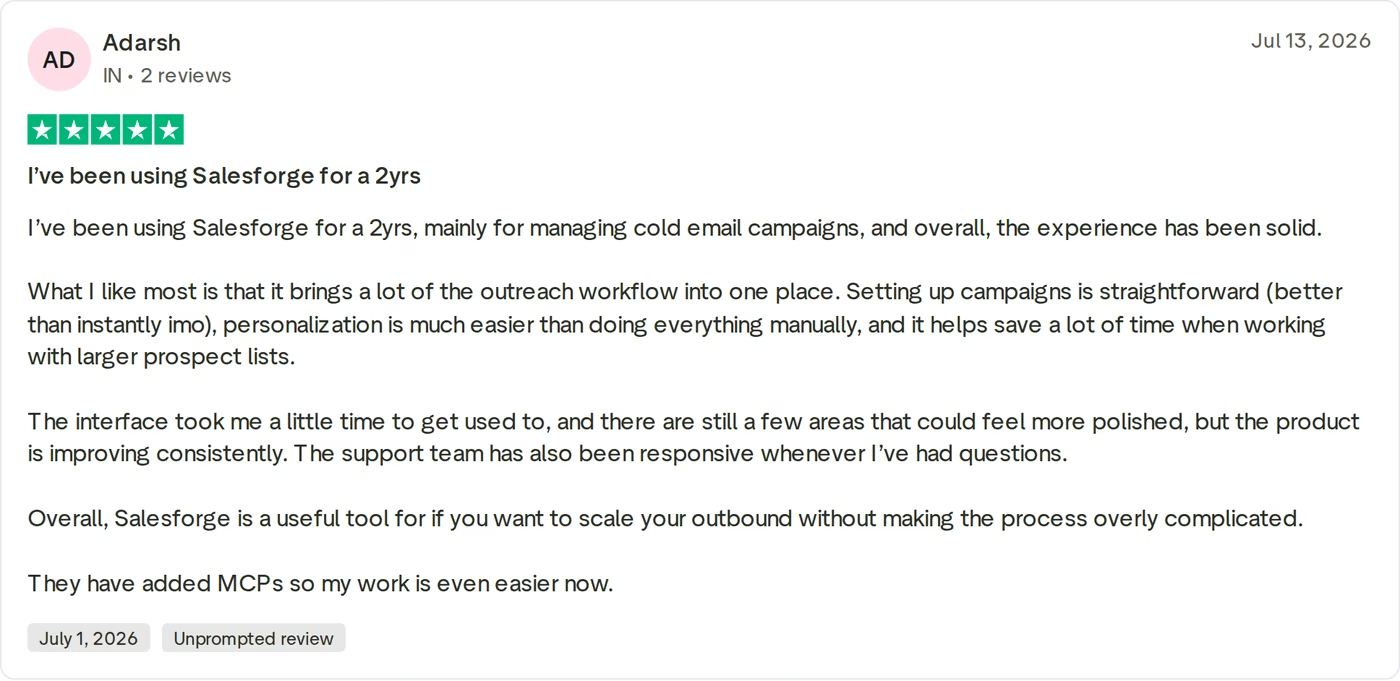
What reviewers say
Known limitations
- LinkedIn, SMS and calling are gated behind the per-user Multichannel plan, so a three-person team pays three times for the same channel access.
- Enrichment and intent signals are not included in the subscription. A campaign that needs 2,000 verified emails burns 10,000 credits, or $100 on top of the plan.
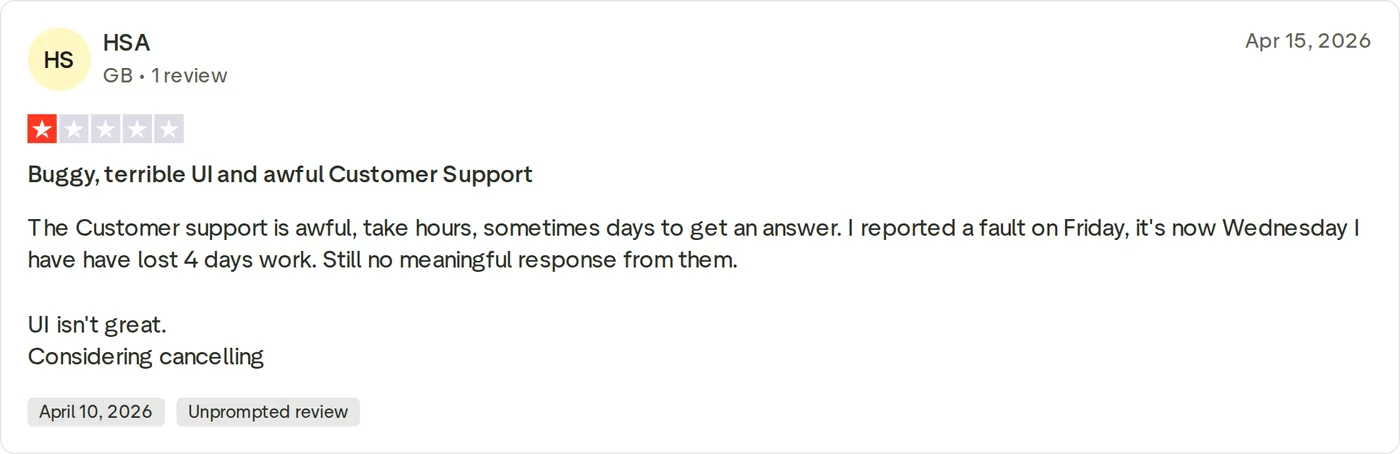
- Trustpilot carries 1-star reviews from February and April 2026 citing multi-day support waits and a broken feature the reviewer says was acknowledged but not owned.
- One February 2026 reviewer flagged currency handling, reporting that a plan advertised in dollars was billed at the same figure in pounds from the UK.
- lemwarm shares the platform's own pool rather than a separately curated premium pool. I went through how it actually works in this lemwarm review.
Klenty Overview: Features, Pricing, and Limitations
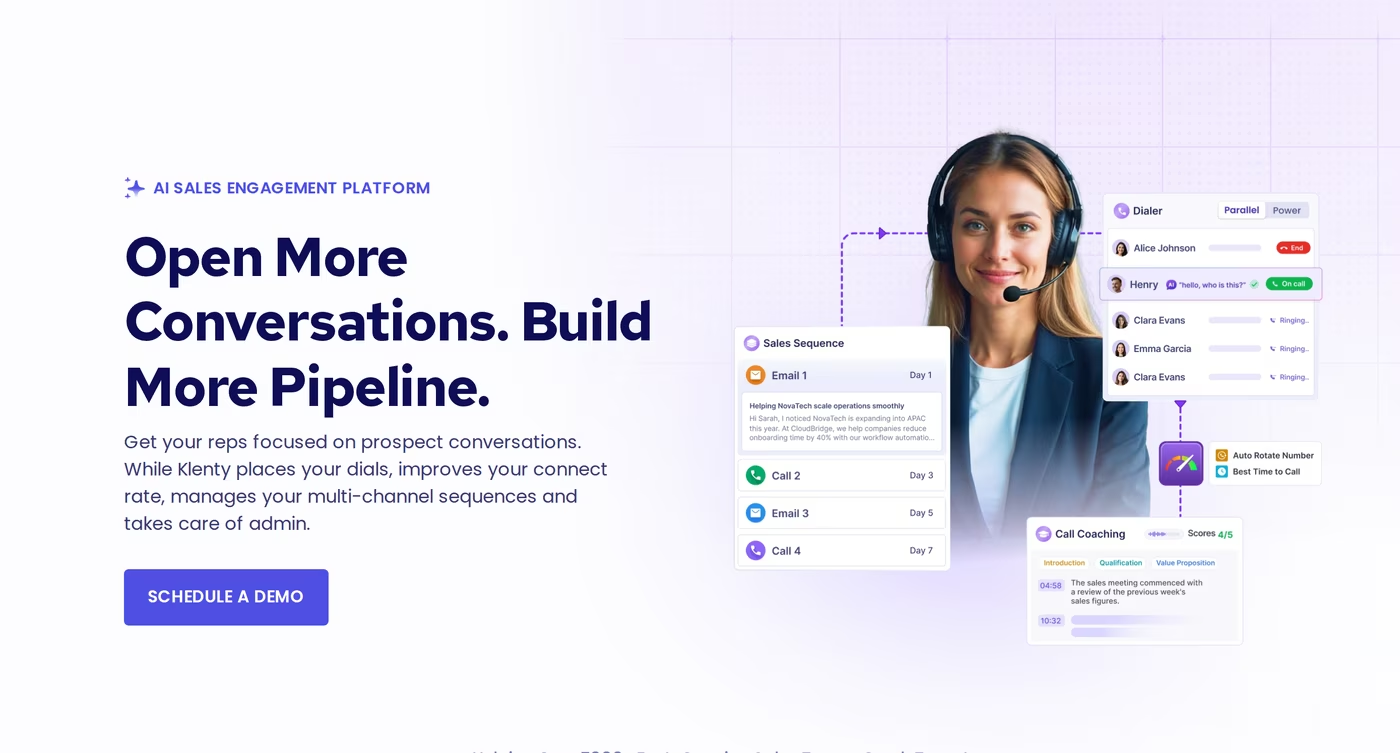
Klenty is a sales engagement platform aimed at SDR teams that live on the phone. Its homepage claims 5,000+ sales teams, and its own comparison pages benchmark it against Outreach, Salesloft, Apollo, Nooks and Orum, which tells you the category it thinks it is in.
Core features
- Dialer suite with parallel dialing, power dialing, Connect AI, AI voicemail detection and AI adaptive roleplays.
- Multichannel cadences across email, calls, SMS and LinkedIn social selling steps.
- Agentic Cadences that build a cadence per account, plus Action AI for next steps after a conversation.
- Account-based selling with account prioritization, stages, coverage and an account panel.
- Call coaching suite with live transcription, AI battlecards, objection detection and call scorecards.
- Native CRM integrations for Salesforce, HubSpot, Pipedrive, Zoho and Microsoft Dynamics, with sales stage automation.
- Email deliverability controls including custom domain tracking, random sending intervals and volume control.
Klenty pricing
Klenty publishes annual and quarterly rates with no monthly option. Starter is $50/mo billed annually or $60/mo quarterly, covering 15,000 contacts and 75,000 emails a month, and the page does not attach a per-user label to it.
Growth is explicitly per user at $70/user/mo annually or $85/user/mo quarterly, and adds calling with 200 minutes. Plus is $99/user/mo annually or $119/user/mo quarterly, with 1,000 minutes and 4,000 data credits. The Parallel and Power Dialer is a $45/user/mo add-on on top of that.
Who it is best for
Mature SDR teams whose primary motion is calling, who already run a CRM as the system of record, and who want coaching data on every call. For a team whose pipeline genuinely comes from the phone, the call coaching depth here is more developed than anything in this comparison, and that is a fair reason to pick it.
Known limitations
Klenty has almost no capturable review evidence on the platforms that allow it, so I am citing what is documented rather than showing a screenshot. Trustpilot holds only two Klenty reviews in total, and the single critical one is a 2024 complaint about the affiliate dashboard rather than the product. On Software Advice it averages 4.6 with no 1-star reviews, where the most critical entry is a March 2024 review saying onboarding support did not do much to get the reviewer settled.
- There is no LinkedIn automation product. "Social Selling" appears once on the pricing page as a Growth feature, and Klenty measures it as tasks a rep completes: its own Plauti case study reports "LinkedIn Activities Completed" and a 40% lift in LinkedIn execution. Automated connection requests, InMails and profile visits are not advertised anywhere on the site.
- No email warm-up product and no email infrastructure. You buy and warm mailboxes elsewhere, then plug them in.
- The 14-day trial is capped at 200 emails, and both Growth and Plus route to "Schedule a Demo" rather than self-serve checkout.
- Calling economics stack quickly: Plus at $99/user/mo plus the $45/user/mo dialer is $144/user/mo before any data credits.
Salesforge Overview: Multichannel Outreach on the Forge Stack
Salesforge is a cold outreach platform where email and LinkedIn are two channels inside one sequence, not two products bolted together. It went live in June 2023, built by a former VP of Sales tired of a fragmented stack.
Core features
- Conditional multichannel sequences. If a connection request is accepted, the LinkedIn message fires. If not, it falls back to email, in one sequence with real branching.
- Six native LinkedIn actions plus email steps: connection requests, messages, InMails, post likes, follows and withdraw requests.
- Unlimited mailboxes on every plan with smart mailbox rotation and dynamic IP rotation.
- Unlimited LinkedIn senders on Growth, alongside unlimited users and unlimited workspaces.
- AI personalization in 21+ languages, with Overdrive Mode pulling from every available source instead of one.
- Warmforge included free and unlimited, with a premium-by-default pool, Heat Score™ per mailbox and placement testing.
- Primebox™ unified inbox for email and LinkedIn replies, with AI sentiment analysis and three reply modes.
- Three infrastructure options under one login: Mailforge at $3 to $2 per mailbox, Infraforge at $4 to $3, and Primeforge at $4.50 to $3.50 for real Google Workspace and Microsoft 365 mailboxes.
- Leadsforge feeding 500M+ contacts straight into sequences with no CSV export step.
- Agent Frank, an autonomous AI SDR who prospects, writes, follows up, handles replies and books meetings in Auto-Pilot or Co-Pilot mode.
- Developer surfaces: an API on Growth, a unified Forge CLI, and an MCP server so Claude or Cursor can run campaigns.
- SOC 2 compliant, with native HubSpot, Salesforce, Pipedrive, Attio, folk, Breakcold and Clay integrations.
Salesforge is the outreach layer of the Forge Stack. Infrastructure sits underneath it in Mailforge, Infraforge and Primeforge, deliverability in Warmforge, lead data in Leadsforge, and autonomous execution in Agent Frank. Each is a separate subscription, but they sync natively with no Zapier in between, and you can move between infrastructure types without migrating platforms.
Salesforge pricing
Salesforge Pro is $48/mo billed monthly or $40/mo billed annually, covering 1,000 active contacts, 5,000 emails a month, 1 user and 1 LinkedIn sender. You can confirm both figures on the live pricing page.
Salesforge Growth is $96/mo billed monthly or $80/mo billed annually, covering 10,000 active contacts, 50,000 emails a month, unlimited users and unlimited LinkedIn senders. It adds A/B testing, multi-language sequences, ESP matching, the API, Primebox AI reply modes and the full integrations library.
Agent Frank is a separate subscription from $499/mo billed quarterly, or $416/mo billed annually, and includes 1,000 active contacts. He is not part of the Pro or Growth plan price.
Grab Your Free 14-Day TrialWho it is best for
Salesforge publishes its own fit criteria: B2B products with ACVs between $5K and $100K, buyers at startups, SMBs or mid-market companies, and a target list of 3,000 businesses or more. It also publishes who it is not for. If you primarily sell to Fortune 500 accounts through long RFP cycles with six- or seven-figure deal sizes, Salesforge says outright that it is a poor fit.
Honest limitations
- Email infrastructure is not included in any Salesforge plan. Connect your own mailboxes or buy Mailforge, Infraforge or Primeforge separately.
- Several features are gated to Growth: the API, A/B testing, ESP matching, Primebox AI reply modes and multi-language sequences.
- Pro is capped at 1 user and 1 LinkedIn sender, so solo operators fit but small teams need Growth.
- Agent Frank has no self-serve trial. He requires a demo first and a 2-week warm-up before he can start sending.
in Action
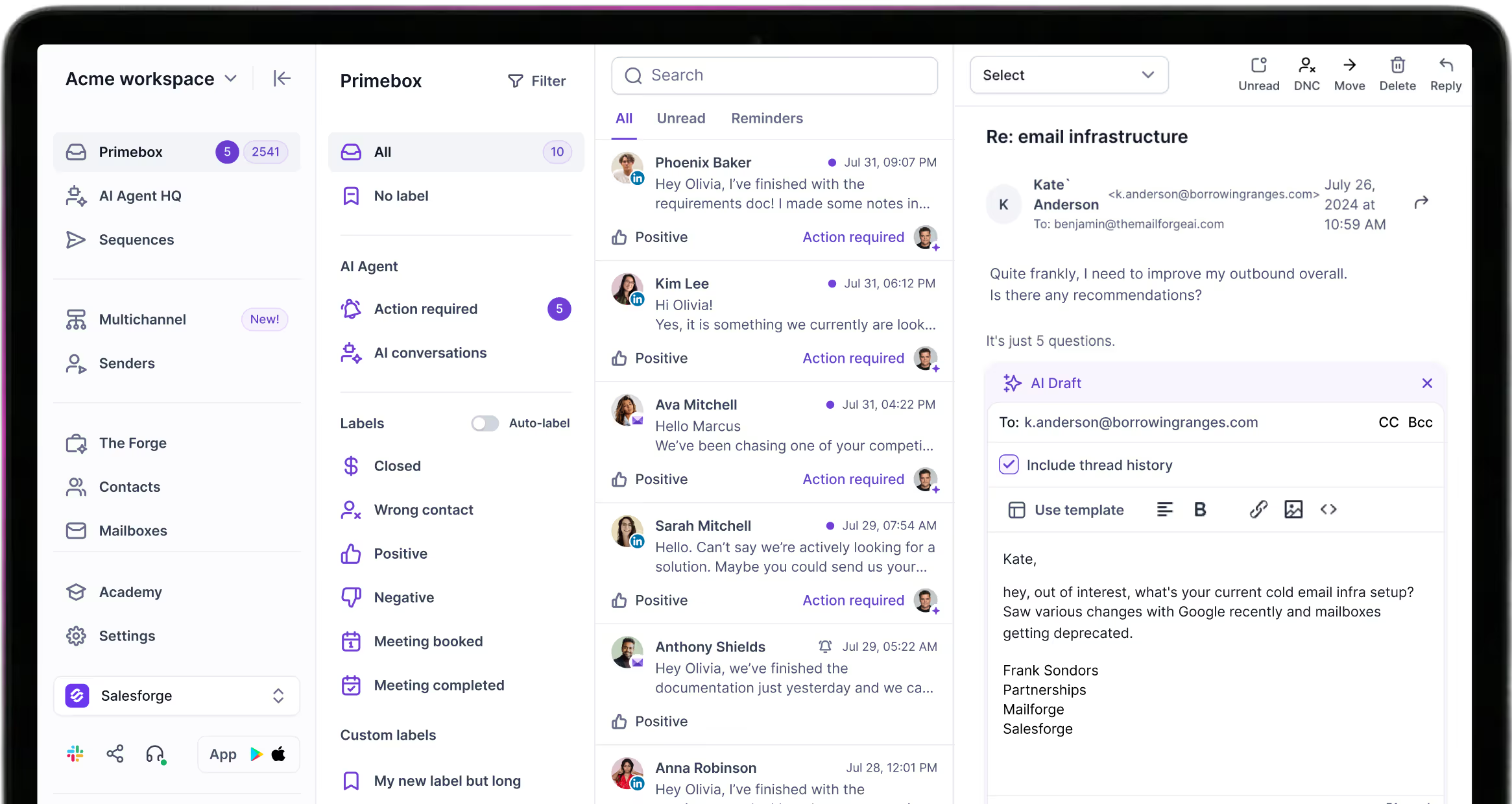
Head-to-Head Feature Comparison: Lemlist vs Klenty
Multichannel outreach
Lemlist covers the most channels on paper: email, LinkedIn, SMS, WhatsApp and calling. Klenty covers email, calls and SMS, with LinkedIn present only as social selling steps rather than automation.
Salesforge runs email and LinkedIn as one conditional sequence with six native LinkedIn actions, so a reply on LinkedIn pauses the email side automatically. The difference from Lemlist is not channel count, it is sender economics: Lemlist gives 5 senders per user on Multichannel, while Salesforge Growth gives unlimited LinkedIn senders without metering seats.
Email deliverability and warm-up
Klenty has nothing here beyond sending controls, which is the honest answer. Lemlist includes lemwarm on all plans plus a Deliverability Hub with rotating IPs and alerts.
Warmforge comes free and unlimited with every Salesforge subscription, and the pool is premium by default rather than premium if you pay more. It blends aged IMAP and SMTP accounts with real Google Workspace and Microsoft 365 mailboxes, runs multilingual warm-up traffic, and scores every mailbox with Heat Score™, where anything above 97 is healthy. Salesforge publishes the numbers it holds itself to: bounce rates under 1%, 30 to 50 cold emails per mailbox per day, and a minimum 2-week warm-up before launch. If you want the mechanics, start with email warm-up and inbox rotation.
AI and personalization
Lemlist's lemAgent researches accounts and drafts messages, and its intent signal agents are a real strength, though each signal is billed in credits. Klenty's AI is aimed at calls: voicemail detection, objection detection, scorecards, plus Action AI for post-conversation next steps.
Salesforge personalizes in 21+ languages, and Overdrive Mode pulls from every source about a prospect rather than one, at 2 credits per preview instead of 1. Neither competitor has an autonomous AI SDR. Agent Frank runs the whole motion end to end, is modeled on top performers in your industry, and comes with a dedicated account manager and a shared Slack channel. I compared the economics of that trade in AI SDR vs SDR.
Inbox management and reply handling
Lemlist has a unified inbox on every plan with reply intent and out-of-office detection. Klenty gives reps a Rep360° view and conversation tracking, but there is no LinkedIn inbox because there is no LinkedIn automation.
Primebox™ is free with every Salesforge subscription and unifies email and LinkedIn replies in one view. It catches replies sent from an address you never contacted, auto-tags sentiment as positive, neutral or negative, and runs on mobile. AI-drafted replies cost 3 credits each and need the Growth plan.
Pricing and scalability
This is the axis that decides most of these deals. Lemlist's Email plan has unlimited users, which is a real advantage for email-only teams, but the moment you want LinkedIn you move to $87/user/mo annual. Klenty is per user from Growth upward, and the dialer add-on is per user again.
Salesforge Growth is $80/mo annual for unlimited users, unlimited LinkedIn senders and unlimited mailboxes. Adding a fourth or fifth operator changes the bill by nothing.
Infrastructure and the wider stack
Neither Lemlist nor Klenty sells dedicated email infrastructure. Lemlist lets you buy domains and mailboxes in-app, which is convenient but not the same as choosing between shared IPs, dedicated IPs and real Workspace mailboxes. Klenty sells none.
Salesforge gives three infrastructure products under one login, and Salesforge itself recommends running two or more so a single burned setup cannot take your outbound down. Woodpecker scaled to 2,500+ mailboxes on Infraforge. For how to pick, I wrote up cold email infrastructure options.
Lead data and prospecting
Lemlist bundles a 650M+ contact database into every plan, which is the largest database included in a base subscription here. Enrichment is billed on top: 5 credits per verified email and 20 per phone number, at a cent per credit. Klenty includes 4,000 phone and email credits, but only on Plus at $99/user/mo.
Salesforge keeps lead data in Leadsforge, a separate subscription from $49/mo covering 500M+ contacts, with waterfall enrichment across 10+ providers and chat-based ICP search. Lists push straight into sequences with no CSV export step. Lemlist includes more contacts in the base price; Salesforge charges for data separately and does not meter enrichment inside the outreach plan.
Agencies and multi-client work
Lemlist supports guest users, shared campaigns and custom user roles on its Enterprise tier. Klenty sells per user from Growth upward, so an agency adding client teams pays per seat as it grows.
Salesforge includes unlimited workspaces on every plan, so each client gets its own sequences and reporting under one login. It also publishes a white-label program with a 20% revenue share, and Infraforge can put each account on dedicated IPs with isolated infrastructure. For an agency, that isolation keeps one client's complaint rate away from another client's sender reputation.
Integrations, compliance and delivery model
All three integrate with the major CRMs, and all three are SOC 2. Klenty specifies Type II certification and GDPR compliance, Lemlist states on its site that it is SOC 2 certified, and Salesforge is SOC 2 compliant across the whole stack. Compliance is not a differentiator here.
One structural difference: Salesforge can be run three ways. Your own team operates it, Agent Frank operates it, or a vetted Forge Expert agency operates it on the same platform. Neither competitor offers that.
Pricing Comparison: What Each Platform Costs at Scale
| Plan | Salesforge | Lemlist | Klenty |
|---|---|---|---|
| Entry tier | Salesforge Pro: $48/mo monthly, $40/mo annual | Lemlist Email plan: $69/mo monthly, $55/mo annual | Klenty Starter: $60/mo quarterly, $50/mo annual |
| Mid tier | Salesforge Growth: $96/mo monthly, $80/mo annual | Lemlist Multichannel: $109/user/mo monthly, $87/user/mo annual | Klenty Growth: $85/user/mo quarterly, $70/user/mo annual |
| Top tier | Growth is the top self-serve plan | Lemlist Enterprise: custom | Klenty Plus: $119/user/mo quarterly, $99/user/mo annual |
| Users included | Unlimited on Growth, 1 on Pro | Unlimited on Email plan, per user above it | Per user on Growth and Plus |
| Add-ons | Infrastructure from $2/mailbox; Leadsforge from $49/mo | Credits for data and intent signals; WhatsApp | Parallel and Power Dialer: $45/user/mo |
| AI SDR | Agent Frank: $499/mo billed quarterly, $416/mo annual | Not offered | Not offered |
| Annual discount | 2 months free | 20% off, or 10% quarterly | Up to 20% off vs quarterly |
The headline numbers look close. They stop being close as soon as you add people or channels, because only one of the three stops charging by the seat.
A concrete scenario
Take a three-person outbound team running email and LinkedIn to about 20,000 emails a month from 20 mailboxes, billed annually.
- Salesforge: Growth at $80/mo covers all three users, unlimited LinkedIn senders, 50,000 emails and free Warmforge. Add 20 Mailforge mailboxes at $2 to $3 each and you land around $120 to $140/mo all in.
- Lemlist: LinkedIn needs Multichannel, so $87/user/mo across three users is $261/mo, before enrichment credits and before mailboxes.
- Klenty: it cannot run this scenario, because there is no LinkedIn automation. Growth at $70/user/mo would be $210/mo for the email and calling side alone, with warm-up bought from another vendor. Drop LinkedIn entirely and Klenty Starter is the cheapest option here at $50/mo, and its page does not label that tier per user.
That is roughly $120 to $140 against $261 and $210, for more LinkedIn capacity and warm-up included. The gap widens with every operator you add.
Who Should Use Which Outreach Tool
You might consider Lemlist if:
- Your outreach is email-only and several people need access, where the Email plan's unlimited users at $55/mo annual is a genuinely efficient structure.
- You want WhatsApp and SMS in the same sequence as email, which Salesforge does not offer.
- You want intent signals and enrichment from the same vendor and are comfortable with credit-based billing.
You might consider Klenty if:
- Your pipeline comes primarily from the phone and you want parallel dialing with call coaching, transcription and scorecards, which is deeper than anything else here.
- Your team works inside Salesforce, HubSpot or Dynamics as the system of record and wants cadences driven from CRM stages.
Choose Salesforge if:
- You sell B2B with ACVs between $5K and $100K to startups, SMBs or mid-market buyers, and your target list runs past 3,000 businesses.
- You need email and LinkedIn in one branching sequence with unlimited LinkedIn senders rather than 5 per seat.
- You are adding operators and refuse to pay per seat to do it.
- You run an agency and need per-client workspaces, isolated infrastructure and white-label options.
- You want the option to hand the motion to an AI SDR without changing platforms.
Final Verdict: Which Multichannel Outreach Platform to Choose
Lemlist and Klenty are both strong in a specific area. Lemlist has the widest channel spread and the better structure for an email-only team with several users. Klenty is the stronger tool for phone-led teams. Neither sells email infrastructure, neither has an autonomous AI SDR, and both charge per seat past their entry plan.
For multichannel B2B outbound that scales past one or two operators, Salesforge is the stronger choice. At $80/mo for Growth billed annually, or $96/mo monthly, you get unlimited users, unlimited LinkedIn senders, unlimited mailboxes, free unlimited Warmforge warm-up and Primebox™. No combination of Lemlist or Klenty plans matches that at any price.
One falsifiable benchmark: UniteSync ran Salesforge with Mailforge and Warmforge to an 85.26% positive reply rate and a $2.86 customer acquisition cost. ChannelCrawler hit 85.71% positive replies on Salesforge with Infraforge and Warmforge, and VAI Consulting booked 3 calls in a single week with Agent Frank. All three case studies are public.

Still weighing it up? The Lemlist comparison and Klenty comparison go deeper, the comparisons index covers the rest, and 20+ free outreach tools let you test deliverability first.
Frequently Asked Questions
Is Salesforge better than Lemlist and Klenty?
For multichannel B2B outbound at more than one seat, yes. Salesforge Growth is $80/mo annual for unlimited users, unlimited LinkedIn senders and unlimited mailboxes, while Lemlist Multichannel is $87 per user per month annual and Klenty Growth is $70 per user per month annual. Salesforge also includes free unlimited Warmforge warm-up and sells three email infrastructure products, which neither competitor does. For phone-led teams, Klenty's call coaching is more developed.
What is the main difference between Salesforge, Lemlist and Klenty?
Pricing structure and channel depth. Salesforge does not meter seats and treats email plus LinkedIn as one branching sequence with six native LinkedIn actions. Lemlist covers five channels but charges per user for anything beyond email. Klenty is built around the dialer, with call coaching and parallel dialing, and has no LinkedIn automation product at all.
Which is cheaper: Salesforge, Lemlist, or Klenty?
Salesforge Pro is the cheapest entry point at $48/mo monthly or $40/mo annual, against Lemlist's Email plan at $69/mo monthly or $55/mo annual, and Klenty Starter at $50/mo billed annually. At three users running email and LinkedIn, Salesforge Growth is $80/mo annual in total, while Lemlist is about $261/mo and Klenty about $210/mo, because both bill per user.
Does Klenty support LinkedIn outreach?
Not as automation. Klenty lists "Social Selling" as a Growth-plan feature and tracks it as rep-completed tasks, which is how its Plauti case study reports "LinkedIn Activities Completed". Automated connection requests, InMails and profile visits are not advertised on its site. Salesforge runs six native LinkedIn actions inside sequences, with unlimited LinkedIn senders on Growth.
Do Lemlist and Klenty include email warm-up?
Lemlist includes lemwarm on all plans plus a Deliverability Hub. Klenty has no warm-up product, only sending controls like random intervals and volume caps. Salesforge includes Warmforge free and unlimited on every plan, with a premium-by-default pool of aged IMAP, Google Workspace and Microsoft 365 mailboxes, and a Heat Score™ per mailbox where 97+ is healthy.
Can I switch from Lemlist or Klenty to Salesforge easily?
Yes. Contacts import by CSV or a Google Sheets connection, and unlimited mailboxes connect on any plan through Google Workspace, Microsoft 365 or custom SMTP. Salesforge recommends a 2-week warm-up on new mailboxes before launching, handled free by Warmforge. Keep your old sequences running until the new mailboxes clear a Heat Score above 97.
Does Salesforge offer a free trial?
Yes, 14 days with no credit card required. The trial covers 50 contacts, 100 emails, 50 email validation credits, 50 personalization credits and 100 social action credits, with warm-up and unlimited mailbox connections active. Agent Frank is the exception: he needs a demo first and a 2-week warm-up, so there is no self-serve trial for him.
Who is Lemlist best for?
Teams that want one vendor across email, LinkedIn, SMS, WhatsApp and calling, and email-only teams with several operators, since the Email plan includes unlimited users at $55/mo annual. Budget for data separately: verified emails cost 5 credits each and phone numbers 20, at 1 cent per credit, so 2,000 verified emails is about $100 on top of the plan.

.jpg)
.jpg)
