I spent most of this year rebuilding outbound motions for teams who were doing everything the old playbook asked of them. More mailboxes. More touches. Another channel bolted on the side. Reply rates kept sliding anyway.
An outbound sales strategy only earns a reply now if the person opening it can tell, in about two seconds, that it was meant for them and not for four thousand people who share their job title. That reads like a soft point until you watch where it bites: which accounts you pick, and whether your mail reaches the primary tab at all.
What follows is the version I run end to end: targeting, sourcing, sending setup, copy, sequencing, and the four numbers I check on Monday. Parts of it will feel obvious. The parts teams skip are almost always the boring ones.
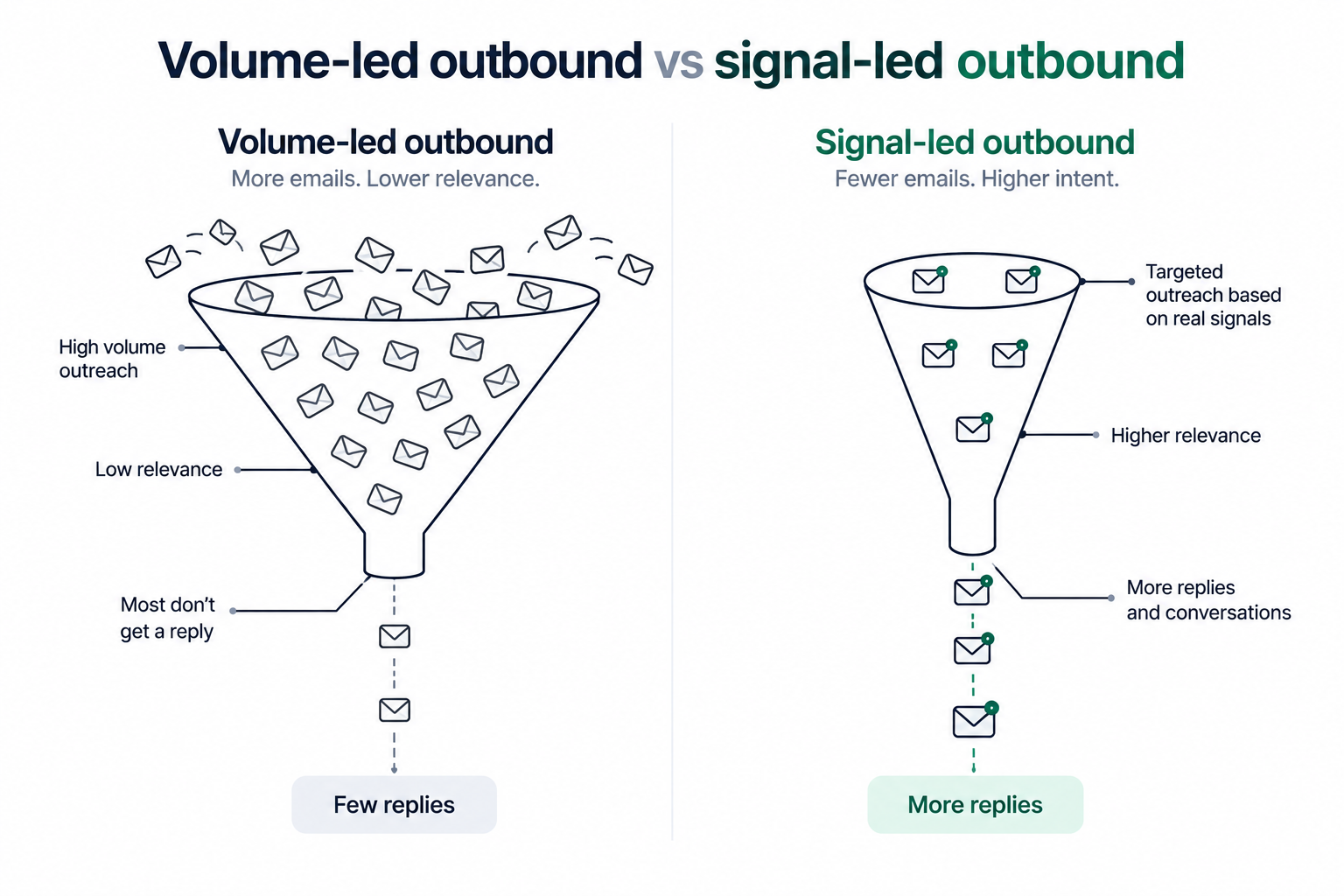
Outbound still produces pipeline in 2026, but the shape of a winning motion changed. Sending volume got cheap, so it stopped being an advantage. What separates teams booking meetings from teams burning domains is signal-led targeting, sending infrastructure that was warmed before campaign day, and one sequence that runs email and LinkedIn together instead of two campaigns stitched by hand. I run mine on multichannel outreach inside Salesforge, with Leadsforge for sourcing and Warmforge handling deliverability underneath.
The definition has not moved in fifteen years. The bar for getting a reply has moved a lot.
Outbound sales is the motion where the seller starts the conversation. You choose the account, you find the person, you reach out before they have raised a hand. Inbound runs the other way. Someone reads something, searches something, books a demo, and shows up with intent already formed.
The mechanics of who goes first have not changed since Predictable Revenue put a name to the model. The cost of entry has collapsed, though. Anyone can provision fifty mailboxes and a five-step sequence before lunch, which means the buyer you want already receives the output of a hundred teams who did exactly that last quarter.
So the useful question for an outbound sales strategy in 2026 is not which channel or how many touches. It is narrower. What do I know about this account that makes contacting them this week reasonable, and can I show that in two sentences?
Three roles usually carry the motion, though the titles blur by company:
Plenty of teams collapse all three into one founder with a laptop, and that arrangement holds up longer than most people expect. I have seen solo founders out-book four-person SDR pods purely because they knew the market well enough to write a first line nobody else could write.
Outbound compared with inbound, in practice:
Most serious B2B teams run both. Outbound is the half you can point at a specific list of accounts and turn on next Tuesday.
The bottleneck moved up a layer, and a lot of teams are still optimizing the layer that already got solved.
For roughly 5 years, the advice was consistent: send more, add a channel, buy more domains, warm them properly, test more subject lines. That advice was correct while execution was genuinely hard. Deliverability was a mess, sequencing tools were immature, and running email plus LinkedIn together was a real competitive edge.
Execution is no longer the hard part. Published benchmark analyses that pool tens of millions of cold emails put the 2026 average reply rate somewhere between3-4%, and the campaigns clearing double digits are not the ones sending the most. In the data I trust most, list size runs inversely against reply rate: tight lists under a couple of hundred contacts routinely clear 15%, while lists past a thousand settle into single digits.
Inbox providers tightened the screws in the same period. Google and Microsoft both publish bulk sender requirements now, including a spam complaint ceiling of 0.3%, which is roughly three complaints in a thousand. Hit it consistently, and you do not get a warning email; you get quietly filtered.
Underneath the benchmarks, the same five failure modes turn up in nearly every audit I run:
Each of these is survivable alone. Stacked, they produce the situation I keep getting called into: a team sending forty thousand emails a month, booking six meetings, and asking whether they should add another channel.
Targeting, sourcing, infrastructure, message, sequencing. Run them in that order, because skipping one quietly poisons the next.
Every weak outbound motion I have reviewed had a target market that was technically defensible and practically useless. "Series A to C SaaS companies in North America with 50 to 500 employees" is a filter, not a market.
The test I use is whether the ICP can be said out loud as a sentence with a problem in it. "Revenue leaders at logistics software companies who just hired their second SDR and have nobody owning deliverability" is a market. It sounds too small. It is not, and the first line practically writes itself.
Narrow also protects your domains. A tight list means fewer sends, fewer complaints, and a higher percentage of people who think the message was fair enough to ignore politely rather than mark as spam.
This is the part of the strategy that changed most in the last eighteen months, and it is where I now spend the majority of setup time.
A static list tells you who a company is. A signal tells you what just happened to them. Those are different inputs, and only one of them gives you a defensible reason to write this week. I build lists in Leadsforge, which sits on a 500M+ B2B contact database and takes a plain-English description of the ICP instead of stacked boolean filters. The chat-based approach matters less for novelty than for speed: I can rewrite a target definition in a sentence and see the count move.
The Signals sourcing path is the piece I use most. Rather than starting from ICP criteria, I start from an event and work back to people:
For company-level signals, Leadsforge matches the company against its lead database and surfaces the relevant employees, so I am not stuck with a company list and no contacts. Every extracted record carries evidence in the details view explaining why it matched, which is the part I did not expect to care about and now check constantly. When a rep asks why a lead is in the list, there is an answer on screen instead of a shrug.
Waterfall enrichment runs across multiple providers in sequence to fill in emails and phone numbers, so coverage on a signal list holds up rather than collapsing to 40%. Company Lookalikes and Competitor Followers Search cover the other two sourcing jobs: accounts shaped like your closed-won set, and the audience already paying attention to a competitor.
Copy gets the credit and infrastructure decides the outcome. I have watched a genuinely good campaign return nothing because it launched from mailboxes bought four days earlier.
There are three sensible shapes for email infrastructure, and the right one depends on volume and budget rather than taste. Shared infrastructure through Mailforge is where I start most teams, because bulk domain and mailbox creation with automated SPF, DKIM and DMARC takes minutes and there is no server to maintain. Infraforge is the move when volume justifies dedicated IPs and reputation you fully control, with pre-warmed mailboxes available if waiting two to four weeks is not an option. Primeforge covers real Google Workspace and Microsoft 365 mailboxes, which is what you want when ESP matching is the goal: sending Google to Google and Microsoft to Microsoft measurably helps primary placement.
The detail worth stealing is diversification. The strongest senders I work with run two providers at once so there is always a matching mailbox for the recipient's inbox provider. All three products sit under one Salesforge login, so moving between them is a settings change rather than a migration project.
Warmup is not optional and should not be a separate invoice. Every mailbox connected to Salesforge gets warmed through Warmforge at no extra cost, with unlimited slots on both plans. One-click AI warmup generates conversation-shaped activity across multiple languages. Heat Score™ tells me when a mailbox is safe to scale. Inbox placement tests show where mail is actually landing before a campaign goes live, and health checks watch DNS, MX and blacklist status in the background.
The sending side has its own set of guardrails. Bounce Shield blocks addresses likely to bounce before they damage reputation. Built-in email validation runs on every contact. Sender rotation spreads volume so no single mailbox absorbs it all, and messages ship text-only by default, without tracking pixels or heavy HTML.
My rule for first drafts: write the email you would send if this were the only account you were allowed to contact all week. Then work out which parts of it can be produced at volume.
Usually the structure survives, and the specifics get automated. AI personalization in Salesforge pulls prospect-specific detail into the message: company news, LinkedIn activity, industry context, with native support across 21+ languages so regional campaigns do not need a separate copywriter per market. That last part is more valuable than it sounds if you sell into Germany and France from a team that writes in English.
What AI does not fix is a message with nothing to say. If the signal is weak, personalization just dresses up an irrelevant email in local clothing.
The multichannel mistake I see constantly is two parallel campaigns, one for email and one for LinkedIn, reconciled by hand in a spreadsheet on Fridays.
A sequence should branch on behaviour. In Salesforge, LinkedIn steps and email steps live in the same flow with real if/then logic: if the connection request is accepted, trigger a LinkedIn message; if it is not, fall back to email three days later. Six native LinkedIn actions are available inside that sequence, which are connection requests, messages, InMails, post likes, follows and withdraw requests. That range lets a sequence behave the way a competent SDR behaves, warming a profile and engaging before pitching rather than firing a connect and a pitch in the same hour.
Account safety is handled underneath rather than left to the operator. Actions route through high-quality shared proxies, with custom proxies available if you want them. Authentication is session-token only, so no LinkedIn password is stored anywhere. Each action type is capped at thirty per day per profile, and nothing injects scripts into the page through a browser extension. LinkedIn automation that ignores these details tends to work beautifully for six weeks and then cost somebody their account.
Replies from both channels land in Primebox™, which is the single inbox for the whole motion. Auto-Pilot handles routine replies end to end. Co-Pilot drafts the response and waits for a human to approve it, which is where most teams should start. Automated follow-ups run across both channels on the same branching logic, and A/B testing plus cross-channel analytics put open rate, reply rate, connection acceptance and meeting conversion on one dashboard instead of three.
Commercially, it is one subscription for both channels. Mailboxes and users are uncapped instead of sold per seat, which changes the maths once a team grows past three people. Open API access comes with the Growth plan. Native integrations cover CRMs like HubSpot, Salesforce, Pipedrive and Attio, data tools like Clay and RB2B, and automation through Slack, Zapier, Make and webhooks.
Every Forge product also exposes an MCP server, so Claude, Cursor or a custom agent can operate sequences and contacts directly. I did not expect to use that one weekly. I do.
Seven steps, in the order I actually do them when starting a motion from zero.
If you want to see this pattern running at scale in someone else's hands, the breakdown of how two agencies run programmatic outbound covers the same sequence with far more automation bolted on.
Four plays carry most of the pipeline I see built, and they work better together than separately.
Still the channel that returns the most per hour spent, and the one with the widest gap between good and bad execution. The teams doing well send less than they used to, from more mailboxes, to smaller lists, with a reason attached to every send. Cold email automation handles the mechanics, and if you would rather start from a structure than a blank page, the cold email templates library is a reasonable place to borrow shapes from before you make them your own.
Best used as a credibility layer, not a pitch channel. A profile view and a thoughtful comment two weeks before the email changes the frame from stranger to vaguely familiar name. Where it earns its keep is the branch: when email goes unanswered, a connection request often does not, and when a connection is accepted, a short message outperforms anything you could have sent by mail.
Written off annually, still working. Connect rates in the eight to twelve percent range are normal for a decent list, and the second-order effect matters more than the call itself: a dial noticeably lifts reply rates on the email that follows. The phone is also the only channel where you hear the objection in real time, which is worth an hour a day on its own.
The cheapest pipeline in the building, and the most consistently ignored. Referred prospects convert several times better than cold ones and close faster. Closed-lost deals from twelve to eighteen months ago are the second cheapest, particularly when the reason for the loss has since changed: a champion moved, a budget freed up, the competing tool got acquired. That last one is a signal you can source for directly.
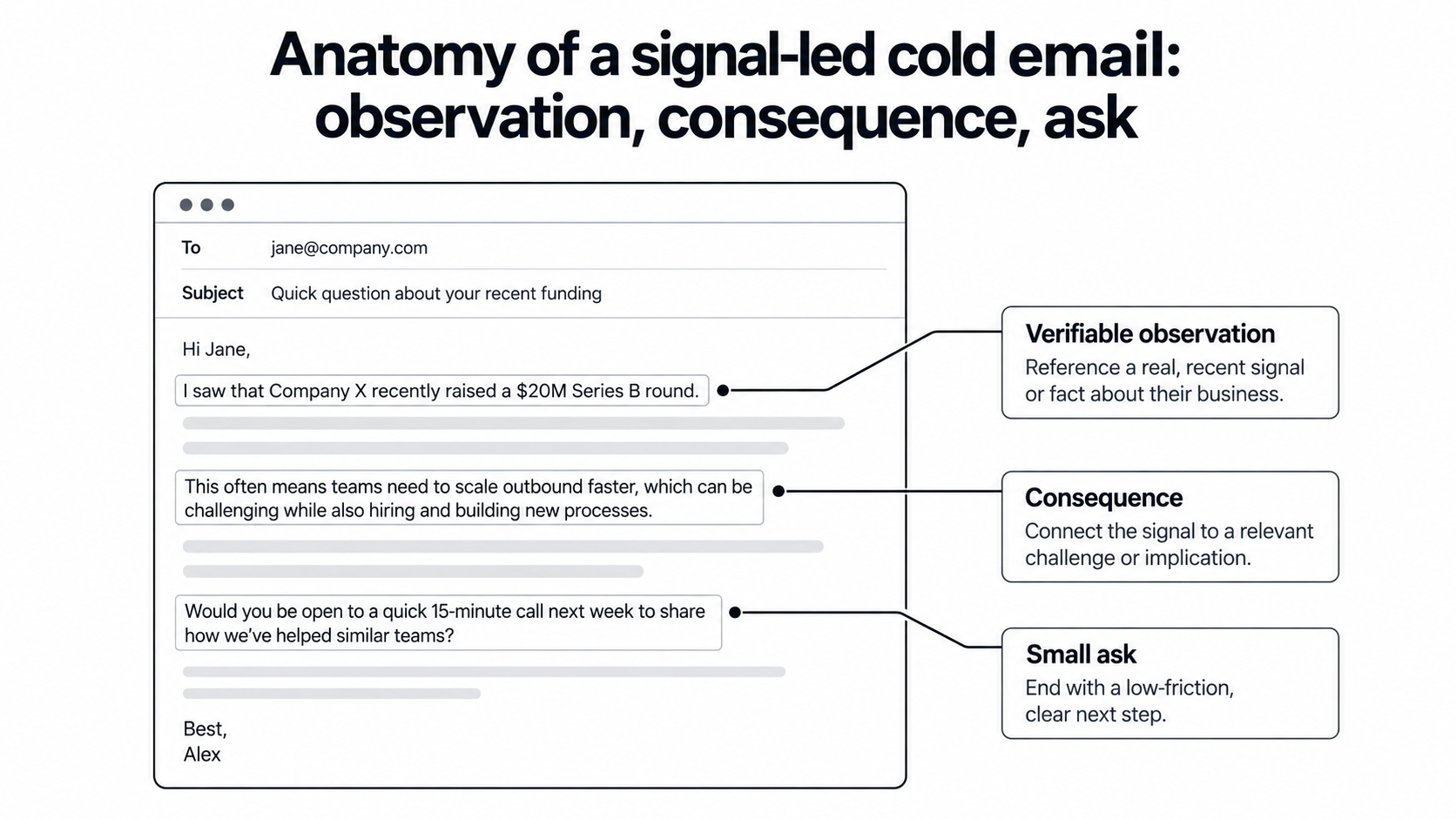
The difference between a deleted email and a replied-to email is usually three specific facts.
Saw you stepped into the VP Sales seat at Halden six weeks ago, and that the team has posted three SDR roles since. Teams hiring that fast usually hit a deliverability wall around the fourth mailbox, before anyone owns it. That is the problem I work on. Worth 15 minutes in the next fortnight?
The second one is not better because it is longer or more clever. It is better because it contains a role change, a hiring pattern, and a consequence that follows from both. The recipient can check every claim in ten seconds, which is exactly why it reads as real.
The LinkedIn variant is the same structure with the consequence cut, because the medium rewards brevity harder than email does. Two sentences, no link, no pitch deck.
Five layers have to work for outbound to produce anything, and most teams assemble them from five vendors who have never spoken to each other.
The comparison below is how I think about the choice. The left column is the job to be done, the middle is the setup I inherit most often, and the right is what I run now.
| Layer | What it has to do | Typical bolted-together setup | How I run it |
|---|---|---|---|
| Sourcing | Find accounts with a reason to buy this quarter | Static database plus manual research in a spreadsheet | Leadsforge with the Signals path, 500M+ contacts, waterfall enrichment, evidence on every match |
| Infrastructure | Deliver mail without burning the domain | Mailboxes from one provider, no second ESP, no diversification | Mailforge for shared, Infraforge for dedicated IPs, Primeforge for Google and Microsoft mailboxes, all under one login |
| Deliverability | Keep reputation healthy while volume climbs | Warmup as a separate per-slot subscription | Warmforge included free with unlimited slots, Heat Score™, placement tests, health checks |
| Outreach | Run email and LinkedIn as one motion | A cold email tool plus a LinkedIn tool, reconciled by hand | Salesforge sequences with conditional branching, six native LinkedIn actions, AI personalization across 21+ languages |
| Reply management | Never lose a positive reply | Shared inbox for email, LinkedIn checked separately | Primebox™ with Auto-Pilot and Co-Pilot modes across both channels |
| Execution | Get the work done without more headcount | Hire another SDR and hope ramp goes well | Team runs it, Agent Frank runs it, or a Forge Expert agency runs it |
That last row is the part I get asked about most. Agent Frank is an autonomous AI SDR rather than a writing assistant. He prospects continuously from the Leadsforge database, enriches contacts before outreach, writes email and LinkedIn messages, runs the sequence, handles follow-ups, manages replies through Primebox and books meetings on the calendar, around the clock. Auto-Pilot lets him send without approval. Co-Pilot keeps a human in the loop on replies, which is where I put every team for the first month.
I frame him as a teammate you hire for the volume work, not a replacement for the people closing deals. The three-way delivery model is genuinely unusual: the same product can be operated by your own team, by Agent Frank, or by a Forge Expert agency, and switching between those does not mean switching tools.
The thread running through all of it is that sourcing, infrastructure, warmup, outreach and reply management sit under one roof. Lists move from discovery into a sequence without a CSV export. Mailboxes provisioned in one product appear in the sending tool without a copy-paste step. That sounds like a convenience argument until you count how many outbound problems are actually integration problems wearing a disguise.
To be fair about the trade-off: if you already run a mature stack you are happy with, and your only gap is sending, a single-purpose tool will be cheaper, and you should buy that instead. The consolidation argument only pays when you are assembling three or more of these layers at once.
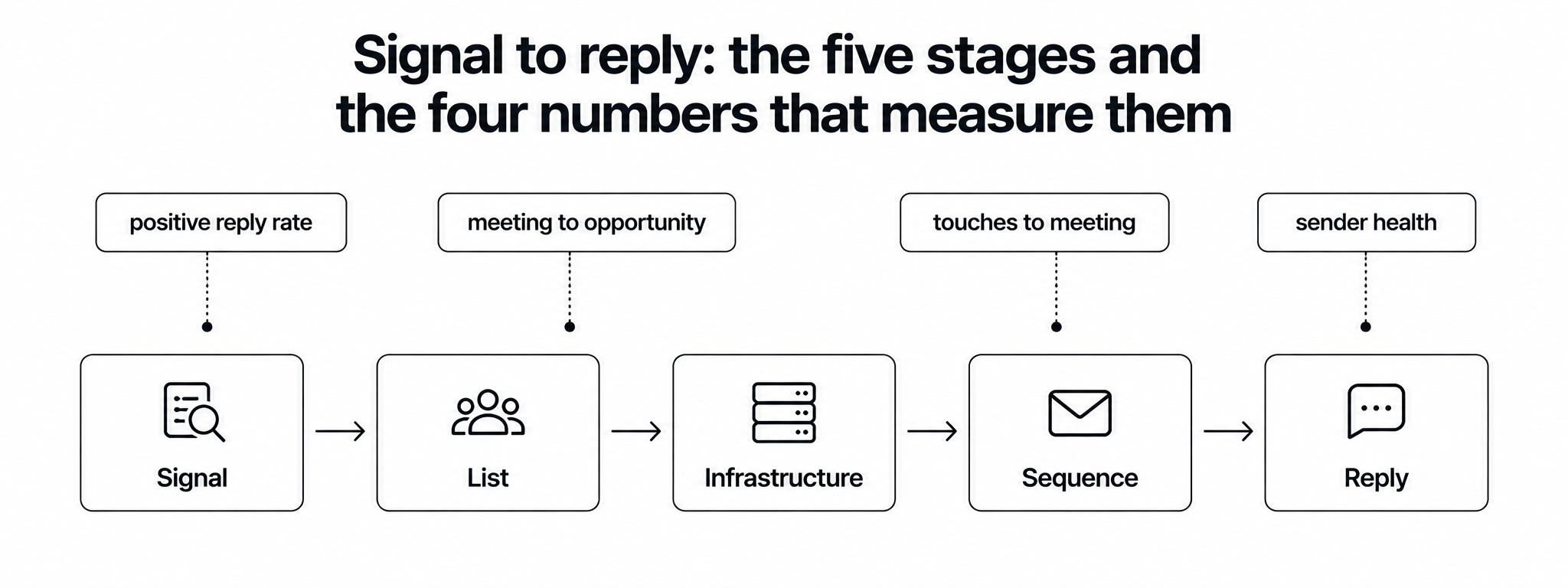
Four numbers, checked weekly, will tell you more than a dashboard with thirty.
Some numbers to steer by, not to obsess over. Three to 5% reply rate is healthy for cold outreach. Two to three meetings per hundred emails is what good looks like at small volume. Bounce rate should sit near 1% on a validated list.
Teams that move from volume-first to signal-first usually see replies improve inside two months while total send volume falls. That is the outcome worth aiming at. Less sending, healthier domains, more conversations.
Four habits that cost more than they return, in the order I would cut them.
Outbound is not dying. Careless outbound is, and it is taking a lot of domain reputations with it.
If I had to compress the strategy into one sentence, it would be this: pick a market narrow enough to be embarrassing, source from things that actually happened, get the sending setup right before writing a word, and run email and LinkedIn as one sequence instead of two. The teams doing that are sending less mail than they were two years ago and booking noticeably more meetings.
The tooling question follows from the strategy rather than leading it. If sourcing, infrastructure, warmup, outreach and reply management already work for you as separate products, keep them. If you are assembling that stack now, or spending Fridays reconciling it, running it under one roof removes a category of problem rather than adding a feature. That is the case for Salesforge, with Leadsforge feeding it, Warmforge underneath it, and Agent Frank available when the volume work outgrows the people doing it.
Start with the market definition. Everything downstream is cheaper to fix than that one.
An outbound sales strategy is the system a team uses to start conversations with buyers who have not raised a hand. It covers who you target, how you source those accounts, the infrastructure you send from, the message itself, the sequence across channels, and the metrics you judge it by. In 2026, the defining feature of a working strategy is that outreach is tied to a real buying signal rather than a static list.
Yes, but the quality bar moved. Average cold email reply rates sit between 3 and 4%, while well-targeted campaigns regularly clear double digits. The gap is targeting and timing, not effort. Teams sending fewer, better-aimed messages from healthy infrastructure are outperforming teams sending far more volume.
Outbound means the seller initiates contact through email, LinkedIn or the phone before the buyer has shown interest. Inbound means the buyer finds you through search, content or referral and initiates the conversation. Outbound gives you control over which accounts you pursue and faster feedback. Inbound compounds more slowly but costs less per lead once established. Most B2B teams run both.
Four to six touches across roughly three weeks works for most B2B motions, spread across email and LinkedIn. What matters more than the count is that each touch carries new information. Follow-ups generate a large share of positive replies, but only when they say something the previous message did not.
Buying signals are events that change a company's readiness to purchase: a funding round, an acquisition, a leadership hire, a hiring surge in a specific function, or a shift in tech stack. They differ from engagement signals like a post like or a page visit, which indicate curiosity rather than intent. In Leadsforge, Signals is a sourcing path that builds lists from job changes, funding, acquisitions and investor activity, with evidence attached to every match.
Source from signals so every contact already has a reason attached, then use AI personalization to turn that context into copy. Salesforge pulls prospect-specific details such as company news and LinkedIn activity into messages across 21+ languages. For teams that want the whole workflow handled, Agent Frank prospects, writes, sequences, follows up and books meetings on Auto-Pilot or Co-Pilot.
Positive reply rate split by signal type, meeting-to-opportunity conversion, touches to first meeting, and sender health measured through Heat Score and bounce rate. Volume metrics like emails sent tell you how busy a team is, not whether the strategy works.