RocketReach shows up in almost every search for contact data. It has 700 million profiles, a Chrome extension most SDRs have tried at some point, and a price that looks reasonable next to ZoomInfo.
Then you look at the ratings and get confused. G2 gives it 4.4 out of 5. Trustpilot gives it 1.2.
That gap is not normal, and it is the reason I spent a week inside the product and its review history. I wanted to know three things. Does the data actually land, what does the credit system really cost you, and why are so many people angry about billing?
So I worked through the plans, the credit documentation, the Chrome extension behaviour, and several hundred reviews across G2, Capterra, Trustpilot, and Reddit.
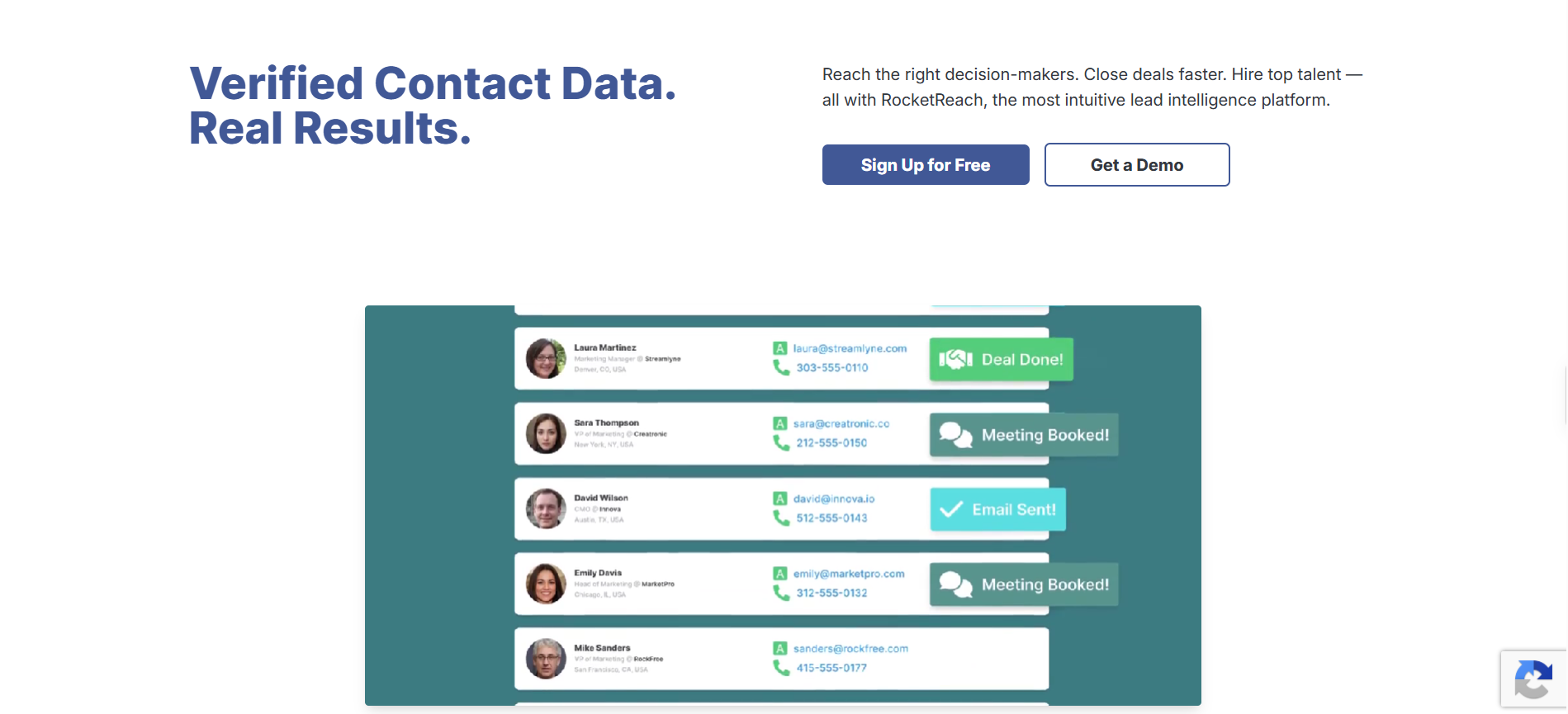
A contact data platform with 700M profiles and 60M companies, plus light email sending through Messages, Sequences, and Autopilot
Best for
Individual recruiters, founders and AEs who need occasional verified contacts rather than list building at volume
Starting price
$69/month on monthly billing, or $33/month billed annually on the Essentials plan
The credit catch
Annual plans give you unlimited lookups but cap exports. Monthly plans do the opposite. Most people find this out after paying
Ratings
G2 4.4, Capterra 4.1, Trustpilot 1.2
Biggest risk
Auto-renewal with no advance warning and a firm no-refund policy. This drives almost every one-star review
What Is RocketReach And Who Is It Built For
RocketReach calls itself a lead intelligence platform. In practice, it is a searchable contact database with an outreach layer bolted on top.
The database claim is 700 million profiles across 60 million companies. The API product goes further at 4.5 billion records. They also claim 125 million phone numbers and coverage across 254 countries.
The audience is wider than most lead prospecting tools you will compare it against. Sales, recruiting, PR and marketing all get addressed in the homepage copy. That breadth shows up in the product, and not always in a good way.
RocketReach has also moved past pure data. There is now Messages for sending email, Sequences for follow-ups, and Autopilot for automated prospect list building.
I will get to how well those work later. The short version is that they exist, and they are not why anyone buys this tool.
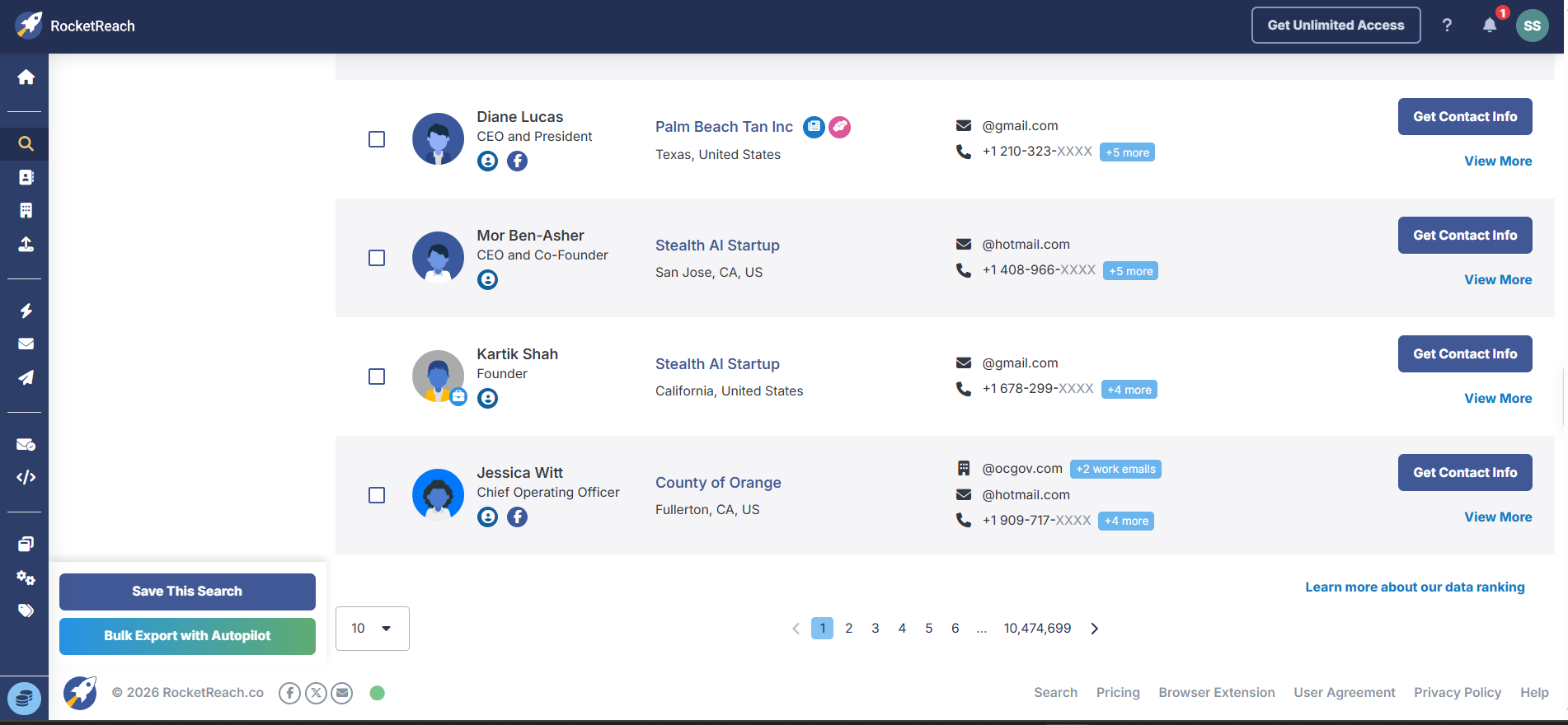
How RocketReach Works From Search To Export
That is the overview. Now here is what actually happens when you sit down and use it.
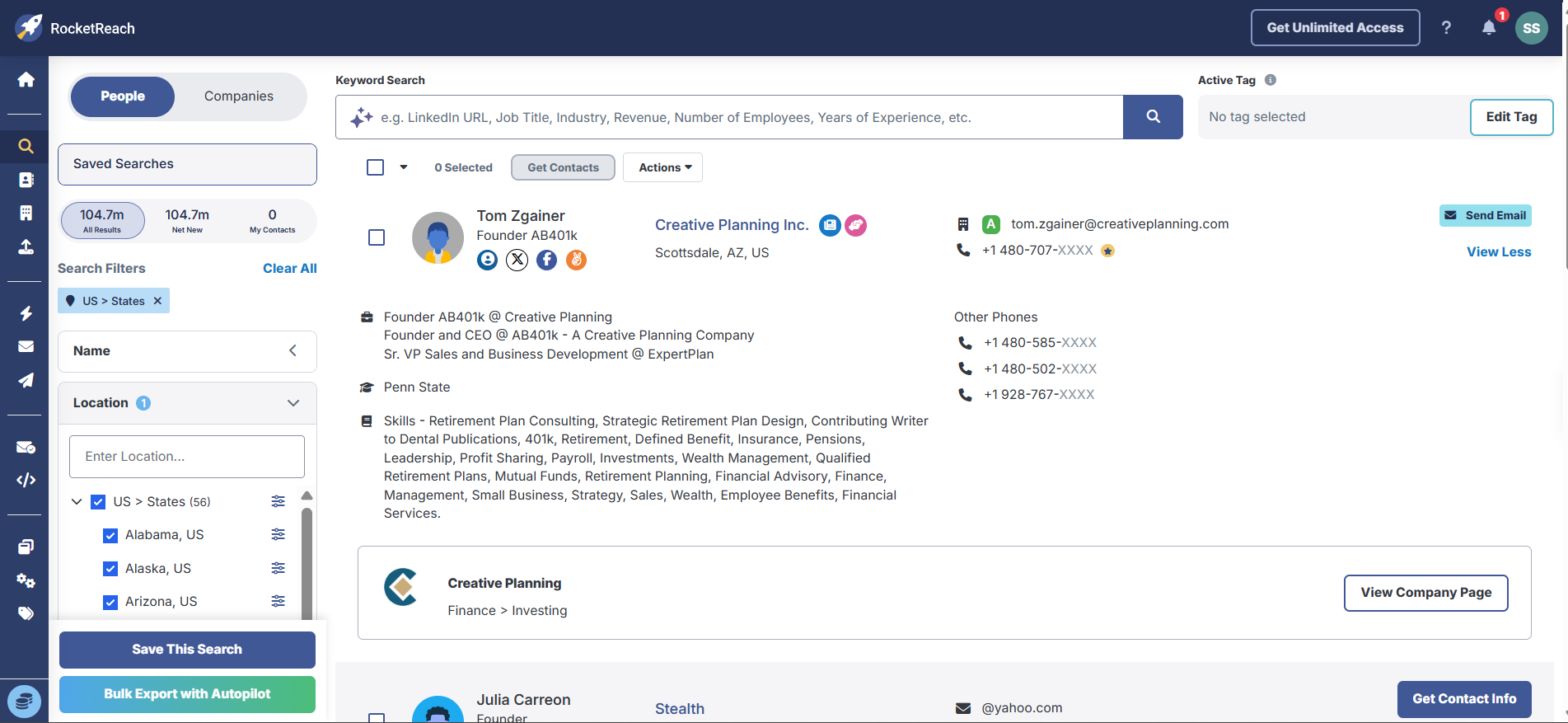
How RocketReach Search And Filters Work
Sign-up takes about a minute and does not ask for a card. You get three free lookups, which is enough to check whether your target market exists in the database and nothing more.
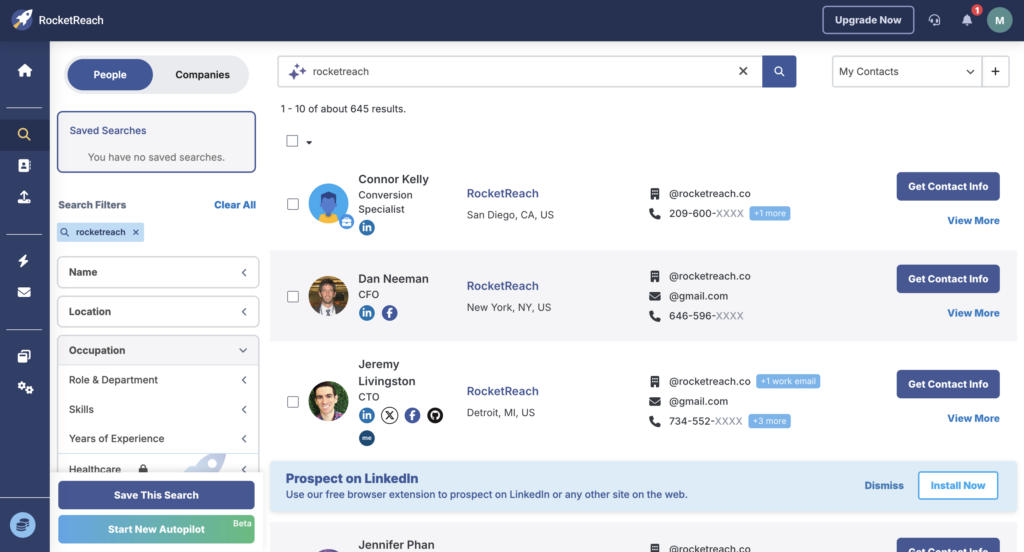
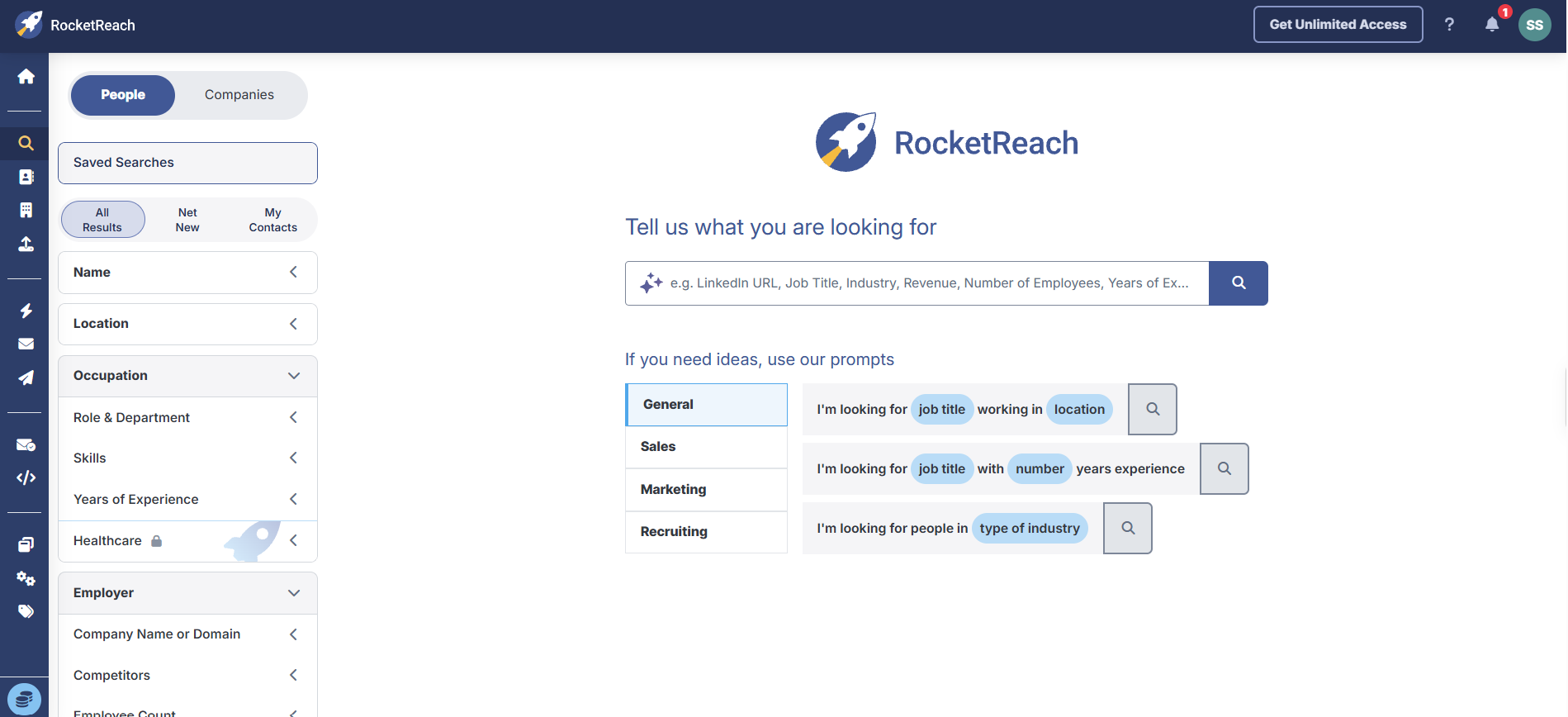
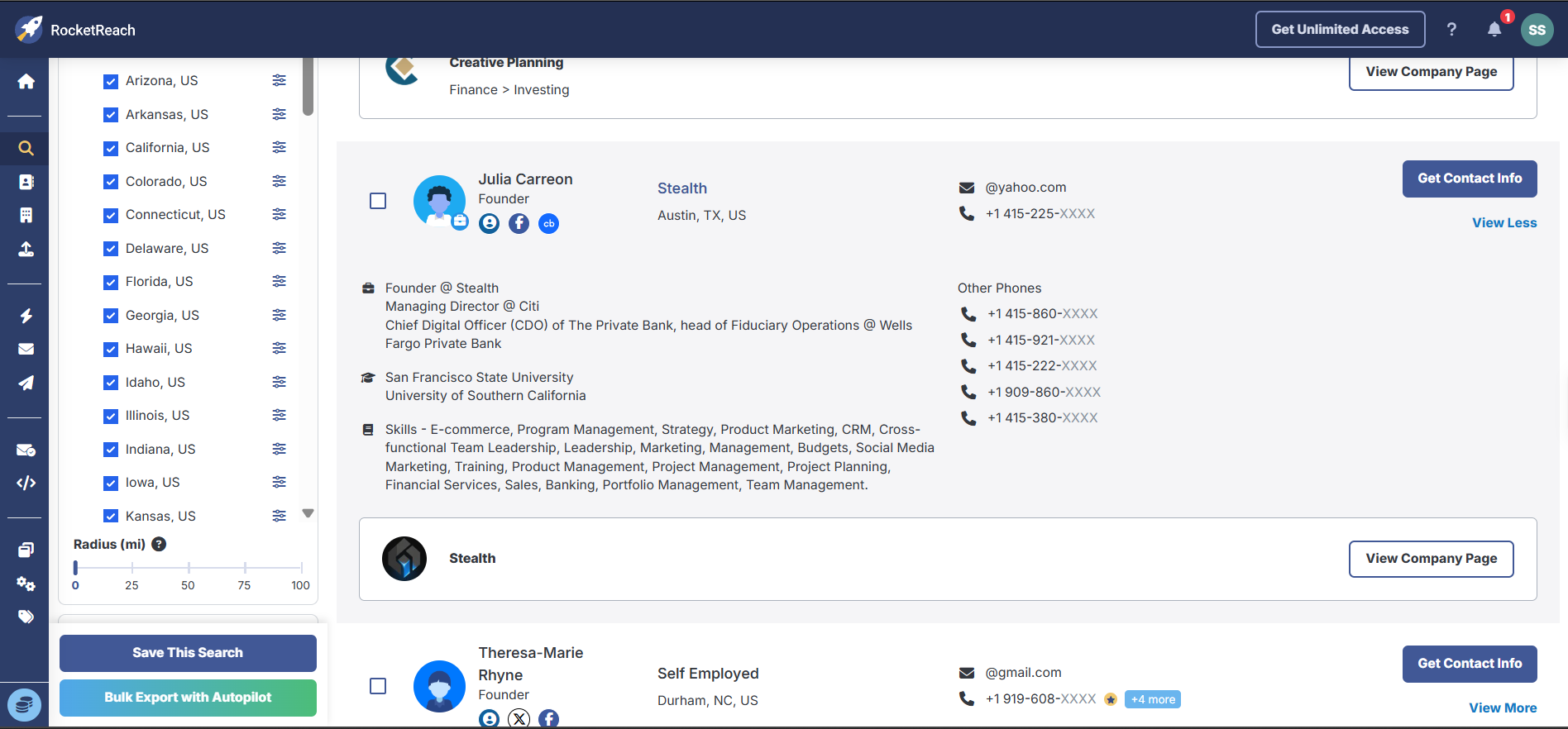
The search itself is the strongest part of the product. There are over 50 filters covering job title, company name, industry, location, company size, revenue, technology stack, and intent topics.
I ran searches for mid-market SaaS decision makers in the US, and the results came back fast. Filter combinations held up without timing out, which is more than I can say for some competitors.
Searching costs nothing. You only pay when you reveal a contact, which means you can refine your filters as much as you want before spending anything.
That is a fair model, and I want to give credit for it.
How RocketReach Credits Are Charged And Refunded
This is the part I would read twice before subscribing.
A credit is consumed when you reveal or add a contact. If RocketReach finds nothing, the credit comes back to you. Look up the same person twice and you are not charged again.
So far so reasonable. The complication is that there are two credit types.
Standard credits sit on the Essentials plan and unlock email only. Premium credits sit on Pro, Ultimate and Team, and unlock email plus phone in a single credit.
That means email and phone draw from the same pool on the higher plans. You are not buying two separate budgets.
But here is the part that catches people out, and I will cover it properly in the pricing section. Lookups and exports are not the same thing, and your plan decides which one gets capped.
Where The RocketReach Chrome Extension Works And Where It Fails
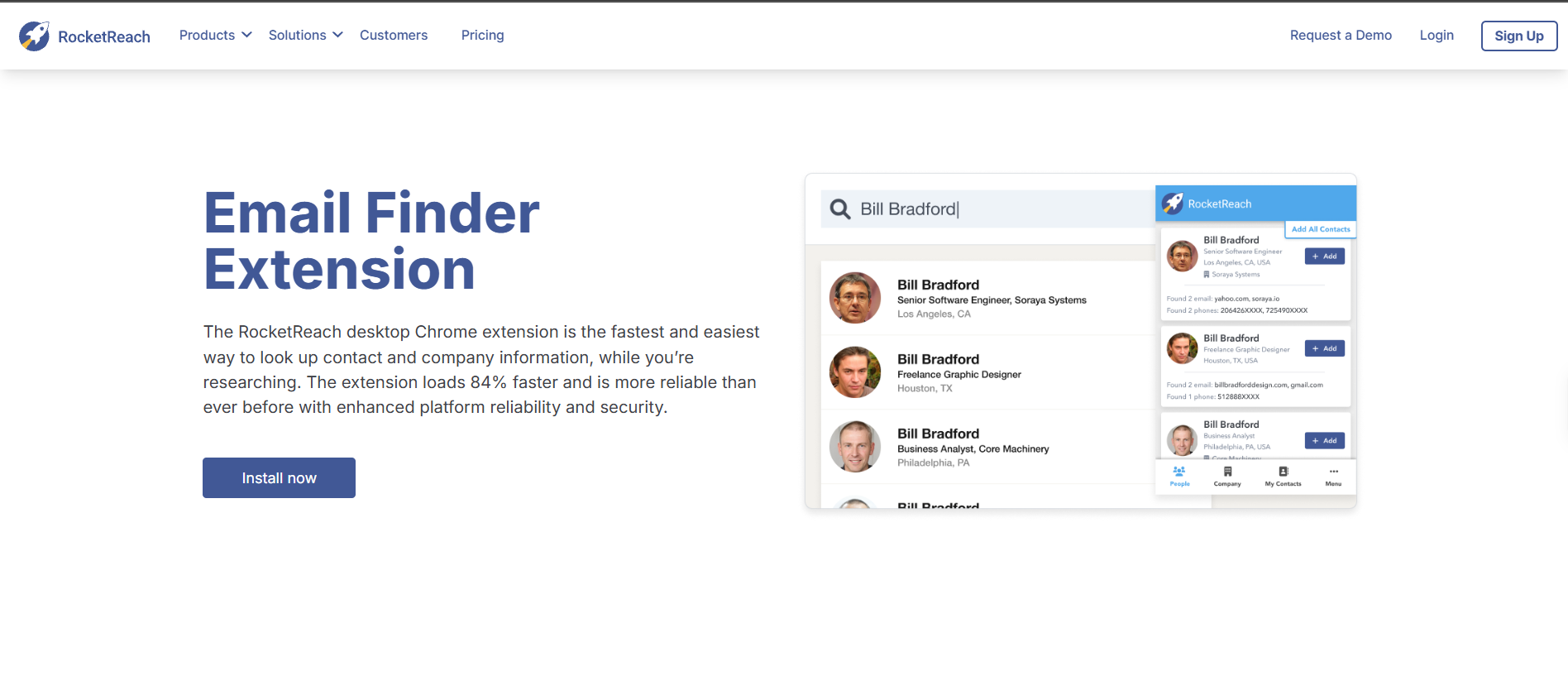
The extension is the feature most people actually use day to day, and I understand why. It sits on a LinkedIn profile and surfaces email and phone without you leaving the tab.
It works on LinkedIn person profiles, company profiles, Recruiter, and Sales Navigator. There is also a mode called RocketReach Everywhere that extends it to most company websites.
A red dot on the icon tells you the page is supported. Small touch, but it saves you clicking into a dead state.
Now the limitation. It does not work on LinkedIn search results pages or list pages.
That matters more than it sounds. If your workflow is running a Sales Navigator search and pulling contacts in bulk from the results view, the extension cannot help you. You have to open each profile individually.
For a recruiter sourcing ten people a day, fine. For an SDR building a list of 300, that is a lot of clicking.
How RocketReach Exports And CRM Integrations Work
Exports go out as CSV, or straight into a CRM if you are on the right plan.
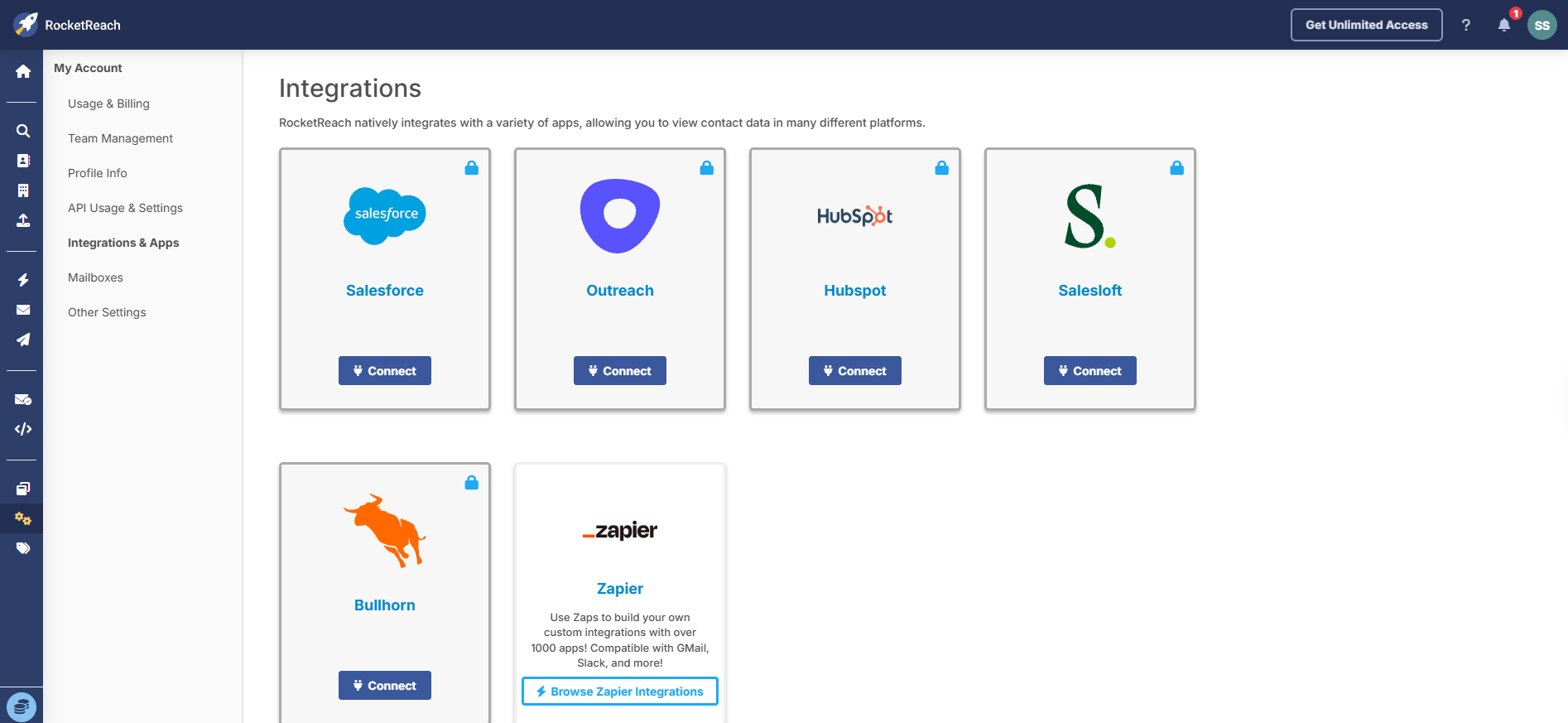
The direct integrations are Salesforce, HubSpot, Outreach, Salesloft, and Bullhorn. Zapier is available too, which covers most of what is missing.
Here is the catch I did not expect. Every one of those five CRM integrations is marked unavailable on the Essentials plan.
So the cheapest paid tier gives you contacts you then have to move by hand. If you are paying $33 a month expecting a HubSpot push, you are not getting one.
Salesforce custom field mapping goes one step further and sits on Ultimate only.
RocketReach Features Tested One By One
I worked through each feature in the order you would actually hit them. Some held up better than the marketing suggests, and a couple did not hold up at all.
If you are comparing against other data prospecting tools, the feature list below is where the real differences live.
1. RocketReach Contact And Company Search
Search is where RocketReach earns its rating. The filter depth is genuinely good, and the interface does not fight you.
What I liked most is that filtering is free. You can build a tight ICP query, look at the result count, and decide whether it is worth spending credits before you commit.
Technographics let you filter by the tech a company runs. Org charts show reporting structure, which helps when you are trying to find the person above your champion.
Both sit on Pro and above. Essentials users get the filters but not the enrichment layers.
The limitation is coverage, not the interface. Results thin out noticeably for European companies and smaller niche industries, which several reviewers flagged independently.
2. RocketReach Email Finder
This is the core product and the reason most people sign up.
Reveal a contact, and you get a professional email, often a personal one too. RocketReach claims 90 to 98 percent deliverability on verified emails.
I could not reproduce that number, and neither could the users writing reviews. One Capterra reviewer tracked an actual send and reported a 44 percent bounce rate on the campaign.
That is one campaign, not a benchmark. But it sits alongside a steady pattern of reviewers saying records go stale.
An account executive put it plainly in his G2 review. "I find the contact lists can be inaccurate or out of date...The filter options could be improved."
So treat the 90 to 98 percent figure as a ceiling for verified records, not an average for everything you pull.
3. RocketReach Phone And Mobile Number Data
Phone data is the upsell. It is the whole reason Pro costs $119 a month against Essentials at $69.
Essentials does not include phone numbers at all. If you need direct dials, you are on Pro at minimum.
The hit rate is where this gets uncomfortable. Sales teams on Reddit consistently report phone numbers working around 50 to 60 percent of the time.
A Capterra reviewer said the same thing in fewer words. She noted that the free phone numbers are often not reliable, while still rating the product five stars overall.
Half of your dials landing on a dead number is survivable for an AE making twenty calls a day. For an SDR team running a calling motion at volume, it is a real cost you should price in.
4. RocketReach Bulk Lookups And CSV Enrichment
Enrich CSV is the feature for anyone with an existing list. You upload a file, and RocketReach fills in the missing contact fields.
It works, and it is the fastest way to burn through credits I found in the product.
This is where the export cap becomes a daily problem rather than a line in the terms. Upload a 2,000-row file on an annual Pro plan, and you have just spent over half your yearly export allowance.
If list enrichment is your main use case, compare it against dedicated data enrichment tools before committing to an annual plan.
The honest limitation is that bulk enrichment amplifies whatever accuracy problem you already have. A 20 percent miss rate on ten contacts is an annoyance. On 2,000 it is a cleanup project.
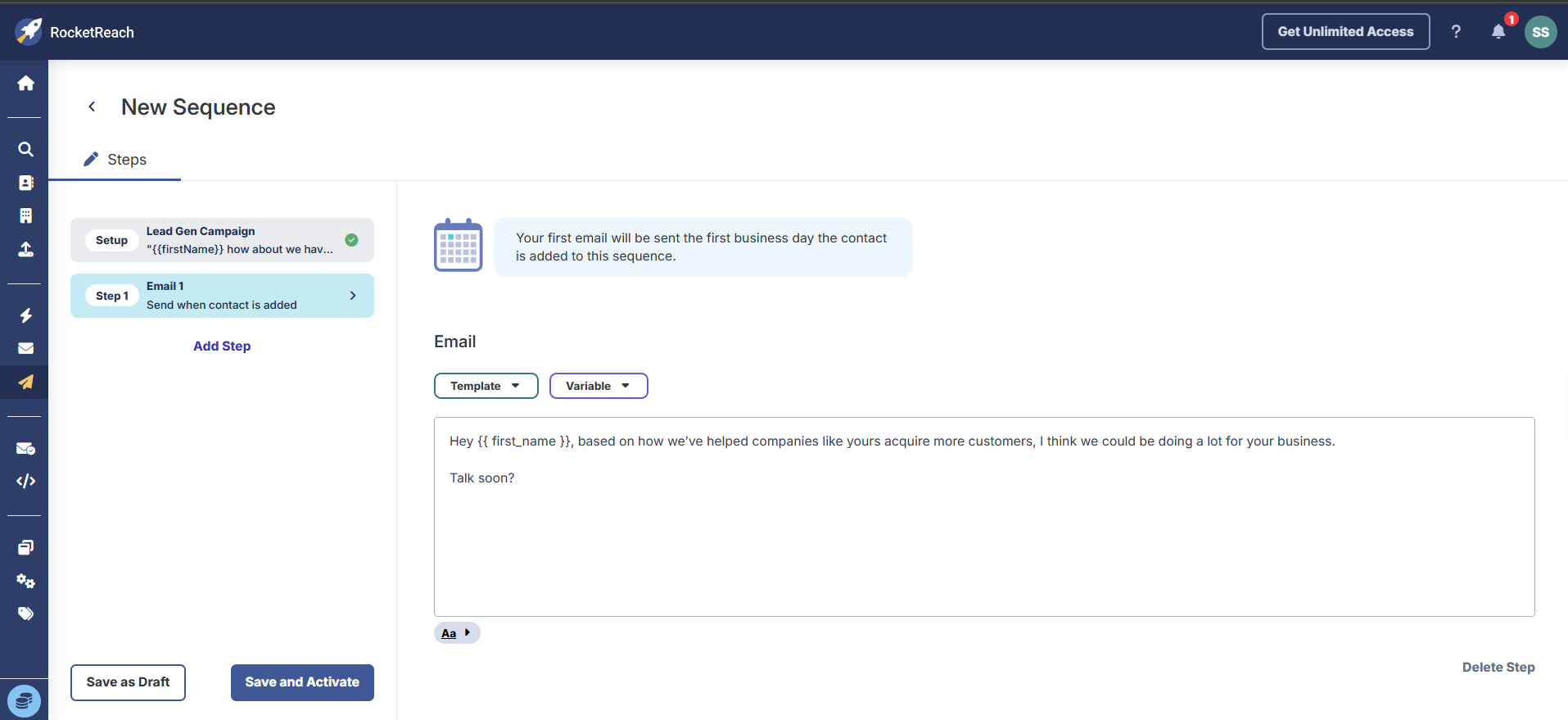
5. RocketReach Messages, Sequences And Autopilot
RocketReach added sending, and I wanted to like this. Buying data and sending from the same tool should remove a step.
Messages lets you send email and automate follow-ups. Sequences adds multi-step cadences with engagement tracking. Autopilot builds prospect lists on a schedule based on criteria you set. There is an AI email writer too.
Autopilot is capped by plan. Essentials gets 5 active jobs, Pro gets 10, Ultimate gets 25.
Sending is capped at 500 emails per day.
Here is where I landed. These features are fine for a founder sending 30 emails a week from one mailbox. They are not built for a cold outbound motion.
There is no mailbox rotation, no warmup, no deliverability monitoring, and no infrastructure layer underneath. Sending cold volume from a data tool's built-in mailer is how you burn a domain.
If you plan to actually run outbound, keep your sending somewhere built for it and use RocketReach for the data.
6. RocketReach Intent Data, Technographics And Org Charts
Intent data is the feature that gets sold hardest and is hardest to access.
There are 12 intent topics available. But intent topics show as unavailable on both Essentials and Pro in the comparison table, which puts them on Team and Custom plans.
Team plans start at $6,000 a year with a five-seat minimum.
So if you read about RocketReach intent data and assumed it came with a $75 a month seat, it does not. Healthcare NPI data sits behind the same wall.
Technographics, org charts, and company news signals are more reachable. Those start on Pro.
My take is that intent is a Team plan feature dressed as a platform feature. Price accordingly.
7. RocketReach Integrations And API Access
The API is the quiet strength here. It covers People Data, Company Data, Email Finder, Phone Finder, NPI and Firmographic endpoints, running against 4.5 billion records.
API access is listed on every paid plan, including Essentials. That is more generous than most competitors at this price.
The gap is rate limits. RocketReach does not publish them, and higher API limits appear as a Team plan feature. That tells you standard plans are throttled somewhere; you just do not know where until you hit it.
For a developer building a lookup into an internal tool, that uncertainty is a planning problem.
RocketReach Pricing Explained
Pricing is where I would slow down the most, because the headline number and the real number are different.
Plan
Coverage
Monthly Billing
Annual Billing
Annual Total
Free
Email only
$0
$0
3 lookups total
Essentials
Email only
$69/month
$33/month
~$396/year
Pro
Email + Phone
$119/month
$75/month
~$900/year
Ultimate
Email + Phone
$209/month
$175/month
~$2,100/year
Team / Custom
Email + Phone + intent, SSO, pooled credits
Annual only
Custom quote
$6,000/year minimum
Prices are per seat and were checked in October 2026. Confirm on the RocketReach pricing page before you buy.
The annual discount is steep. Essentials drops from $69 to $33, which is more than half off.
That discount is doing a lot of work, and it is why so many people end up locked into a year.
Why RocketReach Lookups And Exports Are Not The Same Thing
This is the single most important thing in this review.
Your billing cycle changes which resource gets capped, and the two models are almost opposites.
On monthly billing, you get limited lookups and unlimited exports. Essentials gives 100 lookups a month, Pro gives 250, Ultimate gives 1,000.
On annual billing, you get unlimited lookups and capped exports. The unlimited lookups carry a fair use ceiling of roughly 10,000 a month. Exports are capped at 1,200 a year on Essentials, 3,600 on Pro, and 20,000 on Ultimate.
Read that again, because it has a sharp edge.
On an annual plan, you can look up 10,000 contacts a month and only export 300 of them a month on Pro. The lookup is worth nothing until it leaves the platform.
And unused export credits do not roll over. They are gone at renewal.
What A Team Of Five SDRs Actually Pays For RocketReach
I ran the numbers on a realistic team. Five SDRs, 2,000 contacts each per month, phone numbers required.
That is 10,000 contacts a month, or 120,000 a year.
Annual Pro costs 5 seats at $75, so $375 a month or $4,500 a year. Export allowance is 18,000 a year across the team. You need 120,000. You run out in February.
Annual Ultimate costs 5 seats at $175, so $1,750 a month or $21,000 a year. Export allowance is 100,000 a year. Still 20,000 short.
Team plan starts at $6,000 a year with a custom quote. For 120,000 exports, the real quote will be well above the floor.
So the honest answer is that a five-person SDR team cannot run on a self-serve plan at that volume. You are in custom pricing territory, and you will not know the number until you take a call.
If that math pushes you toward comparing enterprise data vendors, the same export caps are worth checking against ZoomInfo alternatives before you sign anything.
The RocketReach Billing Terms To Read Before You Subscribe
I do not usually give billing its own section. For RocketReach I have to, because this is what the one-star reviews are about.
Here is what the terms actually say.
Annual plans are paid upfront and auto-renew
There are no prorated refunds once a billing period starts
Monthly credits roll over while you are subscribed, then expire 12 months from issue or immediately on cancellation
Annual export credits do not roll over at all
No overage charges exist. You simply stop being able to look people up
The auto-renewal is the flashpoint. One Trustpilot reviewer described being charged £600 with no warning email.
"Automatically renewed by RocketReach at a cost of £600. No advance warning so I could cancel." see review
Another said the refund process itself was the problem.
"They refused a refund, failed to properly escalate my complaint, and simply repeated the charge was valid." See review
Set a calendar reminder 30 days before your renewal date. Treat that as mandatory, not optional.
RocketReach Reviews And Ratings Across G2, Capterra And Trustpilot
The ratings tell three different stories, and the gap between them is the most interesting data point in this review.
Platform
Rating
G2
4.4 out of 5
Capterra
4.1 out of 5
Trustpilot
1.2 out of 5
Here is how I read that spread. G2 and Capterra collect reviews from people using the product. Trustpilot collects reviews from people who went looking for somewhere to complain.
So Trustpilot is not a verdict on the product. It is a concentrated signal about one thing, and that thing is billing.
What Users Like About RocketReach
The Chrome extension is the feature people name first.
Almost every positive review mentions it. An export manager summed up the appeal without any qualifiers. "What I like best about RocketReach is its LinkedIn extension, which makes it quick and easy to access contact information." see review
Speed of list building comes second.
Users consistently describe it as removing friction from a task that used to take an afternoon. One supplier success rep framed it around the relief rather than the output. "I enjoy finding contacts faster, compiling a contact list, and ultimately easing the stress and inefficiency of obtaining leadership contacts for a company." see review
Hit rate on well-known targets is strong.
For contacts at recognisable companies, the database delivers. A president writing on G2 described it as near automatic. "I almost always find the right email address for the person I'm looking to contact, which is incredibly useful for outreach." see review
That pattern is consistent. RocketReach is good at mid-market and enterprise US contacts, and gets weaker as you move away from that core.
What Users Complain About In RocketReach Reviews
Stale records are the most common product complaint.
Reviewers describe contacts with outdated job titles and dead email addresses. A key account manager named both problems in one line. "A few of the contacts mentioned as having the right email ID are not working properly. Some contacts are not updated with current roles." see review
Incomplete data at the paid tiers frustrates volume users.
A VP of operations connected the price to the quality directly. "While the product is inexpensive, the data provided is very often incomplete." See review
Pricing for phone access reads as punitive to individual users.
The jump from email-only to email-plus-phone is the most resented gate in the product. One reviewer described it as paying heavily just to get phone numbers on a single seat.
Billing dominates everything else.
This is where the anger lives. A founder gave a warning rather than a review. "Don't sign up - will be a major headache and they will charge you on the way out." see review
And a general manager described the support experience around a refund request. "The basic answer was that rules are rules. No exceptions. No sympathy." see review
The RocketReach Limitations Worth Knowing Before You Buy
Every limitation below is something users wrote about publicly, not something I inferred from the marketing. I have linked the review behind each one.
1. RocketReach Phone Numbers Hit Around Half The Time
Sales teams on Reddit report direct dials connecting roughly 50 to 60 percent of the time. That lines up with what reviewers say even when they rate the tool well.
A Capterra reviewer who gave five stars still flagged it. She wrote that the free phone numbers are often not reliable. see review
What this means for you is simple. If you are building a calling motion, budget for a second phone data source or accept half your dial list is dead weight.
2. RocketReach Email Bounce Rates Climb Outside The US
The verified email claim is 90 to 98 percent deliverability. Real campaign results reported by users land nowhere near that, particularly outside North America.
One reviewer ran the numbers on his own send and published them.
"Emails I sent were 56% successfully delivered, 44% returned" see review
A 44 percent bounce rate will damage your sender reputation badly. If you are sending cold at any volume, run every list through verification first and read up on email deliverability before you send.
3. The RocketReach Export Cap Stops Campaigns Mid-Run
Annual plans give unlimited lookups and capped exports. Those two numbers do not talk to each other, and you cannot convert one into the other.
Teams report hitting the export ceiling partway through a campaign and having to stop. The knowledge base confirms the mechanic plainly, stating that unused export credits do not roll over to the next year.
So the resource you run out of is not the one the sales page advertises as unlimited.
4. RocketReach Credits Expire And Do Not Roll Over
Monthly credits expire 12 months after issue, or immediately if you cancel. Annual export credits are forfeited at renewal regardless of how many you used.
That combination is what produces reviews like this one from a user charged for a renewal he did not want.
"They will play with some shenanigans when processing refunds. Fairly despicable." See review
Cancel before renewal, and you lose whatever is left in the account. There is no grace period.
5. The RocketReach Unlimited Plan Has A Hidden Cap
Annual plans advertise unlimited lookups. The fair use ceiling is around 10,000 a month.
For most users, that cap is irrelevant. For the ones who hit it, the word unlimited stops meaning anything, and at least one reviewer called it out directly.
"False marketing as they don't have unlimited plan" see review
I would not call this a scandal. I would call it a reason to read the fair use line before you believe the plan name.
Who Should Use RocketReach
RocketReach is a good fit if you match most of this.
You are an individual or a small team buying one or two seats. Recruiters, founders, agency owners, and AEs fit this shape well.
Your targets are at US mid-market or enterprise companies. That is where the database is strongest and where hit rates hold up.
You need contacts in moderate volume, roughly a few hundred a month rather than a few thousand. At that level, the export caps never bite.
You already have a CRM and a sending tool, and you want RocketReach to do one job well.
And you are organised about renewals. If you set reminders and read terms, the billing complaints that drive the Trustpilot score will never touch you.
If any of those apply, it is worth looking at RocketReach alternatives with stronger data accuracy before you commit.
The Best RocketReach Alternative For Outbound Teams
I want to be precise here, because swapping one tool for another only works if they do the same job.
RocketReach is a contact database. Salesforge is an outbound platform. If all you need is a lookup tool for occasional contacts, Salesforge is not what you are shopping for.
But most people buying RocketReach are not buying data. They are buying booked meetings, and the data is step one of five.
That is the gap worth naming. You pay for contacts, then pay again for mailboxes, warm-up, a sequencer, and an inbox to manage replies. By the time the stack is assembled, the $75 seat is the cheapest line on the invoice.
Salesforge runs email and LinkedIn sequences from one place, with unlimited email senders and no per-seat pricing. The Pro plan is $48 a month, or $40 billed annually. Replies from both channels land in Primebox™, so you are not switching tabs to answer anyone.
Then there is Agent Frank, the AI SDR inside Salesforge. He handles ICP-based continuous prospecting, writes the emails, sends them, follows up, and books the meeting.
That makes him the closer comparison to RocketReach than the platform itself. Agent Frank finds the contacts and does something with them, rather than handing you a CSV. He runs on Auto-Pilot if you want him fully autonomous, or Co-Pilot if you want to approve replies before they go out.
Pricing is $499 a month billed annually, or $599 billed quarterly, including 2,000 plus contacts a month at $0.25 per contact. Warmup runs in-house through Warmforge at no extra cost.
Here is the honest limitation. If you only need twelve contacts a month, hiring Agent Frank is overkill, and RocketReach is the cheaper answer. He makes sense when the goal is pipeline, not lookups.
Is RocketReach Worth It In 2026
RocketReach is worth paying for if you are one or two seats doing moderate contact lookups against US companies, and nothing more. The search depth is good, the Chrome extension genuinely saves time, and at $33 a month on annual Essentials, it is hard to beat for individual use.
It stops being worth it in two specific situations. The first is volume, because the export caps make a five-person SDR team a custom quote conversation at $6,000 a year minimum. The second is phone-led outbound, where a 50 to 60 percent hit rate forces you to buy a second data source anyway.
So my recommendation is conditional. Start on monthly billing even though annual is cheaper, run 100 real lookups through your own verification tool, and check the bounce rate yourself before committing to a year.
If the data holds up for your market, take the annual discount and set a renewal reminder. If you find you are really trying to solve for booked meetings rather than contact records, start a free trial of Salesforge and compare the full cost of each path.
RocketReach FAQs
Is RocketReach data accurate?
RocketReach claims 90 to 98 percent deliverability on verified emails. User-reported results are lower, with reviewers citing bounce rates from 10 to 44 percent depending on the list. Accuracy is strongest for US mid-market and enterprise contacts, and weakest in Europe and niche industries. Phone numbers connect roughly 50 to 60 percent of the time according to sales teams on Reddit.
How much does RocketReach cost?
Essentials is $69 a month or $33 billed annually, email only. Pro is $119 a month or $75 annually and adds phone numbers. Ultimate is $209 a month or $175 annually. Team plans start at $6,000 a year with a five seat minimum. Prices are per seat and were checked in October 2026.
Does RocketReach have a free plan?
Yes, but it is limited. The free tier gives you three lookups in total, not three a month. No credit card is required. There is no time-based free trial, so the three lookups are your entire evaluation window unless you pay.
What is the difference between RocketReach lookups and exports?
A lookup reveals a contact inside RocketReach. An export moves that contact out, either as CSV or into a CRM. On annual plans lookups are unlimited up to a 10,000 a month fair use cap, while exports are capped yearly. On monthly plans the reverse applies. Unused annual export credits do not roll over.
Does RocketReach refund unused subscriptions?
No. RocketReach does not issue prorated refunds once a billing period starts, and annual plans auto-renew. This is the most common complaint across Trustpilot, G2 and Capterra, with multiple reviewers reporting renewal charges with no advance warning email. Set a cancellation reminder at least 30 days before your renewal date.
Can RocketReach send cold emails?
It can, within limits. Messages, Sequences and Autopilot let you send and automate follow-ups at up to 500 emails a day. There is no mailbox rotation, warmup or deliverability monitoring, so it is not built for cold outbound at volume. Use it for light founder-led sending, not for a full outbound motion.
What is the best RocketReach alternative for outbound sales teams?
It depends on what you are actually solving. If you need better contact data alone, compare dedicated databases on accuracy in your specific market. If your real goal is booked meetings, Salesforge combines email and LinkedIn sequencing with unlimited senders from $48 a month, and Agent Frank handles prospecting through to meeting booked from $499 a month billed annually.
Book more meetings on autopilot
Set up in minutes. No per-seat pricing. No commitment.



.jpg)

.jpg)