Getting graphic design clients used to be a lot simpler.
You'd post your work on Dribbble, share a few projects on social media, and wait for the inquiries to roll in. For many designers, that was enough to land a new client every few weeks.
That playbook doesn't work anymore.
Today, only 17.8% of businesses hire freelance designers, while 35.5% create their own visuals in Canva. Add AI design tools and a global pool of freelancers, and attracting clients takes a lot more than publishing a portfolio and hoping someone finds it.
The designers consistently landing work in 2026 aren't getting lucky. They're using a small number of client acquisition channels intentionally, sticking with what works instead of chasing every opportunity.
In this guide, I'll break down the 12 methods that are actually bringing in clients today, ranked by how quickly they tend to land your first project.
We'll start with cold outreach because it's the one channel where you control how many opportunities you create.
Let’s get started!
Here are all 12 methods at a glance, sorted by how quickly each one tends to deliver the first paying client.
Three things changed the market in the last two years, and any advice that ignores them is already stale.
The first shift is the collapse of low-end design work. Businesses that used to hire a designer for a social post, a quick flyer, or a simple logo now do it themselves in ten minutes with Canva or an AI logo generator, and can just as easily generate AI infographic visuals for a report instead of briefing a freelancer. That entire tier of work has essentially vanished from the freelance economy, and any designer still competing for it is fighting for scraps.
The second shift is on the supply side. Upwork and Fiverr are now saturated with $10 logo bids from freelancers in every country, which drives prices down and forces designers to compete on rate instead of quality. So racing to the bottom on price is a losing game for anyone with real skill, and the platforms that used to be reliable starter channels are now overcrowded with race-to-zero pricing.
The third shift is the death of passive channels. Uploading work to Dribbble or Behance and hoping to get discovered was a real strategy five years ago, and it delivered clients for designers who consistently posted good work. But that approach stopped delivering results in 2026 unless you already have a large following or a specific niche angle that stands out from the flood of new uploads every day.
So what still works? The methods that put you in front of a specific buyer with a specific offer, instead of hoping the right person stumbles onto your work by accident. That is the shift, and the 12 methods below all reflect it.
The methods below are ordered by how quickly each one tends to produce the first paying client, starting with cold outreach and ending with slower-compounding plays like SEO and speaking gigs.
Each strategy includes a brief explanation of what it is, why it works, and how to execute it properly.
My advice is to pick two or three that fit your situation, rather than trying all 12 at once.
Cold outreach is when you email or DM a business owner or marketing decision-maker who has never heard of you before, with a short personalized pitch that offers real value. It is not spam, and it is not a mass DM blast sent to a scraped list. Done properly, it is a direct, one-to-one conversation opener.
The reason it works so well for designers is buyer behavior. Small business owners, marketing managers, and startup founders rarely search for a designer until they hit a wall, and by then they usually hire whoever is top of mind. So if you reach them first with a relevant offer, you skip the search entirely and land the project before they open a single browser tab.
That is why cold outreach sits at number one on my list. It is the only channel where you fully control the volume, the targeting, and the timing all at once. Warm methods depend on who happens to know you. Content methods depend on the algorithm. Cold outreach depends on your list, your pitch, and how many emails you actually send this week.
Now, running cold outreach properly is a completely different thing from firing off 100 emails and hoping for the best. Three pieces need to line up together, and if any one of them breaks, the whole system falls apart. Here is how I would build it step by step.
Step 1: Define your ICP.
Your Ideal Customer Profile is a short description of the exact type of business you want as a client. Saying "small businesses" is too broad, and it will not get you replies.
A tight ICP sounds more like:
So the tighter your ICP, the more relevant your pitch feels to the reader, and the higher your reply rate will go. If you have never built one before, I broke down the full framework in this guide on defining your ICP for cold outreach.
Step 2: Build a prospect list with verified contact data.
Here is where most designers stall out. Scraping LinkedIn manually gives you maybe 20 verified leads on a good day, and half of those emails still bounce when you actually send. When you want to send 100 targeted emails a week (which is the minimum volume that produces steady replies), the manual approach falls apart.
So the way I skip that mess is with Leadsforge, a lead search engine with 500M+ contacts built specifically for outbound teams.
The way it works is straightforward: you describe your ICP in plain English, like "marketing directors at DTC skincare brands under 50 employees, based in the US," and Leadsforge returns a matched prospect list in minutes instead of hours.
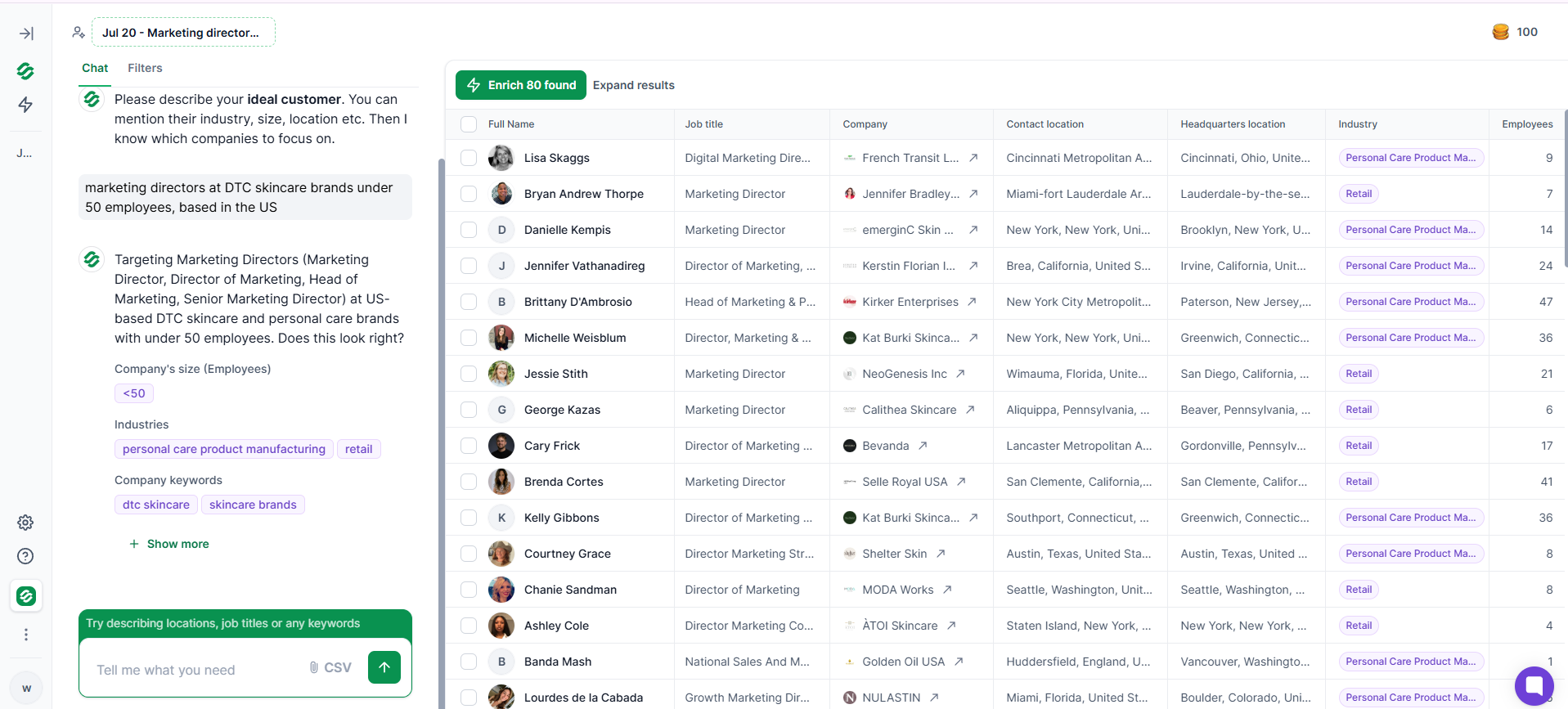
Its waterfall enrichment pulls verified emails and LinkedIn profiles from multiple data sources at once, which keeps hit rates high even on niche ICPs where most databases run thin.
Get 100 free emails on Leadsforge to test it before committing to a paid plan.
Step 3: Write the cold email pitch.
The best-performing cold emails for designers share four traits:
So skip the "I hope this finds you well" opener and the paragraph about your background, because both signal that the email is generic. Here is the template I would use as a starting point:
The last line is the whole trick. Instead of pitching a service and asking for a meeting, you are offering a piece of tangible work they can actually see and react to. Reply rates on this format run 3-4x higher than a standard pitch email. For more variations, 10 cold email templates that actually get replies has a full library you can adapt.
Step 4: Add a LinkedIn touch.
Email alone works, but email combined with LinkedIn works significantly better. So after you send the cold email, follow this sequence:
This multi-channel play typically doubles reply rates on the same prospect list without doubling your effort. The full framework is in this guide on cold email and LinkedIn sequences that get replies.
Step 5: Send at scale without hitting spam.
Now here is the piece nobody talks about honestly. Sending 100 cold emails a day from your personal Gmail account is the fastest way to get blacklisted and ruin your regular email deliverability for good. Cold email at scale needs a completely separate sending setup: secondary domains, mailbox warmup, sender rotation, and reply tracking all working together.
That is why I use Salesforge as the outbound platform. It runs email and LinkedIn from one sequence, comes with unlimited mailboxes, and has no per-seat pricing on top of that. The way it fits into the flow is clean:

And if you would rather not run outreach manually at all, Salesforge also has Agent Frank, an autonomous AI SDR who handles prospecting, writing, sending, and follow-ups on your behalf. Hiring him makes sense when you would rather focus on the design work and outsource the outbound side of the business entirely.
Realistic outcome for cold outreach.
Expect a 3-8% positive reply rate once your list and pitch are dialed in. So if you send 100 emails a week, that translates into 3-8 real conversations and 1-2 landed projects within the first month. The whole system compounds quickly once your list, pitch, and sending setup are working together properly.
Start a 14-day free trial with Salesforge and set up your first cold outreach campaign this week.
Referrals are the highest-converting lead source in freelance work, and most designers underuse them badly.
A referral is when a past client introduces you to someone else who needs design help, so the prospect arrives already trusting you through the person who made the intro.
The reason referrals convert so well is trust transfer. Studies across service industries consistently show that referred clients close 3-5x more often than cold leads, and they often pay more too. So the math is simple: one warm intro from a happy client is worth 30 cold emails.
But here is the catch. Most designers never actually ask for a referral. They wait for it to happen organically, and it rarely does on its own. So here is how to ask properly.
Send a short email one to two weeks after wrapping a project, while the work you did is still fresh in the client's mind. The template I use looks like this:
That is the whole message, with no essay and no awkward hedging attached. Sending this note to 20 past clients typically produces 3-5 warm introductions within a month.
A bonus move is to ask for a testimonial at the same time. Clients who write a testimonial are 2-3x more likely to refer someone within the next 90 days, because the exercise makes them think about your work again. Expect 1 in 5 past clients to refer someone within 30 days when you ask directly.
Your warm network is often the fastest first-client source, especially if you are just starting out. It is the group of people who already know you and would take your call, even if you have not spoken in years.
Your warm network includes more people than you think. It typically covers:
The reason this method works so well is trust. Each of these people already knows you as a competent person, and each of them knows 20-50 people that you do not. So even a small warm network of 40 contacts touches an extended network of over 1,000 potential clients.
That said, most first-time freelancers skip this step because it feels awkward. But it is genuinely the highest-leverage move for landing your first paid project, because the trust is already built in and you do not need a strong portfolio to make it work.
Here is how to run it. Build a list of 30-50 warm contacts in a spreadsheet, then send each one a short message announcing that you are taking on new design work. Keep it casual and non-salesy, something like:
Sending this to 40 people typically produces 4-8 real conversations and 1-3 landed projects within three weeks.
A hybrid of cold and warm outreach that converts unusually well is the free mockup and Loom teardown pitch. It is the play I would run if I wanted to land 2-3 high-quality clients this month without touching a bulk email tool.
Here is how it works. You pick a business whose visual identity is weaker than it should be, redesign a specific piece of it as a quick mockup, and send them a short Loom video walking through what you would improve and why. For smaller businesses, creating a strong visual identity can be an important first step before investing in a full branding project. A logo maker can help teams explore initial concepts and establish a visual direction before working with a professional designer. So instead of asking for a meeting, you are demonstrating tangible value before any pitch happens.
The reason this format converts well is that you flip the usual dynamic. Cold outreach normally asks the prospect for something (their time, their attention, a call). This one gives them something first, which triggers reciprocity and makes replying feel natural rather than transactional.
Here is how to run it end to end:
The close rate on this format runs 5-10%, which is far higher than a standard cold email. The tradeoff is that each pitch takes real time, so this method works best when you are targeting fewer, higher-value prospects rather than sending at volume.
LinkedIn is the channel most designers use wrong. They treat it like a digital resume when it is actually a client-acquisition platform, and the people who hire designers (founders, marketing managers, agency owners) all scroll it every day looking for talent they can trust.
The reason LinkedIn works for designers specifically is compound visibility. Every post you publish gets shown to your existing network, then to their networks if it gets engagement. So over three or four months of consistent posting, you become a familiar name to hundreds of buyers who quietly follow along before ever reaching out.
But most designers show up on LinkedIn like job seekers rather than service providers. Generic headlines. Thin profiles. No consistent posting rhythm. No engagement with the buyers they want to work with. So turning LinkedIn into a real client channel starts with fixing the fundamentals.
Here is what to change first:
Then commit to a posting rhythm. Two or three posts a week works well, and quick process breakdowns, before-and-afters, mini case studies, and short teardowns of design work you admire all perform well. On top of the posting, comment thoughtfully on 5-10 posts a day from founders, marketers, and agency owners in your target niche. This puts you on their radar before you ever send a DM.
For the full profile setup framework, this guide on optimizing your LinkedIn profile to generate pipeline walks through every field. Expect the first inbound conversation 4-8 weeks in if you post consistently.
Subcontracting for marketing and web agencies is one of the most overlooked recurring-revenue channels in freelance design. It is quietly how a lot of full-time freelancers pay their rent without ever running their own client acquisition.
The way it works is simple. Marketing agencies, web development shops, and branding studios frequently take on more design work than their in-house team can handle. So instead of turning projects away, they subcontract to freelance designers under a white-label arrangement, where the agency marks up your work and manages the client while you do the design.
The upside for you is real:
That said, the downside is worth naming honestly. You never own the client relationship, and the agency captures a chunk of the margin. So think of this as complement to your own client work, not a replacement for it.
Here is how to find agencies to partner with:
Then pitch yourself as a white-label design partner with a short email or LinkedIn DM. Mention your specific skillset, your rate, and one or two examples of work relevant to the agency's client base. Expect 3-8 weeks to land your first agency partnership, and two or three good agency relationships can generate steady work for years.
One method most designers overlook completely is showing up in the online communities where their buyers already gather. Every niche has its watering holes, and the buyers you want are asking each other for designer recommendations there every single week.
Here is what those communities look like in practice:
The reason communities work is that they compress the trust cycle. When you show up in a group where someone already respects the recommendations, and the members see your name on helpful posts for weeks, you get referred without ever having to pitch.
But here is the rule that separates the designers who make this work from the ones who get banned. You have to help before you pitch, every single time. So if you show up and immediately post "I'm a designer, DM me for logos," you are done. If you spend two weeks answering questions, sharing quick teardowns, and giving useful advice without any ask attached, people notice and remember.
Here is how to run it properly:
Expect the first client from this method within 4-8 weeks if you stay consistent.
Dribbble and Behance still work in 2026, but only if you use them as active lead-generation platforms instead of passive portfolio uploads. Most designers use them wrong: upload their best work, cross their fingers, and wait for a client to slide into the DMs.
That approach worked in 2018, and it does not work anymore. The platforms are far too saturated for passive discovery to pay off unless you already have thousands of followers.
But the active approach still delivers. It comes down to two things: a tight, niche-focused profile and consistent outbound activity from inside the platform itself.
Here is what to fix on the profile side first:
Then use the DM systems actively. When a company likes one of your shots on Dribbble, look them up and send a short DM introducing yourself. When you notice a brand posting content on Behance that could use a design refresh, reach out directly. Expect 4-12 weeks to your first inbound if you keep the profile tight and the outreach consistent.
SEO is the slow-burn method that compounds silently in the background for years. It is not a fast play, and I would not recommend it as your only channel. But if you commit to it alongside cold outreach, the passive lead flow it generates 12 months in is genuinely transformative.
The idea is simple. Instead of writing generic blog posts about design theory (which nobody who hires designers actually reads), you target the specific search queries your buyers type when they need help. Long-tail keywords like these have low individual search volume but attract buyers with high purchase intent:
Here is how to execute it properly:
Do this over three or four months, and you start ranking on the second or third page. Keep at it for six months, and the leads start trickling in on their own. Expect 3-6 months to your first SEO-sourced lead, but the traffic compounds every quarter after that.
Process content on Instagram and TikTok is a long game, and I would only recommend it if you genuinely enjoy being on camera or making time-lapse videos. The ramp is long, and inconsistent posting produces nothing.
That said, when it works, it works. Showing your design process publicly builds an inbound audience of people who watch your work for months and eventually hire you when they need design help. The formats that perform well are consistent across both platforms:
Here is what actually makes it work. Post 3-4 times a week minimum, because the algorithm rewards consistency far more than quality on a single post. Focus on strong visual hooks in the first two seconds of each video, since attention drops off fast on both platforms. And keep the audio conversational and the pacing tight.
But the honest tradeoff is time. This is a 6-12 month play before you see meaningful client leads, and it only pays off if you post consistently through the quiet months. Skip this method if you are not going to commit to it, because inconsistent posting does nothing at all.
Guest content is how designers build authority in a specific niche, and it compounds slowly but pays off in higher-value clients. Guest posting means writing an article for a publication your buyers already read. Podcast appearances mean going on shows your buyers already listen to.
The reason this method works is borrowed audience. Both formats give you access to a warm, pre-built audience of buyers, which is far more valuable than shouting into your own empty feed for the first year of building a personal brand.
Here is the trick that separates guest posts that land clients from ones that go nowhere. The topic has to help the buyer, not showcase your portfolio. So:
The pitch has to be about the reader's problem, not your work. And once you have written for 3-4 respected publications in your niche and appeared on 2-3 relevant podcasts, buyers start referring to you as "the designer who wrote that piece about X." That referral flow compounds for years. Expect 3-6 months to your first client from a guest piece.
The last method on my list is speaking at niche industry events where your buyers actually gather in person. It is the slowest-compounding play in this piece, and it also produces the highest-value clients when it works.
The keyword here is niche. Do not speak at design conferences where the audience is other designers, because they are not going to hire you. Instead, look at:
The pitch you send to organizers has to help their audience, not showcase your work. So a pitch like "3 branding mistakes that cost medical practices new patients" lands better than "my approach to design for healthcare." The talk itself follows the same rule: teach them something useful for their business, mention your services once at the end, and offer a free 15-minute consultation as the call to action.
Expect 6-12 months to build up a speaking rhythm, but one good talk typically produces 3-5 warm leads that pay off for the next six months. This is a long game, and it works best once you have a specific niche and a clear point of view worth sharing.
If you take one thing away from this piece, let it be this. Getting graphic design clients in 2026 is a process problem, not a talent problem. The designers landing steady work are running two or three channels consistently, and the ones stuck in the feast-or-famine cycle are still waiting to be discovered.
So cold outreach is where I would start if I had to rebuild my pipeline from zero this week. It is the only channel where you control the volume, the targeting, and the timing all at once. Combined with a clear ICP and a proper sending setup, it moves faster than every other method on this list.
If cold outreach is where you want to start too, try Salesforge free for 14 days and launch your first campaign this week.
Related reads worth your time:
Anywhere from one week to three months, depending on the method you use. Warm network reactivation and cold outreach can produce your first client in 1-3 weeks. Content-based methods like LinkedIn posting and SEO usually take 2-6 months to deliver the first inbound lead.
Not for your first client. Warm network outreach and free mockup pitches both work without a full portfolio, because you are either leveraging existing trust or showing tangible work before asking. From your second client onward, a small portfolio of 3-5 focused pieces makes every method faster.
Yes, when done properly. Cold email works for designers because most buyers do not actively search for one until they need help urgently. With a tight ICP, a personalized pitch that offers value, and a proper sending setup, reply rates of 3-8% are realistic. Skip cold email if you are not willing to research your prospects and personalize each pitch.
They are useful as a starter platform for landing your first paid gigs, but they are not a real growth strategy. Both platforms are heavily saturated with low bids from global freelancers, which drives prices down and forces you to compete on price rather than quality. Use them to build initial reviews and testimonials, then transition to the other methods on this list.
Cold outreach combined with warm network reactivation is the fastest combination for most designers. Warm network produces 1-3 conversations within a week from people who already trust you, while cold outreach fills the pipeline with new prospects at scale. Together, they typically produce a first paid project within 2-3 weeks.
.jpg)

![How to Use Jev for Cold Email Agents [Step-by-Step Guide]](https://cdn.prod.website-files.com/6436c3ac9f9fd0594d00b9fc/6acbd25fa19716f481a8dc43_Duplicate-me-open-graph%20(67).jpg)

![How to Use Jev for LinkedIn Outreach [Step-by-Step Guide]](https://cdn.prod.website-files.com/6436c3ac9f9fd0594d00b9fc/6acbc875da442e046e263670_Duplicate-me-open-graph%20(66).jpg)