I spent seven years in consulting before I touched a single outbound tool. The first three of those years, I relied entirely on referrals and word of mouth. It worked until it didn't.
The month my biggest referral source went quiet, I had zero pipeline. No meetings booked. No proposals out. Just an inbox full of newsletters and a calendar with nothing on it.
That moment forced me to figure out how to get clients for a consulting business without waiting for someone else to hand them to me. Since then, I have tested cold email, LinkedIn outreach, content marketing, paid ads, speaking gigs, partnerships, and a dozen other approaches.
Some of them work. Some of them waste months. A few of them changed my business completely.
This is the guide I wish I had back then. Twelve strategies that actually fill a consulting pipeline in 2026, ranked by how fast they produce results and how well they scale.
Every consultant I speak with who struggles with client acquisition has the same issue. Their target audience is too broad.
"I help businesses grow" sounds great at a dinner party. It is useless for prospecting. When I narrowed my focus from "business consulting" to "operational efficiency for mid-market SaaS companies," my reply rates tripled overnight.
Start by answering four questions:
Write those answers down. That is your ideal client profile (ICP). Every strategy in this guide depends on knowing your ICP cold.
If you skip this step and proceed directly to outreach, you will send hundreds of messages to people who will likely never hire you. I know because I did exactly that for six months before I figured it out.
Cold email is still the fastest way to fill a consulting pipeline. That is not my opinion. It is what the data shows. About 61% of B2B decision-makers prefer cold email over other outreach methods, and personalized emails get reply rates around 17%, compared to roughly 7% for generic messages.
For consultants specifically, cold email has a structural advantage. High deal values justify deep personalization. A $50,000 consulting engagement makes it worth spending 15 minutes researching and writing a single email. The economics favor quality over quantity.
Here is the framework I use for consulting cold emails:
For more on writing emails that actually get replies, I put together a detailed breakdown of cold email templates and cold email copywriting strategies that work in 2026.
The infrastructure matters too. If your emails land in spam, the best copy in the world won't help. I set up my sending domains through Mailforge and had DNS configured automatically in under 10 minutes. Then I warmed everything through Warmforge for 14 days before sending the first campaign. Skipping warmup is the fastest way to burn a domain.
LinkedIn outreach gets higher reply rates than cold email for consulting. The reason is simple. Consultants sell expertise and trust. LinkedIn profiles show your face, your background, your content, and your mutual connections. That context makes it easier for a stranger to reply.
The approach is different from email, though. LinkedIn messages need to be shorter, more conversational, and question-led. I treat LinkedIn like a messaging app, not an email client.
My LinkedIn outreach process looks like this: Send a blank connection request. No note. Acceptance rates drop when you attach a sales pitch to the request. Once they accept, wait a day. Then send a short message that asks a single question related to a problem they likely face.
Something like: "Saw your team just closed a Series B. Curious if you are running into scaling challenges on the ops side, or if you have that covered."
That is it. One question. No pitch. The goal is a conversation, not a close.
I wrote a full LinkedIn lead generation guide that covers profile optimization, commenting strategy, and outreach sequences if you want to go deeper.
The real unlock for consulting client acquisition is combining email and LinkedIn in one coordinated sequence. When a prospect ignores your LinkedIn message, a well-timed email two days later gives you a second shot. When they ignore the email, a LinkedIn comment on their recent post keeps you visible.
Multi-channel outreach consistently outperforms single-channel. LinkedIn-only campaigns hit a ceiling around 20 to 30 percent reply rates with strong targeting. Add email as a second channel, and that climbs into the 40s.
The practical challenge is running both channels from one place without switching between tabs. I use Salesforge for this because it runs cold email and LinkedIn outreach inside the same sequence builder. I can set conditions like "if no reply on email after 3 days, send a LinkedIn connection request" and "if connection accepted, send a short message" without managing two separate tools.
Primebox pulls replies from both email and LinkedIn into one inbox. That sounds like a small thing, but when you are running outreach to 200 prospects across two channels, checking replies in four different places is a recipe for missed opportunities.
Most consultants reach out to companies based on static ICP criteria. Industry, company size, location, job title. That is a fine starting point. But it misses timing.
The best time to reach out to a potential consulting client is when something just changed in their business. A new funding round means they have budget and growth pressure. A recent acquisition means they are integrating two companies and probably drowning in operational complexity. A key executive changing jobs means a new decision-maker who wants to make an impact quickly.
These are intent signals. They tell you not just who to contact, but when to contact them.
Leadsforge recently launched a Signals feature that makes this practical. Instead of searching only by ICP criteria, I can now build prospect lists around companies that have recently raised funding, been acquired, or had key people change roles. The tool surfaces the evidence behind each match, so I know exactly why a company appeared in my results.
For consulting, the most useful signals are:
Once I pull a list from Leadsforge Signals, I enrich the contacts and push them into a Salesforge sequence. The whole flow from signal detection to the first email takes about 30 minutes.
Referrals are still the highest-converting source of consulting clients. A referred prospect already trusts you because someone they respect vouched for you. Close rates on referral leads run two to three times higher than cold outreach.
The problem is that most consultants treat referrals as something that happens to them, not something they build. They finish a project, hope the client mentions them to someone, and wait. That is not a system. That is hope.
Here is what a referral system looks like:
At project completion, ask your client directly: "Is there anyone in your network facing a similar challenge who might benefit from a conversation with me?" Not "Do you know anyone who needs a consultant?" The first version is specific and easy to answer. The second is vague and gets ignored.
Follow up 30 days later. Then 90 days. People forget. A gentle reminder keeps you top of mind without being pushy.
Make it easy for them. Send a short blurb they can forward. Include your LinkedIn profile link. The less work the referrer has to do, the more likely they are to do it.
Content marketing for consultants is not about publishing three blog posts a week. It is about creating two or three genuinely useful resources that your ideal clients actually search for.
Think about the questions your clients ask you during the first meeting. Those questions are your content topics. If every new client asks "How do I reduce customer churn in a SaaS business?" then write the best answer to that question that exists on the internet.
One detailed, well-researched guide on a topic your ICP cares about will generate more inbound leads than 50 generic posts about "leadership tips."
The key is matching your content to search intent. If your target client is googling "how to fix high employee turnover in tech startups," you want to be the article they find. That means basic SEO hygiene: primary keyword in the title, URL, and first 100 words. Natural language throughout. Practical, specific advice instead of vague platitudes.
LinkedIn organic content is different from LinkedIn outreach. Outreach is one-to-one. Content is one-to-many. Both matter, but they compound each other.
When I send a connection request to a VP of Operations, the first thing they do is check my profile. If they see three months of consistent, useful posts about operational efficiency, they are far more likely to accept the request and respond to my message.
Content warms up prospects before you ever reach out. Your consistent presence makes you familiar. And when you do send that first message, you are not starting from zero. You are starting with credibility.
The posting frequency that works for most consultants is three to five times per week. Quality matters more than volume. One post that generates 50 comments is worth more than five posts that get three likes each.
Focus on sharing real observations from your work (anonymized, obviously), frameworks you use with clients, and honest takes on industry trends. Skip the motivational quotes and "I am humbled to announce" posts. Decision-makers scroll past those.
Find other service providers who sell to the same audience but do not compete with you. If you are an operations consultant, partner with a fractional CFO. If you do sales consulting, partner with a marketing agency. If you specialize in technology strategy, partner with an implementation firm.
The arrangement is simple. When their client needs your service, they refer you. When your client needs their service, you refer them. No formal contract needed. Just mutual trust and a shared ICP.
I have landed more six-figure engagements from three strong partnerships than from any other single channel. The leads come in warm, pre-qualified, and ready to talk.
Speaking at industry conferences and hosting webinars positions you as an expert in front of an audience that has self-selected into your topic. That is about as warm as a cold lead can get.
Start small. Guest spots on industry podcasts. Webinars co-hosted with a partner. Local meetup talks. You do not need a TED talk to fill your pipeline. You need 50 right people in a virtual room hearing you talk about a problem they face.
Always have a next step ready. A free assessment, a downloadable framework, a link to book a 15-minute call. If you give a great talk and then disappear, you wasted the opportunity.
Slack groups, industry forums, and niche communities are underrated for consulting lead generation. The approach is different from outreach. You are not pitching. You are answering questions, sharing insights, and building a reputation over weeks and months.
When someone in a Slack community asks, "How do I handle scaling my team from 10 to 50 people?" and you give a thoughtful, detailed answer, everyone in that channel sees your expertise. Some of them will DM you. Some of them will remember you six months later when they need help.
The key is consistency. Show up regularly. Be genuinely helpful. Do not drop a link to your services in every reply. The people who sell the hardest in communities get muted first.
Paid ads can work for consulting, but only with tight targeting and realistic expectations. LinkedIn ads let you target by job title, company size, industry, and seniority. Google Ads let you target people actively searching for consulting services.
The challenge is cost. LinkedIn ads often run $30 to $80 per click. At those rates, you need a high conversion rate on your landing page and a high average contract value to make the math work.
Paid ads make the most sense for consultants with average deal sizes above $25,000 and a clear, specific offer. "I help mid-market SaaS companies reduce churn by 30% in 90 days" converts. "I offer strategic consulting services" does not.
This is the newest category and the one I am most interested in for 2026. AI SDRs can handle the prospecting, writing, and follow-up work that used to take a junior hire 40 hours a week.
Agent Frank is the AI SDR built into Salesforge. He finds prospects based on your ICP, writes personalized emails using your knowledge base and product information, sends sequences across email and LinkedIn, follows up automatically, and books meetings into your calendar.
For solo consultants and small firms, this changes the math completely. Instead of choosing between doing client work and doing business development, you can run outbound on autopilot while focusing on delivery.
Agent Frank works in two modes. Auto-Pilot handles everything autonomously. Co-Pilot drafts messages but waits for your approval before sending.
Most consultants I talk to start with Co-Pilot to make sure the messaging matches their voice, then switch to Auto-Pilot once they are confident in the output.
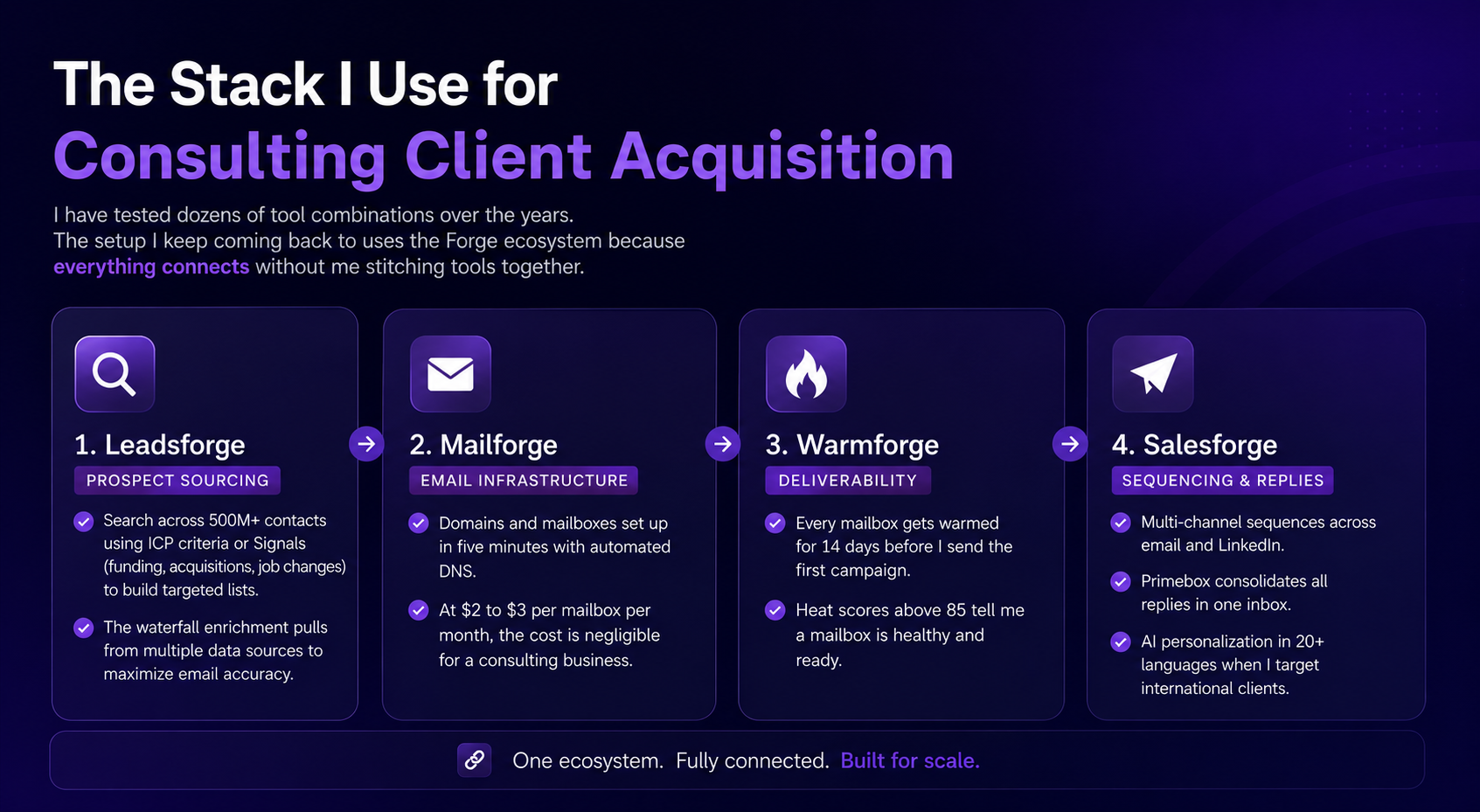
The whole stack from lead sourcing to first email costs less than a single hour of my consulting rate. That is the kind of ROI that compounds.
1: Waiting for referrals instead of building a pipeline. Referrals are great. Depending on them exclusively is dangerous. Build outbound alongside your referral network so you never have a zero-pipeline month.
2: Pitching too early. Consulting is a high-trust sale. Your first message should start a conversation, not close a deal. Ask questions. Listen. Diagnose. Then propose.
3: Targeting too broadly. "I help companies improve" is not a positioning statement. The narrower your niche, the easier it is to find clients who need exactly what you offer.
4: Ignoring deliverability. If you send cold emails from a domain you just bought yesterday without any warmup, your messages will land in spam. Set up proper infrastructure before you send a single campaign.
5: Giving up after 50 emails. Cold outreach is not a lottery ticket. It is a volume game with a learning curve. Track your open rates, reply rates, and meeting rates. Adjust your messaging based on data. Most consultants quit before they collect enough data to optimize.
Start with 20 to 30 emails per warmed mailbox per day. If you are targeting enterprise prospects in high-security industries like finance or healthcare, drop to 5 to 10 per day. Quality matters more than volume for consulting. Ten well-researched, personalized emails will outperform 200 generic templates every time.
Cold email and LinkedIn outreach combined in a multi-channel sequence produce the best results. Email scales better. LinkedIn has higher reply rates. Using both together compounds your touchpoints and keeps you visible across channels. Tools like Salesforge let you run both from one platform.
Expect two to four weeks from first email to booked meeting, and another two to six weeks from meeting to signed engagement. The timeline depends on your deal size, decision-making speed in your target market, and how well your messaging resonates. Smaller engagements ($5K to $15K) close faster. Larger ones ($50K+) take longer because more stakeholders are involved.
Not to start. A strong LinkedIn profile with a clear headline, relevant experience, and a few posts demonstrating your expertise is enough for initial outreach. A website helps with credibility once prospects start researching you, but it should not be a blocker to starting outreach. You can always build one later while your pipeline fills.
Lead databases like Leadsforge let you search 500M+ contacts by job title, industry, company size, and location. The platform uses waterfall enrichment from multiple data providers to verify email addresses, which gives you higher accuracy than single-source tools. You can also use Leadsforge's Signals feature to find decision-makers at companies going through funding rounds, acquisitions, or leadership changes.
Keep it short. Lead with a specific observation about the prospect's business or a recent event at their company. Follow with one sentence about a relevant result you achieved for a similar client. End with a low-commitment ask like a 15-minute call. The entire email should be under 80 words. Skip the company overview, the service list, and the three paragraphs about your background. For tested examples, check this guide on cold email templates that get replies.
Yes. Cold email is legal in the United States under the CAN-SPAM Act and in Europe under GDPR, provided you follow the rules. Include a clear unsubscribe option, use accurate sender information, and do not use misleading subject lines. For B2B outreach under GDPR, you need a legitimate business interest in contacting the person. Consulting outreach to a relevant decision-maker qualifies.
.jpg)

.jpg)

.png)