Last week I recorded a podcast episode that changed how I think about LinkedIn social selling.
I sat across from Alan Ruchtein and Hlib Storchak for just over an hour. Alan is an Argentina-born sales consultant based in Barcelona with 62K LinkedIn followers. Hlib runs GTM consulting for B2B companies and tripled his following to 10K in under 12 months. I have about 40K followers and a bacon emoji that people remember more than my actual name.
Between the three of us there are over 110K followers of combined experience building pipeline from LinkedIn.
But the conversation was not about followers at all. It was about what actually fills a calendar with qualified meetings.
Everything that follows is what Alan and Hlib shared during that session. I added my own plays from running outbound at Salesforge where relevant.
The biggest myth Hlib wanted to kill immediately was the idea that you need a viral post to land clients from LinkedIn.
His exact framing was simple. You do not need to go viral in order to get a lot of clients from LinkedIn. Instead of treating every post like a lottery ticket he treats LinkedIn as one piece of a larger pipeline. A prospect might see a cold email first. Before replying they check his profile. They read a few posts. Maybe they watch a YouTube video. Then they book a call.
The post did not close the deal. The post built just enough trust to move the conversation forward.
Alan backed this up with hard numbers from his own experiment. He published the same lead magnet post three separate times over 12 months. The first version generated 3,000 comments and over 1,000 newsletter subscribers. The second version six months later got half the reach but roughly the same inbound DMs. The third version one week before our recording got 25 comments and 1,000 impressions. Four people still reached out directly and two of them closed.
The reach collapsed by a factor of 250. The pipeline stayed the same.
That tells you something fundamental about how LinkedIn works in 2026. The algorithm changes constantly. Alan said it plainly. The LinkedIn algorithm is changing so much that it is unpredictable. But buyer psychology does not change. People still buy from practitioners they trust. And LinkedIn social selling is the practice of earning that trust one interaction at a time.
Both Alan and Hlib described the LinkedIn profile the same way. It is a landing page.
Before anyone books a call or replies to an outreach message they will click on your profile. The profile has one job. Convince the visitor in a few seconds that they are in the right place.
Alan laid out the golden rule. If your banner shows a picture of Chicago and your headline says you help fintech companies and your About section talks about something completely different then nobody will understand what you do. The message has to be consistent across every element.
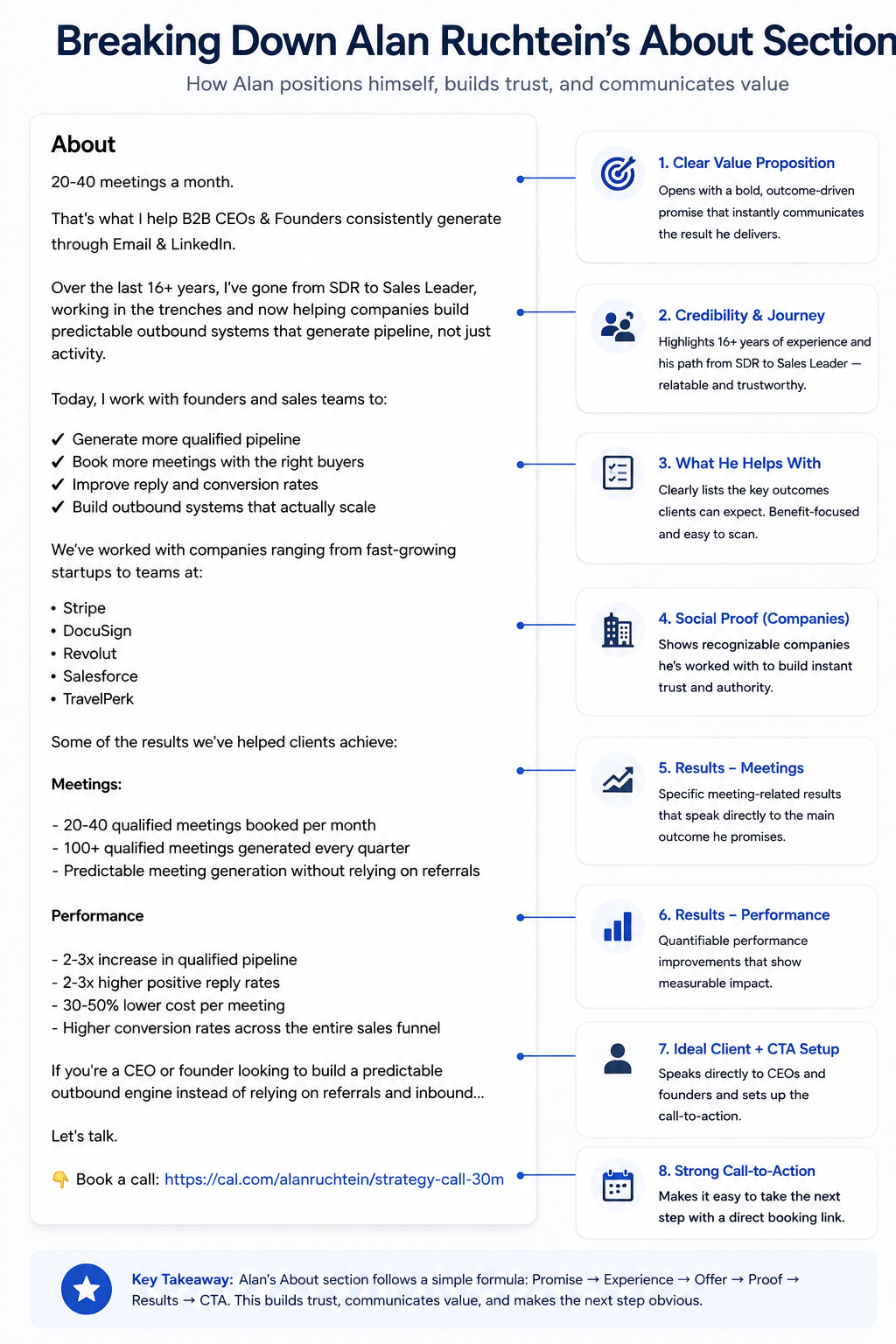
He broke it down into a formula. Start with the offer. The offer is three pieces. Who you help. What outcome you create. What process you use to get them there. Once you have those three answers everything else writes itself.
The banner reinforces positioning. The headline communicates the value proposition. The About section expands on the story and process. The Featured section provides proof through videos and case studies and lead magnets.
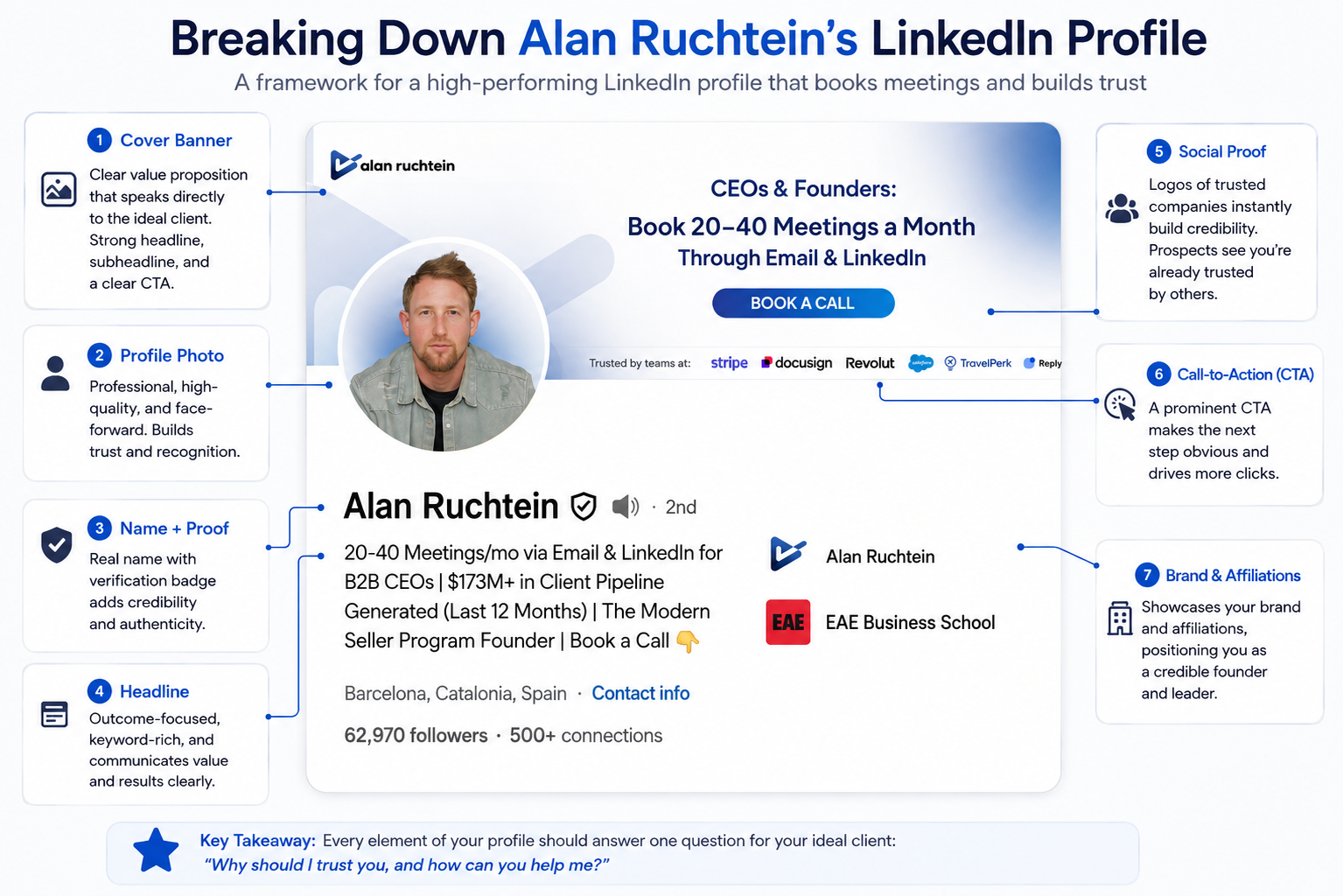
Hlib added a specific point about headlines. He sees too many professionals writing about themselves in third person. The fix is simple. If you do something say it directly. I build X. I help X achieve Y. That specificity builds credibility faster than any clever wordplay.
One tactic from Hlib that generates consistent inbound is putting a DM keyword directly in his headline. His prompt is simple. DM me the word Grow. Every month a handful of qualified people message him with just that word. The keyword lowers the barrier to starting a conversation.
Alan reinforced this with a broader principle. If you keep providing value through posts and content but never tell people what action to take then most people will not act. It is a psychological truth. You need a clear CTA on the profile. Book a call. DM me this keyword. Join my newsletter. Pick one and make it obvious.
The Featured section is where Alan drives particularly strong results. He uses YouTube videos that answer narrow questions about his area of expertise. When a prospect reaches out he can send a seven-minute walkthrough that explains exactly how he operates. By the time they get on a call the prospect already understands his process and is 50% sold before the conversation starts.
This was the section of the conversation where both operators got animated.
Hlib said it directly. In 2026 a significant portion of pipeline comes from comments rather than posts. From the data he tracks up to 40% of total reach can come from commenting on other people's posts.
The math behind this is straightforward. If you comment on a post from someone who has 50K followers and that comment gets strong engagement then your profile is being exposed to an audience you would never reach with your own posts alone. The key is commenting on people in your space who have access to your ideal customer profile.
Alan agreed but added important context. The comment itself has to be worth reading. Saying great post or well said does not work and never did. The comments that drive followers and profile visits fall into two categories. Contrarian opinions that challenge the original post with a different perspective. Or value-add contributions that expand on the topic with specific resources or frameworks.
If you do not have something genuinely useful to add then do not comment at all. Both operators were clear on that point.
On timing I shared my own approach. I click the bell icon on every major creator in our space. The first comment on a post gets the most visibility. Being early and being thoughtful is the combination that drives the highest return.
Hlib confirmed this with specific numbers. He said it is much easier for him to get 3K impressions from a single comment than from an entire post. A contrarian take on a trending topic can easily generate 5K to 10K impressions and a wave of new followers.
What I optimize for in my own commenting is not likes or reactions but saves and sends. When someone forwards a post to a colleague or saves it for later that signal tells the algorithm this content is genuinely useful. I believe saves and sends boost distribution more than comments or reactions because a lot of reactions and comments on LinkedIn are now automated.
Alan shared the exact content framework he follows and it maps cleanly to a GTM funnel.
He splits his posts into three tiers:
TierShareGoalExampleTop-of-funnel~10%Maximum eyeballsTrending topics and news — a company raising a round, a shift in AI tooling, a geopolitical event affecting sales teamsMiddle-of-funnel~80%Build trust and show expertiseHow-to content, frameworks, and step-by-step breakdowns from his own client workBottom-of-funnel~10%Drive actionCase study posts ending in a direct CTA: "Would you like the same transformation? DM me."
On the middle tier he made a point that stuck with me. Do not be afraid of sharing everything even if it is painful and you would like to charge for it. The people who can execute on their own were never going to hire you anyway. The people who cannot execute will see your expertise and reach out.
On the mechanics of posting both operators agreed that the hook is the single most important element. Hlib AB tests different hook variations for the same post and credits this practice as a major growth driver. His most viral post ever started with the line I am quitting LinkedIn. It was clickbait. It worked. The goal is getting people to click the See More button. Everything after that is secondary.
Both operators use AI for ideation and formatting. Alan built a custom GPT with his tone preferences and a library of hook templates. He feeds it a topic and it drafts the post. Hlib uses Claude for spinning up hook variations and formatting posts for scannability. Neither of them uses AI to replace the thinking. They use it to accelerate the packaging.
One format note. Text-only posts and text-plus-image posts outperform every other format on LinkedIn right now. Video posts get dramatically lower reach. I still post videos because the per-impression engagement rate is higher and they create strong brand recall. But if you are optimizing purely for distribution then text is the format.
Publishing content is step one. The real value comes from what happens after someone engages with it.
Both operators have a clear process. When someone who matches their ICP comments on a post or reacts to it they start a conversation. Not a pitch. A conversation.
Hlib described his approach. He responds to every non-AI comment. If the person fits his target profile he replies in the comment thread and then takes the conversation to DMs. He does not want to text back and forth for days. If there is a potential fit he moves directly to booking a call. Sometimes the same day.
Alan takes a different route that involves a permission layer. Instead of immediately sending a long voice note or a pitch he asks a simple question first. Something like this. Hey thanks for commenting. Looks like we are both interested in this topic. Mind if I send you a quick voice note?
Nobody says no to that. Then he sends a short voice note. Not a two-minute sales pitch. Just a real human saying hello. He often follows up with a quick selfie video from wherever he happens to be. Greetings from sunny Barcelona. Then he asks about their business.
The selfie videos while walking generated the strongest responses in both their experiences. The movement in the background creates a pattern interrupt. People actually watch them instead of scrolling past.
I add a localization layer to my own DMs. If I know someone is from a specific country I open with a greeting in their language. Hola. Bonjour. Moin. It is a small detail but it creates what I call cultural affinity. People respond to signals that you took two seconds to acknowledge where they are from. It changes the tone of the entire conversation.
One practical tool recommendation from the session. If you prefer talking over typing use Whisper Flow or a similar speech-to-text tool. You get the speed and detail of speaking with the readability of text. Several people on my team already work this way.
This section of the conversation produced the most actionable playbooks.
Alan started by drawing a distinction that most people miss. Signals, triggers, and intent are not the same thing:
The best prospecting engines layer all three together. A company just raised funding (trigger). Their VP of Sales followed two of your competitors on LinkedIn (signal). And they visited your pricing page last week (intent). That is when you reach out.
The highest-volume signal-based outbound play I run at Salesforge is competitor follower extraction. We pull the full follower list of competitor company pages on LinkedIn. We filter that list to match our ideal customer profile. Then we send a one-line message.
The message is this. Hey so you are following [Competitor]. Do you use them by any chance?
That is it. No pitch. No feature list. Just a question. And it consistently generates 20 to 40% reply rates. People respond with yes or no or some reasoning about why they follow that company. Either way the conversation is started.
Hlib shared a play specific to his Scandinavian market. His team uses Trigify to monitor people posting in native languages about needing meeting booking agencies or outbound help. When someone posts in Swedish asking for recommendations for a cold calling agency his team is in the comments within minutes.
Alan added a more advanced angle. His team built monitoring around headcount growth rates in specific departments. Not just whether a company is hiring but how fast a particular team is growing relative to the rest of the organization. From there they map the trigger to a consequence. If your sales team grew 40% in six months but your pipeline did not keep pace then in 90 days you will have a capacity problem. That is the message. Not congratulations on the new hires. But here is what happens next if you do not act.
Neither Alan nor Hlib treats social selling as a standalone channel.
Hlib described how cold email and LinkedIn feed each other. He sends cold emails through Salesforge. A prospect who ignores the email might still visit his LinkedIn profile. They see his posts and his content. A few days later they add him and say something like I saw your cold email and checked out your profile. I like what you do. That is how the call gets booked.
Alan was even more direct. If you are serious about making money from LinkedIn you must combine social selling with outbound. Unless you are the number one creator in your category with more demand than you can handle you need to be proactive about starting conversations.
One play I use at Salesforge is turning LinkedIn posts into blog content. When a post resonates particularly well I send it to the content team and we expand it into a full article on the Salesforge blog. We reference the original post in the article and link back to the LinkedIn profile. This creates a loop. LinkedIn audience discovers the blog. Blog readers discover the LinkedIn profile. Both channels grow together.
The content also becomes fuel for outbound sequences. A strong post can become a conversation starter in connection requests. A case study post becomes a resource to share during follow-ups. A walkthrough video becomes a credibility asset that prospects reference during sales calls.
When your social selling and your outbound engine reinforce each other every piece of content keeps generating pipeline long after the initial 24-hour distribution window closes.
Both operators were blunt about this.
Alan called it crap. He said he fully supports AI and technology for accelerating workflows. But using bots to spam comments on other people's posts is a different thing entirely. It destroys credibility and it does not build relationships.
Hlib agreed and added a prediction. In the future the more authentic you are on LinkedIn the further ahead you will be. The verified identity badge on LinkedIn exists for a reason. And if your business depends on LinkedIn then getting your account restricted by automated behavior is a risk you cannot afford.
One example from our team. I have an intern in the office whose primary job right now is commenting on LinkedIn. His target is 50 comments per day. Not AI-generated comments. Fifty comments that genuinely add something to the conversation. In two weeks he went from one connection to 80. His comments were not great in the beginning. He even said something tone-deaf on a competitor post early on. But he is learning by doing. And that learning process is how you actually develop the skill of engaging well on LinkedIn.
The takeaway from both operators is consistent. Spend 30 focused minutes per day engaging with people you actually want to do business with. Build your list of target accounts. Turn on the bell notification. Comment with substance. Take the conversation to DMs when there is a fit. That is LinkedIn social selling in 2026. There is no shortcut that preserves the trust you are trying to build.
Both Alan and Hlib do paid brand partnerships on LinkedIn. I have never done one myself but the economics they described were worth documenting.
Alan framed it simply. Brands buy your trust. They cannot buy your profile so they buy your voice. The ROI for the brand is typically higher from a creator collaboration than from running ads because people trust people more than they trust corporate ad copy.
He tracks performance through UTMs and CPMs. Some partnerships are one-off sponsored posts. Others are longer-term ambassador relationships where the creator becomes a consistent presence across webinars and collaborative content.
An interesting trend Alan highlighted is the shift toward micro-influencers in B2B. Some creators with 10K to 20K followers are charging more and delivering higher ROI than creators with 50K or 100K followers. The algorithm does not always reward bigger accounts with proportionally bigger reach. A smaller creator with tight audience alignment can outperform a large account with a diffuse following.
Platforms like Limelight and Passion Fruit now function as marketplaces matching B2B brands with creators. If you are building a following and want to monetize beyond direct client work these platforms are worth exploring.
Social selling builds trust. Outbound starts conversations. Salesforge lets you run both from one platform. Launch email and LinkedIn sequences with unlimited mailboxes and unlimited LinkedIn senders. Or let Agent Frank handle prospecting and meeting booking entirely. Build your lead lists in Leadsforge. Warm your infrastructure with Warmforge. Start a free trial today.
Both operators in this conversation spend four to six hours per week across posting and commenting and DMs. Consistency matters more than volume. Thirty focused minutes per day of commenting and engaging with your target audience compounds faster than sporadic bursts of heavy activity.
Text-only posts and text-plus-image posts consistently outperform every other format for reach. Video posts get significantly lower distribution but generate higher engagement per impression. If you are optimizing for maximum distribution stick with text. If you are optimizing for brand recall and deep engagement add occasional video.
Focus on three things. Optimize your profile to convert visitors into conversations. Comment on posts from larger creators who share your target audience. And monitor LinkedIn signals like competitor followers and engagement to identify warm prospects for direct outreach.
Sales Navigator gives you advanced filters for identifying prospects by job title and company size and intent signals. It is useful but not required. You can run an effective social selling motion with a free LinkedIn account by focusing on commenting strategy and direct engagement with your ICP.
Social selling builds trust over time through content and engagement. Cold outreach starts conversations with people who do not know you yet. The best results come from combining both. Your LinkedIn presence warms prospects before your cold email arrives which increases reply rates and conversion.
Track profile visits and connection requests from target accounts. Monitor DMs that lead to discovery calls. Count the number of deals where the buyer mentioned your LinkedIn content or profile during the sales process. Impressions and reactions are secondary indicators. Pipeline generated and deals closed are the metrics that matter.
.png)