Let me start with the problem email verification tools actually solve, because it's bigger than most people realize.
Every invalid email address you send to isn't just a wasted email. It's a hit to your sender reputation. As your bounce rate goes up, inbox providers start losing trust in you, and eventually even valid emails can end up in the spam folder.
That's why email verification matters.
Verifying your list before you hit send is one of the highest-impact things you can do to improve cold email performance. And once you're sending at any meaningful volume, doing it manually simply isn't an option. You need software.
That said, there's one thing worth pointing out before we compare the tools, because it changes how you should evaluate them.
The term email verification tool actually covers three different types of products. Some are dedicated verification platforms built solely to clean email lists.
Others are cold email platforms that include verification as one feature among many. And one tool on this list is primarily a deliverability platform that added email verification later.
These products solve different problems, so they aren't directly interchangeable.
To make the comparison fair, I've grouped them based on what they actually do.
Let's start with a quick comparison, then I'll walk you through the 6 best email verification tools in detail.
This table is built around what matters when you are shopping for verification specifically. That includes what type of tool it is, its accuracy story, the free tier, pricing, and G2 standing.
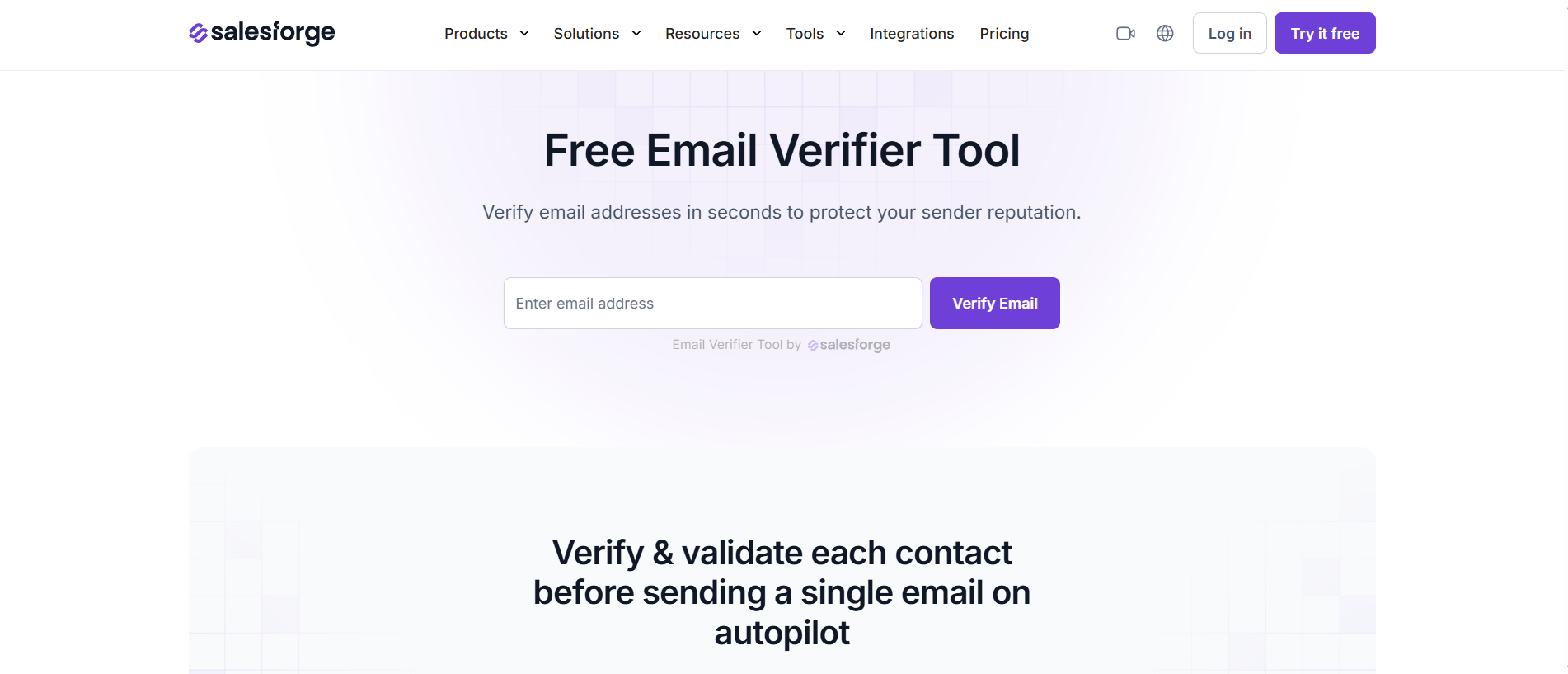
It is a free tool that runs checks across syntax, domain status, and mail-server response. It returns a 0 to 100 risk score for every address you test.
You can verify a single address in real time or run a batch. The checks flag invalid domains, inactive mailboxes, and risky addresses before they ever touch a campaign. Paid plans also bundle validation credits so you can verify inside active sequences without switching tools.
The risk-score format is what I found most useful in practice. Instead of a binary valid or invalid, you get a scale. That gives you room to decide your own threshold based on how aggressive your sending volume is.
But here is why I still put it first. Most outbound teams do not buy a verifier in isolation. They verify so they can send.
Salesforge is the only tool on this list where verified addresses feed directly into multichannel sequences, Warmforge warmup, and Primebox™ reply management without a single CSV export. That closed loop between verification and sending is the real edge.
Pros
Free verifier tool with standard checks and a 0 to 100 risk score
Validation credits bundled into paid plans for in-workflow checks
Native LinkedIn and AI-SDR automation around it
Free warmup through Warmforge and unified inbox through Primebox™
Cons
Not a dedicated verifier; verification is one feature among many
No published accuracy percentage or methodology detail
Verification is bundled, not sold standalone per credit
Pricing Plans (Billed Annually)
Free email-verifier tool
Pro: $40/month (includes 100 email-validation credits per month)
Growth: $80/month
What Users Have to Say?
Salesforge holds a 4.6/5 on G2 from 126 reviews, with support and overall experience highlighted:
"Overall, we love it! customer support is truly outstanding"
If you are evaluating Salesforge against other sending platforms, I covered a broader comparison in my best cold email software breakdown.
2. Bouncer
Best for: Privacy-conscious teams that want a clean, EU-hosted standalone verifier with strong catch-all and toxicity detection.
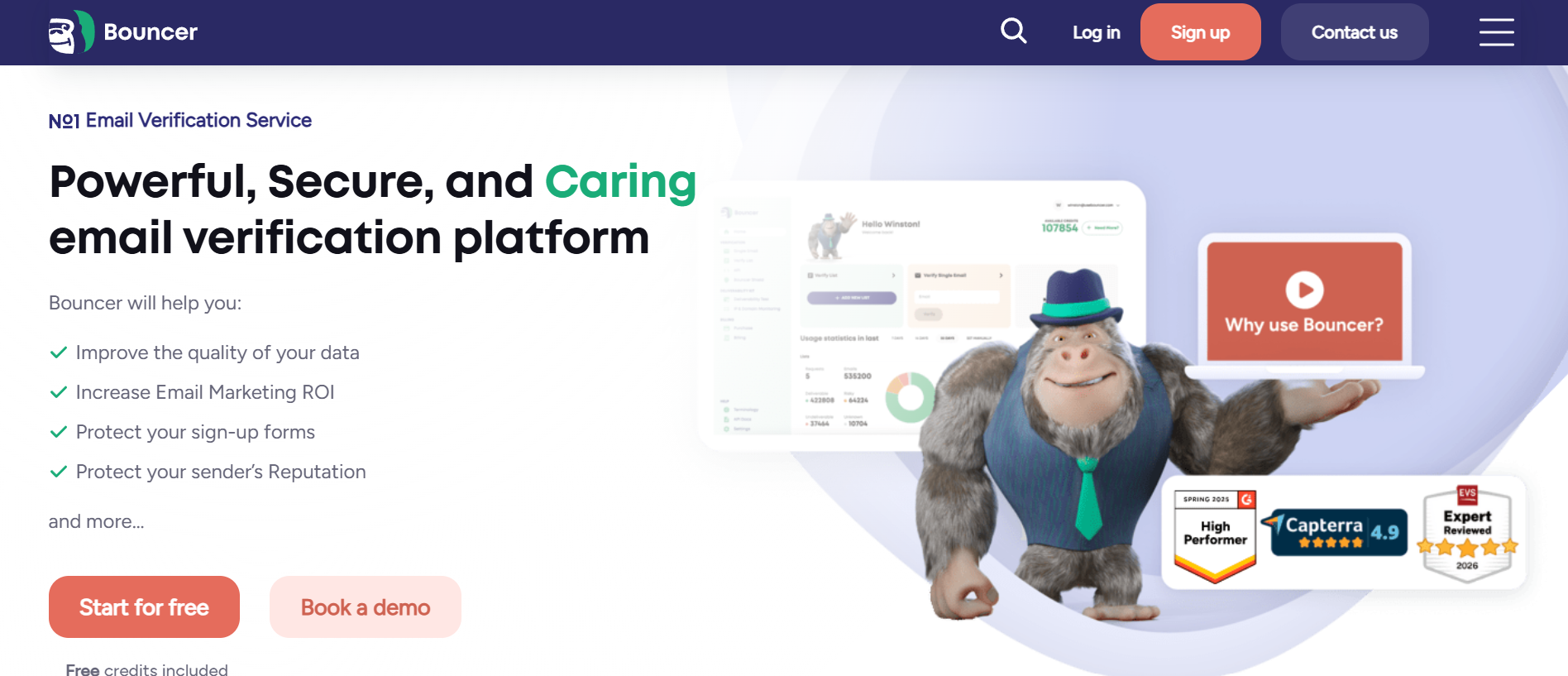
Then there is Bouncer, a dedicated, EU-based email verification platform. It markets top-notch accuracy with under 2% unknown results. It claims 4 billion-plus emails verified. Notably, it does not charge you for duplicates or unknowns.
The checks cover syntax, MX, SMTP, deep catch-all verification, role-based, and disposable addresses. Its Toxicity Check flags spam traps and breached, complainer, or litigator addresses on a 0 to 5 scale. That is a genuinely useful layer for protecting deliverability.
It handles both bulk verification in the app and synchronous or asynchronous API calls. There is also a Shield product for real-time signup-form protection. For teams that care about data residency, it is GDPR compliant and hosted in the EU, with never-expiring pay-as-you-go credits.
Compared with Salesforge, Bouncer is the deeper standalone verifier with toxicity scoring and an explicit compliance story. Salesforge wins on being the connected outbound stack where verification feeds directly into sequences and warmup. The main thing to note is that the Deliverability Kit is a separate subscription.
Pros
Dedicated verifier with deep catch-all and toxicity and spam-trap detection
Never-expiring pay-as-you-go credits, with no charge for duplicates or unknowns
EU-hosted and GDPR compliant, with a clean, simple UI
Real-time API (sync and async) plus Shield form protection
Cons
No single headline accuracy guarantee, marketing "<2% unknowns" instead
The Deliverability Kit is a separate subscription
Per-email cost is higher than some at very small volume
Pricing Plans
100 free credits to start, no card required
Pay-as-you-go from $8 per 1,000 ($0.008 per email), scaling toward $0.002 per email at 1M
Deliverability Kit as a separate subscription ($25 to $250/month)
What Users Have to Say?
Bouncer carries a 4.8/5 on G2 from 336 reviews, with bounce reduction a common note:
Understanding the deliverability side matters as much as list cleaning. I covered the bigger picture in my cold email deliverability guide.
3. ZeroBounce
Best for: Larger or regulated senders who want guaranteed accuracy and enterprise-grade compliance.
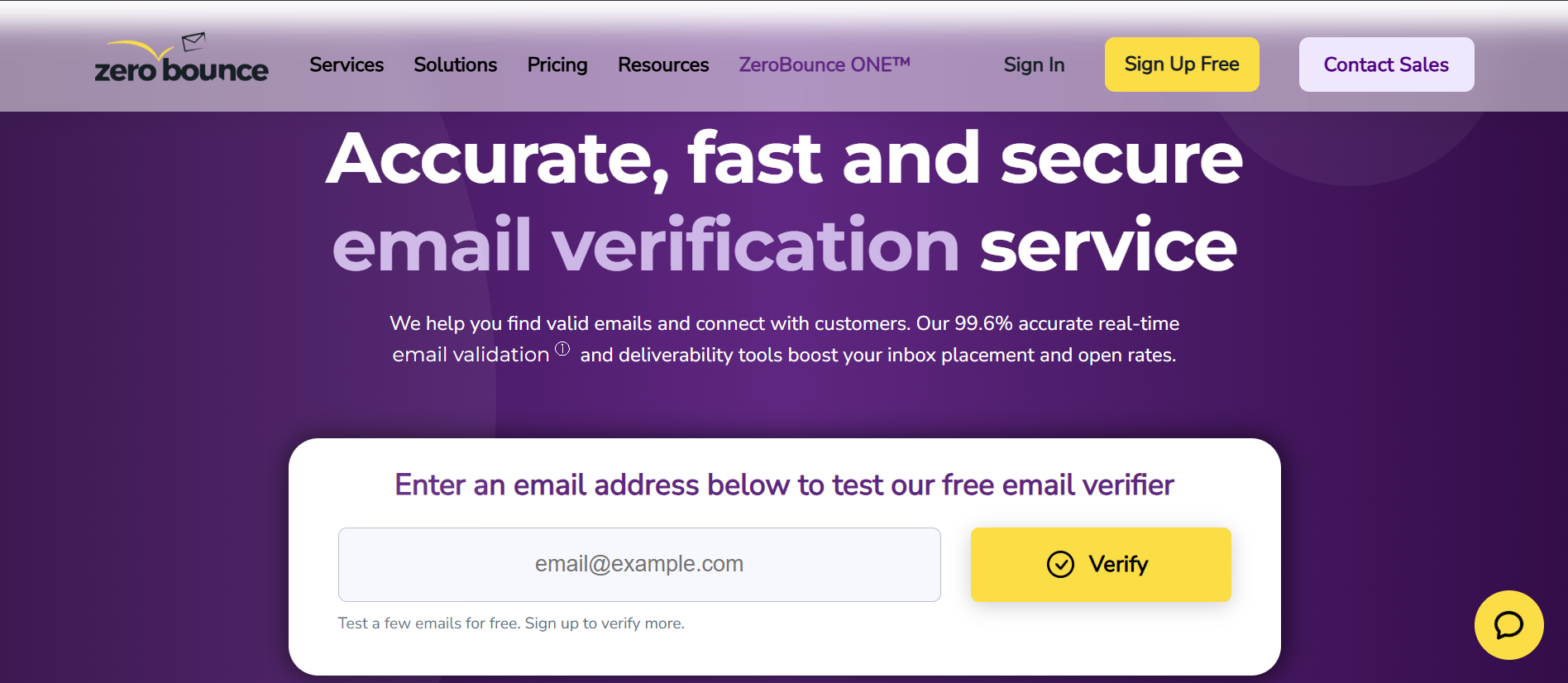
Moving on, ZeroBounce is the closest thing to a gold standard among dedicated verifiers. It is the only tool here with an explicit accuracy guarantee, at 99.6%. It backs that with the widest verification toolset.
The checks span syntax, MX, SMTP, and catch-all with a "Verify+" option for fewer unknowns. It also covers role-based, disposable, abuse, and spam-trap detection, plus AI email scoring. It runs single, bulk, and real-time API verification with strong reliability.
Where it really separates itself is compliance. ZeroBounce is SOC 2 Type 2 and ISO-27001 certified. It is also GDPR, HIPAA, and CCPA aligned. That is the strongest certification story in this set and matters a lot for regulated industries.
Compared with Salesforge, ZeroBounce is the dedicated engine with the guarantee and the certifications. Salesforge wins on giving you verification inside the multichannel outreach workflow. The trade-offs with ZeroBounce are a higher per-credit cost and a 2,000-credit minimum. You still need a separate tool to actually send.
Pros
99.6% accuracy, guaranteed, the only explicit guarantee here
Strongest compliance, with SOC 2 Type 2, ISO-27001, GDPR, HIPAA, and CCPA
Widest toolset, including AI scoring, spam-trap detection, and Verify+ for catch-alls
100 free credits a month, with a fast, reliable API
Cons
Higher per-credit cost with a 2,000-credit minimum
A dedicated engine, so it does not send (you still need an outreach tool)
Can be more than a small sender needs
Pricing Plans
100 free validation credits per month (free with a business domain)
Pay-as-you-go from a 2,000-credit minimum, with volume discounts
ZeroBounce ONE subscription from $99/month (10k credits) with a PAYG discount
What Users Have to Say?
ZeroBounce holds a 4.7/5 on G2 from 1,367 reviews, the largest review base here. Accuracy is the standout:
Best for: B2B teams selling into mid-market and enterprise who keep getting burned by catch-alls and Secure Email Gateways.
Next up is AllegroW, and the category flag matters here too. AllegroW describes itself as the number one inbox-placement platform.
That means it is primarily a deliverability tool. It covers inbox-placement testing, spam-rate tracking, domain health, and authentication monitoring. Verification is a complementary capability, not the core product.
One quick note from the research: the right domain is allegrow.co, since allegrow.com is an unrelated firm.
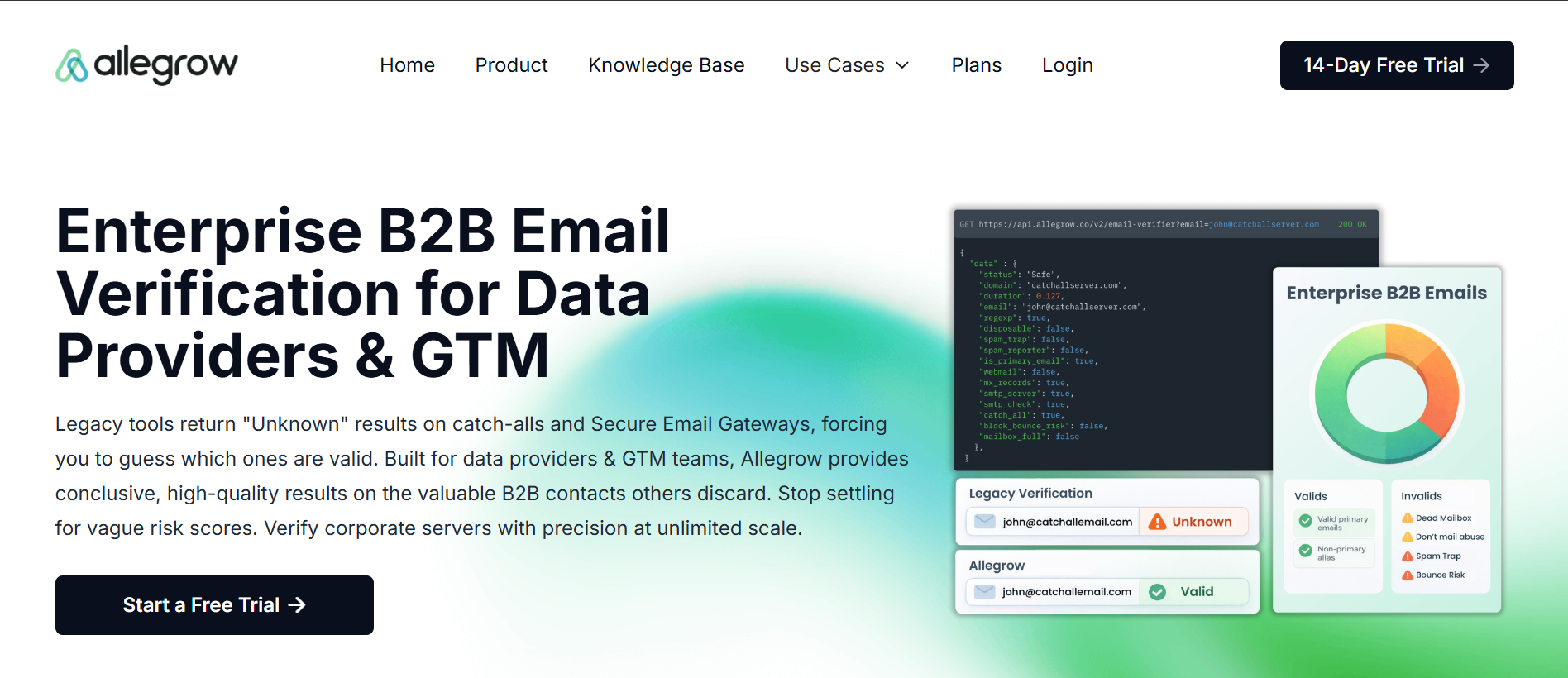
On verification, it skips a headline accuracy percentage. Instead it pitches conclusive Valid or Invalid results on the hard cases that legacy tools mark "unknown."
Its specialty is corporate catch-all servers and Secure Email Gateways like Mimecast and Proofpoint. It resolves these through signal-based analysis and managed rotating-IP infrastructure, without sending test emails.
It also offers Primary Email Detection to find a decision-maker's actively monitored inbox. Compared with Salesforge, these are different jobs. AllegroW is premium enterprise catch-all resolution at $99 to $1,340 a month.
Salesforge is a multichannel outbound stack with verification built into the workflow. AllegroW wins on enterprise depth and SOC 2 compliance. Salesforge wins on price, breadth, and connected sending.
Pros
Resolves corporate catch-alls and Secure Email Gateways like Mimecast and Proofpoint
Conclusive Valid or Invalid on hard cases, without sending test emails
Primary Email Detection finds the actively monitored inbox
SOC 2 certified, with native HubSpot, Outreach, and Salesloft gatekeeping
Cons
Deliverability-first, so verification is a secondary capability
Premium pricing ($99 to $1,340/month), not pay-per-credit at small scale
Overkill for a one-off list clean
Pricing Plans (Billed Annually)
14-day free trial for 1,000 contacts, no card
Starter: $99/month (5,000 contacts, plus $8 per 1,000 add-on)
Scale Plus Unlimited: $1,340/month (unlimited verification plus the full deliverability suite)
API plan: Custom
What Users Have to Say?
AllegroW holds a 4.8/5 on G2 from 61 reviews, with lower bounce rates the recurring theme:
If you are comparing outreach tools alongside your verification setup, I covered ten options in my AI outreach tools comparison.
5. Mailcheck
Best for: Cost-sensitive small businesses that want cheap recurring verification with a social-data scoring twist.
Finally in the dedicated verifier category, there is Mailcheck, a budget email and phone verification tool with a distinctive angle.
On top of standard checks, it validates addresses using social-network and multi-source data. It assigns a "trust rate" score, which is an unusual method in this category.
It markets up to 5x higher delivery and a speed claim of a million emails verified in around 15 minutes. It runs both real-time and bulk verification with an API and does not charge for duplicates. One thing to watch is the name, since it is easy to confuse with MailerCheck.com or browser "mailcheck" libraries.
The honest caveats are that there is no published accuracy percentage. The documented detail on spam-trap, greylisting, and role-based handling is lighter than ZeroBounce or Bouncer.
Compared with Salesforge, both are inexpensive. Mailcheck is a cheap standalone subscription with a social-data scoring angle.
Salesforge bundles verification into a multichannel AI-SDR platform with a clearer workflow integration. Mailcheck wins on rock-bottom monthly entry. Salesforge wins on connected sending and outbound automation.
Pros
Rock-bottom monthly entry at $10/month
Social-network and multi-source data adds a "trust rate" score
Real-time and bulk verification with an API, plus a 40-day money-back guarantee
Cons
No published accuracy percentage and lighter spec detail
A very small review base, at just 6 on G2
Subscription tiers rather than flexible, never-expiring credits
Pricing Plans
10 free verifications without billing, 100 with billing added
Pro: $10/month (1,000 emails, $0.005 overage)
Agency: $30/month (5,000 emails, $0.004 overage)
Enterprise: $90/month (20,000 emails, $0.003 overage), plus custom tiers
What Users Have to Say?
Mailcheck shows a 4.8/5 on G2, but from only 6 reviews. That is far too small to read much into. For what it is worth, one reviewer called it:
Best for: Email-first outbound teams that want verification built into the same tool they use to send, without needing LinkedIn or AI SDR features.
Last on this list is the Saleshandy Email Verifier, a free verifier built into the wider Saleshandy cold outreach platform.
It is not a standalone product. It runs a multi-layer check covering syntax, domain status, MX records, catch-all domains, and a live mail-server SMTP response. It then labels each result Valid, Risky, or Invalid.
You can verify a single address in real time or upload a CSV for bulk cleaning, and download the clean results. Saleshandy positions it around a claimed 98%-plus accuracy and reducing bounces. There is no formal bounce-rate guarantee.
The argument for it is workflow convenience. The verifier lives inside the same platform as your sequences, warm-up, unified inbox, and 852 million contact database.
You verify and send in one place instead of paying a separate vendor. That said, I want to be honest about the trade-off.
As a platform feature, it does not match a dedicated engine like ZeroBounce on guaranteed accuracy or compliance certifications. It also lacks Bouncer's dedicated toxicity and spam-trap module.
Pros
Verification built into the same tool you send from
Because these tools fall into three different categories, the first question is not which is best, but which type fits your situation.
If you want verification inside the same platform you send from, Salesforge is the strongest choice for most outbound teams. You get verification, multichannel sequences across email and LinkedIn, free warmup through Warmforge, unified replies in Primebox™, and optional AI SDR automation through Agent Frank. And for teams where verification is one step in a connected outbound workflow, that trade-off is worth it.
Frequently Asked Questions
What is an email verification tool?
An email verification tool checks whether the addresses on your list are real, deliverable, and safe to email before you send. It typically runs layered checks, including syntax, domain and MX records, and a live mail-server response. It then labels each address as valid, risky, or invalid. Cleaning your list this way protects your sender reputation and keeps your bounce rate low.
Why does email verification matter for cold email?
Because bounces are expensive in more ways than one. Every invalid address that bounces signals to mailbox providers that you are not maintaining your list. That drags down your sender reputation and pushes even your valid emails toward spam. Verifying before you send keeps bounce rates low, which is one of the biggest factors in landing in the primary inbox. I broke this down in more detail in my cold email guide.
What accuracy should I look for in a verifier?
Most quality verifiers operate in the high 90s for accuracy, but claims vary in how they are measured. ZeroBounce is the only tool here that publishes an explicit guarantee, at 99.6%. Others market low "unknown" rates instead. A practical target is keeping your bounce rate under 2%. A good verifier should get you there on a reasonably fresh list.
What is a catch-all email, and can it be verified?
A catch-all domain accepts mail to any address. That makes individual addresses hard to confirm, since the server will not reject unknown ones outright. Standard verifiers often mark these as risky or unknown. Tools that specialize in catch-alls, like AllegroW for corporate servers, or ZeroBounce's Verify+ and Bouncer's deep catch-all checks, are built to return more conclusive answers on exactly these cases.
What is the best free email verifier?
For free credits, ZeroBounce offers 100 per month with a business domain. Bouncer gives 100 to start, both without expiry on a pay-as-you-go basis. Salesforge includes a free verifier tool with no credit requirement. Saleshandy includes 50 free checks, and Mailcheck offers a small free allowance too. The free tiers are a good way to test accuracy on your own list before paying.
Should I use a standalone verifier or one built into my sending tool?
It depends on your workflow. A built-in verifier like Salesforge's or Saleshandy's is more convenient. You verify and send in one place without exporting lists. A dedicated engine like ZeroBounce or Bouncer offers deeper accuracy guarantees, compliance certifications, and specialist features. Those matter more for large or regulated senders. Many teams use the built-in option for routine cleaning and a dedicated tool for high-stakes lists.
How much does email verification cost?
Pricing usually works one of two ways. Pay-as-you-go tools charge per email, roughly $0.008 per email at small volume with Bouncer. That drops sharply at scale. Subscription tools like Mailcheck start around $10 a month for 1,000 emails. Saleshandy sells verification as an add-on at $19 per 5,000. Enterprise-focused AllegroW runs from $99 a month. Your best value depends heavily on your volume and how often you verify.
Book more meetings on autopilot
Set up in minutes. No per-seat pricing. No commitment.
Compare 5 LinkedFusion alternatives for LinkedIn outreach, with a clear look at pricing, automation, account safety, reply handling, and multichannel features.
Compare 5 ListKit alternatives for sales outreach. See which tools are best for prospecting, cold email, LinkedIn outreach, scaling campaigns, and B2B sales data.


.jpg)
.png)
.jpg)