If you have ever tried to run outbound across email, calls, and LinkedIn all at once, you already know why sales engagement software exists.
Doing it manually means living in five tabs, forgetting follow-ups, and losing track of who actually replied. A good sales engagement platform pulls all of that into one place so your team can focus on conversations instead of admin.
Here is the catch I have run into again and again, though. This category is huge, and the tools sit at wildly different price points. On one end, you have lean, flat-rate platforms built for SMBs and agencies.
On the other, you have enterprise revenue platforms with conversation intelligence and AI forecasting that cost a small fortune and hide pricing behind a demo. Picking the right one really comes down to honestly knowing which side of that line you are on.
I have spent real time inside these tools, so in this guide I break down the 6 sales engagement platforms worth comparing in 2026.
For each one, I cover who it is best for, what it does well, where it falls short, what it costs, and what real users say. Let's get into it.
An In-Depth Review of the 6 Best Sales Engagement Software
1. Salesforge
Best for: SDR teams, agencies, and outbound teams that want email + LinkedIn outreach with unlimited mailboxes and no per-seat pricing.
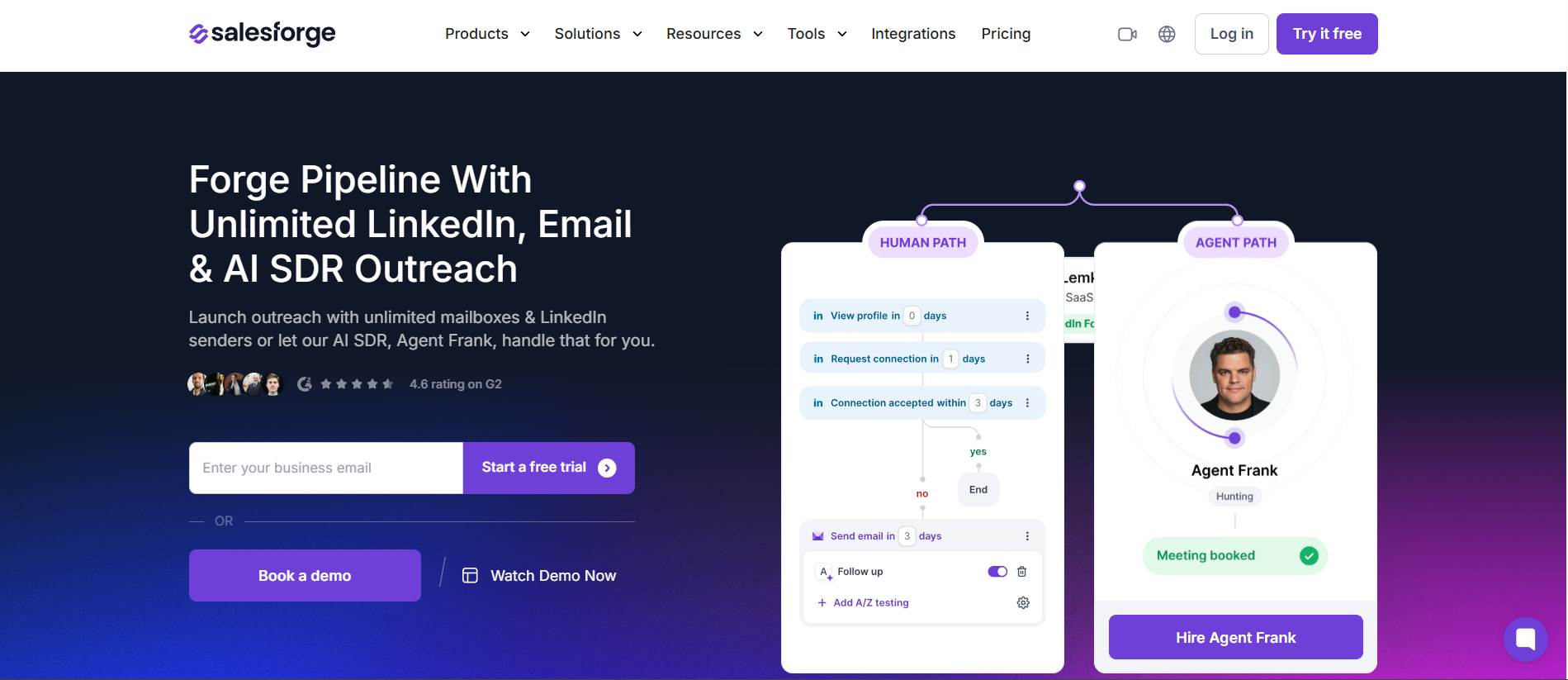
The tool I keep recommending to outbound teams is Salesforge.
The reason comes down to one thing. It puts email and LinkedIn sequencing, unlimited mailboxes, free warmup through Warmforge, and an autonomous AI SDR into a single flat-rate plan. No per-seat math. No surprise add-ons for deliverability.
What makes Salesforge the strongest sales engagement platform on this list is the multichannel angle. You run cold email and LinkedIn outreach from one sequence builder, not two separate tools stitched together.
Unlimited mailboxes come on every plan, so you can rotate senders for deliverability without your bill climbing per inbox. And free unlimited warmup runs automatically through Warmforge, with heat score monitoring and inbox placement tracking built into the same dashboard as your sequences.
Primebox is the feature that surprised me most. When you are running dozens of mailboxes and multiple LinkedIn profiles, replies come in from everywhere. Primebox pulls every email and LinkedIn reply into one unified inbox with two AI modes: Co-Pilot drafts replies for your approval, and Auto-Pilot handles them autonomously.
Then there is Agent Frank, the AI SDR that genuinely changed my workflow. He handles prospecting, writes personalized outreach in 20+ languages, sends sequences, follows up, and books meetings on his own. If you are a lean team that wants to scale pipeline without hiring, Agent Frank is an option I have not seen matched elsewhere.
I covered more AI sales agents in a separate review, and Agent Frank consistently came out on top for autonomous outbound.
The honest limitation is that Salesforge is email and LinkedIn focused. There is no built-in phone dialer. If voice is core to your motion, you will need a separate dialer alongside it. The native CRM is also lighter than what the enterprise platforms offer.
Pros
Email + LinkedIn outreach in one sequence with unlimited mailboxes and unlimited LinkedIn senders
Free unlimited warmup through Warmforge with heat score monitoring and inbox placement tracking
Agent Frank AI SDR for autonomous prospecting, writing, and meeting booking
Primebox unified inbox for managing replies across all mailboxes and LinkedIn profiles
Flat-rate pricing with no per-seat fees, so costs stay predictable as you scale
A/Z testing for multi-variant sequences beyond basic A/B
Cons
No built-in phone dialer, since the platform focuses on email and LinkedIn
Lighter native CRM than enterprise platforms like Salesloft or Outreach
Agent Frank is a premium add-on at $499/month billed quarterly
Smaller G2 review base than some longer-established competitors
Pricing Plans
Pro Plan: $40/month (billed annually)
Growth Plan: $80/month (billed annually)
Agent Frank (AI SDR): $499/month, billed quarterly
What Users Have to Say
Salesforge holds a 4.6/5 on G2 from 126 reviews, with multichannel organization standing out:
"Salesforge Makes Multichannel Outreach Organized and Effective"
Best for: Enterprise revenue teams that want engagement, conversation intelligence, and forecasting in one platform.
Salesloft plays a completely different game from Salesforge. This is a full revenue orchestration platform built for enterprise scale.
On top of multichannel cadences, you get Conversations for conversation intelligence, Forecast for AI forecasting, Deals for opportunity management, and Rhythm, which turns buying signals into prioritized actions for your reps.
In my experience, this is the kind of tool you buy when you have a large, structured sales org and outreach is only one piece of the puzzle. The native dialer, call coaching, deep two-way Salesforce sync, and enterprise admin controls are all genuinely strong. The trade-off is exactly what you would expect at this level.
Pricing is sales-quoted, it bills per seat, and it is far more platform than a small team needs. If you are evaluating whether it fits your stack, I wrote a full breakdown of Salesloft alternatives that maps each competitor by use case.
Pros
Full revenue platform with engagement, forecasting, and deal management
Conversations: conversation intelligence with call recording and coaching
Deep two-way Salesforce sync and one of the largest integration ecosystems
Enterprise-grade admin, governance, and security
Cons
Sales-quoted pricing with no public numbers
Per-seat enterprise cost that adds up quickly
Overkill for small teams that just need outreach
Requires a demo before you can even see pricing
Pricing Plans
Sales-quoted, with no public pricing
Advanced and Elite tiers, plus packaged capabilities for pipeline generation, conversation intelligence, and opportunity management
Per-seat enterprise model, demo required
What Users Have to Say
Salesloft carries a 4.5/5 on G2 from 4,286 reviews, with everyday usability standing out:
"Salesloft Makes Day-to-Day Selling Easy and Organized in One Place"
Best for: Mid-market SDR teams that want multichannel and calling depth at a more reasonable price.
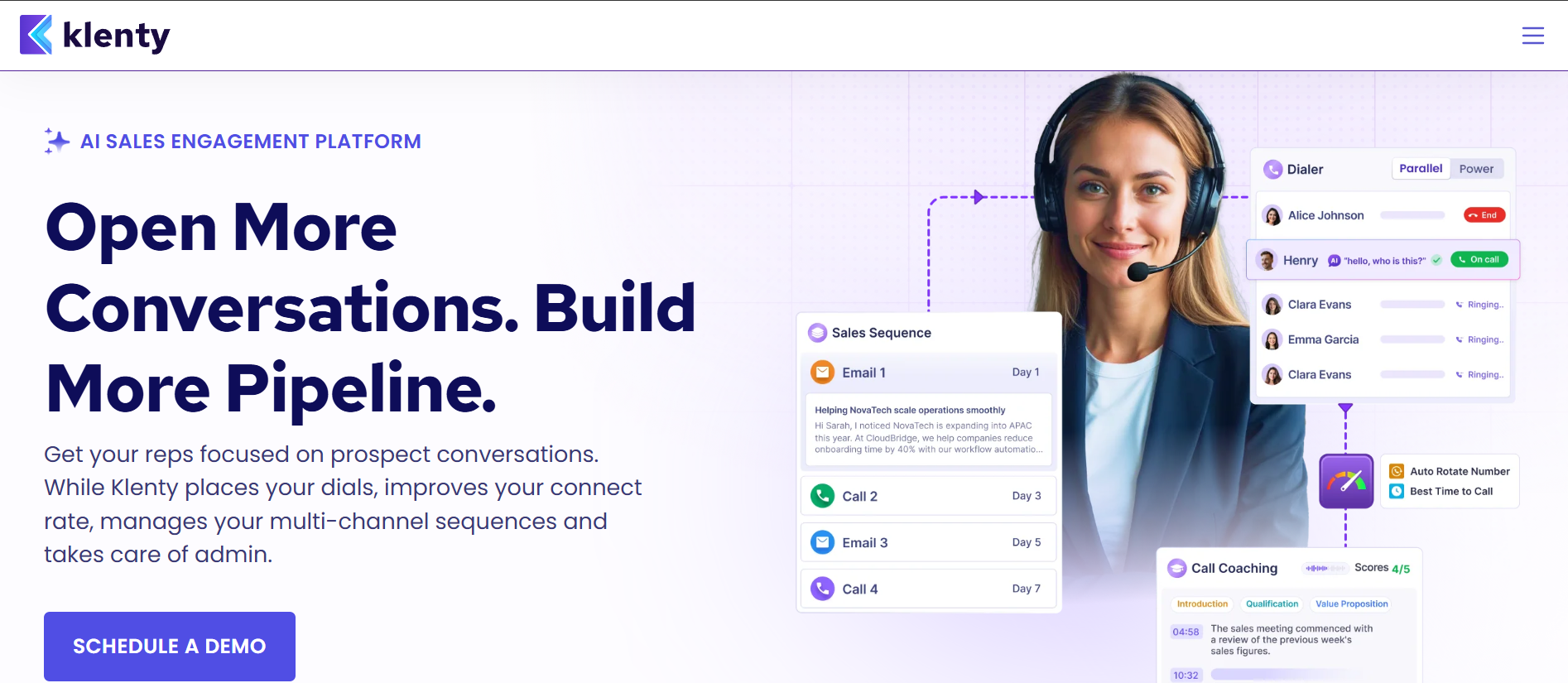
What drew me to Klenty is the calling depth. Most sales engagement platforms treat phone as an afterthought. Klenty does not.
It runs email, cold calling, LinkedIn social selling, and SMS natively. The dialer includes number rotation, local presence, and voicemail drops. A parallel and power dialer is available as an add-on for high-volume calling teams.
The coaching layer is where Klenty punches above its weight class. You get live transcription, AI call scorecards, objection and outcome detection, and battlecards.
That is a lot of conversation intelligence for a mid-market tool. I did a deeper dive into Klenty alternatives if you want a side-by-side against tools at similar price points.
The catch is the per-user model. Like most mid-market tools, the cost climbs as you add reps. And the entry tier is email-only, so multichannel needs a higher plan.
Pros
Truly native multichannel across email, calling, LinkedIn, and SMS
Strong built-in dialer with number rotation and reputation management
Call coaching suite with live transcription and AI scorecards
Deep two-way CRM integrations and sales-stage automation
Cons
Per-user pricing that grows with headcount
The parallel and power dialer is a paid add-on
Less brand recognition than Salesloft or Outreach
Email-only on the entry tier, so multichannel needs a higher plan
Pricing Plans
Starter: $50/month (email only)
Growth: $70/user/month (annual)
Plus: $99/user/month (annual)
Parallel and Power Dialer add-on: $45/user/month
What Users Have to Say
Klenty earns a 4.6/5 on G2 from 388 reviews, and it tends to win over teams who stick with it:
Best for: SMB and mid-market teams that want multichannel outreach plus rich lead data in one self-serve platform.
Lemlist packs a surprising amount into one platform. It runs email, LinkedIn automation, SMS, WhatsApp as an add-on, and an in-app dialer. Your whole multichannel cadence lives in one flow.
On top of that, you get a 650M+ lead database with email and phone finders, intent signals, and a deliverability hub with lemwarm warmup built in.
The AI layer has matured, too. lemAgent handles research, enrichment, reply detection, AI-generated replies, and CRM auto-fill.
For an SMB or mid-market team that wants everything self-serve without enterprise pricing, it is a strong pick. I compared it against several contenders in my Lemlist alternatives breakdown if you want the full picture.
The catch is the same one I flag for most premium tools here. Lemlist bills per user, and data and enrichment run on credits. The real cost climbs as you scale past a few seats.
Pros
True multichannel across email, LinkedIn, SMS, WhatsApp, and calls
Built-in 650M+ lead database with email and phone finders
lemwarm warmup, deliverability hub, and unified inbox
Mature AI with lemAgent for research, replies, and CRM auto-fill
Cons
Per-user pricing that gets expensive for larger teams
Data and enrichment run on pay-per-success credits
Sits at the premium end of the SMB market
WhatsApp is an add-on rather than included
Pricing Plans
Email: $55/user/month (annual)
Multichannel: $87/user/month (annual)
Enterprise: Custom
Data, enrichment, and intent signals run on credits
What Users Have to Say
Lemlist sits at 4.6/5 on G2 from 1,704 reviews, with high-touch outreach as a highlight:
"A Powerhouse for 1:1 Outreach and Securing Major Partnerships"
Best for: Large revenue orgs that want the deepest enterprise revenue platform with agentic AI.
Outreach sits firmly at the enterprise end alongside Salesloft. Sales engagement is just one of roughly ten capabilities on the platform.
You also get a native dialer with Kaia conversation intelligence, sales forecasting, pipeline and deal management, mutual action plans, and rep coaching. All wrapped in enterprise security and governance.
The direction Outreach has taken is toward agentic AI. AI agents can autonomously execute work and recommend the next best action from engagement signals.
For a large revenue org, that depth is the whole point. I ranked a full list of Outreach alternatives in another post, which is useful if you are questioning whether you need this much platform.
As with Salesloft, the trade-offs are the enterprise ones. Pricing is sales-quoted, it bills per seat, and it is far more than an SMB needs. Worth noting too: its G2 rating is the lowest of this group, though it sits on a very large review base.
Pros
The deepest enterprise revenue platform with agentic AI agents
Kaia conversation intelligence with real-time coaching and summaries
Forecasting, pipeline, and deal management in one stack
Deep Salesforce sync and enterprise governance
Cons
Sales-quoted pricing with no public numbers
Per-seat enterprise cost that is steep for smaller teams
Complex and genuinely overkill for SMBs
The lowest G2 rating of the six at 4.3
Pricing Plans
Sales-quoted, with no public pricing
Three packages: Amplify Core, Amplify Plus, and Amplify Pro
Best for: Budget-conscious teams and agencies that want affordable, email-led outreach at high volume.
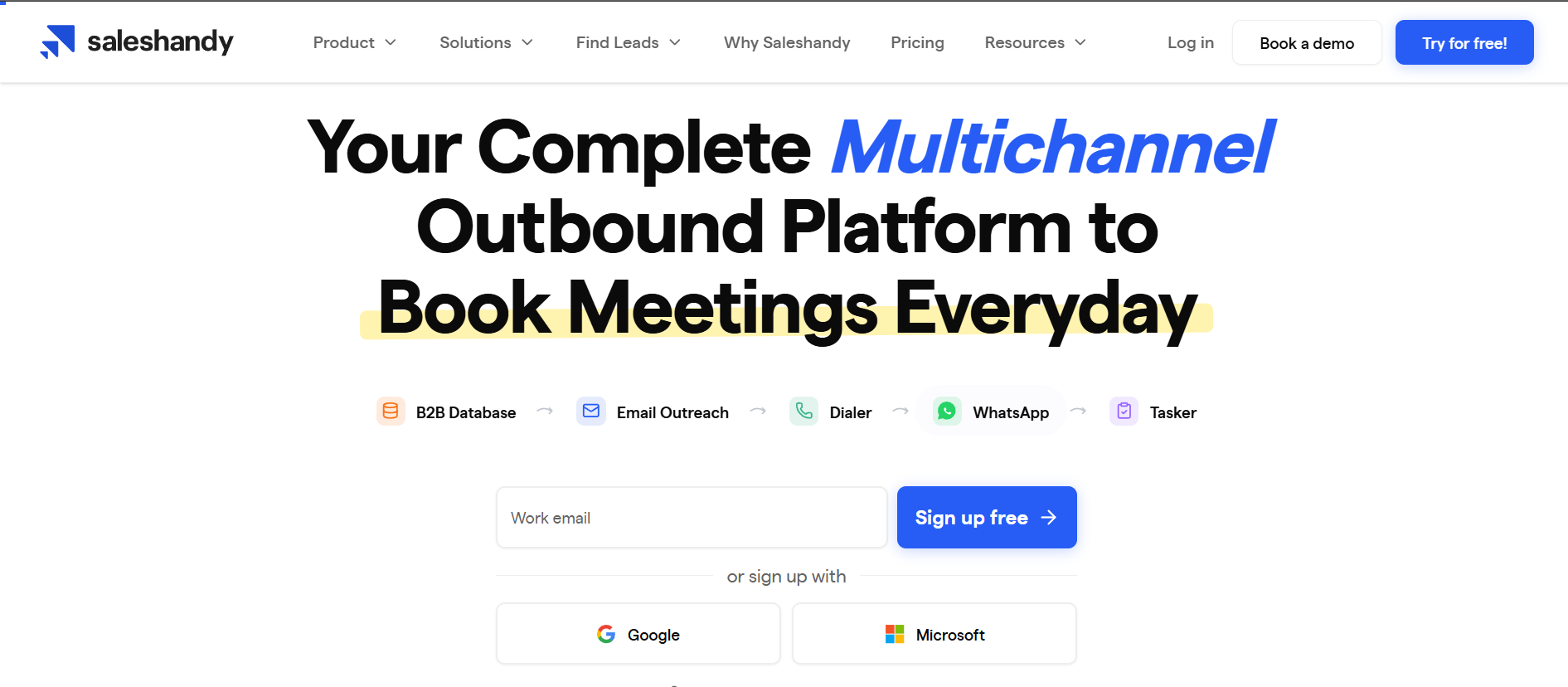
Saleshandy is the cheapest entry point on this list at $25/month.
It runs sequences across email, calls, LinkedIn, WhatsApp, and custom tasks, and it can fall back to another channel automatically if a prospect does not reply. The pricing model is volume-based rather than per-seat, and you get unlimited email accounts on every plan.
What it bundles at that price is respectable. You get a B2B Lead Finder with hundreds of millions of contacts, a built-in dialer with call recording as an add-on, email infrastructure setup, a deliverability suite, and a lightweight CRM.
For agencies, the white-label option and unlimited clients are useful extras. I reviewed Saleshandy in depth elsewhere if you want the full feature-by-feature breakdown.
The honest gaps are real, though. There is no conversation intelligence or call-coaching analytics. No AI forecasting or deal management. And the multichannel execution is shallower than what Salesforge or Lemlist offer, especially on LinkedIn. At high volume, the credit-based lead finder costs add up quickly.
Pros
Flat, volume-based pricing with unlimited email accounts on every plan
Genuinely multichannel across email, call, LinkedIn, and WhatsApp
Built-in B2B Lead Finder, deliverability suite, and infrastructure setup
Agency-friendly with white-label and unlimited clients
Cons
No conversation intelligence or call-coaching analytics
No AI forecasting or deal management for RevOps teams
The dialer is a separate add-on rather than bundled in
The CRM is lightweight rather than a deep enterprise system
Pricing Plans
Outreach Starter: $25/month (annual)
Outreach Pro: $69/month (annual)
Outreach Scale: $139/month (annual)
Outreach Scale Plus: $209/month (annual)
Dialer add-on from $23/month, with unlimited email accounts included on all plans
What Users Have to Say
Saleshandy holds a 4.6/5 on G2 from 779 reviews, with scalable outreach as a recurring theme:
"Powerful, Flexible Platform for Scalable, Personalised Outreach"
Which Sales Engagement Software Should You Choose?
After testing all six, Salesforge is the sales engagement platform I keep coming back to. It runs email and LinkedIn in the same sequence, gives you unlimited mailboxes, includes free warmup through Warmforge, and ships an autonomous AI SDR in Agent Frank.
The flat-rate pricing means your cost does not balloon as you add inboxes or team members. For most SMBs, agencies, and lean outbound teams, that combination is hard to beat.
If your buying decision also involves evaluating lead sourcing tools alongside your engagement platform, my Apollo alternatives list covers the data side of the stack.
Sales engagement software helps your team run and manage outreach across multiple channels like email, phone, LinkedIn, and SMS from one platform. It automates sequences and follow-ups, tracks every touch and reply, and gives you analytics on what is working. Reps spend less time on admin and more time selling.
2. How is sales engagement software different from a CRM?
A CRM is your system of record. It stores contacts, deals, and history. Sales engagement software is your system of action. It executes the outreach, the cadences, the calls, and the follow-ups, then logs that activity back into the CRM. Most teams use both together rather than choosing one over the other.
3. Do I really need conversation intelligence?
Not always. Conversation intelligence records and analyzes calls for coaching and insights. It is genuinely valuable for larger teams that run a lot of phone-based selling and need to coach reps at scale. If your motion is mostly email and light calling, it is a feature you can usually skip. That saves you from paying enterprise prices.
4. What is the best sales engagement software for multichannel outreach?
For email and LinkedIn in one sequence with unlimited mailboxes and free warmup, Salesforge is the strongest option. If you also need a built-in dialer for phone-heavy motions, Klenty offers the deepest calling integration at a mid-market price point.
5. Per-seat or flat-rate pricing, which is better?
It depends on your team and volume. Per-seat tools like Klenty, Lemlist, Salesloft, and Outreach can make sense for structured teams where each rep needs a full license. Flat-rate, unlimited-mailbox tools like Salesforge tend to win for agencies and high-volume senders. You can scale inboxes without your bill multiplying.
6. Can a small team use enterprise tools like Salesloft or Outreach?
You can, but it is usually a poor fit. Both are built for large revenue orgs, bill per seat, and keep pricing behind a demo. For a small team or agency, you would pay for forecasting and governance features you will not use. An SMB-focused tool like Salesforge gives you the outreach engine you actually need at a fraction of the cost.
Book more meetings on autopilot
Set up in minutes. No per-seat pricing. No commitment.
Read this Spring Drive review to see its outbound services, pricing, client reviews, pipeline results, key limitations, and whether it is worth hiring in 2026.


.jpg)
.jpg)

.jpg)
