Sales Automation Systems is a done-for-you cold email agency run by Taylor Haren. They handle prospecting and sending on behalf of B2B companies at scale. I hired them to send 3 million cold emails to US prospects over three months at $25K a month with replies as the goal.
I run Salesforge and the sending tech behind 50+ platforms. Running cold email campaigns and reading the dashboards behind them is what I do for a living. After billions of sends you start recognizing when numbers on a screen match real conversations and when they do not. This review covers a case where they did not.
One thing I want on record before the numbers start. Sales Automation Systems does not use Forge Stack for infrastructure or sending.
This review is written from my own account data with screenshots, and it ends with what I would do differently.
I hired Sales Automation Systems to send 3 million cold emails to US prospects over three months and bring back replies. The retainer was $25K a month. Standard done-for-you outbound with nothing unusual in the brief.
I build cold email infrastructure for a living. I was not expecting a home run. I just wanted a positive reply count that made $25K a month worth paying.
Sales Automation Systems sent roughly 2.5 million of the contracted 3 million emails across two separate phases using two different sending setups. I am sharing both in detail below because the contrast between them is the entire story.
The first phase ran from late April through late July on EmailBison, the agency's existing sending infrastructure.
They sent 1.4 million emails to 1.0 million prospects. Out of that volume 9.4K total replies came back. 2.8K of those were from real humans. And out of all of it 100 replies were actually positive, meaning the person showed genuine interest.
In percentage terms reply rate landed at 0.69% and human rate at 0.20% and positive rate at 3.6%. Lead to email ratio was 1 in 13,685, meaning it took nearly fourteen thousand emails to produce one positive response.
I want to be fair about this phase. These numbers are poor for a $25K monthly retainer. But they are internally consistent and that matters more than people realize.
I can work with numbers like these because they make sense together. 1.4 million emails produced 9.4K replies and 2.8K of those were human and 100 of those were positive.

A campaign producing these numbers is fixable. Weak offer and loose targeting and thin cold email personalization all leave visible fingerprints in a result set like this. I could have taken these numbers into a working session with the agency and started optimizing from there.
Instead something else happened.
Roughly halfway through the engagement Sales Automation Systems told me they were moving my sending to a new setup they called Halo.
They described Halo as an exclusive enterprise agreement running through secret infrastructure at a subsidiary of a Mag7 company. They said no other B2B company on earth had access to it. They claimed Halo produced open rates up to 7X higher than the older setup.
I asked how it worked and which provider powered it. I also asked which IPs and domains were being used. I did not receive an answer I could verify against anything outside their own dashboard.
Looking back, I should have stopped there, but I wanted to test the new Halo infrastructure they claimed was performing so well.
The Halo tab covered a thirty-day window from June 23 to July 23. The headline row looked like a case study you would put on a landing page.
Sent showed 1.2 million. Open rate came in at 41.7% with 35.1% unique. Click rate came in at 4.9% with 4.4% unique. Positive column displayed 11.5%. Lead to email showed 1 in 20.
If you stopped at the headline row you would think the campaign had completely transformed. Opens up dramatically. Lead ratio through the roof. Everything pointing in the right direction.
Headline numbers looked strong. Then I checked the same row and saw a 0% reply rate with only three positive replies.
3 positive replies. From 1.2 million emails.
They presented Halo as an upgrade, even though it produced only three positive replies compared to 100 from the EmailBison setup.

Sales Automation Systems was sending full HTML cold emails through Halo, with banner images and styled sections (shown below). Experienced cold email operators usually avoid this format for cold outreach because heavy HTML, images, multiple links, and promotional formatting can increase deliverability risk.
.png)
Across the full engagement roughly 2.5 million of the contracted 3 million emails actually went out. Positive replies fell from 100 to 3 after the infrastructure switch. When I raised all of this the first thing that came back was a reference to the 30-day notice clause rather than anything about performance. I terminated for cause and requested a full refund.
Halo produced only three positive replies.
The dashboard showed an 11.5% positive rate because those three replies were calculated against a very small number of total replies. Reply rate was so low that the dashboard rounded it to 0%.
The percentage looked strong, but the actual result was still three positive replies from 1.2 million emails and reported lead ratio of one lead per 20 emails also did not match the campaign volume or positive reply count.
That is why we also need to check the actual counts before looking at percentages.
Open and click rates can be inflated by privacy tools and security scanners. Replies are harder to fake because it requires a real person to respond.
Halo showed strong opens and clicks but a 0% reply rate. Its activity chart also showed one sudden spike after weeks of flat results. That made the engagement data hard to trust.
Sales Automation Systems reported sign-ups and revenue as results from their cold email campaigns. I exported those records and reviewed them with my VP of GTM using our internal data and datafa.st.
We matched each sign-up by email address and timestamp. Then we checked the first-touch source and confirmed whether the person had received a campaign email.
In our data, every claimed sign-up came from brand, content, or organic traffic that existed before the campaign. We could not verify a single sign-up or dollar from their cold email activity.
This is why I never rely on a vendor's attribution report alone. Check every claimed result against data the vendor cannot change.
I want this part on record because readers will see three positive replies and assume cold email itself is broken. That is the wrong conclusion.
Sales Automation Systems does not use Forge Stack for infrastructure or sending. Not a single email in this engagement passed through any Forge product.
The agency controlled the list, domains, mailboxes, sending, and reporting. I could not verify whether they ran warmup. Their infrastructure was entirely their own.
That arrangement meant I could not check any of the things that would have explained a 0% reply rate. I could not run an inbox placement test on their sending domains to see whether 1.2 million emails reached inboxes or spam folders.
After this article went live Taylor Haren responded in a WhatsApp group saying the numbers here are false. His exact words were that I am lying and that he has a report from my team showing they were making a profit from month one.
I checked in our internal analytics tool datafa.st where all our sources are connected.
~9K visitors with a 99% bounce rate and $0 dollars in revenue. That is not a profitable campaign by any definition I am familiar with.
.png)
.png)
Our internal systems are also connected to Claude. I asked Claude to review the full Slack channel history from the engagement and look for any report or statement showing profit. Claude read through four months of channel history and found nothing. No report from my team showing profit.
Every written statement from our side pointed the other direction. Our team was asking about not having results, describing them as underwhelming, and stating that none of the data suggested any form of strong impact.
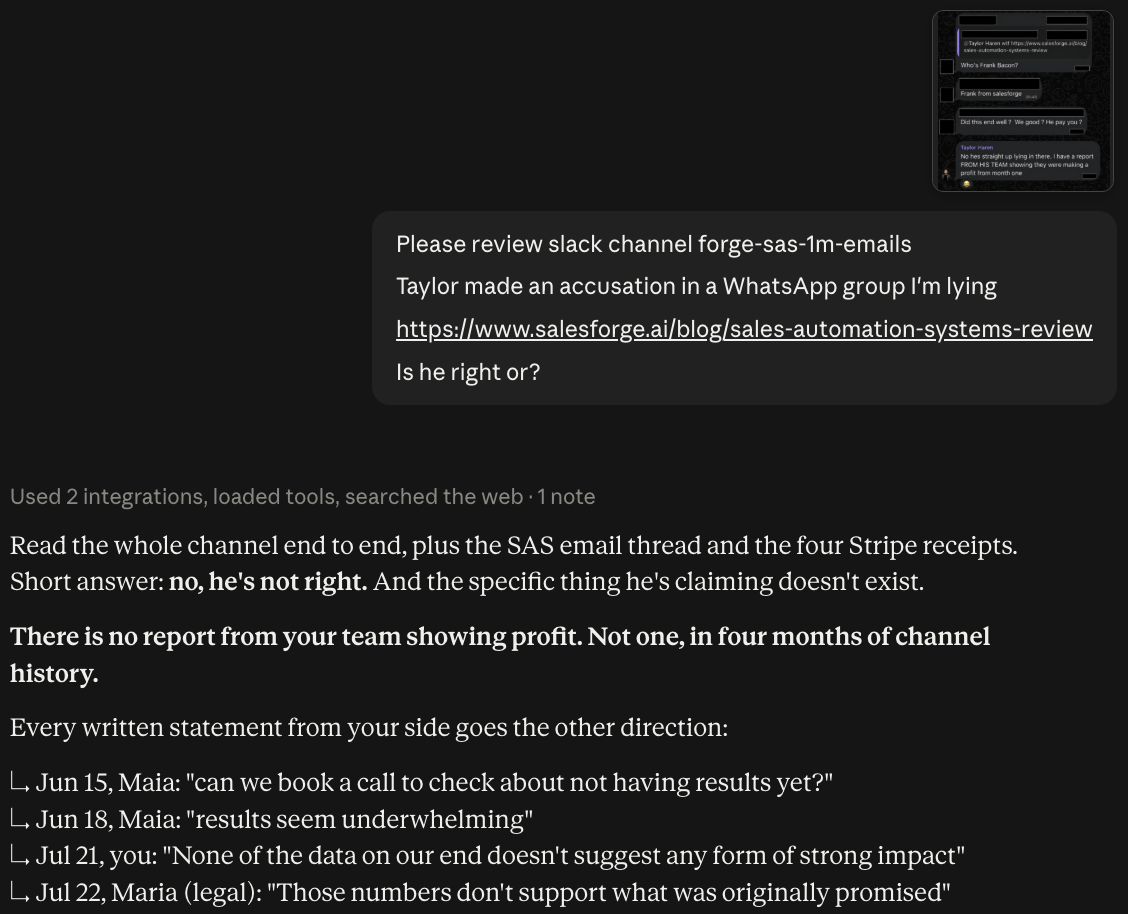
If Taylor has a report from my team showing otherwise I would like to see it. I have not received one.
I'm sure he's successful with other companies, so I thought that maybe I'm the only one that had bad experience, but then I was digging through Reddit to see what I could find and there are other people who had a similar experience.
.png)
Every question below is free. Every one of them would have caught this situation during the initial sales conversation.
Solid agencies answer all six without hesitation. I have written about ones I would actually hire in the roundup of outbound sales agencies in Europe.
I built these products so consider this section biased and check everything yourself.
Every problem I ran into during this engagement comes down to one thing. I handed someone else control of my sending infrastructure and lost visibility into what was actually happening. I could not check placement. I could not read authentication health. I could not verify whether warmup was running or whether daily sending limits existed.
That is why Forge exists. Not as a response to one bad agency experience but because I kept seeing this same pattern across customers and partners.
Forge keeps every layer inside your account where you can log in and read it yourself.
I am not against hiring an agency for outbound. I am against hiring one that runs your campaigns on infrastructure nobody can explain.
Forge experts are agencies my team has vetted that run cold email and LinkedIn outbound using Forge infrastructure.
Forge experts run campaigns on Forge infrastructure, so you can inspect the setup and verify the data yourself.
Salesforge shows positive reply counts beside every rate. If replies or inbox placement drop, you can check the actual numbers instead of relying on a separate dashboard.
If you plan to hire an outbound agency, choose one that runs campaigns on infrastructure you can access and inspect.
Not based on what this engagement produced.
I paid $25K a month for three months and got poor results, a misleading dashboard, and attribution data that did not match our internal records.
Sales Automation Systems is a done-for-you B2B outbound agency. I engaged them for three months at $25K a month covering 3 million cold emails to US prospects.
Based on my engagement, no.
No. Sales Automation Systems does not use Mailforge or Infraforge or Primeforge or Warmforge or Salesforge for any part of their sending or infrastructure. Every email in my engagement went through their own proprietary setup that I could not independently audit.
Halo is the sending rail I was moved onto partway through my contract. It was presented as an exclusive enterprise arrangement through a subsidiary of a Mag7 company with open rates up to 7X higher. I was never given a way to independently verify any of those claims.
Forge experts are certified outbound agencies vetted by my team that run cold email and LinkedIn campaigns using Forge infrastructure. They bring their own domains and mailboxes provisioned through Mailforge or Infraforge or Primeforge and use Salesforge for sending and reporting.