Email is the most underused weapon in political campaigns.
Social media posts get buried by algorithms. Digital ads are expensive and heavily regulated. Direct mail is slow and hard to measure.
A well-written political email lands directly in a voter's inbox. It raises money. It recruits volunteers. It drives turnout.
The problem? Most campaign teams send generic blasts to unsegmented lists. Then they wonder why open rates tank and blame the platform.
I put this guide together to fix that. It covers everything a campaign team needs to run political email that actually moves numbers. 8 ready-to-use templates. List building tactics. Segmentation. Deliverability fixes. And the compliance rules you cannot afford to ignore.
Whether you're running a school board race or a statewide campaign, this applies. Let's get into it.
Political email marketing is the use of email to communicate directly with voters, donors, volunteers, and supporters during a campaign.
It covers fundraising asks, volunteer recruitment, voter persuasion, GOTV mobilization, and post-election follow-ups.
Here's the difference from paid channels. Email gives campaigns full control over the message, timing, and audience. No algorithm decides who sees it. No platform takes a cut of donations. No ad approval slows things down.
That's why email consistently outperforms every other digital channel for political fundraising. Campaigns that invest in list building and segmentation raise more, recruit more, and turn out more voters than those relying on social alone.
Organic reach for political content on social platforms has collapsed. Algorithm changes, moderation policies, and paid-only visibility models mean most posts reach a fraction of followers.
Email doesn't have that problem.
Here's why campaign teams prioritize it:
The campaigns that win aren't the ones with the biggest lists. They're the ones that send the right message to the right segment at the right time.
You cannot run political email marketing without a list. Buying one is a bad idea. Purchased lists have low engagement, high bounces, and can flag your domain as spam before the campaign starts.
Here's how to build a quality list organically.
Every campaign website needs an email capture form above the fold. Keep it simple. Name, email, zip code. The zip code lets you segment by district later.
Add forms to every page, not just the homepage. Issue pages, candidate bio pages, and event pages should all have a subscribe option.
Town halls, rallies, fundraising dinners, and community forums are list-building goldmines. Use registration forms that capture email addresses. Follow up within 24 hours with a thank-you email and a next step.
"Sign this petition" and "Take our community survey" are two of the highest-converting list-building tactics in politics. People give their email to sign something they care about. That email now belongs to the campaign.
Run organic posts and paid ads that drive to a landing page with an email signup. Not to your social profile. The goal is to move supporters from a rented platform to an owned channel.
Most states provide voter registration files with names, addresses, party affiliation, and voting history. Some include emails. Cross-referencing voter files with your campaign's contact data helps you identify registered voters who haven't subscribed yet.
For campaigns that need to reach donors, business leaders, community organizers, or media contacts beyond the voter file, that's outbound territory.
This is where a proper outreach platform earns its place. Salesforge runs email and LinkedIn sequences from one workspace with unlimited mailboxes, which matters when you're building a donor pipeline that spans warm intros, cold outreach, and event follow-ups. You can also feed contacts from Leadsforge, the Forge Stack lead database, directly into your sequences.
Every door knock should include an email ask. Train canvassers to collect email addresses alongside voter contact info. This turns field ops into list-building ops.
Most political email guides give you 2-3 generic templates and call it a day. That's not enough to run a real campaign. These 8 cover the full lifecycle, from first voter introduction to post-election thank you.
If you want more inspiration on structure and framing, I lean on these cold email frameworks when I'm stuck on a first draft. The frameworks translate cleanly to political emails.
Each template includes a subject line, full body copy with merge fields, and a note on when to use it.
When to use: Early in the campaign. Send to new subscribers within 24 hours of signup.
Why this works: It's personal, asks for a reply (which boosts engagement signals), and sets expectations for future emails.
When to use: 48-72 hours before a reporting deadline (end of quarter, pre-primary, pre-general).
Why this works: Real deadline creates urgency. The individual contribution feels meaningful. The ask ties to a visible public outcome.
When to use: After a supporter has donated once. Send 5-7 days after their first contribution.
Why this works: Anchors the ask on a specific campaign expense, making the donation feel tangible. Monthly donors are the most valuable segment in political fundraising.
When to use: 4-8 weeks before Election Day. Send to engaged subscribers who open emails but haven't donated or volunteered.
Why this works: Specific date, time, and location. Removes friction with training and flexible scheduling. Frames volunteering as the decisive factor.
When to use: 3-5 days before Election Day. Send to your full list. Send segmented versions in early voting states.
Why this works: Actionable voting info. The "forward to 3 friends" turns every recipient into a multiplier. The close with a tight-margin stat creates urgency.
When to use: When a major policy issue or local event creates urgency. Time-sensitive.
Why this works: Positions the candidate as responsive and transparent. Ties a current event to the campaign message. Gives the reader a specific next step.
When to use: 7-10 days before a campaign event (town hall, rally, fundraising dinner, community forum).
Why this works: Clear logistics remove friction. RSVP creates commitment. "Space is limited" drives urgency without being dishonest.
When to use: Within 24 hours after the election. Win or lose.
Why this works: Acknowledges the supporter's contribution with specific numbers. The win version sets up continued engagement. The loss version preserves the relationship for future campaigns.
If you want more angles for your first-touch email, this breakdown of cold email templates has hooks that adapt cleanly to donor and volunteer outreach.
Templates are the starting point. Strategy is what separates campaigns that raise $10,000 from those that raise $100,000.
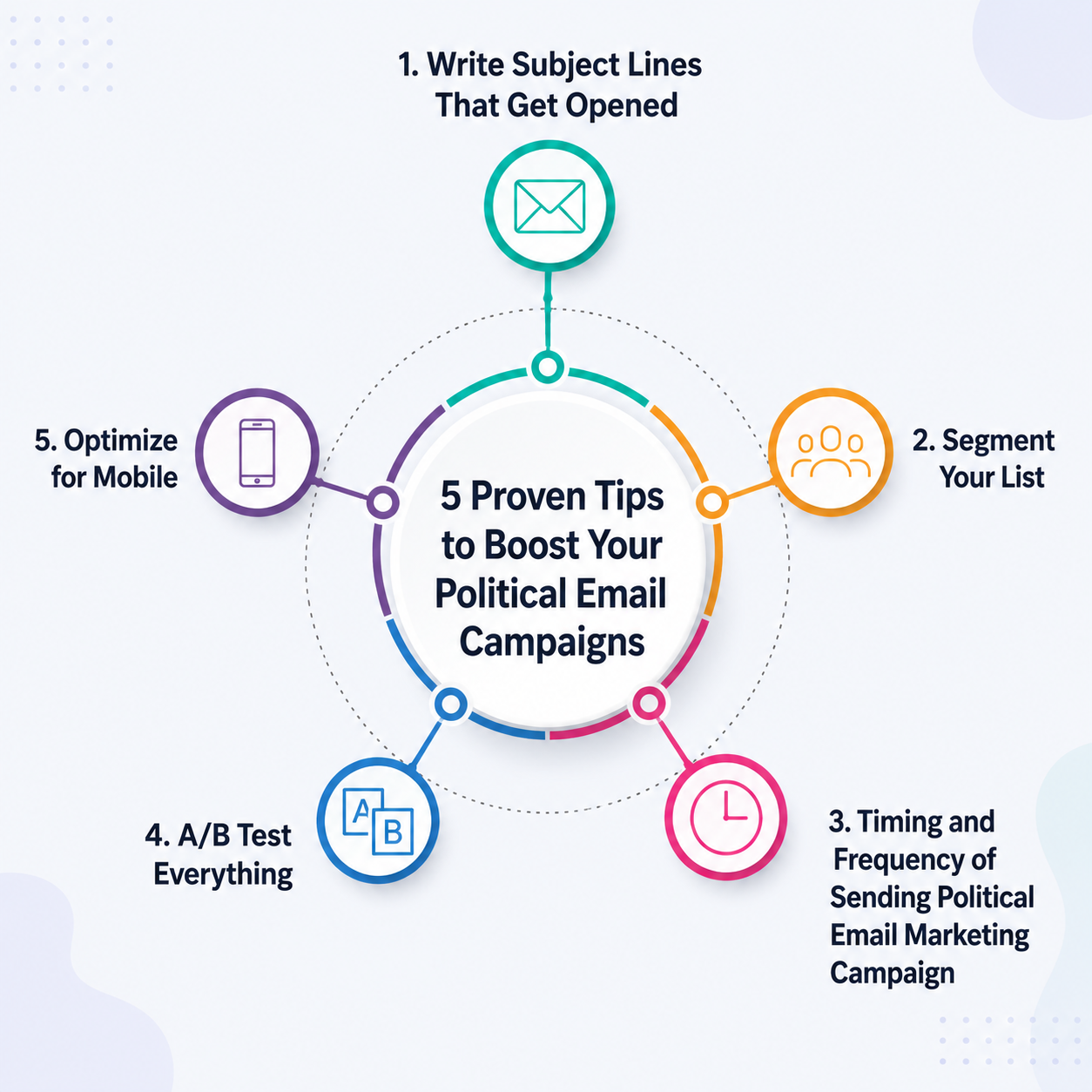
Subject lines make or break your open rate. Keep them under 50 characters. Urgency works ("24 hours left"). Avoid clickbait ("You won't believe what happened") because it trains subscribers to ignore future emails.
Test different approaches. Question vs. statement. Candidate name vs. no name. Emoji vs. no emoji. What works for a statewide campaign may not work for a city council race.
Sending the same email to your entire list is the fastest way to kill engagement. Segment by:
For a deeper walkthrough on how to structure segments without over-complicating things, this email list segmentation guide covers the mechanics.
Political fundraising emails perform best Tuesday through Thursday. Send between 9-11 AM or 7-9 PM local time. Avoid Mondays (inbox overload) and weekends (lower open rates) for fundraising asks.
During the final 30 days of a campaign, frequency increases. Most winning campaigns send daily in the last two weeks. That feels aggressive, but the data shows more frequent emails in the final stretch raise more money than less frequent ones.
The key is matching frequency to urgency. Daily emails work when every email has a clear reason. Deadline. Poll numbers. Opponent news. Event. Daily emails without a reason just increase unsubscribes.
Never send a campaign email to your full list without testing first. Split-test subject lines with 10-15% of your list. Send the winner to the rest.
Beyond subject lines, test:
Personalization compounds these gains. Merge tags for name and city are table stakes. If you want to push further, this piece on dynamic email personalization covers behavioral variables that lift open rates well beyond first-name insertion.
Over 60% of political emails are opened on mobile devices. If your email isn't readable on a phone screen, you're losing the majority of your audience.
Use single-column layouts. Keep paragraphs to 2-3 lines. Make CTA buttons large enough to tap. Preview every email on a phone before sending.
Deliverability is the silent campaign killer. You can write the best fundraising email in history, but if it lands in spam, nobody sees it.
Political campaigns face unique deliverability challenges.
Campaigns go from sending 1,000 emails a week to 50,000 emails a day during the final month. That sudden spike looks suspicious to email providers. Without proper warmup and infrastructure, Gmail and Outlook will throttle or spam-filter your messages right when they matter most.
Many email platforms put multiple senders on shared IPs. If another campaign on the same IP gets flagged for spam, your emails suffer too. Campaigns with large lists should use dedicated IPs or platforms that protect sender reputation.
New campaign domains have zero sending reputation. You have to build it gradually. Start sending low volumes weeks before your first major blast. Increase volume slowly so email providers recognize your domain as legitimate.
This is the layer that Salesforge covers well for the outbound side of the campaign, meaning the emails you send to donors, business leaders, community organizers, and media contacts beyond your voter file.
Every mailbox connected to Salesforge gets automatic warmup through Warmforge at no extra cost. Sender rotation distributes volume across multiple mailboxes to protect domain health. And inbox placement testing shows you where emails actually land (primary, promotions, or spam) before you commit to a full send.
For mass voter list emails, you'll still want a political ESP like NGP VAN, ActBlue, or Mailchimp for Political. But for the donor and media outreach side, treating it like outbound sales gets you better inbox rates. I lean on this step-by-step guide to boosting email deliverability when I'm auditing a new campaign account.
Every campaign domain must have SPF, DKIM, and DMARC records configured. These tell email providers your emails are legitimate. Without them, spam filters flag your messages regardless of content.
Most modern email platforms configure these automatically. If yours doesn't, fix it before sending a single email. The cold email deliverability checklist walks through the full authentication stack in plain language.
Political email marketing is regulated. Ignoring compliance can result in fines, domain blacklisting, and legal trouble for the campaign.
The CAN-SPAM Act applies to all commercial emails sent in the US, including political fundraising emails. Requirements:
Pure advocacy emails without a fundraising or commercial element may fall outside CAN-SPAM's scope. But best practice is to comply regardless. Treating every email as CAN-SPAM-compliant protects the campaign.
Federal campaigns must include a "Paid for by [Committee Name]" disclaimer on all emails. This applies to emails sent by candidate committees, PACs, and party committees.
The disclaimer must be "clear and conspicuous." Most campaigns place it in the email footer. State campaigns should check their state's equivalent rules, which vary.
Some states add extra requirements for political email communications. Examples:
Check your state election commission's website for current rules before launching. Note that specific state rules change, so verify on the official site.
Purchased lists violate most platform terms of service, generate high spam complaint rates, damage domain reputation, and may violate state consumer protection laws. Build your list organically. Every subscriber should have opted in.
What gets measured gets improved. Track these metrics for every email:
Review these weekly. After every major send, review within 24 hours and adjust the next email based on what you learned. For follow-up nudges to donors who didn't convert on the first ask, this gentle reminder email template guide has phrasing that translates well from B2B to campaign use.
Political email marketing is the cheapest, fastest, most measurable channel available to a campaign. The templates and strategies above cover the campaign lifecycle end to end. What separates winning campaigns from losing ones is execution: segment the list, respect deliverability, and treat every send like it's the one that decides the race.
Personalization is where most campaigns fall short at scale. Generic blasts to unsegmented lists tank open rates and burn goodwill.
Salesforge writes hyper-personalized emails using prospect data and engagement signals. Every donor, volunteer, and voter gets a message that reads like it was written for them. Try it free.
Political email marketing is the practice of using email to communicate with voters, donors, volunteers, and supporters during a campaign. It covers fundraising appeals, voter persuasion, volunteer recruitment, GOTV mobilization, event promotion, and post-election engagement. Email is the highest-ROI digital channel for most political campaigns because it provides direct inbox access without algorithm interference.
Yes. Political email marketing is legal in the United States and most democracies. It must comply with laws like the CAN-SPAM Act (unsubscribe links, accurate sender info, physical address), FEC disclosure requirements for federal campaigns, and state-specific rules. Buying email lists and sending unsolicited emails to people who never opted in creates legal and deliverability problems.
In the early campaign phase, 1-2 emails per week is standard. During the final 60 days, 3-5 emails per week is normal. In the last 2 weeks before Election Day, daily emails are common and often produce the highest fundraising returns of the campaign. Every email needs a clear purpose and reason for urgency.
Keep subject lines under 50 characters. Short, specific subject lines outperform long ones. Use urgency when real deadlines exist ("48 hours left"). Use personalization when possible ("[First Name], we need you"). Use plain language over clever wordplay. Always A/B test subject lines with a small segment before sending to your full list.
Start by cleaning your list. Remove hard bounces and subscribers who haven't opened an email in 90+ days. Segment your list so each group gets relevant content. Test subject lines with every send. Verify your domain authentication (SPF, DKIM, DMARC). Warm up new sending domains gradually before high-volume sends. And send at consistent, predictable times so subscribers learn when to expect your emails.
Yes, for the outbound side of the campaign. Salesforge is built for cold outreach across email and LinkedIn, which fits well for reaching donors, business leaders, media contacts, and community organizers outside the voter file. It includes free warmup through Warmforge, unlimited mailboxes with no per-seat pricing, sender rotation, and inbox placement testing. For mass voter emails, most campaigns pair Salesforge with a dedicated political ESP like NGP VAN, ActBlue, or Mailchimp for Political.
.jpg)

.png)