Identifying buying signals has become one of the biggest advantages in outbound.
Around 60% of buyers complete their research before speaking to sales, and 94% of buying groups already have preferred vendors before the first sales conversation.
By the time a prospect replies to your cold email, they've often been evaluating solutions for weeks.
The challenge isn't finding more prospects.
It's identifying the right signals early enough to reach buyers while they're still making up their minds.
In this guide, I'll show you
Let’s get started!
A buying signal is any behavior, event, or statement anywhere on the public or private web that indicates a prospect is moving toward a purchase decision. That includes what they do, what happens to them, and what they say. If it moves the needle on their likelihood to buy, it counts. If it does not, it is noise dressed up as data.
Before going into the categories, one distinction matters because these terms get used interchangeably and they should not be.
Every trigger event is a buying signal. Intent data is one input into buying signals. Not every buying signal is a trigger event or intent data.
For a deeper breakdown of intent data specifically, B2B intent data covers where it comes from, how it works, and how to actually use it.
Buying signals don't just increase reply rates; they reduce the time it takes to move prospects from first touch to sales conversation.
Instead of chasing accounts that might be interested, signals help identify companies that are already entering an active buying cycle.
Here's why that makes such a difference:
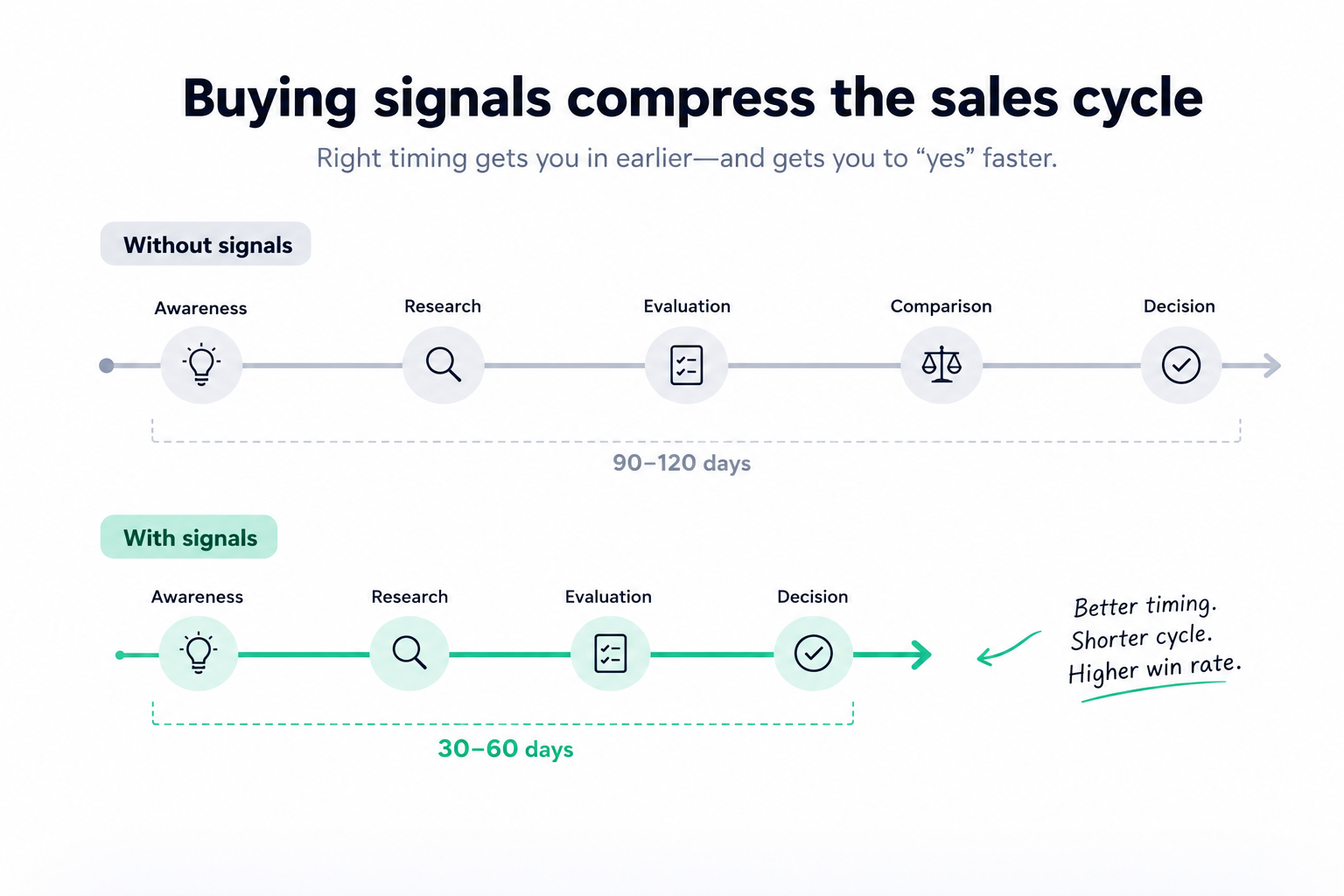
Buying signals surface opportunities while prospects are still researching and evaluating solutions. Reaching out during this stage means becoming part of the decision-making process instead of trying to replace an existing favorite.
Events like a pricing page visit, a new VP of Sales, a funding round, or rapid hiring indicate that something has changed inside the business. These moments often trigger technology evaluations, making them far stronger opportunities than static ICP lists.
When outreach aligns with genuine buying intent, prospects require less convincing because they're already exploring solutions. The result is quicker responses, shorter sales cycles, and a higher likelihood of converting interest into meetings.
The teams booking meetings today are the ones treating signals as the operating input, not the exception. If you want the strategic framing of that shift, signal-based selling covers the philosophy in detail. Everything below is how to actually operate it.
You can slice buying signals a hundred ways. Four categories is what actually works because it maps cleanly to how you detect and act on each type. Anything beyond four gets muddled fast, and reps stop using the framework.
Intent signals show that a prospect is researching a solution and comparing options in real time. This is the highest-value category for outbound because the buyer is already in-market. The decision is being made right now. Speed of response matters more than personalization polish, and the reply-rate curve for intent signals falls off a cliff after 72 hours.
What to watch for specifically:
Repeated pricing page visits within a short window. Three or more visits in a week is the threshold worth reacting to. A single visit is exploratory. Three visits inside seven days is internal evaluation, often across multiple stakeholders at the same account. If your website analytics show account-level visit patterns, this is the most valuable data point you own.
Engagement signals show interest without commitment. The prospect is warming up, learning, or curious. They are not yet in-market, and treating them like they are is one of the most common mistakes I see. Deal with these correctly, and they become a compound advantage. Deal with them wrong, and you burn goodwill on prospects who were not ready.
What counts as engagement:
Trigger signals reflect structural change inside the account. Something just happened that creates urgency, budget, or a new priority. This is where the highest-converting cold outbound comes from because trigger events give you a specific, public reason to reach out that the buyer cannot dismiss as random.
Each of the seven types deserves its own treatment because the response angle is different for each one.
A funding round is a mandate to spend. When a company closes a Series A, B, or C, capital gets deployed inside the first 90 days. Tooling budgets are set during that window. The trick is speed. If you show up 60 days after the announcement, the money is already committed to specific initiatives. Show up in the first 30, and you are on the shortlist for whatever category you sell in.
The angle that works: capacity and scaling. The new capital exists to accelerate something. Frame your outreach around helping them execute the scaling plan the raise is supposed to fund, not around the tool itself.
A new VP of Sales, CMO, CTO, Head of RevOps, or CRO will reevaluate the stack within their first 90 to 120 days. This is not opinion; it is a pattern. New leaders have a mandate from their board or manager to show early wins, and the fastest way to show a win is to swap out an existing tool for a better one. If you sell into that leader's function, their arrival at a target account is one of the strongest signals you can act on.
The angle that works: the evaluation-window pitch. Frame the outreach around what the leader is likely doing in their first 90 days and offer to accelerate that specific evaluation.
If they are hiring five SDRs, they need SDR tooling. If they are hiring three account executives, they need pipeline generation. If they are opening a first-time European role, they need internationalization support. Job postings are one of the most reliable trigger signals because they are public, structured, and always ahead of the tooling decision.
The angle that works: the tooling-gap pitch. Point out the specific tooling that the new hires will need to succeed and frame your product as what gets the hires productive faster.
A company switching from Salesforce to HubSpot, or moving off a legacy MAP, or adopting a new CDP triggers a wave of adjacent tooling decisions. When the primary system changes, everything that connects to it comes under review. Detection is harder for this one because tech stack changes are not always announced, but tools like BuiltWith and HG Insights help.
The angle that works: the integration pitch. Reference the specific tool they just adopted and explain how your product plays with it better than their current alternative.
An acquisition creates two tooling stacks that need to become one. On both sides, integration and consolidation drive tool decisions for the first six months post-close. The buyer often replaces the acquired company's stack with their own. Sometimes the reverse happens if the acquired company had better tools.
The angle that works: the consolidation pitch. Focus on how your product handles the specific integration challenge the merged entity is facing.
New market entry surfaces compliance, localization, and scale needs fast. A US company opening a UK office needs UK-compliant tooling. A B2B SaaS launching in Germany needs GDPR-native infrastructure. Detection often comes from press releases, LinkedIn job posts, or LinkedIn company page updates.
The angle that works: the market-specific pitch. Reference the specific market they are entering and frame your product as what teams succeeding in that market are using.
Counterintuitive but real. Layoffs often trigger workflow tool evaluations because the remaining team needs to do the same work with fewer people. Automation tools, AI tools, and productivity tools see a spike in evaluation activity after a layoff at target accounts.
The angle that works: the do-more-with-less pitch. Directly acknowledge the difficult context and offer to help them maintain output with a smaller team.
Verbal signals appear in language. On a call, in an email reply, in a LinkedIn DM, or in a comment on a post. They are the highest-fidelity signals you can get because they come directly from the prospect's own words, but they are also the most commonly missed because they are scattered across channels.
The phrases to flag as high intent:
Reply sentiment counts too. A short "not right now, ask me in Q3" is a stronger signal than most people realize. It is a specific evaluation window handed to you on a plate. Set the reminder for Q3, reference the earlier reply in the follow-up, and you will book more meetings from those than from cold pitches to fresh contacts.
For call-based verbal signals, tools like Gong and Grain transcribe and pattern-match automatically. For email reply signals, most modern outbound platforms handle this natively.
Not every signal deserves the same response. If you treat them as equal, your best reps waste time on noise while your hottest accounts go cold because someone was chasing a webinar registration. Ranking signals by strength is what separates signal-based programs that book meetings from signal-based programs that generate dashboards.
Three factors separate a strong signal from a weak one, and they compound with each other:
A prospect who read one blog post six weeks ago is weak on all three. A prospect whose CTO viewed your API docs this morning is strong on all three. Every signal you detect should be scored against these three factors before it gets a response.
Here is the tier model that maps to actual response behavior:
Build your scoring around this model. Assign weight to each tier. Let the top of the ranked list drive your rep's day. If your weekly rep report does not surface Strong and Decision-stage signals first, the report is broken, and you are shipping bad prioritization to your team.
Detection without timing is useless. This is the section most competitor content skips entirely, and it is also the section that decides whether your signal program books meetings or produces reports.
A signal is not a static fact. It is a countdown that starts the moment the signal fires. And the countdown length is very different for each signal type, which means treating all detected signals as equally urgent is the same mistake as treating all detected signals as equally strong.
Here are the decay windows I work with:
Build these windows into your rep workflow directly. If a Strong-tier signal is older than its decay window, either deprioritize it or reset the sequence with a fresh anchor. Do not let stale signals clog the queue.
Signals live in three separate places. Most outbound teams only watch one of them, which is why they see maybe 20% of the actual signal surface. Detection at scale requires coverage across all three layers, and each layer has different tools, different data quality, and different latency.
First-party signals happen on your website, in your product, or across your outbound systems. These are the highest-fidelity signals because you own the data end-to-end, and there is no third-party interpretation happening between the event and your visibility.
What lives here:
The tools for this layer are your website analytics, marketing automation platform, and CRM. HubSpot, Google Analytics, and a call recording tool like Gong or Grain cover most of what a mid-market outbound team needs. What matters is that all of these feed into one place where your reps can see the pattern per account, not per session.
The trap here is treating first-party signals as sufficient. They are not. They only fire when the prospect has already found you, which means you are missing every account that is in-market but has not yet engaged with your brand. That is where layers two and three come in.
Third-party signals are the ones happening in the world, on platforms you do not own. This is where most trigger events and firmographic changes live, and this is the layer that separates signal-based outbound from lead-tracking.
What lives here:
You need a data source that aggregates these because manually tracking them across a dozen platforms does not scale past a few dozen accounts.
For enterprise-scale signal stacking, Common Room does it well at the enterprise price point. For a broader tool comparison, the AI tools for B2B prospect research roundup covers the market.
And for the specifically LinkedIn-native side of signal-based prospecting, the Gojiberry AI review walks through the LinkedIn-first approach.
The tool I use for this layer is Leadsforge, which I cover in detail in a dedicated section at the end.
Inferred signals are the ones you have to derive from patterns rather than observe directly. This is the newest and most underused layer, and it is where competitive advantage lives in 2026 because most teams do not know how to operate it yet.
What lives here:
Inferred signals need machine learning under the hood, which is why they were out of reach for most teams until recently.
The signal-based prospecting stack has caught up in 2026. For the tactical application side of turning intent data into outreach, how to use intent data for cold email outreach covers the workflow in depth. For the broader top-of-funnel tool market, 11 AI lead generation tools walks through the leading options.
Single signals underperform. Signal pairs and triplets are where the numbers actually move. This is the concept most outbound teams miss, and it is also where the highest-converting signal-based campaigns live.
If you take one thing from this guide, take this.
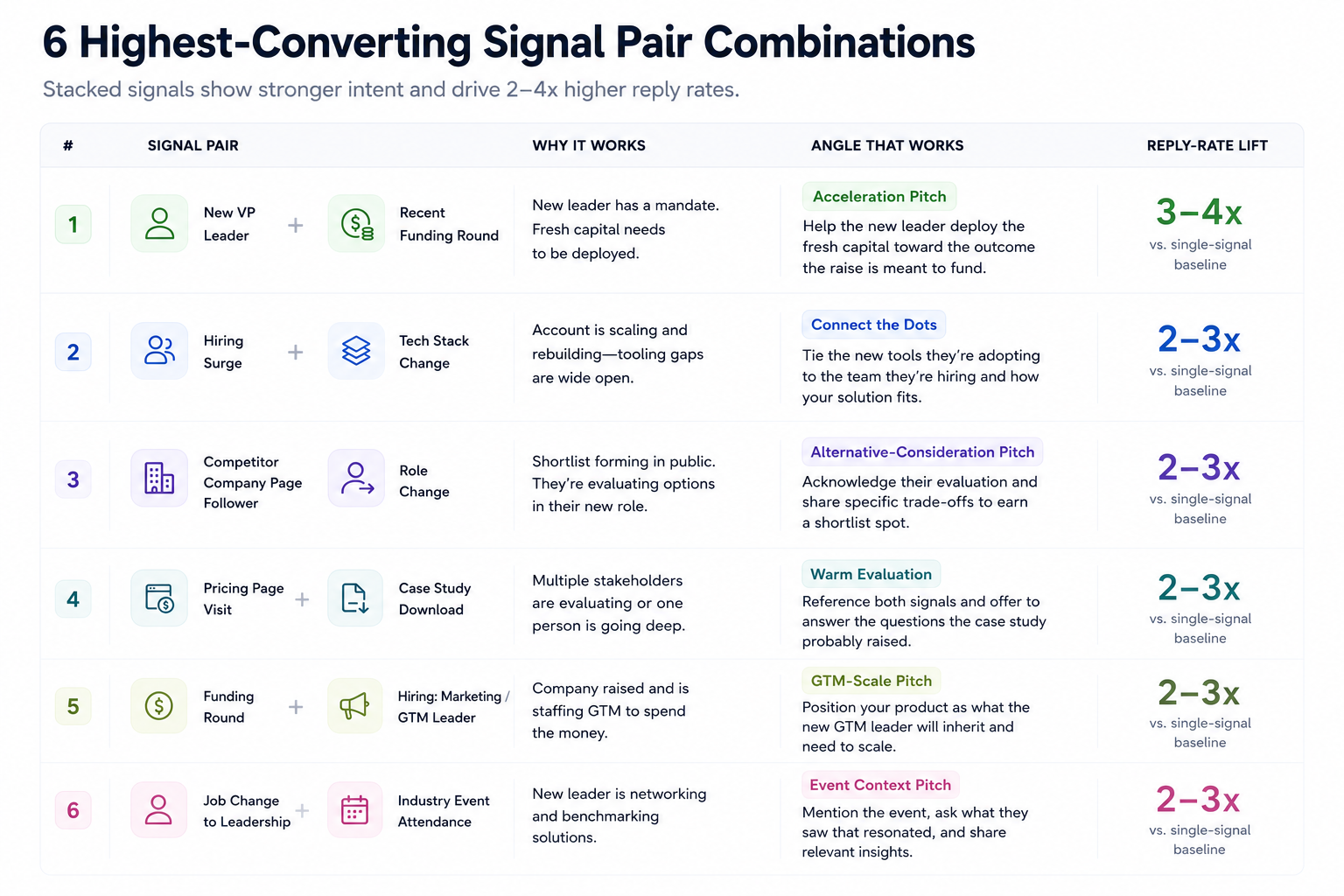
Here are the highest-converting stacks I track.
Each one deserves its own logic because the response angle changes based on which combination fires.
The highest-converting pair in B2B outbound. The new leader has a mandate and a 90-day evaluation window. The company has fresh capital that has to be deployed. Together, the pair signals a target account that is not only ready to evaluate but has the money to buy immediately.
Reply rates on this stack typically run 3 to 4x the single-signal baseline. The angle that works is the acceleration pitch. Frame your outreach around helping the new leader deploy the fresh capital toward the specific outcome the raise is meant to fund.
The account is scaling and rebuilding at the same time. Tooling gaps are wide open, and the team is actively evaluating what to keep versus what to replace. This is a Strong-tier stack because both underlying signals independently indicate evaluation activity.
The angle that works: reference the specific stack change and connect it to the hiring plan. Explain how the new tool they adopted plus the new hires they are making will interact with your product.
The prospect just moved to a new role and is following your competitor on LinkedIn. That is a shortlist forming in public, and the prospect has just told you which vendor they are considering.
This is one of the highest-signal-to-noise stacks in B2B outbound because both underlying signals are unambiguous.
The angle that works: the alternative-consideration pitch. Reach out and acknowledge that they are evaluating options, offer specific trade-off information about your product versus the competitor, and position yourself as adding to the shortlist rather than displacing anyone from it.
Same account, ideally the same person, ideally inside a 7-day window. This stack signals internal evaluation happening. Multiple stakeholders are looking, or one stakeholder is going deep. Either way, the buying committee is engaged.
The angle that works: warm evaluation. Reference both the pricing interest and the specific case study downloaded. Offer to answer the questions the case study probably raised.
Growth mandate is real, and specific. The company raised, and now they are staffing up the go-to-market function to spend the money. Any tooling that supports GTM execution is in play for the next 90 days.
The angle that works: the GTM-scale pitch. Reference the raise and the specific GTM hires and position your product as what the new GTM leader will inherit and need.
New leader networking and evaluating publicly. Event attendance in the first 90 days of a new role means the leader is actively benchmarking and looking at solutions. Combined with the role change, it is a Strong-tier stack.
The angle that works: reference the specific event, ask what they saw that resonated, and offer relevant context on the space they are learning about.
Build stacking rules into your scoring model directly. Assign points per signal, then boost the total score when specific pairs converge. A rep's daily prioritized list should surface stacked accounts at the top, not single-signal accounts. If your CRM cannot do this natively, it is worth exporting to a scoring layer that can.
Detection is half the job. The other half is what you send when the signal fires. Most teams over-invest in detection and under-invest in the response playbook, which is why they end up with beautiful dashboards and a mediocre pipeline.
Fixing that means matching the message to the signal type, moving fast on strong signals, and looping in the right decision-makers when the buying committee is forming.
Every signal type deserves a different opening angle. A funding email is nothing like a leadership-change email. Sending the same generic sequence regardless of the signal is what kills the touch, because the prospect can immediately tell you did not read what actually happened at their company.
Here is the mapping I use, with the specific template for each.
Funding signal → capacity and scaling angle
Hi [First Name], Saw the Series B announcement. Congrats. Most RevOps leaders I talk to after a raise are staring at the same problem, which is how to scale outbound without doubling headcount. Worth a 15-minute call to compare notes on what has actually worked for teams at your stage?
Leadership change → evaluation-window angle
Hi [First Name], Saw you just started as VP of Sales at [Company]. Most VPs I speak to in the first 90 days are auditing the outbound stack. If that is on your list, happy to share what the teams that got it right did differently. Open to a quick chat?
Hiring surge → tooling gap angle
Hi [First Name], Noticed [Company] is hiring 5 SDRs. The scaling pattern I see most often is teams adding reps faster than the systems to support them. Worth a 15-minute call before the new hires start? Happy to walk through what the highest-performing outbound teams put in place before the ramp.
Competitor follower → alternative-consideration angle
Hi [First Name], Noticed you are following [Competitor] on LinkedIn. If you are evaluating [category], there are two or three trade-offs that are hard to see from the outside. Happy to run through them on a call if useful. No pitch, just context.
Pricing page visit → warm evaluation angle
Hi [First Name], Saw you were checking out the pricing page. Happy to answer any questions or set up a 15-minute demo tailored to how [Company] would use it. What is the best way to get you the info you need?
For a broader look at how signal-triggered sequences slot into your broader outbound cadence, Sales Sequence Frameworks walks through the Signal-Triggered Burst format specifically.
When signal data shows engagement across multiple roles at the same account, the buying committee is forming. That is a Strong to Decision-stage signal on its own, and it changes what you should be doing next.
Instead of waiting for your primary contact to loop in stakeholders, reference the signal directly and offer to bring the right people onto the next call yourself. A gentle follow-up like:
Hi [First Name], Noticed your CTO was reviewing our API docs this week. Would it make sense to loop them into the next call so we can cover the technical questions directly? Happy to send a fresh time.
Multi-thread outreach that references the specific engagement outperforms single-thread outreach almost every time, because you are showing the buyer that you are already tracking the committee formation. That reads as competence, not surveillance.
For Weak and Moderate tier signals, spend time to personalize because the account may need warming. For Strong-tier signals, respond fast even if the copy is not perfect. A less polished touch inside the decay window beats a beautiful touch outside it every time.
For Decision-stage signals, invest 30 minutes of research per account before you touch. The account is worth it. A poorly-researched Decision-stage touch reads as spam and burns the account for months.
LinkedIn signals deserve LinkedIn responses. If a prospect just followed your competitor's LinkedIn page, an email response feels off-channel. A LinkedIn connection request with a signal-specific note feels right. If the same prospect visited your pricing page a day later, then email is the right channel because the intent has moved to the web.
Matching response channel to signal channel is one of the least-discussed elements of signal-based outbound, and it is why multichannel outreach is a genuine competitive advantage rather than a nice-to-have. Email-only outbound cannot respond to LinkedIn-native signals in the same channel, which means half the signal surface goes unused.
Personalizing every response manually does not scale past 20 to 30 signals per rep per day. AI-assisted writing that takes the signal context and generates the first draft is what makes the response infrastructure keep up with the detection infrastructure.
The pattern that works is human-in-the-loop, not full autopilot. The AI generates the draft based on the specific signal type. The rep edits for voice and any account-specific context the AI missed. The touch goes out fast without feeling automated.
For the technical side of AI-assisted outbound, including MCP-based workflows, cold email MCP server walks through the setup.
Five patterns kill signal programs. I see all five in almost every team that stalls out on signal-based outbound, and each one is fixable once you know to look for it.
By the time you have three confirmations, the buyer has bought from someone else. This is the single most common mistake, and it comes from applying inbound-marketing intuition to outbound. Inbound rewards patience because the buyer is on your systems and you can watch the whole evaluation. Outbound punishes patience because the buyer is on a shortlist forming across multiple vendors.
Strong-tier signals warrant a same-day response on their own. Stacked signals of any tier warrant a same-day response too. Save the wait-and-see approach for Weak-tier signals only, and even then, only if you are using the wait to stack additional signals that would move the account up in tier.
A whitepaper download is not a buying signal in the same way a pricing page visit is. It is a curiosity signal. Sending a demo pitch to someone who downloaded a blog post is the fastest way to burn a prospect who might have become a real buyer six months later.
The fix is disciplined tiering. If the signal is Weak or Moderate, treat it as nurture. If the signal is Strong or Decision-stage, treat it as sales. Do not let the volume of Weak signals cause your team to drift into pitching everyone, because Weak-signal pitching is what makes cold outbound feel spammy to buyers.
Acting on a 6-week-old pricing page visit like it is a hot signal wastes the touch and reads as spam to the prospect. They do not remember visiting your site six weeks ago, and even if they did, they have moved on to something else.
Every signal needs a freshness check before it becomes a task in your workflow. If the signal is older than the decay window from the table above, either deprioritize it below fresh signals or find a fresh anchor to re-open the touch. A 2-month-old funding announcement paired with a new leadership change this week is a valid outreach angle. A 2-month-old funding announcement on its own is not.
If your infrastructure can only push 50 emails a day per rep and it takes 3 days to spin up a new sequence, most signals will die inside your queue before they can be acted on. Detection without sending capacity is productivity theater, not outbound.
The fix is uncapped sending infrastructure plus warmed-up mailboxes at scale, so that a Strong-tier signal detected at 9 am can trigger an outbound sequence by 11 am. For the foundation of that setup, cold email deliverability covers the sender reputation side.
Weak signals should get templated nurture. Strong signals should get speed. Reserve deep personalization for Decision-stage signals where the account is worth 30 minutes of research, and the deal size justifies it.
Teams that personalize every touch equally end up under-touching their strongest signals because they are spending all their personalization budget on weak accounts. The math does not work. Personalization is a scarce resource that should follow the signal strength curve, not distribute evenly across the pipeline.
Everything I have walked through so far comes down to one operational question. Where do you actually run this at scale?
Detection is half the job. Response inside the decay window is the other half. Most teams over-invest in one and under-invest in the other, which is why they end up with either great dashboards or great sending capacity but rarely both working together.
The two-tool workflow I use handles both halves. Leadsforge finds the signals and enriches the accounts. Salesforge runs the signal-triggered sequences across email and LinkedIn. Neither tool is doing the other's job, which is the point.
Leadsforge is the only data platform I have found that bundles LinkedIn Company Followers, Lookalikes, and Intent Signals in one place at a price that does not require an enterprise contract. Detection lives here.

The Signals feature tracks four categories that map directly to what I walked through earlier in this guide.
Try Leadsforge free — 100 credits, no card required
Detection means nothing without the sending infrastructure to act inside the decay window. A Strong-tier signal has a 24- to 48-hour response window.
If your outreach tool caps you at 50 emails a day per mailbox, or does not support LinkedIn natively, or takes three days to spin up a new sequence, most signals will die inside your queue. That is the gap Salesforge closes.

Here is how the response side maps to the detection side.
The math matters here. If your workflow is signal detected → export CSV → clean data → upload to outreach tool → build sequence → send, you are burning most of the 24- to 48-hour response window on data plumbing.
Cutting that from a two-day workflow to a same-morning workflow is the difference between a booked meeting and a dead signal.
A demo request or quote request is the strongest single signal because it indicates immediate purchase readiness. Outside of direct requests, the strongest signals are stacked pairs like a new VP paired with recent funding, or a competitor follower paired with a role change. Signal stacking beats single-signal detection almost every time, so building your scoring around pairs rather than isolated signals is the higher-leverage move.
A buying signal is the umbrella term for any indicator that a prospect is moving toward a purchase. A trigger event is a specific subtype of buying signal, referring to structural changes inside a company like funding rounds, leadership changes, or hiring surges. Every trigger event is a buying signal. Not every buying signal is a trigger event, because behavioral signals like pricing page visits and verbal signals like discovery-call phrases also qualify.
It depends on the signal. A pricing page visit decays in 48 to 72 hours. A leadership change stays actionable for 90 to 120 days. A funding round runs about 25 to 45 days before the money is committed. A LinkedIn post comment on a relevant pain point stays warm for 3 to 7 days. Every signal has its own decay window, and acting outside the window wastes the touch because the buying context has moved on.
Yes, for first-party signals like your own website behavior and email engagement, and for some third-party signals like public LinkedIn activity and funding announcements from free sources. Building full multi-layer detection manually gets expensive in time, though. A dedicated tool like Leadsforge Signals at $49/month billed annually delivers the same functional coverage as enterprise tools that cost 10 to 20x more.
Reference the signal directly and openly, not obliquely. "Saw the Series B, congrats" reads as attentive. Pretending you did not see the funding round when it is literally in your first line reads as dishonest. Buyers are fine with sellers noticing public signals. What they hate is being tracked in ways that feel invasive or being pitched aggressively before you have earned attention.
For cold outbound, trigger signals like funding, leadership changes, hiring, and tech stack shifts are the highest-converting because they give you a specific reason to reach out that references a public event. For inbound, intent signals like pricing page visits and demo requests matter most because the prospect is already on your systems. Engagement signals are useful for both but work best when stacked with a trigger or intent signal from the other category.
Assign points per signal based on the 4-tier strength model. Weak signals get 1 to 5 points. Moderate signals get 10 to 20 points. Strong signals get 30 to 50 points. Decision-stage signals get 75 to 100 points. Then boost totals when specific stack pairs converge, adding 25 to 50 bonus points for high-converting pairs like new VP plus funding. Your rep's daily list should surface accounts by cumulative score, with decay windows filtering out stale signals automatically.
.jpg)

![How to Use Jev for Cold Email Agents [Step-by-Step Guide]](https://cdn.prod.website-files.com/6436c3ac9f9fd0594d00b9fc/6acbd25fa19716f481a8dc43_Duplicate-me-open-graph%20(67).jpg)

![How to Use Jev for LinkedIn Outreach [Step-by-Step Guide]](https://cdn.prod.website-files.com/6436c3ac9f9fd0594d00b9fc/6acbc875da442e046e263670_Duplicate-me-open-graph%20(66).jpg)