

Growth Rhino sells go-to-market systems for B2B companies whose contracts are worth $50,000 or more. Their site says the client keeps everything at the end: domains, inboxes, sequences and workflows.
That is an unusual promise, and it is hard to check. If you have been searching for Growth Rhino reviews, you will find directory listings and agency roundups, but no verified client reviews anywhere.
I hit the same wall when I started looking. So this Growth Rhino review covers what I found across their site, their 37 published case studies, business listings and three review platforms.
Growth Rhino is a small Canadian agency based in Mississauga, Ontario. They run cold email, calling, LinkedIn and paid ads for B2B clients across North America, Europe and MENA.
Their about page says the company began in 2017 as a growth marketing business, and the founder listed on their team page is Ayhan K. Isaacs.
Below: what they actually sell, what their published pricing covers, where their own numbers disagree with each other, and the questions to ask before you sign.
Need More Meetings?
At a Glance: Should You Hire Growth Rhino?
| Decision Factor | Our Assessment |
|---|---|
| Best For | B2B software, fintech and services companies selling contracts worth $50,000 or more into North America, with a buying committee and a sales cycle measured in months, that want to run the system in-house afterwards. |
| Standout Strength | Published pricing plus written asset ownership. Their pricing page lists cold email at $2,000 to $5,000 a month, and their cold email page states domains, inboxes, sequences and Clay tables are registered in your name from day one. |
| Things to Consider | No verified client reviews on Clutch, G2 or Trustpilot. Their own pages carry four different pipeline-sourced totals. No minimum term or notice period is published anywhere. |
| Not the Right Fit If... | You want meetings delivered with no involvement from your team, your deals close in a single conversation, your contracts sit well below $50,000, or your goal is the cheapest cost per meeting. |
| Before You Decide | Compare a few agencies on industry expertise, pricing model, outbound channels and typical client size before you choose. Two discovery calls will tell you more than any shortlist. |
| Compare Certified Agencies | Explore the Forge Expert Network to find agencies specializing in cold email, LinkedIn outreach, AI-powered outbound, deliverability and GTM consulting. Browse by industry, market, language and expertise. |
Our Verdict on Growth Rhino
Hire Growth Rhino if your average contract is worth $50,000 or more, several people sign off on it, and you want to own the outbound system when the engagement ends.
Two things support this verdict. Their pricing page publishes real starting ranges rather than hiding behind a call, which almost no agency in this category does.
Their cold email page also answers the ownership question in writing. It states that domains, inboxes, sequences and the Clay tables behind them are provisioned in your name.
Three things hold it back:
- No verified client review exists on Clutch, G2 or Trustpilot, so every performance number comes from Growth Rhino.
- Their own pages report four different pipeline-sourced totals, which makes the headline proof hard to rely on.
- No minimum commitment or notice period is published, and the fee for their entry-level Diagnostic is not stated.
Before signing, get three things in writing: the reply-rate basis, the minimum term, and the Diagnostic fee. If you would rather weigh a few options first, you can look at other certified agencies here.
How I Evaluated Growth Rhino
I have not been a Growth Rhino client, so this review is research-based.
I read their homepage, pricing, about, team and cold email pages, and opened individual case studies rather than the summary cards. I searched Clutch, G2 and Trustpilot, checked their Better Business Bureau listing, and looked for a Canadian registry record.
I judged them on four things: infrastructure ownership, lead qualification, contract terms, and whether the published numbers hold up.
Everything below marked "reports" or "says" comes from their own published material.
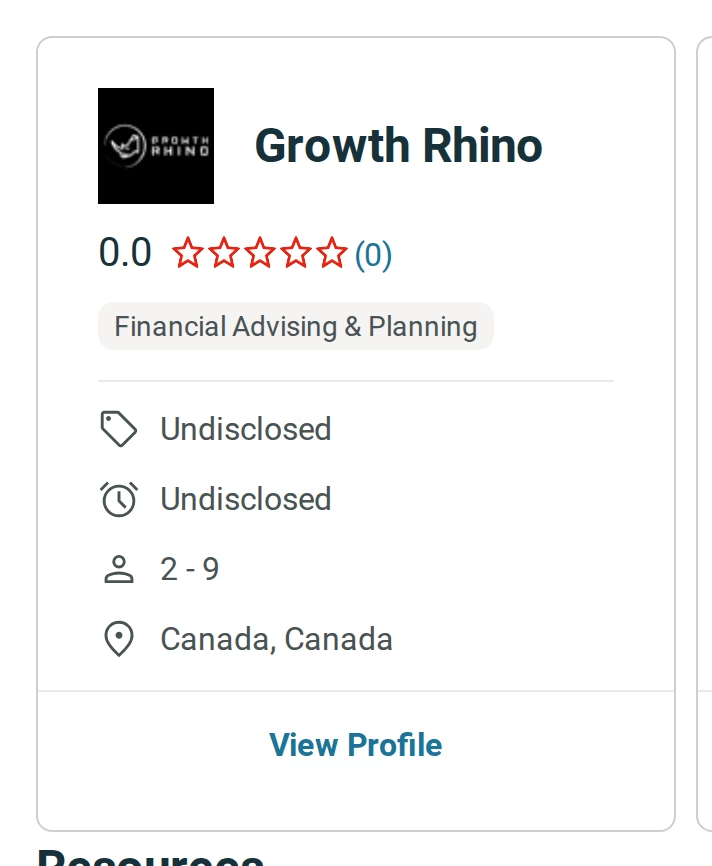
Trustpilot has no profile for their domain, and their BBB page shows no reviews. G2 blocked automated checks, so treat it as unverified rather than empty.
One independent source matched that: a May 2026 cold email agency roundup reported finding no third-party review either.
Growth Rhino Services Reviewed
Growth Rhino sells sourced pipeline for expensive, committee-led deals, and a documented system the client keeps afterwards.

Cold Email and Multi-Channel Outbound
Their cold email page describes signal-based targeting. Sends are triggered by a champion changing roles, a funding round or a relevant hire. They say they track twenty signals, each routed to its own play.
The email deliverability detail is more specific than most agencies publish. Their page says cold volume runs on separate sending domains rather than your primary, with SPF, DKIM and DMARC verified before launch. It also states a cap of roughly 50 sends per inbox per day.
Calling and linkedin outreach run against the same account list, which is what makes it multichannel outreach rather than three separate campaigns. Google Ads and paid social are billed as separate service lines.
GTM Automation and Revenue Leadership
Their site says the automation work is Clay-based and that they are a certified Clay agency. The output is enrichment, list building, routing, follow-ups and reporting, built as workflows the client's team owns.
They also sell fractional CRO, CMO and GTM leadership by the hour. Ask which of the two you are buying, because the pricing page bills them very differently.
What You Get With Growth Rhino (and What You Don't)
| Criteria | Growth Rhino | Certified Forge Experts |
|---|---|---|
| Channels | Email, LinkedIn, cold calling, Google Ads and paid social, per their services pages | Varies by expert. Outbound Pros' profile lists email, LinkedIn, calling and PPC as one motion |
| Lead guarantee | None. Their site says they do not do pay-per-meeting and will not promise guaranteed results without iteration | Some state one. Outbound Pros' profile states a guarantee of 50 to 75 qualified meetings per month |
| Outbound stack | Clay-based; their site says tools are chosen per client rather than forced | Disclosed on each profile. SalesCaptain's cites a Clay Enterprise partnership |
| Infrastructure ownership | Their site states domains, inboxes, sequences and Clay tables are registered in your name from day one | Outbound Pros' profile states owned domain infrastructure with documented SPF, DKIM and DMARC |
| Independent reviews | Clutch profile shows zero reviews. No Trustpilot profile found | Varies. SalesCaptain's profile cites Clutch recognition and names client companies |
| Pricing transparency | Public starting ranges by service on their pricing page | Varies. SalesAR's profile states pricing from $2,500 per month |
| Market coverage | Site states NA, EU and MENA. Published case studies skew heavily to North America, 25 of 37 | Varies. SalesCaptain's profile lists US, CA, EU and AS |
| Team depth | Team page names eight people plus three advisors. Clutch lists 2 to 9 employees | Varies. SalesCaptain's profile describes a dedicated pod per client |
| Best for | $50,000+ contracts, committee buying, and a documented handover | Depends which gap you need filled |
Every Growth Rhino cell above comes from their public material, and every expert cell from live profiles I fetched while writing. Confirm the details on your discovery calls.
How Growth Rhino's Process Works
Their site calls it the Growth Rhino Method: Discover, Position, Build, Launch, Optimize and Scale. Here is how that maps onto what a client experiences.
Discovery and ICP Definition
Their site says the Discover phase researches your market, your buyers' pains in their own words, and the signals worth tracking. Position then agrees upfront on what counts as working.
Ask them to write that definition down. A reply, a meeting and a qualified opportunity are three different things, and the ideal customer profile determines all three.
Prospect List Creation
Their Sortly write-up describes scraping Google Maps for field-service businesses, then enriching and qualifying the accounts with Clay before any outreach.
Ask to see a sample list before launch. Even a quick check of 50 rows will tell you more than any sales call.
Copy and Campaign Approval
Their cold email page says they write and test messaging in your voice, and that you approve before anything sends. Their homepage adds that AI drafts first-pass copy while people decide what to say to whom.
Ask who signs off on each variant, and how fast. Approval bottlenecks are the usual reason cold email copywriting gets watered down mid-campaign.
Campaign Launch
Their site says setup takes the first two to three weeks, covering domains, data, infrastructure and messaging. A 2 to 3 week email warm up runs before real sending, then campaigns launch in small test batches.
Ask what happens if warm-up runs long. Warm-up sits inside the same weeks you are paying a retainer for, so confirm whether billing starts at signature or at first send.
Reply Handling and Meeting Booking
Their cold email page says senior operators handle replies rather than a pooled inbox, qualifying each by intent before it reaches your side. Their ShareChest write-up describes a four-hour demo handoff.
Ask for the name and title of the person answering replies. At these contract sizes, the first human response is part of the product.
Reporting and Optimization
Their site says weekly reviews decide what scales, with every test carrying a success signal and a decision rule agreed in advance. The ShareChest write-up describes a dashboard built for board review.
Ask to see a real client dashboard, redacted. It tells you whether reporting tracks sourced pipeline or just activity, which is the difference that matters in outbound sales.
Growth Rhino Pricing and Contract Terms
Pricing is public, which is rare enough in b2b lead generation that it deserves credit. Their pricing page publishes starting ranges per service so you can self-select before booking a call.
The page is explicit that these are starting points, not quotes, and that your number depends on scope, volume and channels.
What's Included at Each Price Point
Their published ranges: cold email outreach at $2,000 to $5,000 a month, covering infrastructure, targeting, messaging and small-batch testing. LinkedIn outreach runs $1,000 to $3,000. Cold calling runs $2,000 to $5,000, scaling with team size.
Strategy work is billed hourly. Fractional leadership, GTM consulting, positioning and revenue operations are all listed at $125 an hour. Automation builds run $500 to $3,000, and custom sales tools $2,000 to $5,000 per project.
Paid channels work differently. Their FAQ says the management fee is a percentage of your ad budget, typically starting around 2%.
There is no lead guarantee attached to any tier. Their pricing FAQ says they do not do pay-per-meeting because it makes the vendor optimize for meeting count.
Hidden and Additional Costs to Watch
- Domains and mailboxes: the ranges cover the work, not the email infrastructure behind it. Ask whether those costs are billed through or on top.
- Data and enrichment credits: Clay is usage-priced. Ask who holds the subscription and who pays overages.
- Setup and build fees: their FAQ says build work is priced as a project separate from the monthly, so expect two lines, not one.
- LinkedIn seats: ask whose accounts and Sales Navigator seats the outreach runs on.
- The Diagnostic: their FAQ names a fixed-fee Diagnostic as the smallest sensible engagement but does not publish the fee. Ask for it before the call.
One term is missing. Their pricing FAQ says there is no lock-in, but no minimum term or notice period appears on the site, so get both in writing.
Then confirm who holds the domains at exit. If an agency owns your sending domains, leaving means starting your deliverability from zero. Growth Rhino states the opposite in writing, so make sure the contract repeats it.
Who Should Hire Growth Rhino?
- Companies with contracts worth $50,000 or more, which is the buyer their whole site is built around.
- Teams selling into a buying committee, where their per-stakeholder messaging and calling layer earn their cost.
- North American B2B SaaS, fintech and professional services firms, where 25 of their 37 case studies sit.
- Companies expanding into the Gulf, where eight case studies and two named Middle East advisors give real coverage.
- Teams that want the system documented and handed over, not rented indefinitely.
Who Should Not Hire Growth Rhino?
- Buyers who want a block of meetings with no internal involvement. Their homepage says an appointment-setting agency will do that cheaper and faster.
- Companies with contracts well under $50,000, where their own site says the approach would be overkill.
- Teams whose deals close in one conversation, since the method assumes a multi-month cycle.
- Buyers who need an independent reference trail before signing, because none exists publicly yet.
- Anyone optimizing for lowest cost per meeting, which they explicitly decline to compete on.
And if you are sending under a few hundred emails a month, you may not need an agency at all. Running Salesforge yourself at $48 per month covers that volume with warmup included.
Growth Rhino Case Studies and Reported Results
Growth Rhino publishes 37 case studies out of 110+ clients served, describing them as the ones they can name and show numbers for. Each gives the brief, the market, the channels and the timeline.
| Client | Industry | Reported Result |
|---|---|---|
| ShareChest | Investor-relations fintech | 47 meetings a month, up from six. Reply rate 11.4%, up from 1.8%. First sales-qualified lead in nine days, down from 47 |
| Sortly | Inventory software | $225,000 pipeline sourced, 50 meetings booked and 30 qualified opportunities across a 16-month engagement |
| Digital Workbench | Workplace fitout and construction | $2.5M pipeline sourced, 84 leads delivered, 30% converted to qualified |

The specificity is a genuine strength. Countable figures with named clients, stated timelines and a before column beat the vague percentages most agencies publish.
Two things need care. First, the results range enormously between engagements.
ShareChest reports 47 meetings a month. Sortly's 50 meetings across 16 months works out to roughly three a month by my arithmetic. Ask which end of that range your campaign is modelled on, and why.
Second, their totals do not agree with each other. The case study page's own description says $11M sourced, while its top stat block says $16M+. A second block on the same page says $18M+, and the homepage says $74M+.

Labels shift too. The homepage Sortly card calls the $225,000 figure new ARR; the Sortly case study page calls the same number pipeline sourced. Those are very different things to a buyer.
None of this makes the engagements fake. It does mean asking which figure is the real cumulative total and how it is calculated. And remember these are company-reported numbers that no independent platform has verified.
Growth Rhino Limitations to Consider Before Signing
- No independent review footprint: their Clutch profile shows zero reviews, Trustpilot has no profile, and their BBB page shows none either. Ask for two reference calls with clients in your industry, and actually take them.
- Their own pipeline totals conflict: four different figures appear across two pages, from $11M to $74M. Ask which number is current and what it counts.
- One engagement's reply rate is also the headline average: their cold email page says the average across engagements is 11.4% replies, which is also exactly ShareChest's single-engagement figure. Ask how many engagements that average covers.
- Small named team, very wide menu: their team page names eight people including an accountant, while the services span email, calling, LinkedIn, ads, automation and fractional leadership. Ask who works your account and how many other clients they carry.
- No callers named publicly: cold calling is sold as dedicated callers by region and language, but the team page lists no callers. Ask whether calling is in-house or subcontracted.
- Contract terms are only half-published: their cold email page says contracts start short and milestone-based, but no actual term, notice period or Diagnostic fee appears anywhere. Get all three in writing.
None of these should rule Growth Rhino out on its own. But if two or more matter to you, compare agencies that already answer these questions on their public profiles, and that is exactly what the certified agencies below do.
Growth Rhino Alternatives: Certified Forge Experts Worth Considering
Do not just Google "lead generation agency" and pick the first result. Compare agencies whose practices you can verify before a call, the same way you would with any other vendor.
The Forge Expert Network is a directory of agencies certified on the Forge ecosystem. Certification requires completing Salesforge's cold email training and meeting program eligibility requirements, so every listed agency has a disclosed, modern outbound stack.
The directory is younger and smaller than Clutch, so treat it as a curated starting point rather than a complete market map. If you are comparing broadly, the martal group review and abstrakt marketing group review cover two larger North American options.
I picked these three because each answers a specific gap I found above.
1. Outbound Pros
Best for: buyers who want a committed meeting number rather than a system-building engagement.
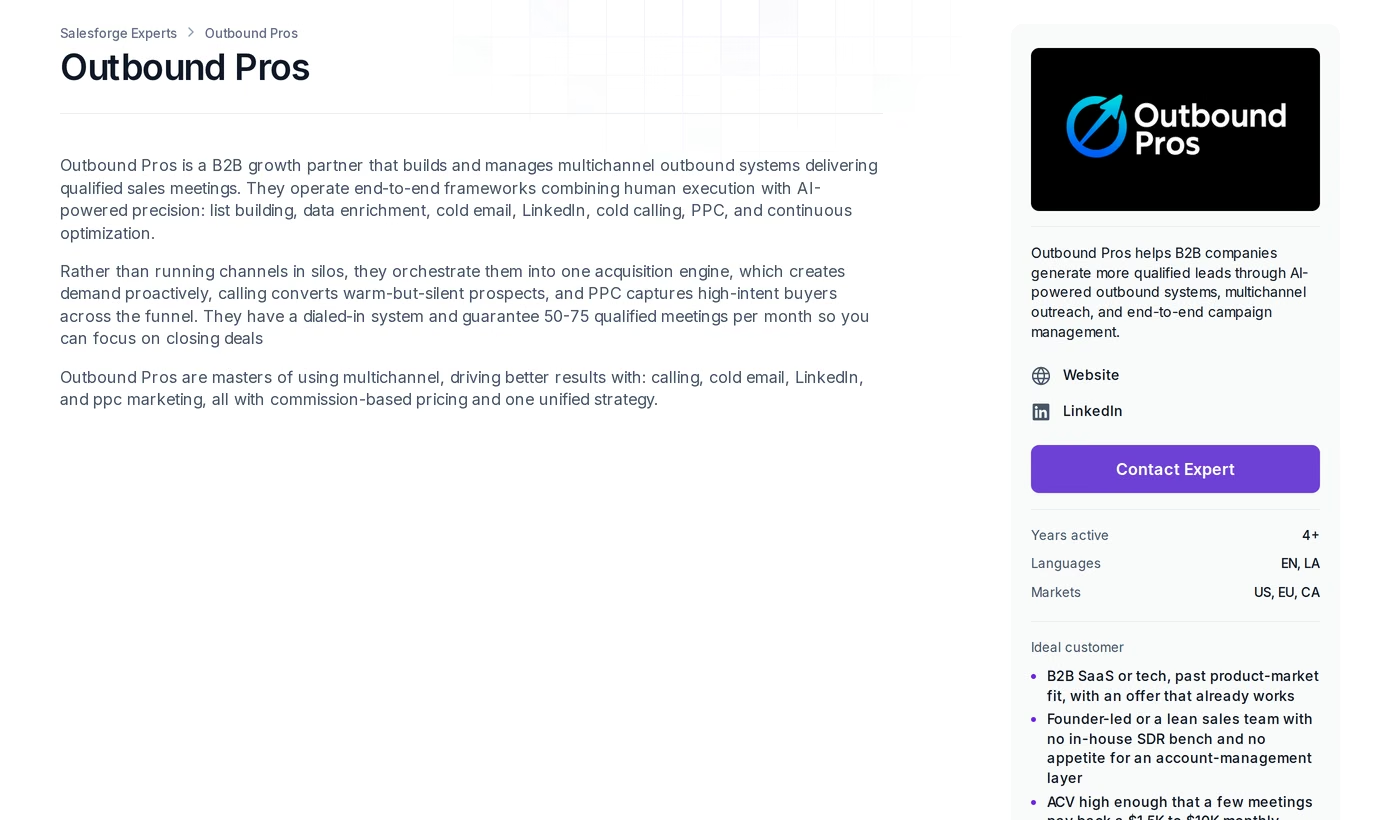
This is the option to look at if a guarantee matters to you. Growth Rhino declines both guarantees and pay-per-meeting pricing, by their own statement. Outbound Pros takes the opposite position: their profile states a guarantee of 50 to 75 qualified meetings per month, with commission-based pricing and a $1.5K to $10K monthly retainer.
Their profile also states owned domain infrastructure with documented SPF, DKIM and DMARC. It reports a 4 to 6 week warm-up targeting 85 to 95% inbox placement, and roughly 21 days to go live. In the Outbound Pros case study, founder Jānis Plūme reports zero downtime across client campaigns.
2. SalesCaptain
Best for: buyers who want a public reference trail and named clients before signing.
This one answers the verification gap. Growth Rhino has no third-party reviews at all.
SalesCaptain's profile leans on an external record instead, saying the agency is recognized as the #1 B2B outbound agency by Clutch. It is led by Bill Stathopoulos, the Clay chapter lead for London.
Their profile reports sending 1.2 million emails a month at a 0% spam rate standard, and names clients including Nestle, GlossGenius and Improvado. It also describes a dedicated pod per account: an account manager, two BDRs, two researchers and a copywriter. No Salesforge case study exists for them, so verify those figures on the call.

3. SalesAR
Best for: B2B companies whose deal sizes sit below Growth Rhino's $50,000 floor.
This is the option if your contracts are smaller. Growth Rhino's site says its method would be overkill below roughly $50,000 a contract. SalesAR's profile names a different band: $10K+ deal sizes or $3K to $5K+ monthly subscriptions, with pricing starting from $2,500 a month.
Their profile reports 700+ clients served, 30,000+ appointments set and an 80% renewal rate, describing ABM-style campaigns rather than volume outbound. A profile testimonial from Akridata reports 190+ appointments over a year. There is no Salesforge case study for SalesAR, so confirm those numbers directly.

Prefer Not to Hire an Agency at All?
Two routes are worth knowing about before you sign a retainer.
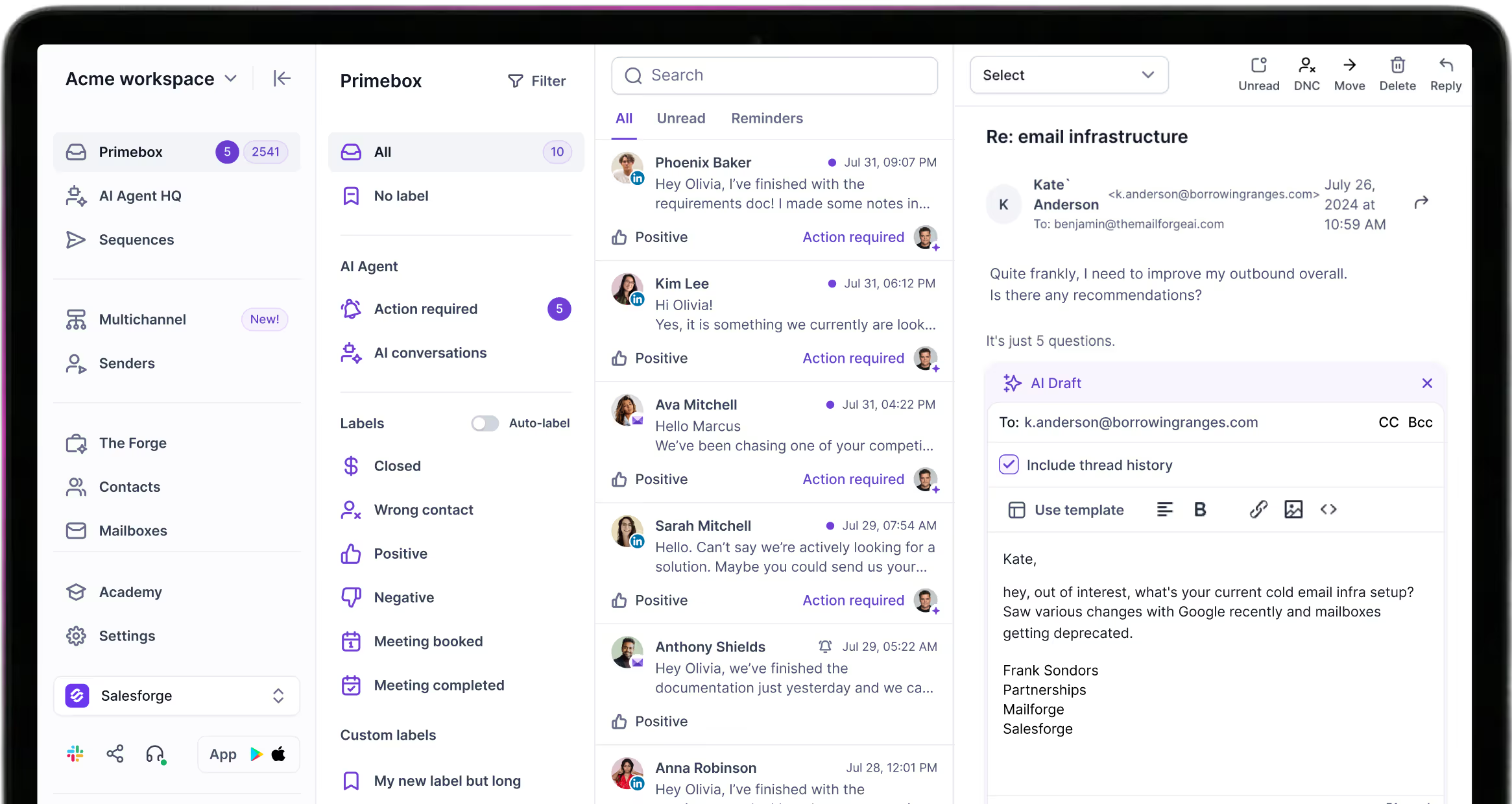
You can run outbound yourself with Salesforge. It starts at $48 per month with unlimited mailboxes and free unlimited warmup included, plus a 14-day free trial. For a founder-led team sending a few hundred emails a month, that covers the job.
Or you can hire Agent Frank, Salesforge's autonomous AI SDR, from $499 per month billed quarterly. He handles prospecting, sequencing, replies and meeting booking on his own, 24/7. Agent Frank is a separate subscription, and he needs a demo plus a two-week warm-up before he starts sending.

in Action
Questions to Ask Before Hiring Growth Rhino
Their answers will tell you more than any review, including this one.
- What counts as a qualified opportunity in our reporting, and who decides?
- Who holds the domains, mailboxes, Clay tables and lists if we stop working together?
- What is the total monthly cost including domains, enrichment credits and the build project?
- Who answers a prospect who replies asking for pricing, and what is their title?
- What is the minimum term and the notice period, in writing?
- How many message variants and list segments do we approve before anything sends?
- Is the reported 11.4% average reply rate across all engagements, and how many does it cover?
- Can we speak to two clients in our industry at a similar contract size?
Final Verdict: Is Growth Rhino Worth It?
Growth Rhino is worth considering if you sell $50,000+ contracts to committees and want to end the engagement owning the machine.
Two things set them apart, and very few agencies do either. Their pricing page publishes real starting ranges, beginning at $2,000 a month for cold email. Their cold email page commits in writing to registering domains, inboxes and sequences in your name.
I would shortlist them for a North American B2B SaaS or fintech company selling $50,000-plus contracts that wants a documented outbound system it can staff internally within a year.
If you need an independent reference trail before you sign, a committed meeting number, or a smaller deal size than their model assumes, compare certified agencies first.
Compare Certified AgenciesFrequently Asked Questions
1. Is Growth Rhino a Legitimate Company?
Yes, on the evidence available. A Better Business Bureau file was opened for Growth Rhino in July 2021 at 1228 Cornerbrook Pl, Mississauga, Ontario, with a listed phone number. Crunchbase lists the legal name as Growth Rhino Inc. with an active operating status. No verified client reviews exist on Clutch, G2 or Trustpilot, so nothing independent corroborates their results. I could not complete a Canadian registry check either, because Ontario's public search was unavailable, so treat incorporation details as unconfirmed.
2. How Much Does Growth Rhino Cost?
Their pricing page publishes starting ranges. Cold email runs $2,000 to $5,000 a month, LinkedIn outreach $1,000 to $3,000, and cold calling $2,000 to $5,000. Strategy and RevOps work is $125 an hour, and paid channel management is a percentage of ad spend. The retainer is not the full price. Build work is quoted separately, and domains, mailboxes and enrichment credits sit outside these ranges.
3. Does Growth Rhino Guarantee Leads?
No. Their site states they do not run pay-per-meeting pricing and will not promise guaranteed results without iteration, because outbound is treated as experimentation. What they do commit to is a success signal and a decision rule agreed before each campaign runs. Get those signals and rules in writing, including what happens to the fee if a campaign misses its threshold two months running.
4. Who Owns the Lead Data and Campaign Assets?
You do, according to their published material. Their cold email page states domains, inboxes, sequences and the Clay tables behind them are provisioned in your name and handed over documented. Their pricing FAQ says taking the work in-house is the intended ending. This is the strongest thing on their site, so make sure the contract repeats it. Domain ownership matters most, because leaving without your domains means rebuilding deliverability from zero.
5. What Are the Best Growth Rhino Alternatives in 2026?
Three certified agencies in the Forge Expert Network cover the gaps. Outbound Pros states a guarantee of 50 to 75 qualified meetings a month, which Growth Rhino does not offer. SalesCaptain's profile carries named clients and Clutch recognition, which Growth Rhino lacks. SalesAR serves $10K+ deal sizes from $2,500 a month, below Growth Rhino's $50,000 contract floor. For smaller volumes, running Salesforge in-house at $48 a month is the cheaper route.
6. Should You Hire a Lead Generation Agency or Build Outbound In-House?
Hire an agency when you need pipeline fast and do not want to hire and train SDRs. Build in-house when you want to own the system, the data and the learning long-term. The middle path is running Salesforge yourself at $48 a month, or hiring Agent Frank as an AI SDR from $499 a month billed quarterly. You can move to an agency once volume justifies it. Growth Rhino's model tries to bridge both by handing the system over.
.png)