Martal Group is a B2B lead generation agency built around a simple idea: put onshore senior sales talent in front of your buyers, and let a proprietary AI system handle the heavy lifting behind the scenes.
Today, the agency runs with 200+ sales executives who average a decade in B2B sales, spread across four countries and four languages. That team structure is what buyers pay for, and it's also what makes Martal harder to compare against cheaper offshore alternatives.
And the track record backs that up. Since founder Vito Vishnepolsky launched the agency in 2009, Martal has served over 2,000 teams across 24 verticals, from SaaS and Cybersecurity to Healthcare and Cleantech. Named clients include Bosch, Zoho, Orange, Telus, Jedox, and ClickWorker.
Their review footprint reinforces that too, with 4.9 stars on Clutch, 4.9 on Google, 4.8 on G2, and perfect 5s on Gartner, UpCity, and Capterra.
So, what makes Martal different, and is it worth the 3 to 4 month pilot commitment they require upfront?
I dug into its services, pricing, reviews, and results to find out.
Martal's independent review footprint is one of the strongest in the space, and it holds up across every platform they're listed on. Clutch shows 4.9. Google Reviews shows 4.9.
G2 shows 4.8. Gartner, UpCity, and Capterra all show perfect 5.0 ratings.
When independent platforms line up this consistently, the underlying delivery quality is usually real, not just the result of one review campaign.
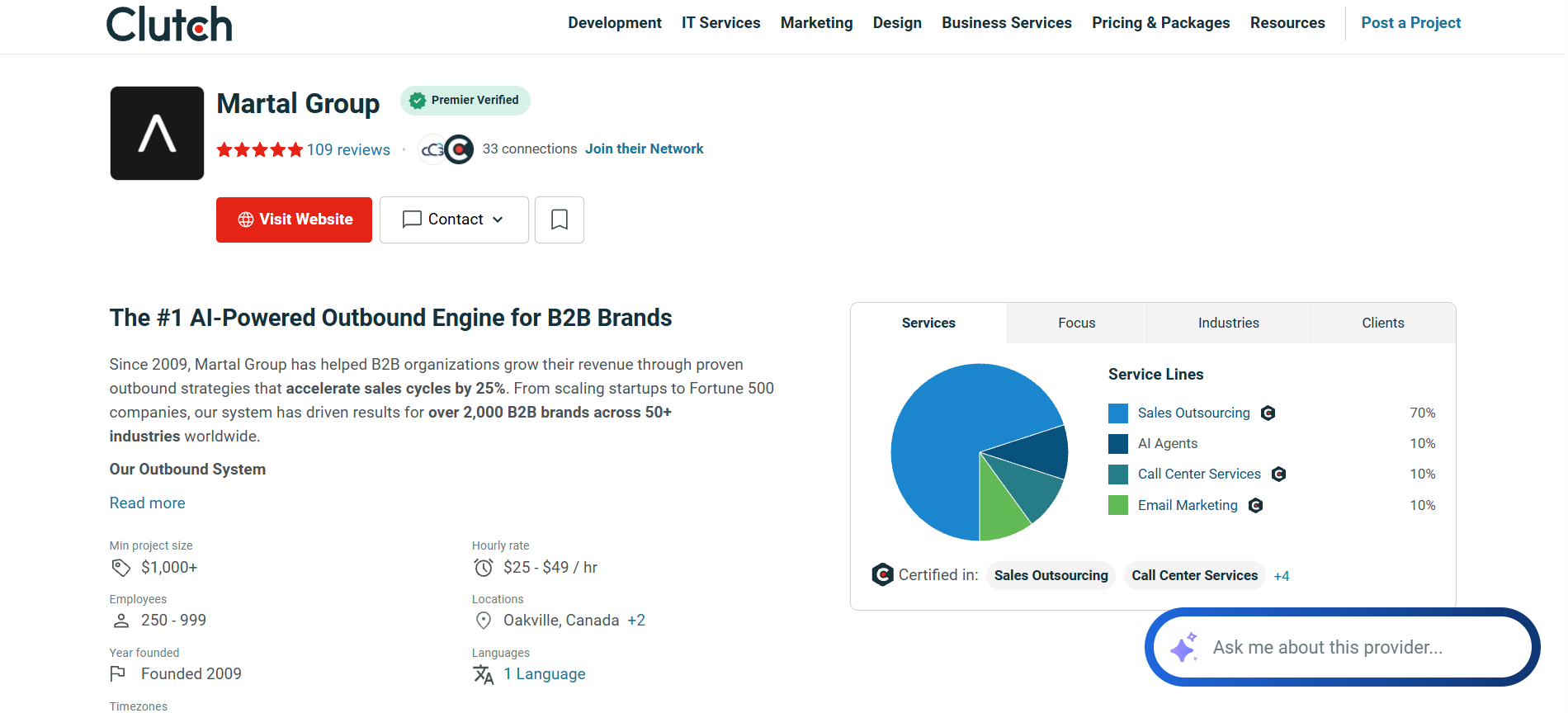
The most common theme across positive reviews is that Martal's assigned sales executive genuinely knew the industry and could hold a peer-level conversation with a technical prospect. This is a sharp contrast to what buyers hit at cheaper agencies where SDRs read from generic scripts. Reviewers repeatedly credit this depth of understanding as the reason they stayed past the pilot.
Buyers expanding into North America, Europe, or LATAM specifically credit Martal with landing first contracts within the first two months of the engagement. The four-language capability (English, Spanish, German, French) and offices in Oakville, San Francisco, Uniondale NY, and Clermont-Ferrand France back this up.
Buyers who worked with other agencies before Martal consistently flag the difference in seniority. This is the single most repeated comparison across the review platforms, and it's why the 4.8 to 5.0 rating footprint holds up across six sources..
Multiple reviews call out Martal reworking messaging, ICP, or channel mix mid-engagement when the first version didn't land. This matters because outbound rarely works perfectly out of the gate, and the willingness to iterate separates the agencies that get results from the ones that don't.
Consistent praise across reviews for the weekly cadence, KPI transparency, and responsiveness of the assigned team. This is the operational hygiene that keeps a 3 to 4 month pilot on track when a shorter engagement would spiral.
No dollar figures appear anywhere on the site. Every service tier says "inquire about pricing," and the AI Sales Platform tiers say the same. Buyers who want to benchmark before booking a call cannot, which forces you to invest sales time before you know if the budget fits.
Tier 1A requires 3 months minimum. Tier 2 and Tier 3 require 4 months. Buyers testing outbound for the first time flag this as substantial upfront exposure compared to competitors offering month-to-month. There is no shorter test option publicly available.
These tiers charge a sales commission on top of the flat retainer, and the percentage is not published. This surfaces as a point of friction when negotiating final contracts, because commission on high-ticket deals compounds fast if the math isn't nailed down upfront.
Standard for any managed outbound engagement, but worth flagging. First campaigns often need 2 or 3 rounds of edits before the messaging locks in, which means the first weeks of the pilot are ramp, not results.
60% of Martal's reps are US-based, 20% are Canadian, and only 10% each are in the EU and LATAM. If your primary market is European or Latin American, the dedicated rep pool feels thinner than the marketing implies. Ask which specific rep will run your account and confirm they're actually based in your target region.
Hire Martal Group if you're a mid-market B2B company selling into US, Canadian, or European markets, and you value onshore senior sales talent over cheaper offshore alternatives. Their team depth is real, their multi-industry playbooks are proven, and the review footprint across six independent platforms is one of the most consistent in the category.
But treat the commitment seriously. The 3 to 4 month pilot, undisclosed pricing, and Tier 2/Tier 3 commission structure mean you're making a significant upfront investment before you see whether it works for you. Get the full monthly cost, commission math, and pilot terms in writing before signing.
If you need month-to-month flexibility, pay-per-meeting pricing, or a smaller test budget, this isn't the fit. Take a look at certified Forge Experts instead. Different fit for a different buyer.
I have not been a Martal Group client, so this review is research-based. Everything below comes from martal.ca directly for pricing, services, and process, and from the six review platforms Martal links to publicly for customer feedback (Clutch, Gartner, Google Reviews, UpCity, Capterra, G2).
I judged Martal on four things: whether the team seniority claim holds up, whether pricing is fair for what you get, whether the pilot commitment is worth the risk, and whether the results published across 24 industries actually match what buyers report post-engagement.
Martal sells nine services across outbound, inbound, and AI-powered outreach. Rather than list all of them here, the ones that actually matter for most buyers evaluating them are the core outbound offer and the AI Sales Platform.
This is Martal's flagship. You get a dedicated Sales Executive, a Research Manager, and a Sales Operations Manager who run cold email, LinkedIn outreach, and cold calling on your behalf, targeting 5 to 7 touchpoints per prospect. Weekly reporting, weekly goal-setting, and CRM integration are all bundled in the standard scope.
Sold separately from the managed services, this is Martal's proprietary tech layer that powers ICP definition, list building, and copywriting. It's trained on 40 million top-performing emails Martal has run, and it plugs into a database of 150 million+ verified contacts filtered by 3,000+ intent signals.
Appointment setting, cold emailing, LinkedIn lead generation, cold calling, sales outsourcing, B2B sales training, and inbound lead generation (SEO plus backlinks) all exist as standalone offerings. Most buyers who come to Martal end up bundling one or two of these into an Outbound Lead Generation engagement rather than buying them separately.
Martal runs a fairly standard omnichannel outbound motion, but the layer that sets it apart is the AI system handling research and copywriting at scale while human reps handle the actual conversations. Here's how a typical Tier 1A engagement plays out.
Within minutes of kickoff, the AI generates your business profile and detailed descriptions of your target ICPs. Your team reviews and approves before campaigns launch. Get the qualification standard for a "qualified lead" written into the scope here, because this is where the economics of the engagement get set.
Martal's platform builds lead lists using intent signals and technographic data from a database of 150M+ verified contacts. Ask for a sample list of 50 records before campaigns launch. Data quality is where the whole engagement lives or dies. If you want to compare against agencies with a different data model, my Belkins review covers what a US-focused retainer competitor looks like.
The generative AI, trained on 40M+ successful B2B emails, drafts ICP-specific campaign copy that Martal's team vets and edits before it sends. Ask if you can approve the copy before the first campaign goes out. You should sign off on at least the first send.
Campaigns run across email, LinkedIn, and phone with 5 to 7 touchpoints per prospect. Each rep gets a custom sending domain with warming and validation built in, which handles the deliverability side automatically. If you want to run this same channel mix with your own team, my roundup of the best multichannel outreach tools covers the software side of the same problem.
As responses roll in, Martal's assigned sales executive nurtures, qualifies, and books meetings directly on your calendar. This is the point where senior reps matter most. Junior SDRs at cheaper agencies burn qualified prospects here by mishandling the response.
Weekly meetings, weekly reports, quota setting, and KPI tracking are all included in standard scope. Ask for a sample dashboard on your discovery call so you can verify what metrics get tracked and how often campaigns iterate.
Martal doesn't publish dollar figures anywhere on the site. Both their managed services and their AI Sales Platform are fully custom-quoted, and every tier requires a discovery call to get a number.
What is published is the structure of each tier, which gives you the shape of the commitment before you book the call.
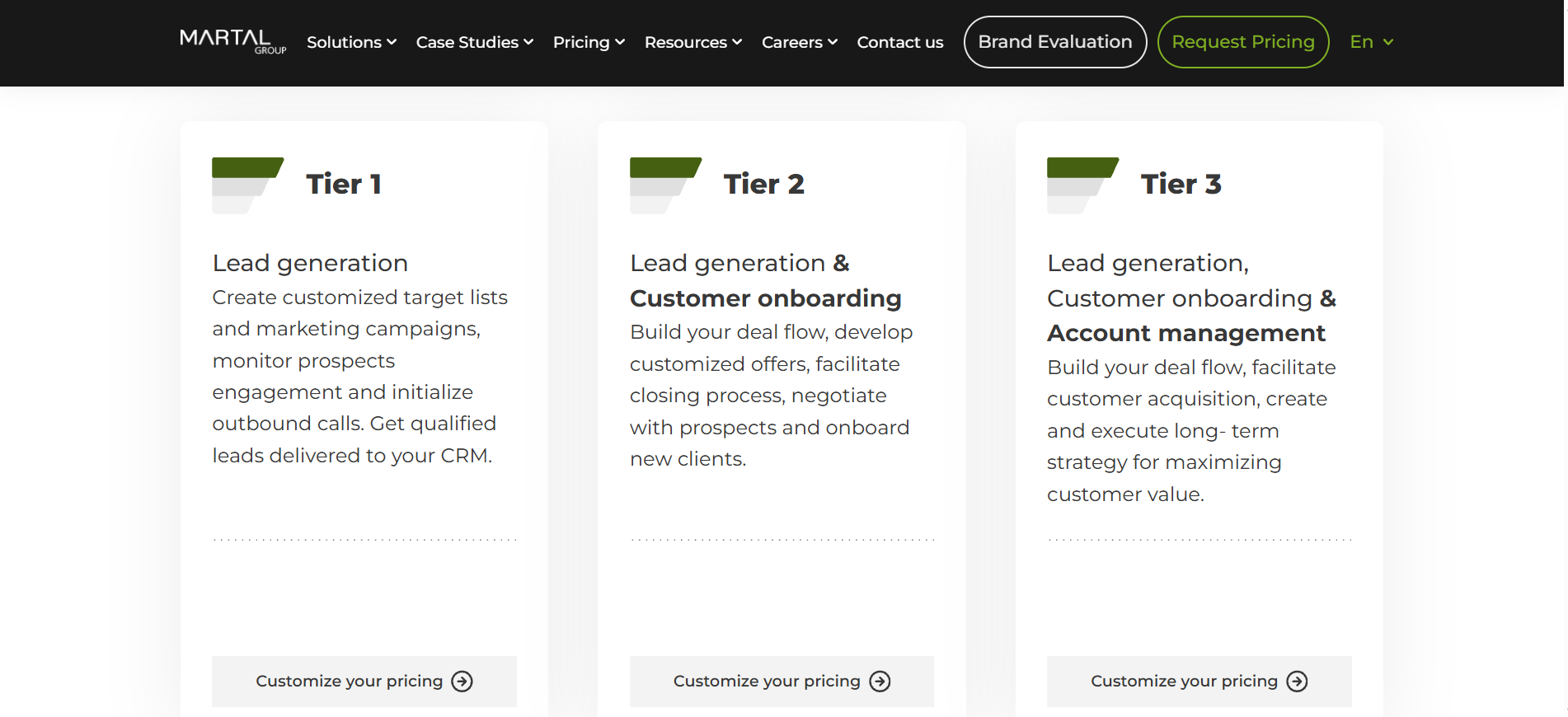
1. Tier 1A (Outbound Lead Generation)
This is a 3-month pilot followed by a monthly subscription. Flat fee per month. You get a dedicated Sales Executive, Research Manager, and Sales Operations Manager.
2. Tier 2 (Outbound + Sales Onboarding)
The secon plan is a 4-month pilot followed by a monthly subscription. Flat fee per month plus a sales commission on closed deals. Martal's team runs the full sales cycle through discovery calls and demos.
3. Tier 3 (Full Account Management)
The last pricing plan is a 4-month pilot followed by a monthly subscription. Flat fee plus commission. Martal handles the entire relationship, including account management after the deal is signed.
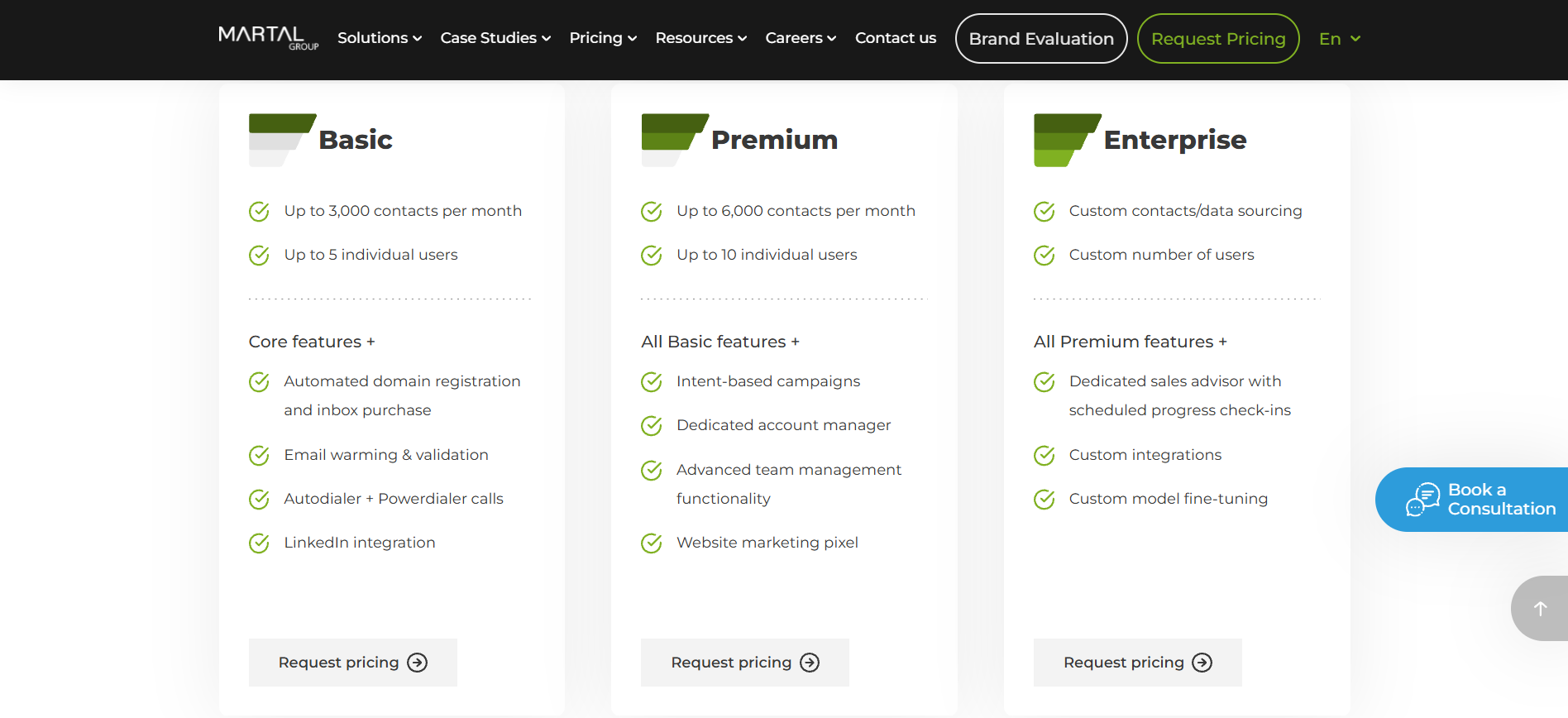
Basic, Premium, and Enterprise tiers, all custom-quoted. Martal claims this platform saves up to 60% versus building your own tech stack and up to 93% versus a traditional B2B outbound model.
Martal publishes what a single month of Tier 1A activity looks like: 3,000 to 5,000 prospects targeted, 9,000 to 12,000 emails sent, 150 to 200 total responses, 20 to 30 qualified leads, and 5 to 15 flipped leads (closed). Use this to back into your own economics. If your deal size makes 15 closed deals a year worth the retainer plus commission, the math works.
Martal fits you well if you're a mid-market B2B tech, SaaS, cybersecurity, fintech, or industrial company, and your ICP lives in the US, Canada, or Europe. You want onshore senior reps with average 10+ years in B2B sales, you can commit to a 3 or 4 month pilot, and your budget supports a flat monthly retainer plus a possible commission layer.
If your deal size is high enough that 15 closed deals a year covers the cost, and your product has clear market fit, this is a viable option. The multi-industry playbooks across 24 verticals mean Martal has probably run campaigns close to your ICP before.
Skip Martal, or at least compare harder, if you need pay-per-meeting pricing, month-to-month flexibility, or a small budget under a few thousand dollars per month. Also skip if you're still testing your ICP fundamentals, because the 3 to 4 month pilot doesn't leave enough runway to reset if the targeting hypothesis is wrong at the start.
Buyers whose primary market is APAC or Australia should also look elsewhere. Martal covers US, Canada, EU, and LATAM only.
If your monthly outbound volume is under a few hundred emails, you may not need an agency at all. Running Salesforge yourself covers that volume with warmup included.
Martal publishes 21 named case studies on the site and industry-level aggregate results across 24 verticals. The pattern across the strongest results is consistent: multi-year engagements (24 to 32 months) with hundreds of booked meetings per client and clear retention.
Financial Services is the standout, with one 24-month engagement producing 880 booked meetings and over 1,000 qualified leads. Healthcare (213 booked meetings in 24 months) and Ecommerce (349 in 13.5 months) show similar durability. Named clients like ClickWorker, Jedox, and Bosch anchor the roster with recognizable B2B logos.
The caveat worth flagging: industry-level aggregates are portfolio averages. Your actual monthly volume depends heavily on your ICP, deal size, and how tightly the campaign gets calibrated in the first month. Use the published funnel benchmark (20 to 30 qualified leads per month) as your per-client expectation, not the aggregate.
Every service tier and every AI Platform tier requires a discovery call to get a dollar figure. Buyers who want to benchmark before booking cannot, which means you invest sales time before you know if the budget fits.
Tier 1A is 3 months minimum. Tiers 2 and 3 are 4 months. That's a significant upfront investment for buyers testing outbound for the first time, and there's no shorter test option publicly available.
The pricing page says "flat fee per month + sales commission" for these tiers without specifying the percentage or what it applies to. Ask upfront, because commission on high-ticket deals compounds fast if the terms aren't nailed down.
60% of Martal's reps are US-based. Only 10% each are in the EU and LATAM. Buyers whose primary market is Europe or Latin America should confirm the specific rep assigned to their account is actually in-market, not a US rep handling the region remotely.
Trade shows and conference attendance are listed as "at an extra cost." Additional publications and back-links are also extra. Get the full scope in writing so extras don't stack unexpectedly during the engagement.
Martal's approach assumes you know your ICP. Pre-product-market-fit teams often burn a 3 to 4 month pilot without meetings if the targeting hypothesis is wrong from the start. This is worth an honest self-assessment before signing. My Callbox review covers a competitor with similar multi-region scale if you want to compare on this specific fit.
If Martal isn't the right fit, don't just Google "lead generation agency" and pick the first result. Compare a few agencies whose practices you can actually verify.
My best lead generation agencies in the USA breakdown covers the broader landscape.
The Forge Expert Network is a directory of agencies certified on the Forge ecosystem. Certification requires completing Salesforge's cold email training and meeting program eligibility requirements, so every listed agency has a disclosed, modern outbound stack.
Best for: Buyers who want Martal's multi-region European coverage but with published entry pricing and a smaller pilot commitment.
Forge rating: 5/5
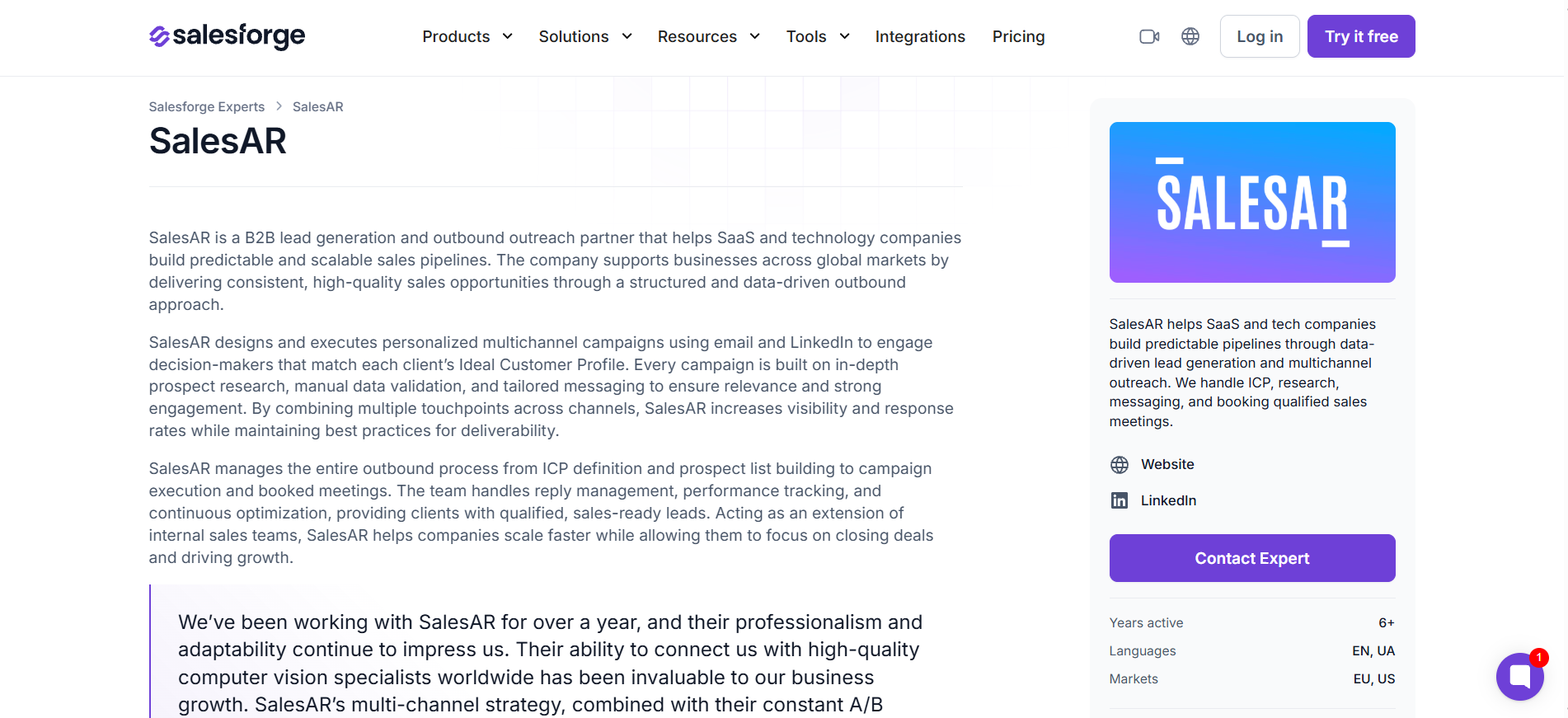
SalesAR publishes a starting price of $2,500 per month and covers EU and US markets, which is a direct answer to Martal's hidden pricing and 3 to 4 month pilot commitment.
Their profile reports 700+ clients served, 30,000+ appointments set, and an 80% contract renewal rate. Named case study clients include Akridata with 190+ appointments generated.
Best for: Buyers who want Martal's phone-heavy multichannel breadth but with a contractual meeting guarantee.
Forge rating: 5/5
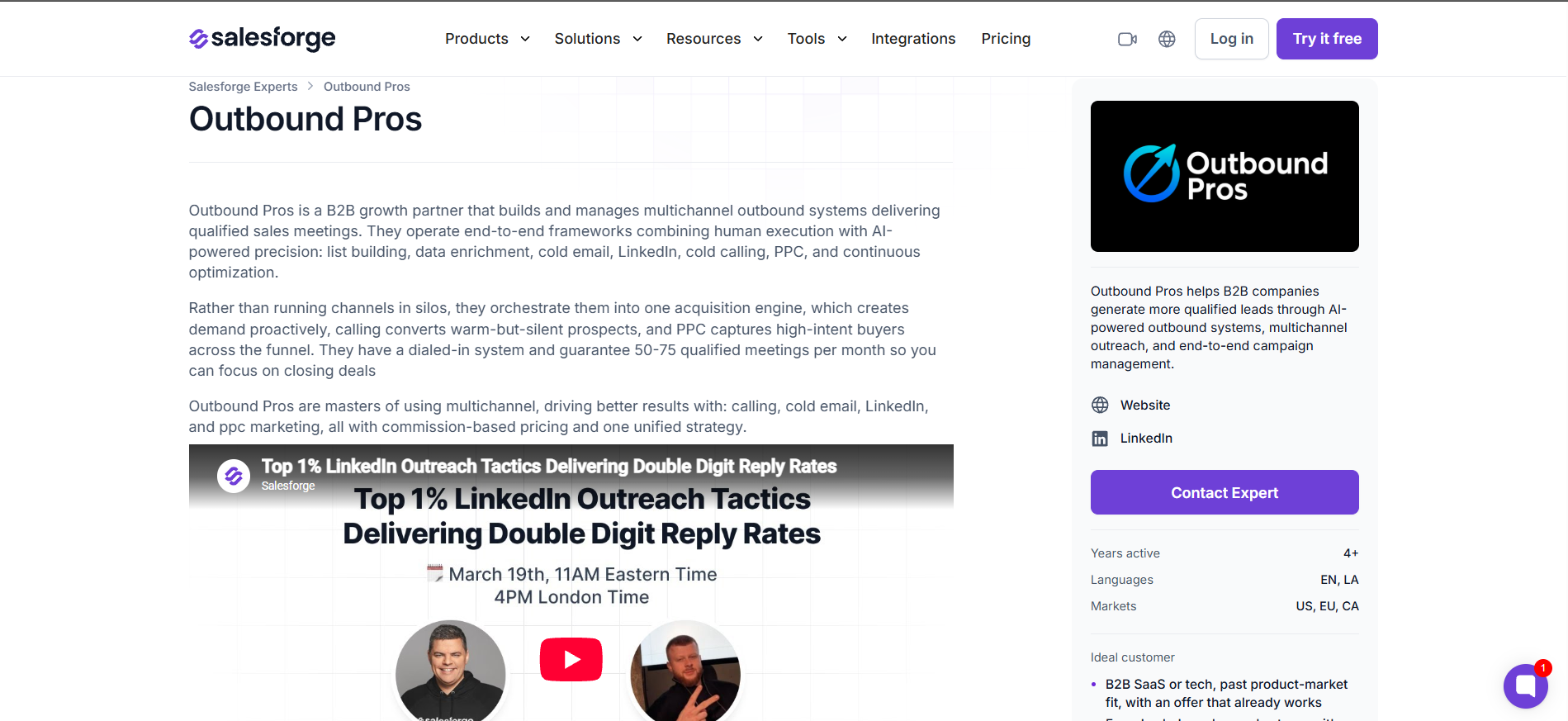
Outbound Pros guarantees 50 to 75 qualified meetings per month with commission-based pricing on top of a $1.5K to $10K monthly retainer. That's a meeting count commitment Martal won't sign. Their profile also states dedicated owned domain infrastructure with documented SPF, DKIM, and DMARC setup, plus a four to six week warm-up targeting 85 to 95% inbox placement.
Best for: $5M to $50M ARR companies that want an outbound partner but plan to bring the system in-house eventually.
Forge rating: 5/5
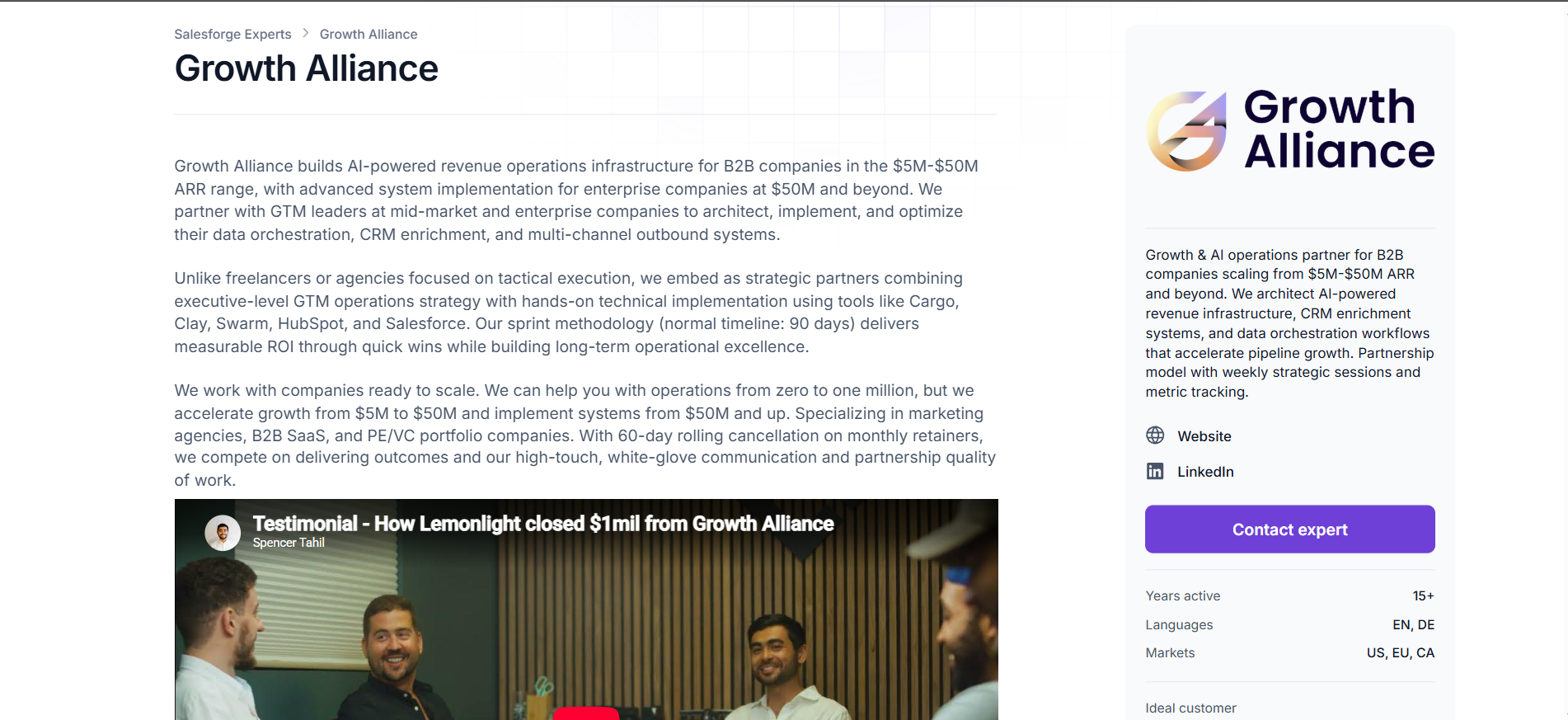
Growth Alliance offers programs from $10K per month with 60-day rolling cancellation and a 90-day sprint methodology. Their profile says systems are built to become the client's own and keep running afterwards, which is a cleaner exit than Martal offers.
They cap engagements at four to six clients with 100 to 120 hours each per month, and their case study reports founder Spencer Tahil running 1,000+ client domains and mailboxes above a Heat Score of 89.
Two routes skip the agency entirely.
Run outbound yourself with Salesforge. It starts at $48 per month with unlimited mailboxes and free warmup included, plus a 14-day free trial.
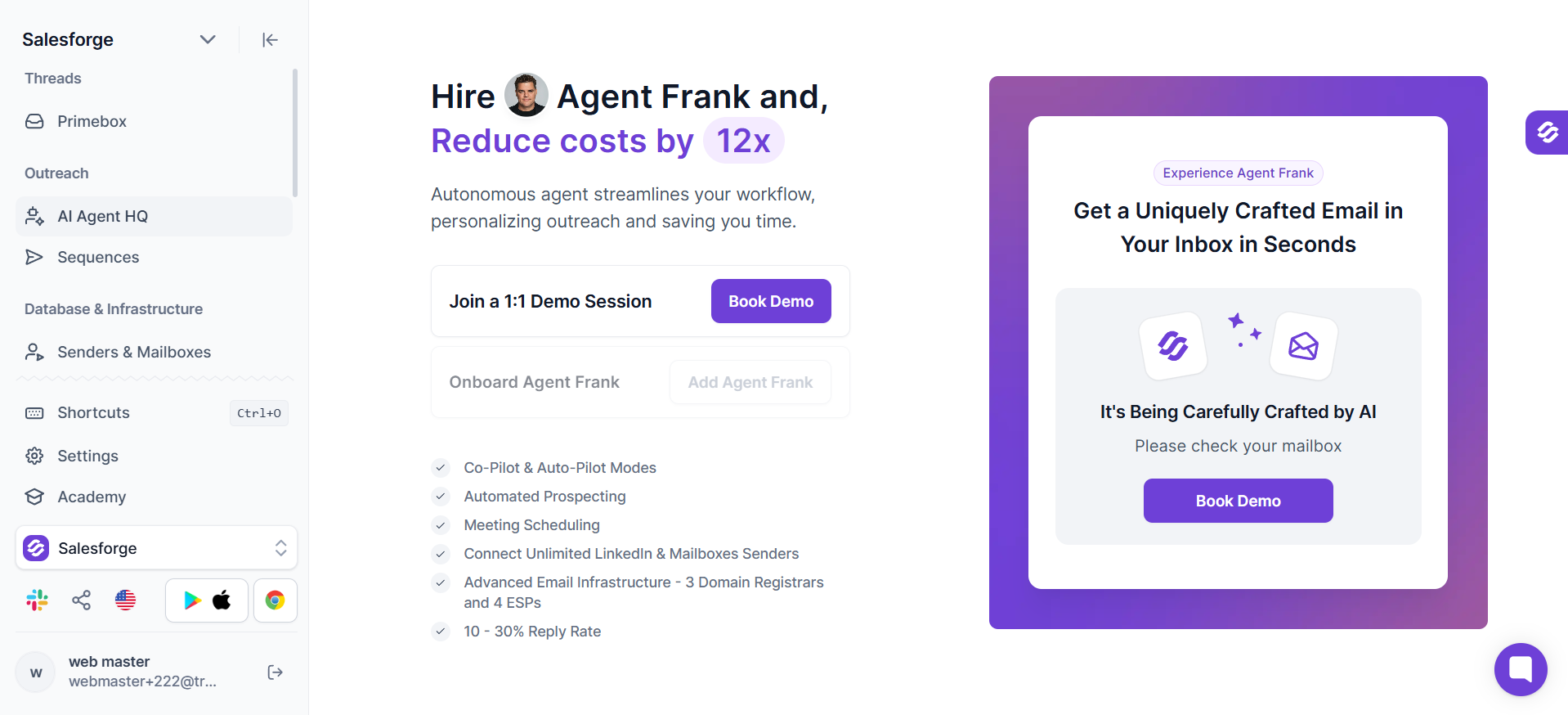
Or hire Agent Frank, Salesforge's autonomous AI SDR, from $499 per month billed quarterly. He handles prospecting, sequencing, replies, and meeting booking on his own. He is a separate subscription, and he needs a demo plus a two-week warm-up before he can send.
Take these into your discovery call. Their answers will tell you more than any review, including this one.
Martal Group is worth considering if you're a mid-market B2B tech, SaaS, cybersecurity, or industrial company selling into US, Canadian, or European markets, and you can commit to a 3 to 4 month pilot at a flat monthly fee plus possible commission.
The team seniority is real. The multi-region coverage is real. The consistent 4.8 to 5.0 star ratings across six independent review platforms are one of the strongest signals in the space.
But the hidden pricing, mandatory 3 to 4 month pilot, and undisclosed commission structure are all real friction points that deserve honest attention before signing. Get the numbers in writing, verify the specific rep assigned to your account, and pull two callable references from your industry before committing.
If you need transparent pricing before booking a call, month-to-month flexibility, or a smaller test commitment, compare certified alternatives in the Forge Expert Network that already publish those terms.
Yes. Martal Group is a Canadian B2B lead generation agency founded in 2009 by Vito Vishnepolsky, with offices in Oakville Ontario (headquarters), San Francisco, Uniondale New York, and Clermont-Ferrand France. The company reports 200+ onshore sales executives, 2,000+ teams served, and 15 years in business. Named clients include Bosch, Zoho, Orange, Telus, Jedox, and ClickWorker. Rated 4.8 to 5.0 stars across six independent platforms: Clutch, Gartner, Google Reviews, UpCity, Capterra, and G2.
Martal doesn't publish pricing figures anywhere on the site. Both the managed services and the AI Sales Platform are fully custom-quoted based on scope, and every tier requires a discovery call to get a dollar figure. What is published is the tier structure and pilot commitment length.
Martal requires a 3-month pilot for Tier 1A (Outbound Lead Generation) or a 4-month pilot for Tier 2 (Sales + Onboarding) and Tier 3 (Full Account Management). After the pilot, the engagement converts to a monthly subscription. The pricing difference between pilot and subscription is not disclosed publicly.
Tier 1A includes a Sales Executive, Research Manager, and Sales Operations Manager as your onshore team. Tier 2 and Tier 3 use Fractional Sales Executives and add account management. Named reps on the site have between 6 and 20 years of B2B sales experience.
Martal publishes what a single month of Tier 1A activity looks like: 3,000 to 5,000 prospects targeted, 9,000 to 12,000 emails sent, 150 to 200 responses, 20 to 30 qualified leads, and 5 to 15 flipped leads.
Martal is a 3 to 4 month pilot with flat fee plus optional commission, and their reps are onshore senior operators across US, Canada, EU, and LATAM. Belkins is a US-focused retainer agency with 233 Clutch reviews and stronger third-party validation. Callbox has 22 years of history and genuine APAC coverage with Campaign Pods pricing. My Belkins review and Callbox review cover both alternatives.
Three certified agencies in the Forge Expert Network answer specific gaps. SalesAR publishes a $2,500 monthly starting price with EU + US coverage. Outbound Pros guarantees 50 to 75 qualified meetings monthly with commission pricing. Growth Alliance builds systems clients keep after engagement with 60-day rolling cancellation. For smaller volumes, running Salesforge in-house from $48/month is a leaner alternative.
.jpg)

.jpg)

.jpg)