Without wasting even a minute of your time, I want to guide you towards the key takeaways that you must learn before making a decision on whether cold email or email marketing is the best approach for your next campaign.
Both channels send emails. Everything else about them is different. Here is the short version before the details.
Both channels send emails. That is where the overlap ends.
The whole distinction comes down to one word: consent.
Cold email reaches someone who has never heard from me. Email marketing reaches someone who asked to hear from me. Everything else follows from that. The tools change, the rules change, and the metrics change.
Here is the quick answer before the details. Cold email is how I start relationships. Email marketing is how I keep them.
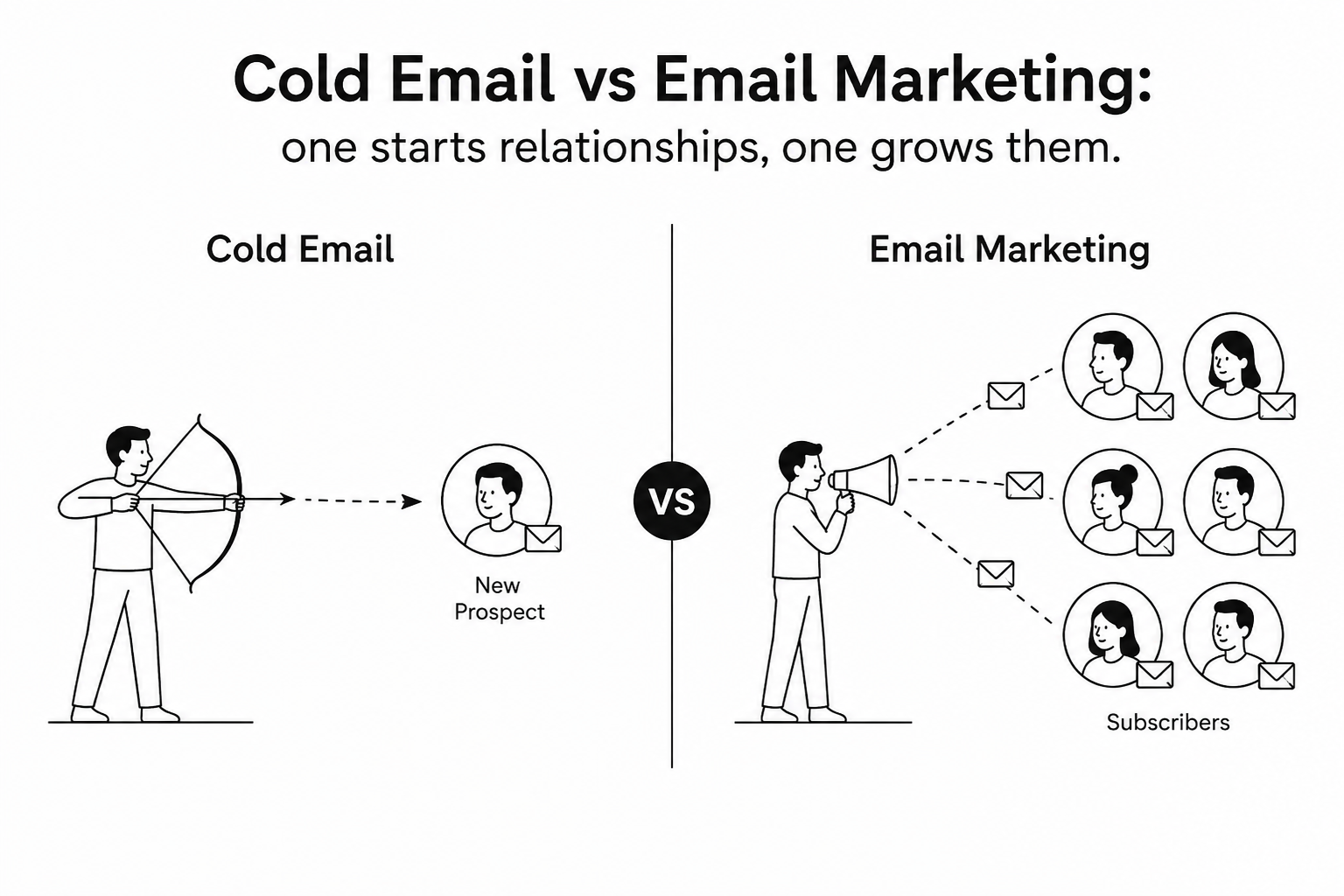
Cold email is outbound. I reach a prospect who fits my ideal customer profile and has no prior relationship with my brand.
The goal is not a sale on the first send. The goal is to start a conversation and book a meeting.
Cold email works for B2B teams selling to decision-makers who do not know them yet. Founders, SDR teams, agencies, and growth teams use it to open a pipeline from zero.
Most teams run this at scale with cold email automation, not by hand. Alongside LinkedIn outreach, cold email is one of the two strongest client acquisition channels in 2026.
A working campaign has five moving parts. Each one protects the next.
Email marketing is permission-based. I send to people who opted in through a form, a download, or a purchase.
The audience already knows my brand, so the job shifts from starting a relationship to growing one. It is a strong channel, and it earns its reputation on an engaged list.
Email marketing fits any brand with an audience to nurture. E-commerce stores, media brands, and SaaS teams use it for newsletters, product updates, and lifecycle campaigns.
The return is strong when the list is engaged, which is why it stays a core channel for retention and repeat revenue.
The shape is different from a cold email. The list comes to me, then I keep it warm.
The fastest way to see the split is a direct comparison.
Read it as two different jobs, not two versions of the same job.
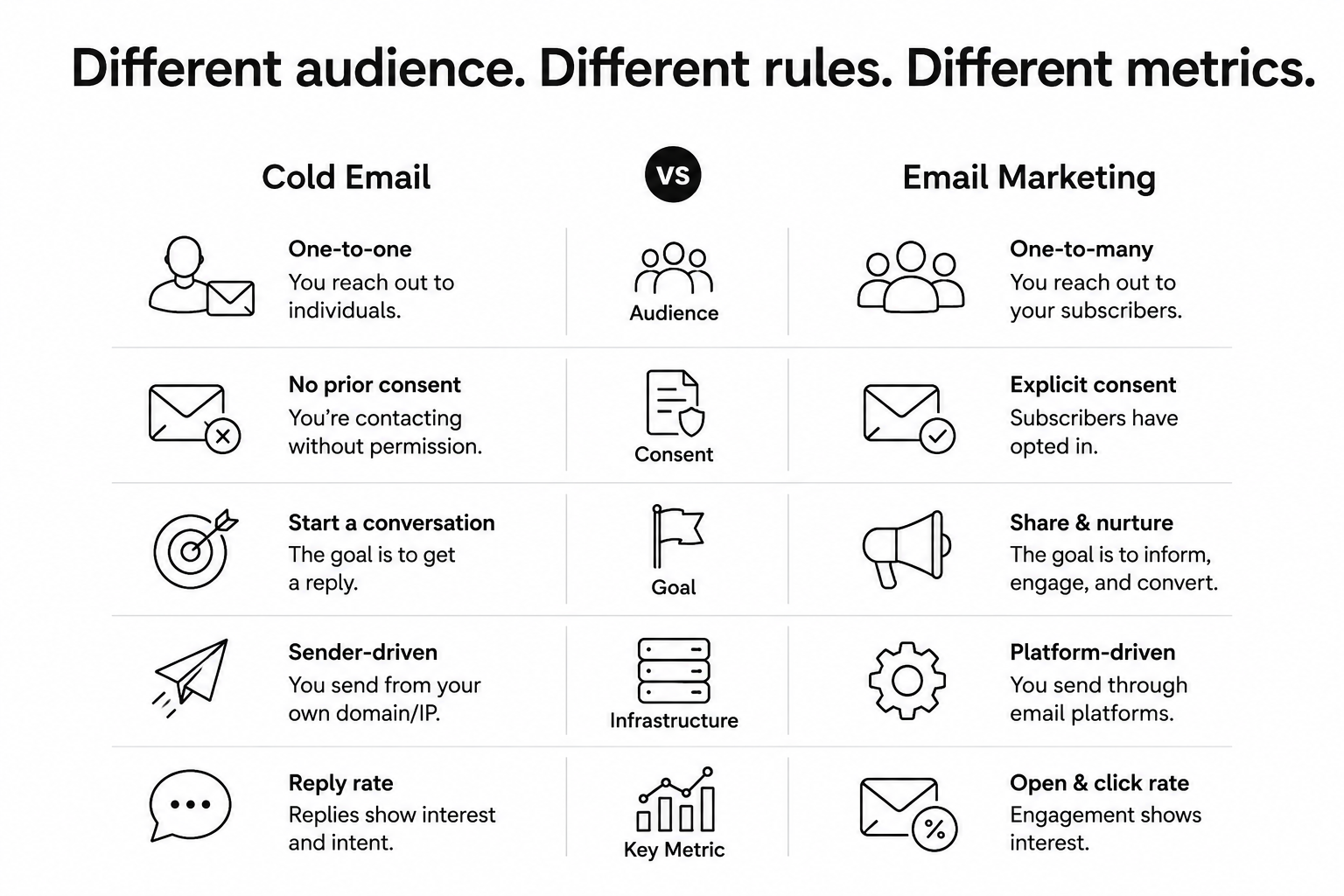
People try to compare cold email and email marketing on the same numbers. That never works.
Each channel is measured on a different action, so the benchmarks live in different ranges.
Marketing emails to an engaged, opted-in list often see open rates in the high thirties percent, with click rates in the low single digits.
Cold email reply rates usually sit in the low single digits, and a well-targeted, personalized campaign can climb into double digits.
Those numbers are not competing. One counts opens on a warm list. The other counts replies from strangers.
I judge cold email on replies and booked meetings. I judge email marketing on clicks and revenue per send.
Consent changes the legal picture, so each channel plays by its own rulebook.
Getting this wrong is how teams lose domains and inboxes.
Email marketing needs prior opt-in almost everywhere. No opt-in, no send.
Cold email is allowed for legitimate B2B outreach in many regions, but it still carries obligations. I identify myself honestly, keep the message relevant, offer a clear way to opt out, and honor removals fast.
In the US that maps to CAN-SPAM. In the EU it maps to GDPR and legitimate interest. In Canada it maps to CASL.
None of this is legal advice, so I confirm the current rules for each market before a campaign goes live.
This is the mistake I see most often. A team runs cold outreach through a marketing platform, then wonders why deliverability collapses.
The tools are built for opposite jobs, and the infrastructure underneath them is not interchangeable.
Marketing platforms are tuned for bulk sends to engaged subscribers. Point them at cold traffic and the reputation model works against me.
Cold email needs its own foundation. That means cold-email-ready email infrastructure, sender rotation, ESP matching, and constant email deliverability monitoring.
It also needs a real email warm-up before the first campaign, not after the damage is done.
The Forge Stack gives me all of that under one roof. Mailforge for shared IPs, Infraforge for dedicated IPs with pre-warmed mailboxes, and Primeforge for real Google Workspace and Microsoft 365 mailboxes with ESP matching.
Warmforge warms every mailbox for free with Salesforge, with Heat Score™ tracking and inbox placement tests in the same view.
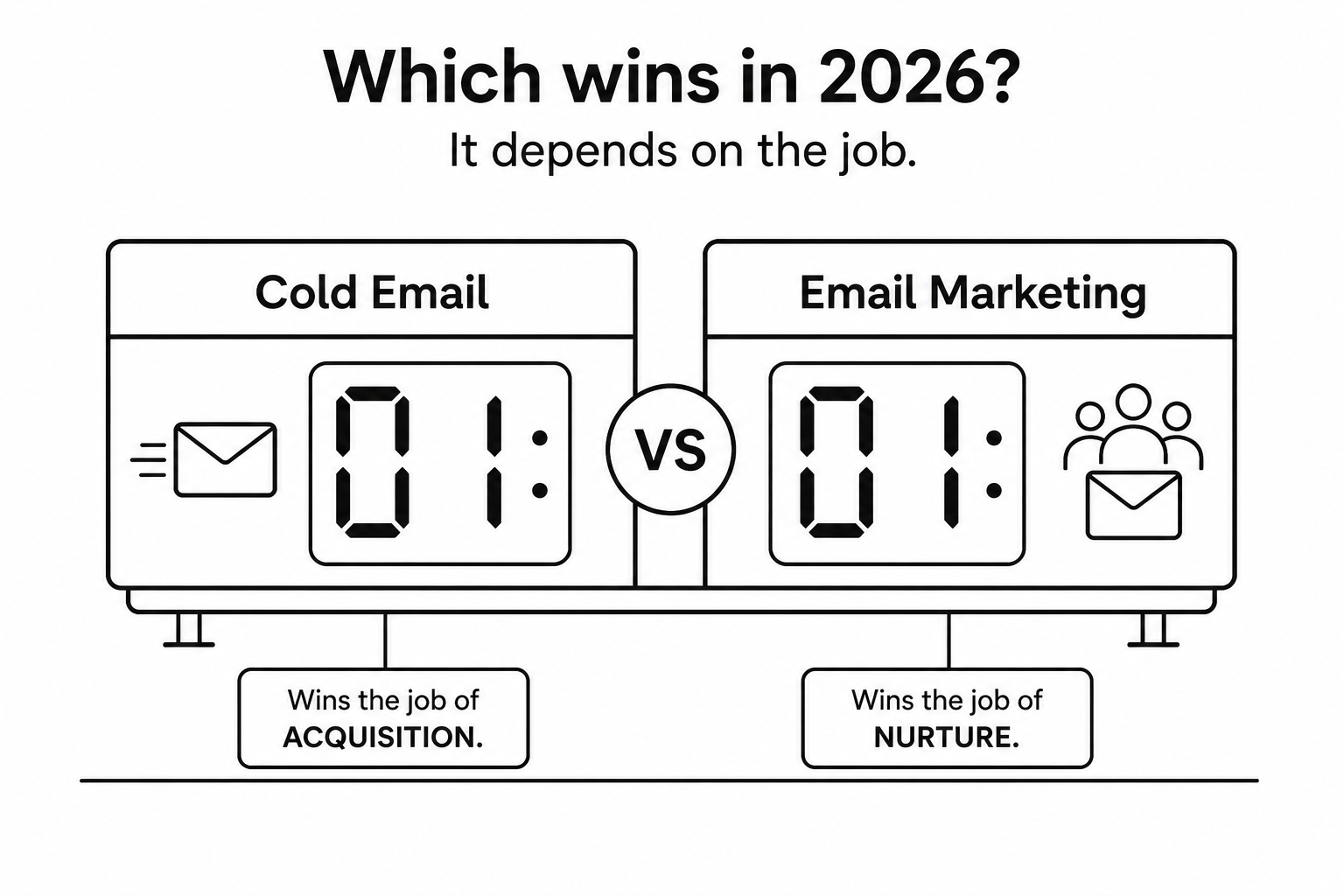
Here is the honest answer. Neither one wins outright because they do not compete for the same job.
The winner depends entirely on the outcome I am chasing.
If the job is a net-new B2B pipeline, cold email wins. It reaches buyers who will never find my opt-in form on their own.
If the job is revenue from an audience that already knows me, email marketing wins. Nothing nurtures a warm list better.
Most serious teams run both. Cold email opens the door, and email marketing keeps the relationship warm once a prospect opts in.
But if I am building a pipeline from zero in 2026, cold email is the growth engine, and it pairs with LinkedIn as the two channels that actually fill a B2B pipeline.
Cold email only wins when it reaches the inbox and reads as if a human wrote it. That takes more than a send button.
Here is the exact setup I use, and where the Forge Stack does the heavy lifting.
Reply rates start with the list, not the copy.
I build targeted lists in Leadsforge from a 500M+ contact database, with waterfall enrichment filling in verified emails and numbers.
The newest addition is Signals, which sources prospects from real buying events instead of static filters. I can build a list around a Job Change, a Funding round, an Acquisition, or an investor activity, so I reach accounts while they are in-market.
Every match comes with evidence explaining why it fits, so outreach lands in the buying window instead of hoping the timing is right. For local prospecting, I can also pull businesses by location and type with Local Companies Search.
A great list dies in spam without deliverability. This is the layer most teams skip.
Warmforge runs free unlimited warm-up on every mailbox, so reputation builds before real sends. ESP matching lines up my sender with the recipient's provider, Google to Google and Microsoft to Microsoft.
Sender rotation spreads volume across mailboxes, and Bounce Shield pauses any mailbox that starts to bounce. Text-only content keeps the payload clean, which reads better in placement tests than heavy HTML.
Cold email is stronger with a second channel beside it. LinkedIn is that channel.
In Salesforge, I drop LinkedIn steps between email touches inside one multichannel outreach sequence, with real if-then logic. If a connection request gets accepted, the sequence sends a LinkedIn message. If not, it falls back to email.
Every reply from both channels lands in Primebox™, my unified inbox, with Co-Pilot drafts and Auto-Pilot handling replies end-to-end.
When I do not want to run outbound by hand, Agent Frank does it for me.
He is an autonomous AI SDR who prospects, writes with AI personalization across 21+ languages, sends, follows up, and books meetings 24/7.
He works from the same Leadsforge data and the same deliverability stack, so nothing gets bolted on.
That is the part no single-channel tool matches. Infrastructure, warm-up, lead finder, multichannel outreach, and an autonomous AI SDR sit under one roof.
I can run the whole thing three ways: my own team operates it, Agent Frank operates it, or a Forge Expert agency operates it for me.
Cold email and email marketing are not rivals. There are two tools for two jobs.
If I want to nurture an audience that already opted in, email marketing wins, and it earns its reputation for return.
If I want a net-new pipeline in 2026, cold email wins, and it wins bigger when it runs on real infrastructure with LinkedIn beside it.
I run all of it through Salesforge, since the list, the deliverability, the sending, and the replies live in one place.
The right answer is not one channel. It is knowing which job I am doing, then using the tool built for it.
Is cold email the same as email marketing?
No. Cold email is outbound to prospects who never opted in, aimed at starting a conversation. Email marketing is permission-based sending to subscribers, aimed at nurturing and selling to an existing audience. They differ in audience, tools, rules, and metrics.
Is cold email legal in 2026?
Yes, for legitimate B2B outreach in many regions, as long as I follow the rules. I identify myself, keep the message relevant, offer a clear opt-out, and honor removals fast. CAN-SPAM, GDPR, and CASL each set the specifics, so I confirm the current requirements per market before sending.
Can I send a cold email from Mailchimp or another marketing platform?
I would not. Marketing platforms are built for opt-in bulk sends, and using them for cold traffic damages sender reputation and risks account suspension. Cold email needs its own infrastructure, warm-up, and sending controls, which a dedicated cold email setup provides.
Which has better ROI, cold email or email marketing?
They are not measured the same way. Email marketing shows a strong return on an engaged list. Cold email shows return through booked meetings and a new pipeline from accounts that were never on my list. The better ROI depends on whether the goal is retention or acquisition.
Do I still need email marketing if I run cold email?
Often yes. Cold email opens the relationship. Once a prospect opts in, email marketing keeps them engaged. The two channels hand off to each other rather than replace each other.
What is the best tool for cold email?
I use Salesforge because it combines lead sourcing, free warm-up, deliverability controls, and LinkedIn in one sequence, with Agent Frank available to run it autonomously. That removes the need to stitch four separate tools together for one motion.


.png)