I've run cold email both ways. I've handed outbound to an agency, and I've built it in-house from an empty domain list.
Both worked. Both also let me down at different points, and the reasons had little to do with which option was "better."
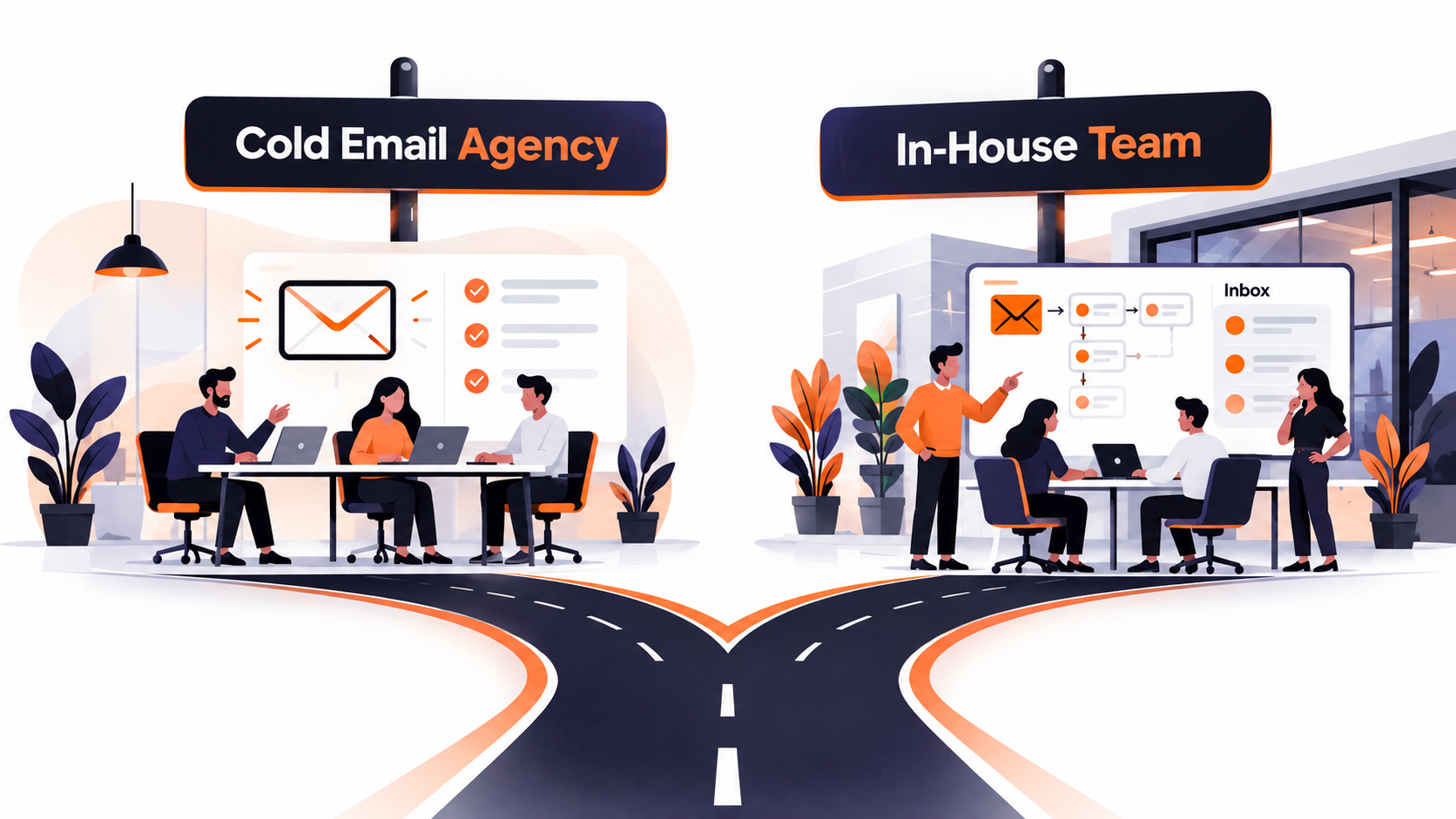
The cold email agency vs in-house decision really comes down to three things: how fast you need meetings, who should own the learning, and how much deliverability work you can carry.
This guide walks through both paths honestly, the exact process I'd follow for each, and a side-by-side comparison so you can pick what fits your team right now.
Pick an agency when you need pipeline within weeks, have no outbound operator, and want specialists carrying deliverability risk. Forge Experts are certified partners who already run on the Forge Stack.
Pick in-house when cold email is a long-term channel and you want the domains, data, and know-how to stay with you. Salesforge and the Forge Stack cover leads, infrastructure, warmup, sending, and replies under one login.
Don't want to hire an SDR? Agent Frank, an AI SDR, runs the in-house workflow autonomously on the same stack.
Most teams go hybrid: an expert agency proves the message, then an in-house team or Agent Frank takes over the same account.
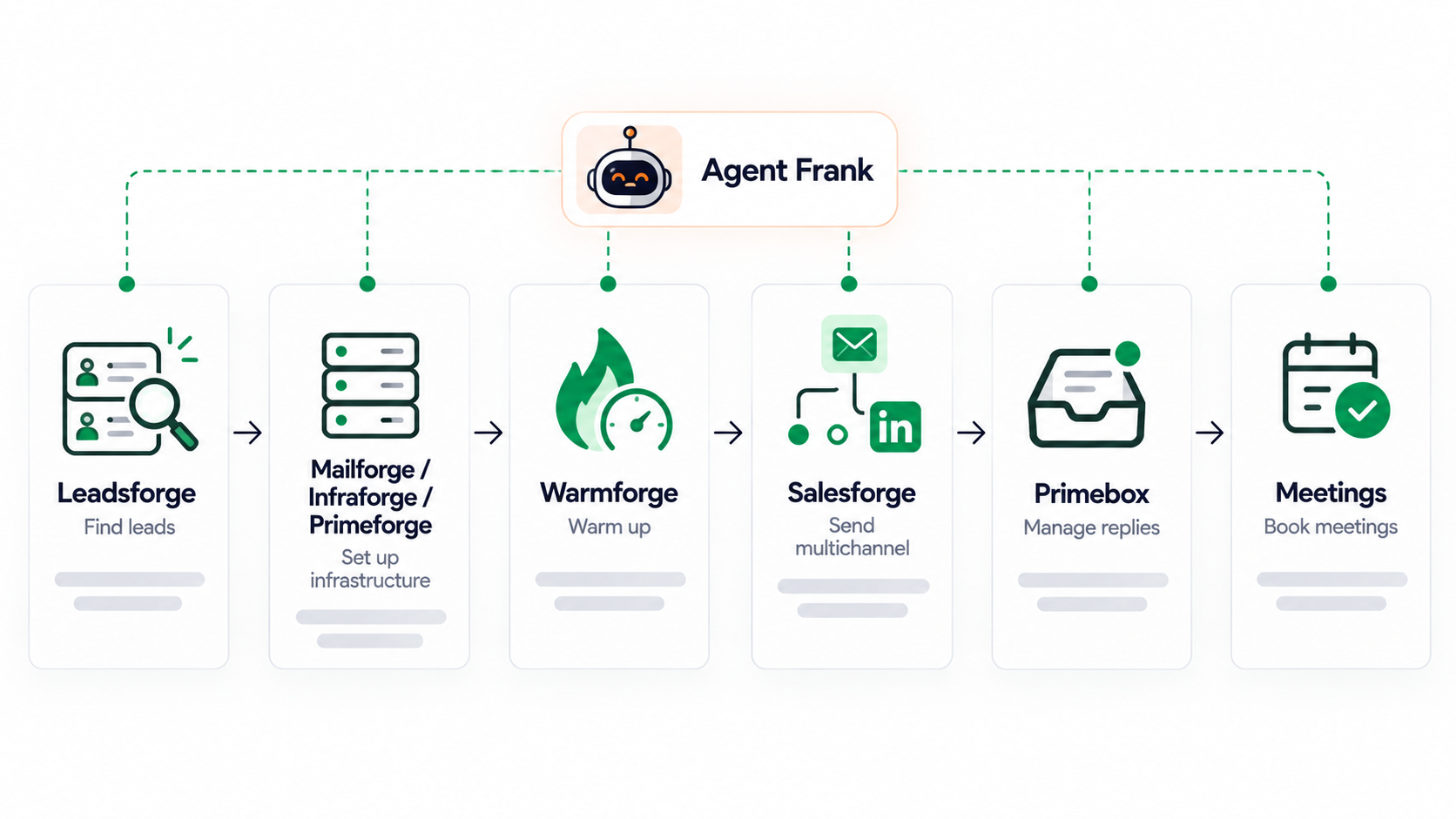
One stack, three operators: your team, Agent Frank, or a Forge Expert agency.
What "Agency" and "In-House" Mean in Cold Email
Before comparing costs, it helps to be clear about what you're actually buying with each option.
A cold email agency runs outbound for you. That usually covers list building, copywriting, domain and mailbox setup, warmup, sending, and booking meetings onto your calendar.
In-house means your own people run that same workflow inside software you control. You own the domains, the sequences, the reply data, and every lesson the campaigns teach.
The work itself doesn't change. What changes is who does it, who keeps the assets afterwards, and who absorbs the mistakes while the channel matures.
The question most teams skip
People frame this as a cost question. In my experience, it's really a control and timing question.
An agency rents you a working machine. In-house builds you one. Neither is wrong, but they fit very different stages of a company.
What Each Path Really Costs
Sticker price misleads in both directions, so here is where the money and the time actually go.
The in-house cost stack
The highest in-house cost is people, not software. Most fully loaded SDR estimates I've seen land between $95K and $130K a year once salary, commission, benefits, and management time are counted.
Ramp is the second cost. The Bridge Group's 2025 SDR benchmark puts average ramp at 3.0 months and average tenure at 1.9 years, so a real slice of every hire goes to learning instead of producing.
Then comes the tool stack: a lead database, domains and mailboxes, warmup, a sequencing tool, and an inbox for replies. Bought from five vendors, that stack adds friction and line items fast.
The agency cost stack
Agencies usually charge a monthly retainer, a per-meeting fee, or a mix of both. Full-service retainers commonly start in the low thousands per month and climb with volume, channels, and market complexity.
What you skip is hiring, ramp-up, and the deliverability learning curve. A good agency has already made its mistakes on someone else's domains.
What you don't automatically get is the learning. When the contract ends, the know-how leaves with the agency unless you plan the handoff from day one. My outsourced SDR agency review shows how that trade-off plays out with a traditional provider.
The cost both paths share: deliverability
Here's the part neither option escapes. If emails land in spam, it doesn't matter who wrote them.
Strong cold email deliverability depends on infrastructure, warmup, list quality, and sending discipline. That's why I care less about "agency or in-house" and more about the stack either option runs on.
When a Cold Email Agency Is the Right Call
An agency makes the most sense when speed and specialist skill matter more than building internal capability today.
Signs you should hire a cold email agency
You need qualified meetings this quarter, not after a three-month ramp.
Nobody on your team has run cold email at volume or managed deliverability.
You want to test a new market, segment, or language before committing headcount.
Founders or AEs are prospecting at the expense of closing.
You'd rather pay for outcomes than build and manage an SDR function.
Why I'd look at Forge Experts first
If I were hiring an agency today, I'd start with Forge Experts, the Salesforge partner network of certified agencies, consultants, and sales professionals.
Every expert in the network already runs client outreach on Forge products. To qualify, they complete the Salesforge cold email course, show the Forge Expert credential publicly, and maintain recurring revenue on the stack.
That matters more than it sounds. An agency that already knows the infrastructure, warmup, and sequencing tools doesn't spend your first month learning its own setup.
The network covers four specialties: cold email and deliverability, multichannel outreach across email, LinkedIn, and phone, data enrichment and lead generation, and sales automation with AI SDR workflows.
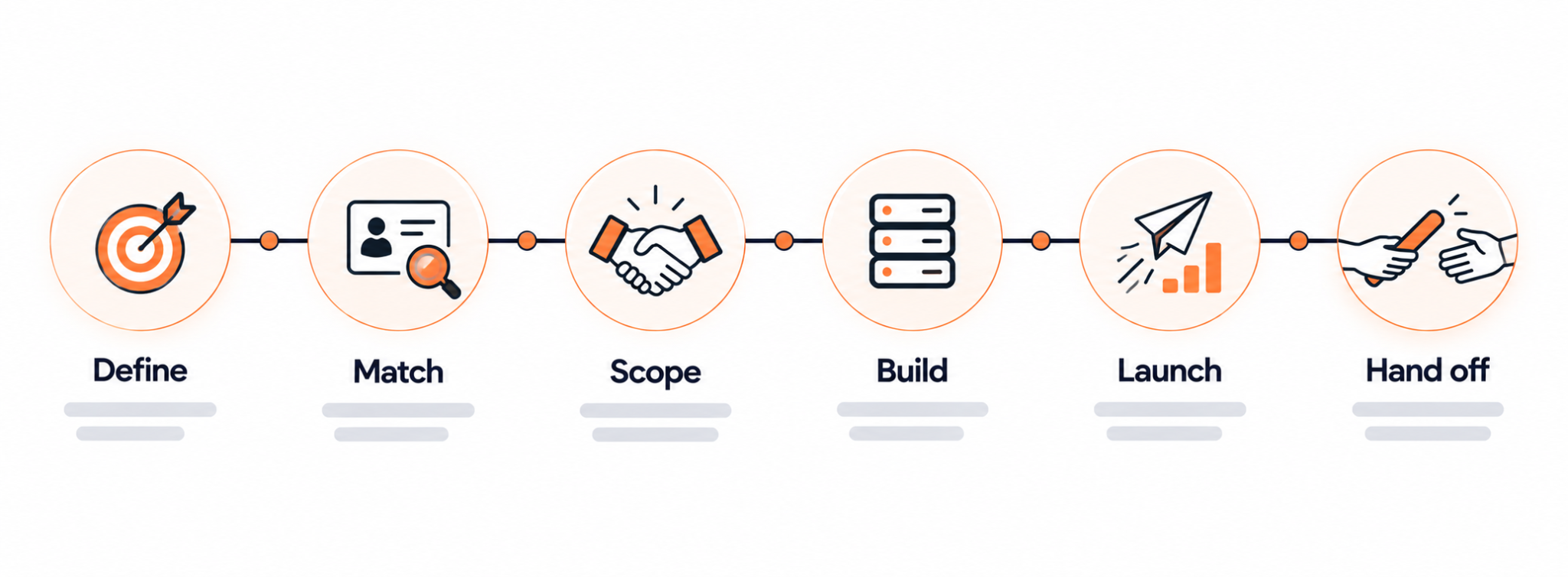
How the Forge Experts process works
Define the outcome. Write down your ICP, target markets, monthly meeting goal, and what counts as a qualified meeting for your sales team.
Find your match. Use the Expert Search on the Forge Experts page to filter partners by industry, market, language, or service.
Scope the engagement. On the first call, agree on channels, volume, reporting cadence, and whose account holds the domains and mailboxes.
Build on the Forge Stack. The expert sets up Mailforge, Infraforge, or Primeforge mailboxes, warms them through Warmforge, and builds sequences in Salesforge.
Launch and review. Campaigns go live, replies land in Primebox™, and you review meetings booked and reply quality on a fixed cadence.
Plan the handoff early. Because everything runs on Forge products, bringing the work in-house later means taking over an account, not rebuilding a stack.
Where agencies fall short
I'd be lying if I said agencies fit everyone. They work best when your offer is already clear and easy to explain.
If your product is complex or your message is unproven, an outside team can only go as far as your positioning lets them. Someone internal also has to give fast feedback on meeting quality.
Watch infrastructure ownership too. Ask upfront whose name the domains sit under, because rebuilding domain reputation after leaving an agency can take months.
Want Certified Specialists Running Your Outbound?
Browse Forge Experts by industry, market, or language and work with a partner who already runs on the stack you would use in-house.
In-house wins when cold email is a long-term channel, and you want the data, domains, and know-how to compound inside your company.
Signs you should build in-house
Outbound is a permanent pipeline source, not a short experiment.
Your product needs deep context that an outside team would struggle to carry.
You want every reply, objection, and winning angle to feed your own playbook.
You have, or can hire, one person who'll own the channel end to end.
You want email and LinkedIn running as one motion instead of through separate vendors.
The in-house process on Salesforge and the Forge Stack
When I build in-house, this is the workflow I follow. Each step maps to one Forge product, and all of them sit under one login with separate subscriptions.
Step 1: Build the list in Leadsforge.
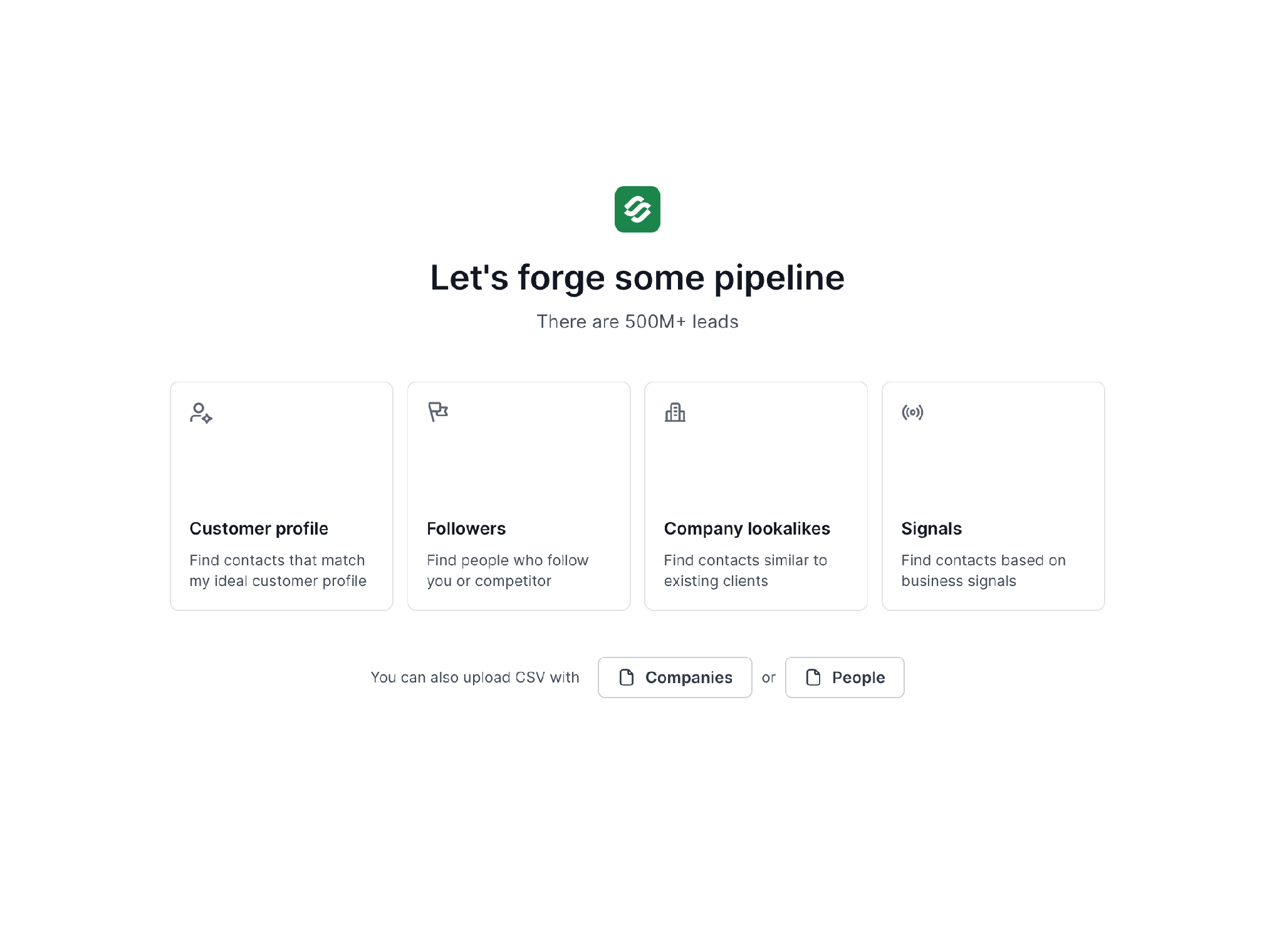
Leadsforge searches a 500M+ B2B contact database. I describe my ICP in plain English and get a matching list, with no filter stacking or boolean queries.
For sharper targeting, Company Lookalikes surfaces accounts similar to my best customers, and Competitor Followers Search finds people already following a competitor.
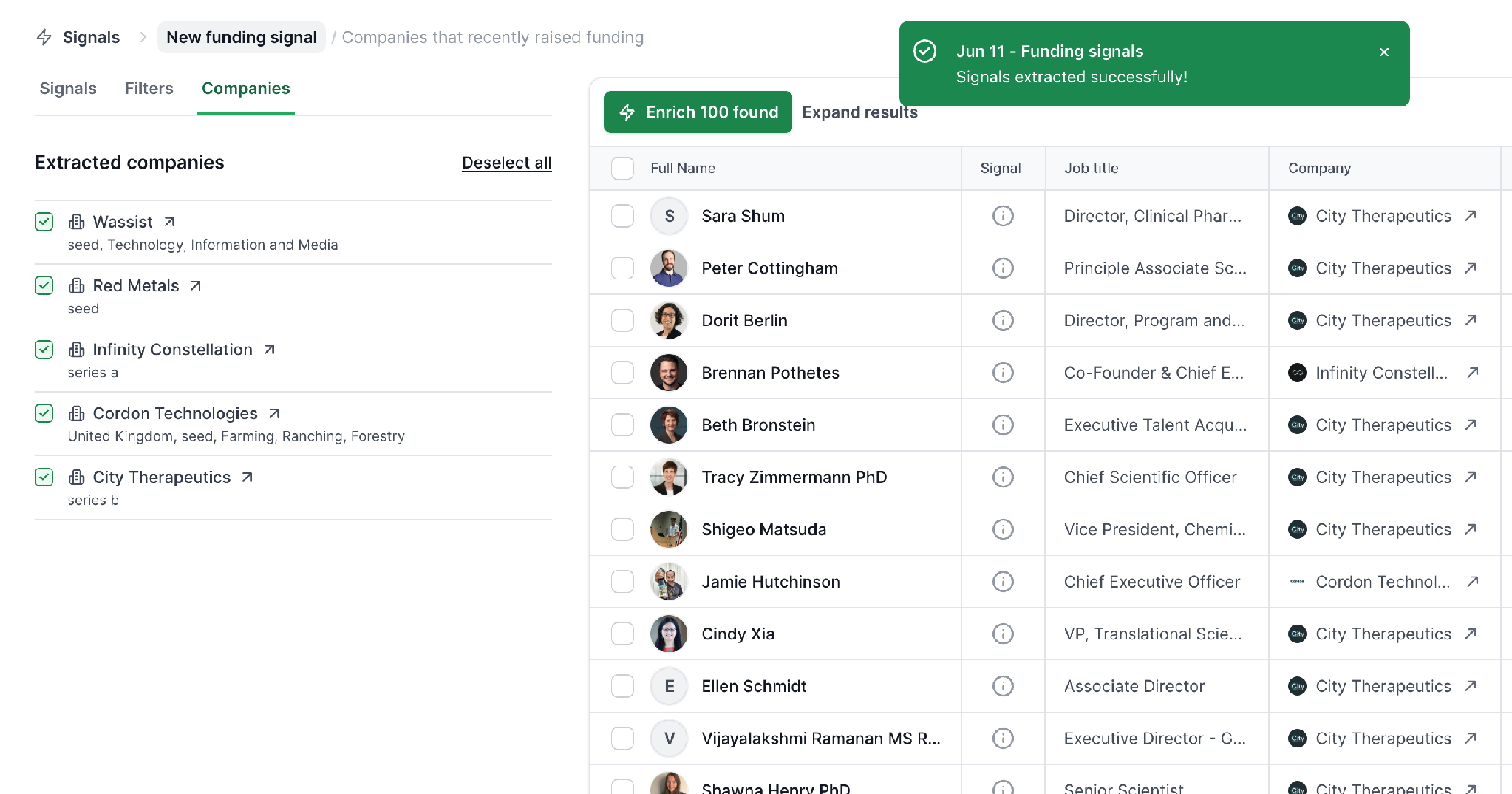
The newest addition is Signals. I can now build lists from real buying events: job changes, acquisitions, funding rounds, and active investors. Each signal has its own filters, like signal period, location, seniority, funding round, or ticket size.
What I like most is the evidence. Every matched company or contact has a Details view explaining why it matched, so the first email can open with a real reason to talk now.
For company signals, Leadsforge also matches those companies against its lead database and surfaces the relevant employees. Credits are charged only at extraction, based on how many results I select.
For local prospecting, Local Companies Search finds businesses by location, radius, and business type using Google Maps data. Waterfall enrichment then queries multiple data providers in sequence to fill in emails and phone numbers.
Step 2: Pick infrastructure that matches your stage.
Mailforge: shared infrastructure built for cold outreach, with automated SPF, DKIM, and DMARC and set up in minutes. I use it when starting or scaling fast on a budget.
Infraforge: dedicated IPs with a sender reputation that is fully yours, plus pre-warmed mailboxes (sold separately) to skip the two-to-four-week warmup wait.
Primeforge: real Google Workspace and Microsoft 365 mailboxes with a pre-warmed option, built for ESP matching.
The teams I've seen do best pair Primeforge with Mailforge or Infraforge. Running two or more providers means there's always a mailbox that matches the prospect's inbox provider, and you can switch options without migrating platforms.
Step 3: Warm every mailbox with Warmforge.
Warmforge comes free with every Salesforge plan, with unlimited warmup slots. The email warmup runs on a premium pool with multilingual activity, and Heat Score™ tells me when a mailbox is ready for more volume.
Inbox Placement Tests show whether emails reach primary, promotions, or spam across major providers. Health Checks watch DNS, MX, and blacklist status for every mailbox.
Step 4: Build sequences in Salesforge.
Salesforge runs cold email and LinkedIn as one multichannel outreach sequence with real if/then logic. If a connection request gets accepted, a LinkedIn message follows. If it doesn't, the sequence falls back to email.
AI personalization across 21+ languages pulls prospect details like company news and LinkedIn activity, so I can localize campaigns without a copywriter per region. Unlimited mailboxes, users, and workspaces mean adding reps never adds seat costs.
Step 5: Protect deliverability while sending.
This is where in-house teams usually get hurt, so I lean on the built-in guardrails:
Bounce Shield blocks sends to addresses likely to bounce before reputation takes the hit.
Built-in email validation checks every contact before it enters a sequence.
Sender rotation spreads volume across mailboxes and domains. My guide to inbox rotation explains why that matters.
ESP matching pairs Google senders with Google recipients and Microsoft with Microsoft (Growth plan).
Text-only content ships without heavy HTML, tracking pixels, or attachments by default.
Step 6: Handle every reply in Primebox™.
Primebox™ pulls email and LinkedIn replies into one inbox. Co-Pilot drafts replies for a human to approve, while Auto-Pilot handles them end to end.
The LinkedIn email & phone finder Chrome Extension, powered by Leadsforge, lets reps pull verified contacts straight from LinkedIn profiles. New users get 100 free credits on signup.
Step 7: Measure, test, and connect.
A/B testing (Growth plan) and campaign analytics track open, reply, positive reply, and meeting rates. Native integrations cover HubSpot, Salesforce, Pipedrive, Attio, Clay, Zapier, Make, Slack, and more.
The API (Growth plan), MCP server, and CLI let Claude, Cursor, or your own agents create sequences and manage contacts directly. Every Forge product exposes MCP, so one protocol reaches the whole stack.
Put together, that's the "under one roof" advantage of the Forge Stack. Lead finder, infrastructure, warmup, multichannel sending, and an AI SDR come from one ecosystem, and Leadsforge lists move into Salesforge without a CSV export.
Where in-house falls short
In-house is slower to start. Even with a clean stack, someone has to learn ICP targeting, copy, and deliverability, and that takes weeks.
It also depends on people. If your one outbound owner leaves, the channel can stall until you replace them, and SDR tenure data suggests that happens sooner than most founders expect.
Finally, tools only work when someone runs them consistently. Software removes busywork, not the need for judgment.
Build Your In-House Outbound Engine
Start Salesforge free for 14 days with no credit card. Unlimited mailboxes and Warmforge warmup come included from day one.
There's a third way to run cold email in-house that skips the SDR hiring problem altogether.
If hiring and ramping an SDR is your real blocker, Agent Frank is worth a look. He's an autonomous AI SDR who runs the full outbound workflow on the same Forge Stack your team would use.
Agent Frank prospects continuously from the Leadsforge 500M+ database, enriches contacts, and writes personalized email and LinkedIn messages. He runs multichannel sequences, manages replies through Primebox™, and books meetings directly on your calendar.
He works 24/7 without manual intervention, and the base plan handles up to 1,000 active contacts. Co-Pilot mode lets you approve his replies, while Auto-Pilot lets him run on his own.
I treat him as a teammate, not a replacement. He handles prospecting and follow-ups so your reps can spend their time on calls and closing.
If you're weighing him against a human hire, the AI SDR vs human SDR breakdown goes deeper. The AI SDR vs agency comparison covers the outsourced angle.
He fits best for B2B teams selling to startups, SMBs, and mid-market companies at roughly $5K to $100K ACV. If you mostly sell into Fortune 500 accounts through long RFP cycles, a human-led motion still fits better.
The Hybrid Model Most Teams Land On
You don't have to pick one path forever, and on a shared stack, switching later is far less painful.
The pattern I see most often is simple: an agency proves the message, then the work comes in-house once it converts.
A Forge Expert launches campaigns, finds the segments and angles that book meetings, and documents what works. Then your team, Agent Frank, or both take over the same Salesforge workspace.
Another common split keeps high-volume, top-of-funnel outreach with an agency, while account-based outreach to your top accounts stays in-house where your context matters most.
This is why the delivery model matters. The Forge Stack runs three ways: your team operates it, Agent Frank operates it, or a Forge Expert agency operates it. Same infrastructure, same data, different operator.
Cold Email Agency vs In-House: Side-by-Side Comparison
Here is how the three ways to run the same stack compare across the factors that decide most outbound setups.
Factor
Forge Expert agency
In-house team on Salesforge
In-house with Agent Frank
Time to first meetings
Fastest, specialists start with a proven playbook
Slowest, expect a learning period
Fast after setup and a two-week warmup
Upfront effort
Low, mostly briefing and feedback
High, hiring plus setup
Medium, guided setup with an account manager
Cost structure
Monthly retainer or per-meeting fees
Salaries plus software subscriptions
AI SDR subscription plus infrastructure
Who keeps the learning
Shared, unless the handoff is planned
Fully yours
Yours, inside your own account
Domain and mailbox ownership
Agree upfront; Forge products simplify transfer
Fully yours
Fully yours
Deliverability expertise
Built in from day one
Learned over time, with built-in guardrails
Built into the stack
Message control
Indirect, through briefs and approvals
Direct
Direct, Co-Pilot lets you approve replies
How it scales
With the retainer
With headcount
Without new hires
Best for
Fast pipeline, new markets, no outbound operator
Core long-term channel, complex products
Lean teams wanting ownership without SDR hiring
A Quick Self-Check Before You Decide
Answer these five questions honestly, and the right path usually becomes obvious.
Do I need meetings in the next 60 days? If yes, lean toward an agency or Agent Frank.
Is my message already proven? If not, an expert agency can find it faster than a new hire.
Will outbound still be a core channel in two years? If yes, plan to own it in-house.
Do I have someone who can own deliverability? If not, bring in an expert or pick a stack with guardrails built in.
Is SDR hiring my bottleneck? If yes, Agent Frank can fill that seat.
Final Verdict
There's no universal winner, but there's usually a clear winner for your current stage.
If speed matters most and nobody on your team has run cold email at volume, hire an agency. I'd start with Forge Experts because they already operate on the stack, so a later move in-house doesn't mean starting over.
If cold email is a long-term growth channel, build in-house on Salesforge. Leadsforge, Mailforge, Infraforge, Primeforge, Warmforge, and Salesforge cover the full workflow under one login, and Warmforge warmup comes included.
If you want in-house ownership without hiring, hire Agent Frank. And if you are unsure, start with an expert, prove the message, then bring it in-house on the same stack.
Whichever path you choose, the bigger decision is the stack underneath. Pick one that lets you change operators without rebuilding everything.
Is a cold email agency cheaper than building in-house?
In the first few months, usually yes, because you skip hiring and ramp time. Over a longer horizon, an in-house team tends to cost less per meeting once it is productive, as long as someone owns deliverability.
How long does each option take to book the first meetings?
An experienced agency can often start booking within the first month or two because it brings a playbook and ready infrastructure. In-house teams need longer, since new mailboxes need two to four weeks of warmup unless pre-warmed, plus time to find messaging that works.
Who owns the domains and mailboxes when I hire an agency?
It depends on your contract, so settle it before kickoff. Ask for domains and mailboxes under your own name or account. On the Forge Stack, domains and mailboxes can move between workspaces, which makes a later handoff simpler.
What are Forge Experts?
Forge Experts are certified agencies, consultants, and sales professionals in the Salesforge partner network. They run client outreach on Forge products and specialize in cold email and deliverability, multichannel outreach, data enrichment, and AI SDR workflows. You can search them by industry, market, or language.
Can I run cold email in-house without hiring an SDR?
Yes. Agent Frank is an AI SDR who prospects, writes personalized email and LinkedIn messages, handles replies through Primebox, and books meetings 24/7 on the Forge Stack. Your team keeps ownership of the account and can approve replies in Co-Pilot mode.
Can I start with an agency and move in-house later?
Yes, and it is the most common path I see. If the agency builds on Salesforge and Forge infrastructure, your team or Agent Frank can take over the same workspace instead of rebuilding domains, warmup, and sequences.
What tools do I need to run cold email in-house?
You need lead data, sending infrastructure, warmup, a sequencing tool, and a reply inbox. On the Forge Stack, those are Leadsforge, Mailforge, Infraforge or Primeforge, Warmforge, Salesforge, and Primebox, all under one login.
Book more meetings on autopilot
Set up in minutes. No per-seat pricing. No commitment.
Compare a cold email agency vs an in-house team on cost, ramp time, control, and deliverability. See how Forge Experts run outbound for you, how to build in-house on Salesforge and the Forge Stack, and where Agent Frank fits as an AI SDR teammate.
A practical playbook for link building outreach in 2026. Learn how to build verified prospect lists, set up warmed sending domains, write short pitches, run email and LinkedIn sequences, handle replies, and track the links you earn.
Cold email best practices work in a fixed order: infrastructure first, list second, copy third. I cover domain setup, warmup, list quality, short plain-text copy, sending limits, follow-up timing, and the few numbers that show a campaign is healthy.