

Clay is a credit-based data enrichment workbench with 150+ providers and an email-only sequencer, from $185/mo monthly. Apollo is a per-seat sales platform with a 240M-contact database, sequences and a dialer, from $65/seat/mo monthly. Neither automates LinkedIn in the same sequence as email, and neither puts email and LinkedIn replies in one inbox.
For multichannel B2B outbound, Salesforge is the stronger choice. It runs email and LinkedIn in one sequence, with free Warmforge warm-up, Primebox™ replies and no per-seat pricing. Plans start at $48/mo monthly ($40/mo annual).
Clay vs Apollo usually comes up when a team has a few thousand target accounts and no verified contacts yet. I checked both vendors' live pricing pages and recent Trustpilot reviews on November 7, 2026.
The old line that "Clay finds data and Apollo sends email" no longer holds. Clay replaced its plans in March 2026 and now ships its own email sequencer. Apollo still sells its own database, sequences and a US dialer per seat.
I also cover the setup I'd pick instead: Salesforge for email and LinkedIn, fed by Leadsforge or by Clay. UniteSync ran Salesforge with Mailforge and Warmforge to an 85.26% positive reply rate.
Lead Data and Outreach Comparison at a Glance: Clay vs Apollo
| Feature | Salesforge | Clay | Apollo |
|---|---|---|---|
| Outreach channels | Email + LinkedIn in one conditional sequence | Email only, through Clay Sequencer | Email and calls; LinkedIn steps are tasks a rep carries out |
| LinkedIn automation | 6 native actions, up to 30 per action per day per profile | No native LinkedIn steps; LinkedIn ad audiences on Growth | None; each LinkedIn step is a rep task |
| Lead data | Leadsforge: 500M+ contacts with waterfall enrichment (separate plan, from $49/mo) | 150+ providers paid with data credits, chained into waterfalls | Own database: 240M contacts and 30M companies |
| AI and agents | AI personalization across 21+ languages; Agent Frank AI SDR, separate, from $499/mo billed quarterly | Claygent web research; AI runs on data credits | AI Assistant and AI Research; AI lead scoring from Professional |
| Warm-up | Free, unlimited Warmforge on every plan | Managed warm-up for inboxes bought in Clay; opt-in for your own | Email warm-up in the Deliverability Suite, from Basic |
| Email infrastructure | Mailforge, Infraforge and Primeforge under one login (sold separately) | Buy Google or Outlook inboxes and domains for Sequencer on Clay Growth | Domain and mailbox purchasing, from Apollo Basic |
| Reply inbox | Primebox™: email + LinkedIn replies, free on every plan | Global Inbox for Sequencer email replies | Email replies only |
| Testing and analytics | A/B testing on Growth; open, reply, positive reply and meeting rates | A/B tests and an Analytics tab in Clay Sequencer | A/Z testing from Apollo Professional |
| Free option | 14-day free trial, no credit card | Clay Free: $0, 100 data credits a month | Apollo Free: $0, 900 credits per seat per year |
| Entry price | Salesforge Pro: $48/mo monthly ($40/mo annual), 1 user | Clay Launch: $185/mo monthly ($167/mo annual), unlimited seats | Apollo Basic: $65/seat/mo monthly ($49/seat/mo annual) |
| Team plan | Salesforge Growth: $96/mo monthly ($80/mo annual), unlimited users and LinkedIn senders | Clay Growth: $495/mo monthly ($446/mo annual), adds CRM sync | Apollo Professional: $99/seat/mo monthly ($79/seat/mo annual) |
| Best for | SMB and mid-market B2B teams, $5K-$100K ACV | GTM engineers who build data workflows | Rep teams that want data, email and calls per seat |
Clay Overview: Data Enrichment, Signals and Sequencer
Clay is a GTM data platform built around tables. Each column can pull data from a provider, run an AI prompt or trigger an action. Clay bills in data credits and actions, not seats.
Clay core features
- Waterfall enrichment: runs several providers in a row until one returns an email or phone number.
- Data marketplace: buys contact and company data from 150+ providers out of one credit balance.
- Claygent: an AI agent that browses the web to fill custom columns, like a company's competitors.
- Signals: job changes, promotions, new hires, company news and social listening from Launch, plus web intent from Growth.
- Clay Sequencer: native cold email sequences of up to four emails, with A/B tests, managed warm-up and a Global Inbox for replies.
- Audiences and ads: pushes audiences to LinkedIn and Meta ads on the Growth plan.
- CRM sync and HTTP API: auto-syncs and enriches a CRM and calls any HTTP API, both from Growth.
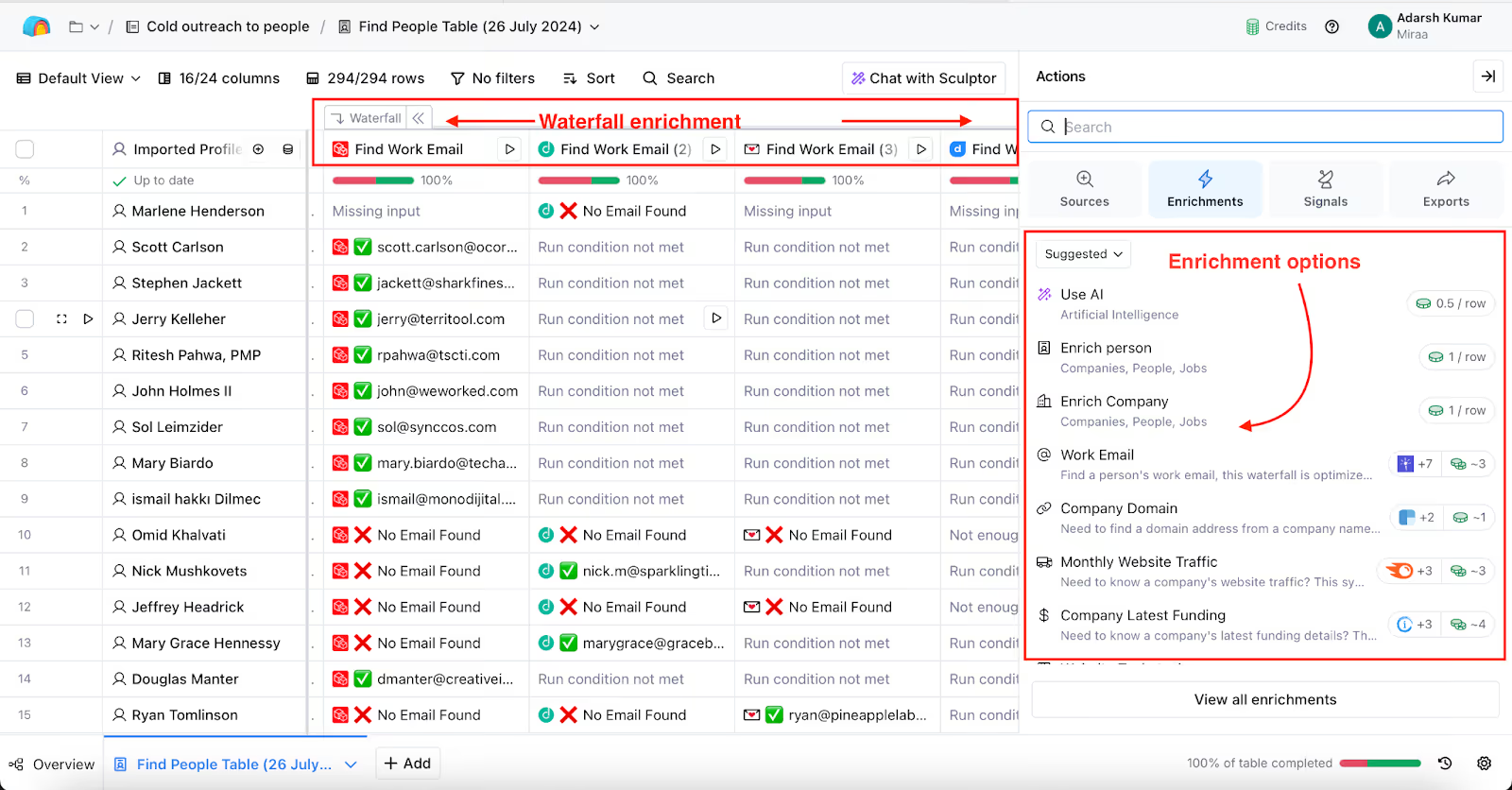
In the screenshot, later columns show "Run condition not met" once an earlier provider has found the email. Rows marked "No Email Found" move on to the next provider.
Clay pricing
Clay replaced its Starter, Explorer and Pro plans in March 2026 (more on Clay's pricing changes). Each plan price is actions plus data credits added together.
- Clay Free: $0, with 100 data credits, 500 actions a month and up to 200 rows per table.
- Clay Launch: $185/mo monthly or $167/mo annual, with 2,500 data credits and 15,000 actions a month.
- Clay Growth: $495/mo monthly or $446/mo annual, with 6,000 data credits and 40,000 actions a month.
- Clay Enterprise: custom pricing, from 100,000+ data credits and 200,000+ actions a month.
Every plan includes unlimited seats. Extra credits cost a 30% premium, and only part of your unused credits roll over.
Who Clay is best for
Clay fits RevOps leads and GTM engineers who like building workflows in a spreadsheet-style tool. It suits teams that would otherwise pay several data vendors separately.
Clay limitations
- CRM sync starts on Clay Growth, so a sales team that needs HubSpot or Salesforce sync pays $495/mo, not $185/mo.
- Clay Sequencer is email-only and sends up to four emails per lead. There are no LinkedIn steps, calls or SMS.
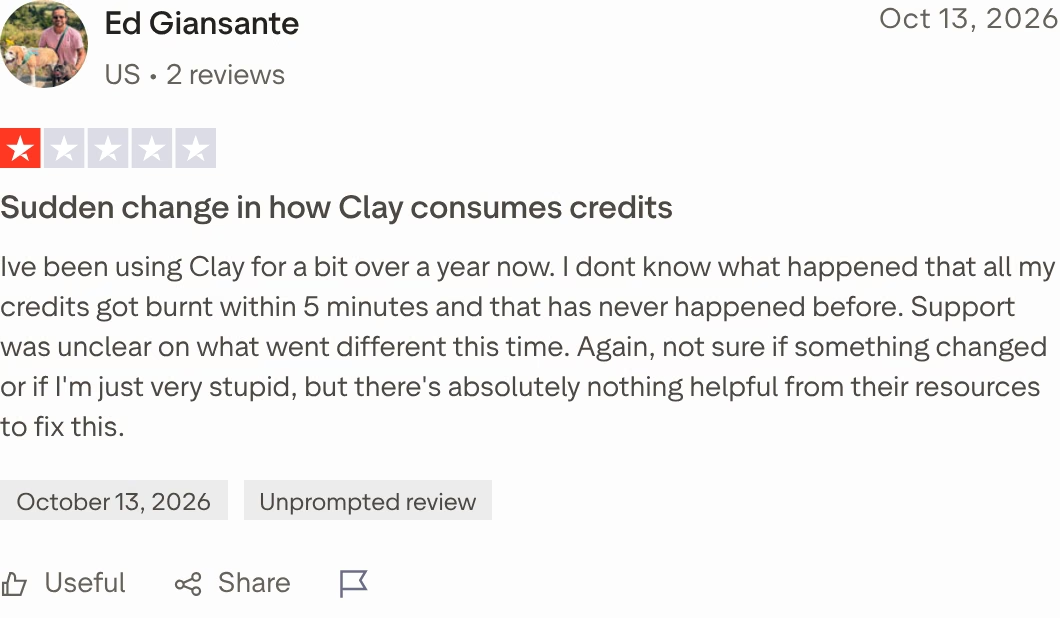
- Two meters make costs hard to predict, since one workflow can burn actions and data credits at different speeds. If that's a dealbreaker, compare these Clay alternatives.
What reviewers say about Clay
Clay's Trustpilot profile is unclaimed and holds 27 reviews with a 2.7 TrustScore as of November 7, 2026. The recent 1-star reviews focus on credit burn and a hard-to-learn interface.
Apollo Overview: Sales Database, Sequences and Dialer
Apollo is an all-in-one sales platform built around its own B2B database of 240M contacts and 30M companies. Search, sequences, calls and deal tracking share one login. You pay per seat, and each seat comes with credits for data.
Apollo core features
- Contact and company database: 240M contacts with advanced filters, intent topics and website visitor identification.
- Sequences: unlimited sequences on paid plans, with A/Z testing from Professional.
- Dialer: a US dialer on paid plans (credits apply). The Advanced Dialer add-on adds parallel and power dialing for $119/team/mo annual.
- Deliverability Suite: email warm-up plus domain and mailbox purchasing, from Basic.
- Enrichment: waterfall enrichment and automated CRM enrichment for CSV, CRM and API data, from Basic.
- AI tools: an AI Assistant, AI Research fields per record and AI lead scoring from Professional.
- Chrome extensions: a prospecting extension plus Gmail and Salesforce extensions.
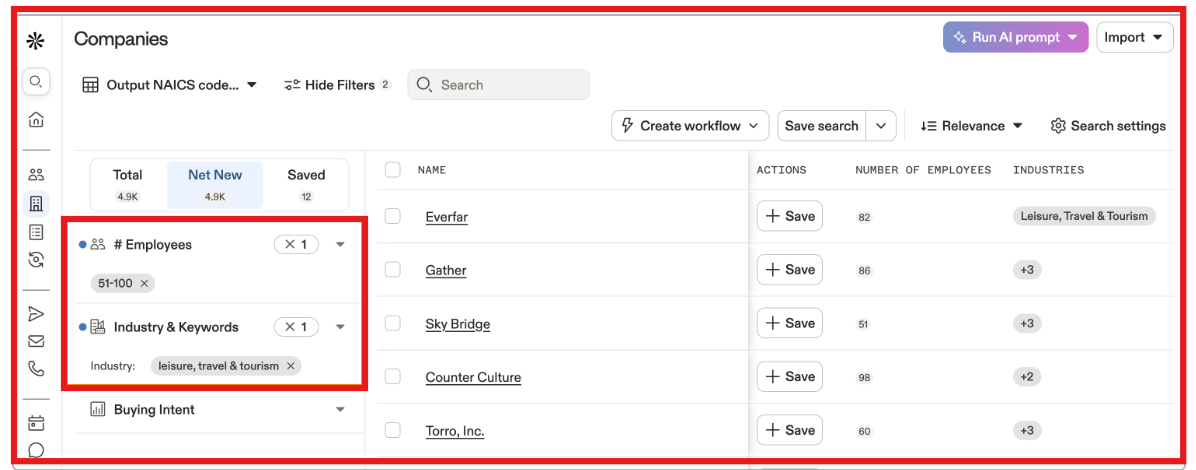
In the screenshot, two filters return 4.3K companies, and the Net New tab shows which ones aren't saved yet.
Apollo pricing
- Apollo Free: $0, with 900 credits per seat per year and 2 sequences.
- Apollo Basic: $65/seat/mo monthly or $49/seat/mo annual, with 30,000 credits per seat per year.
- Apollo Professional: $99/seat/mo monthly or $79/seat/mo annual, with 48,000 credits per seat per year.
- Apollo Organization: $119/seat/mo billed annually, with a 3-seat minimum and 72,000 credits per seat per year.
Unused credits expire at the end of each billing cycle, and every seat must be on the same plan. For a hands-on view, read this four-week Apollo test.
Who Apollo is best for
Apollo fits rep teams that want data, email and calls in one tool and accept per-seat pricing. It works best for teams that call US numbers often, since the base dialer is US-only.
Apollo limitations
- Costs grow with headcount: 10 reps on Apollo Professional cost $990/mo on monthly billing.
- Apollo Basic connects 1 mailbox per user, so sending more means Professional or more seats.
- LinkedIn steps in Apollo sequences are tasks that remind a rep to act on LinkedIn. Teams that want this automated can compare these Apollo alternatives.
What reviewers say about Apollo
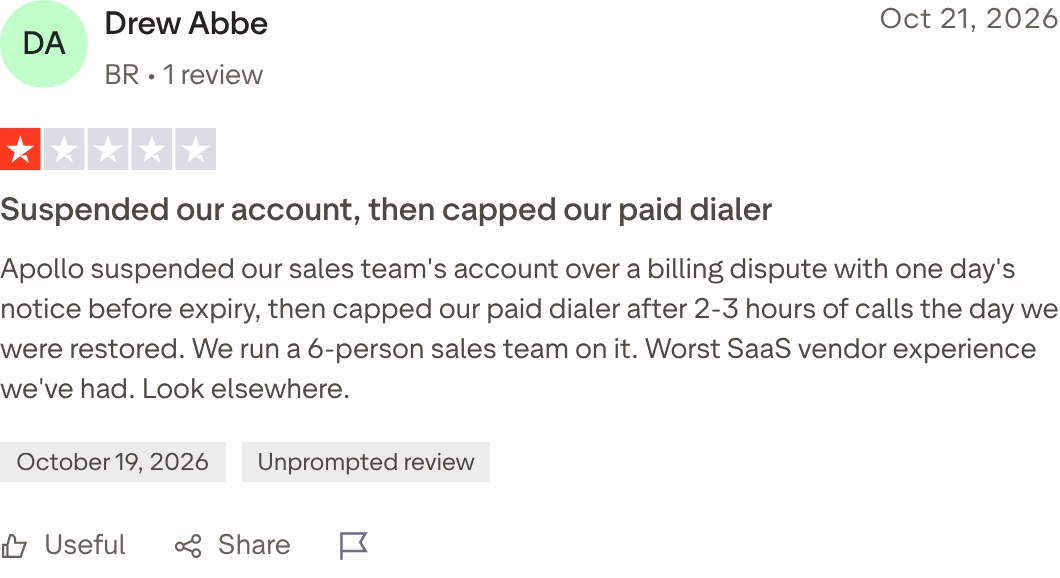
Apollo's claimed Trustpilot profile shows 1,392 reviews and a 3.2 TrustScore as of November 7, 2026. Recent 1-star reviews cite billing disputes, weak support and privacy complaints.
Salesforge Overview: Multichannel Outreach on the Forge Stack
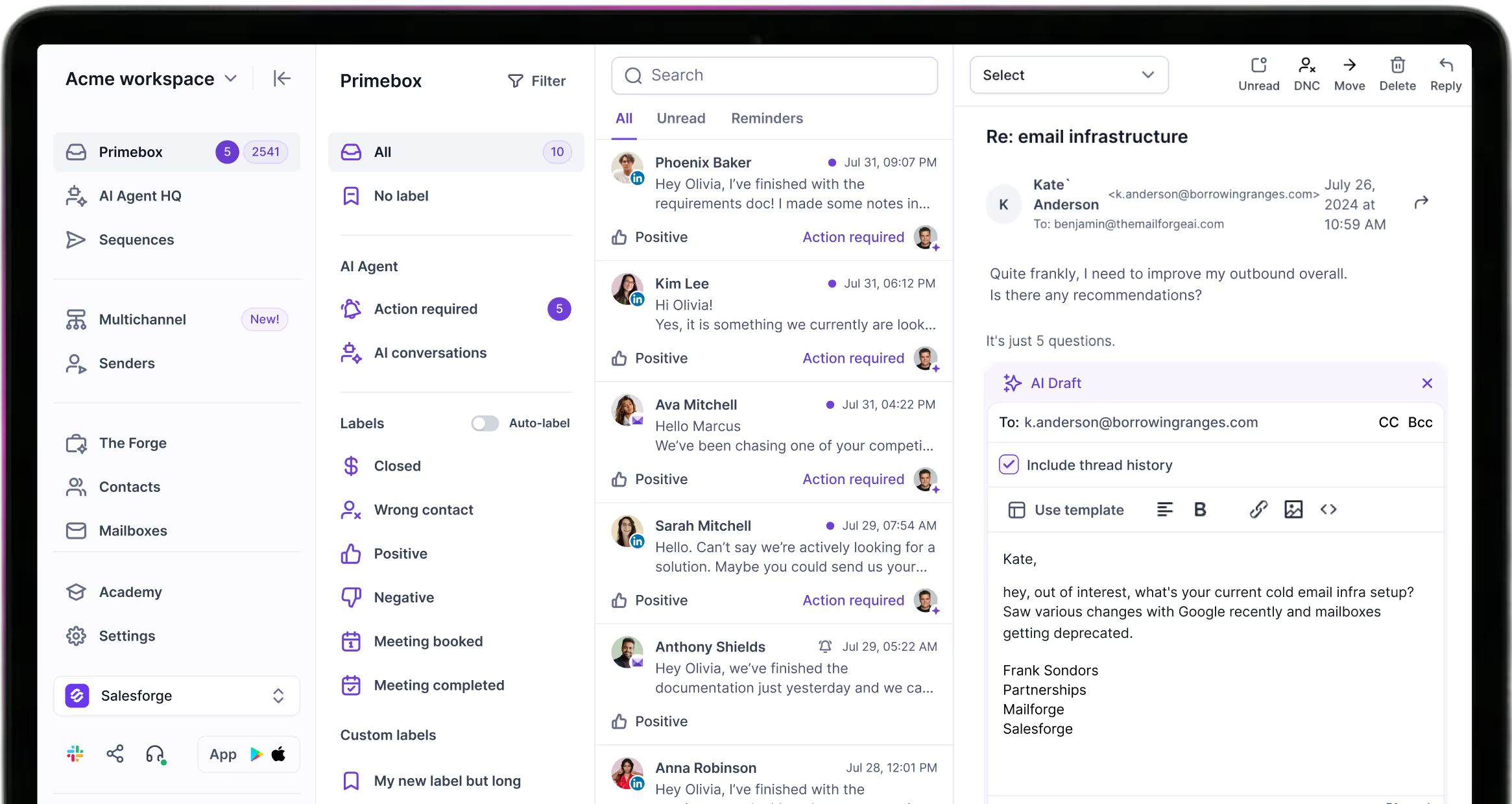
Salesforge is a multichannel outreach platform that runs cold email and LinkedIn in one sequence, with one inbox for replies. It's the outreach layer of the Forge Stack, which also covers lead data, warm-up, email infrastructure and an AI SDR.
Salesforge core features
- Conditional multichannel sequences: if a connection request is accepted, a LinkedIn message goes out. If not, the sequence falls back to email.
- Six native LinkedIn actions: connection requests, messages, InMails, post likes, follows and withdraw requests, capped at 30 per action per day per profile.
- Account safety as standard: session-token login (your LinkedIn password is never stored), shared proxies and no Chrome extension injection.
- Unlimited mailboxes and workspaces: on every plan, plus unlimited users and LinkedIn senders on Growth.
- AI personalization across 21+ languages: AI variables pull company news, LinkedIn activity and industry context. Overdrive Mode uses every source at once.
- Unlimited warm-up via Warmforge: every connected mailbox warms up for free.
- Deliverability controls: sender rotation, text-only emails, Bounce Shield, built-in email validation and ESP matching on Growth.
- Primebox™: one inbox for email and LinkedIn replies. The Autopilot and Co-pilot AI reply modes need Growth.
- LinkedIn email & phone finder Chrome Extension: powered by Leadsforge's 500M+ contacts, with 100 free credits for new users.
- A/B testing and analytics: A/B tests on Growth, plus open, reply, positive reply and meeting rates.
- API, integrations and MCP: on Growth, the API, a native Clay integration and the full integrations library, plus an MCP CLI for Claude or Cursor.
The Forge Stack behind Salesforge
Leadsforge feeds lists straight into Salesforge sequences, with no CSV export. Warmforge handles warm-up, and three infrastructure options sit under one login: Mailforge (shared), Infraforge (dedicated IPs) and Primeforge (Google Workspace and Microsoft 365). Each is a separate subscription, and every product is MCP-native.
The same stack runs three ways. Your team runs it, Agent Frank runs it, or a Forge Expert agency runs it for you. Neither Clay nor Apollo has an AI SDR that works email and LinkedIn end-to-end.
Salesforge pricing
- Salesforge Pro: $48/mo monthly or $40/mo annual. 1,000 active contacts, 5,000 emails a month, 1 user, 1 LinkedIn sender and unlimited mailboxes.
- Salesforge Growth: $96/mo monthly or $80/mo annual. 10,000 active contacts, 50,000 emails a month, unlimited users and LinkedIn senders, plus API, A/B testing, ESP matching and Primebox™ AI.
- Agent Frank: a separate subscription from $499/mo billed quarterly ($416/mo billed annually) for 1,000 active contacts. He needs a demo and a 2-week warm-up before he starts sending.
Annual billing gives 2 months free on both plans. You can verify the live price before you buy.
Start Your 14-Day Free Trial - No Card NeededWho Salesforge is best for
Salesforge fits B2B teams selling deals of $5K-$100K ACV to startups, SMBs and mid-market companies, with 3,000+ target businesses. ChannelCrawler reached an 85.71% positive reply rate on Salesforge, Infraforge and Warmforge. Salesforge itself says it's a poor fit for Fortune 500 targets, long RFP cycles and six- or seven-figure deals.
Salesforge limitations
- Email infrastructure isn't included. Mailboxes cost $3 to $2 (Mailforge), $4 to $3 (Infraforge) or $4.50 to $3.50 (Primeforge) each per month on annual billing.
- API access, ESP matching, A/B testing and the full integrations library need Growth.
- Agent Frank has no self-serve trial. He starts after a sales-led demo and a 2-week warm-up.
in Action
Head-to-Head Feature Comparison: Clay vs Apollo
Here's how the three tools compare on the seven areas that shape an outbound stack.
Lead data and enrichment
Clay: you search people and companies in Clay, then buy emails and phone numbers from 150+ providers with credits. Waterfalls chain those providers, so coverage depends on the ones you pick.
Apollo: its own database of 240M contacts and 30M companies, plus waterfall enrichment from Basic. One vendor means one data model and one bill.
Salesforge: Leadsforge searches 500M+ contacts from a plain-English prompt and adds waterfall enrichment, Company Lookalikes, Competitor Followers Search and intent signals. Lists go straight into a Salesforge sequence. Clay users on Salesforge Growth can keep Clay and push rows in through the native integration, which runs on a Salesforge API key.
This Salesforge video walks through the Chrome Extension that finds emails and mobile numbers from 500M+ leads:
Multichannel outreach
Clay: Clay Sequencer sends cold email only, with no call, SMS or LinkedIn steps. On Growth, Clay can push audiences to LinkedIn ads, but LinkedIn outreach needs another tool.
Apollo: sequences mix email, calls and LinkedIn steps, but each LinkedIn step is a task that reminds a rep to act. Calls run through the built-in US dialer, with international calling in the Advanced Dialer add-on.
Salesforge: email and six native LinkedIn actions run in one sequence with if/then branches. If a connection request is accepted, a LinkedIn message follows; if not, the sequence switches to email.
Growth adds unlimited LinkedIn senders, so ten reps' profiles cost the same as one. That's multichannel outreach in one tool.
Email deliverability and warm-up
Clay: Clay Growth lets you buy Google or Outlook inboxes for Sequencer, and Clay warms them for about three weeks. It matches Gmail prospects to Gmail senders, and its docs name Smartlead and Zapmail as the vendors underneath.
Apollo: the Deliverability Suite adds warm-up plus domain and mailbox purchasing from Basic. Apollo Basic connects 1 mailbox per user, and Professional adds unlimited Google and Microsoft mailboxes.
Salesforge: every mailbox gets free, unlimited email warm-up through Warmforge, started in one click. Its multilingual pool mixes aged IMAP/SMTP, Google Workspace and Microsoft 365 mailboxes, and Heat Score™, placement tests and health checks flag problems early. ESP matching (Growth), Bounce Shield and three mailbox options sit in the same login.
AI personalization and AI SDR
Clay: Claygent researches each company on the web and writes the result into a column. Its templates cover jobs like finding competitors, case studies or portfolio companies. You then reference those columns in Sequencer emails.
Apollo: AI Research adds custom fields per record, an AI Assistant is on every plan (5 chats on Free), and AI lead scoring starts on Professional.
Salesforge: AI personalization across 21+ languages pulls company news, LinkedIn activity and industry context into each message. Overdrive Mode uses every source at once.
Agent Frank goes further. He prospects from Leadsforge's 500M+ contacts, enriches each lead, writes email and LinkedIn messages and runs the follow-ups. He handles replies in Primebox™, books meetings 24/7 and works in Auto-Pilot or Co-Pilot mode.
VAI Consulting booked 3 calls with him in the first week after narrowing its ICP.
Reply handling
Clay: replies to Sequencer campaigns land in a Global Inbox, which covers email only. Clay tags each reply automatically, for example as interested or not interested.
Apollo: email replies are tracked in Apollo. LinkedIn conversations stay in LinkedIn, since reps run those steps themselves.
Salesforge: Primebox™ is a master inbox for email and LinkedIn replies, included on every plan. It catches replies sent from a different address, tags sentiment and offers Autopilot or Co-pilot AI replies on Growth. It saves replies as templates, sets follow-up reminders and runs on mobile.
Pricing and scalability
Clay: seats are unlimited, but CRM sync starts on Clay Growth at $495/mo. Heavy enrichment pushes you into bigger credit packs, and top-ups cost a 30% premium.
Apollo: every seat pays the plan price. Ten reps on Apollo Professional cost $990/mo monthly or $790/mo annual. Credits are pooled across seats but expire every cycle.
Salesforge: Salesforge Growth costs $96/mo monthly for unlimited users, mailboxes and LinkedIn senders. That's less than one Apollo Professional seat at $99/mo.
One subscription covers both channels, so there's no separate LinkedIn tool to license. Leadsforge credits never expire, while Apollo's expire each billing cycle.
Integrations and stack
Clay: CRM sync, webhooks and HTTP API calls start on Growth. Data warehouse syncs and the Clay API need Enterprise.
Apollo: integrates with Salesforce, HubSpot, Outreach, Salesloft and Marketo. Its FAQ points custom integrations to API access on Custom plans.
Salesforge: native CRM integrations cover HubSpot, Salesforce, Pipedrive, HighLevel, Breakcold, Attio and Folk. Data tools include Clay, Bitscale, RB2B, Databar AI, Persana AI, Sendspark and Weezly, plus Slack, Zapier, Make and Webhooks. The API is on Growth, and the MCP server lets Claude or Cursor launch sequences.
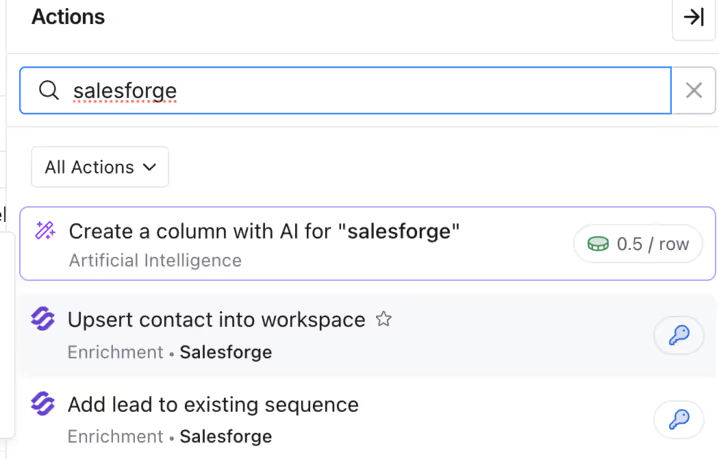
That's the Salesforge and Clay flow: enrich in Clay, then send from Salesforge with warm-up and Primebox™ included.
Clay vs Apollo Pricing Compared (2026)
I took every Clay and Apollo price below from their live pricing pages on November 7, 2026, and cross-checked them against third-party pricing trackers.
| Plan level | Salesforge | Clay | Apollo |
|---|---|---|---|
| Free option | 14-day free trial, no credit card | Clay Free: $0 | Apollo Free: $0 |
| Entry plan | Salesforge Pro: $48/mo monthly, $40/mo annual | Clay Launch: $185/mo monthly, $167/mo annual | Apollo Basic: $65/seat/mo monthly, $49/seat/mo annual |
| Team plan | Salesforge Growth: $96/mo monthly, $80/mo annual | Clay Growth: $495/mo monthly, $446/mo annual | Apollo Professional: $99/seat/mo monthly, $79/seat/mo annual |
| Largest plan | Salesforge Growth already covers unlimited users | Clay Enterprise: custom | Apollo Organization: $119/seat/mo annual, 3-seat minimum |
| Pricing model | One plan price per account; unlimited mailboxes | Actions + data credits; unlimited seats | Per seat + pooled credits |
| Annual discount | 2 months free | 10% | Up to 24% |
Agent Frank is a separate subscription from $499/mo billed quarterly ($416/mo annual). He isn't part of Salesforge Pro or Salesforge Growth. Apollo Organization's 3-seat minimum puts its real entry point at $357/mo billed annually.
Clay's price doesn't move with headcount, but it jumps from $185/mo to $495/mo the day you need CRM sync. Apollo works the other way: each seat costs $49 to $119 a month on annual billing, so the bill grows with every rep you add.
Salesforge charges one plan price for the whole team. On Salesforge Growth, the first and the twentieth user cost the same $96/mo.
What a 5-person team pays per month
Say five reps need CRM sync and want to contact 2,000 new prospects a month. On monthly billing:
- Apollo Professional: 5 seats × $99 = $495/mo ($395/mo annual).
- Clay Growth: $495/mo ($446/mo annual), the first Clay plan with CRM sync.
- Salesforge Growth: $96/mo ($80/mo annual) for unlimited users and 10,000 active contacts.
Salesforge doesn't include data or mailboxes. Leadsforge Essential adds $49/mo for 2,000 credits (1 credit per email), and Mailforge mailboxes cost $3 to $2 each per month on annual billing, plus domains.
Even with 10 Mailforge mailboxes and Leadsforge, the Salesforge stack stays well under Apollo's $495/mo, which already includes data credits. Ten mailboxes sending 30 emails a day for 20 working days cover 6,000 emails, or 3 per prospect.
Who Should Use Clay, Apollo, or Salesforge
You might consider Clay if:
- You have a RevOps lead or GTM engineer who will build table workflows and wants 150+ data providers on one bill.
- You trigger outreach from signals like job changes and company news, and email is your only channel.
- You want Claygent to research accounts in ways no single data vendor covers.
You might consider Apollo if:
- Your reps call US numbers as much as they email. For that phone-heavy motion, Apollo is the simpler pick, because the database and dialer share one login.
- You'd rather pay per seat for one 240M-contact database than manage data credits.
Choose Salesforge if:
- You sell B2B deals of $5K-$100K ACV to startups, SMBs or mid-market companies and target 3,000+ businesses.
- You want email and LinkedIn in one conditional sequence, with every reply in Primebox™.
- Your team is growing and per-seat pricing hurts: Salesforge Growth covers unlimited users and LinkedIn senders for $96/mo.
- You run outbound for several clients and need unlimited workspaces and mailboxes, with each client in its own workspace.
- You want an AI SDR option later, since Agent Frank runs on the same stack as a separate subscription.
For Apollo against Salesforge alone, read the Salesforge vs Apollo comparison or browse all Salesforge comparisons.
Final Verdict: Which Outbound Tool to Choose in 2026
Clay and Apollo both solve the data half of outbound, in opposite ways. Clay rents you 150+ providers through credits and now sends email. Apollo sells its own 240M-contact database and a dialer per seat.
Neither automates LinkedIn in the same sequence as email, and neither gives you one inbox for email and LinkedIn replies. That gap matters once your buyers answer on both channels.
For multichannel B2B outbound, Salesforge is the stronger choice. Salesforge Growth costs $80/mo annual ($96/mo monthly) and includes unlimited users, LinkedIn senders and mailboxes, free Warmforge warm-up and Primebox™. On monthly billing, that's $96/mo against $99/mo for a single Apollo Professional seat.
If you already run Clay, keep it for data and send through Salesforge. One falsifiable benchmark: UniteSync ran Salesforge, Mailforge and Warmforge to an 85.26% positive reply rate and a $2.86 CAC. The case study is public.

Clay vs Apollo FAQs
Is Salesforge better than Clay or Apollo?
For multichannel outbound, yes. Salesforge runs email and six native LinkedIn actions in one sequence, includes free Warmforge warm-up and puts every reply in Primebox™.
Clay and Apollo are stronger as data sources: Clay buys from 150+ providers, and Apollo has its own 240M-contact database. You can pair Clay with Salesforge through the native integration on Growth, or use Leadsforge for data instead.
What's the main difference between Clay and Apollo?
Clay is a data workbench built on 150+ providers, and Apollo is a sales platform built on its own database. Clay chains those providers into waterfalls and bills by credits, with unlimited seats.
Apollo sells access to 240M contacts plus sequences and a US dialer, billed per seat. Both now send cold email, but neither automates LinkedIn.
Which is cheaper: Clay, Apollo or Salesforge?
For a team, Salesforge is the cheapest of the three. Salesforge Growth costs $96/mo monthly ($80/mo annual) for unlimited users.
Clay Launch starts at $185/mo, and CRM sync needs Clay Growth at $495/mo. Apollo Professional costs $99 per seat per month, so five reps pay $495/mo. Salesforge doesn't include lead data, so budget $49/mo for Leadsforge Essential and its 2,000 credits.
Does Clay or Apollo support LinkedIn outreach?
Not as automated outreach. Clay Sequencer is email-only, and Clay's Growth plan can only push LinkedIn ad audiences.
Apollo can add LinkedIn steps to a sequence, but each one is a task that a rep has to carry out. Salesforge automates six LinkedIn actions, such as connection requests, InMails and post likes, inside the same sequence as email.
Can I use Clay with Salesforge, or switch from Apollo?
Yes to both. On Salesforge Growth, the native Clay integration lets a Clay table upsert contacts into a Salesforge workspace or add leads to an existing sequence.
You keep Clay's waterfalls and Claygent research, and Salesforge handles sending, LinkedIn steps, warm-up and replies. To leave Apollo, export your contacts as a CSV and upload them into a Salesforge sequence.
Which tool has better email deliverability?
Salesforge gives you the most deliverability controls of the three. Every mailbox gets free, unlimited Warmforge warm-up with Heat Score™ tracking, plus Bounce Shield, sender rotation and ESP matching on Growth.
Clay warms the Sequencer inboxes you buy and matches Gmail prospects to Gmail senders. Apollo includes warm-up in its Deliverability Suite from Basic. You can also run a free placement test with Salesforge's free outreach tools.
Does Salesforge offer a free trial?
Yes. Salesforge has a 14-day free trial on Pro and Growth, with no credit card required. You can connect unlimited mailboxes during the trial, so warm-up starts before your first campaign.
Trial usage is capped, so plan a small test list. Agent Frank is different: he has no self-serve trial and starts after a demo and a 2-week warm-up.
Who is Clay best for, and who is Apollo best for?
Clay is best for GTM engineers and RevOps teams who build data workflows and want many providers on one bill. Apollo is best for rep teams that want data, sequences and a US dialer in one per-seat tool. If your outbound runs on both email and LinkedIn, Salesforge covers the sending side for either one.


