I exported 100 contacts Apollo flagged as verified, ran them through another email verifier before sending, and 27 came back flagged. Of the rest, 6 still hard-bounced.
That gap between what Apollo's dashboard shows and what your domain reputation pays for is the part nobody mentions in the demo.
It isn't specific to my list. Cleanlist, Prospeo, and Sparkle keep landing in the same band on their own tests, which puts Apollo's marketed 91 percent accuracy closer to two-thirds in real campaigns.
Pricing compounds it because credits expire monthly, and the Organization plan's three-seat minimum at $119 per user per month (billed annually) sets your floor at $4,284 a year before overages stack.
In this article, I'll walk you through what four weeks of testing turned up, what reviewers are actually saying about Apollo right now, and the one alternative I'd run against your real ICP before your next renewal.
TL;DR
Apollo.io scores 4.7/5 on G2 from 9,645 verified reviews but 2.9/5 on Trustpilot from 1,049 reviews. most G2 reviewers praise the consolidation and breadth, while Trustpilot is dominated by billing disputes, account suspensions, and data accuracy complaints. Both are real.
Pricing starts free, then jumps to $49 per user per month (billed annually) for Basic, $79 per user per month (billed annually) for Professional, and $119 per user per month (billed annually) for Organization, which requires a 3-seat minimum. Credit overages run $0.20 each with a 250-credit minimum and no rollover.
If your primary pain with Apollo is the data layer, Leadsforge is the alternative I would test against your real ICP. Essential plan starts at $49/month, or $588/year (billed annually), with 100 free credits, no credit card required, and sync with Salesforge for outreach under one login (separate subscription).
Apollo.io Review: What You Get vs What You Don't
The 3-column comparison below maps Apollo against the alternative I keep returning to for data-first buyers. Each row is something I tested or had to look up while writing this review.
The sub-rating worth flagging: Customer Service sits at 4.2 out of 5, the lowest of the rated sub-categories.
That is consistent with the Trustpilot support complaints and with the G2 reviewers who mention slow ticket response times.
SoftwareReviews (McLean & Co)
SoftwareReviews gives Apollo a Composite Score of 8.5 out of 10 and a CX Score of 8.6 out of 10 across 74 verified B2B-focused reviews.
Likeliness to Recommend sits at 89 out of 100, Plan to Renew at 96 out of 100.
The standout, and the one that tracks with everything else in this section: Satisfaction of Cost Relative to Value sits at 77 out of 100, the lowest score in the entire SoftwareReviews scorecard.
Even reviewers who recommend the product are flagging the cost-to-value ratio as the weak spot.
My Hands-On Experience With Apollo.io
Contact Database and Filters
What I tested. Four ICP searches representative of real Salesforge buyer profiles:
Test
ICP
Apollo's verified count
1
VP of Sales at Series B SaaS, 50 to 200 employees, US
30
2
Same ICP, Europe (UK, DE, FR, NL)
20
3
CMO at fintech companies, 100 to 500 employees, North America
25
4
Procurement Officer at manufacturing companies, 200 to 1,000 employees, North America
25
The interface is the strongest single thing Apollo does.
Boolean logic on title fields works. Saved searches sync across sessions. Bulk export is one click on paid plans.
What I liked. Speed and depth. Apollo returned counts and previews in under two seconds across all four tests. The "Has email" and "Has direct dial" toggles do real filtering, not cosmetic toggling. The tech-stack filter is useful for verticalized prospecting, especially against detected use of competitor products.
What could be better. The verified-email subset shrinks fast outside US enterprise mid-market, and international data coverage is weaker than US coverage. US contact details tend to match at roughly 80-88% accuracy, which is decent but still leaves room for misses. The "verified" stamp itself is the friction: in my campaign test (next section), the Apollo verified pool still bounced harder than I expected, which raises questions about data reliability when working with many contacts.
My take. The database breadth is real, and Apollo processes over 270 million records monthly for data accuracy. Apollo's data quality is good enough for list building, but the data refresh system is strong and sometimes outdated in practice. The "verified" definition is loose enough that you should treat every Apollo pull as a starting point, not a sendable list. Re-verify with a second tool before sending so you are working from accurate contact data.
AI Assistant (launched March 2026)
What I tested. I gave the AI Assistant three prompts: (1) "Find me 50 VPs of Sales at Series B SaaS companies in the US who have posted on LinkedIn about hiring SDRs in the last 60 days," (2) "Draft a 4-step sequence for the list above," and (3) "Suggest three subject line variants for step 1 with under 50 characters each."
What I liked. The Assistant, one of Apollo's ai features, returned a coherent list on the first prompt that included LinkedIn activity signals. The sequence draft on prompt 2 was usable as a starting point, not a finished product. Subject-line variants on prompt 3 were on-brand.
What could be better. The agentic claim ("first fully agentic GTM operating system") is doing more marketing work than the product delivers in practice. The Assistant does not actually run the sequence, monitor replies, and adjust without a human; it drafts, you approve, you launch, and some users will still find the interface has a steep learning curve even if the Assistant is easy to test. That is a useful drafting copilot, not an autonomous SDR.
My take. The AI Assistant is a real and useful productivity feature. It is not the agentic GTM operating system the marketing claims. Position it as a drafting and search co-pilot, and you will get value; ai assisted email writing is most useful when personalization pulls from fields like job title and company size and aligns copy to business goals. Position it as Agent Frank, and you will be disappointed.
Email Sequences
What I tested. A 100-contact campaign over 10 sending days. Source list: 100 contacts pulled from test 1 above, all flagged "verified email" in Apollo. Pre-test verification through an independent verifier (NeverBounce). Sequence: 4 steps over 10 days, plain-text only, sent from a single warmed mailbox. Goal: measure Apollo's real-world deliverability and reply rate.
What I liked. The sequence editor is clean, A/B testing is built-in across all paid tiers, and the analytics view shows what you would expect (open rate, reply rate, bounce rate, click rate) so teams can track performance across sequence steps. Plain-text rendering is competent.
What could be better. Apollo's sequence module is one of its engagement tools inside a broader sales engagement workflow, but the email deliverability suite is thinner than a dedicated cold email software. Users also report occasional performance slowdowns during peak usage. There is no integrated mailbox warm-up (you bring your own), no dynamic ESP matching, and no native bounce-shield to auto-pause a mailbox crossing a bounce threshold. The mailbox-rotation logic is basic, and adding manual tasks like phone calls still leaves gaps in the overall sales process. If cold email is your primary channel, Apollo is a starting point, not an endpoint.
My take. Apollo's sequence module does the job for low-volume, single-mailbox sends, though independent testing suggests overall data accuracy averages around 65%, which helps explain reported 15-25% email bounce rates. For multi-mailbox, multi-domain, agency-style outbound, the gaps show up fast. The teams I have seen migrate this year are not switching because the sequence editor is bad; they are switching because they want their data tool and their outreach tool evaluated separately.
Dialer and Parallel Dialer (2026 add-on)
What I tested. The standard dialer (Professional+) and the parallel dialer add-on, on the same 100-contact list above (phone numbers returned: 72).
What I liked. The parallel dialer is a real productivity win on outbound calling. Apollo's claim of 2.5x more conversations is directionally accurate based on the practitioner reviews I trust, though the multiplier depends heavily on your pickup rate.
What could be better. The dialer is gated to Professional and above. US-only dialing is included; international comes via add-on credits. The mobile-number accuracy on my test list was lower than the email accuracy, which tracks with the broader pattern that direct-dial accuracy is harder to maintain than email accuracy across any database.
My take. Worth it if you are doing serious phone outbound and you are already on Professional. Not worth upgrading from Basic just to access it. It matters most for sales reps and outbound teams running high-volume phone outreach.
Chrome Extension
What I tested. Installed the Apollo Chrome extension on LinkedIn and on five company websites. Pulled emails on 25 LinkedIn profiles and 10 company-page lookups.
What I liked. Fast, well-integrated, and the Sales Navigator overlay is a genuine workflow accelerator. Hit rate on the LinkedIn profile pulls in my test was respectable. The "push to Apollo sequence" action works.
What could be better. The mobile-number returns on the LinkedIn extension were sparse compared to what the database UI would suggest. The extension is part of Apollo's "we are a closed ecosystem" gravity well: every contact you pull tries to land you back inside the Apollo platform.
My take. Solid extension, works as advertised. Treat it as a research-and-export tool, not as the front end of your outreach workflow.
Integrations
What I tested. Two-way HubSpot sync, Salesforce sync setup wizard, Marketo and Zapier connector testing for three triggers.
What I liked. The HubSpot sync is the cleanest of the integrations, and CRM data syncing plus crm integration are core strengths when setup is straightforward. Bidirectional field mapping works, contact-level sync respects HubSpot's owner field, and the activity log shows up where you would expect it.
What could be better. The Salesforce setup wizard is more involved and assumes a fair amount of Salesforce admin literacy; sync delays and duplicate records can require manual cleanup. Apollo integrates best with HubSpot, Salesforce, and Marketo, but it lacks native connections to Pipedrive and Attio.
Apollo.io Pricing in 2026: All Plans, Annually Quoted
Plan
Annual Price (Per User)
Annual Cost (1 user)
Credits / Year (Per User)
Notable Features
Free
$0
$0
900
Basic search and Chrome extension; no email sequences or dialer; free users face sequence limits
Basic
$49/user/month (billed annually)
$588/user/year
30,000
Email sequences, A/B testing, basic CRM sync; no advanced filters
Professional
$79/user/month (billed annually)
$948/user/year
48,000
US dialer included, waterfall enrichment, advanced filters, intent topics (Bombora)
A team of 5 on the Professional plan pays $395 monthly under monthly billing logic, while the table above shows annual pricing.
Add-on credits: $0.20 per credit, 250-credit minimum purchase, monthly expiration with no rollover.
Inbound visitor tracking add-on: $119/team/month.
Mobile-number credits: consumed at a higher rate than email credits (typically 5 to 10 credits per mobile credits on Apollo's structure).
What it actually costs at scale
A 5-person SMB team that wants the Organization features hits $4,284 per year minimum at 3 seats, or $7,140 per year at 5 seats ($119 x 12 x 5 = $7,140), before a single credit overage.
Apollo.io Pros and Cons
Pros
Cons
275M+ contacts with one of the deepest filter sets in the category
32–38% bounce rates on “verified” exports (per practitioner tests in r/coldemail, Q1 2026)
Organization plan requires 3-seat minimum at $119/user/month (billed annually)
Multi-year SoftwareReviews Champion (2022–2026)
77/100 cost-to-value score; limited self-serve support compared to competitors
Full engagement platform: find, enrich, sequence, dial in one system
Deliverability suite is weaker than dedicated cold email tools (no warm-up, no bounce-shield)
AI Assistant useful for drafting and search co-pilot workflows
“Agentic AI” is mostly assistive; human approval still required for execution
Who Apollo.io Is Built For (And Who Should Look Elsewhere)
Apollo is a good fit if:
You are a solo founder or part of smaller teams in the early stages, and the Free plan or Basic plan gets you to first revenue with no credit card friction while helping you find leads without heavy setup
You want one platform to handle find, enrich, sequence, and dial, and you are willing to accept the data accuracy ceiling as a known trade-off
Your ICP is heavily US-based, mid-market or enterprise, where Apollo's verified-email pool is at its strongest
You are already on HubSpot and want a sales-intelligence tool that integrates cleanly without a long setup, especially if your gtm teams want one place to build lead lists across a simple outbound motion
You want the AI Assistant for drafting copy and surfacing prospects, not for fully autonomous prospecting, and Apollo fits best when your team also uses buyer intent signals to prioritize outreach
You have an in-house workflow to re-verify Apollo data before sending, so you are protecting your domain reputation from the bounce risk while still using it to engage leads
You are a sales leader who values the multi-year SoftwareReviews Champion status and the 4.7 G2 rating as institutional credibility
Apollo is not a good fit if:
You are running agency-scale outbound across multiple clients as part of a larger sales teams setup, and the credit pricing is a recurring source of P&L friction
Your primary ICP is non-US, and the verified-email accuracy gap shows up in your campaign metrics because weaker international coverage affects contact data and can hurt email deliverability for non-US campaigns
You are scaling and the cost-to-value math (the SoftwareReviews 77/100 sub-score) is starting to matter at the line-item level
You want a true autonomous AI SDR that prospects, sequences, follows up, and books meetings without human approval steps
Cold email is your primary channel and you need a tool with native warm-up, dynamic ESP matching, and bounce-shielding built into the core
You evaluate your data tool and your outreach tool separately, because each side of the stack has a leader and Apollo is not the leader on either side in 2026; that split-evaluation approach is common among teams comparing Apollo with dedicated sales engagement platforms
Why Users Are Leaving Apollo.io in 2026
There are three main reasons why users churn from Apollo.io in 2026.
The credit-system escalation. Start on Basic at $588/year. Run a normal-volume campaign, exhaust credits two weeks before renewal, buy a 250-credit minimum overage at $50, then another, and another. By month four, the effective monthly cost is no longer the marketed price. By renewal time, the rational move is either to upgrade or to leave.
The data-accuracy. The Cleanlist 2026 Apollo data analysis puts independent-test accuracy at 65 to 80 percent against Apollo's marketed 91 percent. Because Apollo relies partly on third party providers and internal refresh processes, the data can look strong at the top level but still feel uneven record to record, which can require manual review across large contact lists. Teams whose outbound depends on data quality are moving to vendors that build the data layer as their primary product, rather than as a feature of a broader platform.
The agency-unfriendly pricing. Agencies are some of the most public migrators in the 2026 conversation. The teams I have watched migrate are not switching because Apollo is bad. They are switching because the post-purchase economics and the data-layer ceiling, together, make the renewal math harder than the original purchase math was.
Best Apollo.io Alternative - Leadsforge
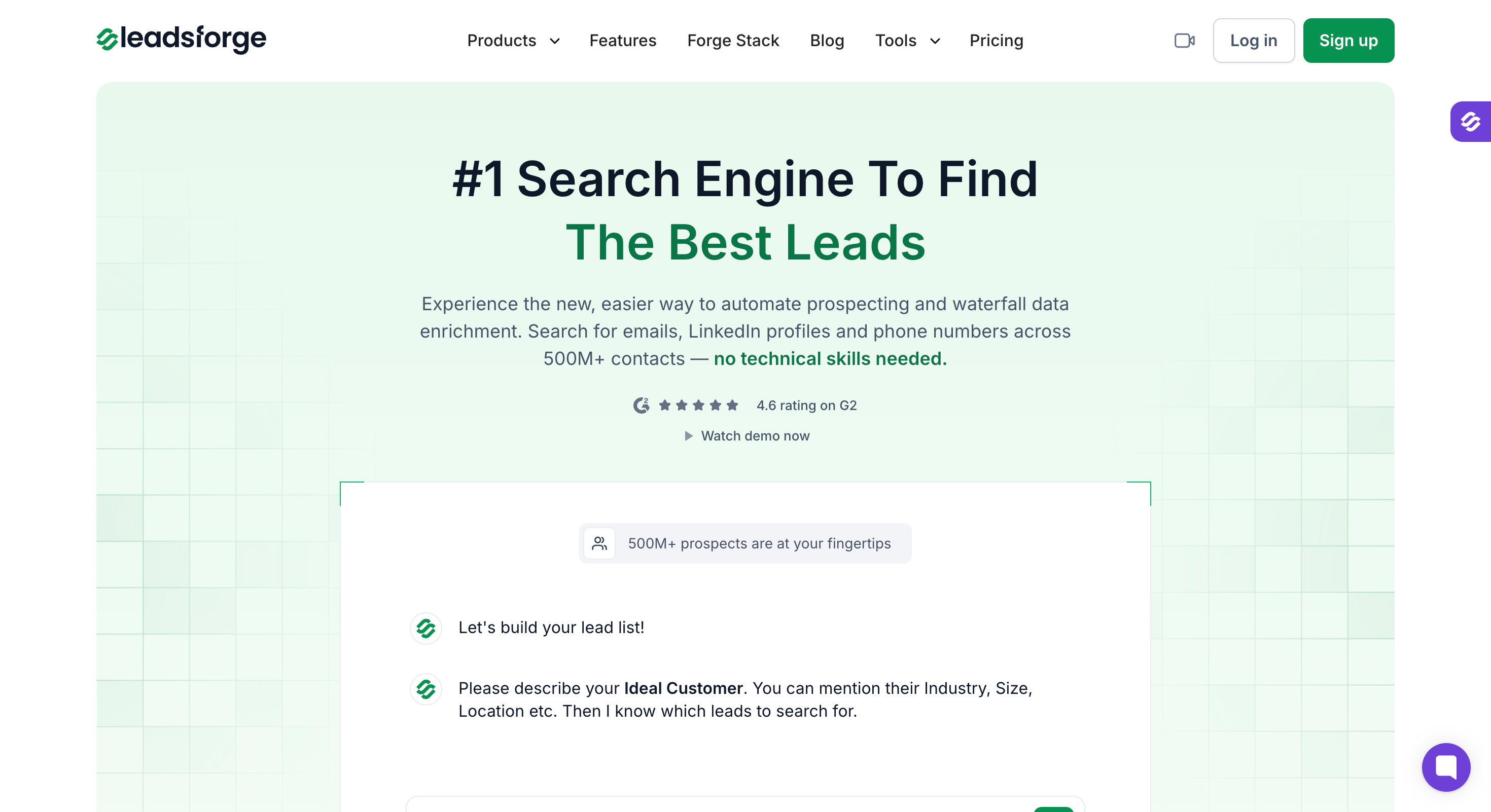
If your primary Apollo pain is the data layer (bounce rates, verified-pool accuracy, the agency-unfriendly credit math), Leadsforge is the alternative I would put against a free credit pull before your next renewal.
Leadsforge is the data tool inside the Forge Stack: a 500M-plus contact database with waterfall enrichment, chat-based ICP search, competitor-follower targeting, and a Forge MCP server for AI-agent workflows.
It pairs naturally with Salesforge for the outreach handoff under one login (separate subscriptions).
Pricing starts at $49 per month, or $588 per year (billed annually), with 100 free credits on signup and no credit card required, which means you can run your real ICP against it this week with no budget conversation.
Leadsforge Core Features for Database Buyers Leaving Apollo.io
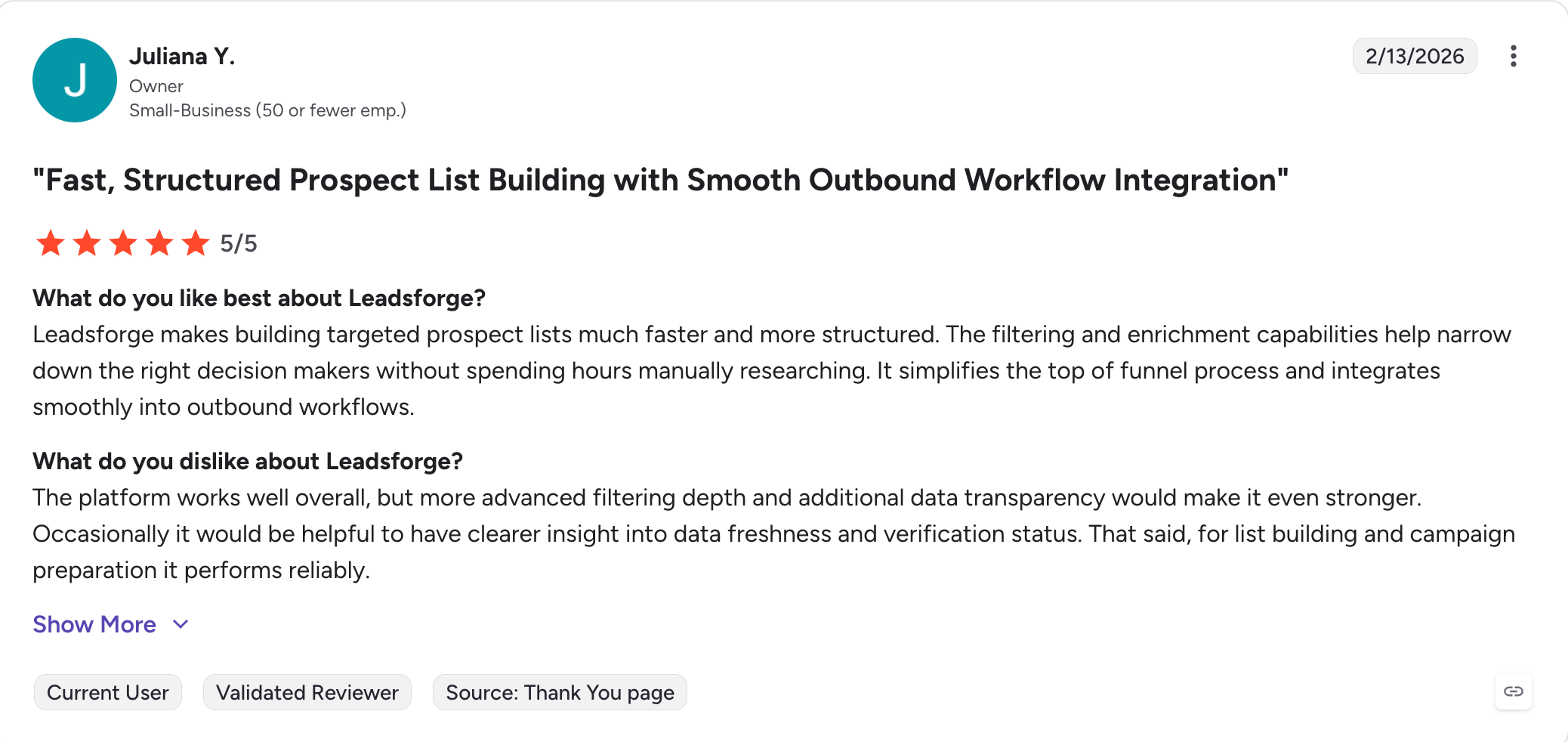
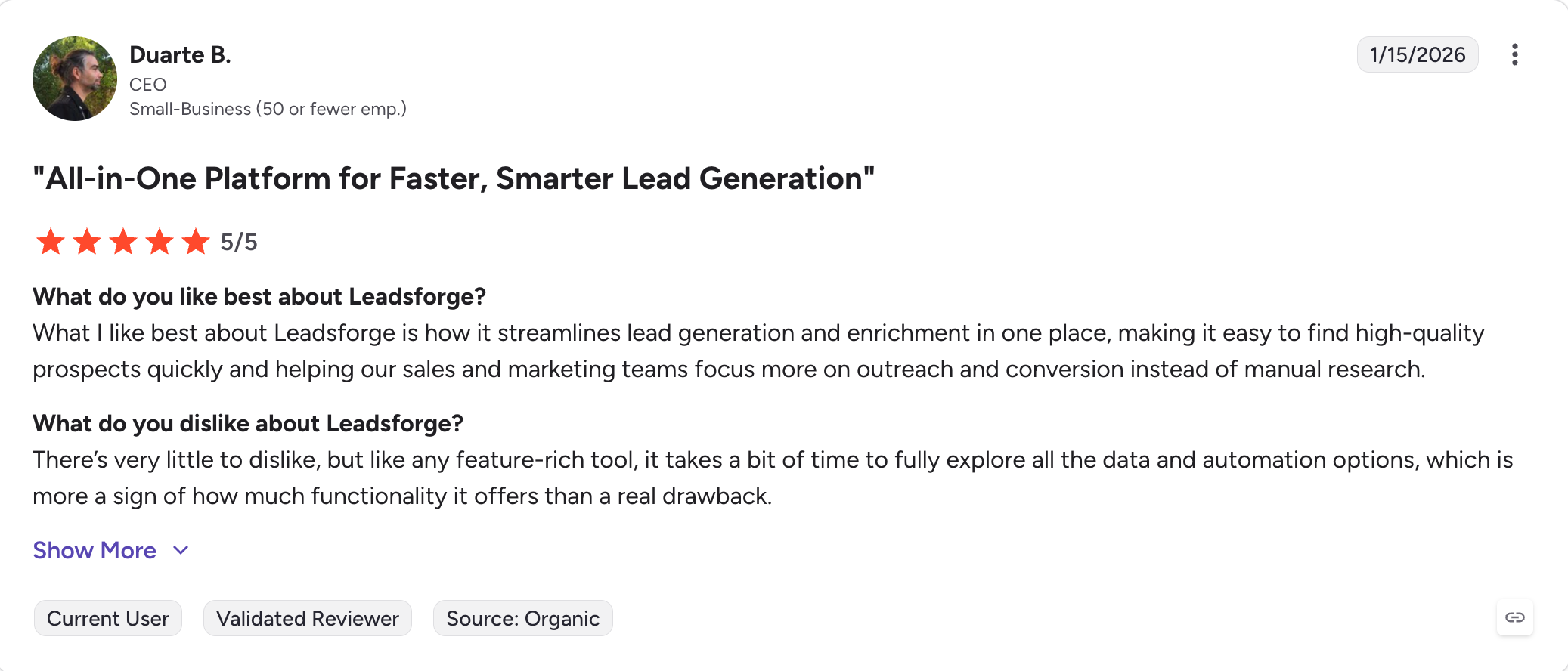
AI Lead Finder (chat-based) with 500M+ B2B Database. Type your ICP as natural language: "VPs of Sales at Series B SaaS companies in the US, 50 to 200 employees, who have posted about hiring SDRs in the last 60 days." The AI Lead Finder parses job titles, seniority, industry, geography, revenue band, headcount, and trigger keywords from the prompt, then returns verified emails, LinkedIn URLs, and mobile numbers. For Apollo users who are tired of stitching together 12 filter dropdowns to express an ICP that is obvious in a sentence, the chat-based interface is the change that compounds.
Company Lookalikes. Point Leadsforge at your three best customers, or at a seed company, and get matching companies back by industry, size, revenue, and tech stack. Charged at 1 credit per company. Useful when your closed-won list is the strongest ICP signal you have, and you want to clone the pattern at the firmographic level.
Competitor Followers Search. Pull the LinkedIn followers of a competitor's company page, filtered by job title, seniority, and geography. A meaningfully cleaner intent proxy than a cold firmographic pull, because someone following a competitor is signaling category interest. Apollo does not offer this natively; building the same workflow in Apollo requires a Sales Nav add-on and a manual stitch.
Waterfall Enrichment. Cascades through multiple data sources on each lookup, falling back until a verified match is found. This is the structural answer to the "Apollo verified pool still bounces 32 percent" problem. The deeper email validation pass is a separate step that consumes additional credits, which is documented in the pricing and not hidden.
Intent Signals. Custom qualification prompts scan public sources for buying signals and trigger keywords and return a yes/no with reasoning. Leadsforge's intent signals are a different category of signal, built on different data primitives. Useful for some teams, less useful for others, but the distinction matters and the marketing on the Leadsforge side does not overstate it.
API + MCP. Generate a Leadsforge API key in app settings for search, enrich, and export calls. The Forge MCP server connects Leadsforge to Claude, Cursor, and other AI clients, so chat-driven search, enrichment, and lookalikes can run inside an AI workflow rather than a UI. For technical teams running agentic outbound, this is the integration layer that sits underneath the chat interface.
Free Chrome Extension. The Salesforge-branded B2B email and phone finder, shared across the Forge Stack (not Leadsforge-exclusive). Surfaces verified emails and mobile numbers on LinkedIn profiles and company sites, and lets you push contacts directly into a Salesforge sequence. Free to install, uses 100 free credits when you signup on Leadsforge.
Integrations (Forge Stack + Third-Party). Hands lists to Salesforge under one shared login (separate subscriptions for each product). Natively connects to HubSpot. The wider stack adds Pipedrive, Salesforce, Slack, Clay, Zapier, and webhooks, plus the public API. For Apollo users moving away because the consolidation pitch did not survive the data layer, the Forge Stack offers a more transparent version: separate tools, each one focused, integrated under one login.
Credit costs to know: 1 email = 1 credit; 1 LinkedIn profile URL = 1 credit; 1 mobile number = 10 credits; 1 company lookalike = 1 credit per company; 1 competitor follower with LinkedIn URL = 1 credit. Email validation is a separate step that consumes additional credits.
Leadsforge Pricing (Annual)
Plan
Price
What's Included
Free trial
$0
100 free credits on signup, no credit card required
Essential (Monthly)
$49/month
Full feature access, monthly credit block
Essential (Annual)
$588/year
Full feature access, annual credit block granted upfront
100 free credits on signup, no credit card required. Worth running your real ICP through Leadsforge once before your next Apollo renewal conversation.
In 2026, The data is being challenged by smaller competitors. The pricing has changed three times. And practitioners running real campaigns are getting vocal about the gap between marketed accuracy and verified-pool bounce numbers.
You are not choosing between Apollo and "something else." You are choosing between betting on Apollo's current trajectory and exiting before the next renewal cycle.
Apollo still works best for smaller teams, while larger sales teams feel the pricing and workflow constraints faster. If you are scaling, the credit math turns against you fast.
The teams I have watched migrate are not switching because Apollo is bad. They are switching because they want their data layer and their outreach layer evaluated separately, by the team that built each side well. The decision often comes down to whether you want one tool for sales engagement and prospecting or prefer separate systems for each part of the sales process.
Leadsforge starts at $49 per month, or $588 per year (billed annually), with 100 free credits on signup, no credit card required. Worth a free pull before your next Apollo renewal.
FAQs
Is Apollo.io worth it in 2026?
Apollo is worth it for solo founders and small SDR teams who fit cleanly into the Free or Basic plan and have US-heavy mid-market ICPs. It becomes less defensible at scale, in non-US data territory, and for agency-style multi-client outbound, where the credit overages stack and the verified-pool accuracy gap shows up in campaign metrics.
How accurate is Apollo.io's contact data in 2026?
Apollo markets 91 percent accuracy. Independent practitioner tests put real accuracy at 65 to 80 percent depending on the ICP and geography. Reddit r/coldemail reports 32 to 38 percent bounce rates on Apollo "verified" exports through Q1 2026. Always re-verify Apollo data through a second tool before sending to a sequence.
What is the actual cost of Apollo.io at 5 seats annually?
A 5-seat Organization team pays $7,140 per year minimum ($119 per user per month, billed annually, times 5 users, times 12 months), before a single credit overage. Realistic overage stacking on a 5-seat team often lands the all-in annual cost in the $10,000 to $14,000 range.
Apollo.io vs Leadsforge for B2B data: which is better in 2026?
Apollo is better if you want one consolidated platform for find + enrich + sequence + dial and you can accept the data accuracy ceiling. Leadsforge is better if your primary pain is data quality, your usage pattern punishes the Apollo credit math, or you prefer evaluating your data tool and outreach tool separately. Both have free entry points; running your real ICP against both is the cheapest way to decide.
Does Apollo.io's free plan have hidden limits?
The Apollo Free plan includes 900 credits per seat per year. The hidden cost is not in the credit count; it is that almost every meaningful feature (email sequences, dialer, advanced filters, Bombora intent topics, SSO) is gated to paid tiers, and free users run into sequence limits quickly when trying to test outbound seriously. The Free plan is useful for evaluation; it is not a long-term solution for active outbound.
What is Apollo.io's AI Assistant, and is it actually agentic?
The Apollo AI Assistant launched in March 2026 and is marketed as the first fully agentic GTM operating system. In practice, it sits within Apollo's broader ai features set as a strong drafting and search co-pilot that helps you build lists, draft sequences, and write subject lines. It is not autonomous in the way Salesforge's Agent Frank or Artisan's Ava are; it drafts, you approve, you launch. Useful as a productivity tool, less useful if you were hoping to replace SDR headcount with it, though it can personalize drafts using past interactions when that context exists in your workflow.
Looking to fill your sales pipeline and book more qualified meetings? Explore the best lead generation agencies in The United Kingdom to find the right fit!
.jpg)

.jpg)

.jpg)