If you’re looking for a RevOps agency in Paris, you’ve probably come across Ceres.
They help B2B teams fix their CRM, tighten up their sales and marketing processes, and build a RevOps setup that can actually scale.
But here’s the question I’d ask before hiring them: Will bringing Ceres in actually help you generate more revenue?
That’s what I wanted to find out.
I went through their services, pricing, case studies, and customer feedback to see what you’re really getting for the money.
By the end of this review, you’ll have a much clearer answer on whether Ceres is worth hiring for your team.
Before I get into the deep dive, here's the fast read for anyone in a hurry.
Given all of that, here's the honest read.
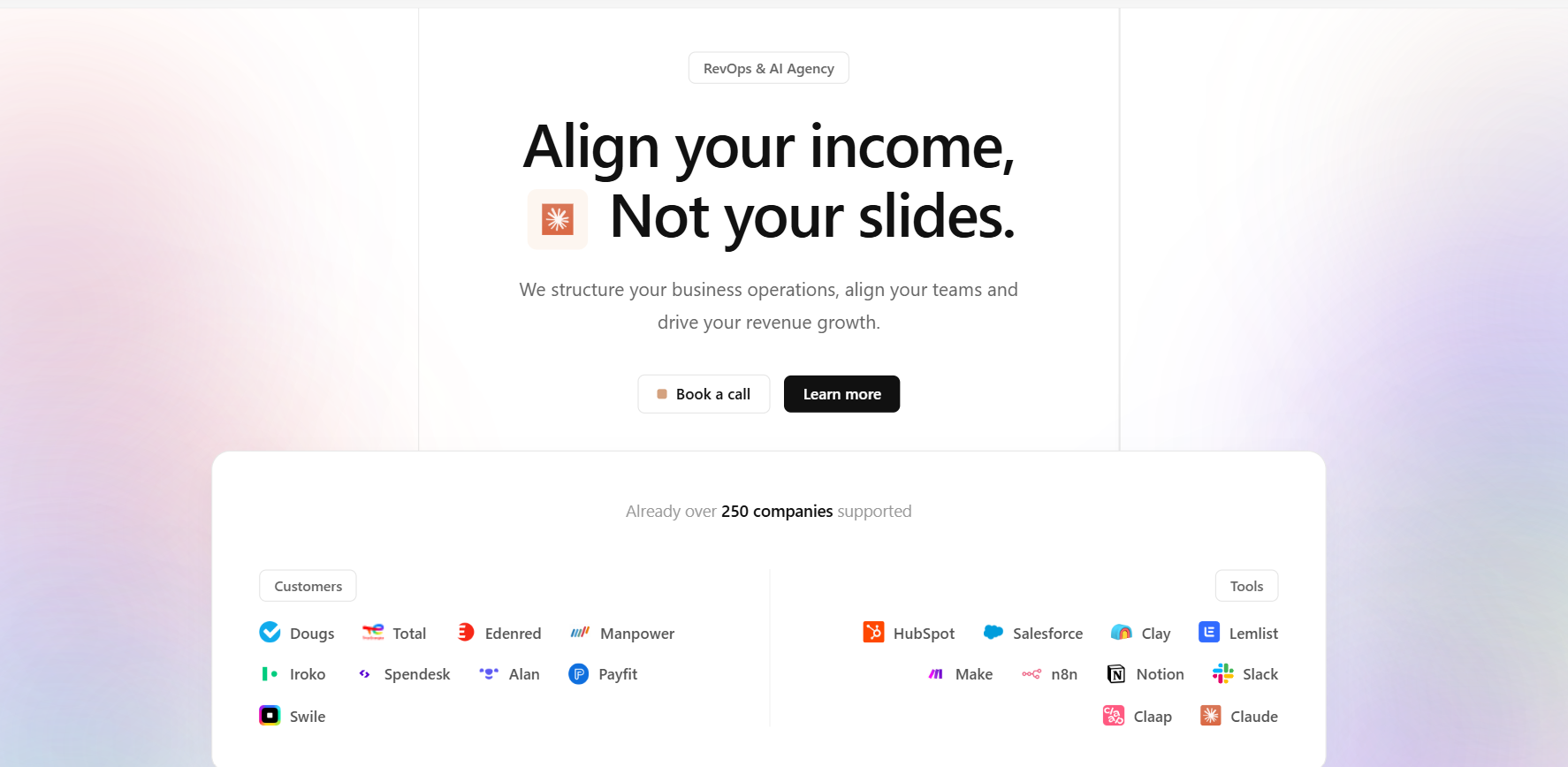
Hire Ceres if you're a 50 to 500 person French or francophone B2B team, already on HubSpot (or actively migrating to it), and you've got a clear bottleneck in one of four places. Maybe your data quality is bleeding into forecast accuracy.
Maybe your workflows are manual where they should be automated. Or maybe AI is on the roadmap but nobody has the time to actually build agents that connect to the CRM.
Two things back this verdict up.
But the tensions are real too, and I'd be doing you a disservice not to name them.
If any of those tensions rule Ceres out for you, compare certified alternatives in the Forge Expert Network. I'll get to the three that address specific Ceres gaps further down.
Before I go deeper, one quick note on how I approached this.
I'm not a Ceres customer. This review is research-based, built from two source layers.
For pricing, services, contract terms, and case studies, I pulled everything directly from Ceres agency. For independent reviews and outside sentiment, I checked Sortlist, G2, Clutch, Trustpilot, and the HubSpot Partner directory.
I judged Ceres on four criteria that actually matter when you're picking a RevOps agency.
That's the ten-thousand-foot view. Here's where I actually land after digging deeper into what Ceres sells and how the tiers fit together.
Ceres offers four core service tiers, and each one is priced separately and available as a standalone engagement. That matters, because it means you can hire them for the specific bottleneck you have, not a bundle that solves problems you don't.
Here's how Ceres stacks up against certified Forge Experts on the dimensions buyers actually decide on.
Every Ceres cell comes from ceres. agency directly. Confirm the specifics on your discovery call.
That covers what Ceres sells. Now here's how a typical engagement actually plays out, from the first call to results on the ground.
This is the entry point, and it's genuinely free. Ceres says the call is enough to scope the perimeter and identify quick wins, no commitment and no invoice. The team confirms whether you're a fit before proposing anything, which is a healthy filter.
Ask: Which specific tier fits my bottleneck, and why not the other three?
If you move forward, this is where the money starts. Ceres runs a paid 72-hour audit as the fixed-fee starting point, mapping your CRM, processes, teams, and tech stack. You walk away with a prioritized worklist split between quick wins (under 2 weeks) and structural projects (4 to 8 weeks), plus a 6-month budget recommendation.
Ask: What happens if the audit findings contradict what I said on the discovery call?
Next comes the two weeks to translate the audit into an executable plan. Target data schema, pipeline design, automation architecture, integrations, KPIs, everything gets validated with your team before build starts. If you're also running outbound, this is where you'd map how Salesforge activity syncs back into HubSpot via OutboundSync or a native integration.
Ask: Who signs off on the design before build starts, and what happens if we change our mind mid-build?
Now the actual work starts. Weekly sprints, weekly demos, so you never wait a month to see something. Deliverables include a cleaned and structured CRM, live automations, a targeted AI layer, per-silo dashboards, and full documentation plus runbooks.
Ask: If we hit an obstacle mid-sprint, does the fixed fee cover the extra hours, or do we get a change order?
At the end of every project, Ceres includes 30 days of support after handoff. The quoted price is the final price, they say, no hidden fees.
Ask: What counts as scope inside the 30-day window, and what triggers additional billing after?
If you want continuous ops after the project ends, the Accompagnement retainer takes over. A dedicated RevOps expert (same person every month) embedded 1 to 5 days per week, with weekly iterations and monthly ROI reporting. Cancel with 30 days' notice, no long-term lock-in.
Ask: If we switch retainer level or pause, how is unused time credited?
Here's where Ceres genuinely differentiates itself.
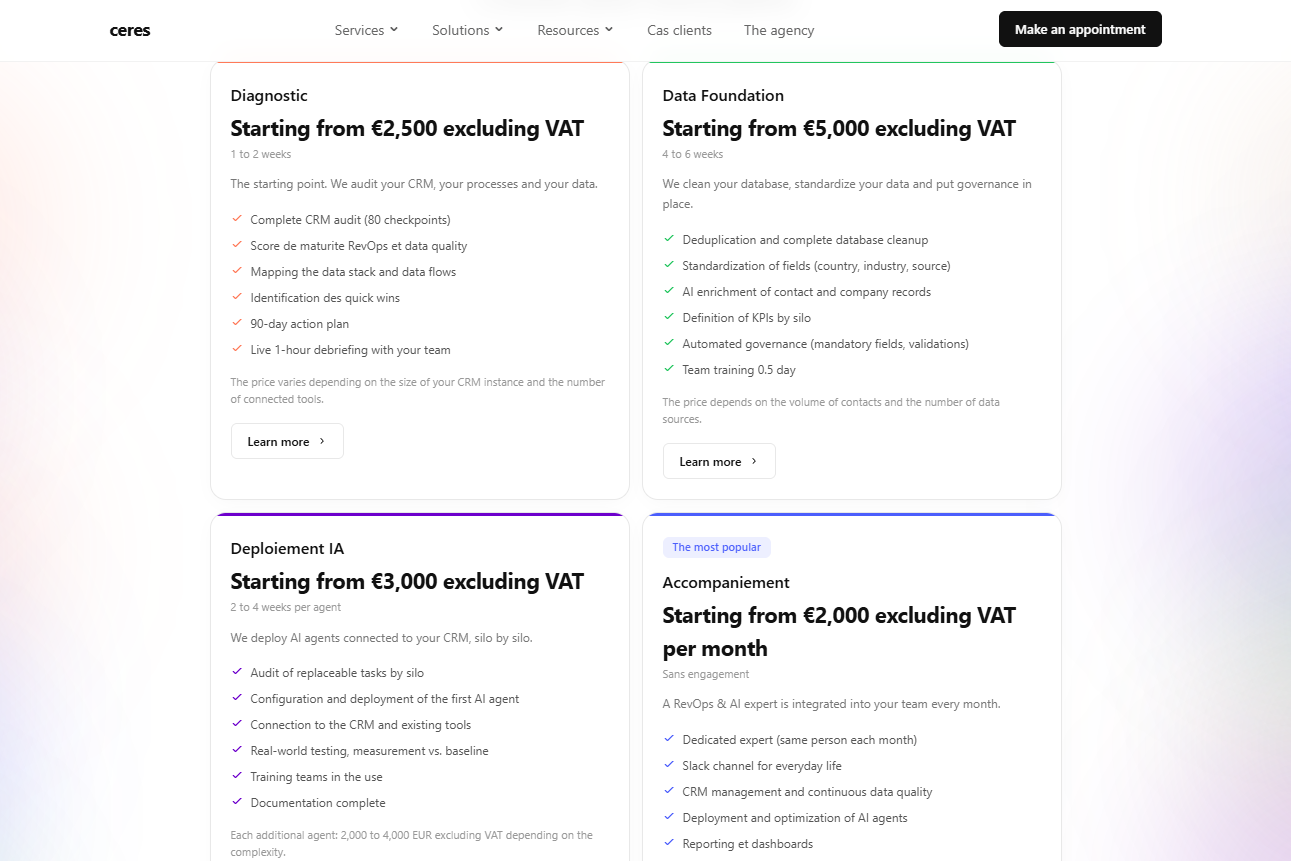
Every tier price is published on ceres.agency/tarifs. In the RevOps agency category, that alone is a signal.
A few payment details worth knowing.
Ceres accepts installment payments on any project over €5,000, spread across 2 to 3 monthly payments. And if you follow the Diagnostic with either Fondation Data or Déploiement IA within 30 days, the diagnostic fee is credited toward that project.
What's not there matters just as much.
There's no money-back guarantee and no performance guarantee published anywhere on the site. The only real commitment on that side is a "no hidden fees" promise plus 30 days of post-delivery support.
Pricing transparency helps a lot, but a few contract details still need explicit confirmation.
Get all of that in the SOW before signing. The pricing transparency doesn't yet extend to the entity structure, and that's the one gap I'd close early.
Now for the practical question. Who is this actually right for?
Ceres fits a French or francophone B2B SaaS or services company, roughly 50 to 1,000 employees, already on HubSpot (or migrating to it), with a defined operational bottleneck. Maybe your data quality is bleeding into forecast accuracy. Maybe your workflows are still manual where they should be automated. Or maybe AI is on the roadmap but no one on your team has time to build agents that actually connect to the CRM.
Two conditions make the fit especially strong.
Your bottleneck maps cleanly to one of the four tiers, so you're not buying a bundle when a single targeted project would do the job. And you have a real business case where AI agents built on Claude and MCP would replace measurable manual hours, not just look good in a board deck.
The flip side matters just as much, and Ceres is admirably upfront about it.
They explicitly say they don't do outbound execution, paid ads, content creation, or strategic consulting without execution. So if what you actually need is cold email at scale, a lead generation engine, or a GTM engineering team that runs outbound campaigns end-to-end, Ceres is the wrong door.
And if your monthly outbound volume is under a few hundred emails and you want to keep it that lean, an outbound agency or a dedicated cold email platform is a cleaner fit than a RevOps engagement.
Now the results themselves. Ceres publishes case studies with named clients (which, again, most French agencies won't do), so let me walk you through the four strongest.
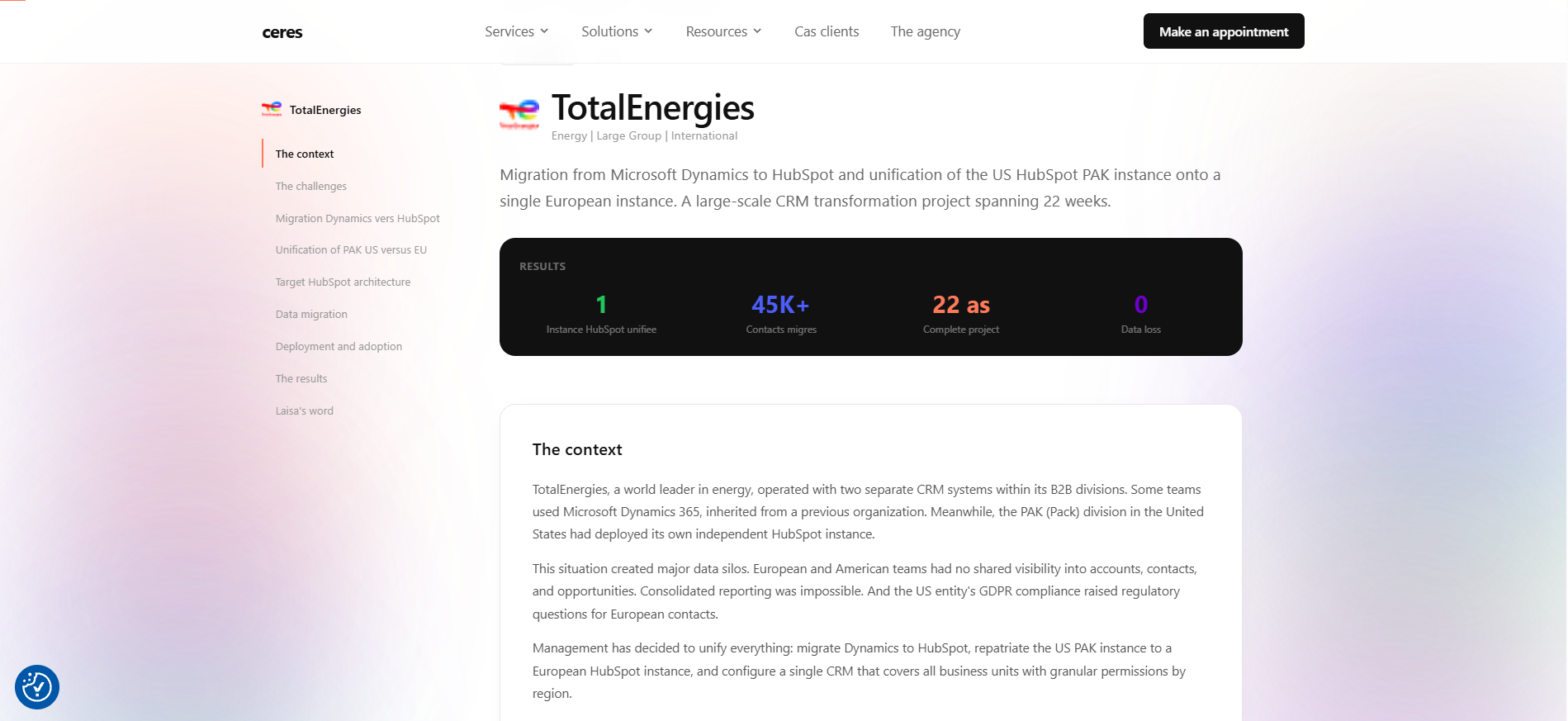
1. TotalEnergies is the most complex engagement on the list, and honestly the most impressive. Ceres migrated 45,000+ contacts from Dynamics into HubSpot across multiple regions, with GDPR compliance baked into the migration from day one. They report zero data loss over a 22-week project, and Bruno Teixeira (Ceres's Partner focused on complex integrations) is named as the lead on this account.
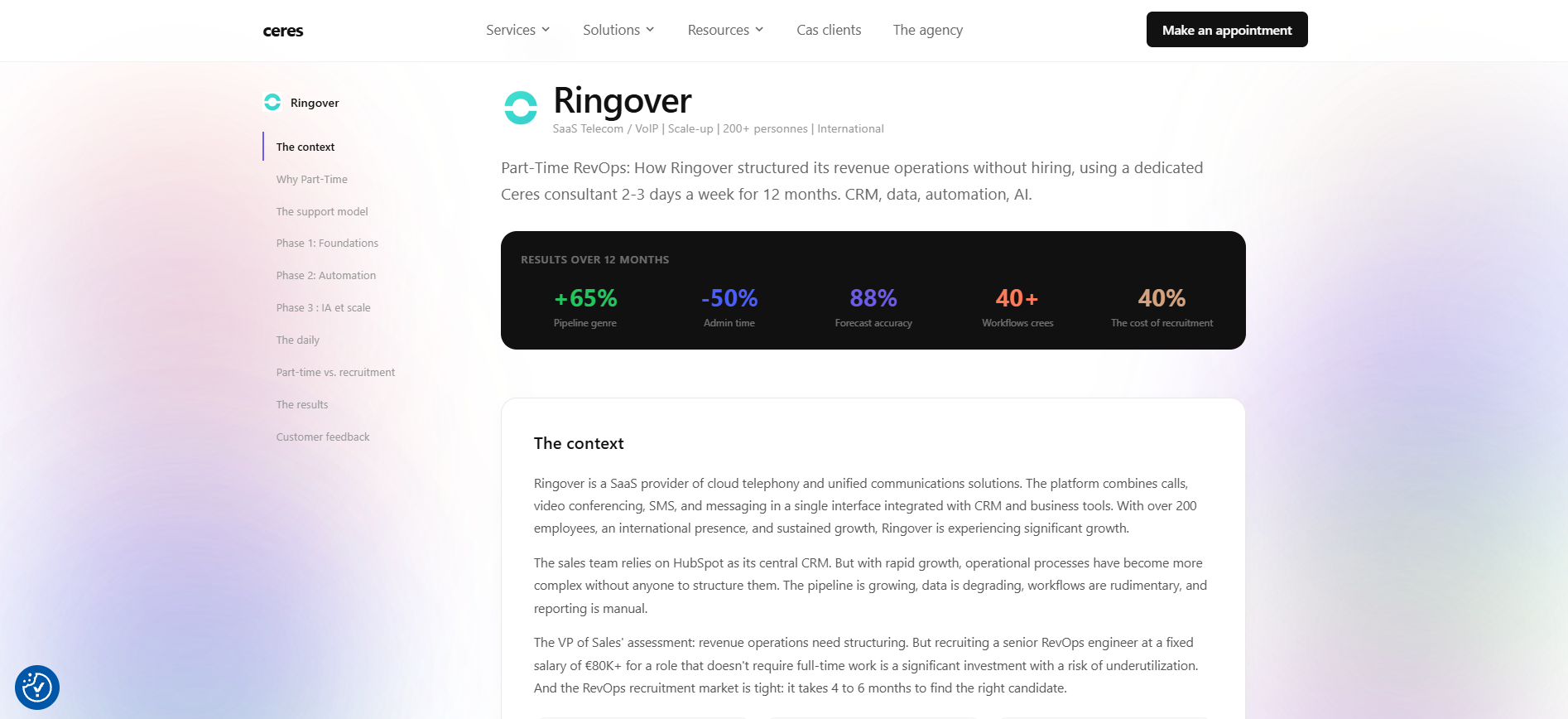
2. Ringover is the longer-form Accompagnement retainer, 12 months of embedded RevOps work. Ceres reports a 65% pipeline lift over that period, 88% forecast accuracy, and a 40% cut in recruiting cost by delaying an internal RevOps hire.
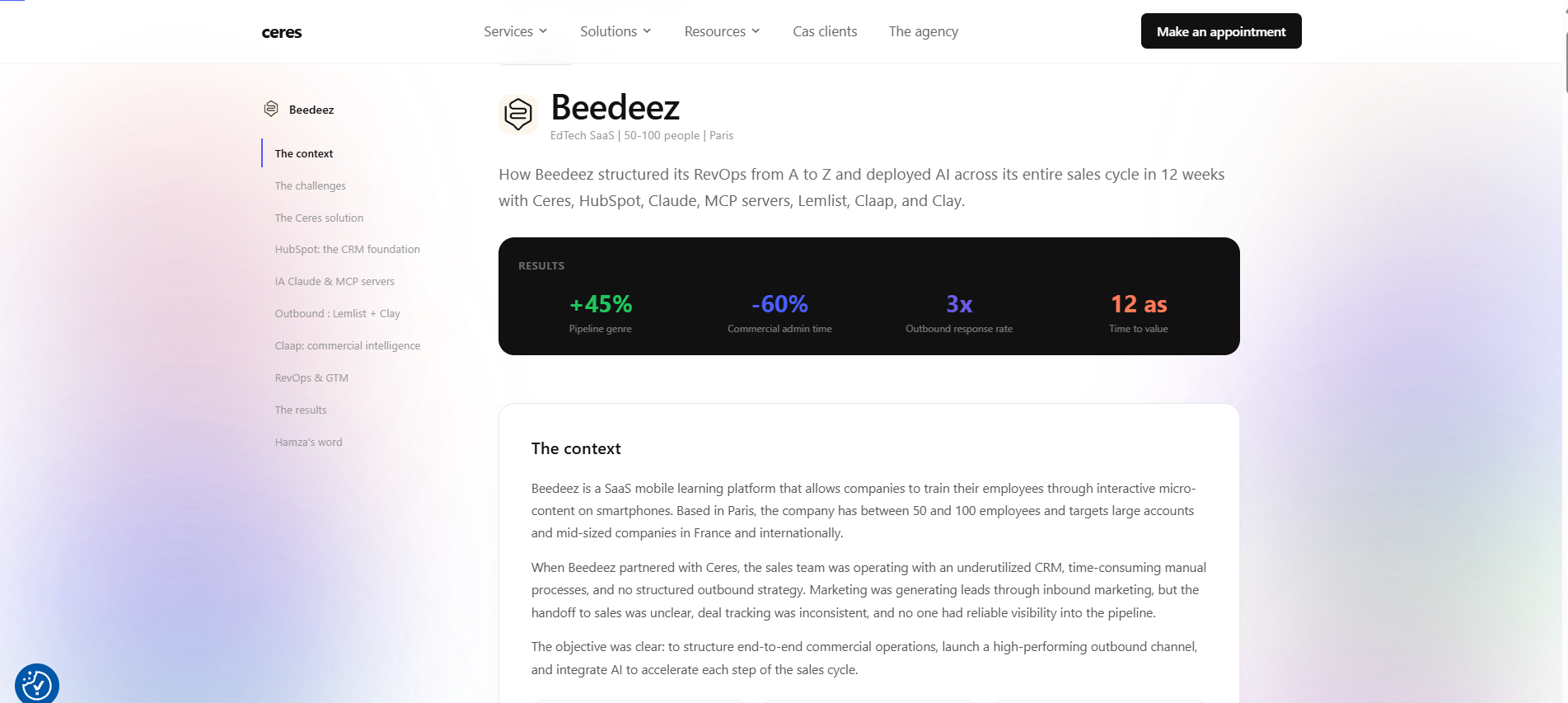
3. Beedeez is the flagship AI agent case, and it's the one to read closely if AI agents are what you're actually buying. Ceres deployed a full RevOps + AI stack using HubSpot, Claude, MCP servers, Lemlist, Claap, and Clay. Reported results: 45% pipeline lift, 60% cut in admin time, and a 3x reply rate on outbound.
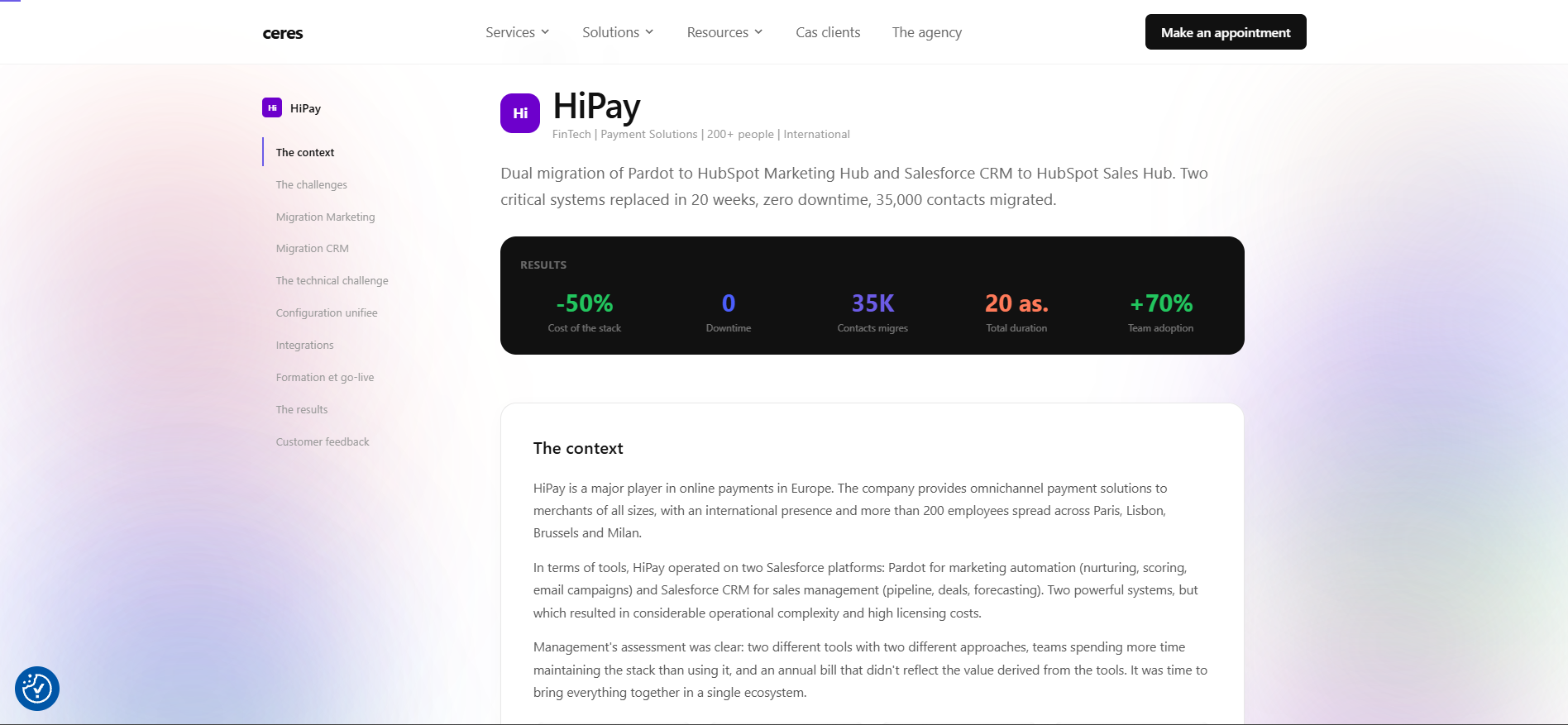
4. HiPay is the double migration. Both Pardot and Salesforce out, HubSpot in, zero downtime across a 20-week project. Ceres reports a 50% cut in stack cost as the headline metric.
Beyond the friction points I've already covered, there are a few structural gaps worth naming before you sign anything.
This is the biggest one, honestly. Ceres has just 3 credible independent reviews across every platform I could find, all on Sortlist, all 5/5, and one of them is over 7 years old. Zero reviews on G2, Clutch, Trustpilot, or the HubSpot Partner directory. A separate 12-review listing on Trustburn reads as templated content with no client names or specifics, so I wouldn't count it.
For a firm claiming 250+ engagements over 8 years, the credible-review base should be significantly deeper. That doesn't invalidate the case studies, but it does mean you're leaning on the case studies alone.
Ceres calls HubSpot "our reference CRM" on the site, with "100+ instances deployed" as the volume claim. Salesforce, Dynamics, Pipedrive, and Attio migrations are all offered, but the depth is not comparable. So if your long-term CRM is Salesforce and you're not migrating, another agency with deeper Salesforce roots is likely a better fit.
Delivery happens in French and English only. That covers France, Belgium, Switzerland, Quebec, and English-speaking teams, which is a lot. But it doesn't cover German, Spanish, or Italian rollouts natively. So for a pan-European multi-region CRM migration, you'll want either an agency with in-market language depth or a delivery model that layers in local specialists.
There are at least three related entities in play. "Ceres" as the consumer-facing brand, "Ceres Growth Marketing" as the legal entity name, and a separately branded Canadian site at agence-ceres.ca ("Agence HubSpot à Montréal"). The Sortlist listing uses yet another name variant. So confirm which entity is actually billing you and which one holds the HubSpot partner certification.
If Ceres isn't the right fit, or you just want to compare shortlists before signing, here are three certified Forge Experts that each address a specific Ceres gap.
Quick context first. The Forge Expert Network is Salesforge's directory of certified agencies and consultants who work inside the Forge Stack ecosystem daily. Each one is vetted, active, and publishes what they specialize in, so you can filter by industry, language, or expertise before you even reach out.
I picked the three below because each answers a specific gap in the Ceres offer, not because they're the biggest names on the list.
Best for: Teams that need the outbound execution layer Ceres explicitly won't touch.
Forge rating: 5/5
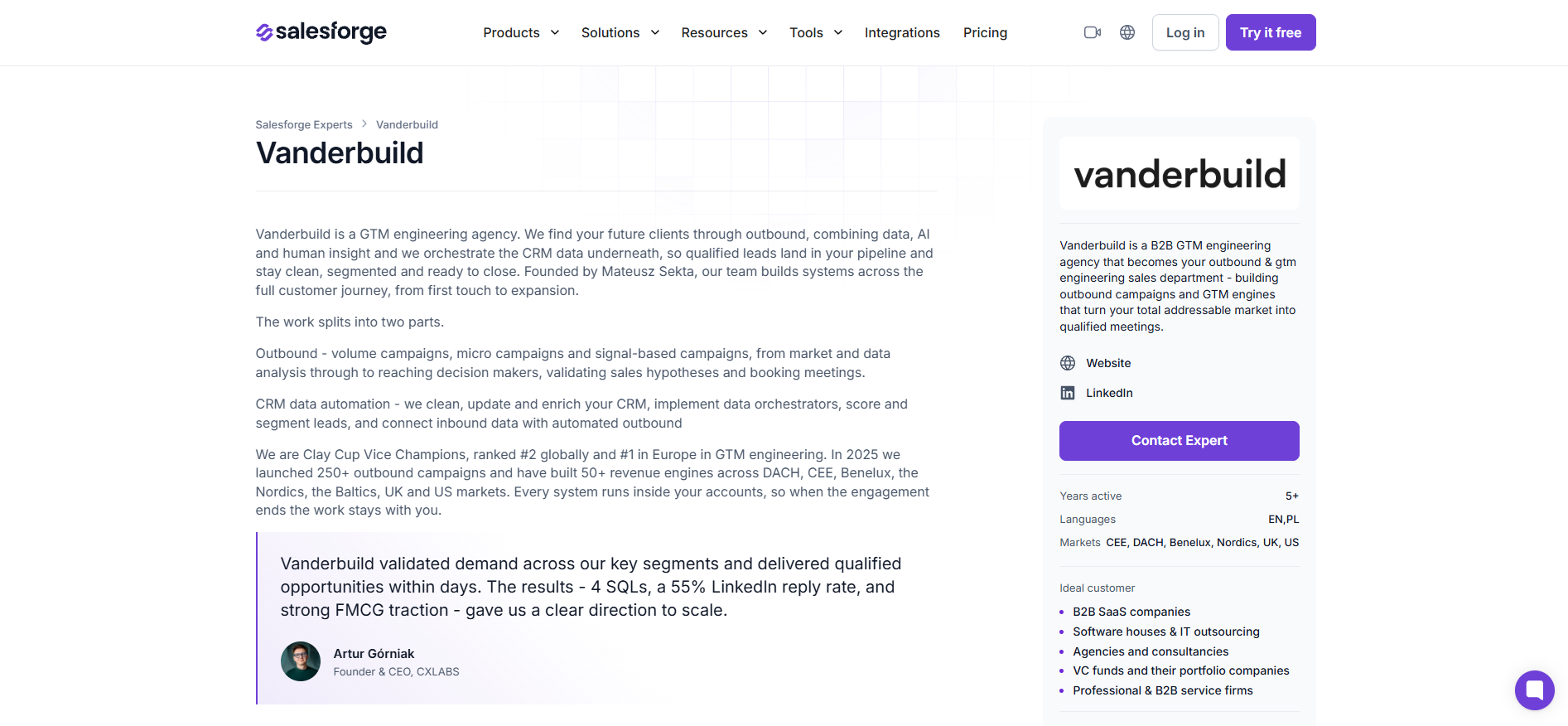
Vanderbuild is a B2B GTM engineering agency that essentially becomes your outbound and GTM engineering sales department. Where Ceres builds the RevOps foundation, Vanderbuild fills the pipeline that sits on top of it. So if your bottleneck is actually "we need meetings on the calendar" and not "we need clean CRM data," Vanderbuild is the direct answer.
Best for: English-first B2B teams ($5M to $50M ARR) wanting the same AI-powered revenue infrastructure DNA Ceres offers, but outside francophone markets.
Forge rating: 5/5
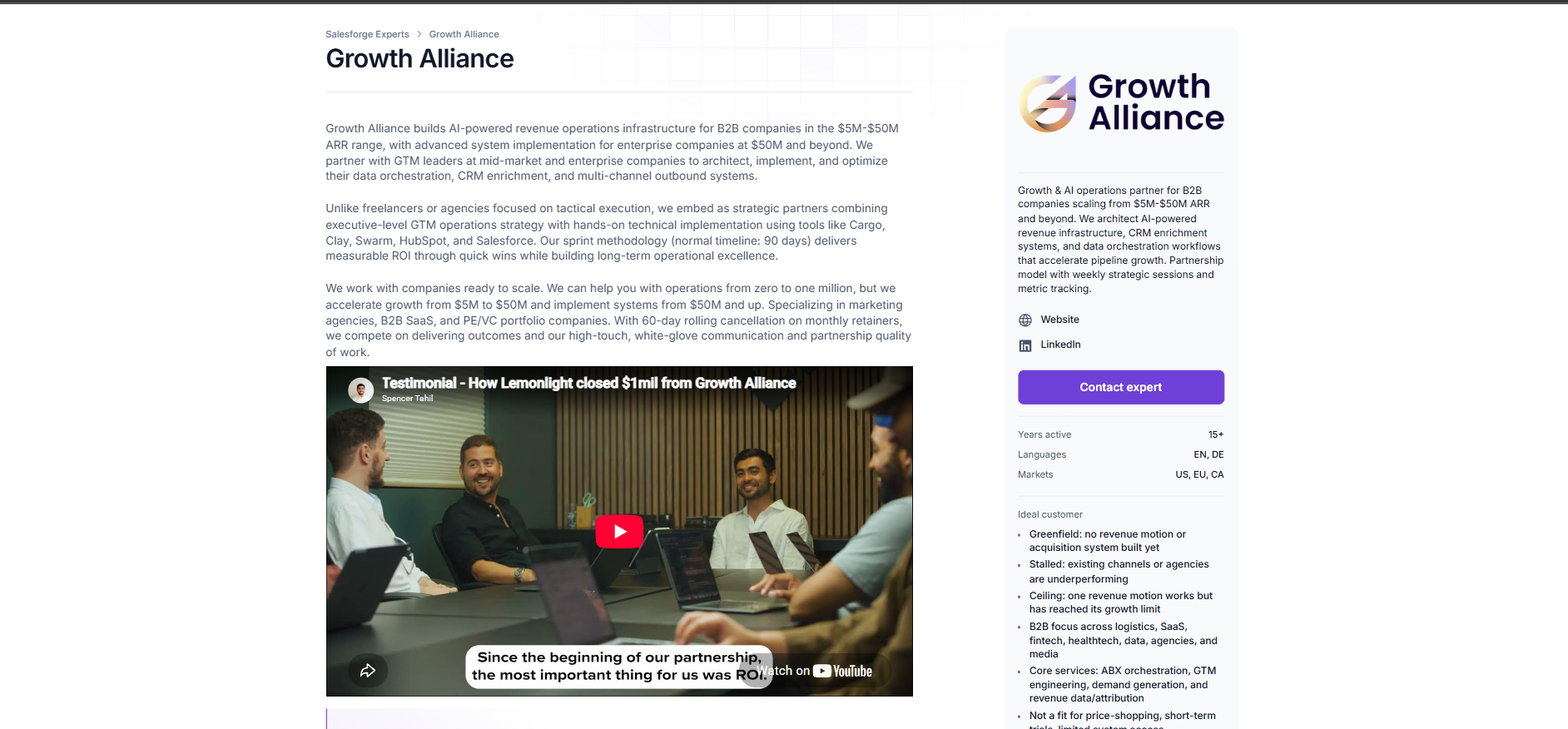
Growth Alliance architects AI-powered revenue infrastructure, CRM enrichment systems, and data orchestration workflows. The service DNA is genuinely closest to Ceres among any Forge Expert I've looked at. The difference is delivery is English-first and the ICP is US and international scale-ups. So if you like the Ceres model but need it outside francophone markets, this is the shortlist parallel.
Best for: Teams wanting Clay-native outbound systems with a genuine independence path.
Forge rating: 5/5
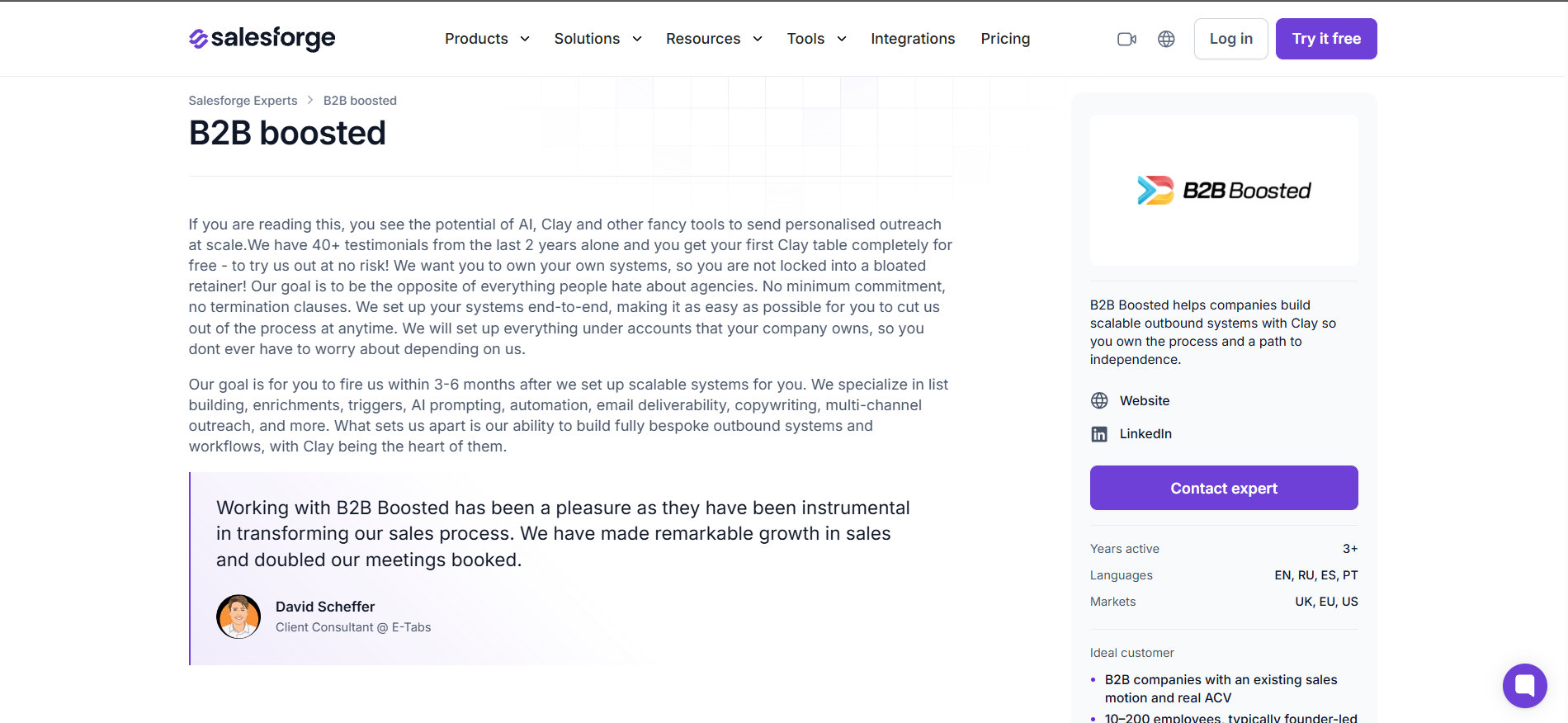
B2B Boosted builds scalable outbound systems on Clay so you own the process, with a clear path to running it yourself. Ceres is a Clay partner too, so the underlying tooling DNA is similar. The difference is B2B Boosted is outbound-execution-first, and they'll hand the system back to you when it's running.
Beyond agencies, there are two routes that skip the outsourced model entirely.
For outbound execution in-house, Salesforge is the all-in-one outbound stack (email + LinkedIn, unlimited mailboxes and senders) starting at $48 per month. No per-seat pricing, and native HubSpot and Salesforce integrations so all the outbound activity syncs back into whatever CRM you already run.
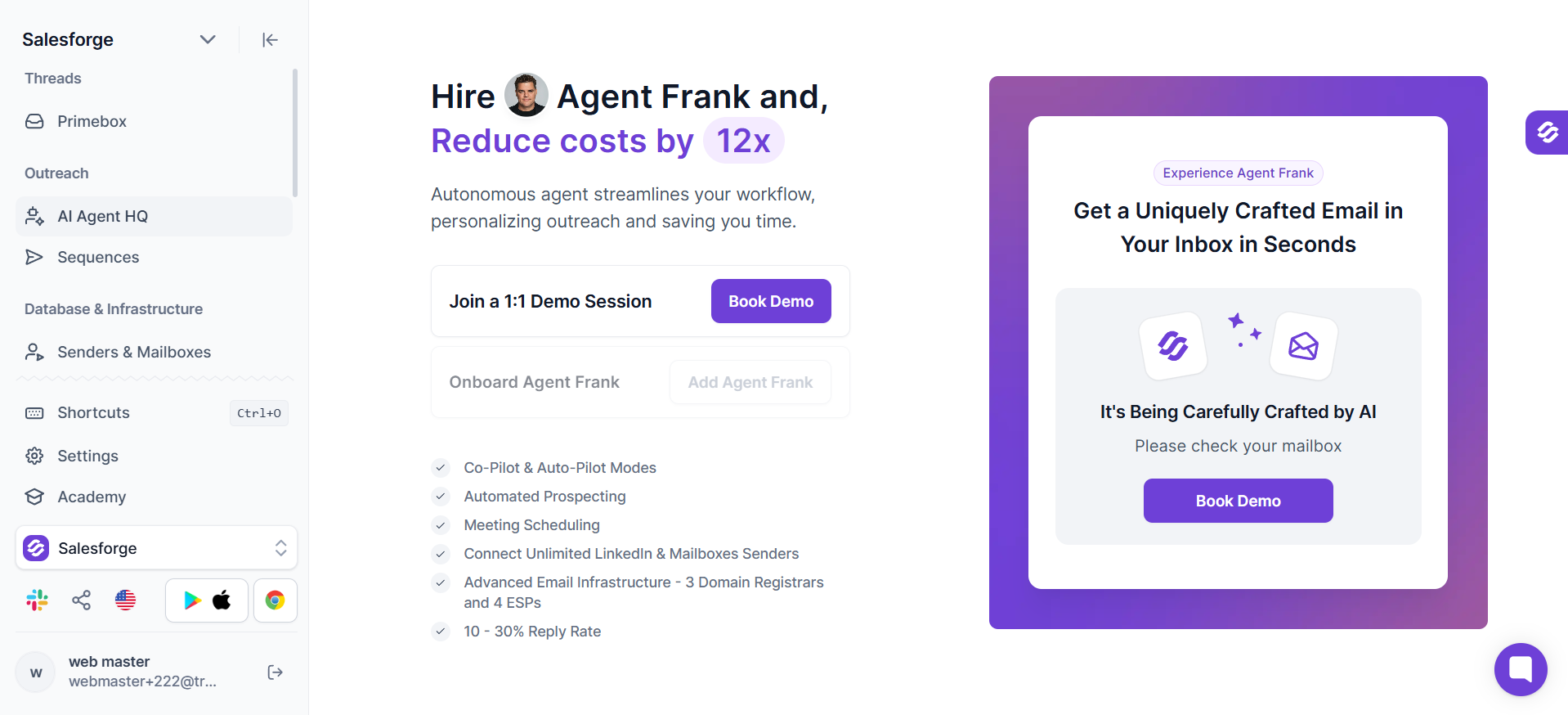
For a fully autonomous SDR, Agent Frank is the AI SDR that prospects, writes, sends, and books meetings on your behalf. He runs Auto-Pilot or Co-Pilot, and starts at $499 per month billed quarterly. He's faster to activate than an agency retainer, no ramp-up billing, and he doesn't cost more when you send more.
Whichever direction you're leaning, take these ten questions into your discovery call. Their answers will tell you more than any review, including this one.
Pulling it all together.
Ceres is a defensible yes if you're a French or francophone B2B team on HubSpot with a defined bottleneck that maps to one of the four tiers, and you can reconcile the client-count and address inconsistencies on the discovery call. The pricing transparency alone puts them ahead of most of the category, and the case study depth on complex migrations like TotalEnergies and HiPay is real.
The one caveat: nail down the entity structure, the AI agent portability, and the scope-creep clause in writing before signing anything. The pricing transparency doesn't yet extend to those specifics, and they're where friction tends to show up post-signing.
If you need outbound execution, English-first delivery, or Salesforce-native depth, compare certified alternatives in the Forge Expert Network that already publish those terms.
Yes. Ceres operates under the legal entity Ceres Growth Marketing, based at 128 rue La Boëtie, 75008 Paris (per the legal notice). Co-founded by Guillaume Delachet and Simon Toussaint, with Bruno Teixeira as Partner and Stéphane Morel as COO. The team is 15+ senior specialists (no juniors, per the site). Named clients include TotalEnergies, Alan, Spendesk, Payfit, Manpower, Dougs, Iroko, Ringover, and HiPay. Independent reviews are limited to 3 on Sortlist, all 5/5.
Ceres publishes full tier pricing on ceres.agency/tarifs. Diagnostic from €2,500. Fondation Data from €5,000. Déploiement IA from €3,000 (additional agents €2,000 to €4,000). Accompagnement retainer from €2,000 per month. Combo packages: Starter from €6,500, Growth from €9,000, Scale on custom quote. Installment payments are accepted on any project over €5,000.
There is no money-back or performance guarantee published. The only published commitments are "no hidden fees" (quoted price is final), 30 days of post-delivery support included after every project, and 30-day cancellation notice on the retainer. If you follow the Diagnostic with a larger project within 30 days, the diagnostic fee is credited to that project.
Ceres builds AI agents using Anthropic's Claude models connected to your CRM (usually HubSpot) via MCP servers. Reported use cases include lead qualification, call summaries, contact enrichment, anomaly detection, and predictive churn alerts. The Beedeez and Iroko case studies are the flagship references for this work. Confirm agent ownership and portability terms in your SOW.
Guillaume Delachet is co-founder of Ceres and the site's "Directeur de la publication." His background is ex-Growth at B2B scale-ups, with hands-on expertise in HubSpot, Clay, and Claude. He's the direct contact email owner ([email protected], per the legal notice) and appears to remain involved in accounts. Simon Toussaint co-founded the agency alongside him, with a Sales and Revenue Operations background.
Ceres is a RevOps and AI infrastructure agency (CRM audit, data cleanup, workflow build, AI agents). The Kiln is a GTM engineering agency that overlaps on RevOps but also runs outbound automation and enrichment end-to-end. Cold Email Hackers sits fully on the outbound execution side, running cold email campaigns for you. Ceres builds the CRM and data foundation. The other two run activity on top of it.
The three certified Forge Expert alternatives worth comparing are Vanderbuild (outbound execution gap), Growth Alliance (English-first AI revenue infrastructure), and B2B Boosted (Clay-native outbound with independence path). For teams skipping the agency route entirely, Salesforge at $48/mo runs outbound in-house, and Agent Frank at $499/mo billed quarterly is the AI SDR alternative. For a broader agency shortlist, see the lead generation tools rundown.

.jpg)
.jpg)