If you have been comparing email verifiers, MillionVerifier has almost certainly shown up in your search. It keeps appearing in cheapest-verifier roundups, and the pricing genuinely is lower than most of the market.
But cheap verification only helps if the results are right. A list that comes back clean and still bounces at six percent costs you far more than the forty dollars you saved.
So I went through MillionVerifier's pricing page, its API documentation, its catch-all page, and several years of reviews across G2, Capterra and Trustpilot. I wanted to answer three questions before recommending it to anyone running B2B outbound.
The first was what it actually costs at real sending volume. The second was whether the accuracy claim holds up in user reports. And the third was how it handles catch-all domains, because catch-alls are everywhere in B2B data.
Here is what I found, including one change from last week that you should know about before you buy.
Pay as you go only, no monthly subscription anywhere on the site
Starting price
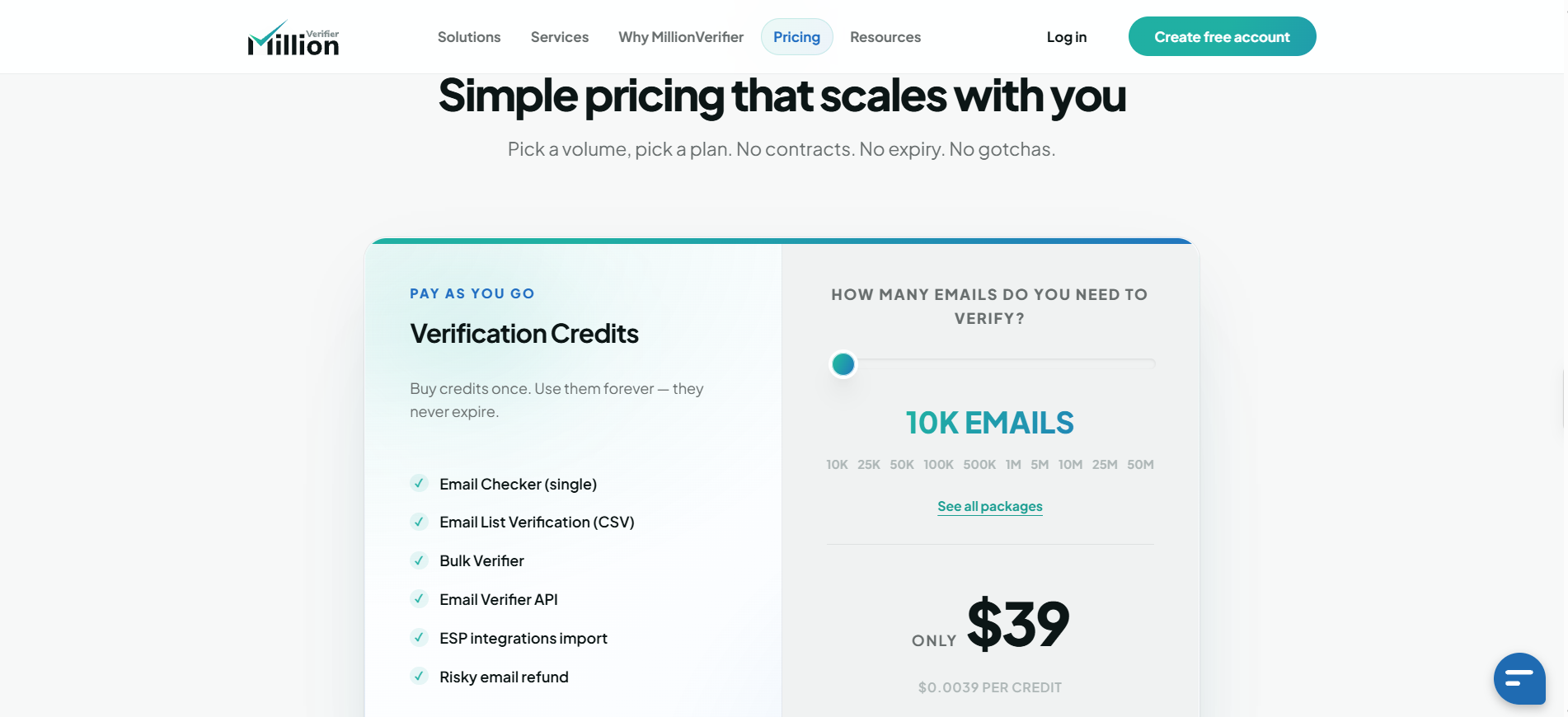
$39 for 10,000 credits, which works out to $0.0039 per email
Credit expiry
Credits never expire, so unused balance carries over indefinitely
Accuracy claim
99%+ accuracy, self reported, with no independent test backing it
Catch-all handling
Built-in resolution that claims to settle 30% to 40% of catch-alls
What you are not charged for
Unknown results and unresolved catch-all emails
G2 rating
4.2 out of 5
Capterra rating
4.4 out of 5
Trustpilot rating
4.2 out of 5
Biggest recurring complaint
Catch-all accuracy, especially on Yahoo domains
Best for
High-volume senders who want the lowest cost per verified email
Weakest for
B2B agencies whose lists are heavy with catch-all domains
What Is MillionVerifier?
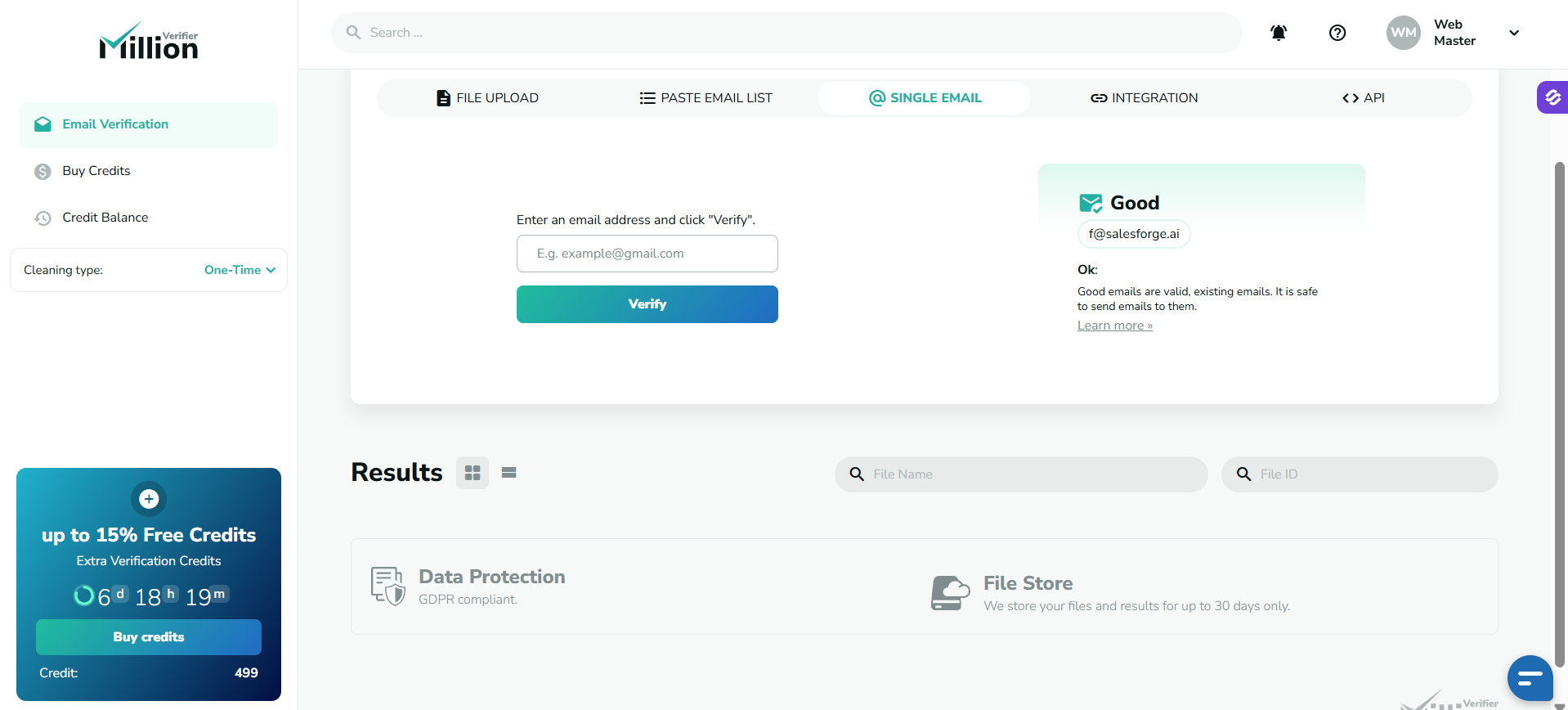
MillionVerifier is a standalone email verification service that cleans lists before you send to them. You upload a file, it checks every address, and it returns a sorted list of valid, invalid, risky and unknown contacts.
So before you compare tools, work out which of those four you are in. It decides whether price or catch-all accuracy should lead your decision, and I have broken the wider category down in this comparison of email verification tools.
How MillionVerifier Works
The workflow is deliberately simple, and that simplicity is the main reason reviewers like it.
1. Upload or Paste Your List
MillionVerifier accepts TXT, CSV and XLSX files. You can also paste addresses straight into the browser, and the tool converts them to a CSV behind the scenes.
2. Let the Verification Run
Processing speed is quoted at 2,700 emails per minute on the bulk verifier page. The same page states that a million emails can clear in roughly six hours.
3. Download the Sorted Results
Results come back split by category, so valid addresses sit in one column and invalid in another. Anything the system could not settle lands in risky or unknown.
4. Pay Only for What It Could Resolve
You are not charged for unknown results, and you are not charged for catch-all addresses the system fails to resolve.
That last rule is uncommon in this category, and it changes your real cost per usable email more than the headline price does.
The Complete Breakdown of MillionVerifier Features
The feature set is narrow on purpose. This is a verification tool rather than an outbound platform, so there is no sequencing, no mailbox management and no warmup attached.
Here is what you actually get.
1. MillionVerifier Bulk List Verification
Bulk cleaning is the core product, and it is what most reviewers are buying.
Accepts TXT, CSV and XLSX files
Copy-paste option that converts pasted addresses into a CSV automatically
Stated speed of 2,700 emails per minute
Claimed throughput of one million emails in around six hours
Maximum list size is not published anywhere on the site
That last gap matters if you process lists in the millions, so confirm the ceiling with support before buying credits.
2. MillionVerifier Catch-All Resolution
This feature decides whether MillionVerifier fits B2B outbound, so it deserves the most attention.
Catch-all servers accept mail for any address, valid or not, which means a standard verifier cannot confirm whether the inbox is real. Most tools mark them risky and leave the decision to you.
MillionVerifier runs a resolution step instead, and here is what it claims:
Resolves 30% to 40% of catch-all addresses into a definite valid or invalid result
Places resolved addresses directly into your standard download columns
Costs one standard credit, the same as any other email
Marks unresolved catch-alls as risky and charges you nothing for them
Requires no separate tool or add-on purchase
The claim is strong. The reviewer history is where it gets complicated, and I cover that below.
Catch-all domains also carry a deliverability cost that has nothing to do with bounces, which is worth understanding before you decide how to treat them. I explained that in this piece on sender reputation.
3. MillionVerifier Result Categories and Credit Rules
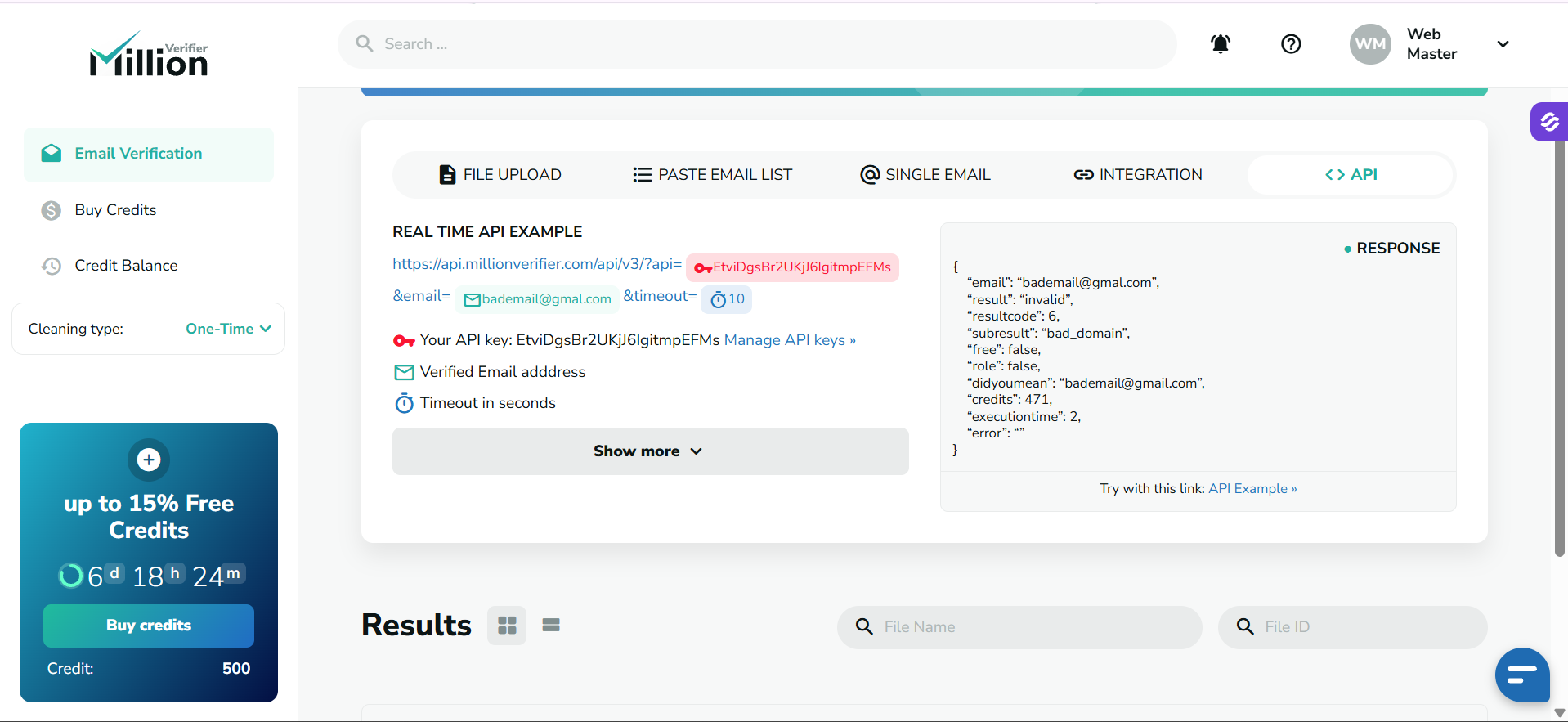
The API returns a result field and a subresult field, and the categories are easy to read side by side.
Result
What It Means
Charged?
OK
Valid address, safe to send
Yes
Catch-All
Accept-all server, resolution attempted
Only if resolved
Disposable
Temporary or throwaway address
Yes
Invalid
Does not exist or will bounce
Yes
Unknown
Could not be determined
No
Free and role come back as flags rather than separate results, so a Gmail address and an info@ address both return OK with a label attached.
The API also returns a didyoumean field that catches typos such as gmal.com and suggests gmail.com. That is a small feature with outsized value, because typo domains are a known trap vector.
4. MillionVerifier API and Developer Access
The API is the one part of this product that technical reviewers praise without qualification.
Single verification endpoint at api.millionverifier.com, using your key and the target email
Optional timeout parameter between two and sixty seconds, defaulting to twenty
Separate bulk upload endpoint for file-based verification
Credits endpoint that returns your remaining balance
Unlimited API keys with IP whitelisting, labels and individual on or off toggles
Documentation in PHP, cURL, Go, Python, Ruby, Java, NodeJS and C#
The missing piece is published rate limits. They do not appear in the public docs, so ask support for the ceiling before you wire real-time verification into a signup form.
EverClean handles ongoing hygiene rather than one-off cleaning, and it runs daily against your connected platform.
Native connections cover fourteen tools:
Mailchimp, Sendinblue, Mailgun, Mailjet and Elastic Email
Campaign Monitor, ActiveCampaign, GetResponse, AWeber and MailerLite
Zoho CRM, HubSpot, Reply and Drip
Notice what is absent. Zapier is not mentioned anywhere on the live site, and the lineup leans toward email marketing platforms rather than cold outreach tools.
If your sending happens inside a dedicated cold email platform, expect to move files by hand.
MillionVerifier Pricing Explained
Pricing is where MillionVerifier wins most of its arguments, so it is worth seeing the full ladder rather than only the entry price.
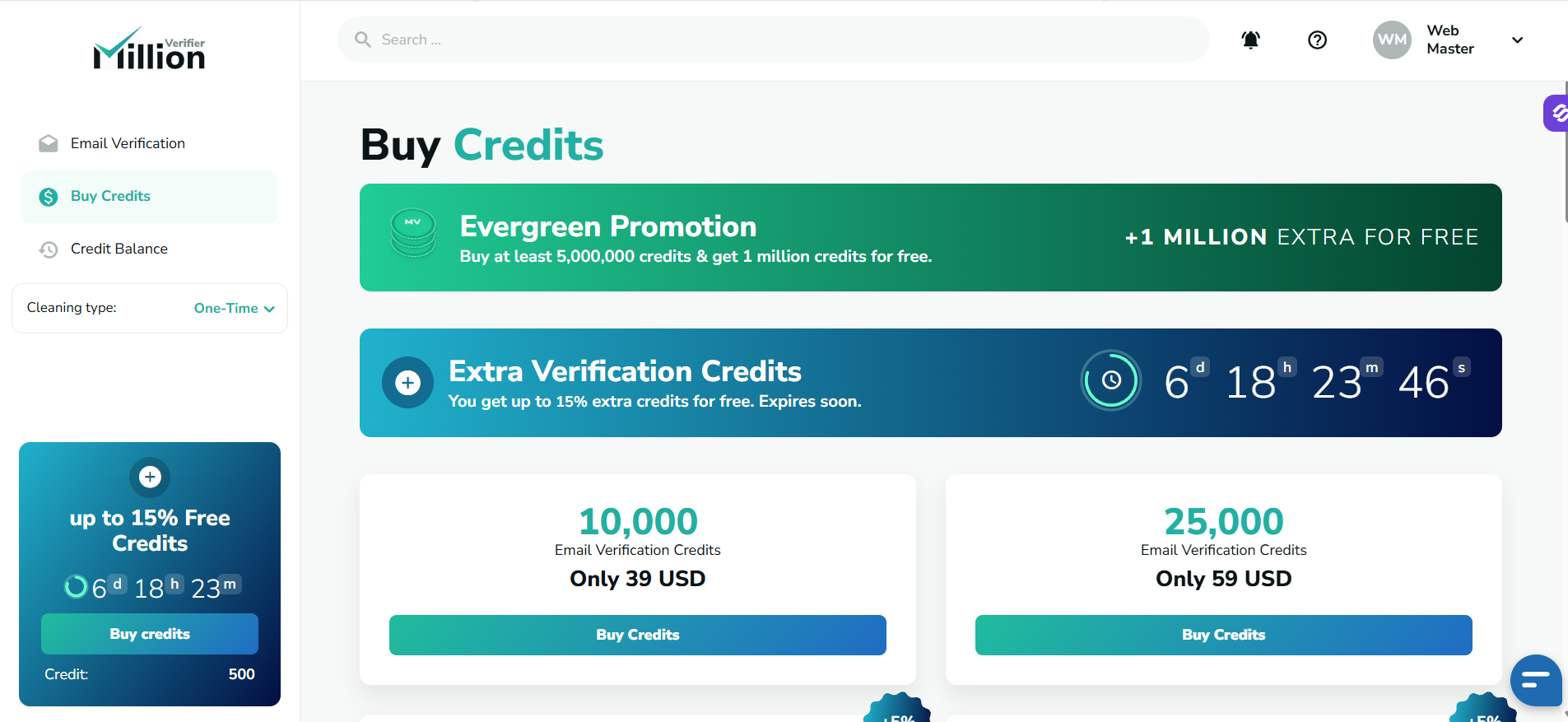
The model is pay as you go, with no subscription, no annual plan and no seat-based tier anywhere on the site. Credits never expire.
The minimum purchase is 10,000 credits at $39, and the site carries a 100% money-back guarantee on risky emails.
Read that guarantee carefully, because the scope is narrower than it first looks. It applies to risky emails rather than to your whole purchase, and no refund time window is published anywhere.
What a Four to Five Person Outbound Team Actually Pays
Headline prices are easy to misread, so here is the real math at normal B2B volume.
Say you verify roughly 50,000 contacts a month across four or five senders.
Buying monthly at the 50,000 tier costs $89 a month, or $1,068 a year
Buying one million credits once costs $449 and covers twenty months at that pace
That brings your effective monthly cost down to around $22
Because credits never expire, there is no downside to buying ahead apart from the upfront outlay. It is the single biggest cost lever in this product, and most buyers miss it.
How MillionVerifier Pricing Compares With Other Verifiers
MillionVerifier comes in at roughly half the entry cost of NeverBounce, Bouncer and Emailable, and a fraction of ZeroBounce at pay-as-you-go rates. All of these drop at volume, so check each pricing page before you commit.
MillionVerifier Reviews and Ratings
Ratings across the three main platforms sit in a tight band.
G2: 4.2 out of 5
Capterra: 4.4 out of 5
Trustpilot: 4.2 out of 5
Capterra's sub-scores are the more revealing number. Ease of use leads at 4.56, while customer service trails at 4.29, and that gap turns out to be the story in the written reviews too.
What Reviewers Like About MillionVerifier
1. The Price Beats Almost Everything Else in the Category
Many reviews across G2, Capterra and Trustpilot said MillionVerifier was the cheapest option they evaluated, and they said it in comparative rather than absolute terms. One cold email user wrote that it was "much cheaper than a lot of the competitors I looked at." Source: G2 review
2. You Are Only Charged for Results It Can Resolve
Several reviewers singled out the billing model rather than the price itself, because unknowns and unresolved catch-alls cost nothing. A small-business founder on G2 noted that "they only charge for valid emails. Credit doesn't run out monthly." Source: G2 review
3. Credits That Never Expire Remove the Monthly Reset Problem
Reviewers who had switched from subscription tools repeatedly mentioned no longer losing unused credits at the end of a billing cycle. A founder on Capterra called it the "best low cost email verification tool on the market for the price." Source: Capterra review
4. The Interface Is Simple Enough to Learn in One Session
Ease of use is MillionVerifier's highest Capterra sub-score at 4.56, and the reviews back that up. One reviewer described it as "the simplest and most efficient tool I've used so far." Source: Capterra review
5. Long-Term Users Keep Renewing Rather Than Switching
Retention signals matter more than any single rating, and several reviewers mentioned multi-year use. One Trustpilot reviewer wrote, "I have been a user for the past 3 years…Best provider so far." Source: Trustpilot review
What Reviewers Complain About in MillionVerifier
1. Catch-All Detection Is the Most Repeated Weakness
This is the single most common complaint, and it comes from independent reviewers with no connection to each other. One Capterra reviewer stated that MillionVerifier has "probably the worst catch-all detection." Source: Capterra review
Worth noting: these complaints cluster in 2022 and 2023, and the catch-all resolution page appears to have been rewritten recently. No independent reviewer has verified the newer engine yet.
2. Yahoo Domains Are Flagged as a Specific Problem
At least two separate Capterra reviewers raised Yahoo addresses independently, and the site does not address this anywhere. One BDR reviewer reported that the catch-all filter "does not work properly and does not work with Yahoo." Source: Capterra review
3. Support Response Times Draw Consistent Criticism
Support is the lowest-scoring category on Capterra, and reviews across platforms describe long silences. One marketing founder said a list sat unprocessed for five days with "nothing from an actual person" in reply. Source: Capterra review
G2's own review summary reflects the same pattern, noting that support can be slow when issues come up.
4. Accuracy Loses Direct Comparisons Against Premium Tools
A smaller group of reviewers tested MillionVerifier against higher-priced verifiers and found the results weaker. One Capterra reviewer who otherwise rated it well said it was "not as accurate as a ZeroBounce or Emailable." Source: Capterra review
5. Two Billing Complaints Remain Unresolved in Public Threads
These are single data points rather than patterns, but both are serious enough to name.
A May 2026 G2 reviewer reported that a five dollar starter pack shown before registration disappeared after signup, replaced by a forty dollar minimum
An earlier G2 reviewer reported being charged $259 four times across two weeks following account inactivity
Trustpilot shows the company responding to 76% of negative reviews, so the support channel is active even when reviewers describe it as slow.
MillionVerifier Limitations to Know Before You Buy
1. The MillionVerifier Accuracy Claim Is Self-Reported
MillionVerifier states 99%+ accuracy across its homepage, bulk verifier page and API page. I found no independent benchmark from 2024 onward that either confirms or contradicts it.
2. MillionVerifier Does Not Document GDPR or Data Retention
No GDPR page, retention policy or certification appeared on the product pages I reviewed. For EU audiences or regulated use cases, check their privacy policy directly before uploading a list.
3. MillionVerifier Free Signup Credits Are Unclear
The site invites you to create a free account, but neither the homepage nor the pricing page states what free includes. An older review referenced daily free searches, though that offer is not visible today.
4. The MillionVerifier Ownership Change Is Days Old
Southern Vector took over from GBD Software as a Service Ltd in October 2026. Support quality was already the weakest scoring category, which makes a transition period harder to ignore.
5. MillionVerifier Offers No Subscription Option
For some teams, pay as you go is the attraction. But if your finance process prefers predictable monthly billing, the credit-pack model will create friction.
Who Should Use MillionVerifier
MillionVerifier Is a Good Fit If
You verify in large batches and want the lowest possible cost per email
Your lists are mostly consumer or mixed domains rather than heavy B2B
You can buy credits ahead and benefit from the no-expiry rule
You want verification inside your own product through a clean, well-documented API
You are comfortable moving files manually between tools
MillionVerifier Is Not the Right Fit If
Your lists are dense with catch-all domains, which is standard in B2B outbound
You need documented GDPR and data retention commitments
You expect fast support when a large run stalls
You want verification connected directly to your sending platform
You need predictable monthly billing rather than credit packs
If your list comes back forty percent risky, the low price stops being the deciding factor. What you have then is a data quality problem, and it shows up immediately in your cold email metrics.
The Best MillionVerifier Alternative for Cold Email Teams
If verification is a standalone job for you, MillionVerifier does that job cheaply and you can stop reading here.
But most people looking for a verifier do not actually want a verifier. They are trying to fix a bounce rate, and verification is only one of several things that decides whether those emails land.
That is where Salesforge changes the calculation. Verification runs inside the same platform that sends your sequences, so there is no exporting, no re-importing and no second subscription to manage.
Here is what sits around it:
A free email verifier that runs eight checks per address and scores it from 0 to 100
Bulk verification on the same engine inside paid plans, feeding straight into campaigns
Unlimited mailboxes with no per-seat pricing
Warmup and deliverability monitoring through Warmforge
Primebox™ as a single inbox for replies across email and LinkedIn
Agent Frank as an AI SDR if you want prospecting and follow-up handled for you
Plans start at $48 a month, and the free verifier costs nothing to try.
So the honest framing is this. MillionVerifier is the cheaper line item, while Salesforge is the cheaper outcome, because one tool covers verification, sending, warmup and reply management instead of three.
MillionVerifier is worth it if you want the lowest cost per verified email available and your lists are not dominated by catch-all domains. The never-expiring credits, the no-charge rule on unknowns and the API quality are real advantages that reviewers confirm across several years.
It is not worth it if you run B2B outbound at scale and need catch-all resolution you can trust. The complaint history there is too consistent to wave away, even though the newer engine may well have fixed it.
I would also hold off on a large credit pack for now. The ownership change is a week old, support was already the weakest scoring category, and big pay-as-you-go balances are hard to walk away from.
If you want verification that lives next to your sending, warmup and reply management instead of beside it, try Salesforge free and compare both on the same list.
MillionVerifier claims 99%+ accuracy on its homepage, API page and catch-all page. That figure is self-reported, and no independent benchmark was available to confirm it. Several reviewers rate accuracy well, while others compare it unfavourably against ZeroBounce and Emailable on catch-all and Yahoo addresses.
How much does MillionVerifier cost?
MillionVerifier starts at $39 for 10,000 credits, which is $0.0039 per email. Prices fall steeply at volume, reaching $449 for one million credits and $2,599 for ten million. There is no subscription option, only pay as you go, and credits never expire.
Do MillionVerifier credits expire?
No. Credits never expire, which is stated on both the homepage and the pricing page. That makes buying a larger pack ahead of time the cheapest way to use the product, since one million credits cost roughly a tenth per email of the entry tier.
Does MillionVerifier handle catch-all emails?
Yes. It runs built-in catch-all resolution that claims to settle 30% to 40% of catch-all addresses into valid or invalid, and unresolved ones cost you nothing. Reviewers in 2022 and 2023 criticised catch-all accuracy heavily, though those complaints predate the current engine.
What is the MillionVerifier money-back guarantee?
MillionVerifier advertises a 100% money-back guarantee, but it applies to risky emails rather than every purchase. No refund time window is published on the site, so confirm the exact terms with support before buying a large credit pack.
Does MillionVerifier integrate with cold email tools?
Its EverClean automated cleaning connects to fourteen platforms including Mailchimp, HubSpot, ActiveCampaign, Zoho CRM and GetResponse. Most are email marketing platforms rather than cold outreach tools, and Zapier is not listed, so cold email teams usually move files manually.
What is the best MillionVerifier alternative?
Salesforge is the strongest alternative for cold email teams, because verification sits inside the same platform that handles sending, warmup and replies. The free Salesforge email verifier scores addresses from 0 to 100 across eight checks, and bulk verification runs on the same engine inside paid plans.
Book more meetings on autopilot
Set up in minutes. No per-seat pricing. No commitment.