
Personalized Outbound Strategy
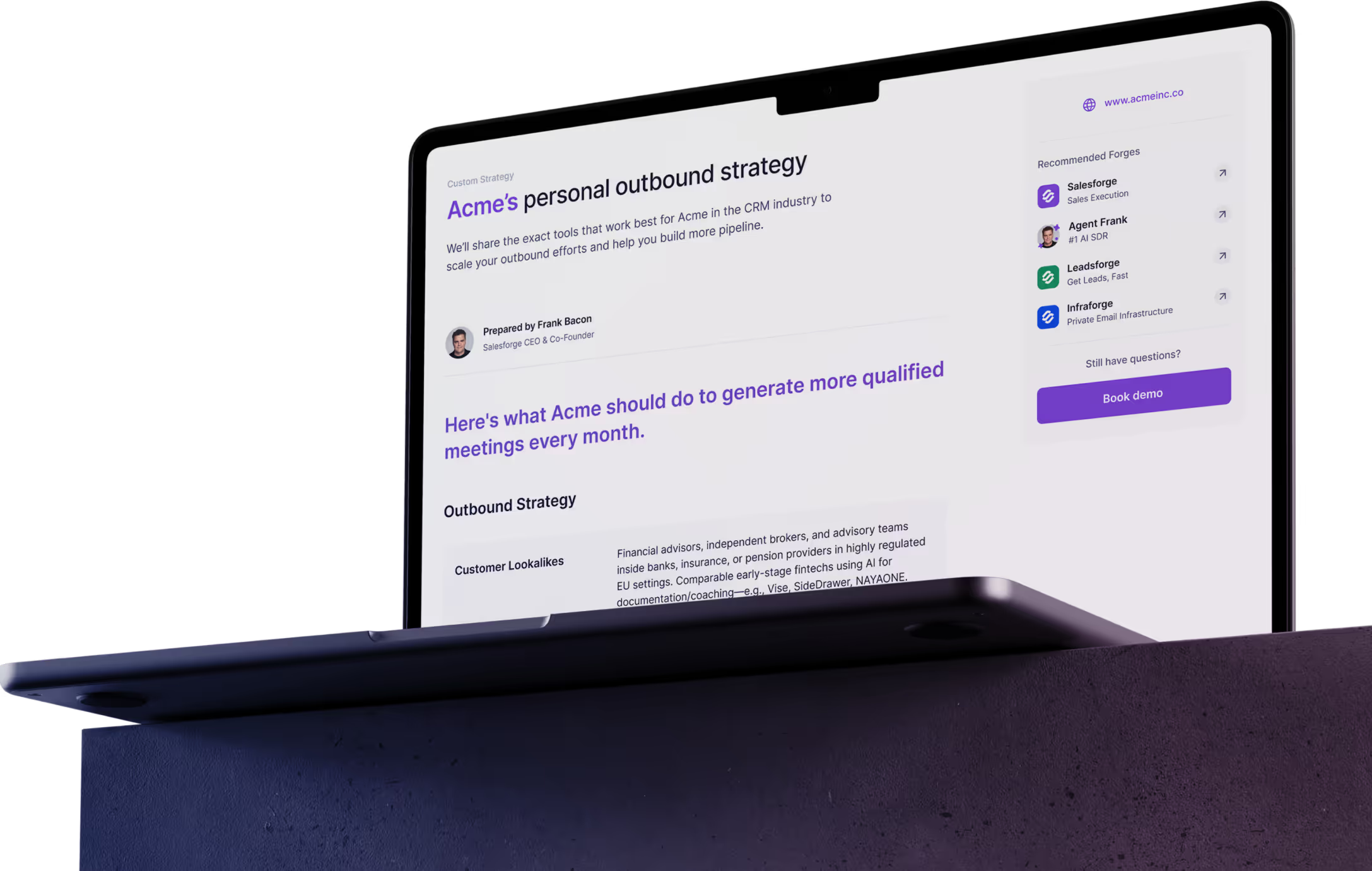
Get The Right Outbound Strategy In Minutes
Enter your email to get a custom plan & stack recommendation for your business
It's being carefully crafted by AI
Please check your mailbox in 5 minutes
Your buyer might not be on LinkedIn.
Most outbound agencies can't solve that, and I've never seen one raise it before a contract gets signed. They build your list from Sales Navigator, and whoever isn't in there simply doesn't get contacted.
I think about the procurement lead at a 2,000-person contractor who has bought software for fifteen years and has forty connections. Or the plant manager who has never posted anything. They hold real budget. They're invisible to the tool your agency depends on.
CairnShift built something for this. They search company websites, forums, blogs and news to find people missing from LinkedIn-first data, and they call it Ghost Profile discovery. Looking at who they work with makes the reason obvious: Dutch engineering, construction, deep-tech and legal firms.
What I couldn't get comfortable with is everything around it. No published pricing. No reviews on any platform I checked. Four case studies, and not one quotes a client by name.
So I spent a while working out whether the method is good enough to justify signing up with that little information. That's what this review covers.
Here’s the short version, so you can decide whether the full review is worth your time.
Nothing. That’s the honest answer.
I searched for CairnShift on G2, Clutch, and Trustpilot but couldn’t find a profile on any of them. Their website doesn’t feature testimonials, and none of their four case studies includes a client quote or names the person involved.
In other words, there’s no public customer feedback. No one talks about what it’s like to work with the team, how well they communicate, or whether they would hire CairnShift again.
That’s worth considering. Most agencies of this size publish at least a few client quotes. CairnShift names four clients but doesn’t let any of them speak for the experience.
Hire CairnShift if your buyers aren’t on LinkedIn and you haven’t built a repeatable sales process yet.

First, their Ghost Profile discovery searches company websites, forums, and news sources for people missing from LinkedIn-first datasets. Most agencies rely heavily on Sales Navigator, which can render much of the industrial and deep-tech market invisible.
Second, they help run your discovery calls instead of simply handing you a playbook. At naext.ai, this led to interview-style conversations with board members that deliberately had no commercial objective. Few agencies would recommend a call that isn’t designed to close a deal.
My verdict is yes, but only if you fit the profile and speak with references first. Ask for two clients you can call, and find out what phase three will cost.
If your buyers are easy to find on LinkedIn, or you need stronger proof before committing to six months, consider one of the other agencies reviewed here.
I have no relationship with CairnShift, so this review is based entirely on desk research. I approached it in three ways.
I reviewed the four-phase journey, the engine breakdown, and their positioning to understand what genuinely sets them apart from a typical GTM agency.
With so little independent evidence available, the method needs to do more of the convincing.
I started with each client’s situation before CairnShift arrived, as that reveals more about who the service is suited for than the final result.
I then checked every reported outcome for a baseline, timeframe, and measurable result. Only one of the four included all three.
G2, Clutch, Trustpilot, public pricing, testimonials, and even one named client quote. I found none of them. Those gaps shaped this review just as much as the information on CairnShift’s website.
One caveat applies throughout. Whenever I say CairnShift “reports” something, the claim comes directly from its own website. I found no independent source to verify it.
CairnShift doesn’t offer a menu of services. From what I found, they follow one sequence, and you buy it in phases.
Four engines support the process: Knowledge, Content, Activation, and Revenue. Every email and call-prep workflow draws from the Knowledge Engine, which explains why they believe month six outperforms month two.
Six months, four phases. The order stood out most: nothing gets sent until month two.
That’s deliberate, but expensive. You’re paying for a full month of research before the first email goes out. Most agencie’s sales automation systems I review start sending by week two and refine their targeting as they go.
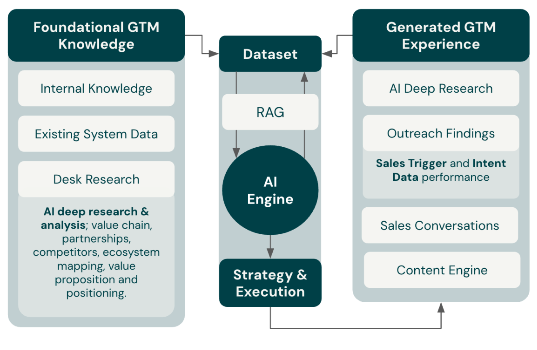
This phase covers research, your ICP, positioning, and rewriting your assets to match. For Mourik, that meant mapping target companies and personas by geography, which required input from people inside the business.
Before signing, ask how many hours your team will need to contribute. That cost won’t appear on the invoice.
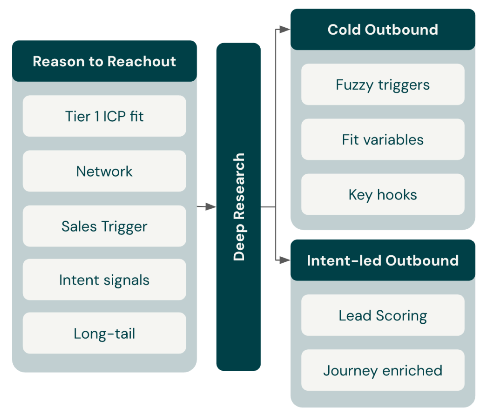
Outreach begins here. One detail I’d want included in the agreement: Mourik tested its messaging with friendly customers before scaling it.
That’s the cheapest way to catch weak messaging early, but it’s also the kind of step agencies quietly skip when deadlines get tight.
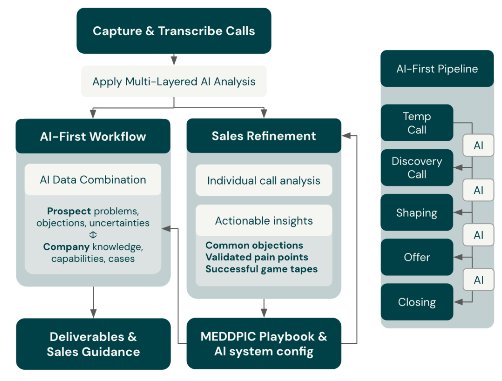
CairnShift joins your first discovery calls and documents what works. This separates them from a list-building agency. It’s also where Eleads saw its clearest result, reducing discovery calls from 45 minutes to 15.
That was a process improvement, not a pipeline result. If your problem is conversion rather than lead volume, this is the phase you’re paying for.
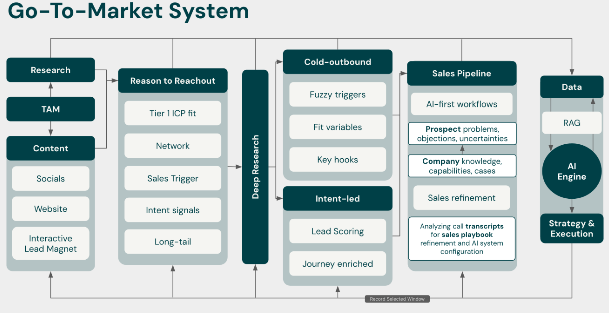
CairnShift analyzes unit economics and wins and losses, then updates your positioning based on what prospects actually say during calls.
This is the point I’d consider most carefully: the promised compounding begins in month six. Evaluate CairnShift after three months, and you’re judging the setup rather than the full product.
I couldn’t find pricing anywhere. Not on CairnShift’s website, in its case studies, or through a partner directory. There’s no price range, engagement model, or minimum commitment.
That makes CairnShift the least transparent agency I’ve reviewed in this series. It matters even more because of how the offer is structured.
The four phases run across six months, and the RevOps phase, which supports the entire compounding argument, doesn’t begin until month six.
So you’re not simply paying a monthly fee you can walk away from. You’re committing to six months before reaching the part they’re really selling.
Based on CairnShift’s published work, it could be a strong fit if:
Skip CairnShift, or compare alternatives carefully, if:
Their site features four named-client case studies. All figures below come directly from CairnShift:
Eleads is the only result I can properly examine: 24 to 48 over six months, with a clear starting point and outcome. That’s meaningful.
The other three become less convincing under scrutiny. Mourik reports 20 meetings but gives no baseline or timeframe, even though in-person meetings with a €749 million contractor are more valuable than 20 booked calls.
Blits.ai reports conversations, not outcomes. And naext.ai’s “identified key GTM partner” describes a single event rather than a repeatable system.
The range of clients is more revealing than the results. Mourik is a 2,100-person engineering company founded in 1933, while naext.ai is a deep-tech startup prioritizing development.
Applying the same method at such different scales suggests the process adapts well to client size.
Six months and no published pricing rules CairnShift out for a lot of teams before the first call.
The Forge Expert Network lists agencies certified on the Forge ecosystem, with the stack and channels disclosed on each profile.
I picked these three because they solve the same problem, a GTM motion that isn't producing pipeline, with more of the terms published upfront.
Best for: Founders who want the systems fixed alongside the strategy.
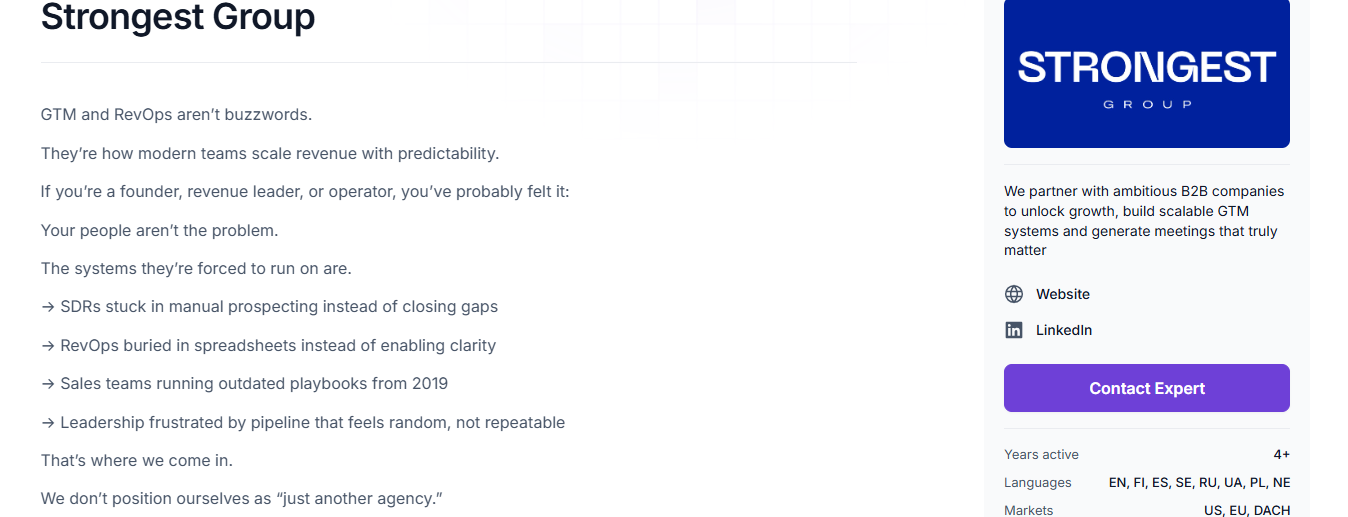
Strongest Group embeds across GTM strategy, Clay-powered outbound workflows, RevOps infrastructure and sales enablement.
Their framing matches CairnShift's closely. The people aren't the bottleneck, the systems they run on are.
The difference is where they start. CairnShift spends month one on research before anything ships.
Best for: Companies between $5M and $50M ARR that want exit terms in writing.
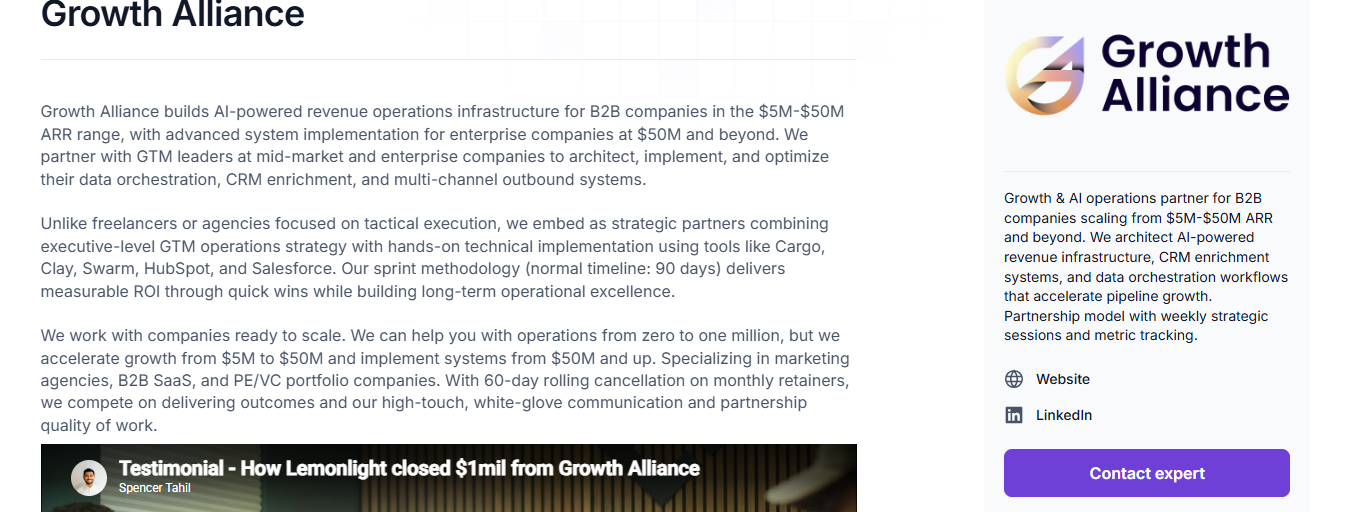
Growth Alliance builds RevOps infrastructure covering data orchestration, CRM enrichment and multichannel outbound, using Cargo, Clay, Swarm, HubSpot and Salesforce.
They run 90 day sprints and state 60-day rolling cancellation.
That's the comparison to make. CairnShift's compounding phase starts at month six, and they publish nothing about how you exit.
Best for: Technical verticals that want signal timing rather than volume.
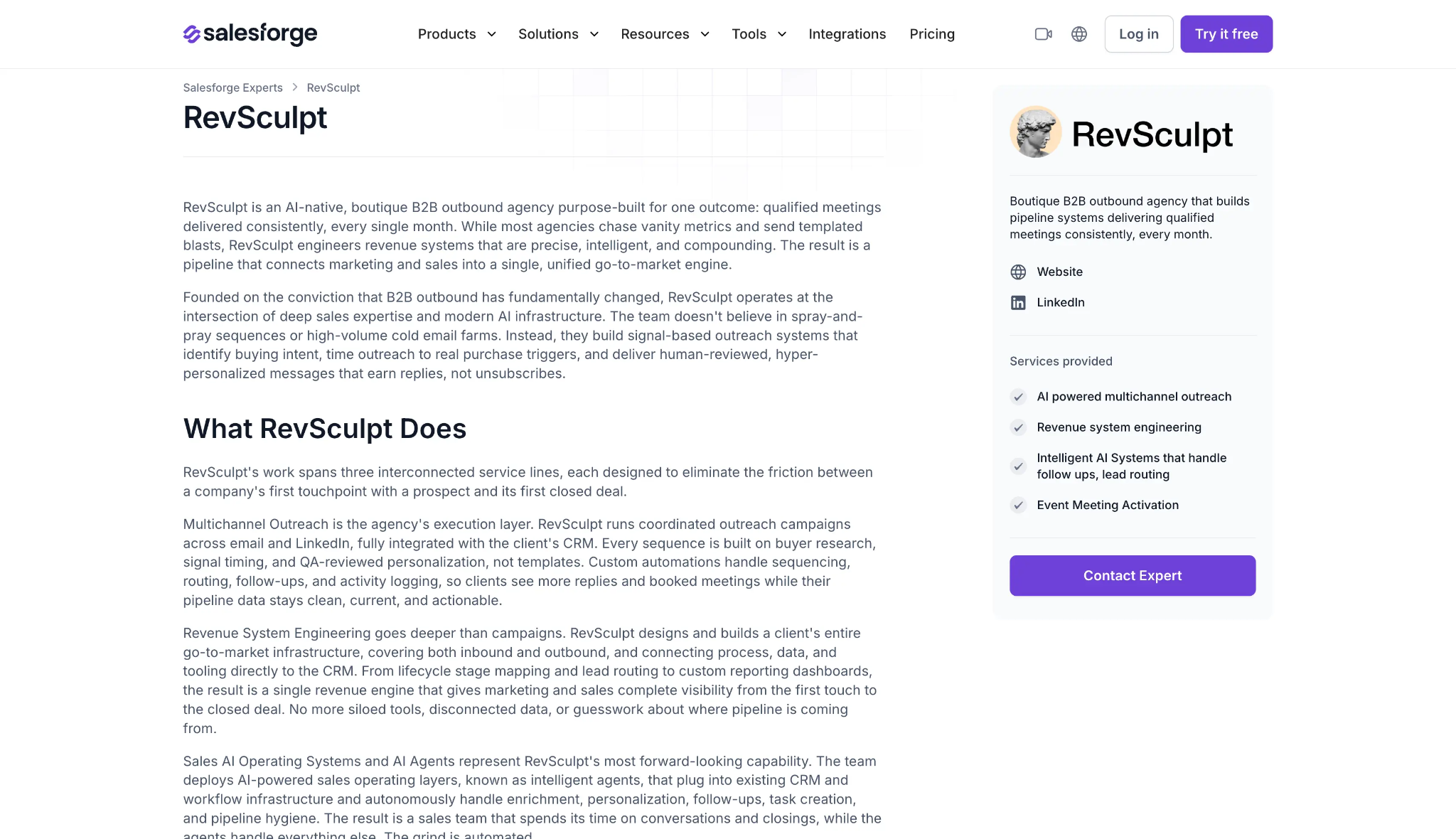
RevSculp runs signal-based outreach across email and LinkedIn, timed to funding news and regulatory triggers, with every message reviewed before it sends.
Their profile reports over 6,000 meetings across 15+ verticals and a 14x return on outbound spend for one client.
Self-reported, but countable, which is more than three of CairnShift's four case studies offer.
Bring these questions to the first call:
Enter your email to get a custom plan & stack recommendation for your business
Please check your mailbox in 5 minutes
I’d sign for the Ghost Profile capability alone if my buyers were genuinely difficult to reach. Nothing else I’ve reviewed in this series solves that problem.
What I wouldn’t do is sign without more evidence. There’s no pricing, no reviews, no named client feedback, and the part at the heart of the offer doesn’t begin until month six. That’s a lot to take on trust.
My answer is conditional. Speak with two references, get phase-by-phase pricing in writing, and decide only after both happen.
If they don’t, the agencies in the Forge Expert Network publish their terms upfront.
.jpg)

.jpg)

.jpg)