Started as an SDR. Grinded my way to SVP of Sales at Whatagraph, where I was running a 50+ person sales team hitting hundreds of meetings a month.
For most of that journey, Apollo.io was part of the stack. So was ZoomInfo. Lusha. Outreach. About a dozen other tools that promised to fix pipeline and mostly just added to the bill.
Here's what I learned after 10 years:
Most sales teams don't have a tool problem. They have a data and workflow problem that tools keep promising to fix and keep failing at.
Apollo is the clearest example. Credits expire every billing cycle. Exported contacts bounce at rates Apollo doesn't advertise. The filters that matter (intent signals, website visitor tracking, technographics) are locked behind the $119 per user Organization tier.
That's why I started Salesforge and built Leadsforge as part of the Forge stack.
But this article isn't a pitch. It's a breakdown.
I evaluated 9 Apollo.io alternatives on data accuracy, deliverability, pricing, and real workflow fit.
Full disclosure: Leadsforge is on the list. I'll also tell you where every other tool genuinely wins.
Here are my top 3 picks if you want the answer right away:
Leadsforge — My top pick if you want an AI-powered search engine for leads. 500M+ verified contacts, waterfall data enrichment across multiple sources, and a chat-based ICP search that replaces Apollo’s clunky filter UI. Best apollo.io alternative for teams that want accurate contact data without wrestling with dashboards, plus advanced features and advanced analytics capabilities for sales teams.
ZoomInfo — Best for enterprise sales and marketing teams that need the deepest US firmographics, buyer intent data, and website visitor tracking. Worth it if your budget starts at $15K per year and you're selling into Fortune 1000 accounts.
Cognism — Best for EMEA-focused teams running phone-heavy outbound. Phone verified mobile numbers via Diamond Data, GDPR compliance with DNC screening across 13 countries, and Bombora intent data on the Elevate plan.
Keep scrolling for the comparison table and full breakdown of all 9 Apollo.io alternatives I tested.
Best for: Sales and marketing teams who want to describe their ideal customer in plain English and get a verified lead list back in seconds, without wrestling with filter dashboards or stitching together multiple data sources.
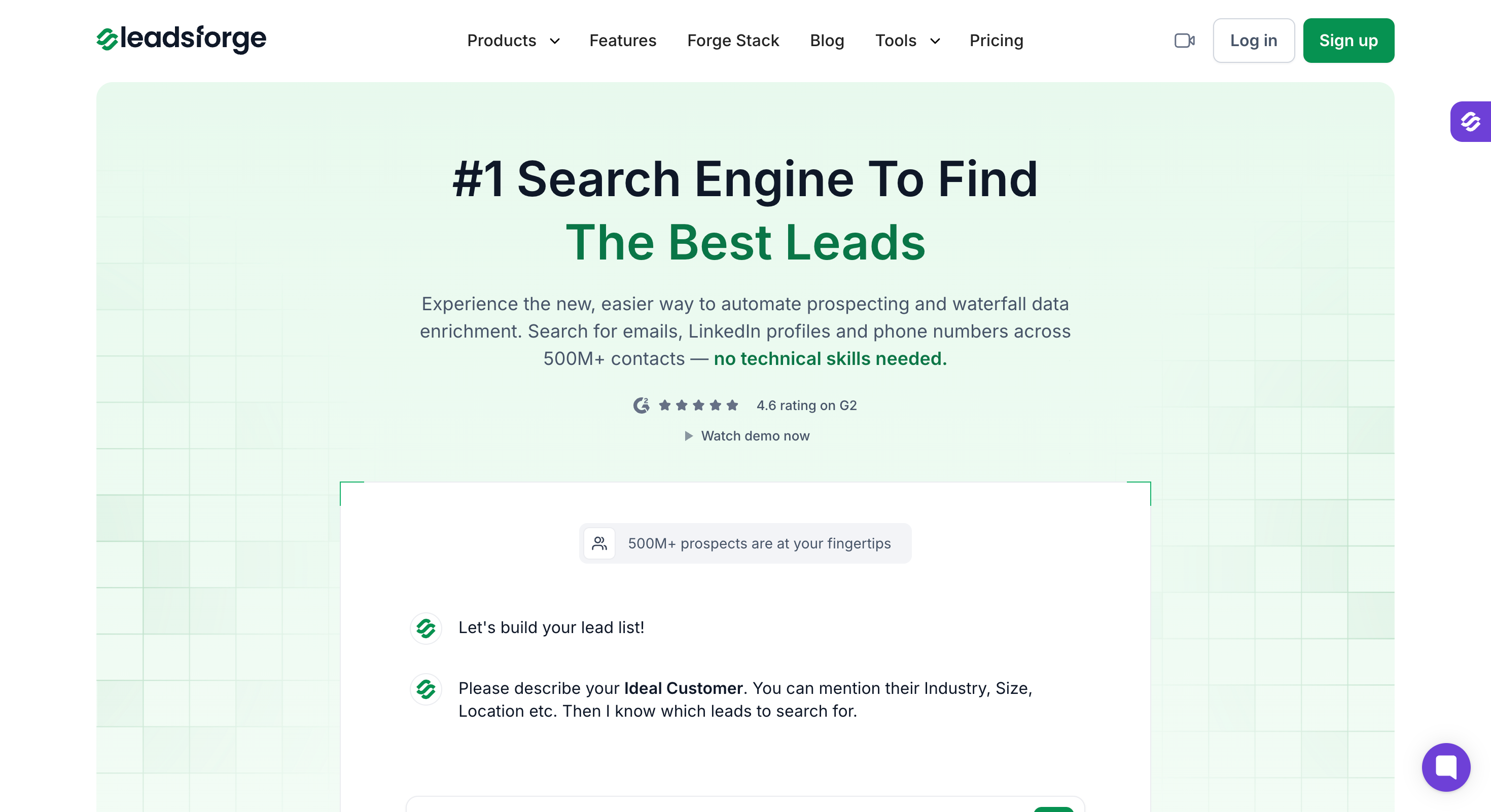
Leadsforge homepage
Leadsforge takes a different approach to prospecting than almost every other tool on this list.
Instead of making you navigate a filter UI with 30 dropdowns, it lets you describe your ICP the same way you'd describe it to a colleague.
Type "Marketing managers at publicly funded tech companies in the USA" into the chat, and Leadsforge returns a list of matching profiles with verified contact data attached.
Behind the chat, it's running waterfall data enrichment across multiple B2B data providers, pulling from whichever source has the best match for each specific contact.
This means it plugs directly into the broader Forge stack for multi-channel outreach. But it also works as a standalone prospecting tool with clean CSV exports if you're running sequences elsewhere.
Where Leadsforge Beats Apollo
Chat-based ICP search replaces filter fatigue: Apollo makes you build your search by clicking through filters for industry, size, technology, and a dozen other fields. Leadsforge lets you describe your target in natural language and handles the filter mapping automatically. For anyone who’s lost 20 minutes trying to find the right Apollo filter combination, this alone is worth switching for.
Waterfall data enrichment across multiple sources: Apollo is a single-source database. If Apollo doesn’t have the email, you don’t get the email. Leadsforge queries multiple verified B2B data providers in sequence until it finds the right record, which meaningfully improves match rates compared to single-source tools.
Comprehensive database and detailed company data for better sales automation: Leadsforge offers a comprehensive database with 500M+ verified contacts and robust company data, enabling more effective sales automation, targeted outreach, and data enrichment compared to Apollo’s 275M contacts. This extensive and reliable company data supports efficient lead generation, multi-step verification, and campaign success, especially for teams prospecting outside the US.
Real-time verification at the moment of reveal: Emails are validated live, LinkedIn URLs are confirmed against live profiles, and phone numbers go through format and validity checks before you’re charged for the contact.
Built-in intent signals and lead qualification: You can qualify leads with custom prompts inside the same chat interface, which Apollo doesn’t offer natively.
Native push to Salesforge for multi-channel sequences: One-click export to email and LinkedIn sequences in Salesforge without the copy-paste hassle. If you’re running the full Forge stack, this removes an entire step from your workflow.
Key Features
500M+ verified B2B contacts across global markets with chat-based prospecting and natural language ICP search
Waterfall enrichment that pulls emails, LinkedIn profiles, and phone numbers from multiple verified data providers until a match is found
Native MCP server (Forge MCP) exposes Leadsforge as an AI-native tool inside Claude Desktop, Claude Code, Cursor, and any MCP-compatible client. Run contact search, waterfall enrichment, and lookalike search through a conversation with your AI assistant, with setup in under 5 minutes.
Company lookalike search that finds similar target accounts from a seed domain list
Company page follower lookup that turns a competitor's LinkedIn followers into a prospecting list
Real-time data verification for emails, LinkedIn URLs, and phone numbers at the moment of reveal
Intent signals and lead qualification via custom prompts inside the chat
Seamless data export to CSV or directly into Salesforge for multi-channel outreach
API access for teams that want to integrate Leadsforge into custom workflows
100 free credits to test the platform before paying anything
What I Liked about Leadsforge
The chat interface genuinely does remove filter fatigue. I spent less time building searches and more time reviewing leads.
Waterfall enrichment meaningfully beats single-source tools for match rates, especially on harder-to-find contacts.
The lookalike and company follower searches are workflow features I haven't seen combined in one tool elsewhere. Useful for account-based prospecting.
Push-to-Salesforge integration is clean. No CSV juggling if you're already in the Forge ecosystem.
100 free credits is enough to actually test the tool on real ICPs, not just a toy demo.
Leadsforge Pricing
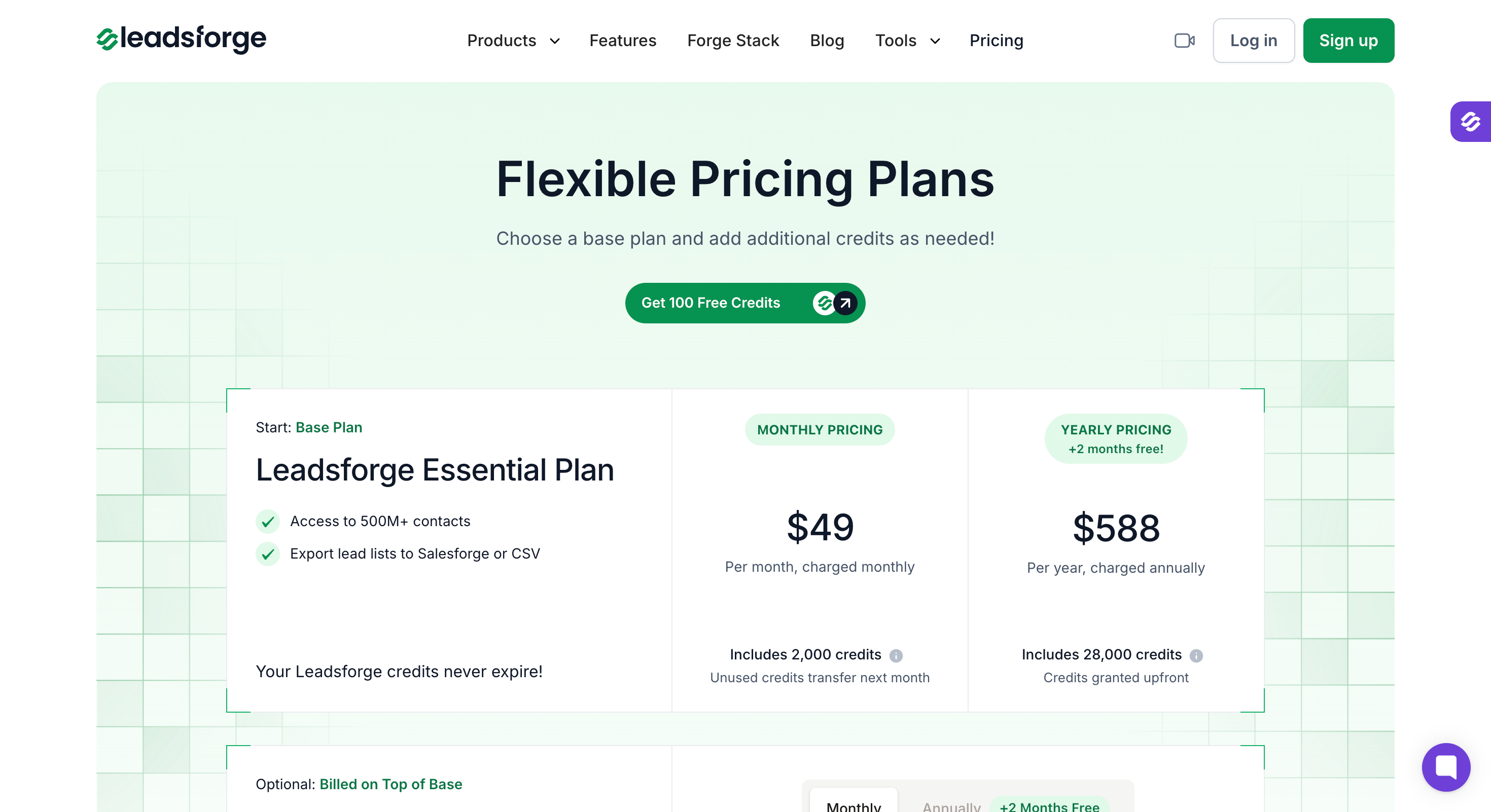
Leadsforge uses a credit-based pricing model with a free-to-start entry point. Credits never expire on either the monthly or yearly plan.
Leadsforge Pricing
Free Trial: 100 credits to test the platform, no credit card required
Essential Plan (Monthly): $49 per month with 2,000 credits. Unused credits roll over to the next month.
Essential Plan (Yearly): $588 per year with 28,000 credits granted upfront. Saves over 14% plus 2 months free compared to monthly billing.
Extra Credit Packs: Add-on credits available from 2,000 to 200,000+ credits, billed on top of your base plan
Credit usage breaks down as follows:
1 email reveal = 1 credit
1 LinkedIn profile URL = 1 credit
1 mobile number = 10 credits
1 company follower + their LinkedIn URL = 1 credit
1 company lookalike (charged per company, not per lead) = 1 credit
Best for:Mid-market and enterprise sales and marketing teams focused on the US market that need the deepest firmographics, technographics, and buyer intent data available, and can justify a $15,000+ annual contract.
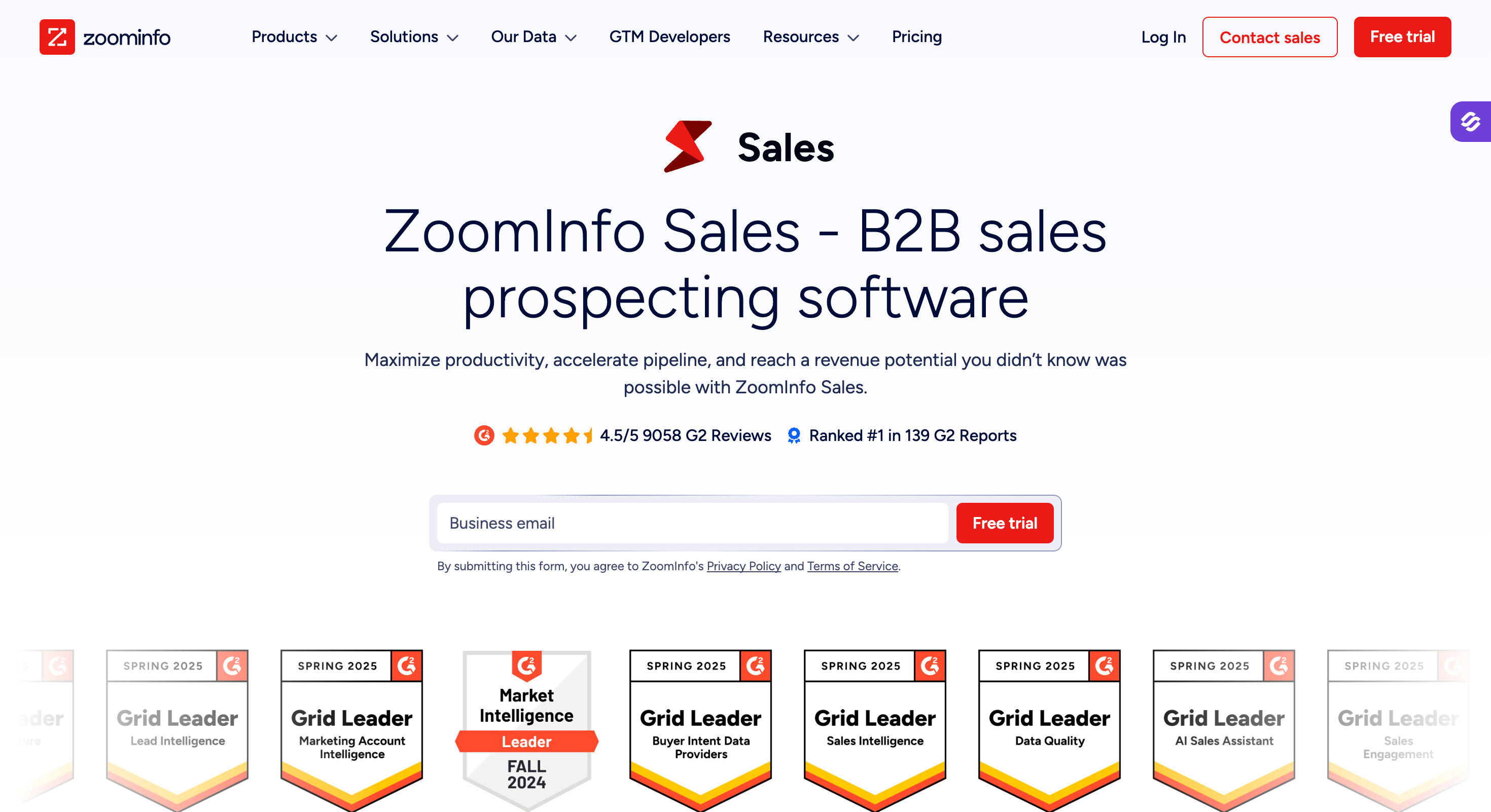
ZoomInfo home page
ZoomInfo is the biggest B2B data platform on the market, and has been for a decade. If you've worked in enterprise sales, you've used it or competed against teams who did.
The core pitch is data depth, not just data volume. Where Apollo gives you 275M+ contacts with basic firmographics, ZoomInfo gives you detailed org charts, department-level headcounts, tech stack intelligence down to the specific software a company uses, and intent signals powered by their first-party data combined with Bombora.
For enterprise teams selling into complex buying committees at Fortune 1000 accounts, that depth matters. For most other teams, the price tag makes it hard to justify.
Where ZoomInfo Beats Apollo
Deepest US firmographics and technographics on the market: Org charts, department-level headcounts, technology stack details (what CRM, what marketing stack, what security tools), and executive change alerts. Apollo has technographics on paper but the depth isn’t comparable. ZoomInfo’s detailed company data is more reliable for targeted outreach, data enrichment, and account verification.
Native intent data plus Bombora integration: Real-time buyer intent data shows which accounts are actively researching solutions in your category. Apollo offers intent signals too, but only on the $119 per user Organization tier.
Website visitor tracking (WebSights): Identifies which companies are visiting your site right now and enriches them with contact data for outreach. Apollo doesn’t offer website visitor tracking at any tier.
Real-time buying signals and Scoops: Leadership changes, funding rounds, technology adoptions, and hiring surges surfaced as they happen, not weeks later.
Complete buying committee mapping: Org charts and buying group intelligence show reporting structures and identify economic buyers, technical evaluators, and champions across the account. For account-based selling into complex organizations, this is difficult to replicate.
35,000+ integrations including Salesforce, HubSpot, and Microsoft Dynamics: Deeper integration with enterprise CRM records than most competitors.
Advanced analytics and sales engagement platform: ZoomInfo’s advanced analytics and comprehensive sales engagement platform deliver premium data analysis, AI-driven insights, and robust reporting capabilities, giving sales and marketing teams a significant advantage over Apollo.
Key Features
300M+ professional profiles and 100M+ company records across global markets
Intent data from ZoomInfo’s first-party signals plus Bombora covering thousands of topic categories
Website visitor identification (WebSights) that reveals companies browsing your site
Org chart mapping with reporting structures and decision maker hierarchy
Technographics and tech stack intelligence showing exactly what software a company uses
Real-time alerts on target accounts for leadership changes, funding, and hiring activity
Advanced search with 300+ filters across firmographics, technographics, and intent
Advanced features including robust analytics, sales automation tools, and workflow integrations for data-driven sales and marketing strategies
AI-powered ideal customer profiling on the Elite plan
Chrome extension for LinkedIn and web-based prospecting
Native integrations with Salesforce, HubSpot, Microsoft Dynamics, Outreach, Salesloft, and 35,000+ other tools
What I Liked
The data depth is genuinely unmatched for US enterprise prospecting. If you're selling a $50K+ deal into a Fortune 1000 account, the org chart and intent data alone can pay for the contract.
Website visitor tracking is a real differentiator. Apollo tells you who might be interested based on firmographics. ZoomInfo tells you who's literally on your pricing page right now.
The integration ecosystem is the most extensive on this list. If your tech stack is deep, ZoomInfo plays well with most of it.
Limitations I Noticed
Annual contracts are mandatory with no monthly billing option. You need a signed contract just to access the platform, and there's no self-serve trial.
Auto-renewal clauses with 60-90 day cancellation windows are a recurring complaint across G2 and Reddit. Miss the window and you're committed for another year.
Credits do not roll over between months or contract years. Unused credits expire permanently.
ZoomInfo Pricing
ZoomInfo does not publish pricing on their website. All plans are quote-based and require annual contracts. The figures below are compiled from Vendr transaction data, G2 reviews, and publicly reported user experiences.
ZoomInfo Pricing Page
Professional (SalesOS): Approximately $14,995 per year with a 3-seat minimum
Advanced: Approximately $25,000 to $30,000 per year with intent data, technographics, and website visitor tracking added
Elite: Approximately $40,000 to $45,000+ per year with AI copilot, advanced signals, and priority support
Additional costs most teams encounter:
Each seat beyond the base: $2,000 to $5,000 per year depending on tier
Global Data Passport (international contacts): $10,000+ per year
Engage (built-in sequencing): $5,000 to $10,000 per year
Enrich (CRM data enrichment): $10,000 to $15,000 per year
Best for:Mid-market and enterprise sales teams selling into European markets that rely on cold calling, need GDPR-compliant data, and can justify a $15,000+ annual contract.
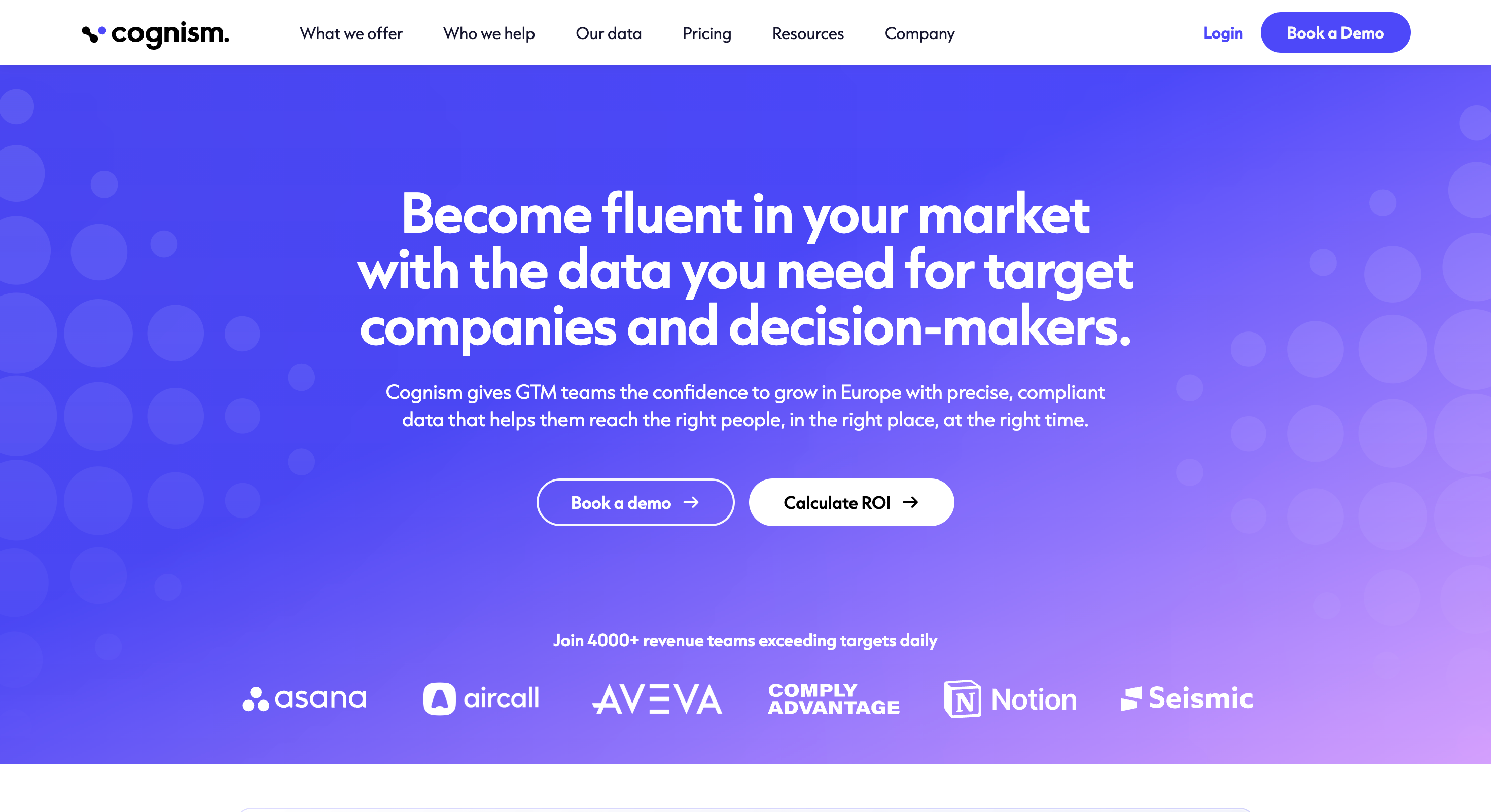
Cognism home page
If your outbound strategy depends on getting decision makers on the phone, and especially if you're selling into the UK, Germany, France, or the broader EMEA region, Cognism is the strongest pick on this list.
Apollo gives you phone numbers. Most of them are unverified switchboard lines or generic company dials. Cognism's Diamond Data is different. Every mobile number in that dataset has been manually verified by a research team, and Cognism claims an 87% connect rate versus roughly 30% for industry-standard unverified numbers.
Where Cognism Beats Apollo
Phone verified mobile numbers via Diamond Data: Manually verified mobiles with an 87% connect rate claim versus roughly 30% for standard databases. Apollo’s mobile numbers are largely unverified.
Accurate contact details and verified data accuracy: Cognism provides verified, up-to-date, and accurate contact details, ensuring you reach the right decision-makers. Its verified data accuracy, maintained through continuous multi-source validation, sets it apart from Apollo and improves deliverability, reduces bounce rates, and enhances campaign effectiveness.
Strongest European data coverage on the market: Cognism reports significantly deeper contact coverage across the UK, Germany, France, and the rest of EMEA compared to most US-focused data providers.
GDPR-compliant data with DNC screening across 13 countries: Cognism checks every contact against Do Not Call lists in the UK, Germany, France, and 10+ other countries. Apollo doesn’t offer this level of compliance screening natively.
Bombora-powered intent data on the Elevate tier: Identifies companies actively researching topics related to your solution. Apollo locks intent behind its $119 per user Organization tier.
Diamonds-on-Demand service: Submit specific high-priority prospects for manual verification, typically with a 48-hour turnaround. Apollo doesn’t offer manual verification at all.
Unrestricted data access on paid plans: Cognism moved away from strict credit limits on most tiers. You get “unlimited” access subject to a fair-use policy (roughly 2,000 records per user per month) rather than Apollo’s cycle-based credit expiration.
Sales Companion Chrome extension: Surfaces fresh contact data on LinkedIn profiles and company websites in real time, with tighter integration into sales workflows than Apollo’s extension.
Key Features
Global B2B contact database with approximately 25M contacts on Grow and 50M on Elevate
Diamond Data phone-verified mobile numbers with an 87% claimed connect rate
GDPR and CCPA compliance with DNC list screening across 13 countries
Intent data powered by Bombora on the Elevate plan
Signal Data covering hiring trends, funding rounds, technology changes, and job moves
Diamonds-on-Demand for manual verification of priority contacts
Sales Companion Chrome extension for LinkedIn and corporate website prospecting
Advanced analytics and advanced features for sales teams, including premium data analysis, AI-driven insights, and comprehensive reporting capabilities
CRM integrations with Salesforce, HubSpot, Pipedrive, Outreach, and Salesloft
CSV enrichment on demand or scheduled
ISO 27001 and ISO 27701 certified for enterprise security and privacy
What I Liked
Diamond Data is a real differentiator if your team lives on the phone. The 87% connect rate claim is aggressive, but even at 60 to 70% it's meaningfully better than the industry average.
GDPR compliance is baked into the product rather than bolted on. For teams selling into Europe, the legal protection around DNC screening is genuinely valuable.
EMEA data coverage beats every US-focused competitor by a significant margin. If your ICP is UK, DACH, or French companies, this is the tool.
No credit system on most tiers. "Unlimited" access under fair-use policy is easier to budget than Apollo's expiring credits.
Limitations I Noticed
Cognism is a data provider, period. There's no built-in email sequencing, no warmup, no CRM, no outreach automation. You'll need a separate tool like Salesforge for execution.
Asia-Pacific contact coverage has visible gaps outside of major hubs.
Pricing is fully quote-based with no self-serve signup or free trial. You must book a demo to get numbers, and you can't test the platform beyond a 25-lead sample.
Cognism Pricing
Cognism does not publish pricing on their website. All plans are quote-based and require annual contracts.
The figures below are compiled from third-party procurement data (Vendr), user reports on G2 and Reddit, and verified review sites.
Cognism pricing page
Grow (Platinum): Approximately $15,000 platform fee per year + approximately $1,500 per user per year. A solo user pays roughly $16,500 per year. A 5-user team pays roughly $22,500 per year.
Elevate (Diamond): Approximately $25,000 platform fee per year + approximately $2,500 per user per year. A 5-user team pays roughly $37,500 per year. Adds Diamond Data, Bombora intent, and Diamonds-on-Demand.
Enterprise: Custom quoted, typically $30,000 to $100,000+ per year
Best for:Individual sales reps, recruiters, and small teams who prospect directly on LinkedIn and need fast email + phone lookups via a Chrome extension, without the complexity of a full prospecting platform.
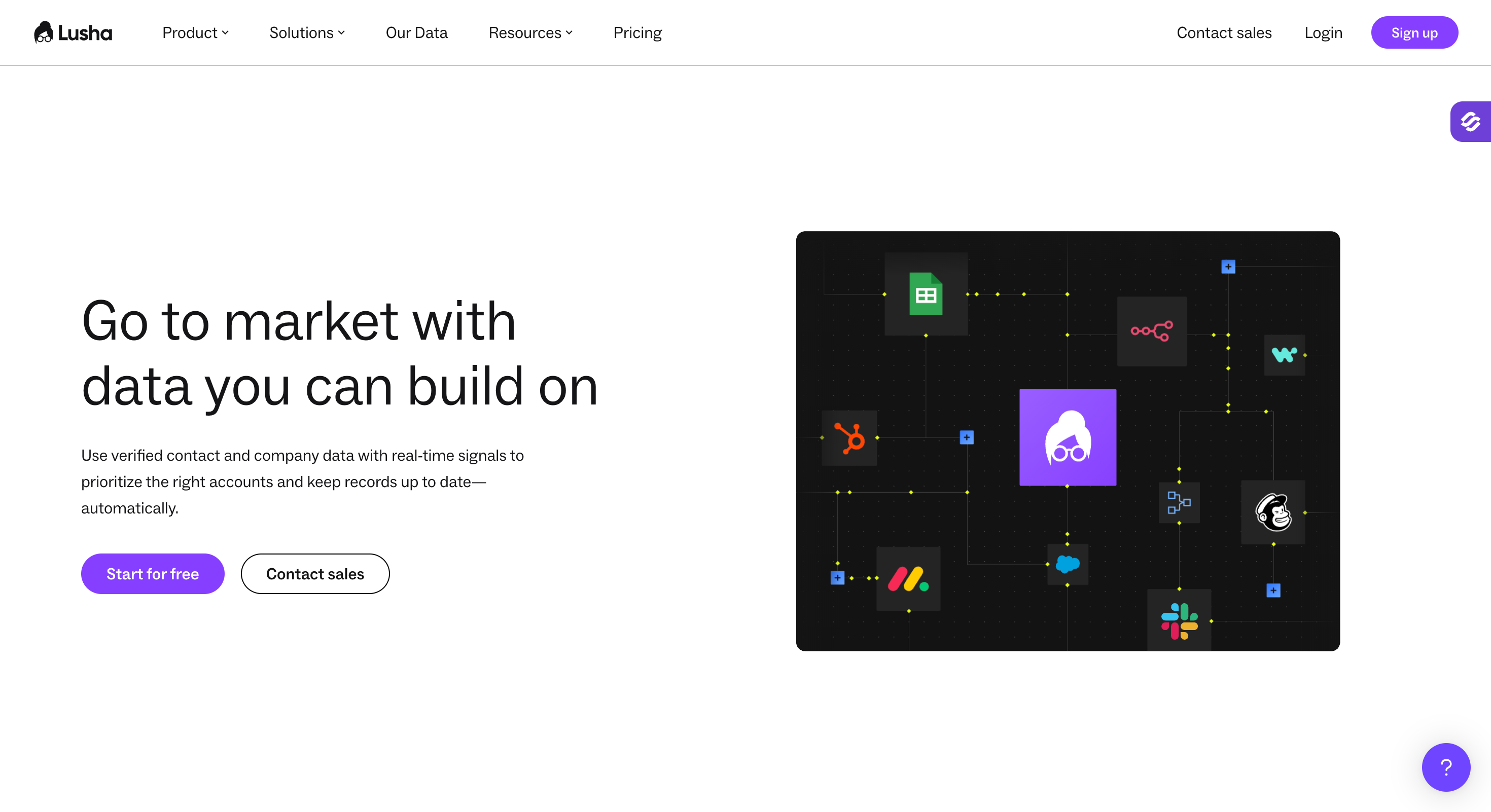
Lusha home page
Lusha is one of the simplest tools on this list.
It's built around a single core workflow: you browse LinkedIn, the Chrome extension surfaces contact info in real time, and you reveal emails or phone numbers with a click.
That's it. No searchable contact database to navigate, no advanced filter UI, no built-in sequencing. If you prospect primarily on LinkedIn and just need fast access to verified emails and direct dials, Lusha does that one job faster than Apollo's broader platform.
Where Lusha Beats Apollo
Chrome extension speed on LinkedIn: Install the extension, browse LinkedIn profiles, and reveal verified contact info in seconds. Apollo's extension works but the reveal flow is slower and the interface is more crowded.
Zero learning curve: Lusha is productive in under 10 minutes. Apollo's dashboard requires real onboarding time to use effectively.
Functional free plan with 40 credits per month: Enough to verify a handful of contacts and test data quality against your target market. Apollo's free plan is broader but less specialized for quick LinkedIn lookups.
Monthly plan credit rollover up to 2x your limit: Unused credits on monthly plans roll forward instead of expiring the way Apollo's do.
Job change alerts and technology filters: Track when key decision makers move companies and filter prospects by tech stack on higher tiers. Apollo offers these too, but Lusha's alerts are cleaner.
Strong direct dial reputation: Most Lusha users cite phone data as the platform's strongest feature. Direct numbers that actually connect, not just company switchboards.
Key Features
Chrome extension for LinkedIn, Sales Navigator, company websites, and Gmail
Email and phone number reveal with verification and confidence scores
Basic prospecting platform with limited search filters
Job change alerts for tracking prospect movement on higher plans
Technology filters for targeting based on tech stack
Bulk reveal up to 25 contacts on Pro, 150 on Premium
CRM integrations with HubSpot, Salesforce, Pipedrive, and Outreach on paid plans
Team collaboration and shared lead lists
What I Liked
The Chrome extension is genuinely the fastest way I've used to reveal contact info on LinkedIn. No switching tabs, no copy-paste, just click and reveal.
Setup takes minutes. No onboarding, no configuration, no training.
Direct dial quality is consistently praised across G2 reviews. For SDRs who live on the phone, this matters.
The free plan is actually testable. 40 credits per month is enough to verify Lusha's data quality against your ICP before committing.
Limitations I Noticed
No searchable B2B contact database the way Apollo has. You need to start from LinkedIn, a company website, or a CRM record. Lusha doesn't let you build a search from scratch based on ICP filters alone.
Phone numbers cost 5 credits each on annual plans (or 10 credits on some monthly plans). Email reveals are 1 credit. A single contact with both email and phone costs 6 to 11 credits.
Credit math breaks down fast for phone-heavy outbound. Pro at 3,000 credits per year gets you roughly 500 full reveals (email + phone). An active SDR hits that limit in weeks, not months.
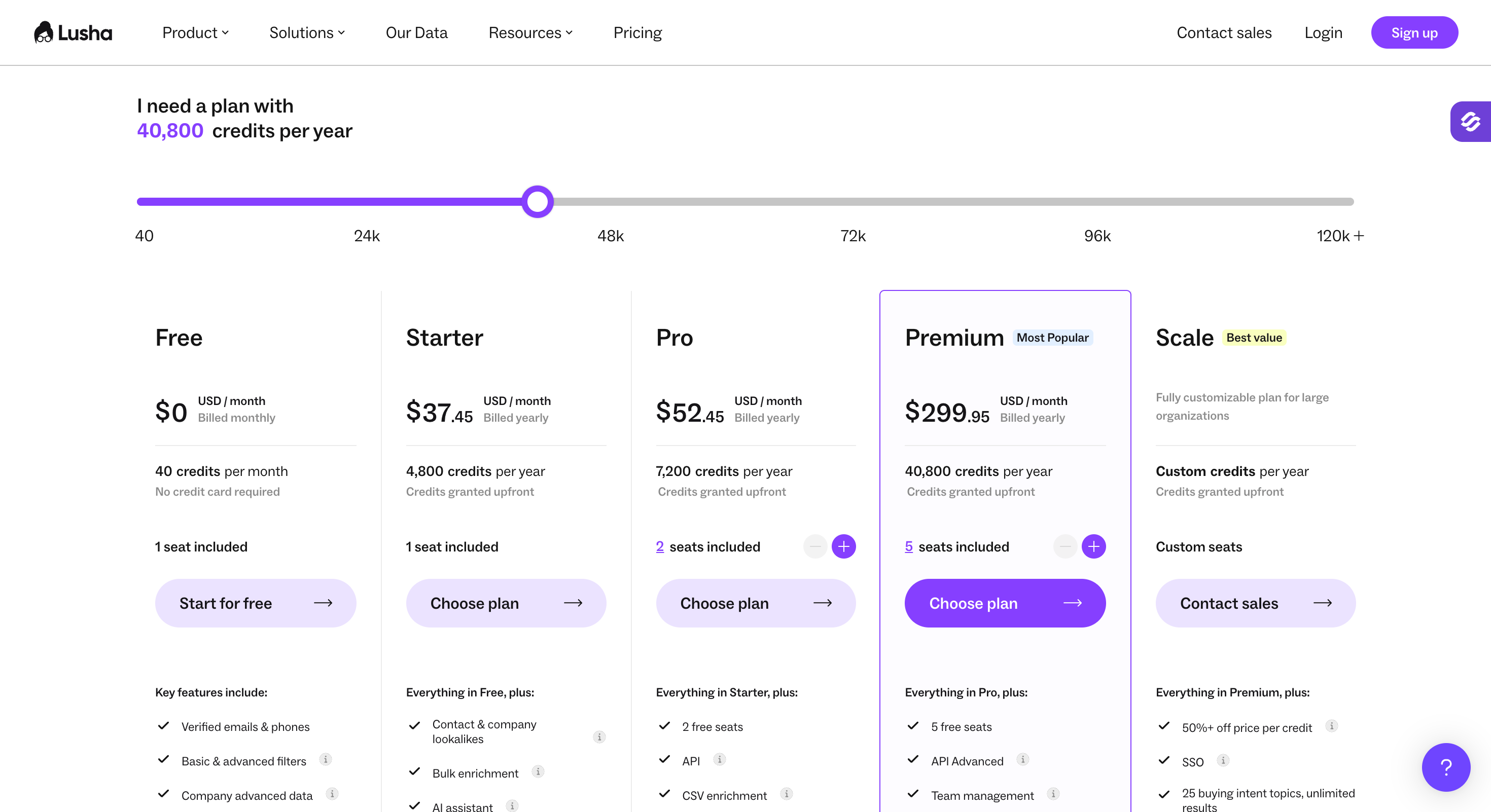
Lusha Pricing
Lusha uses a per-user credit system. Every plan charges 1 credit per email reveal and 10 credits per phone number reveal (updated from the previous 5-credit rate). Annual billing saves roughly 25% versus monthly.
Best for:Individual sales reps, recruiters, and small teams that need a large B2B contact database with Chrome extension lookups and per-seat pricing, without the enterprise contracts of ZoomInfo or Cognism.
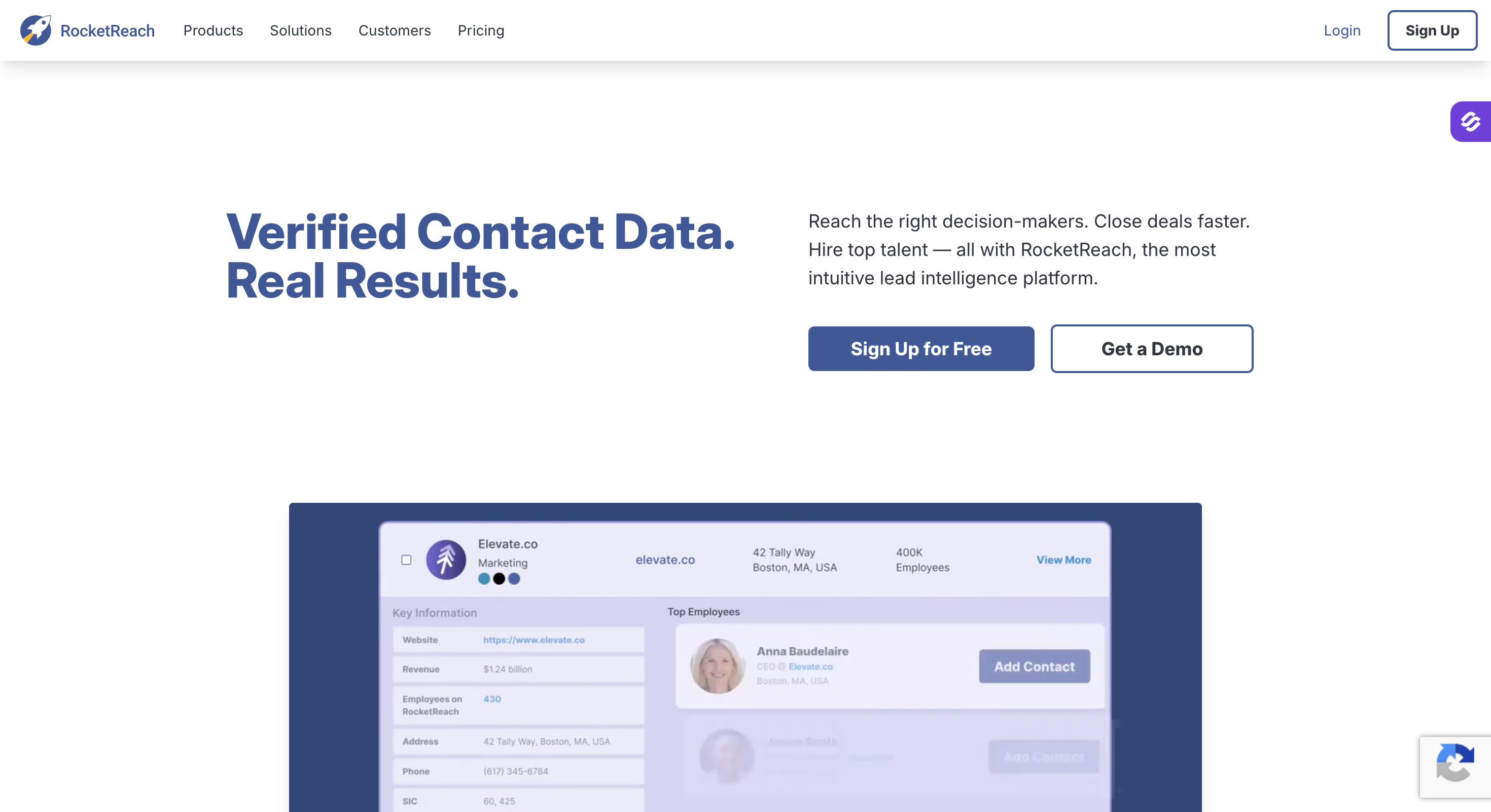
RocketReach home page
RocketReach has been in the contact data space since 2015 and has built one of the larger B2B databases on the market.
700M+ professional profiles and 60M+ company records, covering most of the major data gaps Apollo leaves for mid-market and enterprise prospecting.
The pitch is straightforward. You need a bigger database than Apollo's 275M with similar per-seat pricing, without jumping to ZoomInfo's $15,000 annual minimum.
That's the real niche RocketReach occupies. It's not as cheap as Lusha, not as deep as ZoomInfo on intent data, but it covers more contacts than Apollo at a similar entry price with a cleaner individual-user experience.
Where RocketReach Beats Apollo
700M+ professional profiles: Roughly 2.5x Apollo's 275M database, with particularly strong coverage of mid-market and enterprise contacts that Apollo's SMB-focused database can miss.
60M+ company records: with advanced firmographic filters including technographics, funding stage, revenue, and employee count.
Real-time Chrome extension lookups on LinkedIn, Crunchbase, AngelList, and company websites. The extension can trigger fresh data scrubs on a contact rather than serving only cached database records.
Unlimited lookups on annual Essentials, Pro, and Ultimate plans (fair-use up to 10,000 contacts per 30 days). Apollo caps data credits by tier with hard monthly expiration.
Cleaner individual-user pricing. Essentials at $33 per month annual gets solo prospectors a full email database. Apollo's Basic at $49 per user is more expensive for individual use.
Strong email accuracy for verified contacts: RocketReach claims 90 to 98% deliverability on A-grade verified emails, with most users reporting 85 to 90% real-world accuracy for US contacts.
Job change alerts and company trend signals on Pro and above. Apollo offers these too but locks richer intent signals behind the $119 Organization tier.
Healthcare data coverage on the Ultimate plan, which is rare outside of specialty providers.
Key Features
700M+ verified professional profiles with global coverage across industries and geographies
60M+ company records with advanced firmographic and technographic filters
Chrome extension with real-time lookups on LinkedIn, Crunchbase, AngelList, and company websites
Bulk lookup and enrichment for filling in gaps on existing prospect lists
Advanced search with 100+ filters including job title, seniority, industry, technologies, funding, and revenue
Org charts and company trends on higher plans
Autopilot automations on Pro and above for automated contact finding
CRM integrations with Salesforce, HubSpot, Outreach, Salesloft, and Bullhorn
REST API on the Ultimate plan for custom workflow integration
Email grading system with A through F ratings for deliverability confidence
What I Liked
The database size is genuinely large. For mid-market and enterprise US prospecting, RocketReach found contacts that Apollo's database didn't have.
The Chrome extension is fast and stays reliable on LinkedIn, which matters for reps who prospect directly from profiles.
The email grading system (A through F ratings) helps you prioritize which contacts to actually use in campaigns. Apollo doesn't surface confidence scores this clearly.
Limitations I Noticed
Phone number accuracy is lower at 55 to 65% in independent testing.
No built-in sequencing, no email warmup, no cold email infrastructure. You'll pair RocketReach with a separate sending tool like Salesforge.
Essentials plan is email-only. Phone numbers require the $75 per month Pro plan, a 2.5x price jump.
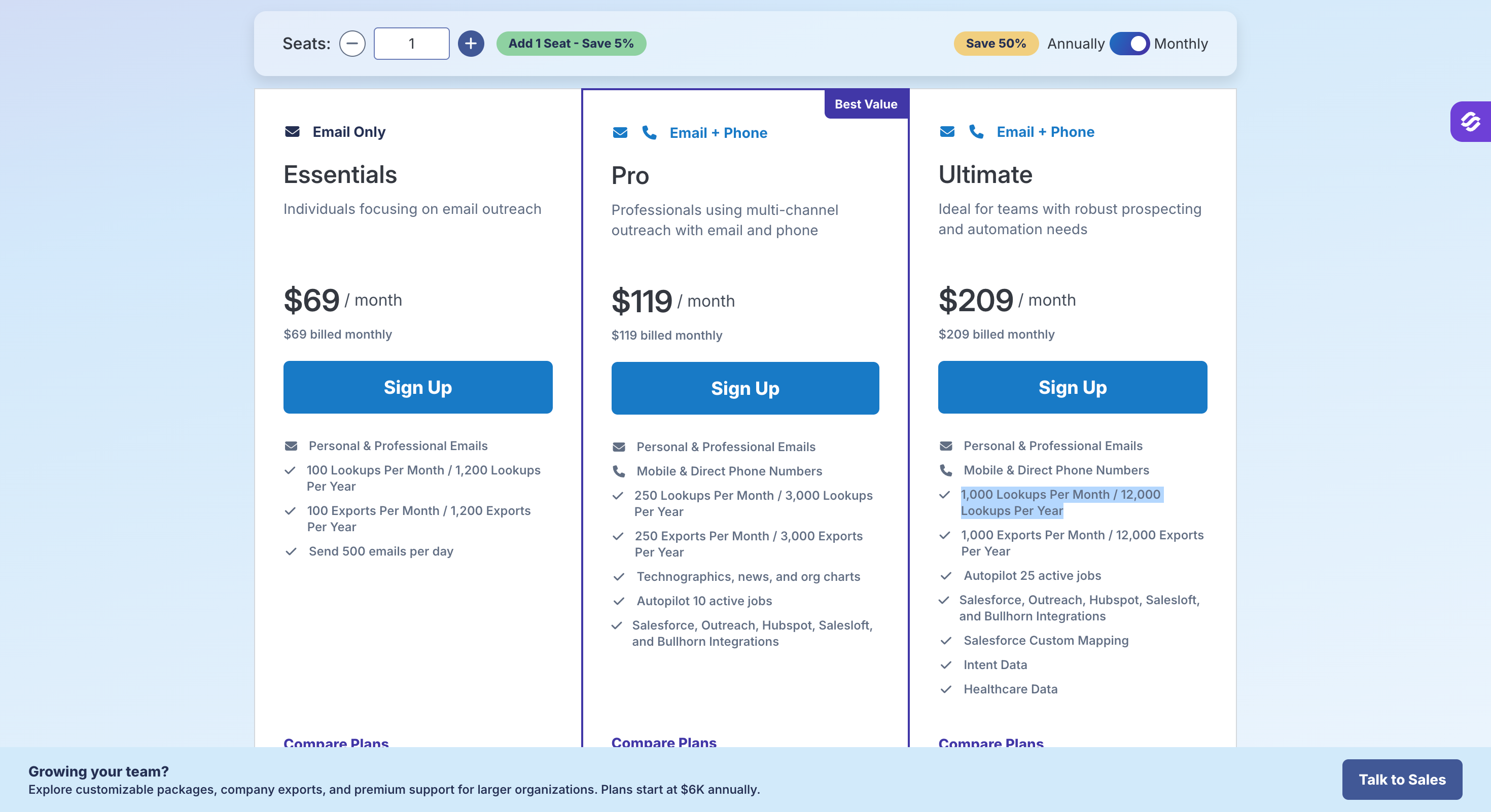
RocketReach Pricing
RocketReach uses a per-seat model with annual billing required for the listed rates. Monthly billing costs significantly more. All paid plans are priced per user, so team costs multiply with headcount.
RocketReach pricing
Essentials: $69 per month (Email Only | 100 Lookups Per Month / 1,200 Lookups Per Year)
Pro: $119 per month (Email + Phone | 250 Lookups Per Month / 3,000 Lookups Per Year)
Ultimate: $209 per month (Email + Phone | 1,000 Lookups Per Month / 12,000 Lookups Per Year)
Best for:Solopreneurs, small sales teams, and agencies who want a single tool that combines email finding, verification, cold email campaigns, and basic CRM at a lower price point than Apollo's paid tiers.
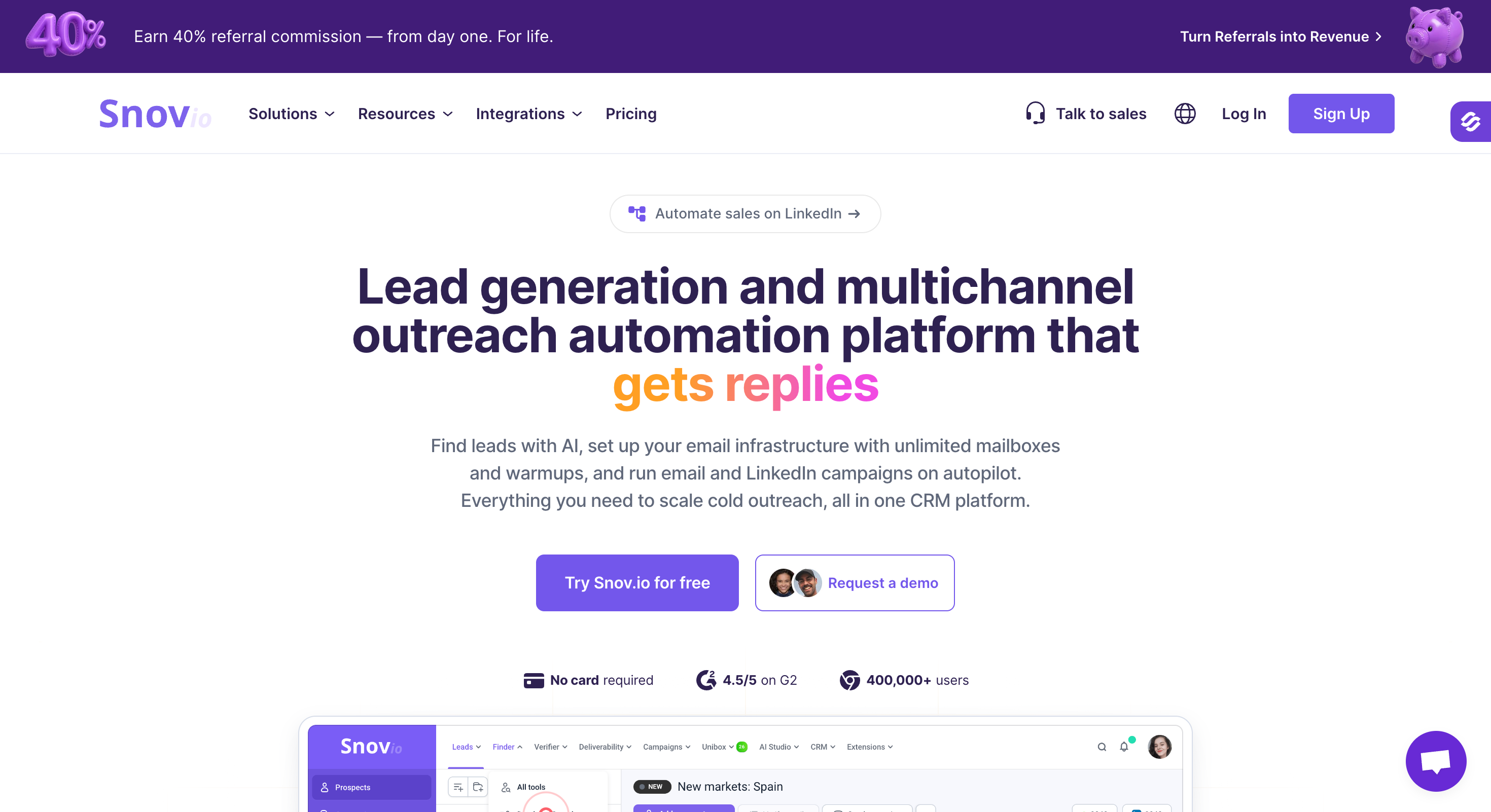
Snov.io home page
Snov.io is one of the few tools on this list that tries to be an all-in-one like Apollo. Email finder, email verifier, drip campaigns, basic CRM, and LinkedIn automation (as an add-on), all inside a single platform.
The pitch is consolidation. Instead of paying for Apollo plus a separate verification tool plus a separate sending tool, you get the core outbound stack in one subscription starting at $39 per month.
The tradeoff is depth. Snov.io's database (50M+ company profiles) is much smaller than Apollo's 275M contacts, email accuracy sits around 75 to 80% for US contacts, and the LinkedIn automation that competitors bundle in their core plans runs as a separate $69 per slot add-on.
For solopreneurs and small teams running email-first outreach on a budget, it works.
For volume outbound or multi-channel sequences, you'll hit limits fast.
Where Snov.io Beats Apollo
Built-in drip campaigns on every paid plan: Apollo's Basic plan includes sequences, but Snov.io's campaign builder has more condition-based logic (if opened, if clicked) and behavioral triggers built in.
7-tier email verification included: Snov.io verifies emails across syntax, MX records, SMTP records, catch-all detection, and more. Apollo's verification is less thorough.
Credits roll over as long as your subscription is active: Apollo credits expire every billing cycle. Snov.io's unused credits carry forward to the next month.
Free CRM included on all plans: Up to 20 pipelines, 100 stages each, deal management, and Google Calendar sync. Apollo charges for advanced CRM features on higher tiers.
Unlimited email accounts and campaigns on every paid plan: Apollo caps email accounts by tier.
Unlimited team seats on Pro plans: Apollo charges per user on every paid tier.
Cheaper entry point than Apollo: Starter at $39 per month gives you 1,000 credits, 5,000 recipients, and the full outreach workflow. Apollo Basic at $49 per user per month covers contact data but fewer sequencing features.
Better international coverage for European contacts: Snov.io was founded in Ukraine and has stronger coverage across EU markets than Apollo's US-centric database.
Key Features
Email finder with domain search, bulk lookup, and Chrome extension for LinkedIn prospecting
7-tier email verifier with syntax, MX, SMTP, and catch-all detection
Drip campaigns with A/B testing, behavioral triggers, and conditional logic on Pro plans
Unlimited email accounts and warmup (3 warmup slots on Starter, unlimited on Pro)
Free built-in CRM with up to 20 pipelines and deal tracking
LinkedIn Automation as an add-on ($69 per slot per month) with profile visits, connection requests, and messages
Email tracker for opens, clicks, and replies
REST API for custom integrations
Native integrations with Salesforce, HubSpot, Pipedrive, Slack, and Zapier (5,000+ connections)
Deliverability testing with DNS record checks and inbox placement tests (25 credits per check)
What I Liked
The all-in-one approach genuinely works for solo operators. Email finder + verifier + campaigns + CRM in one subscription is meaningful cost savings versus stitching together Apollo + Mailchimp + a verifier.
Credit rollover is a real advantage over Apollo. Unused credits carry forward, so you're not penalized for slower months.
7-tier email verification is more thorough than most competitors include natively.
Limitations I Noticed
Database size is significantly smaller than Apollo.
Email accuracy sits around 75 to 80% for US B2B contacts based on independent testing.
LinkedIn automation is a separate $69 per slot per month add-on, not bundled. Each slot covers one LinkedIn account. Teams running LinkedIn outreach across multiple profiles stack add-on costs fast.
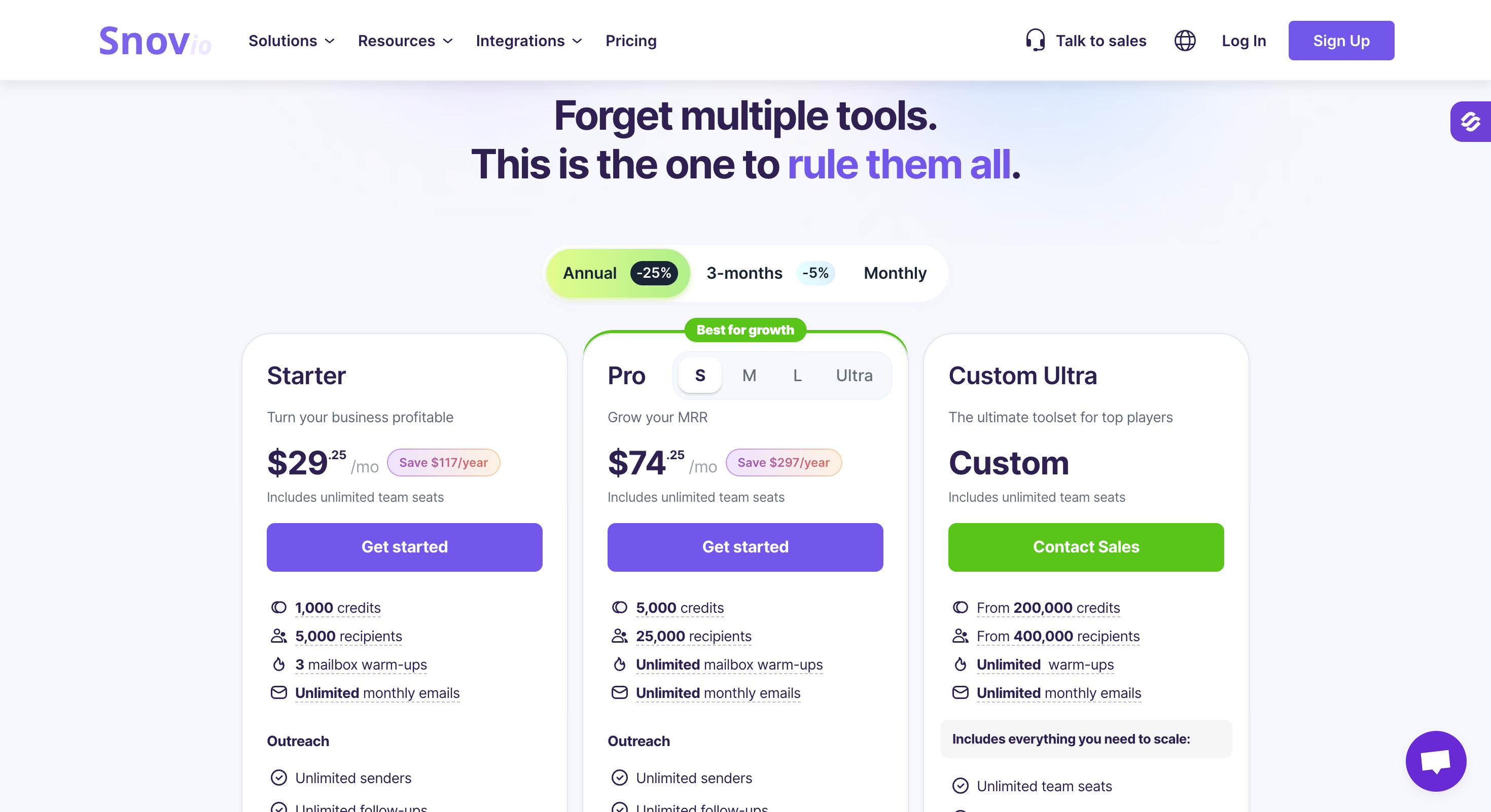
Snov.io Pricing
Snov.io uses a credit system plus recipient allowances. Annual billing saves roughly 25% across all paid tiers.
Best for:Sales and marketing professionals who prioritize creative, personalized outreach across email, LinkedIn, and calls, and who close enough deals per rep to justify premium per-user pricing.
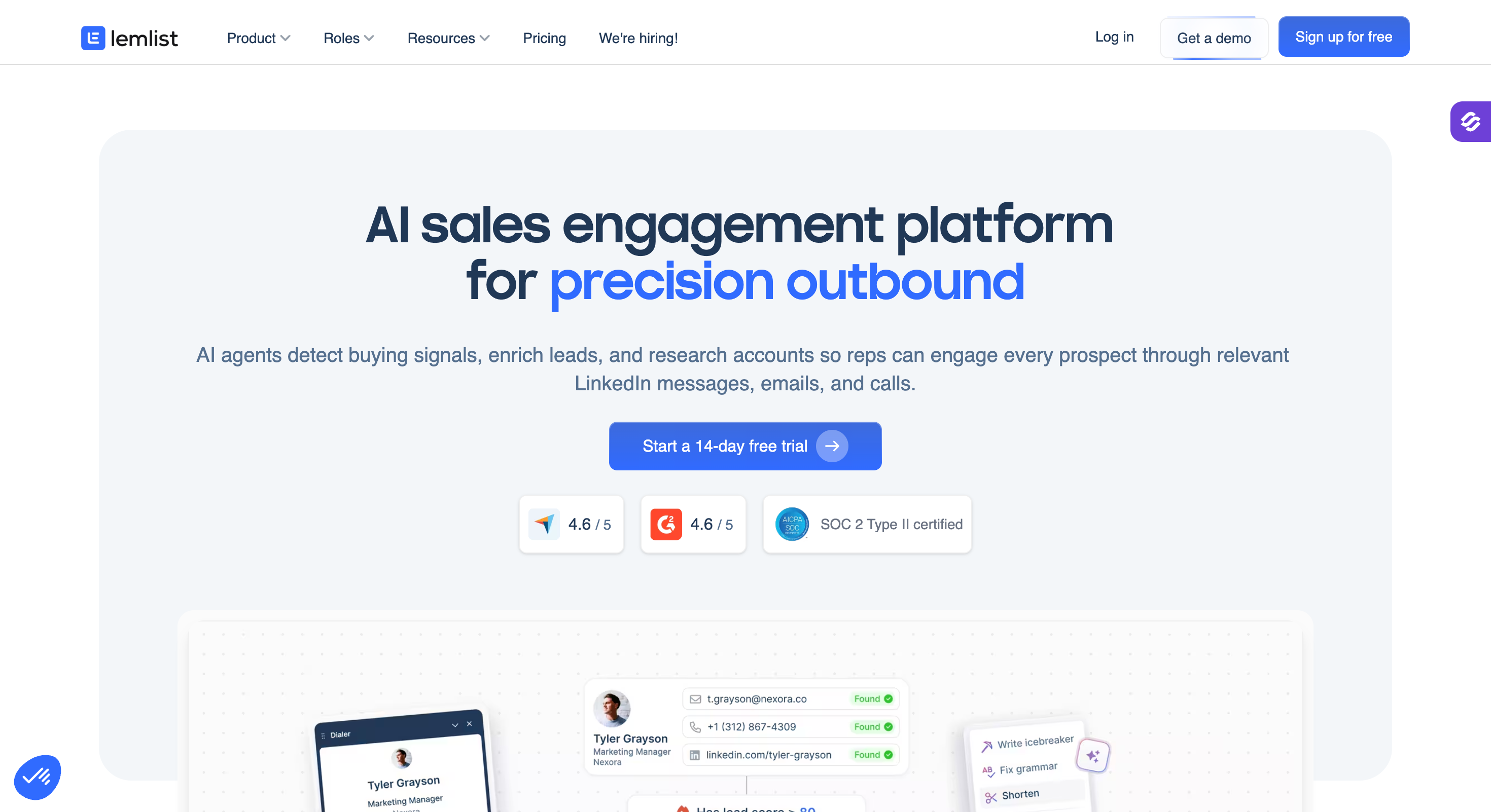
Lemlist home page
Lemlist is a sales engagement platform that offers robust sales engagement tools and sales automation features for multi-channel outreach.
Lemlist’s biggest differentiator is personalization depth.
You can dynamically insert custom images (like a screenshot with the prospect’s name on a whiteboard), personalized landing pages, and video thumbnails directly into cold emails.
Apollo’s sequences are text-based with merge tags. Lemlist turns every email into something closer to a one-to-one marketing asset.
They’ve also built out true multi-channel sequencing that combines email, LinkedIn (connection requests, profile visits, messages), cold calls, and WhatsApp into a single automated workflow. Apollo offers LinkedIn steps, but the automation depth isn’t the same.
The tradeoff is price. Lemlist charges per user per month, which scales poorly for growing teams.
For a solo operator or a 2-person agency closing high-ticket deals, the premium makes sense. For a 10-person SDR team, the math gets harder.
Where Lemlist Beats Apollo
Dynamic image and video personalization in cold emails: Embed screenshots with the prospect’s name, company logo, or website image rendered inline. Apollo’s sequences are text-only with merge tags.
Custom personalized landing pages: Create unique landing pages per prospect that auto-populate with their details. Apollo has no equivalent.
True multi-channel sequencing: Combine email + LinkedIn actions + calls + WhatsApp in a single automated workflow. Apollo’s LinkedIn automation is less sophisticated.
Advanced sales automation and sales engagement tools: Lemlist’s sales automation and sales engagement tools streamline outreach, automate repetitive tasks, and enhance sales workflows—giving it a significant advantage over Apollo.
Lemwarm email deliverability booster included free on paid plans: Gradually warms up sending volume with actionable deliverability tips. Apollo’s warmup infrastructure was discontinued and relaunched through third-party providers.
450M+ lead database with waterfall enrichment: Built-in lead finder that pulls emails from multiple providers. Apollo is a single-source database.
Native CRM integrations: Salesforce, HubSpot, Pipedrive, and Zapier support comes standard on the Multichannel Expert plan.
Key Features
Dynamic image personalization with custom variables rendered inline in emails
Personalized landing pages embedded in outreach sequences
Lemwarm deliverability booster included free on all paid plans
450M+ lead database with waterfall enrichment and AI search
AI-powered copywriting for sequence generation and personalization
A/B testing with variant optimization
Chrome extension for LinkedIn, Gmail, and CRM prospecting
Intent signals and buying triggers on higher plans
Native CRM integrations with Salesforce, HubSpot, and Pipedrive
Advanced analytics and advanced features for premium data analysis, comprehensive reporting, and personalized outreach
What I Liked
The image personalization feature is genuinely unique on this list. If your outreach strategy depends on standing out visually, nothing else comes close to what Lemlist does natively.
Multi-channel sequencing with real LinkedIn automation depth is a meaningful step up from Apollo's LinkedIn steps.
Lemwarm included free on paid plans is better deliverability infrastructure than Apollo's current third-party-reliant warmup.
Limitations I Noticed
Per-user pricing adds up fast. A 5-person team on Multichannel Expert costs $545 per month at the current new-customer rate. The same team on Apollo Basic costs $245 per month.
Multi-channel features are locked behind the $109 per user Multichannel Expert plan. Email Pro at $79 per user is email-only.
Extra email accounts cost $9 per month each beyond the 3 included on Email Pro or 5 included on Multichannel Expert.
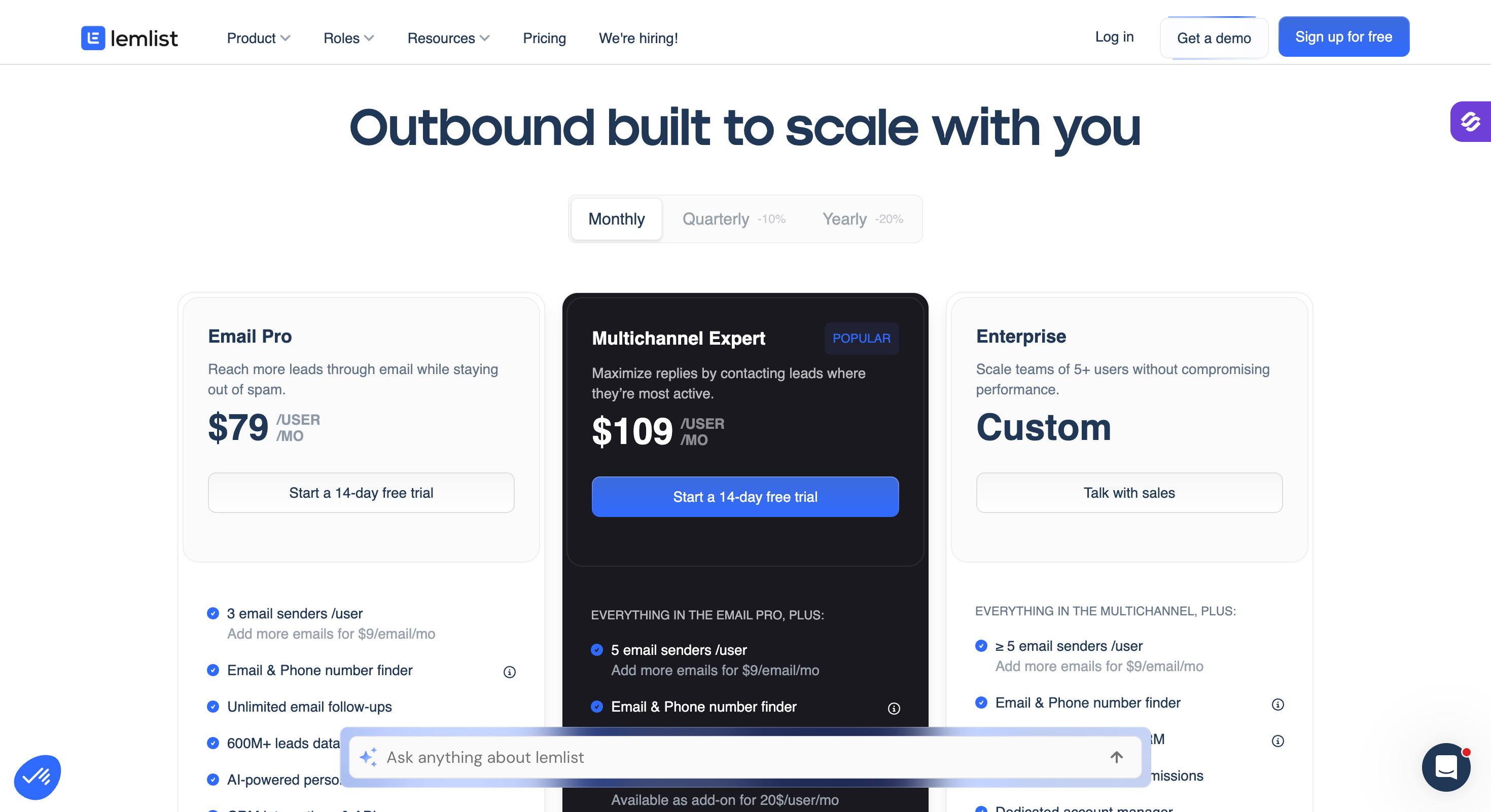
Lemlist Pricing
Lemlist charges per user per month. Annual billing saves roughly 15 to 20%.
Note: Lemlist increased pricing by $10 per user per month for new customers as of February 5, 2026. Existing customers keep their original rates. The figures below are current for new signups.
Lemlist pricing page
Free: 500 credits per month for lead finder only, no campaign sending
Email Pro: $79 per user per month ($69 existing customer rate), 3 email accounts, 1,000 lead credits, Lemwarm warmup, email campaigns only
Multichannel Expert: $109 per user per month ($99 existing customer rate), 5 email accounts, 1,500 lead credits, adds LinkedIn actions + calls + WhatsApp
Best for:Marketers, PR professionals, recruiters, and solopreneurs who need fast domain-based email lookups with source transparency, and don’t need a full prospecting platform with phone numbers or intent signals.
Hunter.io has been the go-to email finder since 2015, known for providing accurate contact details and accurate data for domain-based prospecting. Three million users, 76M+ indexed websites, and a domain search tool that basically defined the category.
It’s not trying to be a prospecting platform like Apollo. It’s an email finder with a built-in verifier and a basic campaigns tool bolted on top. Y
ou enter a company domain, Hunter returns every discoverable email address connected to it, along with confidence scores and the public sources where each email was found. Hunter.io focuses on providing verified contact details to ensure outreach efforts are based on reliable and up-to-date information.
If your workflow is “I know which company I want to reach, I just need the right email,” Hunter does that one thing with speed and transparency that Apollo’s broader platform can’t match.
If you need phone numbers, firmographics, buying signals, or anything beyond email lookup, Hunter won’t replace Apollo.
Where Hunter.io Beats Apollo
Domain search with full source transparency: Type in any company website and Hunter instantly pulls all discoverable email addresses connected to that domain, along with the public sources where each email was found. Apollo doesn’t have an equivalent feature that’s this fast and transparent.
Accurate and comprehensive contact details: Hunter.io provides verified, up-to-date, and accurate contact details—including emails and phone numbers—helping you reach the right decision-makers and improve sales engagement. Its focus on data accuracy and enrichment sets it apart from Apollo.
Built-in email verification with confidence scores: Verify any email address individually or in bulk before sending. Hunter shows a confidence score and verification status for every result, which is useful for cleaning existing lists as well as finding new contacts.
Generous free plan with real functionality: 25 searches and 50 verifications per month, no credit card required. Apollo’s free plan is also real, but Hunter’s feels more practical for solo users doing light prospecting.
Per-account pricing, not per-user: All Hunter plans are billed per account with unlimited team members. Apollo charges per user. For small teams sharing a subscription, Hunter’s pricing model is meaningfully cheaper.
Clean, fast interface with zero learning curve: Most users are productive within 10 minutes of signup. Apollo’s dashboard has more capability but a steeper learning curve.
Unified Credits system since July 2025: Searches, verifications, and enrichments now draw from a single credit pool, which simplifies budgeting compared to Apollo’s separate email and mobile credit tracking.
Key Features
Domain Search with source transparency for every email found
Email Finder for specific name + company lookups
Email Verifier with confidence scores and validation status
Bulk processing for searching and verifying entire lists at once
Advanced analytics and advanced features for premium data analysis, reporting, and enhanced email verification and prospecting
Campaigns tool for basic cold email sending with follow-ups
Chrome extension for quick lookups on LinkedIn and company websites
API access for integrating email finding into custom workflows
Auto-verification of discovered emails on paid plans
AI Writing Assistant for sequence generation
CRM integrations with HubSpot, Salesforce, Pipedrive, and Zapier
What I Liked
Domain search with public source citations is genuinely unique. No other tool on this list shows you exactly where each email was found on the open web.
The free plan is generous enough for actual light prospecting, not just a demo. 25 searches + 50 verifications per month is workable for solo consultants or freelance writers.
Per-account pricing with unlimited team members is a significant cost advantage for small teams.
Limitations I Noticed
Hunter is email-only. No phone numbers, no direct dials, no mobile data on any plan, including Enterprise. If your team needs phone access for cold calling, you'll need a separate tool.
No searchable B2B contact database. You need to know the domain first. Apollo lets you build searches from scratch using industry, role, and company size filters.
No firmographic or technographic filters. You can't search for "Series B SaaS companies in the US with 50 to 200 employees" like you can on Apollo or Leadsforge.
No intent data or buying signals. Hunter tells you who's at a company, not which companies are in-market.
Hunter.io Pricing
Hunter moved to a Unified Credits system in July 2025. All searches, verifications, and enrichments now draw from a single monthly credit pool. Annual billing saves roughly 30%.
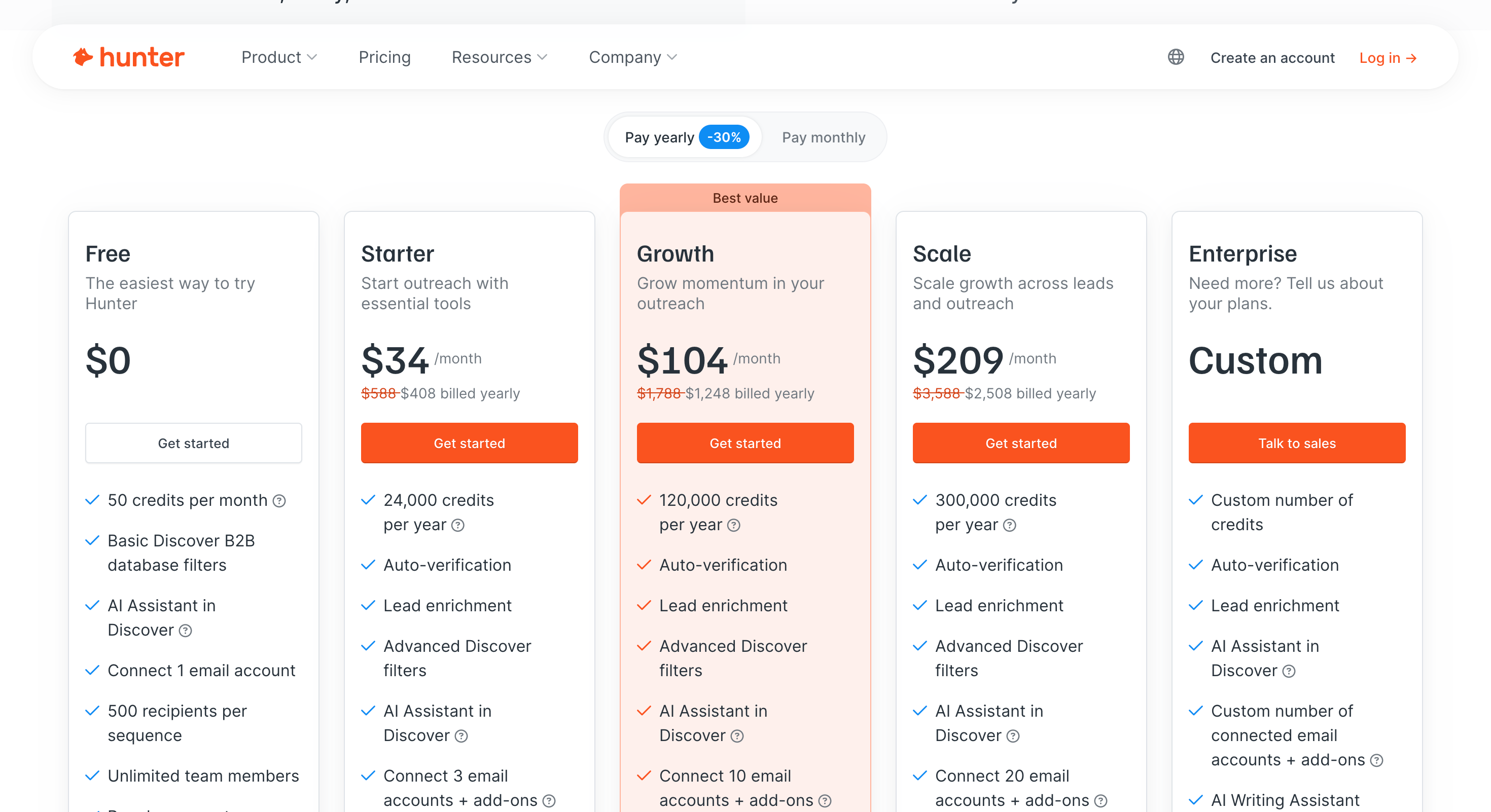
Hunter IO pricing
Free: 25 searches + 50 verifications per month (combined pool), 1 email account, 500 recipients per sequence
Starter: $34 per month annual ($49 monthly), 500 searches or 1,000 verifications, 3 email accounts, 2,500 recipients per sequence
Growth: $104 per month annual ($149 monthly), 5,000 searches or 10,000 verifications, 10 email accounts, 7,500 recipients per sequence
Scale: $209 per month annual ($299 monthly), 10,000 searches or 20,000 verifications, 15 email accounts, 15,000 recipients per sequence
Enterprise: Custom pricing starting around $500 per month with 20,000+ credits
Credit consumption:
Email Finder and Domain Search: 1 credit per email found
Email Verifier: 0.5 credits per verified email (0 credits for "Unknown" results)
Extra credit packs: from $10 for 100 credits
Additional email accounts beyond plan limit: $10 per month each
Best for:RevOps, technical GTM teams, and growth engineers who need multi-source data enrichment, custom workflows, and AI research agents, and have the internal resources to build and maintain sophisticated prospecting pipelines.
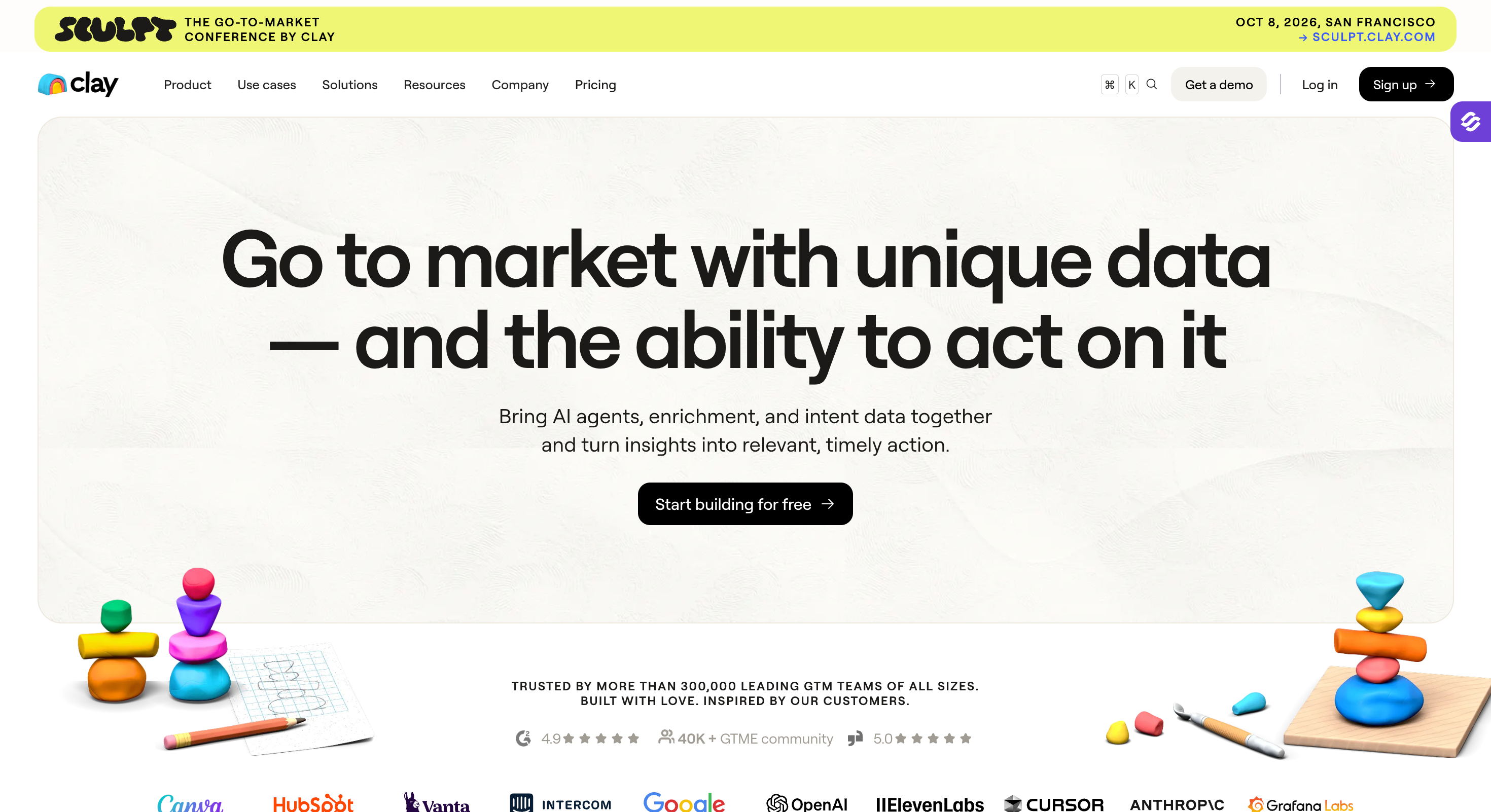
Clay home page
Clay is different from every other tool on this list.
It’s not a contact database. It’s not a sending tool. It’s a data enrichment and workflow automation platform that connects 100+ premium data providers into a single spreadsheet-like interface, enabling enrichment of company data and business contacts from a comprehensive database of providers.
You don’t use Clay to find leads in the traditional sense. You use Clay to enrich leads from wherever you get them (Leadsforge, Apollo, LinkedIn exports, your CRM, website visitor tools) by running them through customizable workflows that pull from multiple sources, apply AI-driven research, and push cleaned data wherever you need it.
Clay is genuinely powerful for teams that know what they’re doing. It’s also genuinely expensive, has a steep learning curve, and requires internal technical resources to get full value. If you’re looking for “Apollo but cheaper,” this isn’t it.
If you’re looking for “custom data pipelines that single-source tools can’t build,” Clay is in a category of its own.
Where Clay Beats Apollo
100+ data sources in one subscription: Avoid vendor lock-in by layering multiple providers in a single workflow. Clay passes provider costs through without markup, so you get wholesale rates on sources that cost more to buy directly. Clay’s enrichment workflows provide access to detailed company data and business contacts from multiple sources, supporting more accurate outreach and lead generation.
Claygent AI research agent: Automate manual research tasks like summarizing job posts, verifying domain ownership, checking tech stacks, or creating lead scoring models. Apollo has no equivalent AI research layer.
Flexible workflow builder: Build enrichment, scoring, and outbound workflows without engineering. Sync to CRMs, sequencers, or data warehouses automatically. Apollo’s automation is linear and template-based.
Intent signal tracking across multiple sources: Monitor job changes, funding rounds, product launches, technology adoptions, and buying signals in real time. Apollo’s intent data is limited and locked behind the Organization tier.
CRM cleanroom functionality: Keep Salesforce and HubSpot records updated by auto-enriching data, fixing formatting, merging duplicates, and adding context signals. Apollo’s CRM enrichment is basic.
Waterfall enrichment with failover logic: Query multiple providers in sequence until one returns verified data, similar to Leadsforge’s waterfall approach but with far more granular control over which providers are queried first.
Unlimited users on every plan: Pricing is credit-based, not seat-based. A 20-person team pays the same as a solo user at the same credit tier. Apollo Professional for 20 users costs $1,580 per month.
API access for custom integrations: Deep support for HTTP APIs, webhooks, and your own API keys on higher plans. Apollo’s API is more limited.
Key Features
Multi-source data enrichment across 100+ premium data providers in one subscription
Claygent AI research agent for automated research tasks and lead scoring
Flexible workflow builder with spreadsheet-like interface for non-engineers
Intent signal tracking including job changes, funding, tech adoption, and hiring
Waterfall enrichment with customizable provider sequences
Native CRM integrations with Salesforce, HubSpot, and Pipedrive on the Growth plan
HTTP API integration for connecting to any external system
Webhooks as a native data source and trigger
AI prompting and LLM integration for custom automation
Advanced analytics and advanced features for technical teams, including premium data analysis, comprehensive reporting, and sophisticated sales automation
Chrome extension for on-the-fly enrichment
SOC 2 Type II, GDPR, and ISO 27001 certified
What I Liked
The flexibility is unmatched on this list. Teams with custom GTM motions can build pipelines that no single-source tool can replicate.
Claygent's AI research is actually useful for real workflows. Summarizing job posts, checking tech stacks, or categorizing companies by custom criteria happens in seconds.
The multi-source enrichment model solves Apollo's single-database weakness structurally. If one provider doesn't have the email, another might.
Limitations I Noticed
Steep learning curve.
Clay is not a finished product, it's a workflow builder.
Credits expire faster than expected for teams running complex multi-step workflows.
Top-up credits cost 50% more than your plan rate during overages. High-volume months can spike costs unexpectedly.
Clay Pricing
Clay overhauled its pricing structure in March 2026. New customers now see two self-serve tiers plus Enterprise. Legacy customers on old plans can keep their pricing indefinitely, but new signups go to the restructured model.
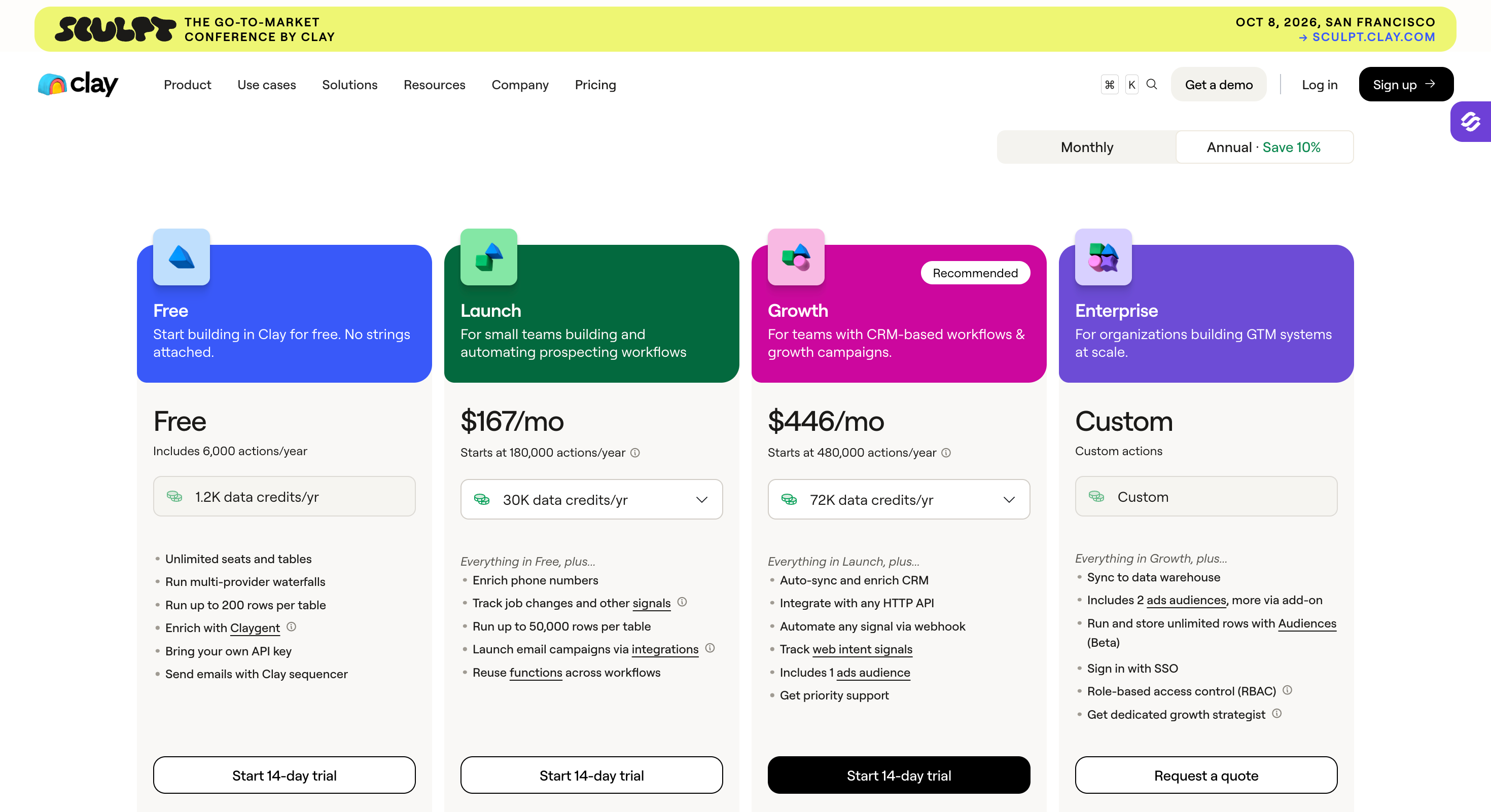
Clay pricing page
Current plans (self-serve, billed annually):
Free: 100 credits per month, unlimited users, basic features
Launch: $167 per month annual ($185 monthly), 2,500 Data Credits + 15,000 Actions, phone enrichment, signal tracking, no CRM sync
Growth: $446 per month annual ($495 monthly), unlimited Data Credits and Actions, HTTP API, webhooks, CRM integrations (Salesforce, HubSpot), Web Intent
Enterprise: Custom pricing, starts $30,000+ per year
Legacy plans (existing customers only, closed to new signups as of April 10, 2026):
Starter: $134 per month annual ($149 monthly)
Explorer: $314 per month annual ($349 monthly)
Pro: $720 per month annual ($800 monthly)
Credit system notes:
Data Credits are consumed when pulling enrichment data from Clay's 100+ providers. Failed lookups still cost credits.
Actions are consumed for platform operations like running workflows, triggering AI, or exporting data.
Top-up credits cost 50% more than your plan rate during overages.
Annual billing delivers all credits upfront with a 10% discount.
Clay also requires LinkedIn Sales Navigator ($99 per user per month) for its LinkedIn enrichment features, which is an extra cost most Clay users don't plan for.
Before I dropped 9 tools into this article, I wanted to make sure I wasn't just recycling the same feature lists you'll find on every other listicle.
So I set a few ground rules for what actually counts as a real Apollo.io alternative.
Here's how I evaluated each one.
Data accuracy and verification method: A tool's contact database is only as good as its verification process. I looked at how each platform sources its data, how often it re-verifies contacts, and whether you get refunds for invalid leads. Apollo's biggest weakness is that exported contacts decay fast because the database isn't being checked in real time. Tools with waterfall data enrichment or reveal-time verification got higher marks.
Database size and global coverage: Apollo claims 275M+ contacts, which sounds impressive until you try prospecting outside the US and hit coverage gaps. I checked each tool's published database size, regional strength (especially EMEA and APAC), and whether the depth of in depth account data held up for the markets I care about.
Pricing transparency and credit systems: Apollo's credit system expires every billing cycle whether you use them or not. Any Apollo alternative worth considering either gives you rollover credits, refunds unverified data, or moves away from per-user pricing entirely. I flagged the credit system on every tool and compared total cost for a 5-person team against Apollo's equivalent tier.
Advanced search capabilities and filter depth: Apollo locks technographics, intent signals, and website visitor tracking behind its $119 per user Organization plan. I checked which tools make advanced search filters and buying signals available on base plans versus gating them behind enterprise tiers.
Integration depth and outreach features: Some of these tools are pure data providers. Others include built-in sequencing, email finder utilities, and CRM sync. I noted where each one fits, because the right Apollo alternative for a 2-person agency is different from what an enterprise team running Salesforce HubSpot integrations actually needs.
Real user reviews on G2, Capterra, and Reddit: I pulled recent reviews from each tool's public review pages to cross-check my own take against what actual sales and marketing professionals are reporting. Where a tool had repeated complaints about billing, data accuracy, or support, I flagged it.
One more honest note: I didn't run full 30-day cold outreach campaigns through every single tool. That would have cost me multiple months.
Instead, I tested the prospecting and search workflows hands-on where I had access, reviewed public demos and free trials, and built the rest of my take from G2 and Reddit sentiment plus the tools' own documentation.
Where my hands-on time was limited, I say so in the tool section.
Apollo.io is a solid starter tool. For a solo SDR or a 2-person sales team that just needs a cheap database and basic sequencing, it does the job.
However, if you’re noticing high bounce rates or struggling with outdated contact details, your existing leads may be suffering from incomplete or inaccurate information, which can hurt outreach effectiveness. If you’re hitting any of the signs below, you’ve probably outgrown Apollo.
1. Your credits expire every billing cycle whether you use them or not.
Apollo's credit system resets monthly on the Basic and Professional plans. Y
ou paid for 30,000 credits at the start of the year. You used 18,000. The rest? Gone.
Most Apollo.io competitors either roll unused credits over, refund credits for unverified contacts, or drop the credit model entirely. Apollo does neither.
2. Your bounce rate is climbing even though you're "using verified data."
Apollo claims 91% email accuracy, but real-world bounce rates on exported contacts regularly run 15% to 30% according to online complaints.
The issue is that Apollo’s database isn’t re-verified in real time, and lacks verified data accuracy through continuous multi-source validation.
A contact that was valid three months ago might not be today. Without verified data accuracy, bounce rates increase and outreach effectiveness suffers. By the time you send, the damage to your domain reputation is done.
3. The advanced search filters you actually need are locked behind the $119 Organization plan.
Technographics, buyer intent data, intent signals, website visitor tracking, and the more granular job title filters live on Apollo’s Organization tier.
Many Apollo alternatives offer advanced features and advanced analytics, such as premium data analysis and comprehensive reporting, even on lower-tier plans.
That plan requires a 3-user minimum, which means your real floor is $357 per month even if you’re a solo operator.
For small sales and marketing teams, the math doesn’t work.
4. Apollo only refunds bounced emails if you sent from Apollo.
If you export contacts to another sending tool (Instantly, Salesforge, your own infrastructure) and an email bounces, Apollo does not refund the credit.
You eat the cost of their data quality issue.
Leadsforge, on the other hand, refund credits for unverified data automatically, regardless of where you send from.
5. The phone numbers are switchboard lines, not direct dials.
Apollo lists phone numbers on most contacts.
What it does not tell you prominently is that a large portion of those numbers are generic company switchboard lines, not phone verified mobile numbers for the actual decision maker. Accurate contact details for key decision makers—such as economic buyers, technical evaluators, and champions—are crucial for effective outreach and higher connect rates.
Cognism, which manually verifies mobiles, reports an 87% connect rate compared to the roughly 30% industry average for unverified lines.
6. Your Chrome extension keeps breaking on LinkedIn.
Recent G2 reviews flag the Apollo Chrome extension for crashing on LinkedIn profiles, failing to sync with Salesforce, and occasionally getting flagged by LinkedIn's anti-automation systems.
If LinkedIn Sales Navigator is core to your prospecting workflow, extension reliability matters a lot more than Apollo treats it.
7. Customer support response times have gotten worse, not better.
The average response time on Apollo support tickets is 3-5 days, particularly on lower-tier plans.
When you're running campaigns and something breaks, that's a long time to wait.
Tools like Leadsforge and Cognism offer priority support and faster response windows on their base plans.
That said, if you're nodding along to three or more of these, it's worth evaluating the 9 Apollo.io alternatives below.
Final Verdict: Which Apollo.io Alternative Should You Pick?
I tested 9 Apollo.io alternatives across data accuracy, deliverability, and pricing. Each has its strengths.
But if I had to pick one tool that solves Apollo's biggest weaknesses for the largest number of teams, it's Leadsforge.
Apollo's three most consistent problems are filter fatigue, single-source data that decays fast, and credits that expire whether you use them or not. Leadsforge solves all three.
If you're on Apollo right now and hitting credit limits, dealing with high bounce rates on exported data, or tired of filters locked behind enterprise tiers, Leadsforge is where I'd start.
Try Leadsforge free with 100 credits. No credit card required. Enough to run real prospecting searches and compare the data quality against Apollo yourself before committing.
Leadsforge is the best Apollo.io alternative for most teams. It solves Apollo's biggest problems (filter fatigue, single-source data, expiring credits) with chat-based ICP search, waterfall data enrichment across 500M+ verified contacts, and credits that never expire at $49 per month.
Is Apollo.io still worth using in 2026?
Apollo.io works fine for solo operators and 2-person teams sending email-only outreach at low volume. The problems start when you scale: credits expire every billing cycle, bounce rates on exported contacts run 15 to 25%, and advanced search filters like intent signals and website visitor tracking are locked behind the $119 per user Organization tier. If you're hitting any of those limits, it's time to evaluate alternatives.
Is there a free alternative to Apollo.io?
Yes. Leadsforge offers 100 free credits at signup with no credit card required. Hunter.io's free plan includes 25 searches and 50 verifications per month.
What's the cheapest Apollo alternative with a lead database?
Leadsforge starts at $49 per month flat for 2,000 credits with one subscription covering the whole team and credits that roll over.
AI sales infrastructure is the full system that lets AI find prospects, reach them, follow up, and book meetings. This guide breaks down the six tools that make it up, and how to build the stack in order so automation produces pipeline instead of noise.


.jpg)



.jpg)