You do not need another tool that writes a passable first line and calls it prospecting. The best AI Sales Prospecting Tools help B2B teams find the right accounts, enrich the right contacts, and send without breaking deliverability.
In B2B outbound, prospecting still means five jobs have to happen in the right order, finding the right accounts, enriching the right contacts, spotting timing signals, writing relevant outreach, and sending through infrastructure that protects deliverability. If any one of those jobs breaks, the pipeline math breaks with it.
That is why the best AI Sales Prospecting Tools in 2026 are not just copy generators. They are systems for coverage, data, enrichment, signal detection, personalization, sequencing, handoff, and measurement.
This list is written for founders, agencies, SDR leaders, and RevOps operators deciding what to buy next. Some tools here are best for raw contact data. Some are better for outbound execution. Some only make sense once you already have a CRM, a RevOps owner, and enough budget to negotiate annual contracts.
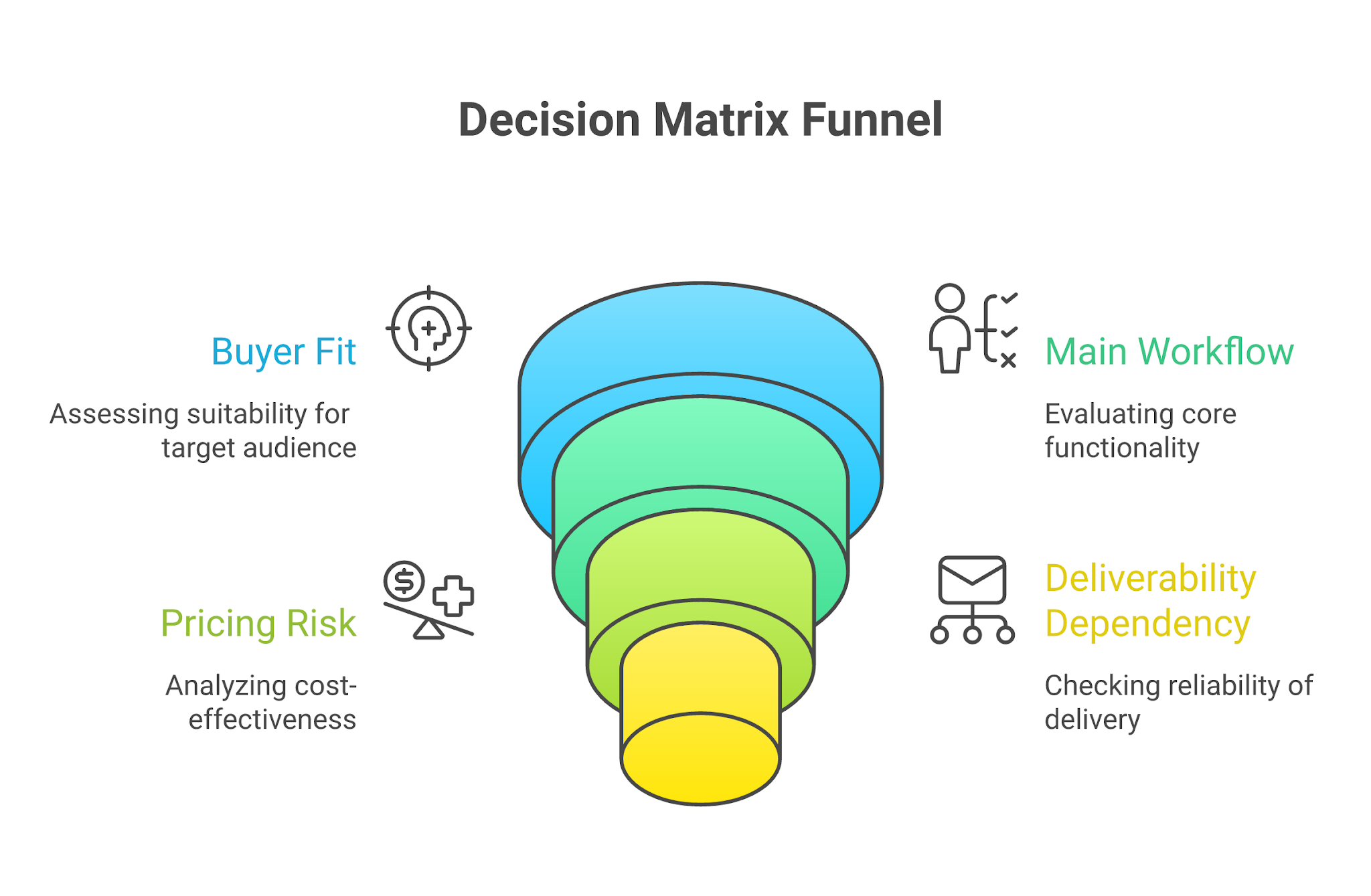
This is a source-grounded evaluation, as of May 2026. We assessed each vendor against official product and pricing pages, public case studies, recent pricing analyses where pricing is not transparent, and public buyer feedback patterns. We did not claim first-hand testing.
Each tool was judged on six dimensions:
For listicle fairness, Salesforge is not automatically ranked first for every team.
Salesforge earns the top spot for teams where outbound execution and infrastructure are the bottleneck. If you only need a clean contact export for manual calling, Salesforge is heavier than you need.
Use this table as the first filter. It will not replace procurement, but it will stop the most common mistake of buying an AI SDR when the real problem is data quality, or buying a database when the real problem is sender infrastructure.
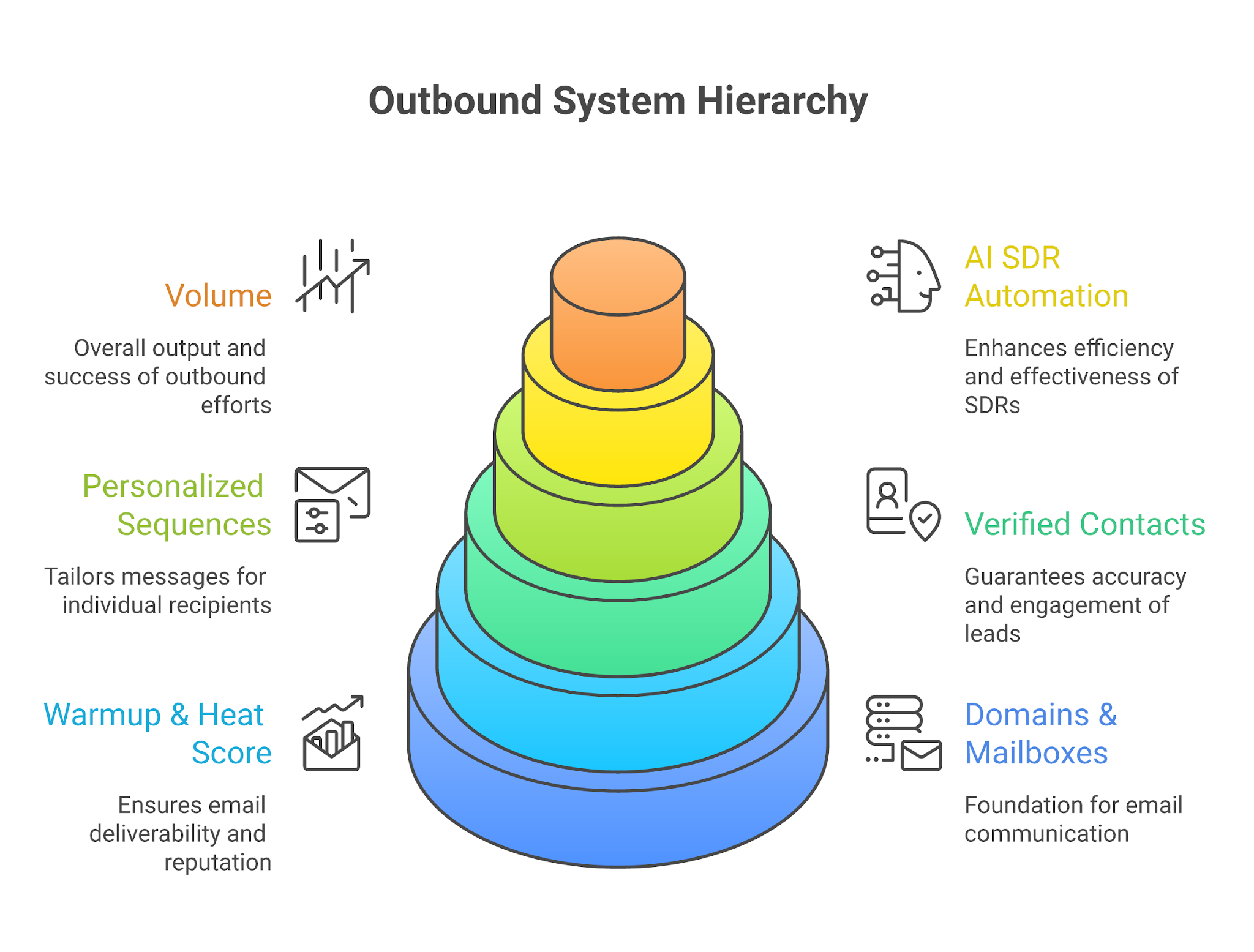
The right sequence is simple, ICP first, data second, infrastructure third, outreach fourth, agent autonomy fifth. Skip the order and you pay for automation that only scales bad inputs.
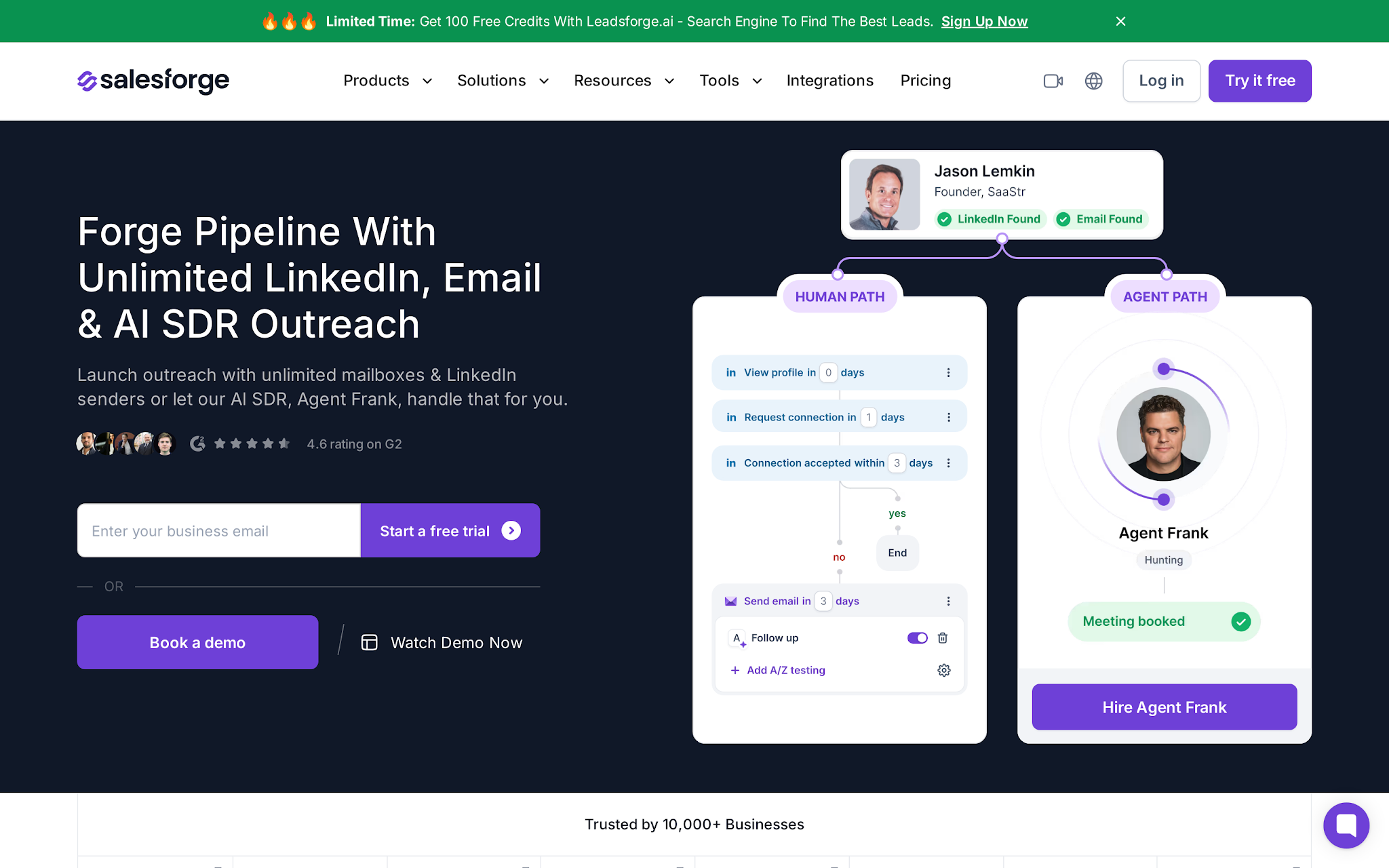
Salesforge is the strongest fit when the prospecting bottleneck is not contact discovery alone, but the operating system around outreach. The platform brings unlimited email mailboxes, unlimited LinkedIn senders, deliverability protection, and Agent Frank into the same outbound motion, which matters because prospecting does not stop at finding contacts. Someone still has to send, rotate, warm, monitor, reply, and book.
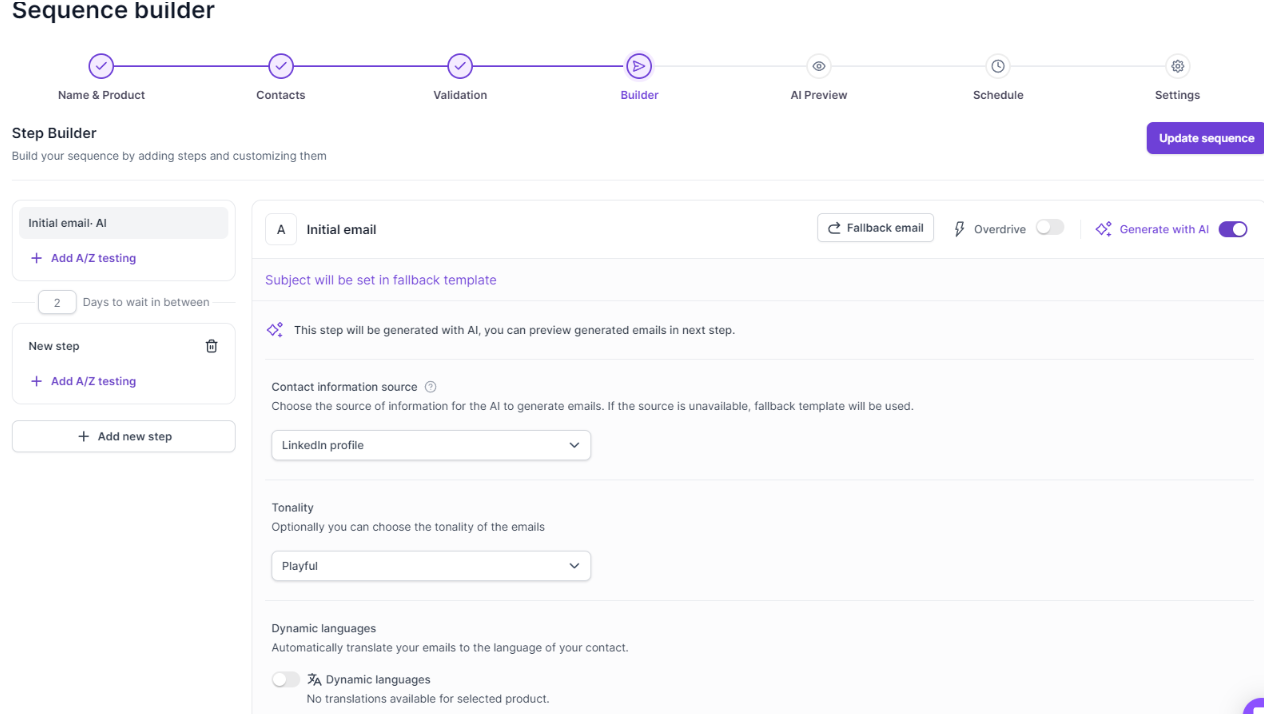
Salesforge is strongest when the buyer already believes cold outreach works but wants fewer disconnected tools. The Forge Stack covers the layers most teams duct-tape together, Leadsforge for prospect discovery, Mailforge/Infraforge/Primeforge for infrastructure, Warmforge for deliverability, Salesforge for sequences, and Agent Frank for AI SDR execution.
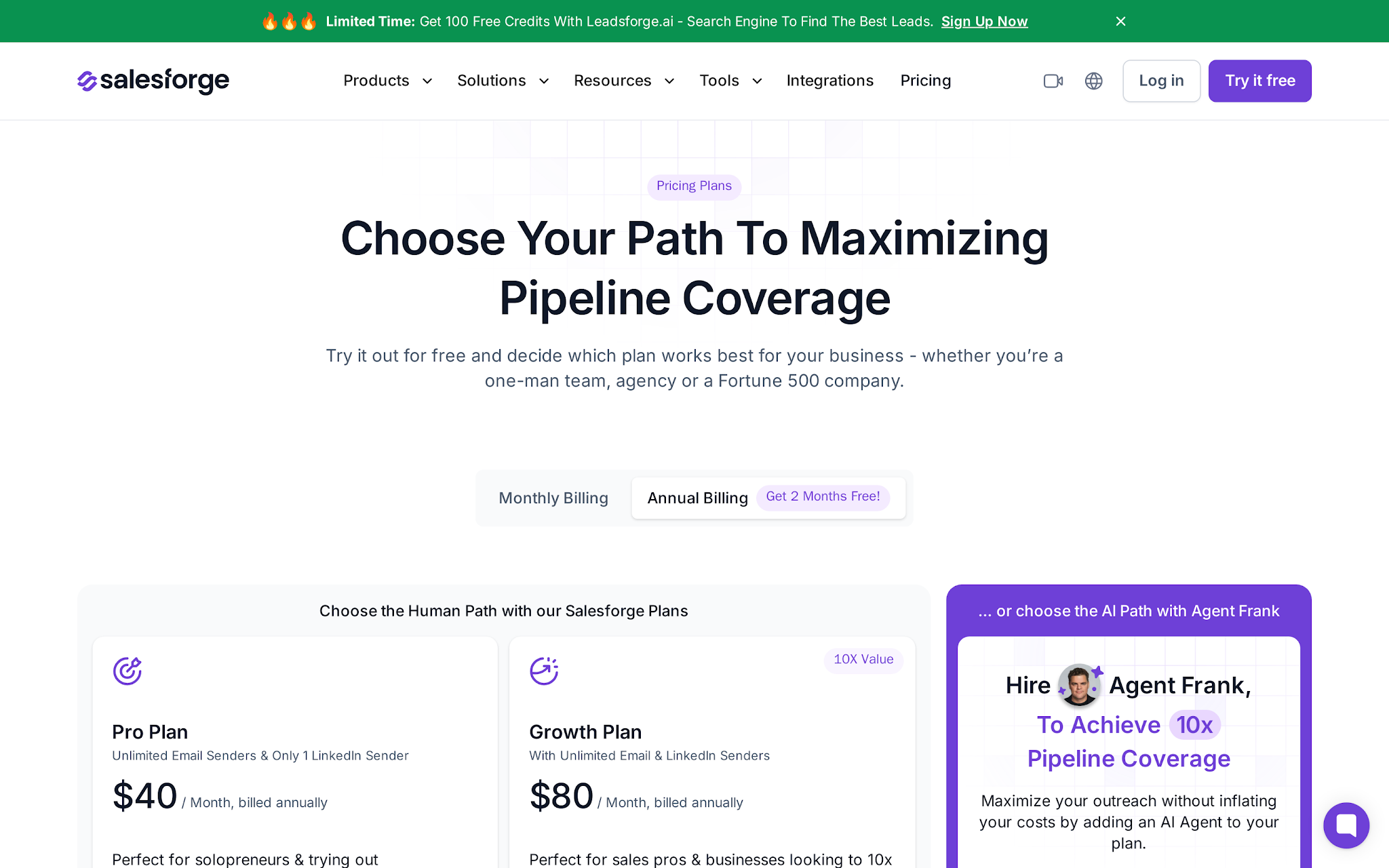
The practical wedge is infrastructure. Salesforge pricing includes unlimited premium warmup, unlimited mailbox connections, smart mailbox rotation, Primebox, sentiment analysis, and dynamic IP rotation on the human plans, with Pro listed at $40/month and Growth at $80/month on monthly billing. Agent Frank starts from $499/month billed quarterly, with 2,000+ contacts per month and 24/7 automated prospecting.
Best for: Founders, outbound agencies, and growth teams that care about sending volume, mailbox rotation, LinkedIn touches, warmup, and agent-assisted meeting booking in one stack.
Avoid if: You only need a contact database, you already have a locked enterprise engagement stack, or your ICP is still unproven.
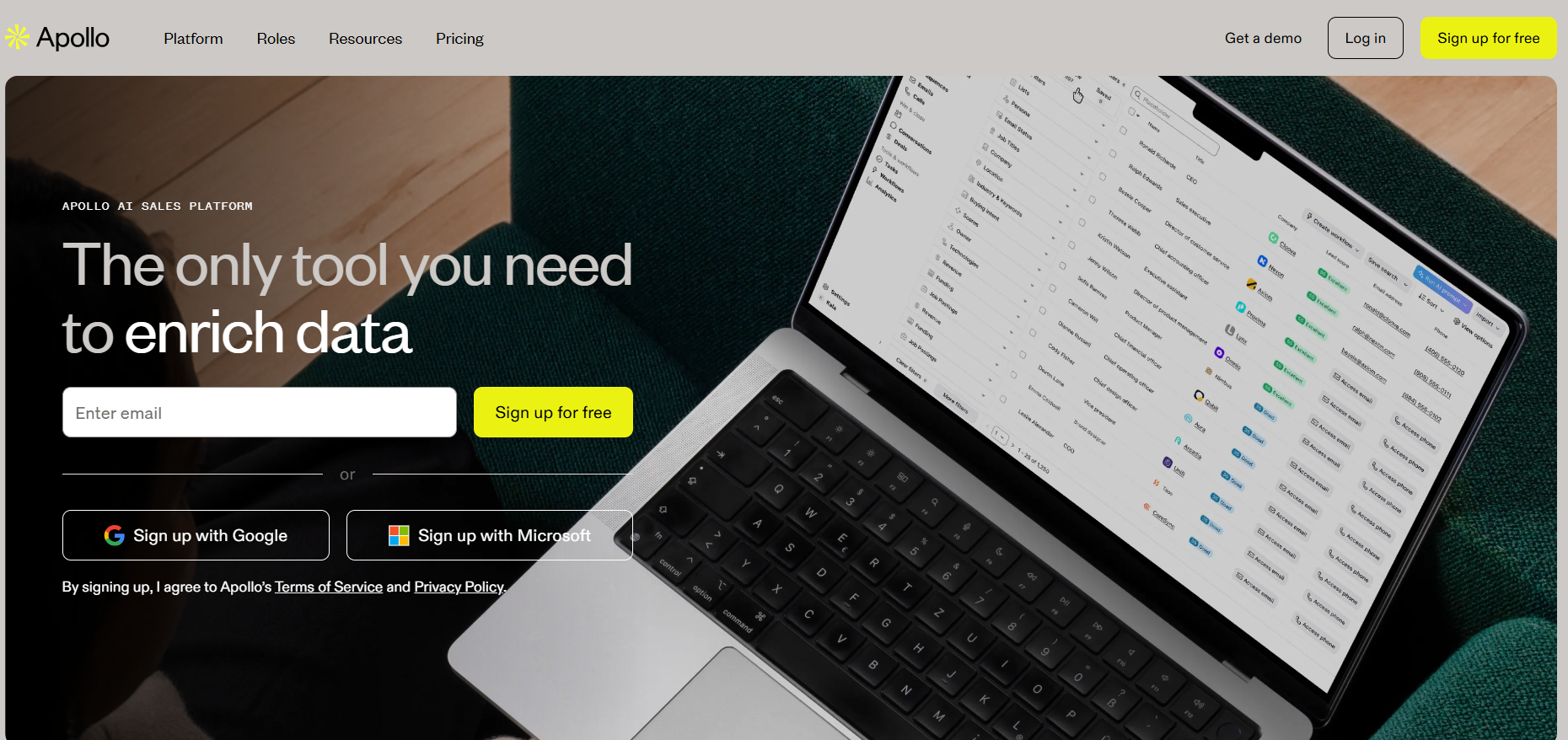
Apollo remains one of the easiest starting points for a lean B2B sales team because it lets reps move from search to sequence without a heavy RevOps build. The product spans outbound, inbound, enrichment, and deal execution, with plans structured for companies of multiple sizes, which makes Apollo's public pricing easier to understand than a fully sales-led data contract.
The buyer value is speed. A founder or small SDR team can search, save contacts, write sequences, and start outreach without stitching together a data provider and a separate engagement tool.
The credit, export-credit, and fair-use details are still worth reading closely because Apollo gets expensive when a team treats the database like an unlimited export machine.
The tradeoff is the same one operators report across large databases, data quality varies by market, persona, and geography.

Apollo is strong enough for a large percentage of SMB and mid-market prospecting, but serious outbound teams should still verify emails, suppress risky contacts, and monitor bounce rate before increasing volume.
Best for: startups and mid-market teams that need prospect search, contact data, and basic engagement in one place.
Avoid if: you need heavy mailbox infrastructure, agency-grade sender rotation, or custom enrichment logic across many providers.
Pricing read: Apollo can look cheap at first, but the real question is credit use, export behavior, user count, and whether you need separate deliverability tooling.
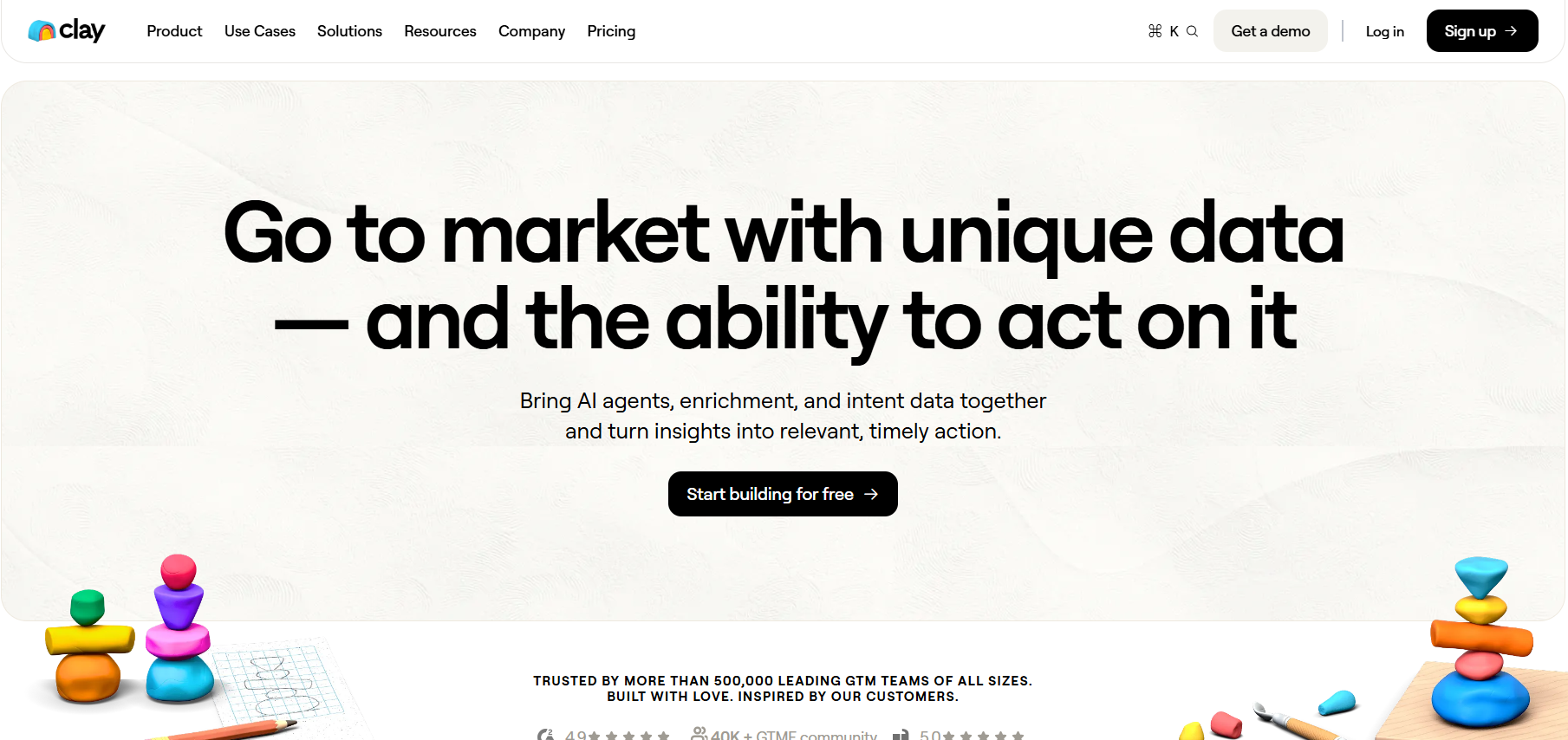
Clay is the tool for teams that want to build prospecting workflows, not just search a database. Multi-provider waterfalls, Claygent web research, bring-your-own API keys, signal tracking, CRM sync, and enrichment at scale give Clay a different job than Apollo or Lusha, it becomes the workbench where operators decide what a qualified account actually means.
That makes Clay unusually strong for complex ICPs. You can start with a broad account list, enrich firmographics, add technographics, run web research, classify accounts, score contacts, and push qualified records into your sequencer. For a GTM engineer, this is exactly the point, the workflow is programmable.
The tradeoff is operating cost and complexity. Clay's newer pricing model separates actions and data credits, and the buyer has to understand both. If your team treats Clay like a simple prospecting database, it will feel expensive and overbuilt. If you treat it like a GTM workflow builder, the math can work.
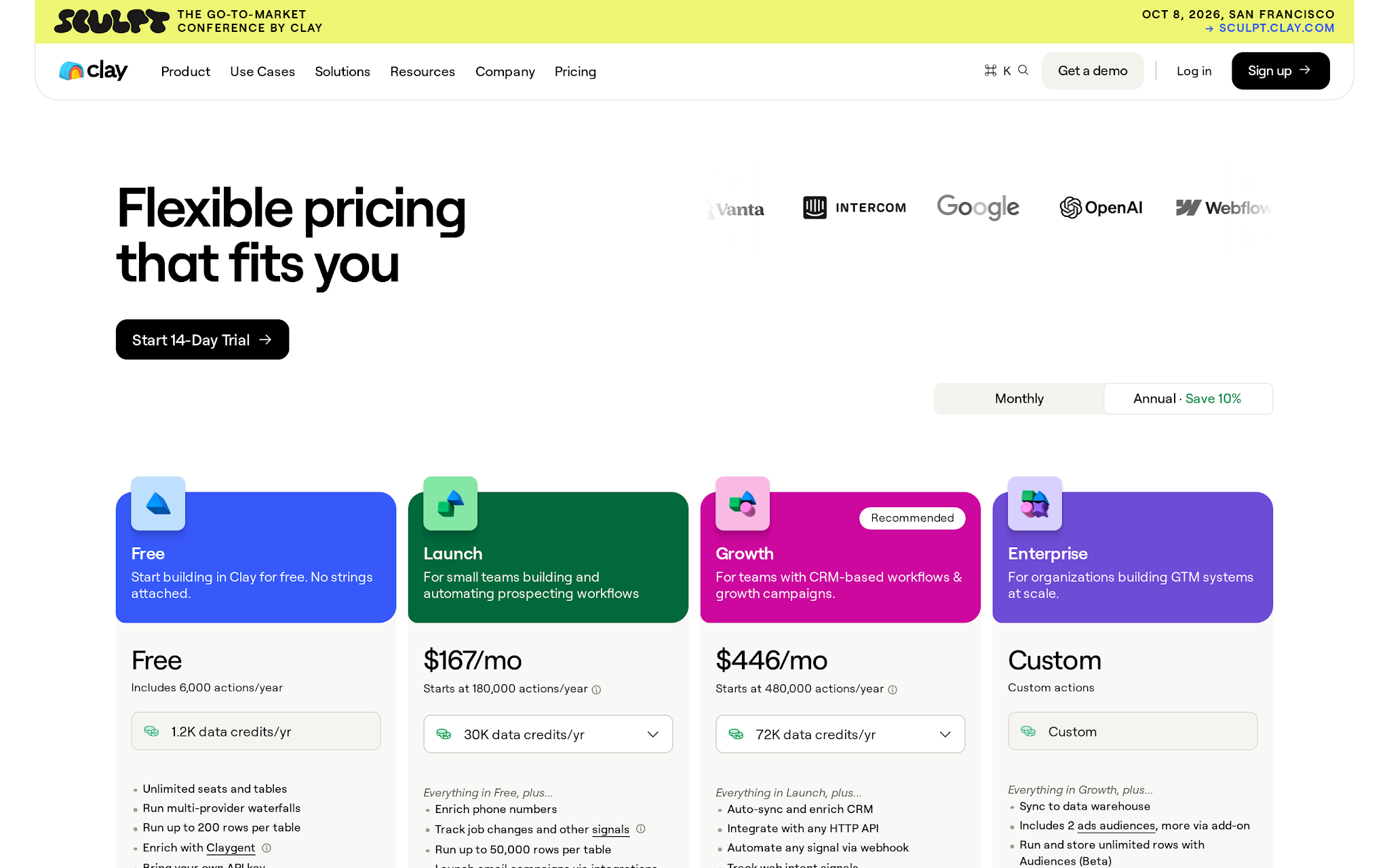
Best for: RevOps-led teams, agencies, and technical growth teams that need custom enrichment, waterfall logic, and signal-based list building.
Avoid if: your reps need a simple daily prospecting screen, or nobody owns the enrichment logic after launch.
Pricing read: start only after mapping the workflow. Count rows, enrichment steps, web research calls, CRM pushes, and ongoing refreshes before buying.
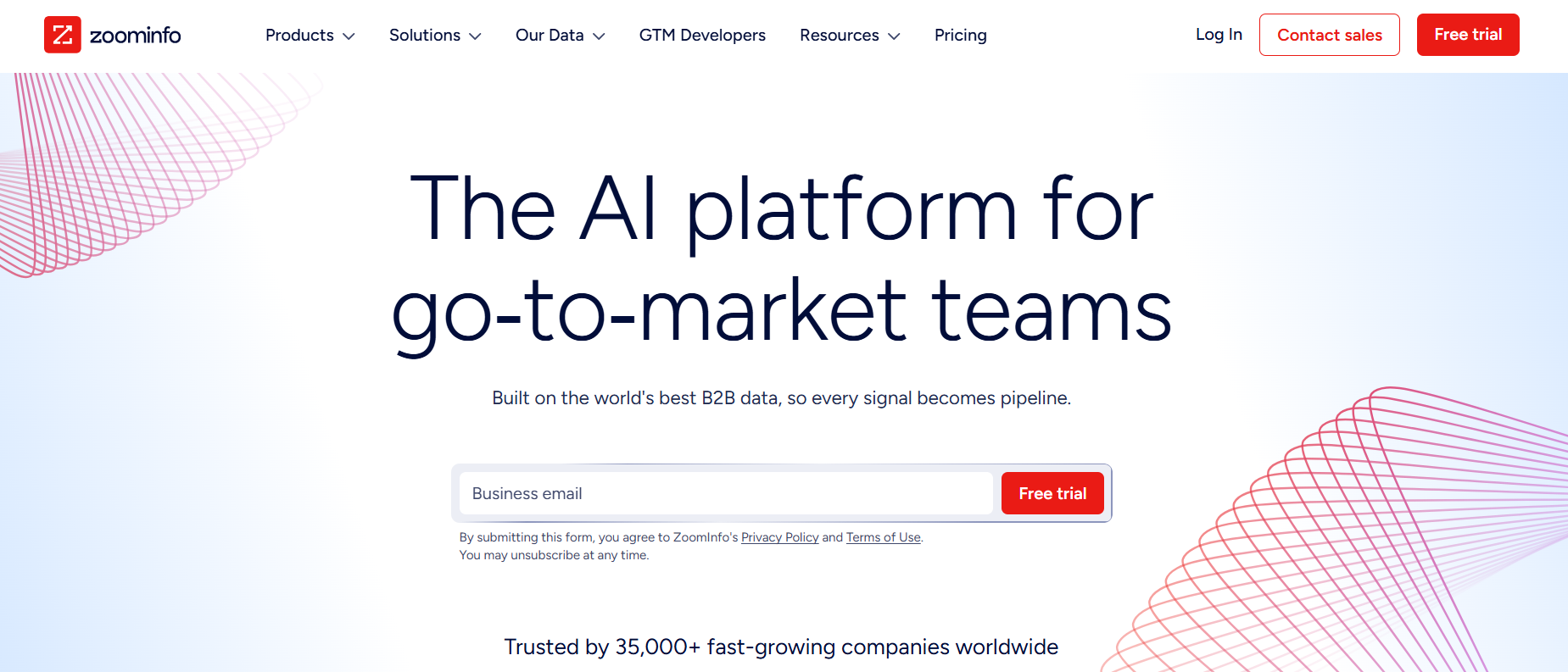
ZoomInfo is still the enterprise benchmark for B2B sales intelligence. It is strongest where teams need a large contact database, direct dials, intent, org intelligence, enrichment, and enterprise governance across more than one department. Its paid product set includes ZoomInfo Copilot, ZoomInfo Sales, ZoomInfo Marketing, ZoomInfo Operations, and ZoomInfo Talent, so the buying conversation is broader than SDR prospecting alone.
The value is not cheap contact lookup. It is coverage and control for larger revenue organizations. If you have territory rules, multiple SDR teams, sales operations, marketing operations, and account-based workflows, ZoomInfo can justify a premium because the data layer touches more than prospecting.
The tradeoff is procurement. ZoomInfo does not behave like a self-serve founder tool. Pricing is sales-led, contracts are heavier, and buyers should negotiate based on seats, credits, product modules, and renewal terms.
Best for: Enterprise and upper mid-market teams that need data depth, direct dials, governance, and intent signals across departments.
Avoid if: You are a small team that mainly needs verified emails for cold outreach. You will pay for enterprise surface area you do not use.
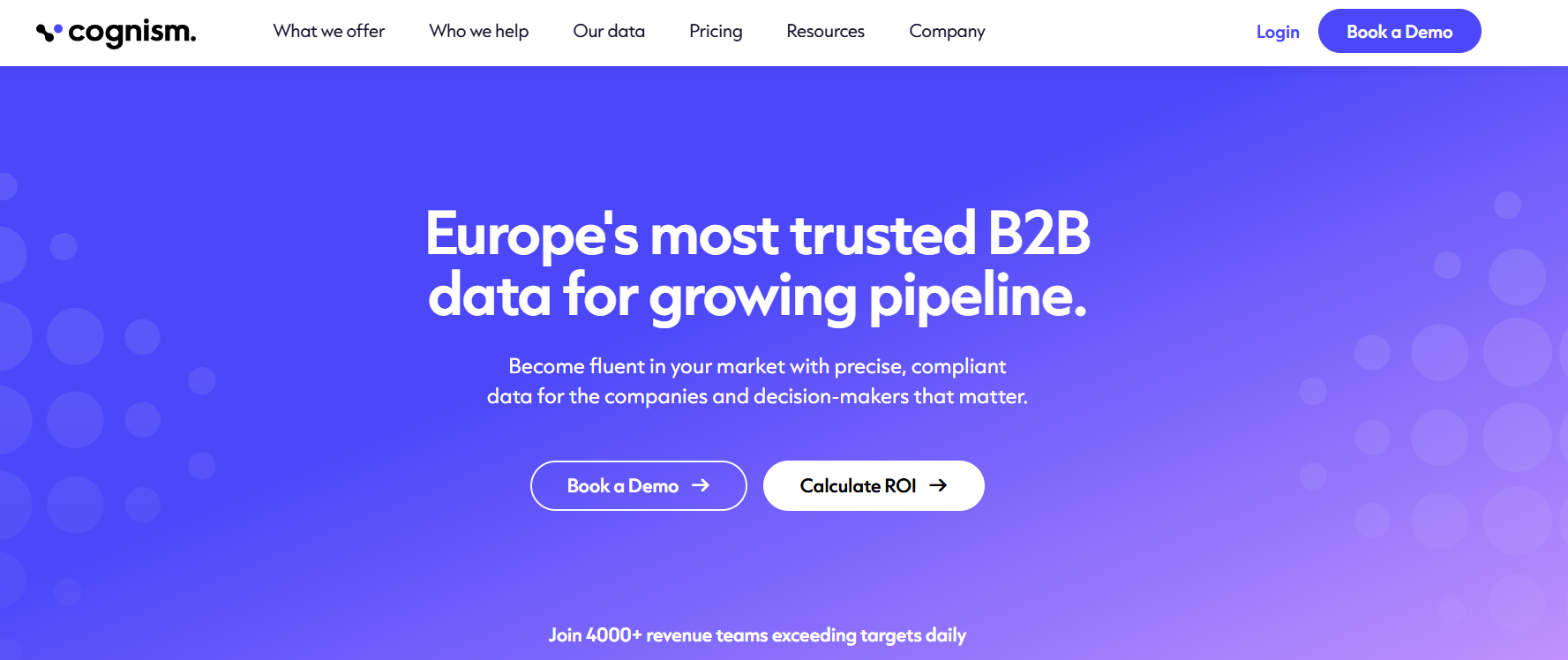
Cognism fits teams that care about high-quality B2B data, verified mobile numbers, buying signals, and compliance posture. The buying case is strongest when AI Search, account context, buying signals, browser-extension workflows over LinkedIn and websites, targeted lists, firmographic and technographic filters, AI account research, and account prioritization all feed a serious territory motion rather than one-off list pulls.
That is why Cognism should be judged on territory coverage, mobile accuracy, and account context rather than raw record count alone. Cognism is especially relevant when your outbound motion is not purely US-centric. For EMEA selling, data compliance and phone coverage become buying criteria, not nice-to-have details.
The tradeoff is that Cognism is a sales intelligence platform first. You will still need sequencing, mailbox infrastructure, warmup, and reply handling elsewhere unless you pair it with another tool.
Best for: Sales teams selling into Europe, teams that need mobile numbers, and RevOps teams that want a cleaner intelligence layer.
Avoid if: You are looking for one tool to find contacts, send sequences, rotate mailboxes, and book meetings.
Pricing read: Expect sales-led pricing. Judge it against territory coverage, mobile accuracy, compliance needs, and how much of your current data stack it replaces.
Lusha is a practical sales intelligence pick when reps need verified emails, phone numbers, buying signals, and a browser extension inside LinkedIn and company websites. The important buying detail is credit shape. Lusha prices a verified email reveal at 1 credit and a phone number reveal at 10 credits, so a call-heavy team burns budget differently than an email-first team.
The reason to consider Lusha is simplicity. Reps can reveal contact details, enrich records, and move faster without needing a complex workflow builder. Its API and GTM workflow positioning also make it useful for teams that want data inside existing tools rather than another full sales cockpit.
Lusha is not a complete outbound engine. You still need a sending platform, deliverability controls, and sequence management.
Best for: SMB and mid-market sales teams that need fast contact data and do not want enterprise procurement.
Avoid if: Your workflow requires custom waterfall enrichment, agent-led outreach, or multi-mailbox sending controls.
Pricing read: Model phone usage carefully. A phone-number-heavy motion consumes credits differently than an email-first motion.
Seamless.AI belongs in the shortlist when the team wants high-volume prospect discovery, contact data, and automated outreach from one vendor. The public product promise is verified prospects, automated outreach, and meeting growth, so the right evaluation is not “does it have contacts?” It is whether the contacts are accurate enough for your ICP and whether the contract model fits your risk tolerance.
Its practical fit is teams that want a large contact search engine and are comfortable buying through a more sales-led process. It can work for reps who spend much of the day building lists and finding direct contact paths.
The tradeoff is buyer confidence around pricing and data accuracy. Public pricing detail is limited compared with tools like Lusha or Apollo, and user feedback around cancellation, credits, and contact accuracy is mixed. That does not make the product unusable. It means procurement should test a narrow ICP sample before committing.
Best for: teams that prioritize contact discovery volume and can run their own quality checks before sending.
Avoid if: transparent pricing, flexible cancellation, and deliverability controls are top buying requirements.
Pricing : ask for the full credit model, contract term, cancellation terms, export rules, and what happens when contact data is wrong.
If this is the point where your notes say “we need more contacts,” pause for one operational check. More contacts only help when your domains, mailboxes, warmup, suppression rules, and reply workflow can absorb the extra volume.
For email-first teams, that is where Salesforge should enter the shortlist. Use Salesforge when the bottleneck is not merely finding names, but turning verified contacts into safe sending volume across mailboxes, LinkedIn senders, warmup, and Agent Frank.
If the current stack already has data but reply rates are weak, test the outbound system before you buy another database.
Amplemarket is a broad outbound platform: data, signals, sequencing, dialer, deliverability features, and AI prospecting workflows. Lead generation and signals, email and phone credits, Duo Voice, Duo Inbox, sequences, analytics, A/B testing, CRM integrations, and deliverability tooling make Amplemarket a consolidation bet, not a narrow data purchase.
The buying argument is consolidation. If your team currently pays for a data tool, sequencing platform, dialer, warmup tool, and reply assistant, Amplemarket can reduce stack sprawl. That is where it feels strongest.
The broad platforms need adoption discipline. If reps only use the database and ignore signals, inbox workflows, or deliverability features, the effective price goes up.
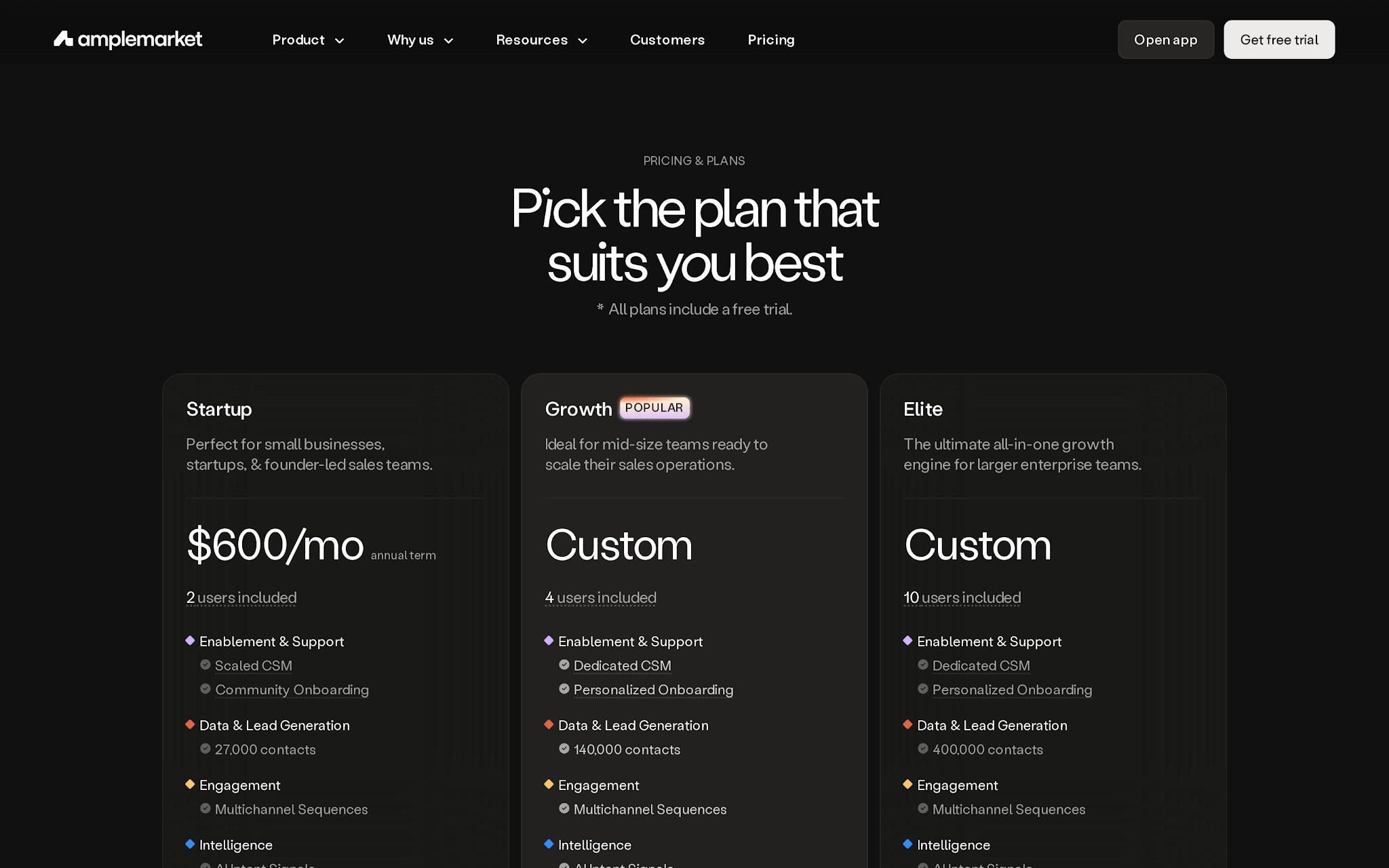
Best for: SDR teams that want data, multichannel engagement, signals, and deliverability features in one operating system.
Avoid if: You already have a mature best-of-breed stack and only need one missing layer.
Pricing read: Compare Amplemarket against the tools it replaces, not against a narrow data provider.
Regie.ai has moved beyond copy generation into a full prospecting system. Regie's public pricing puts AI SEP at $180/user/month with a 10-seat minimum and Force Multiplier Rep at $499/user/month with a 5-seat minimum.
Force Multiplier adds enrichment credits, custom waterfalls, bounce and job verification checks, a parallel dialer, mailbox rotation, research agents, and reasons to engage.
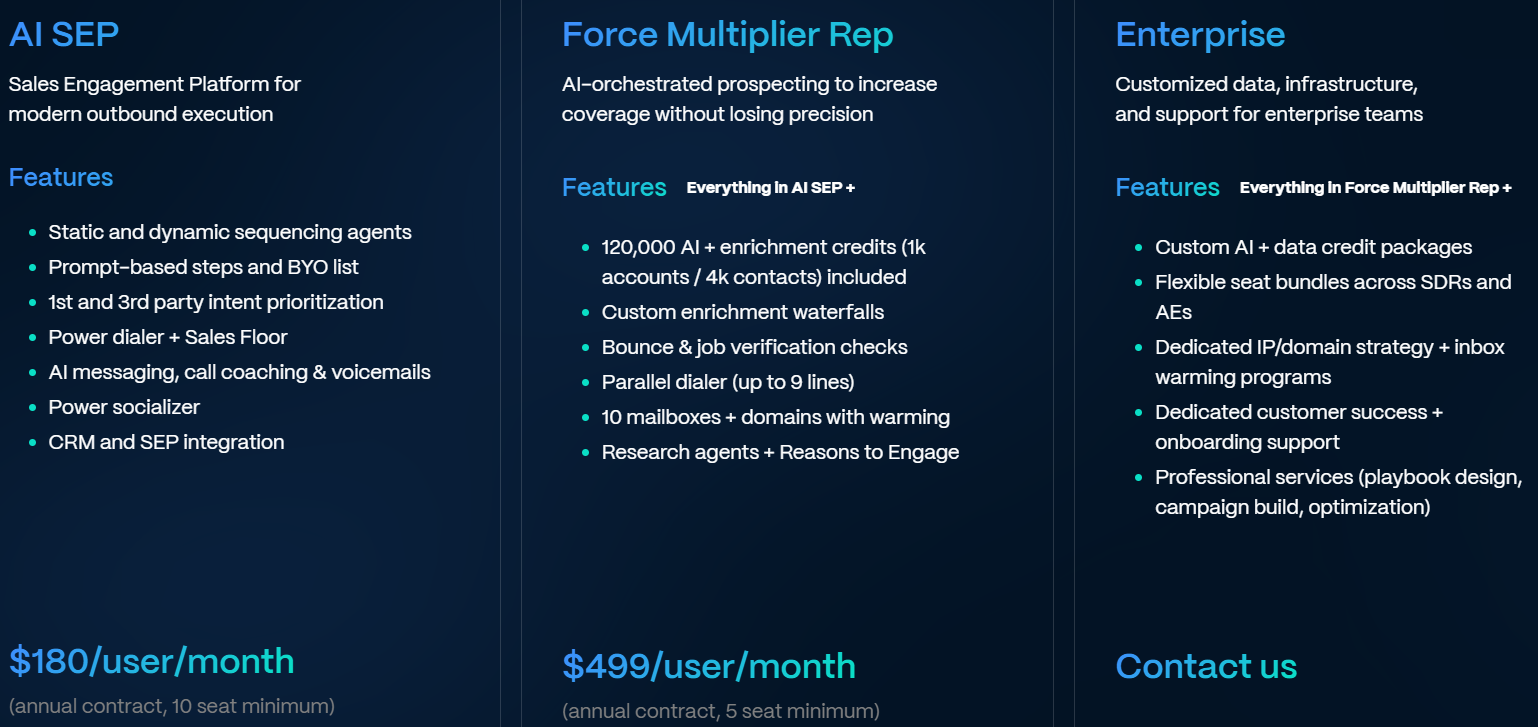
That is a serious outbound operating layer. Regie makes the most sense when a revenue org wants agent-assisted prospecting, sequencing, data enrichment, dialer coverage, and manager visibility under one contract.
The tradeoff is minimum spend. A 5-seat or 10-seat minimum puts Regie outside many founder-led and agency budgets.
Best for: Enterprise SDR teams that want AI prospecting, dialer, enrichment, and sales engagement under one governed platform.
Avoid if: You are a solo founder, small agency, or email-first team that does not need phone-heavy orchestration.
Pricing read: Calculate seats, enrichment credits, mailbox rotation add-ons, dialer needs, and implementation effort before comparing it to cheaper tools.

11x sells Alice as a digital SDR for outbound pipeline creation. Alice Growth is visibly priced from $3,750/month billed annually, with up to 5 end users, 2,000 new prospects per month, managed Gmail mailboxes, domain setup, warmup, inbox rotation, monitoring, CRM sync, and support.
The public pricing copy also references $36,000 per year, so buyers should confirm the contracted annual price during procurement rather than relying on one number.
The value is packaging. 11x does not ask a buyer to assemble data, infrastructure, warmup, and sending logic from scratch. It sells a worker-like system with a monthly prospect capacity.
That is attractive for teams that want an AI SDR program without owning every operational detail. The tradeoff is control. If your ICP, compliance rules, messaging, or infrastructure preferences are highly specific, a managed AI SDR model can feel less flexible than building your own stack.
Best for: Funded B2B teams that want an AI SDR with bundled infrastructure and can commit to annual spend.
Avoid if: You need granular control over every enrichment source, sender setup, and message path.
Pricing read: Compare the visible $3,750/month Growth price and the FAQ's $36,000/year reference against the fully loaded cost of one SDR plus tools, not against a $99/month database. The buying question is whether the managed worker model is worth the control tradeoff.
Artisan Ava is for buyers who want the AI BDR promise packaged as a named agent. Ava is presented as finding prospects, sending personalized outreach, handling objections, and booking meetings, with B2B data, enrichment, signals, multichannel sequences, and meeting booking.
Trial access with credits lowers the initial test barrier, but it does not remove the need for campaign governance.
Ava fits buyers who want the category promise directly: less manual BDR work, more automated prospecting, and a single named agent to manage. That can be compelling for teams that do not want to build Clay workflows or manage several point tools.
The tradeoff is proof. AI SDR products live or die on data quality, guardrails, and reply handling. If the tool contacts weak-fit prospects or over-automates nuanced replies, the pipeline damage is real.
Best for: Teams testing AI BDR coverage with a defined ICP and a willingness to monitor early campaigns closely.
Avoid if: Your outbound motion requires careful enterprise account research, legal review, or high-touch founder-led messaging.
Pricing read: Confirm what credits buy, how many prospects can be contacted, what channels are included, and where humans approve messages.
HubSpot Breeze Prospecting Agent is built for teams already working inside HubSpot. The agent monitors buying signals, sources contacts, personalizes outreach, and lets users review emails before sending or run in a more autonomous mode.
It is available in Starter, Professional, and Enterprise editions and uses HubSpot Credits at $1 for each recommended outreach contact.
The key advantage is CRM context. If your sales and marketing teams already live in HubSpot, prospecting inside the same data model reduces handoff friction. Reps do not have to export contacts into another system just to act on timing signals.
The tradeoff is ecosystem lock-in and credit forecasting. Outcome-style pricing sounds clean, but buyers still need to define what a recommended contact is worth and how often the agent will trigger.
Best for: HubSpot-centric teams that want prospecting tied to CRM records, signals, and existing sales workflows.
Avoid if: You do not use HubSpot deeply, or you need cold email infrastructure outside HubSpot's ecosystem.
Pricing read: Model credit burn by recommended outreach contacts, not by closed-won deals.
Reply.io is a sales engagement platform with Jason as its AI SDR. Jason is built around booking meetings by automating sales outreach, from finding prospects to handling responses. The buyer risk is not the base promise; it is the add-on map for LinkedIn, calls and SMS, AI/live data credits, and email validation.
Reply.io fits teams that already think in sequences and want agent help layered into a recognizable outbound platform. The workflow is closer to SDR enablement than a fully managed AI worker.
Best for: SDR teams that want multichannel sequences with AI assistance and still keep humans close to reply handling.
Avoid if: You expect a fully autonomous agent to own every conversation without rep review.
Pricing read: Quote the channels you will actually use: email, LinkedIn, calls, SMS, validation, and data credits.
Instantly started as a cold email sending and warmup tool, but its prospecting layer has expanded. SuperSearch now gives email-first teams a 450M+ B2B contact database, AI search, waterfall work email enrichment with 5+ providers, web research, email writing, community templates, and enrichment for jobs, news, technology, and funding, which makes Instantly more than a sequencer.
That makes Instantly relevant for email-first outbound teams that want fewer tools between list building and campaign launch. The credit model needs discipline: AI Sales Agent uses 5 credits per generated prospect, regardless of whether that prospect is approved, so review workflow affects cost.
The tradeoff is that Instantly is still strongest around cold email execution. If your prospecting program depends on phone, LinkedIn orchestration, or enterprise CRM governance, it may need support from other tools.
Best for: Cold email teams that want lead search, enrichment, AI writing, and sending close together.
Avoid if: You need enterprise revenue orchestration, direct-dial depth, or complex multichannel governance.
Pricing read: Calculate both sending plan cost and Instantly Credits usage. Generated prospects are not the same as approved pipeline.
Salesloft is not a pure prospecting database. It is a revenue orchestration and sales engagement platform where Rhythm prioritizes seller actions, brings buyer signals into one place, and helps teams decide what to do next. That makes Salesloft a fit for mature seller workflow, while sales-led pricing keeps it out of the low-cost contact-data comparison.
The prospecting value is workflow discipline. Salesloft helps larger teams make sure reps follow cadence steps, act on signals, and keep execution consistent. That is different from finding net-new contacts.
If your main problem is building lists from scratch, Salesloft is not the first tool to buy. If your main problem is standardizing outbound execution across reps, it belongs in the conversation.
Best for: SDR and AE teams with existing data sources, CRM governance, and a need for consistent execution.
Avoid if: You need a self-serve contact database or low-cost cold email stack.
Pricing read:Compare Salesloft to Outreach and other enterprise sales engagement systems, not to Apollo or Lusha.
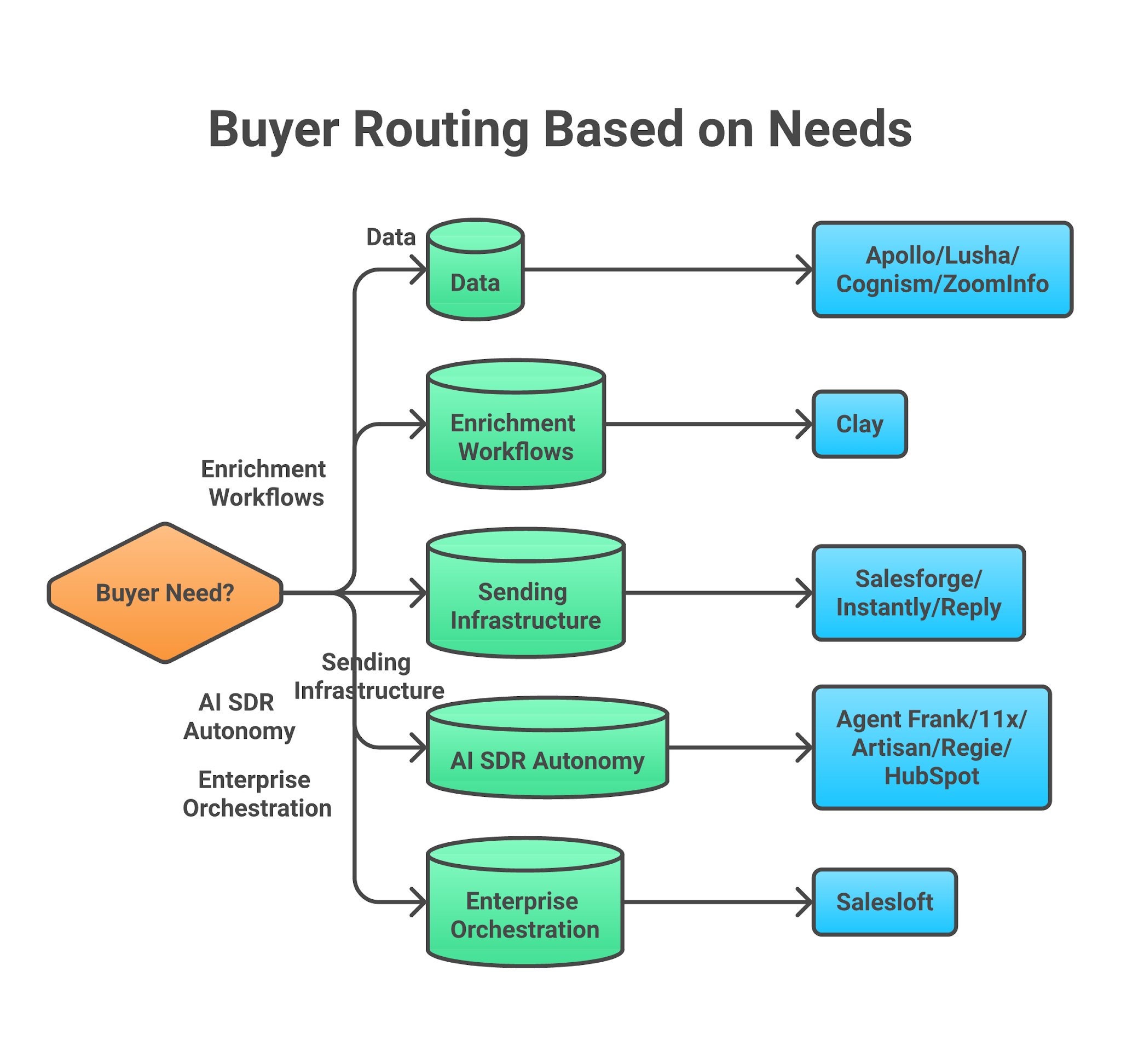
Start with the failure point, not the category label. If reps cannot find enough contacts, buy data. If contacts bounce, fix enrichment and verification. If good prospects do not reply, inspect message relevance and timing. If replies arrive but nobody follows up, fix inbox and handoff. If domains burn, stop buying prospecting tools and fix infrastructure.
A simple buying sequence works:
Two checks matter before you sign anything.
First, ask whether the tool owns the failure point or only exposes it. A database can show that your ICP is too broad, but it cannot fix sender reputation. A sequencer can expose weak copy, but it cannot make a bad list accurate. An AI SDR can follow up forever, but it still needs a clear market, verified contacts, and a deliverability floor.
Second, ask who will operate the tool every week. Clay needs a workflow owner. ZoomInfo needs RevOps governance. Salesloft needs manager discipline. Agent Frank needs ICP clarity and campaign guardrails. The worst purchase in this category is the one nobody owns after onboarding.
For B2B teams running cold outreach at volume, the best AI sales prospecting tool is the one that matches the broken layer in your system.
If you need contact data, start with Apollo, Lusha, Cognism, or ZoomInfo. If you need custom enrichment, use Clay. If you need email-first prospecting and sending, look at Salesforge or Instantly. If you want an AI SDR, compare Agent Frank, 11x Alice, Artisan Ava, Regie.ai, HubSpot Breeze, and Reply.io Jason against the amount of control you need.
For Salesforge's core buyer, the order is clear, infrastructure first, warmup second, list quality third, personalization fourth, volume fifth. Agent Frank makes more sense after those pieces are in place because he is not just writing emails.
He is finding prospects, sending across email and LinkedIn, following up, and booking meetings inside the Forge Stack.
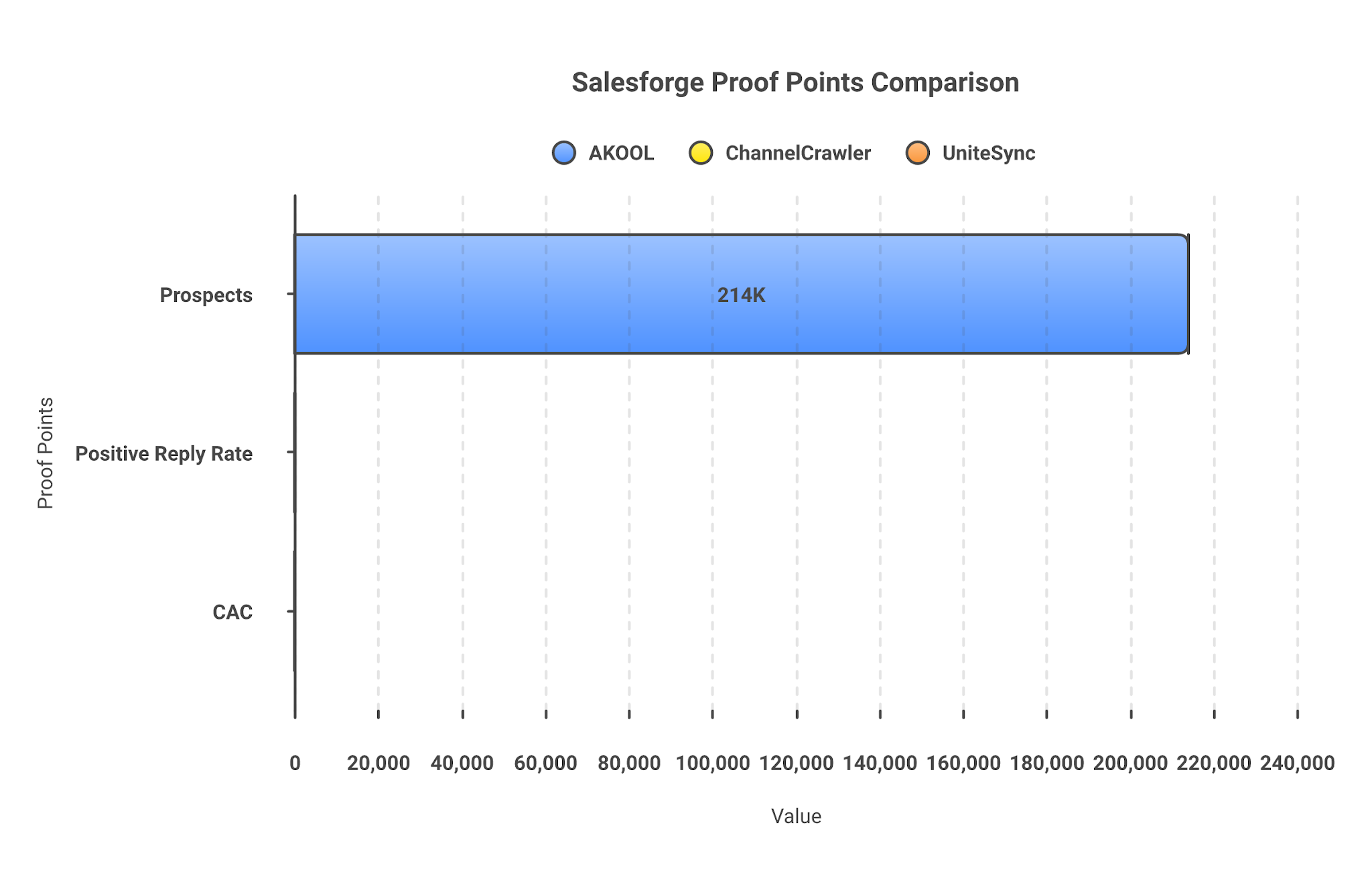
Salesforge has public proof points that matter for this category: AKOOL reached 214K+ prospects with a 16%+ positive reply rate, ChannelCrawler reported an 85.71% positive reply rate using Salesforge, Infraforge, and Warmforge, and UniteSync reported an 85.26% positive reply rate with a $2.86 CAC using Salesforge, Mailforge, and Warmforge.
If your outbound motion needs the same stack logic, start with the human path on Salesforge Growth or hire Agent Frank for AI SDR coverage. The free trial lets you test the operating system before committing budget, and no credit card is required.