Hiring an outbound agency sounds simple until you have to figure out what you're actually paying for.
You want someone who can find the right prospects, get your emails in front of them, and turn that outreach into meetings.
But once an agency starts talking about signals, Clay, deliverability, mailbox rotation, and all the machinery behind a campaign, it gets harder to tell what genuinely matters and what is just part of the pitch.
That's what made Reachly worth looking into.
They have a fairly specific way of running outbound, and unlike many agencies, they actually show some of the thinking behind their setup.
But a good outbound system is only part of the decision. You also need to know whether the results hold up, what the engagement actually looks like, and whether there are any gaps between what the agency promises and what you can verify yourself.
So that's what I wanted to find out with this Reachly review.
I went through the company's website and case studies, looked into its founders and their backgrounds, and checked independent sources including G2, Clutch, Trustpilot, GoodFirms, and Reddit.
If I were considering Reachly for my own outbound, these are the things I'd want answered before booking the call.
Here's a quick summary so you can decide whether reading further is worth your time.
That's the ten-thousand-foot view. Here's where I actually land after digging deeper.
Hire Reachly if you're a B2B founder in APAC with a $10,000-plus ACV, you want a done-for-you outbound partner who publishes the operational math instead of hiding behind buzzwords, and you have someone on your team ready to take the meetings the agency books.
Two things support this. The Clay first-100 Solutions Partner credential is real, and the deliverability spec on their Email Deliverability page is genuinely detailed.
Most agencies at this price point say "we protect your domain reputation" and stop there. Reachly names the domain count, the mailbox count, the bounce thresholds, and the idle-rotation math. That's operator work.
Founder Thibault Garcia's LinkedIn also checks out.
He scaled BD at Taboola APAC, InMobi SEA, and Agoda Media Solutions before launching Reachly, and the second case study, The Great Room, corroborates its numbers with a named Head of Sales quote and specific funnel data. That's operator pedigree, not consultant pedigree.
Treat this as a conditional yes. Book the discovery call, ask them to reconcile the Primal relationship, publish the contract terms in writing, and walk you through three direct client references outside their case study set. Sign if the answers hold up. Walk if they don't.
I have not been a Reachly client, so this review is research-based. I evaluated them the way I would shortlist any done-for-you outbound agency for my own pipeline.
I went through every service page on reachly.co, both published case studies, and their About and Services pages. I read Thibault Garcia's public LinkedIn Experience and post activity, cross-referenced independent 2024 APAC-launch press coverage, and searched Clutch, G2, Trustpilot, GoodFirms, and DesignRush for independent reviews. I also searched Reddit and LinkedIn for third-party sentiment.
I scored them against the questions I ask every agency in this category. I want to know who owns the sending infrastructure and domains if the engagement ends, whether the person selling me on the call is the person running my account, whether the case study numbers can be corroborated by named client contacts, and whether the tenure and credentials story is consistent across their own site and third-party listings.
Here's what I found on the services side.
Reachly sells eight services on their Services page, all built on the same done-for-you retainer model. TAM mapping, signal-based account scoring, contact sourcing and verification, deliverability infrastructure, copy and sequencing, and inbox management with meetings booked directly onto your calendar.
The eight services are Outbound Lead Generation, SDR as a Service, Cold Email Agency, LinkedIn Outreach Agency, B2B Appointment Setting, SaaS Lead Generation, LinkedIn Ghostwriting, and Email Deliverability.
The first two are the same offer packaged for two different buyer mindsets. One reads as a project buyer's landing page, the other as a headcount-replacement buyer's landing page.
If you want to compare quotes cleanly, ask which line item you are actually being priced against.
Here's how their offer compares against certified agencies in the Forge Expert Network, a directory of verified agencies that meet Salesforge's certification requirements.
Every Reachly cell comes from their public material. Confirm the details on your discovery call.
Their site describes a six-step "How it works" flow on the homepage and a week-by-week timeline on the service pages. I've mapped both to the six stages you'll actually experience as a client, with the questions to raise at each one.
Every engagement starts with a call framed as a "free outbound audit" or "book a call." Reachly's SDR as a Service page says the call covers your TAM, the signals worth targeting, and the volume it takes to hit your number. You leave with the plan whether or not you sign.
Ask what deliverable comes out of the audit call and whether it's yours to keep if you don't sign. A useful audit deliverable is one you could show a competitor and still get value from.
Reachly maps your addressable market, and scores accounts against their signal criteria before any contact enrichment happens. This is the right sequence. Accounts get scored through Clay's enrichment waterfall alongside Trigify for intent monitoring.
Ask what the scoring criteria are and whether you get to see and adjust them. A scoring model you can't inspect is a black box you are paying to trust.
Contacts get sourced from LinkedIn Sales Navigator and enriched through a waterfall of email-finding providers, including Icypeas. Every email address gets double-verified before it enters a sequence, and Reachly's rule on their Email Deliverability page is to pause any campaign whose bounce rate crosses 5 percent.
Ask what happens operationally when a bounce threshold trips. Pausing is the right call, but ask how they rebuild the send volume afterward without disrupting your pipeline.
Domains get bought, and mailboxes get provisioned via Zapmail. Warmup runs for four weeks through Smartlead, with weekly rotation and blacklist monitoring on every mailbox. Reachly's published spec is 72 domains and 180 mailboxes to sustain 30,000 emails a month, with roughly a third of the pool resting at any time.
Ask whether the domains they buy remain your property if you leave. If the answer is no, you are renting your sender reputation, and losing it at contract end resets your warm-up and deliverability to zero.
LinkedIn campaigns go live first in week 3 while email finishes warming. Email sequences launch in week 4, sent plain-text with no tracking pixels and matched ESP rotation. Reachly's rule is to retire any angle that produces zero positive replies over 1,000 sends.
Ask whether you get to review copy angles before they go live and how quickly a failing angle gets swapped out. A 1,000-send test window is reasonable, but you should know when you can veto.
Every reply gets qualified by Reachly's team against your fit and intent criteria, and meetings get booked directly onto your calendar. A master inbox gives you visibility into every send, reply, and meeting in real time.
Ask for a sample weekly report from a comparable engagement before signing. Ask what happens if the qualified-meeting count falls short of what was discussed on the audit call, because the retainer stays flat either way per Reachly's own homepage.
Once you know how the outbound work runs, pricing becomes the next thing to pin down before signing.
Reachly publishes an entry price on their SDR as a Service page.
The flagship retainer starts at $3,500 a month for a flat fee that covers data, domains, mailboxes, and sequencing. That's unusually transparent for this category. Most competitors gate the number entirely behind a discovery call.
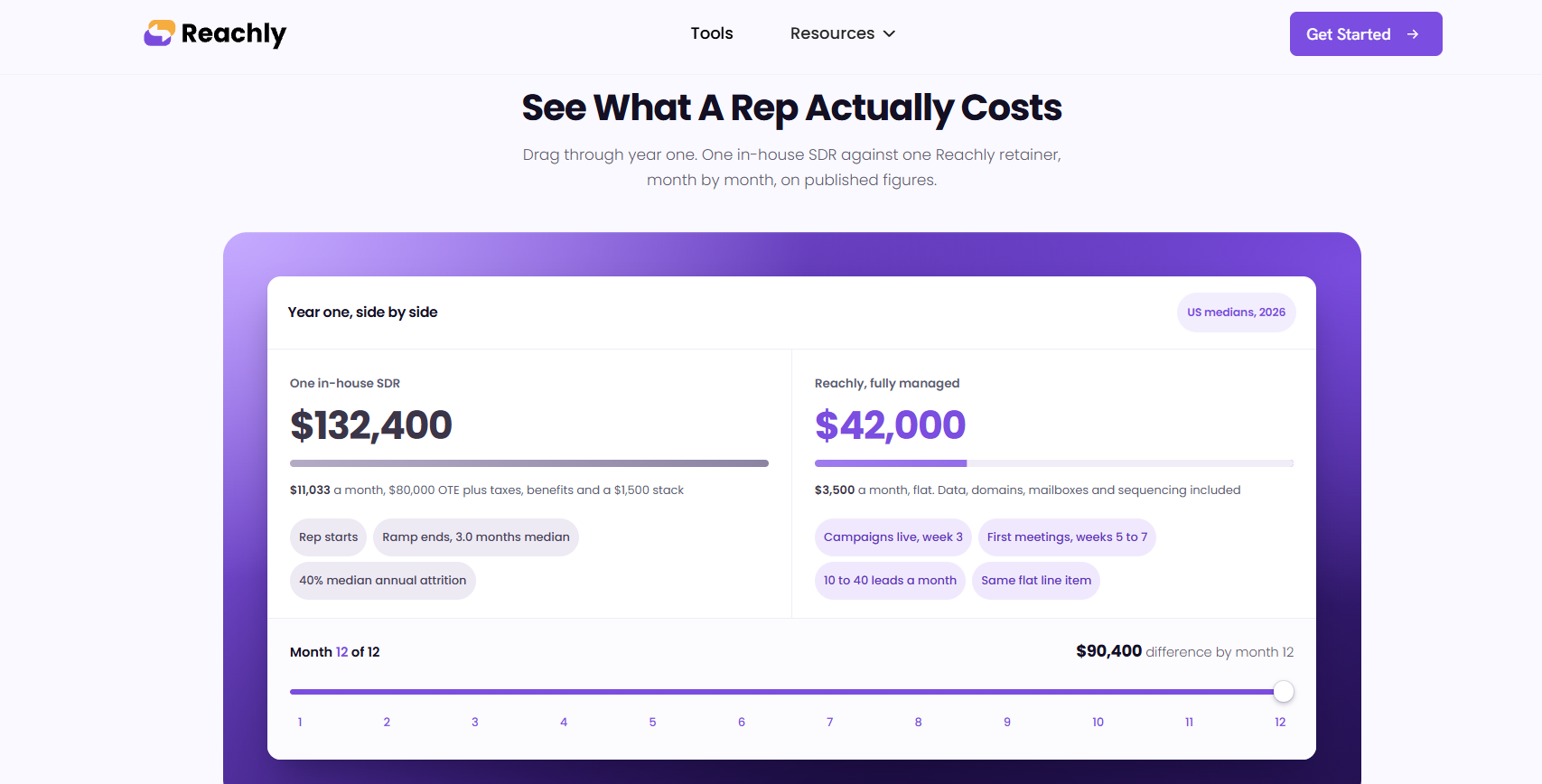
Watch for Clay Enterprise seats and workflow credits first. If Reachly is running your Clay stack, you are paying Clay directly on top of the Reachly fee.
Smartlead sending credits come next. Reachly names Smartlead as the sending platform, and while the retainer covers the sequencing work, high-volume sends can push you into higher Smartlead tiers.
Then you have the domain and mailbox costs. Reachly buys domains through Zapmail as part of the retainer, but if you want additional domains beyond the standard pool for a specific campaign, that is a separate line item worth asking about.
LinkedIn Sales Navigator seats matter if LinkedIn is a real channel for you. Enterprise seats can run higher than most founders expect when they scope only the base tier.
Data enrichment credits beyond Clay's default limits are the last thing to check. High-volume enrichment can burn through credits fast on the wrong workflow, and the overage bill lands separately from your monthly retainer.
Ask which of these are inside the Reachly quote and which are your responsibility. That single question can double or halve your all-in monthly cost.
Based on their published work, Reachly fits you well if:
Skip them, or at least compare harder, if:
If you're sending under a few hundred emails a month, you don't need a done-for-you agency at all. Running Salesforge yourself at $48 per month covers that volume with warm-up included.
For the founders who do fit the profile, here's what the reported outcomes actually look like.
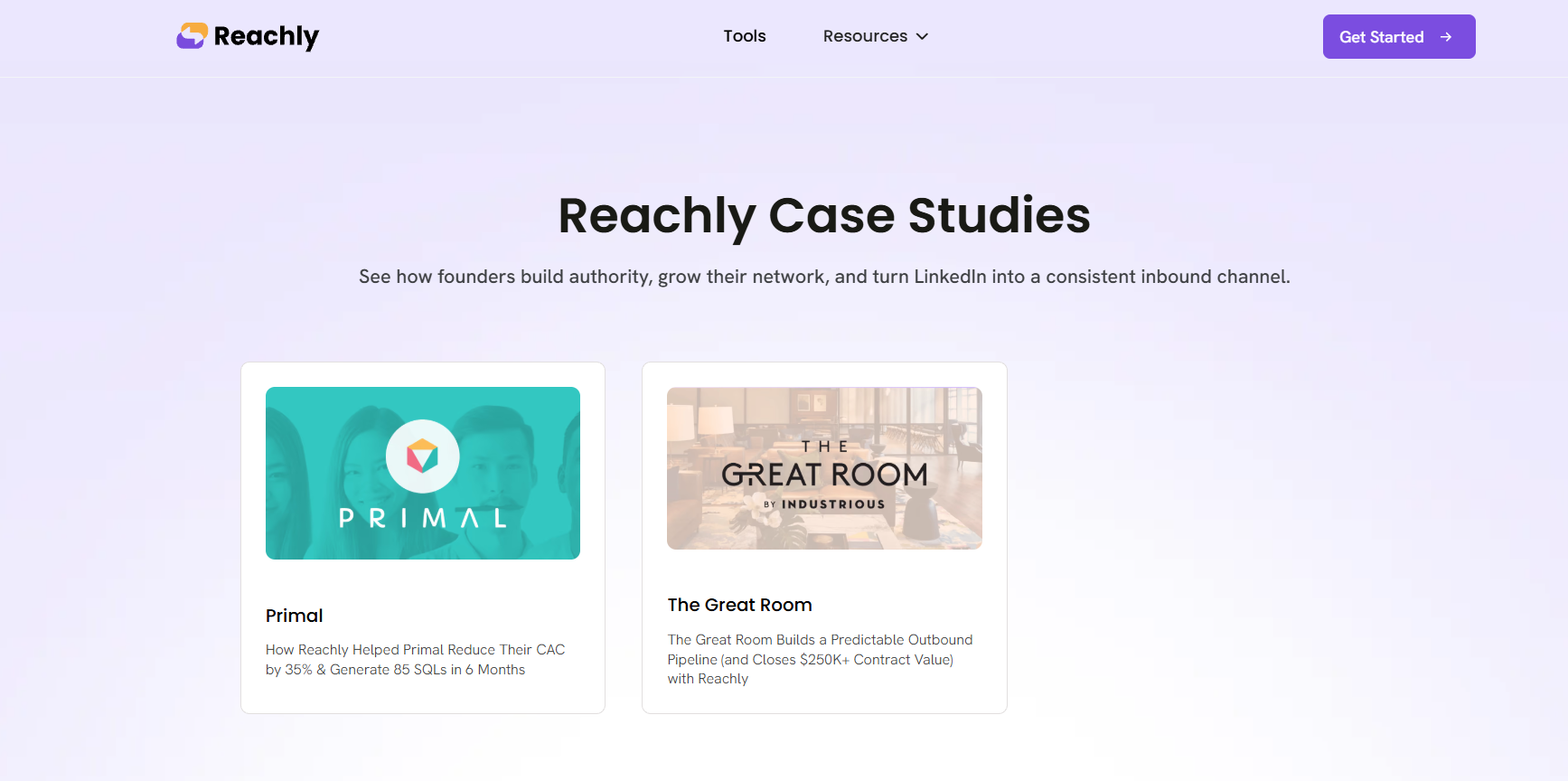
Reachly has two case studies published on their Case Studies page. Both are worth reading in full, and both come with context a buyer should know. All figures are as reported by Reachly.
Two things stand out.
Both case studies are APAC-based, which is a fit signal or a limitation depending on where you sell. And the results are specific and countable, which I trust more than vague lines like "boosted pipeline significantly."
Every agency has trade-offs. Here are the ones I found from Reachly's public material.
None of these should rule Reachly out on their own. If two or more matter to you, it's worth comparing agencies that already answer these questions on their profiles.
If Reachly isn't the fit, the worst thing you can do is Google "outbound agency" and pick the first result that pops up.
The Forge Expert Network is a directory of certified agencies who've been vetted on the Forge ecosystem, and it's a saner starting point than the SERP.
Here are three matched to different needs a Reachly shopper is likely to have.
Best for: Founders who want done-for-you outbound like Reachly but with US and EU market proof and an embedded delivery model.
The gap between "we run your retainer from Bangkok" and "we run your retainer with people who sell in your market every day" is one of the biggest reasons APAC-centric outbound partners struggle when the buyer is in London or Austin.
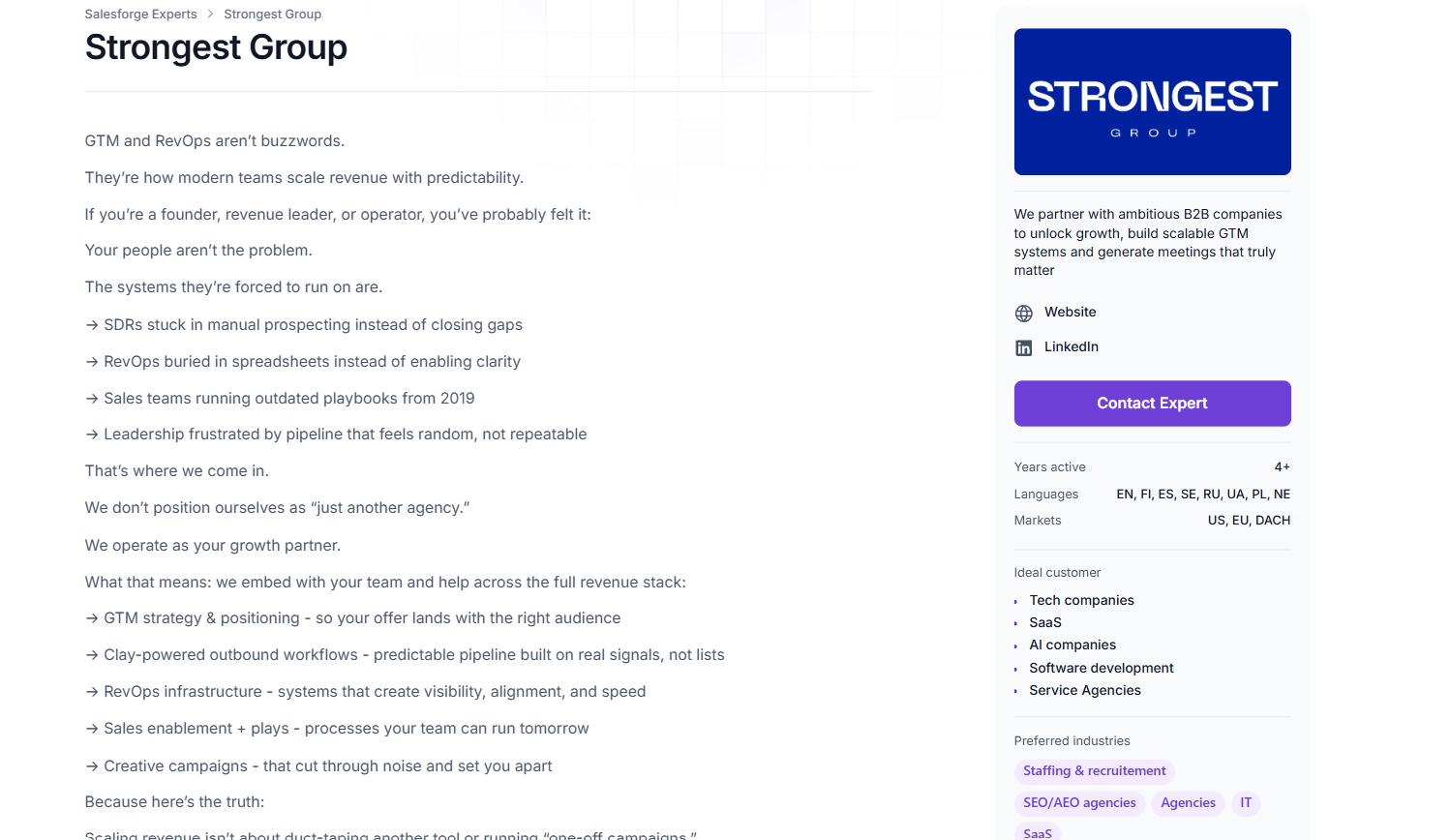
Strongest Group closes that gap. They embed with your team as a growth partner and cover the full stack from GTM strategy through RevOps down to Clay workflows and Scandinavian cold calling.
The difference matters most for founders whose buyers are in North America or Northern Europe, where local timezone coverage, local phone presence, and local case study evidence actually matter to the buying committee. If you liked Reachly's retainer model but need a partner with proof in your specific geography, this is the closer alternative.
Best for: Buyers who need cold calling as a real channel, not a nice-to-have.
Reachly layers cold calling in for high-value accounts, but the primary motion is email and LinkedIn with Clay as the enrichment layer. That's fine for APAC SaaS deals, but it becomes a problem the moment your ACV crosses six figures or your buyers are mid-market operators who don't answer email.
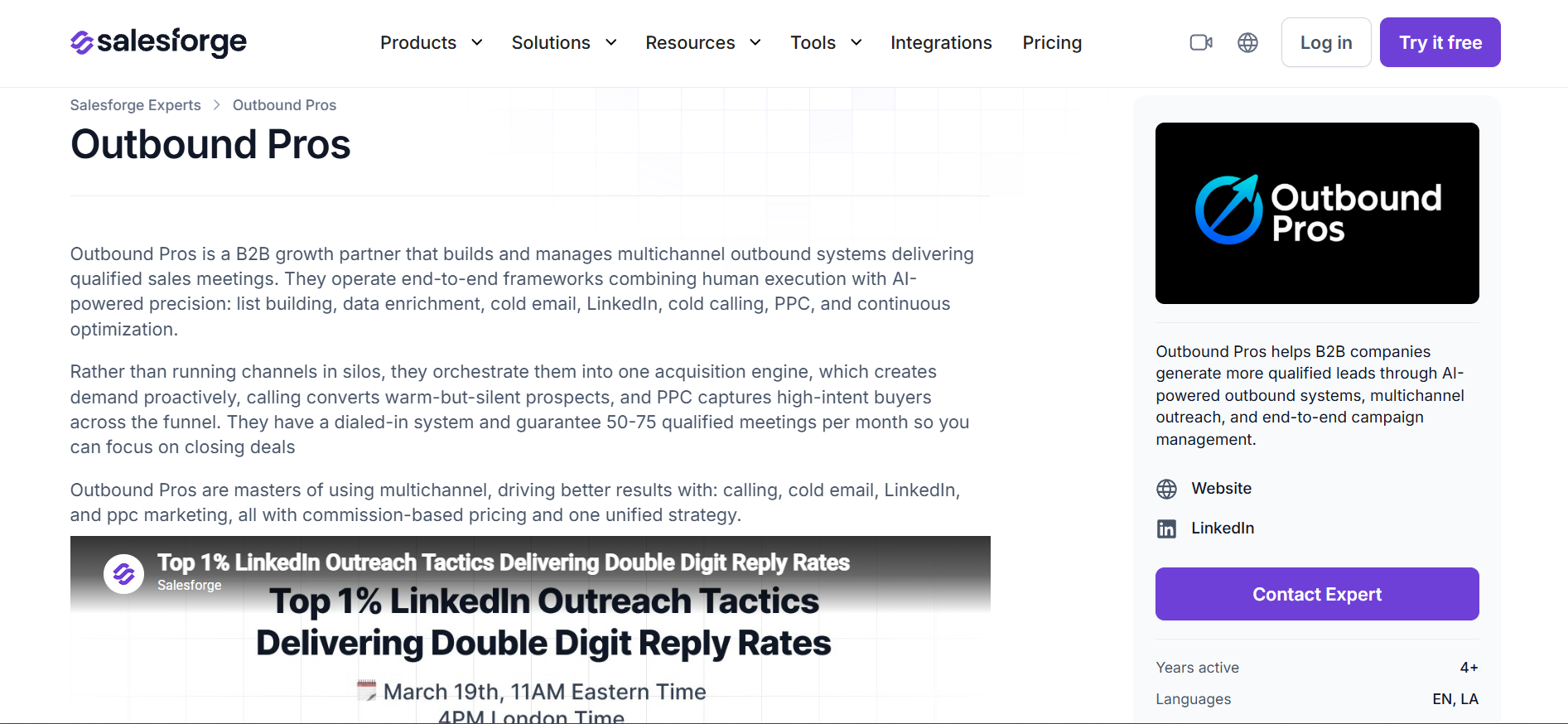
Outbound Pros builds cold calling into every campaign as a first-class channel alongside email, LinkedIn, and PPC. Their profile commits to 50 to 75 qualified meetings per month with commission-based pricing, which is a very different accountability model than Reachly's flat retainer. If the "retainer stays the same whether we hit your KPI or triple it" model felt too founder-friendly for the agency and too founder-unfriendly for you, the commission structure here reverses that dynamic.
Best for: Technical vertical operators in HealthTech, FinTech, and compliance who want Reachly's Clay-first, signal-based story but applied to short-cycle triggers.
The Clay first-100 Solutions Partnership is Reachly's strongest engineering credential. What Reachly doesn't emphasize is that most Clay workflows can be engineered for either volume outreach or signal-based outreach, and those are very different plays. Reachly's case studies lean toward volume.
The Primal engagement produced 85 SQLs in six months, which is roughly 14 meetings a month.
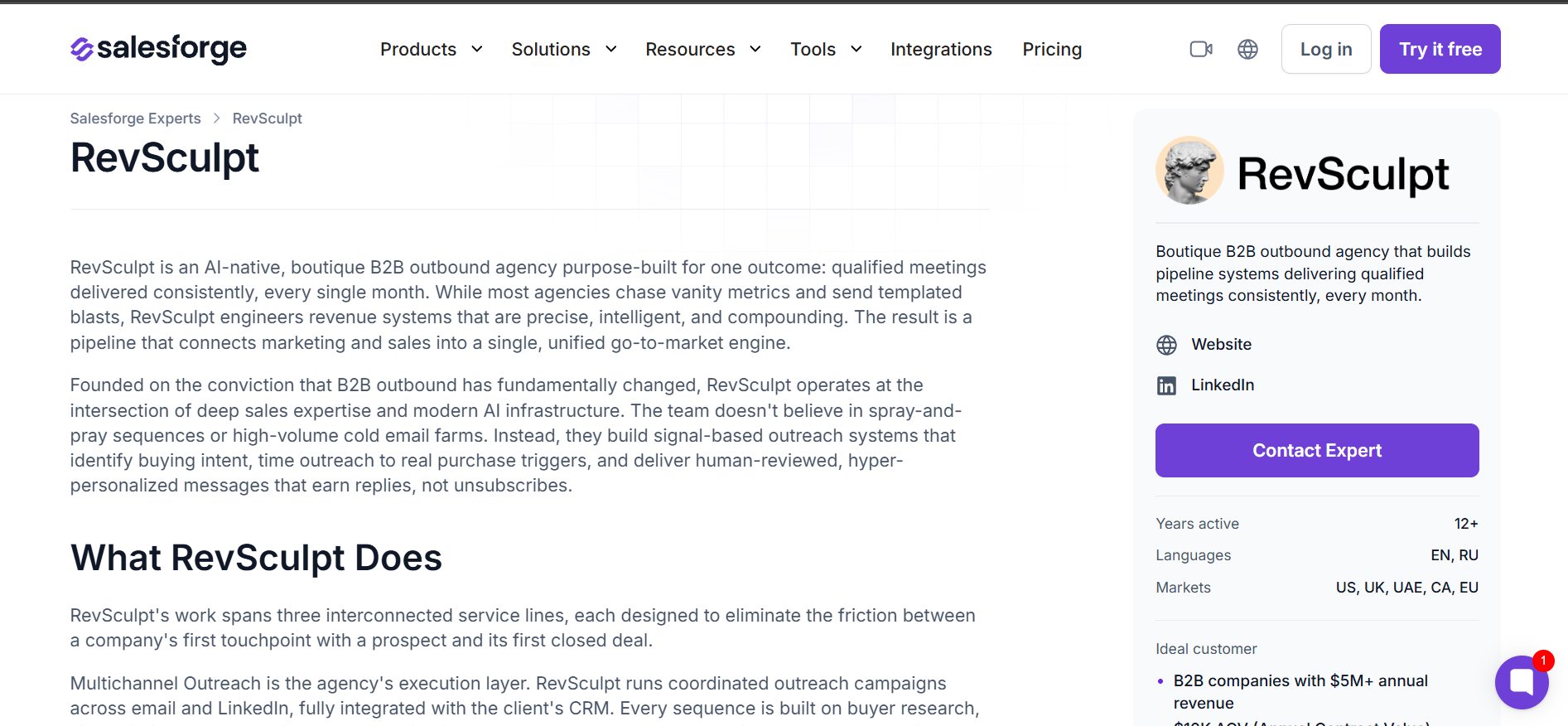
If you came for the Clay expertise but your ICP needs timing-based triggers like funding rounds, regulatory shifts, or exec moves more than volume, RevSculpt is the closer fit. Their profile reports over 6,000 qualified meetings scheduled across more than 15 B2B verticals, with most clients seeing their first meeting within 18 days of onboarding. That's the timeline signal-based work is supposed to deliver, and it's rare to see it stated on a profile.
There are two more routes worth knowing about.
You can run outbound yourself with Salesforge. It starts at $48 per month with unlimited mailboxes and free warm-up included, and it's the tool most Forge Experts run on the back end anyway.
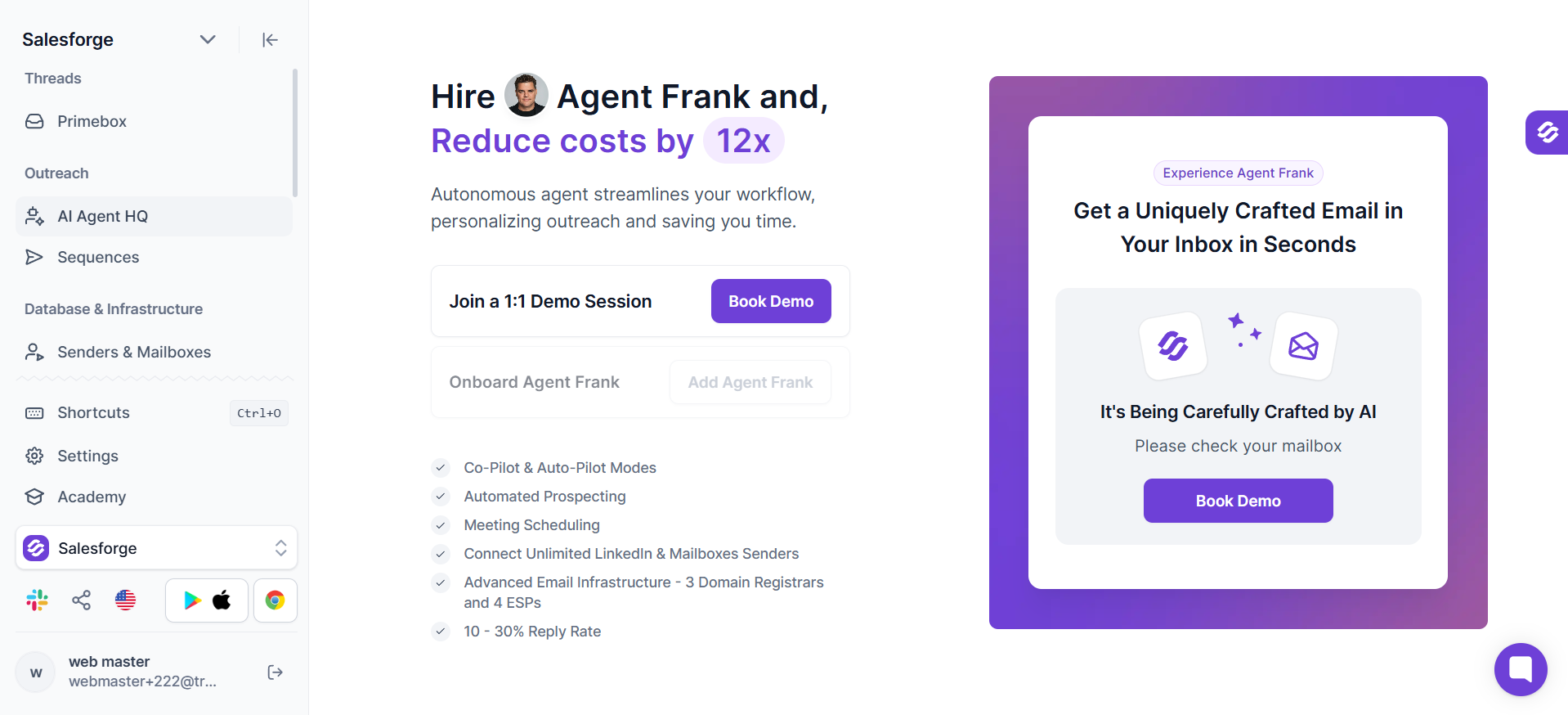
Or you can hire Agent Frank, Salesforge's autonomous AI SDR, from $499 per month billed quarterly. He handles prospecting, sequencing, replies, and meeting booking on his own. He doesn't need coaching, he doesn't have a learning curve, and there's no weekly call to wait for before you see progress.
Those alternatives aside, if Reachly is still on your shortlist, take these questions into your discovery call. Their answers will tell you more than any external review, including this one.
Those questions matter more than any review, including this one. Here's where I land overall.
Reachly is worth considering for APAC-based B2B founders with a $10,000-plus ACV who want a done-for-you outbound partner publishing real operational math instead of buzzwords, and who have the team capacity to take the meetings once they're booked.
The Clay first-100 Solutions Partner credential is real. The deliverability spec is genuinely detailed. The Great Room case study reads as independently plausible and gives real ground truth on what the model can produce. I'd shortlist them for an APAC Series A or B startup that wants a service, not a system to build.
Founders who want North American or European market specialization, cold calling as a first-class channel, or a heavier independent-review footprint should compare certified agencies before signing. And any buyer should get the Primal relationship, the contract terms, and the domain ownership questions answered on the discovery call before wiring any money.
If you're still weighing your options, browse the Forge Expert Network to match agencies by market, channel, and delivery model.
Or start a free trial with Salesforge if the retainer route isn't what you actually need.
1. Is Reachly a Legitimate Company?
Yes. Reachly operates from Bangkok, Thailand, at 29 Vanissa Building, Tower B, 14th Floor, Soi Chidlom, Ploenchit Road, Lumpini, Pathumwan, Bangkok 10330. Reachly's About page says the company was founded in 2023 by Thibault Garcia, though third-party directory listings on Clutch and GoodFirms list the founding year as 2024. Independent 2024 APAC-launch press also named Mark McDowell, CEO of Primal, as co-founder, though Reachly's current site does not list him. Ask them to clarify the founding story on your call.
2. How Much Does Reachly Cost?
Reachly publishes an entry price of $3,500 a month on the SDR as a Service page for their flagship flat-retainer program, which includes data, domains, mailboxes, and sequencing. The exact quote for a given engagement still requires a discovery call, and contract length and cancellation terms are not disclosed anywhere on the site. Ask for total monthly cost including any Clay licenses, Smartlead sending credits, and additional domain fees before signing.
3. What Does Reachly Actually Do?
Reachly is a done-for-you B2B outbound agency running signal-based multi-channel campaigns across email, LinkedIn, and cold calling. The agency handles TAM mapping, account scoring, contact sourcing, deliverability infrastructure, copy, sequencing, and inbox management, then books qualified meetings directly onto your calendar. Standalone services also exist for cold email only, LinkedIn only, appointment setting, LinkedIn ghostwriting, and SaaS-specific outbound.
4. Is Reachly a Real Clay Partner?
Yes. Founder Thibault Garcia is a Clay first-100 Solutions Partner, a real credential Clay vets for deployment expertise. Reachly is also a Smartlead Certified Partner and a HeyReach Certified Expert, though both of those certifications were earned in August 2025 and post-date the flagship case studies. Ask which specific Clay workflows their team will build for your data before signing.
5. Does Reachly Have Reviews on G2 or Clutch?
Reachly has one Clutch review from February 2024 (5 stars), zero reviews on G2, zero on Trustpilot, and zero completed reviews on GoodFirms. An 8-review Google cluster on DesignRush's aggregation dates from a single 48-hour window in February 2025. For a company reporting 50-plus clients since 2023, that's a small independent review footprint, and the absence itself is the finding worth weighing.
6. Should You Hire a Done-for-You Outbound Agency or Build In-House?
Hire a done-for-you outbound agency when you have budget for a $3,500-plus monthly retainer, your TAM and ACV clear the qualifying threshold, and you specifically want someone else to own the deliverability, copy, and reply-handling work. Build in-house when your team has the capacity and expertise to run it themselves, or when your volume is low enough that the retainer math doesn't justify the spend. Or bypass both by running Salesforge yourself, or hiring Agent Frank to run outbound for you as an AI SDR without any agency involvement.
.jpg)

.png)