The most expensive mistake I see founders make in outbound isn't picking the wrong agency. It's picking the right agency for the wrong problem.
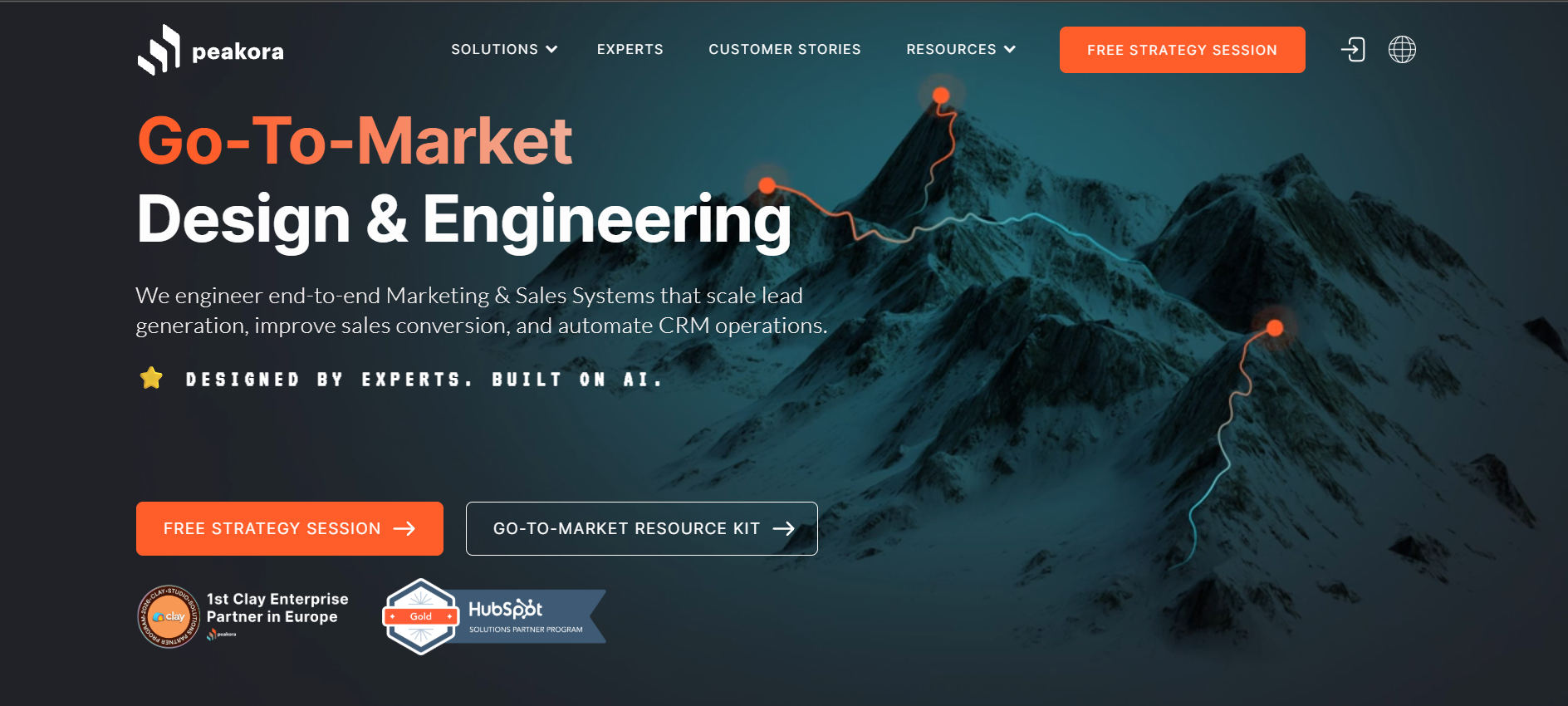
Peakora is the first Clay Enterprise Partner in Europe and the only one in DACH. And that's a big DEAL!
They are a Go-To-Market Design & Engineering agency that engineers the GTM systems that produce campaigns.
The question isn't whether Peakora is good at what they do. It's whether what services they offer align with what you want to grow your business.
And that's what this review is going to help you figure out before their strategy call.
If you've been through their site, you'll probably get where I'm coming from. The homepage looks good, the case studies have real numbers, and the credentials are there.
But then you start looking for the basics, like pricing or reviews from actual customers, and things get a little unclear.
Hence I read every page, case study, and checked out Clutch, G2, Trustpilot, and Reddit.
Below is what I found and the questions I'd walk in with if this was my money.
Here's a quick summary so you can decide whether reading further is worth your time.
That's the ten-thousand-foot view. Here's where I actually land after digging deeper.
Hire Peakora if you want a GTM design and engineering agency to build your outbound system with you, and you have the team capacity to run it once it's built.
Two things support this. The Clay Enterprise Partnership is real, and the founding team has operator credentials that hold up when you check LinkedIn. Joël Capt scaled ARR from four to twenty million as a head of growth.
Tim Eckert grew Frontify from 40 to 250 people. That's not consultant pedigree. That's operator pedigree, and it changes what the design sessions and the built systems are actually worth.
Their positioning is also unusually honest. Most agencies bury the "we don't execute for you" fine print six clicks deep on their site. Peakora puts it on the homepage. "We Don't Run Campaigns for You, We Build Your Lead Gen System With You." If you read that line and thought "good, that's what I want," you're their buyer.
Three things should hold you back.
Treat this as a conditional yes. Book the strategy call, ask them to clarify pricing, the review platform, and the tenure story. Sign if the answers hold up. Walk if they don't.
I have not been a Peakora client, so this review is research-based. I evaluated them the way I would shortlist any GTM design and engineering agency for my own pipeline.
I went through every service page on peakora.io, all four detailed case studies, and their Experts page. I read the founders' public LinkedIn content, checked business records for RLGH AG, and searched Clutch, G2, and Trustpilot for independent reviews. I also searched Reddit and LinkedIn for third-party sentiment.
I also scored them against the questions I ask every agency in this category. I want to know who owns the systems they design and engineer for you, what happens to your Clay workflows if you leave, whether the weekly calls are run by a partner or a junior, and whether the design work is a real framework or a series of ad hoc conversations.
Everything below marked "reports" or "says" comes from Peakora's own published material.
Here's what I found on the services side.
Peakora sells six programs, all built on the same design and engineering model. A custom roadmap, a hands-on system build, an eLearning platform to teach your team how to run it, and weekly calls with an assigned expert.
The six programs are Generate More Leads, Close More Deals Faster, Increase CRM Efficiency, Retain and Expand Clients, Achieve Product Market Fit, and Improve Leadership.
The lead-gen program is the one most buyers land on when they search for Peakora, and it's the one closest to what you'd expect from an outbound-focused agency. The other five sit further away from outbound and closer to strategy and org design.
Here's how their offer compares against certified agencies in the Forge Expert Network, a directory of verified agencies that meet Salesforge's certification requirements.
Every Peakora cell comes from their public material. Confirm the details on your strategy call.
Their site describes both a five-stage engagement flow led by GTM Experts and Engineers, and a four-stage lead-gen framework. I've mapped both to the six stages you'll actually experience as a client, with the questions to raise at each one.
Every engagement starts with a strategy session led by a GTM Expert. Peakora's site says this session identifies the biggest bottlenecks in your current GTM and outlines where design and engineering work would create the most impact.
Ask what deliverable comes out of the strategy session and whether it's yours to keep if you don't sign a full engagement. Most consulting strategy sessions end with slides that never get used again.
The next stage is where the Clay Enterprise Partnership matters. Peakora's GTM Engineers implement Clay to handle enrichment, data workflows, and automation. Their site describes real-time enrichment from over 100 sources, and signal tracking for triggers like job changes and tech stack.
Ask which specific Clay workflows they'll engineer for your data, and how many of them are template copies versus custom builds. A serious Clay partner should be able to name specific tables and enrichment chains, not just "AI-powered enrichment."
This is where the sequences, sender rotation, and inbox routing get engineered. Peakora doesn't name the sending platform they use, which is unusual for an agency claiming outbound engineering expertise.
Ask which sending platform sits behind the Clay layer, who owns the domains and mailboxes, and what happens to them when the engagement ends. If they keep them, you lose your sender reputation and rebuild warmup from zero.
Peakora's site says most companies start seeing results within a few weeks of launch. That timeline assumes the infrastructure is already built and warmed.
Ask them for a week-by-week timeline from signing to first send. Two to four weeks is realistic if you're engineering infrastructure from scratch. Anything less deserves a follow-up question.
The weekly call is where the design and engineering work gets handed over to your team. Peakora's site describes these as "personal weekly project calls with your assigned startup veteran."
Ask who your assigned expert will be by name, and check that person's LinkedIn before you sign. If the expert who sold you on the call isn't the one running the weekly, you're paying enterprise pricing for junior handover.
The last stage covers ongoing measurement and refinement of the system that's been built. Peakora's site references a "gameplan resulting in measurable impact on your KPIs" but doesn't name a specific dashboard or reporting cadence.
Ask for a sample report from a comparable engagement, and agree on a review schedule in writing. Weekly for the first month is fair. Monthly after that is standard.
Once you know how the design and engineering work runs, pricing becomes the next thing to pin down before signing.
Peakora does not publish pricing on their site. I navigated to peakora.io/pricing and got a 404 error. There is no pricing link in the header or footer navigation. Every CTA on the site routes to the same "Free Strategy Session" booking link.
That's common for design and engineering engagements, but it makes budgeting harder before you commit to a call. Comparable GTM design engagements in the DACH market tend to run in the low five figures for a three-to-six-month program, though this varies widely.
Peakora's case studies reference "6-month scaling program" and "3-month program" language, but these describe program duration, not contractual minimums or cancellation terms.
Watch for Clay Enterprise seats and workflow credits first. If Peakora is engineering your Clay stack, you're paying Clay directly on top of the Peakora fee.
HubSpot licensing comes next if you don't already have it. Peakora's CRM engineering assumes HubSpot as the backbone, which means another line item on your invoice.
Then you have domain and mailbox costs. Cold outbound at any scale means multiple sending domains, and someone is paying for them each month.
LinkedIn Sales Navigator seats matter if LinkedIn is part of the campaign scope. Enterprise seats can run higher than most founders expect when they scope only the base tier.
Data enrichment credits beyond Clay's default limits are the last thing to check. High-volume enrichment can burn through credits fast on the wrong workflow, and the overage bill lands separately from your monthly retainer.
Ask which of these are inside the Peakora quote and which are your responsibility. That single question can double or halve your all-in monthly cost.
Based on their published work, Peakora fits you well if:
Skip them, or at least compare harder, if:
If you're sending under a few hundred emails a month, you don't need a design and engineering agency at all. Running Salesforge yourself at $48 per month covers that volume with warmup included.
For the founders who do fit the profile, here's what the reported outcomes actually look like.
Peakora's case studies live as gated blocks on a single Customer Stories page. Four have detailed narratives. All figures are as reported by Peakora.
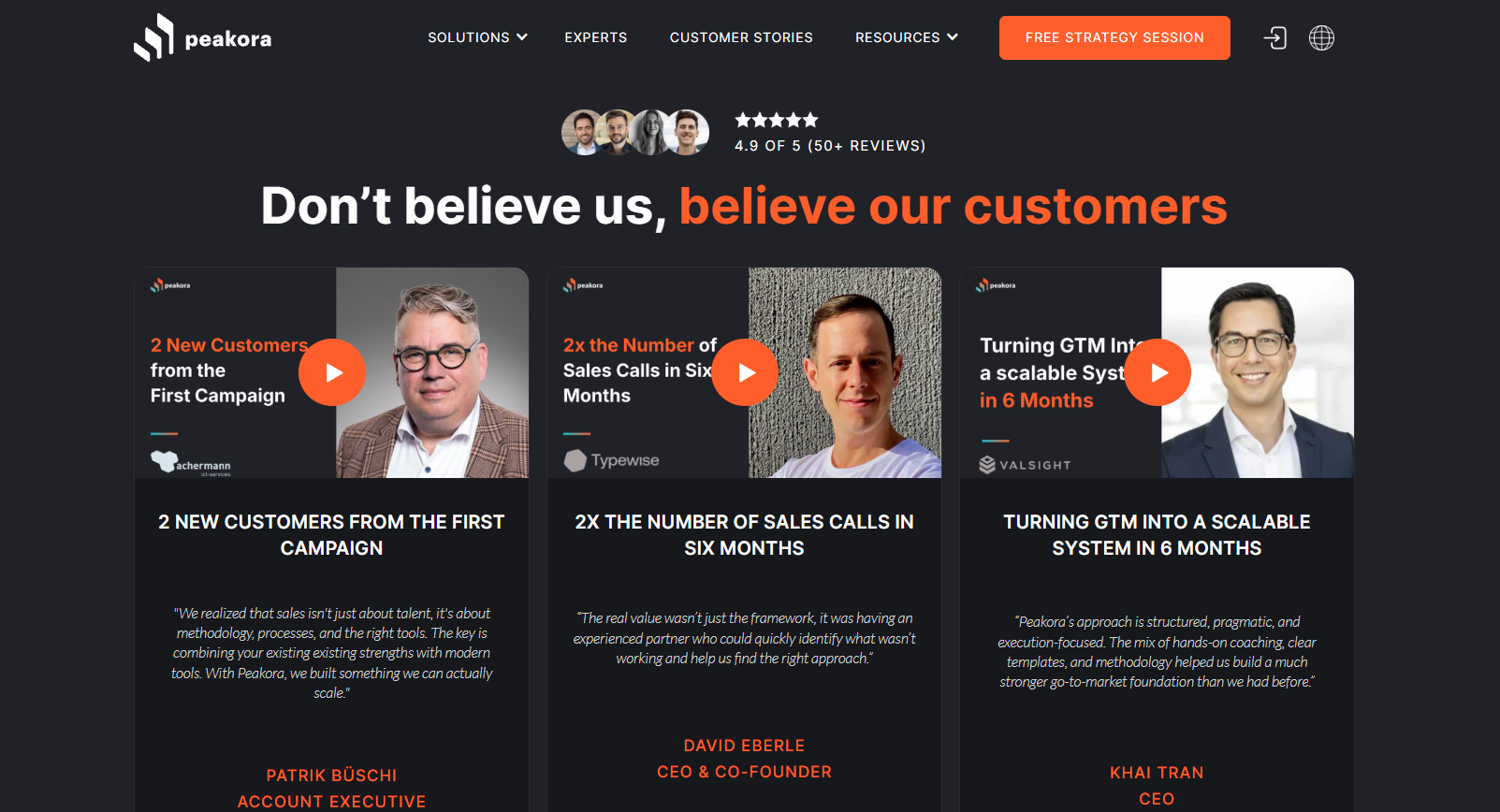
Two things stand out. The industry range is wide, from alternative investments to hardware to SaaS. And the results are specific and countable, which I trust more than vague lines like "boosted pipeline significantly."
One flag is worth naming here. The KleverKey quote refers to the vendor as "the team at RGH," not Peakora. That's almost certainly a leftover from a past brand or entity name that wasn't cleaned up when the testimonial was ported. It doesn't invalidate the result, but it's the kind of detail that signals a rebrand that hasn't fully settled.
The caveat repeats. These are company-reported numbers. No independent platform has verified them.
Every agency has trade-offs. Here are the ones I found from Peakora's public material.
None of these should rule Peakora out on their own. If two or more matter to you, it's worth comparing agencies that already answer these questions on their profiles.
If Peakora isn't the fit, the worst thing you can do is Google "GTM engineering agency" and pick the first result that pops up. The Forge Expert Network is a directory of certified agencies who've been vetted on the Forge ecosystem, and it's a saner starting point than the SERP.
Here are three matched to different needs a Peakora shopper is likely to have.
Best for: Founders who want Peakora's design and engineering approach but with the campaign execution actually happening alongside it.
The gap between "we'll build your system and hand it over" and "we'll run it for you" is the biggest reason design and engineering engagements stall on the operator side. Strongest Group closes that gap. They embed with your team as a growth partner, not a vendor, and they cover the full stack from GTM strategy through RevOps down to Clay workflows and Scandinavian cold calling.
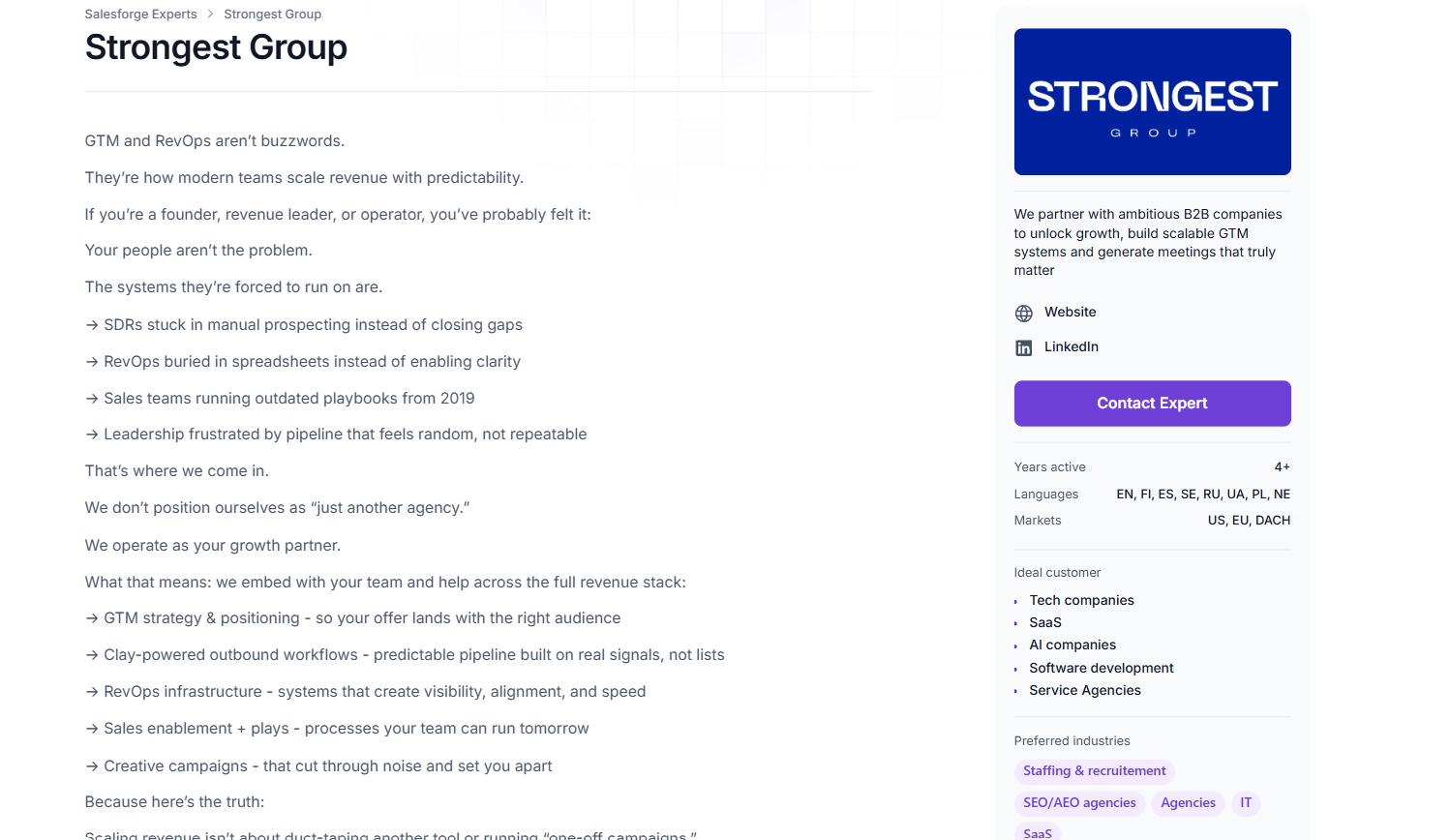
The difference matters most in the first ninety days, when the handover phase of a Peakora-style engagement can stall pipeline. Strongest Group runs campaigns from day one while the system gets built alongside them. If Peakora's design-and-engineer model appealed but you can't afford six months before revenue moves, this is the closer alternative.
Best for: Buyers who need cold calling as a real channel, not a nice-to-have.
Peakora's outbound program is engineered around email and LinkedIn with Clay as the enrichment layer. There's no cold calling function inside the model.
That's fine for European SaaS deals, but it becomes a problem the moment your ACV crosses six figures or your buyers are mid-market operators who don't answer email.

Outbound Pros builds cold calling into every campaign as a first-class channel alongside email, LinkedIn, and PPC. Their profile commits to 50 to 75 qualified meetings per month with commission-based pricing, which is a very different accountability model than a design and engineering retainer.
Best for: Technical vertical operators in HealthTech, FinTech, and compliance who want Peakora's Clay-first story but applied to signal-based outreach.
The Clay Enterprise Partnership is Peakora's strongest engineering credential. What Peakora doesn't emphasize is that most Clay workflows can be engineered for either volume outreach or signal-based outreach, and those are very different plays.
If you came for the Clay expertise but your ICP needs timing-based triggers (funding rounds, regulatory shifts, exec moves) more than volume, RevSculpt is the closer fit.
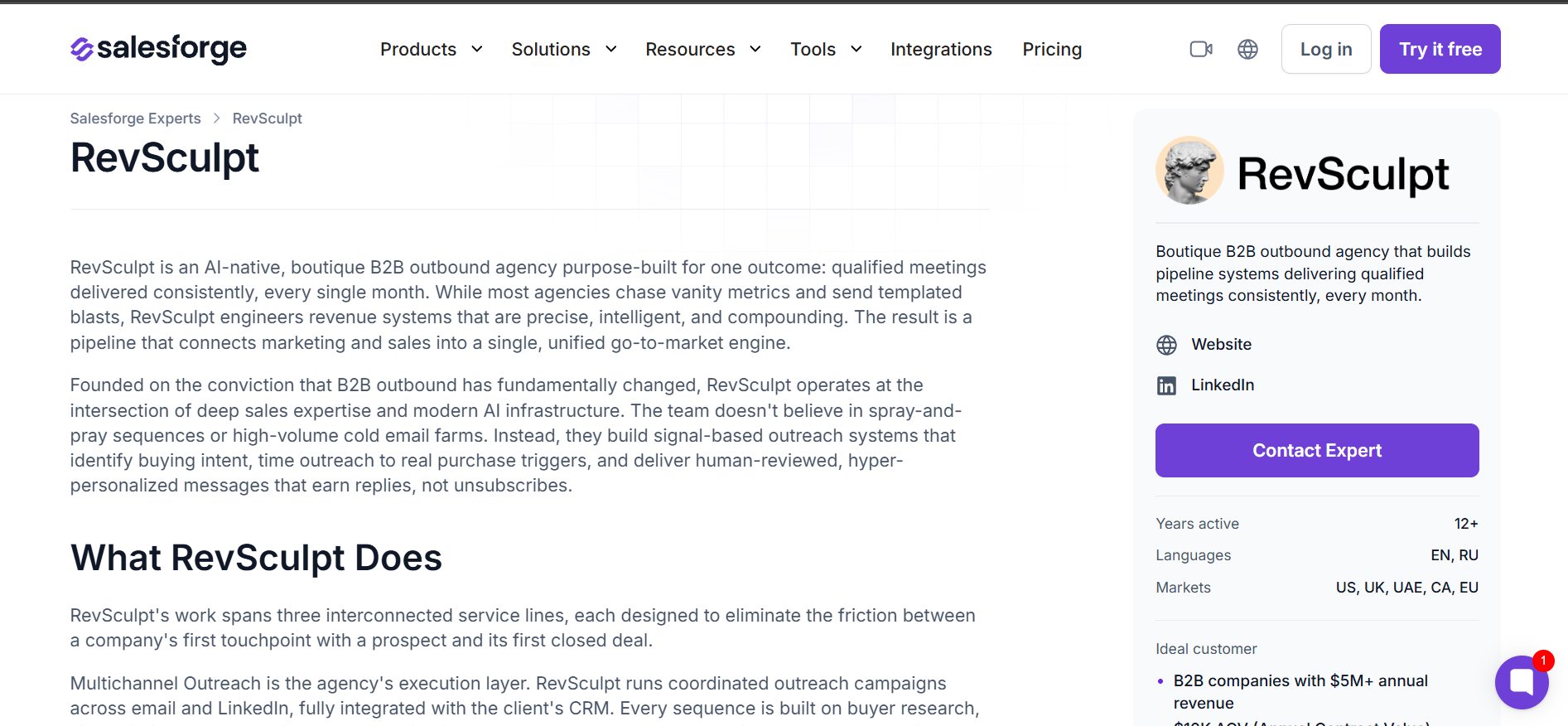
Their profile reports over 6,000 qualified meetings scheduled across more than 15 B2B verticals, with most clients seeing their first meeting within 18 days of onboarding. That's the timeline signal-based work is supposed to deliver, and it's rare to see it stated on a profile.
There are two more routes worth knowing about.
You can run outbound yourself with Salesforge. It starts at $48 per month with unlimited mailboxes and free warmup included, and it's the tool most Forge Experts run on the back end anyway.
Or you can hire Agent Frank, Salesforge's autonomous AI SDR, from $499 per month billed quarterly. He handles prospecting, sequencing, replies, and meeting booking on his own. He doesn't need coaching, he doesn't have a learning curve, and there's no weekly call to wait for before you see progress.
Those alternatives aside, if Peakora is still on your shortlist, take these questions into your strategy call. Their answers will tell you more than any external review, including this one.
Those questions matter more than any review, including this one. Here's where I land overall.
Peakora is worth considering for DACH-based B2B founders who want a GTM design and engineering agency to build their outbound system with them, and who have the team capacity to run it once it's built.
The Clay Enterprise Partnership is real. The founder credentials are real. The design-and-engineer positioning is honest about what it is on the homepage, which is more than most agencies in this category. I'd shortlist them for a Series A or B startup in Europe that wants a system, not a service.
Founders who want done-for-you campaign execution, North American market specialization, or pricing transparency should compare certified agencies before signing. And any buyer should get the review platform, tenure, and pricing questions answered on the strategy call before wiring any money.
If you're still weighing your options, browse the Forge Expert Network to match agencies by market, channel, and delivery model. Or try Salesforge yourself if the design and engineering route isn't what you actually need.
Yes. Peakora operates under RLGH AG, a Swiss company based at Blegistrasse 23, 6340 Baar. The address matches their site, and their Clutch profile lists the company as founded in 2021, though Peakora's own site references "since 2016" on one page. Ask them to clarify the founding date on your call.
Peakora does not publish pricing anywhere on peakora.io. Every CTA routes to a free strategy session, and pricing is quoted after that call. Ask for the total monthly cost including Clay licenses, HubSpot, and any data or infrastructure fees before signing.
Peakora is a GTM design and engineering agency, not a done-for-you outbound shop. They design and engineer lead-gen systems with you through a combination of custom roadmap, hands-on Clay build, an eLearning platform, and weekly calls with an assigned expert. Their homepage is explicit that this isn't done-for-you delivery. "We Don't Run Campaigns for You" is the exact line.
Yes. Peakora is the first Clay Enterprise Partner in Europe and, per their site, the only one currently in DACH. Clay vets enterprise partners for real deployment expertise. Ask which specific Clay workflows their engineers will build for your data before signing.
No independent reviews exist on G2, Clutch, or Trustpilot as of this writing, despite Peakora claiming "4.9/5 (50+ Reviews)" on their homepage. Ask them which platform the 50-plus reviews live on and request the links.
Strongest Group, Outbound Pros, and RevSculpt are certified alternatives in the Forge Expert Network. Strongest Group works as an embedded GTM partner, Outbound Pros adds cold calling to done-for-you multichannel, and RevSculpt fits technical verticals wanting signal-based outreach. Running Salesforge in-house or hiring Agent Frank as an AI SDR are the tool-based routes.
Hire a GTM design and engineering agency when you've decided to build in-house and need expert design plus hands-on Clay engineering to get the system right. Build in-house from scratch when your team already has both the design chops and the technical skills. Or bypass both by running Salesforge yourself, or hiring Agent Frank to run outbound for you as an AI SDR without any agency involvement.
.jpg)

.png)