A 90-day GTM build sounds great!
Kinetyca helps to build your outbound, content, ads, and RevOps systems, and gets everything running within three months.
They also have the tool credentials to back up the pitch: Kinetyca is a Clay Solutions Partner, Smartlead Certified Expert, and HeyReach Certified Expert.
But here's the part I'd want to know before signing anything: what happens after those 90 days?
Because building a GTM system and building one your team can actually run are two very different things.
That question became hard to ignore when I started digging into Kinetyca. Their site looks polished. There are 16 case studies with specific numbers, and the founders have solid credentials behind them.
But when I went looking for pricing, contract details, and independent customer feedback, the picture wasn't quite as complete.
So I went deeper.
I read through the site, all 16 case studies, both founders' LinkedIn posts, and checked G2, Clutch, Trustpilot, and Reddit for what customers were saying outside Kinetyca's own marketing.
Here's what I found, including what looks genuinely strong, what I'd want clarified, and the questions I'd walk in with if this was my money.
Here's a quick summary so you can decide whether reading further is worth your time.
That's the ten-thousand-foot view. Here's where I actually land after digging deeper.
Hire Kinetyca if you want a Clay-centric multichannel GTM system built and documented in 90 days, and you have the team capacity to run it once it's built.
Two things support this. The tool-partner credentials with Clay, Smartlead, and HeyReach are real, and they matter for the actual execution work Kinetyca does.
The founders have operator credentials that hold up when you check LinkedIn. Matteo Fois publishes nearly daily on the actual mechanics of Clay workflows and Claude-based agency operations, which is a much stronger signal of hands-on expertise than most agency websites carry.
Their positioning is also more specific than most in the category. Where competitors bury the "we build systems, you run them" reality behind vague language, Kinetyca's FAQ says it directly. "By day 90, you have a fully built GTM system with documentation, playbooks, and reporting. You can continue scaling with us, or your team can take ownership and run the system internally." If you read that line and thought "good, that's what I want," you're their buyer.
Three things should hold you back.
Treat this as a conditional yes. Book the strategy call, ask them to clarify pricing, the review platform, and the case study weight questions. Sign if the answers hold up and one referenced client agrees to a call in your ICP. Walk if they don't.
I have not been a Kinetyca client, so this review is research-based. I evaluated them the way I would shortlist any GTM systems agency for my own pipeline.
I read every page on kinetyca.com, all 16 case studies, the full systems page, the terms of use, and the guides library. I cross-checked both founders' LinkedIn profiles for tenure, credentials, and content output. I searched G2, Clutch, Trustpilot, Google Reviews, LinkedIn recommendations, and Reddit for independent client feedback. I also checked two market roundups covering the GTM engineering agency category to see how Kinetyca positions against direct peers.
I scored them against the questions I ask every agency in this category. I want to know who owns the systems they build for you, what happens to your Clay tables and workflows if you leave, whether the weekly calls are run by a founder or a junior, and whether the multi-engine promise is backed by comparable evidence across all four engines.
Everything below marked "reports" or "says" comes from Kinetyca's own published material.
Here's what I found on the services side.
Kinetyca sells four integrated components, all delivered as one 90-day build. Three "Engines" (Outbound, Content, Ads) plus a "RevOps Brain" that runs the data ingest, enrichment, and reasoning layer underneath them.
The Outbound Engine is the one most buyers land on when they search for Kinetyca, and it's the deepest of the four in terms of published evidence. Cold email, LinkedIn, and signal-based outbound routed through Clay, Smartlead, HeyReach, and Instantly. The Content Engine and Ads Engine round out the multichannel story, though the case study evidence is thinner for both.
Here's how their offer compares against certified agencies in the Forge Expert Network, a directory of verified agencies that meet Salesforge's certification requirements.
Every Kinetyca cell comes from their public material. Confirm the details on your strategy call.
Their systems page describes an 11-step outbound flow, plus separate 5 to 8-step flows for the Content Engine, Ads Engine, and RevOps Brain. I've mapped all of that to the six stages you'll actually experience as a client, with the questions to raise at each one.
Every engagement opens with account definition and ICP database work. Kinetyca uses Gemini for market research and pulls from Apollo, ZoomInfo, and Ocean.io to build the target list.
Ask them to walk you through the exact criteria they'll use to filter your total addressable market, in writing. If the definition is loose here, the enrichment and messaging layers built on top will inherit the same imprecision, and your reply rate will show it.
Every account and contact gets pushed into Clay, which Kinetyca treats as the central system of record. Waterfall enrichment layers signal data from RB2B, G2, Bombora, and "20+ more" sources. Data cleaning happens here too.
Ask which specific Clay tables and workflows they'll build for your data, and how many are template copies versus custom builds. A serious Clay partner should be able to name specific tables and enrichment chains, not just "AI-powered enrichment." Also ask who owns the Clay tables at handoff, because losing that ownership means paying to rebuild your data infrastructure elsewhere later.
Domains, mailboxes, and warmup happen next, alongside LinkedIn sender configuration through HeyReach and email execution through Smartlead, Instantly, or EmailBison. The Smartlead and HeyReach certifications are real credentials for this specific work.
Ask for their standing recommendation on how many domains and mailboxes you need for your sending volume before you sign. Also confirm who owns the domains and mailboxes when the engagement ends. If they keep them, you lose your sender reputation and rebuild warmup from zero.
Clay AI Agents generate personalized messaging based on the enriched signal data from step two. Kinetyca publishes a "Claude skill file trained on signal data from over 1 million cold emails and 300 Clay tables" in its guides library, which points to how they think about copy at scale.
Ask to see three actual outbound sequences they wrote for a client in your industry. A well-configured personalization layer looks very different from a mail-merge dressed up in signal data, and the sequences will tell you which one you're getting.
Once campaigns go live, positive replies get routed into HubSpot or your CRM, with real-time Slack alerts pinging your sales team. Kinetyca does not close deals for you, so your reps still own the actual conversation once a lead raises a hand.
Confirm the routing rules before launch. A misfired handoff at this stage is how qualified leads sit in someone's inbox for three days and go cold.
A weekly review cadence runs through Notion, Slack, and HubSpot dashboards for the length of the 90-day build. By day 90, Kinetyca's FAQ promises "a fully built GTM system with documentation, playbooks, and reporting" and the option for your team to run it internally.
Ask for a written list of every deliverable that qualifies as "documentation" before you sign. The difference between a full SOP library and a shared Notion page is what determines whether the handoff is real, and it's the difference between "build and own" and "build and re-engage."
Once you know how the 90-day build actually runs, pricing becomes the next thing to pin down before signing.
Kinetyca does not publish pricing anywhere on their site. There is no pricing link in the header or footer navigation. Every CTA on the site routes to the same "Request a Strategy Call" booking flow.
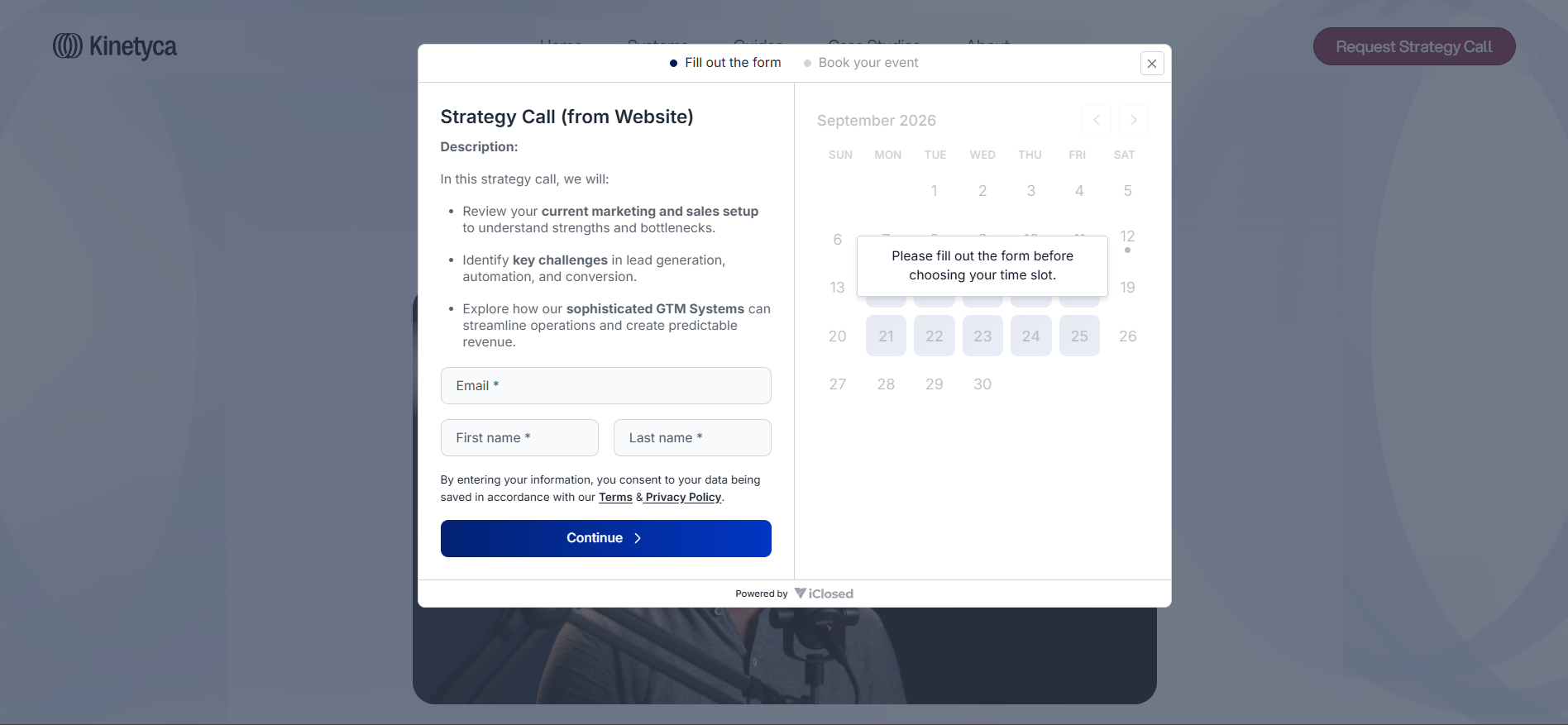
That's common for build-with-you engagements, but it makes budgeting harder before you commit to a call. Comparable GTM systems engagements in the mid-market tend to run in the mid-to-high five figures for a 90-day program, though this varies widely by scope.
I also read the full Terms of Use, dated February 27, 2026. It's a standard website legal agreement covering IP and disclaimers. It contains zero service-engagement terms. No minimum contract length, no cancellation clause, no refund policy, no performance guarantee.
Based on their published work, Kinetyca fits you well if:
Skip them, or at least compare harder, if:
If you're sending under a few hundred emails a month, you don't need a GTM systems agency at all. Running Salesforge yourself covers that volume with warmup included.
For the buyers who do fit the profile, here's what the reported outcomes actually look like.
Kinetyca publishes 16 detailed case studies on their site. All figures below are as reported by Kinetyca.
Two things stand out. The industry and revenue-band range is wide, from early-stage AI coaching to $27M+ video production. And the results are specific enough to verify on a reference call, which I trust more than aggregate lines like "generated significant pipeline."
One flag is worth naming here. The LimoLane case study on the same site (not in the table above) shows €525k in sales in its top stat block, but the "Results" section at the bottom of the same page says €175k. Same client, same engagement, two different revenue figures. If you're evaluating Kinetyca based on their European work, ask which figure is correct and get the answer in writing before citing either.
The caveat repeats. These are vendor-reported numbers. No independent platform has verified them.
Every agency has trade-offs. Here are the ones I found from Kinetyca's public material.
None of these should rule Kinetyca out on their own. If two or more matter to you, it's worth comparing agencies that already answer these questions on their profiles.
Here are the two sections updated. Forge Experts filled in from the Peakora blog (Strongest Group, Outbound Pros, RevSculpt) with fresh blurbs written from the Kinetyca-buyer angle, and case study links added inline to the Case Studies table.
For the buyers who do fit the profile, here's what the reported outcomes actually look like.
Kinetyca publishes 16 detailed case studies on their site. All figures below are as reported by Kinetyca.
Two things stand out. The industry and revenue-band range is wide, from early-stage AI coaching to $27M+ video production. And the results are specific enough to verify on a reference call, which I trust more than aggregate lines like "generated significant pipeline."
One flag is worth naming here.
The LimoLane case study on the same site (not in the table above) shows €525k in sales in its top stat block, but the "Results" section at the bottom of the same page says €175k. Same client, same engagement, two different revenue figures. If you're evaluating Kinetyca based on their European work, ask which figure is correct and get the answer in writing before citing either.
If Kinetyca isn't the fit, the worst thing you can do is Google "GTM systems agency" and pick the first result that pops up. The Forge Expert Network is a directory of certified agencies that have been vetted on the Forge ecosystem, and it's a saner starting point than the SERP.
Here are three matched to different needs a Kinetyca shopper is likely to have.
Best for: Buyers who want Kinetyca's Clay-centric multichannel build but with campaigns actually running alongside it, not waiting until day 91.
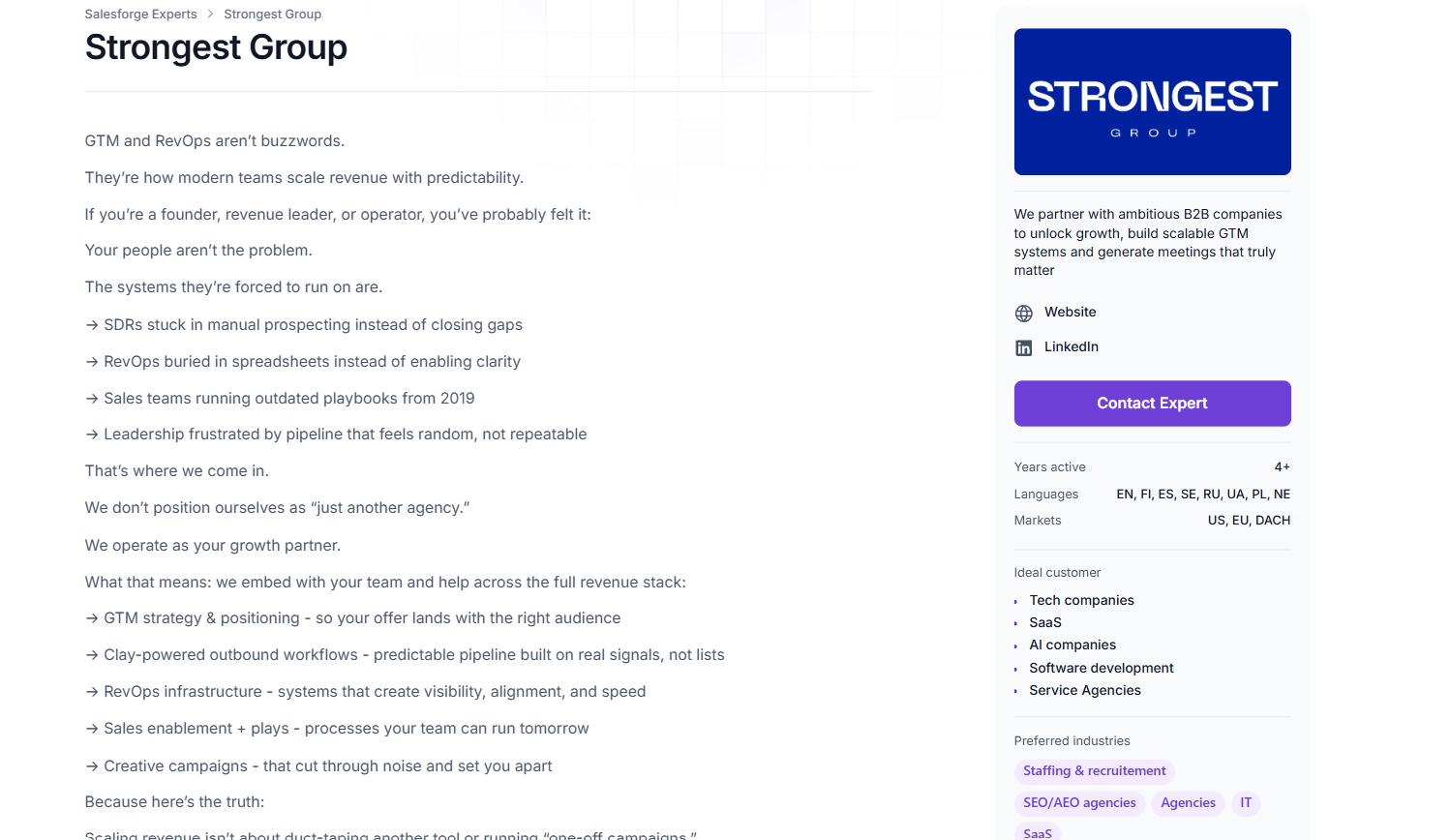
The gap between "we'll build your system and hand it over in 90 days" and "we'll run it for you starting week one" is the biggest reason build-and-hand-off engagements stall on the operator side. Strongest Group closes that gap. They embed with your team as a growth partner rather than a vendor, and they cover the full stack from GTM strategy through RevOps down to Clay workflows and Scandinavian cold calling.
The difference matters most in the first ninety days, when the handover phase of a Kinetyca-style engagement can leave your pipeline flat while your team learns to operate the system. Strongest Group runs campaigns from day one while the system gets built alongside them. If Kinetyca's build-and-own model appealed but you can't afford three months before revenue moves, this is the closer alternative.
Best for: Buyers who need cold calling as a first-class channel, not a nice-to-have layered on top of email and LinkedIn.

Kinetyca's Outbound Engine is engineered around email, LinkedIn, and signal-based enrichment through Clay. Cold calling isn't part of the model, and it doesn't show up in any of the 16 case studies. That's fine for early-stage SaaS deals, but it becomes a problem the moment your ACV crosses six figures or your buyers are mid-market operators who don't answer email.
Outbound Pros builds cold calling into every campaign as a first-class channel alongside email, LinkedIn, and PPC. Their profile commits to 50 to 75 qualified meetings per month with commission-based pricing, which is a very different accountability model than a fixed 90-day build fee. If a Kinetyca strategy call left you unsure whether an email-and-LinkedIn build alone would move your specific ICP, this is the shop to compare against.
Best for: Technical vertical operators in HealthTech, FinTech, and compliance who want a Clay-first story but applied to signal-based outreach rather than volume outbound.
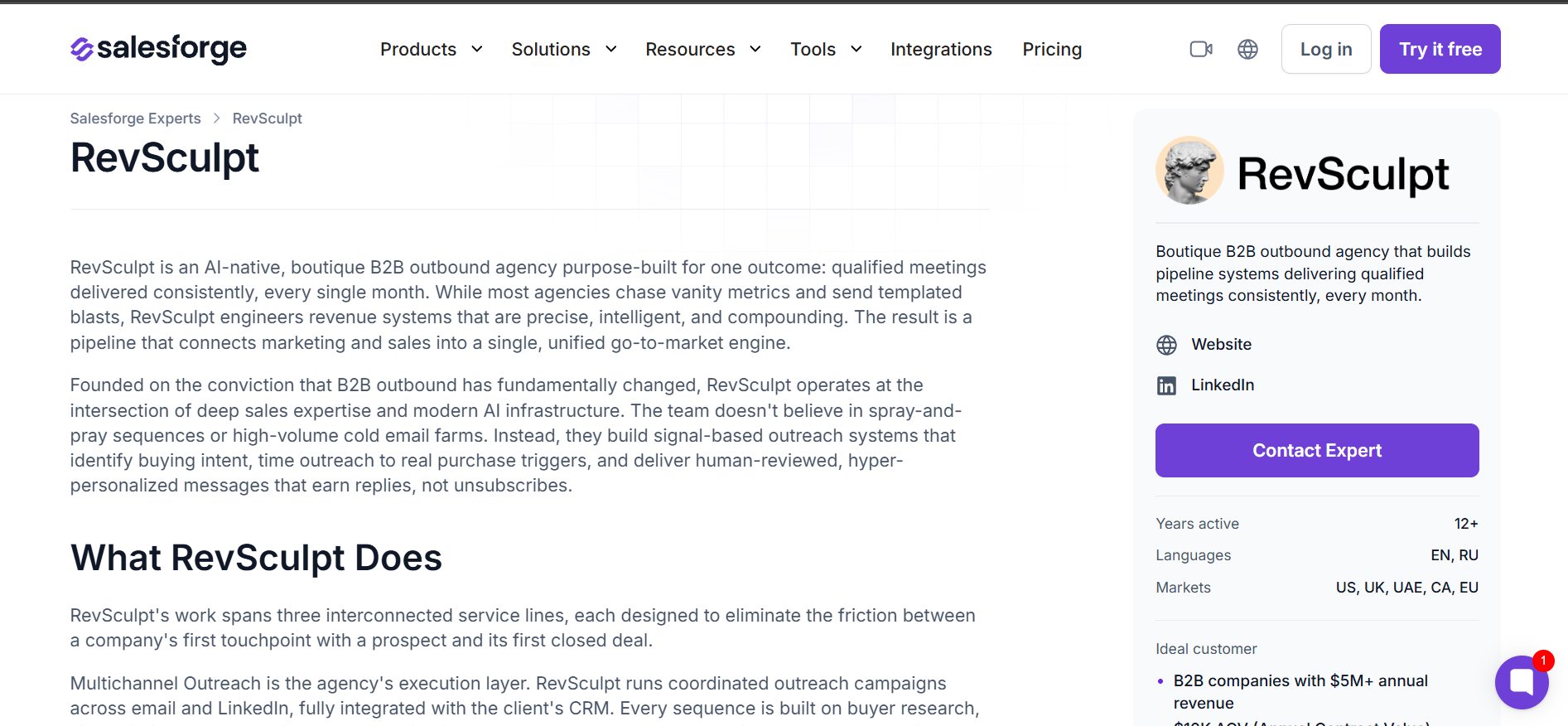
The Clay Solutions Partnership is Kinetyca's strongest engineering credential. What Kinetyca doesn't emphasize is that most Clay workflows can be engineered for either volume outreach or signal-based outreach, and those are very different plays. Looking at the case studies, the 40,000 emails/month capacity figure from the BIGVU engagement points to a volume orientation.
If you came for the Clay expertise but your ICP needs timing-based triggers like funding rounds, regulatory shifts, or exec moves more than volume, RevSculpt is the closer fit. Their profile reports over 6,000 qualified meetings scheduled across more than 15 B2B verticals, with most clients seeing their first meeting within 18 days of onboarding. That's the timeline signal-based work is supposed to deliver, and it's rare to see it stated on a profile.
There are two more routes worth knowing about.
You can run outbound yourself with Salesforge. It starts at $48 per month with unlimited mailboxes and free warmup included, and it's the tool most Forge Experts run on the back end anyway.
Or you can hire Agent Frank, Salesforge's autonomous AI SDR, from $499 per month billed quarterly. He handles prospecting, sequencing, replies, and meeting booking on his own. He doesn't need coaching, he doesn't have a learning curve, and there's no weekly build call to wait for before you see progress.
The strategy call is where every commercial term gets defined. Ask these ten questions before it ends, and get the answers in writing.
Kinetyca is a defensible pick for a $1M+ ARR B2B team that wants a Clay-centric multichannel GTM system built and fully documented inside 90 days, with a real option to run it in-house afterward.
The strongest evidence sits in the case studies. Sixteen client engagements, four of them showing meaningful cross-channel and infrastructure work beyond pure outbound, and both founders publicly documenting how they operate on a near-daily cadence. The tool-partner credentials with Clay, Smartlead, and HeyReach are genuine for the specific execution work Kinetyca does.
Three conditions would kill the recommendation. If independent third-party review coverage is a procurement requirement, Kinetyca has none. If your team cannot support a Clay-based system after handoff, the "build and own" promise becomes "build and re-engage." If your sales motion is enterprise procurement with formal RFP cycles, this is not the shop, and Kinetyca will tell you so on the strategy call.
If none of those kill conditions apply, book the strategy call, ask the ten questions above in writing, and sign only if the answers hold up and one referenced case study client agrees to a reference call in your ICP.
If you would rather test the outbound layer yourself before committing to a full agency build, start a free Salesforge trial and see what your own team can do with the channels Kinetyca configures on your behalf.
Kinetyca builds GTM systems for B2B companies across four areas: outbound, content, ads, and a data layer they call the RevOps Brain. The build is delivered as one integrated 90 day engagement, not as separately priced services. Clay sits at the center of the technical stack, with HeyReach, Smartlead, HubSpot, and n8n as the primary execution tools.
The published framework is "Your First 90 Days of Momentum," so the core build is 90 days. Kinetyca's FAQ says most teams see early momentum by the end of month one or start of month two, with results compounding through day 90. After the build, clients can continue with Kinetyca or take the system in-house.
Kinetyca does not publish pricing anywhere on its website. Every commercial term is gated to a strategy call. The implicit qualifier is the FAQ line about typically working with B2B companies over $1M ARR, which functions as a self-filter rather than a stated minimum project fee.
Kinetyca publishes 16 named case studies, including Colleva, Lemonlight, KlientBoost, LimoLane, StryvRevenue, Scoutbee, Cloudset, and Framework Consulting. Company sizes range from solo-operator services firms to companies described as generating over $27M in annual revenue. Results reported span from $35k in new sales to $2.6M in pipeline.
No, and Kinetyca says so directly. The FAQ names solopreneurs and very early-stage teams as an explicit not-a-fit category. The stated minimum profile is a B2B company over $1M ARR that has already achieved product-market fit and needs the top-of-funnel machine built.
Clay is the central data and workflow tool. Execution runs through Smartlead, HeyReach, and Instantly for outbound. HubSpot is the CRM of choice. Claude and n8n handle the AI and automation layers. Kinetyca is officially certified as a Clay Solutions Partner, Smartlead Certified Expert, and HeyReach Certified Expert.
Kinetyca gives clients a choice at day 90. You can continue scaling the system with Kinetyca on an ongoing basis, or your internal team can take ownership of the documented playbooks and run the system without them. The realism of the second option depends on whether your team has an in-house ops or SDR person who can operate Clay and the connected tool stack.
.jpg)

.png)