Graph8 has gained attention because it positions itself as more than a sales engagement tool. It combines prospect data, buyer intent, AI agents, voice calls, outreach, CRM, meeting booking, and pipeline management inside one platform.
For founders, sales leaders, and RevOps teams, the appeal is clear. Graph8 can help find buyers, launch campaigns, qualify leads, book meetings, and keep sales activity connected without forcing teams to manage every step manually.
But the bigger question is whether Graph8 is strong enough to handle these workflows in real sales teams. In this Graph8 review, I’ll break down its features, pricing, AI capabilities, pros and cons, user feedback, and overall value.
By the end, you’ll know where Graph8 stands out, where it may fall short, and whether it is the right platform for your team.
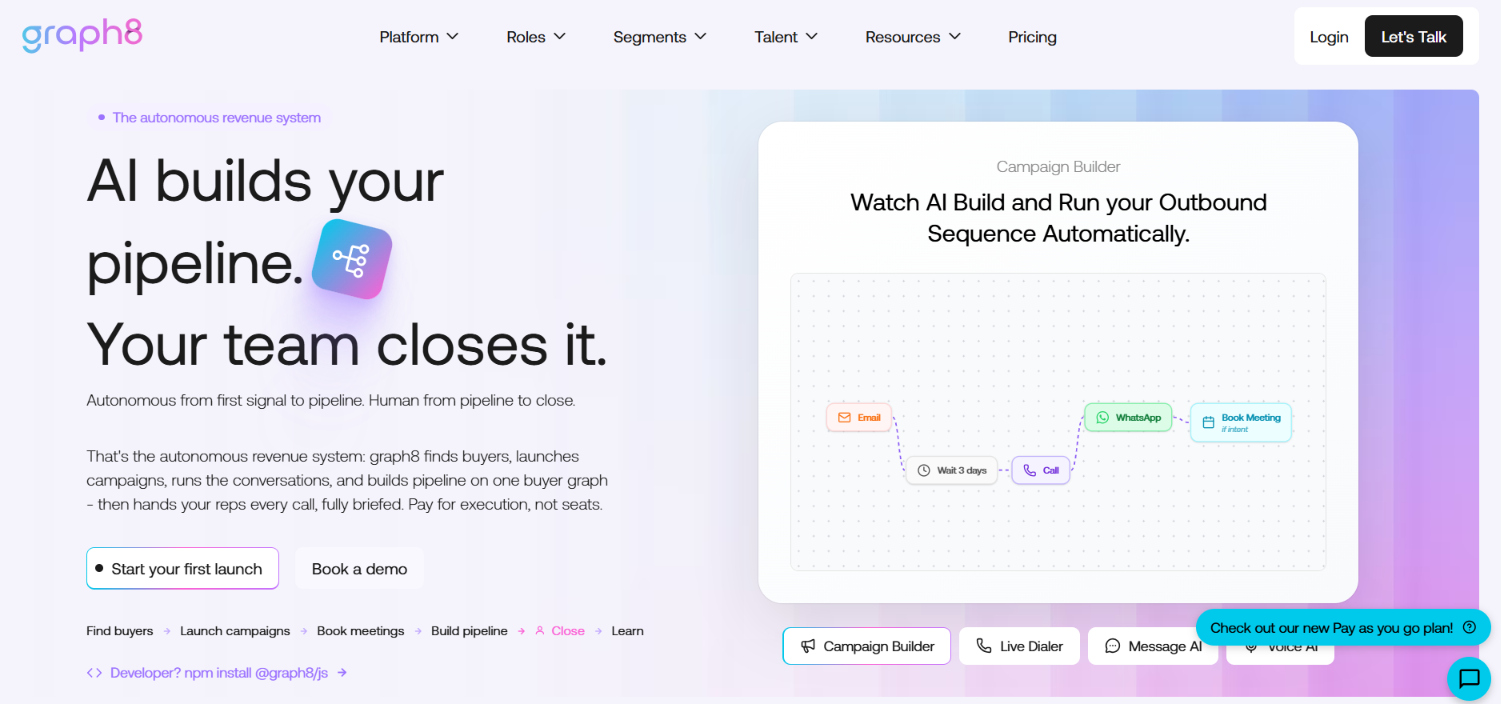
Alt text: Graph8 homepage
Graph8 is an AI GTM platform that brings CRM, outbound sequencing, dialer, B2B data, intent signals, visitor identification, meeting routing, and AI agents into one system. The platform works around a central Buyer Graph. This means contacts, accounts, conversations, signals, campaigns, deals, and pipeline data sit in the same place instead of being spread across separate tools.
In simple terms, Graph8 helps a team find buyers, launch campaigns, handle conversations, book meetings, update CRM data, and move opportunities through pipeline from one workspace.
Graph8 offers a wide range of GTM features, but some stand out more than others. Below are the features that I think add the most value and make Graph8 different from many other platforms.
This is easily the most important part of Graph8. Instead of keeping prospect data, CRM records, emails, calls, meetings, and pipeline in separate systems, Graph8 keeps everything connected through one Buyer Graph. Every interaction updates the same buyer record, so your sales team and AI agents always work from the latest information. I think this is one of Graph8's strongest ideas because it removes a lot of the data silos that exist in most outbound stacks.
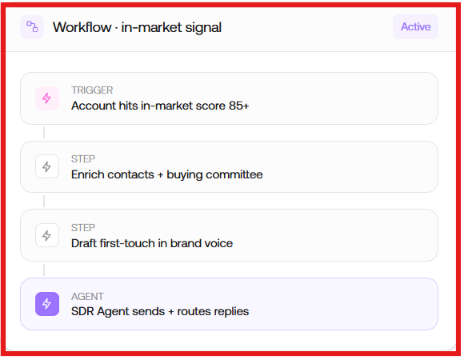
Alt text: Multi-step work, designed once, run by agents.
Many AI sales tools help you write emails. Graph8 tries to replace much more of an SDR's daily work. Its AI SDR Agent can build prospect lists, draft outreach, route replies, qualify leads, and pass opportunities to the right rep. For teams spending hours on manual prospecting every day, this could save a significant amount of time.
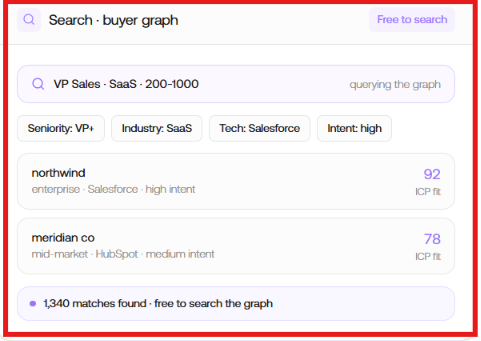
Alt text: Graph8 Buyer Graph showing prospect search with ICP fit scores, intent filters, and company matches.
Graph8 includes prospect data inside the platform. It includes access to 700M+ verified contacts, 100M+ companies, buying signals, visitor identification, and enrichment. That means you can find prospects and start outreach from the same workspace instead of exporting data between multiple tools.
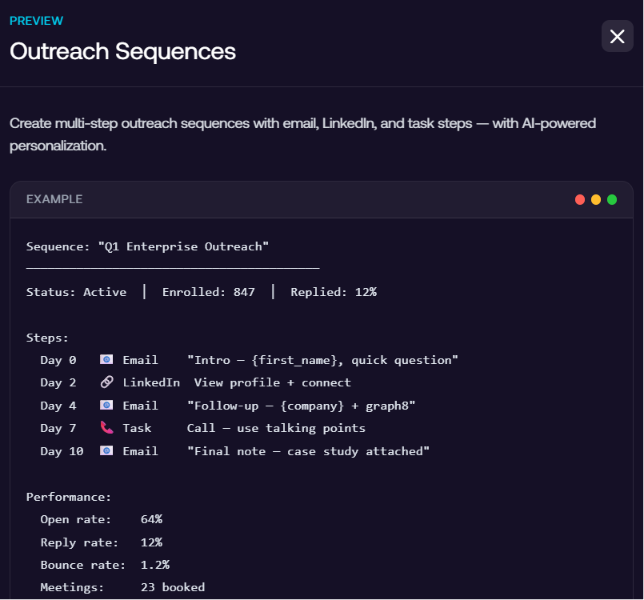
Alt text: Example of multi-step outreach sequence
Graph8 lets you build one sequence across email, phone, LinkedIn, SMS, and WhatsApp. That's useful because modern outbound rarely happens on a single channel. Managing every touchpoint from one campaign is much easier than switching between separate outreach tools.
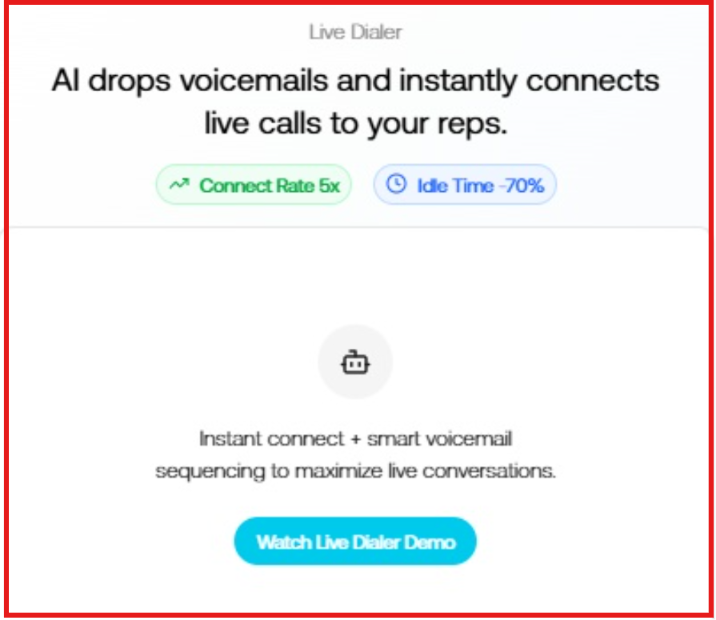
Alt text: Graph8 Live Dialer showing AI voicemail drops and instant connection to live prospects.
Graph8's Live Dialer uses AI to handle repetitive calling tasks before bringing a sales rep into the conversation. It can automatically drop voicemails, connect reps only when a prospect answers, and use AI Voice to qualify prospects or book meetings before handing the call over. This feature helps sales reps spend less time waiting between calls and more time talking to qualified prospects.
Instead of sending data back and forth between different platforms, Graph8 keeps outreach, contacts, pipeline, and deals together in one CRM. If you already use HubSpot, Salesforce, or Pipedrive, you can sync them instead of replacing them completely. For businesses trying to simplify their GTM stack, this flexibility is a great advantage.
Alt text: Graph8 pricing
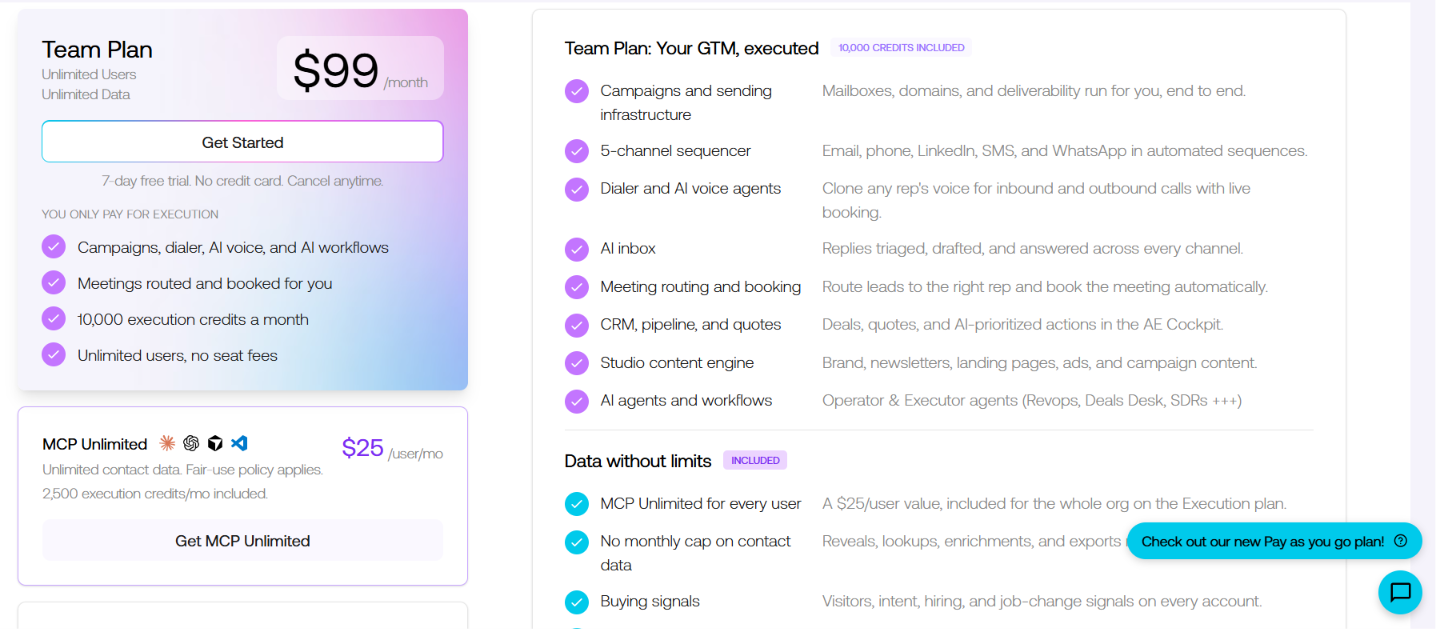
Graph8 has a simple pricing model with three options. You can start for free, pay only for what you use, or choose the Team Plan if your business runs outbound at scale. The Team Plan includes unlimited users, so your cost doesn't increase as your team grows.
Plan
Price
Best For
Pay As You Go
Free
Teams that want to test the platform before paying. Includes 1,000 contact reveals and 500 execution actions, then $0.05 per credit.
MCP Unlimited
$25/user/month
Teams that need unlimited contact data and use Graph8 through MCP tools like ChatGPT, Claude, Cursor, or VS Code.
Team Plan
$99/month
Businesses that want the full platform with 10,000 execution credits, unlimited users, AI agents, CRM, outreach, dialer, AI Voice, workflow automation, and unlimited contact data (fair use).
I think the $99 Team Plan offers the best value. Unlimited users are included, and every major feature is unlocked, so you don't have to pay extra as your team grows. If you're not ready to commit, the free Pay As You Go plan is a good starting point because you can try the platform without a credit card. As your usage grows, you can move to the Team Plan instead of paying for multiple GTM tools separately.
Pros
Cons
Combines prospecting, outreach, CRM, AI agents, calling, buyer signals, and workflow automation in one platform.
There's a learning curve because the platform includes many GTM features.
Supports multichannel outreach across email, LinkedIn, phone, SMS, and WhatsApp.
May be more than some teams need if they only want a dedicated outreach or prospecting tool.
Unlimited users on the Team Plan with no per-seat pricing.
Execution-based pricing means your costs increase as platform usage grows.
Includes built-in CRM, pipeline management, meeting routing, and quotes.
Fair-use limits apply to contact data and platform usage.
Includes 700M+ contacts, 100M+ companies, buyer signals, and waterfall enrichment in one platform.
Teams already using an established CRM may prefer to integrate Graph8 first instead of replacing existing workflows immediately.
One thing I like is that Graph8 lets you build multichannel outreach from one place. You can combine email, phone, WhatsApp, and meeting booking into a single workflow instead of managing separate outbound tools.
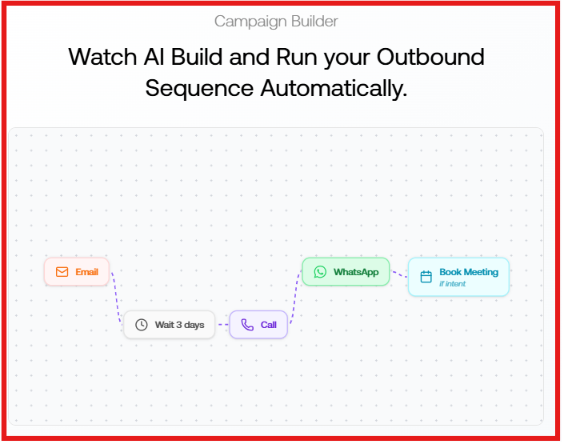
Alt text: Graph8 multichannel outbound workflow with email, phone, WhatsApp, and meeting booking.
Whether it can replace your entire outbound stack depends on how your team works. If you're using different tools for outreach, calling, meeting scheduling, and prospect data, Graph8 has enough built-in functionality to replace a large part of that workflow.
Instead of using...
Graph8 can handle...
B2B data tools
Finding contacts, companies, and enriching prospect data.
Outreach tools
Running email, LinkedIn, phone, SMS, and WhatsApp campaigns.
Dialers
Making and receiving calls with its built-in dialer and AI Voice.
Meeting scheduling tools
Routing leads and booking meetings automatically.
CRM tools
Managing contacts, deals, quotes, and pipeline.
Intent and visitor identification tools
Tracking buying signals and identifying website visitors.
Graph8 is a strong option if your goal is to reduce the number of outbound and GTM tools your team uses. It combines prospecting, outreach, calling, CRM, buyer signals, and AI workflows into one platform, so you spend less time switching between different systems.
That said, I wouldn't replace every tool on day one. If your business already relies on platforms like HubSpot or Salesforce, I'd connect Graph8 first, see how it fits your workflow, and then decide which tools are worth replacing.
Graph8 isn't difficult to use, but it isn't a beginner tool either. Because it combines prospecting, CRM, outreach, calling, buyer signals, and AI agents in one platform, there are more menus and workflows to learn than with a dedicated outreach tool. The platform becomes much easier once your data sources, mailbox, CRM, and workflows are connected. After that, most day-to-day work happens from the same place instead of switching between multiple GTM tools.
Who Will Find It Easy?
Who May Need More Time?
Graph8 has a learning curve because it covers so many GTM functions. But if your team plans to use most of those features, the extra setup is worth it because everything works from one platform.
.jpg)

.jpg)

.jpg)