TL;DR - If your priority is scaling multi-channel outreach with a single, centralized workflow, deliverability-first infrastructure, and a tool that supports unlimited sending accounts and reply management out of the box, Salesforge is the platform I’d pick.QuickMail is a very lightweight tool with a focus on email and LinkedIn outreach, which makes it a practical choice for teams that want control without moving into a heavier stack. Instantly is a decent option for email-only sending and lead scraping, with an emphasis on an accessible pricing model.
Introduction
I set out to evaluate three prominent tools: QuickMail, Instantly and Salesforge. I pit them head-to-head across a set of practical and relevant criteria I use when picking cold outreach software, such as pricing, multi-channel outreach capabilities, deliverability and sender reputation, personalization, customer support and resources, scalability, campaign management, and more, to help you pick the right option for your business.
Comparison Table
Criteria
Salesforge
QuickMail
Instantly
Pricing
Starts from $48/mo/company
Starts from $9/mo
Starts from $47/mo/workspace
Free Version / Trial
14-day free trial
14-day free trial
14-day free trial
Team Usage
Unlimited LinkedIn senders, mailboxes, shared workspaces and seats with Growth plan ($96/mo)
Unlimited LinkedIn senders & mailboxes, though only 1 workspace ($99/mo plan)
Free warm-up via MailFlow (3rd party tool), smart sender groups that auto-swap weak inboxes, SPF/DKIM and blacklist monitoring, inbox rotation, plain-text/untraceable sending
Major CRMs, API, Zapier, webhooks, Make, Clay, Sendspark, RB2B
QuickMail vs Instantly vs Salesforge: Cold Email Tools At A Glance
From my experience:
QuickMail is a solid outbound tool for teams that want email and LinkedIn in one place, with unlimited email addresses and unlimited LinkedIn accounts available on the higher plans. QuickMail also puts a lot of weight on deliverability and education, with resources like guides, courses, a podcast, and a community.
Instantly is great for email-only outreach, though pricing troubles (vendor lock-in especially), occasional limits around deeper personalization, and lackluster advanced deliverability controls are worthwhile caveats.
By contrast, Salesforge is the perfect central outreach stack - it combines multi-channel sequences, unlimited mailboxes and LinkedIn senders, state-of-the-art deliverability capabilities, several proprietary infrastructure options, and even an optional AI SDR (Agent Frank) that can find, quality and reach out to leads all in my sleep. Hands-on customer support are available 24/5 and the unified inbox (Primebox) helped me treat replies consistently across channels, which reduced manual triage as well.
Pricing Plans & Free Trials - Which Tool Provides The Highest & Quickest ROI?
Salesforge provides 2 plans oriented around outreach scale and a 14-day free trial (with 2 free months granted when billed annually):
$48/mo for Pro plan (you get: 1000 active contacts in sequence, 5000 messages/mo, 100 email validation credits/mo, 100 personalization credits/mo, unlimited mailboxes, unlimited contact storage, free premium warm up via Warmforge, unlimited workspaces, connect unlimited mailboxes, a unified inbox (Primebox), mailbox rotation, dynamic IPs, live chat support and more)
$96/mo for Growth plan (you get: 10x the credits from the Pro plan, unlimited seats, A/B testing, personal onboarding, API access, 100 social action credits/month, multi-language sequences, Primebox AI reply crafting, ESP matching, access to a massive knowledge base and more)
QuickMail offers 3 plans aimed towards teams with different scaling goals, as well as a 14-day free trial to try out the product, though they don't offer discounts for quarterly/annual billing, and they do require card info to sign up:
$9/mo for Starter plan (you get: 1 email sender, 1 LinkedIn account, 1 workspace, 1000 contacts, 3000 emails sent, warm-up via MailFlow, Zapier, basic support)
$99/mo for Growth plan (you get: unlimited email senders, unlimited LinkedIn accounts, 1 workspace, 30000 contacts, 100000 emails sent, as well as API and priority support)
$299/mo for Agency plan (you get: 2 workspaces ($49 per additional workspace), 50000 contacts, 300000 emails sent, webhooks)
Instantly's pricing model offers multiple product lines (Outreach, SuperSearch and CRM) with plans scaled for outreach volume and credits (+ a free trial and discounted annual billing), but for this comparison we'll focus on the Outreach pricing.
$47/mo for Growth plan (you get: unlimited email accounts, unlimited email warmup, 1,000 uploaded contacts, 5,000 emails/month, chat support)
$97/mo for Hypergrowth plan (you get: unlimited email accounts, unlimited warmup, 25,000 uploaded contacts, 100,000 emails/month, premium live support and team features)
$358/mo for Light Speed plan (you get: everything in Hypergrowth, 100,000 uploaded contacts, 500,000 emails/month, and the SISR (Server & IP Sharding & Rotation) deliverability system)
If you have ambitious growth plans and expect lots of mailboxes and LinkedIn sending accounts, Salesforge offers the perfect model for your needs.
Multi-Channel Outreach: Cold Email Campaigns vs LinkedIn Campaigns
It's hard to over-emphasize the importance of multi-channel outreach in today's cold outreach landscape.
Salesforge supports email + LinkedIn sequences natively. It also offers unlimited LinkedIn senders, unlimited mailboxes, unlimited seats, and even unlimited shared workspaces. Salesforge's unified reply inbox (Primebox) made it incredibly easy for me to keep a single workflow across both channels, with the additional perk of adding AI touches to streamline the process further.
QuickMail covers both email and LinkedIn outreach, with the higher plans letting me connect unlimited email addresses and LinkedIn accounts while rotating sending across them (though workspaces are limited and require paying additional fees).
Instantly, on the other hand, is email-first. You can integrate LinkedIn via 3rd party integrations, but you’ll often have to deal with various struggles, such as managing replies separately.
If LinkedIn is a core channel for you, I’d lean toward a tool that treats the channel as first-class. Salesforge does that out of the box.
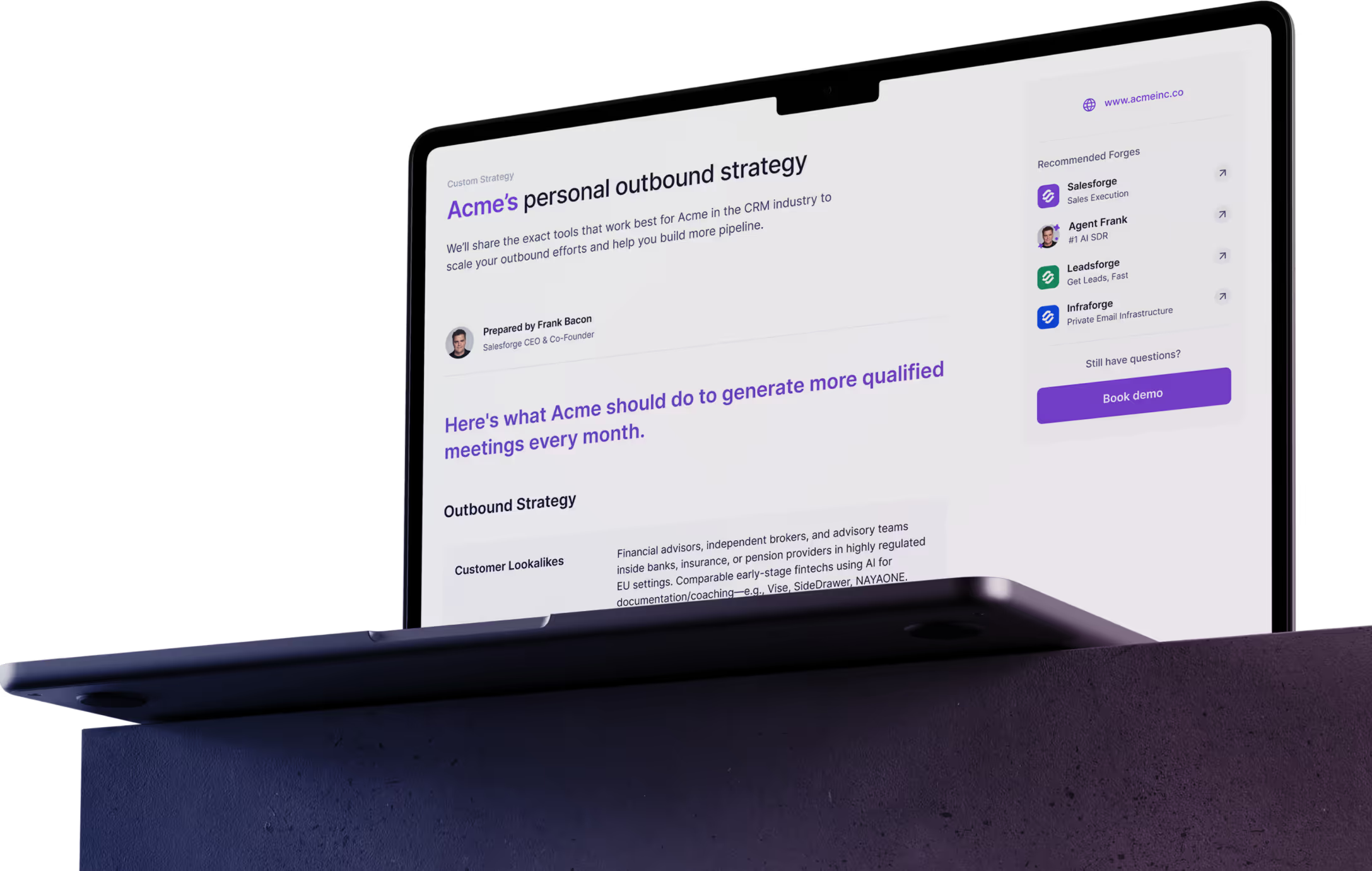
Personalized Outbound Strategy
Get The Right Outbound Strategy In Minutes
Enter your email to get a custom plan & stack recommendation for your
business
It's being carefully crafted by AI
Please check your mailbox in 5 minutes
Email Warm-Up, Proprietary Infrastructure & Other Inbox Placement Features
Deliverability is the single biggest hidden cost of cold email marketing. If your emails land in spam, nothing else matters. This is one area where Salesforge differentiates itself:
And more. Building sender reputation gradually while spreading volume across addresses and IPs to avoid single-mailbox throttles or sudden reputation hits is crucial for a scaling business. And that's paired with proprietary infrastructure options:
Or your team can connect custom infrastructure if they so choose
Those infrastructure features reduce the risk of landing in spam and make multi-channel outreach more reliable, especially when you have a leads database and want to integrate email at scale.
QuickMail is focused on getting emails into inboxes, and its deliverability pages highlight this via free warm-up (albeit thorugh a 3rd party tool - MailFlow), inbox rotation, blacklist monitoring, custom domain tracking, human-like sending, email verification, and deliverability insights.
Instantly pitches unlimited warm-up and some basic deliverability testing capabilities like placement tests, mailbox rotation and ESP matching. Otherwise, for an email-centric outreach tool, it's email deliverability capabilities are fairly run-of-the-mill, with deeper issues (such as an identifiable email fingerprint) also hindering deliverability.
But if your core objective is maximizing steady inbox placement with a setup that removes the need for manual warm-up and maximizes deliverability to the fullest potential, I found Salesforge’s model to be perfect.
Running campaigns for multiple clients or multiple sales reps means juggling many email accounts, avoiding cross-sender reputation damage, and often rotating senders.
Salesforge advertises unlimited mailboxes and unlimited LinkedIn senders for the Growth plan, which starts at $96/mo. This removes many constraints and lets me add mailboxes for each sales rep, mailbox per client, or dedicated mailboxes per campaign affordably. For agencies managing multiple client accounts, that means they can scale without creating a big vendor bill per new mailbox. Moreover, Salesforge also offers unlimited shared workspaces and seats. Also a great feature I ran across is the Primebox - a unified inbox with consolidated replies - which simplifies reply triage when dozens of senders are in flight.
QuickMail is decent when the main job is rotating across many email and LinkedIn senders without making the workflow feel messy. Its automatic rotation and sender support make it practical for scaling outbound, especially when deliverability matters, but it's capabilities in the realm of scale reach nowhere near Salesforge's level.
Instantly supports unlimited mailboxes, but otherwise it doesn't focus on massive scale as much as Salesforge does. I found it to be a decent fit if you only want to run many parallel email campaigns and that's as far as your vision of scale goes.
Customer Support Channels & Resources
When comparing each vendor's support side-by-side:
QuickMail is the most content-heavy of the three. While it offers a support email and support tickets, its site leans on educational material, community, courses, podcasts, and playbooks, which are useful when I want to learn by example, but could provide roadblocks when I have specific questions and need the help of the support team.
Instantly provides a help center and practical how-to articles (campaign creation, Unibox management, warm-up guidance), plus a Slack community and Facebook group to meet likeminded people. Apart from that, they have the standard support channels covered - live chat and email.
Salesforge takes customer support & resources very seriously, while coupling product tooling with a people-first enablement stack that’s designed to reduce onboarding friction.
Salesforge focuses on customer support and convenience and reduces the manual tasks sales teams often struggle with - no separate deliverability vendor, fewer manual data entry steps, and a partner focused on ironing out initial list hygiene and infrastructure.
Besides that, Salesforge customers also get:
24/7 email and live chat support
Extensive documentation
Youtube tutorials
An active Slack community
The Salesforge Academy
And even weekly AMA sessions.
Who Should Pick Which Tool?
Pick Salesforge if you run campaigns that need unlimited email accounts/LinkedIn senders, want unified reply management, want a deliverability-first workflow with unlimited free warm-up, or simply want an affordable option for smooth cold outreach. It’s my pick for teams and agencies of all sizes managing multiple clients and sales teams that need high inbox placement across many senders.
Pick QuickMail if you're a team that wants a polished email + LinkedIn workflow and values a strong educational ecosystem around the product. It's especially comfortable for operators who want a very basic, though limited tool without moving into a more complex stack.
Pick Instantly if you want high-volume, email-first sequences and fast test cycles. It’s useful when you have an external lead stack to feed campaigns and don't mind things such as vendor lock-in, lack of mobile app, absent proprietary email infrastructure options, or a generally lackluster perspective towards deliverability.
QuickMail vs Instantly vs Salesforge: My Final Verdict
After comparing feature sets, deliverability tooling, campaign building UX, agency workflows, customer care, and pricing, my choice for the go-to tool for cold outbound would be Salesforge if your primary needs are:
Scaling outreach across unlimited email accounts and LinkedIn senders,
Seamless consolidated reply handling with the Primebox,
Why do businesses aiming to manage multiple campaigns choose Salesforge over Instantly and QuickMail?
Salesforge is built for businesses aiming to manage multiple campaigns with less effort. Its user-friendly interface supports cold email outreach, outreach campaigns, and automated outreach in one place, so teams can sync data and save time. Compared with Instantly and QuickMail, it is stronger for multiple users, centralized reply management, and scaling outreach activity without adding extra cost or a steeper learning curve.
How does Salesforge improve deliverability and keep email campaigns out of the spam folder?
Salesforge focuses on better deliverability with a warm-up tool, mailbox rotation, ESP matching, placement tests, and its deliverability network. These key features help email campaigns land in inboxes instead of the spam folder. For businesses that run follow-up emails and automated follow-ups, that matters because stronger inbox placement can improve response rates and make the email platform more reliable than other tools.
Is Salesforge more cost effective for a basic plan or advanced features?
Salesforge can be cost effective because its basic plan already includes useful core features for cold email outreach, while advanced features are available when teams need them. That makes it a practical email platform for businesses that want to start small and grow into more outreach campaigns later. Compared with Instantly and QuickMail, it can reduce the need for extra tools and extra cost as your sending limits expand.
What Salesforge key features help manage email campaigns and follow-up emails?
Salesforge combines email campaigns, automated outreach, and automated follow-ups with a user-friendly interface that makes campaign work easier to manage. Teams can create outreach campaigns, organize multiple campaigns, and keep follow-up emails consistent across channels. That makes it a strong choice for businesses that want actionable analytics, faster workflow, and a single place to manage multiple users and outreach activity.
Is Salesforge better cold outreach software than Instantly and QuickMail?
For teams that want better cold outreach, Salesforge stands out with deliverability-first infrastructure, a warm-up tool, and advanced analytics. Instantly and QuickMail are useful in their own ways, but Salesforge is more complete for businesses that need email outreach plus automation, fewer manual steps, and stronger reporting. Its key features help teams move faster, save time, and run outreach campaigns with more control.
Book more meetings on autopilot
Set up in minutes. No per-seat pricing. No commitment.
I dug through Workflows.io's five services, its $4K to $12K pricing bands, ten published case studies, and how it stacks up against certified outbound alternatives.
I dug through corebits.io, the gtm.corebits.io subdomain, and every case study across their three engines to give you an honest read before you book the discovery call.
Read this Vantage Profiles review for a clear look at its LinkedIn account rental service, pricing, identity risks, customer feedback, and whether it is worth using.





.jpg)