You've sent the first email. Then the follow-up. Then another. Now you're staring at your sequence, cursor hovering on send, wondering if this one lands as helpful or annoying.
I've been there more times than I want to admit. Running Salesforge means I watch this exact moment play out across thousands of campaigns every week. It's where most sequences quietly break.
The problem is nobody teaches you when to stop. Every guide out there tells you to follow up more. Almost none tell you when to close the loop and walk away.
So this is that guide. I'll cover the signals that tell you to stop, how many follow-ups actually make sense by scenario, the reputation math that should change how you think about sending "just one more," how to write a breakup email that gets a reply, and the automation piece that makes all of this hold up at scale.
Let's get into it.
If you're skimming, here's the short answer by scenario.
And the rules that hold across every scenario:
There are four signal types I watch when I'm mid-sequence. Any one of them is a soft stop. Two together is a hard stop.
Here's how each one shows up in a real campaign.
If your prospect hasn't opened the last two emails, they either aren't seeing them or aren't interested. Both mean the same thing for your sequence. Stop.
The trickier version is opens without replies. Two opens, no reply, no click, that's a lukewarm read at best. I'll send one more with a genuinely different angle, then close the loop.
Repeated opens with no reply after three touches is a signal you're being politely ignored. Push past it and the "polite" part disappears.
Read your draft out loud. If it's saying the same thing as your last email in different words, stop writing and stop sending.
Every follow-up needs a new reason to exist. A new proof point, a different angle, a lower-friction ask, or a genuine question. Recycling the original pitch is what trains inboxes to see you as noise.
If you can't write a follow-up that adds something new, the sequence is done. That's not failure. That's respect for the reader's time and yours.
Not every "no" comes wrapped in the word "no." Watch for phrases like "not the right timing," "let me circle back later," "sending this to my colleague," or "we're evaluating other tools right now."
These are polite closes. The sender is buying themselves runway to say no without saying no.
Treat them as a stop signal. Send one more email acknowledging the timing, then move the prospect to a re-engagement list to revisit in 90 days.
This is the signal most people miss because it isn't in the prospect's behavior. It's in your infrastructure.
Bounce rates creeping above 2%, spam complaint rates approaching 0.1%, or a drop in Google Postmaster reputation are all telling you that your list or your cadence is a problem, not just this one prospect. If you're seeing any of those, stop the campaign. Not just the prospect. The whole campaign.
Then check your sender reputation before you queue up another one.
So how many is the right number when the outreach is cold?
Here's how I think about it. Deal size, buying cycle, and prospect seniority set the count. Not personal preference. Not what the last vendor told you.
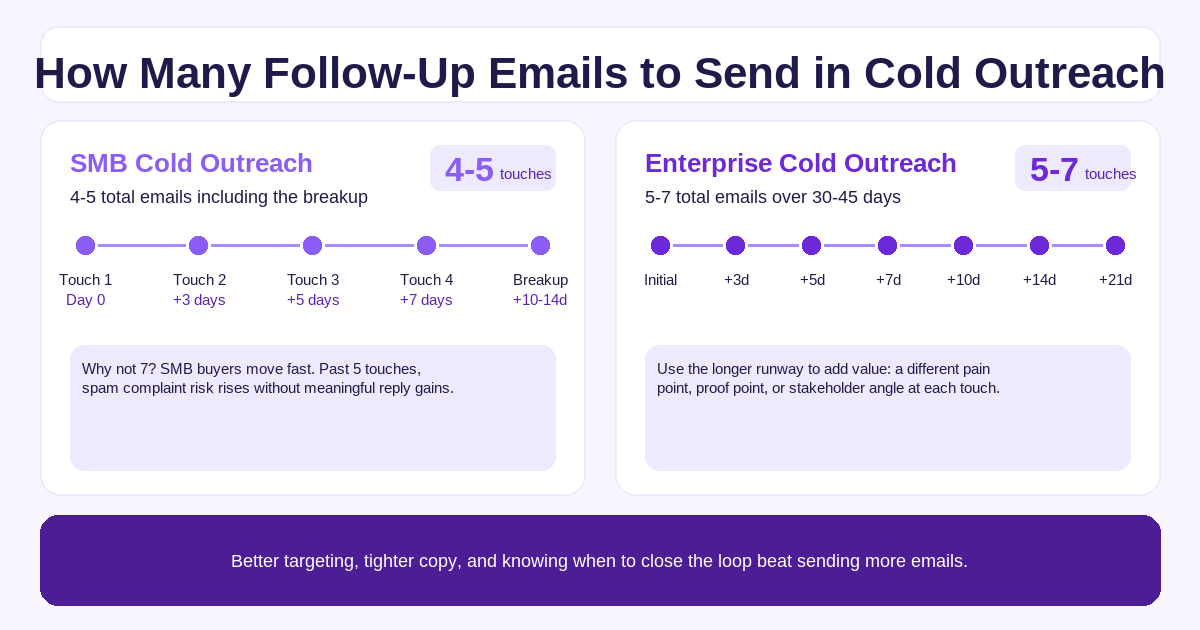
For SMB cold outreach, I run 4 to 5 total emails including the breakup.
The rhythm looks like this: initial email, follow-up 3 days later, follow-up 5 days after that, follow-up 7 days after that, then the breakup 10 to 14 days later.
Why five and not seven? SMB buyers move fast when they're interested. If four touches haven't landed, the fifth is almost never the one that does. And every extra send past five raises your spam complaint risk without raising reply rates in a meaningful way.
I've watched teams push to 7 or 8 emails on SMB lists thinking persistence would save the campaign. It doesn't. What saves the campaign is better targeting, tighter copy, and knowing when to close the loop.
Enterprise is different. Longer buying cycles, more stakeholders, and thicker calendars mean you get more space to work with.
For enterprise cold outreach, I run 5 to 7 total emails over 30 to 45 days. The cadence stretches to something like 3, 5, 7, 10, 14, and 21 days between touches.
The extra runway isn't permission to be pushier. It's permission to add more genuine value. Each follow-up should reference a different pain point, a different proof point, or a different stakeholder angle at the account.
If you're sending seven "just checking in" emails to a VP, you're not doing enterprise outreach. You're just annoying an executive on a longer cadence.
The breakup email in enterprise sequences works especially well. Decision-makers appreciate the acknowledgment that their calendar is packed. Many of them will reply to a breakup with a real reason and a real timeline.
Cold outreach isn't the only place this question comes up. Here's how the count shifts across the other common scenarios.
For post-demo or warm follow-ups, cap the sequence at 2 to 3 emails.
The rhythm is 2 days after the call, 5 days after that, and one more at day 10 if nothing has moved. After that, the deal is either in motion or it isn't.
Warm follow-ups have a different psychology. The prospect has already given you their attention once. Repeatedly asking for it again reads as pushy in a way cold outreach doesn't.
If the timeline goes cold after the third touch, log the reason in your CRM and move on. Come back in a quarter with a genuine new angle.
For job applications, send 1 to 2 follow-ups at most. That's it.
Send the first one 7 days after applying. Send the second one 7 to 10 days after the first if you had a real touchpoint like an interview or a recruiter call.
Beyond two, you're pushing into territory that hiring managers actively hold against candidates. The "eager and interested" version of persistence turns into "can't read the room" fast.
If you're recruiting, 2 to 3 follow-ups spaced 3, 7, and 14 days apart is the range that works.
The first two are gentle nudges. The third is a soft close. Something like "Should I take you off my list for this role, or is there a better time to connect?"
Candidates respect the direct ask. They usually respond with a real yes or no, which is what you wanted in the first place.
Partnership outreach runs longer than sales. 3 to 4 follow-ups across 30 days is the right range.
Cadence looks like 5, 7, 14, and 21 days. Every touch should reference something specific to their business, not a template pitch about mutual value.
If the fourth email doesn't land, the timing or the fit is off. Both are legitimate reasons to close the loop.
Journalists and editors are inbox triage machines. 1 to 2 follow-ups is the ceiling.
Send the first 3 days after the initial pitch, the second 7 days after. If nothing lands, they've decided. Sending a third is what gets you filtered next time.
For link-building outreach, 2 to 3 follow-ups over 2 weeks works. Cadence of 5, 10, and 14 days is a reasonable rhythm.
If the page you're pitching to hasn't been updated recently or the site owner isn't actively publishing, the sequence is dead before you send it. Check the site first, then send once, follow up twice, and move on.
Here's the part most guides skip. Every extra follow-up you send has a cost, and that cost isn't measured in the current campaign. It's measured in every future send from your domain.
Let's break down the numbers.
Reply rates drop by 55% at the fourth follow-up compared to earlier touches in the sequence, according to Instantly's 2026 benchmark data. That's not a small dip. That's the returns collapsing.
Unsubscribe rates triple at the fourth touch. Spam complaint risk triples again at the fifth. And Google's bulk sender guidelines cap spam complaint rate at 0.1% before you're in trouble, with active throttling starting at 0.3%.
Cross the 0.3% ceiling and Google throttles your domain until your spam rate stays below 0.3% for seven straight days. That's every email from every mailbox on that domain slowed down. Cold outreach, transactional email, and your personal reply to a co-founder all sit in the same queue.
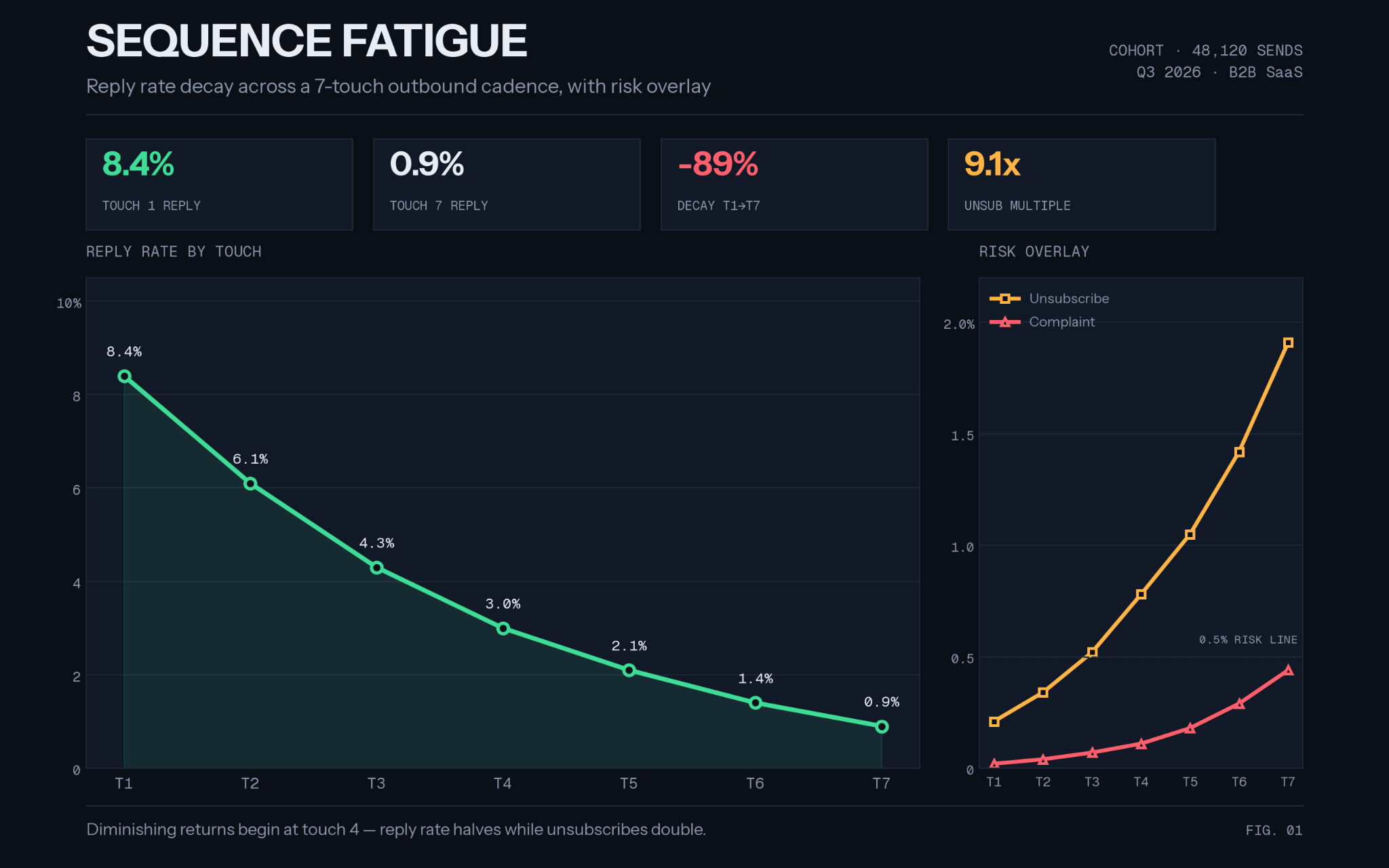
So here's the mental model I use. Every follow-up past the third is a bet. Are the incremental replies worth the incremental spam complaint risk? Sometimes yes for enterprise. Almost never for SMB.
If your bounce rate is already above 2% or you're seeing complaint rates climb, the answer is always stop.
Fix the daily send volume math and keep your emails out of spam before you push more touches through a compromised setup.
None of this matters if your mailboxes aren't warmed properly in the first place. Reputation math starts before your first campaign, not after your first spam complaint.
The breakup email is the send most people are afraid of. It shouldn't be. It's usually the highest-performing message in the entire sequence.
Here's why. Most sequences work by asking. The breakup email works by removing the ask.
When you tell a prospect you're closing the loop and stepping back, you flip the dynamic. There's no pressure to reply. No obligation to explain themselves. That's exactly what makes people reply.
Loss aversion kicks in. The door they've been leaving unopened is now being closed for them. Some of them will finally push it open.
Structure it in three parts. Acknowledge the silence without making it awkward. Say you're stepping back and closing the loop. Leave the door open with a low-friction way to reconnect later.
Here's the version I use:
That's it. Three sentences. No pitch, no case study, no CTA link. The email is the CTA.
Send it 10 to 14 days after your last unanswered follow-up. If you want more variations to test, I have 10 polite reminder templates that share the same tone as this breakup.
Here's the part nobody warns you about. Knowing when to stop is only half the job.
Actually executing it, across 200 prospects, every day, without dropping a send or firing off a follow-up after someone has already replied, is where good sequences die.
Do it manually and something always breaks. A follow-up goes out three hours after the prospect replied. A cadence gets skipped because Monday got busy. A 3am send lands in the wrong time zone. Or worse, you forget to stop the sequence after the breakup, and someone gets a sixth email that reads as harassment.
This is where automation stops being a nice-to-have and starts being the reason your stop rules actually work.

I run all of this inside Salesforge because it handles the parts that break manually.
The point isn't that you can't run cold outreach manually. It's that the discipline required to stop at the right time falls apart at scale. Automation is what protects you from your own busy Monday.
More than 5 total emails including the breakup is too many for cold outreach in most cases. Beyond that point, reply rates drop sharply and spam complaint risk climbs faster than incremental replies. If you find yourself needing 7 or 8 touches to get responses, the problem is usually targeting or copy, not persistence.
Stop the second a prospect replies, whether the answer is yes or no. Stop when engagement signals across your last two touches point to disinterest, like no opens or repeated non-replies to opened emails. And stop the moment your sender reputation shows warning signs, since one bad campaign can throttle every future send from that domain.
Only for enterprise outreach with long buying cycles, and only when every extra touch adds something new. 5 to 7 total emails over 30 to 45 days can work for named accounts with multiple stakeholders. For SMB or transactional deals, past 5 is where the math flips against you.
A breakup email is the final message in a follow-up sequence that tells the prospect you're closing the loop and stepping back. It removes the ask instead of adding one, which usually pulls the highest reply rate of the entire sequence. Three sentences is enough: acknowledge the silence, say you're pausing, leave the door open.
They can, if you send too many or your list quality is poor. Google throttles domains that hit a 0.3% spam complaint rate, and unsubscribe rates triple at the fourth follow-up compared to earlier touches. The safest range is 3 to 5 total emails with clean lists, verified sending infrastructure, and an auto-stop rule when someone replies.
For B2B cold outreach, no. Tuesday through Thursday mornings in the recipient's time zone consistently pull the best engagement. Weekend sends often get buried under Monday inbox triage, which increases the chance of your email being deleted or marked as spam without being read.
.jpg)

.jpg)
.jpg)