One client of mine had been getting twenty meetings a month from his last agency. Every month, exactly as promised.
On the calls, though, almost all of them said the same thing. "I told the person who rang me that I'm not looking for this. And they said this is just an informational call."
Half of those companies were the wrong size for him anyway.
The agency had not lied about anything. It booked twenty meetings and it got paid for twenty meetings.
That is pay per lead working as designed. You pay a fixed fee for each lead delivered and nothing when none arrive, and it sounds like the fairest deal an agency can offer. You pay for booked meetings, so the agency books meetings. Whether those people want to buy is not its problem.
I sold pay per lead myself when I started, because everyone did. Eight years later I stopped.
In this article I cover what pay per lead costs, where it breaks, and what else that money buys.
Pay per lead is a pricing model where a business pays a fixed fee for each lead an agency delivers. You agree the fee in advance. No lead means no charge.
Lead generation agencies sell this way, and so do affiliate networks and data vendors. You see it most in insurance, legal services, home improvement and B2B software. Buyers in these industries are easy to count and easy to reach.
The model puts the risk on the agency. A retainer pays an agency every month, results or not, while pay per lead pays nothing until a lead arrives.
It only puts half of that risk there. The agency carries the cost of producing a lead, and that is an hour of calling. You carry the cost of a lead that goes nowhere, and that is a week of your rep's time.
Every pay per lead deal I have seen runs the same five steps.
The trouble shows up in step five. By then, step one has already settled everything worth arguing about, in a clause you read once.
There is no standard, no trade body, and no definition an agency has to meet. The word means whatever your contract says it means.
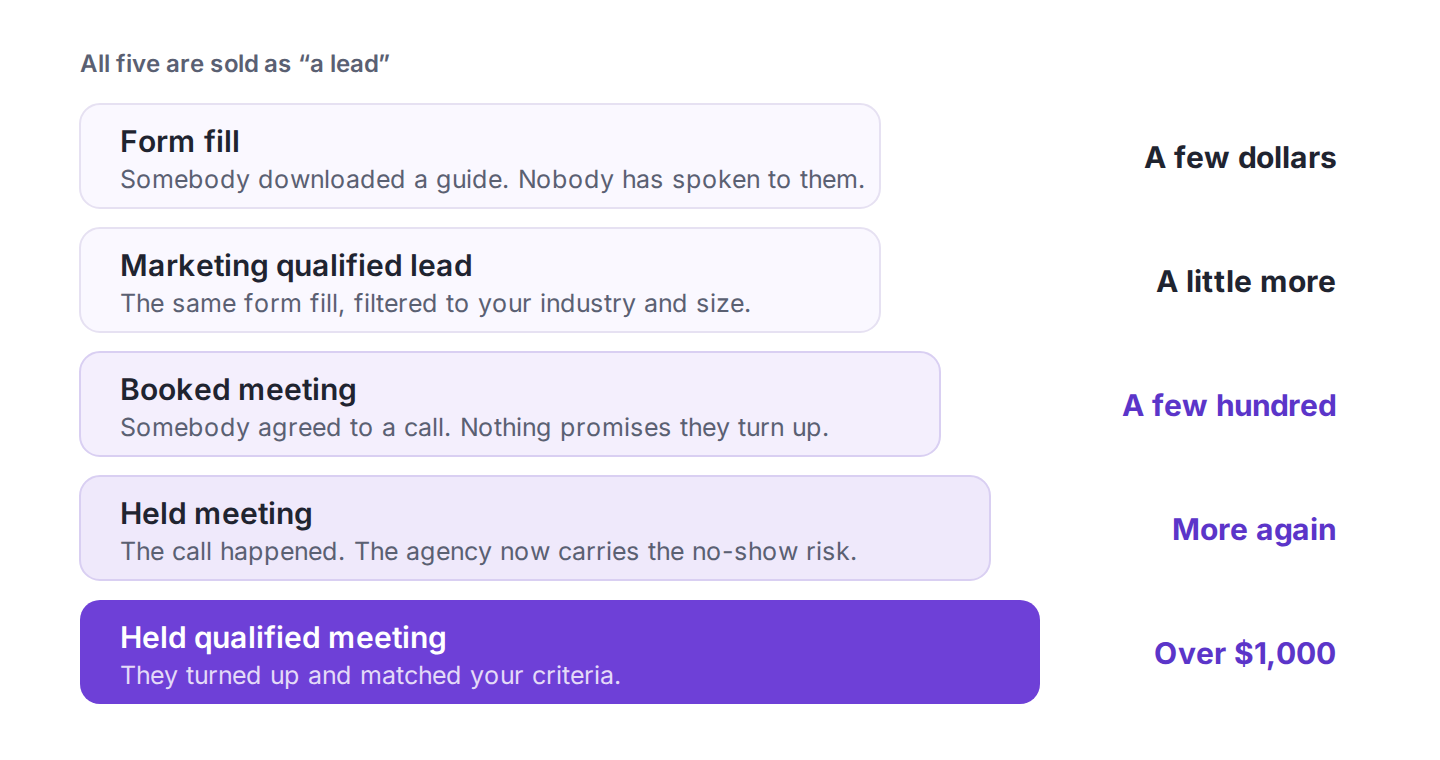
Agencies sell five different things under the same word, and the price tracks how much work each one takes.
Each step along that list moves risk from you to the agency, and the price moves with it.
Clients ask me what a lead should cost. I always ask what the agency is counting first, because every published benchmark counts something different.
First Page Sage tracks cost per lead across thirty industries. In 2026, they estimated a lead costs $249 in B2B SaaS, $429 in cybersecurity, $547 in manufacturing and $682 in legal services.
Those look low to me, and the reason is in the method. First Page Sage counts every channel. A referral that cost you nothing sits in the same average as an ad click that cost you plenty.
Metadata measured the same question differently. It looked at 153 B2B advertisers running paid ads, and counted only the people who reached a CRM. On that basis a Google lead cost $524 and a LinkedIn lead cost $202.
So one benchmark says $249 and another says $524 for broadly similar companies. Neither is wrong. They are counting different people. I never quote a client a single figure without first asking what their agency plans to count.
When a quote comes back higher than a client expected, the reason is almost always one of four things.
The first is how far the agency takes each lead. A form fill and a held qualified meeting are a hundred times apart in price. Some agencies quote the cheap one while describing the expensive one.
The second is who you want to reach. A VP costs more than a manager, because far fewer of them pick up the phone.
The third is what you sell and where you sell it. Legal and financial services sit at the top of every benchmark I have seen, and cost per lead also shifts by geographical location because industry demand is not the same in every market.
The fourth is exclusivity, which also changes with geographical location. You pay roughly double for a lead nobody else receives, and I covered what that word is worth in the section above.
None of the prices above include what you pay before a single lead arrives.
Most agencies charge a setup fee. I have seen these run from $650 at the smaller shops to $5,000 or more at the larger ones. The fee covers list building and campaign setup you never see.
Then there is the term. Six to twelve months is standard, so a bad fit costs you the rest of the contract.
The one people miss is the dispute cap. Most agencies will only let you reject 10% to 25% of a month's leads. Anything over that line you pay for, however bad it is. If a third of your leads are wrong, you are buying the extra ones twice.
A client once told me he was happy at $300 a lead. That sounded reasonable until I asked what he closed.
He was closing one in twenty, so each customer was costing him $6,000. His gross profit per customer was $4,500. He had been running at a loss for two quarters and the cost per lead had looked fine the whole time.
You get the real number by dividing the lead price by your close rate. Here is what that does to a $300 lead.
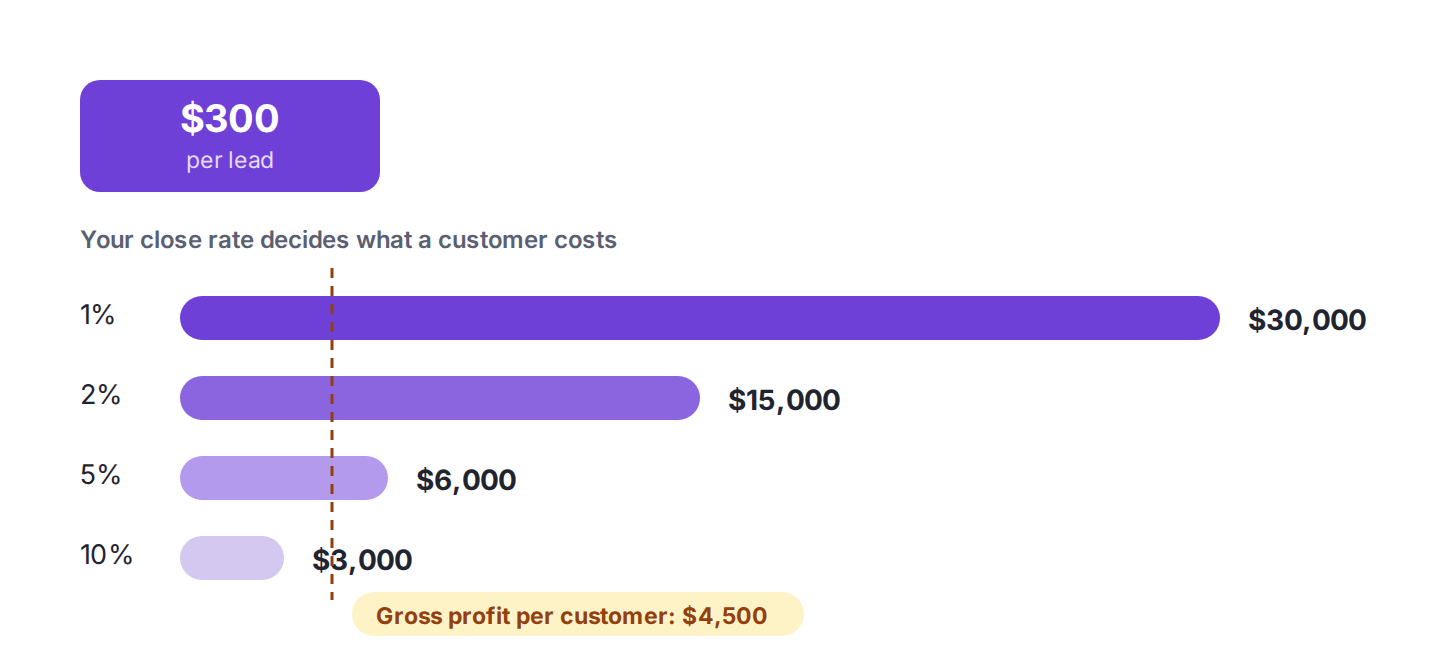
Same lead, same price, ten times the difference.
Lead price only works if your sales funnel is structured well enough to support healthy conversion rates on the leads coming in. Metadata put the median cost per customer across its B2B advertisers at $58,887, so these numbers get large faster than people expect.
I would work that out against your own gross profit before signing anything.
There are five risks of pay per lead, and they all start in the same place.
The agency gets paid for one outcome and you need a different one.
An agency earns more by sending you more leads, so volume is what it optimises for.
My client's agency could have asked each business owner one question and cleared nine in ten off the list. That would have cut its own invoice by ninety percent, so of course it never asked.
The incentive was working exactly as the contract described, and lead quality suffered as a result.
In other words, focusing on lead quantity often harms lead quality because the lead generation process rewards more names instead of better screening.
You are paying for the cheap part of the job. Sorting out the rest falls to you, even though fewer high quality leads would have been far more useful. When an agency optimises for volume, bad leads pile up and the client relationship can suffer.
Agencies can also make a lead pay twice by selling it to more than one buyer, and most contracts allow this.
HomeAdvisor ended up in a class action over it. Contractors allege in their amended complaint that the company promised each lead would reach four providers at most. Homeowners then told them they were the tenth or twentieth caller, and one former employee alleged that staff routinely overrode the cap. A court has not ruled on those claims.
I now ask every seller how many buyers get the same lead. I also want that number written into the contract.
You never hear what the agency said to get someone on your calendar.
The prospect turns up expecting whatever that caller promised. Somebody expecting an informational chat will spend your rep's first five minutes being corrected, and the conversation never really recovers.
I have watched good reps lose deals that were never there.
When a meeting turns out to be worthless, the contract decides whether you pay for it.
Pay Per Lead also carries critical compliance and fraud risk because providers follow different standards.
Disputes can also turn on data privacy and consent requirements, since lead generation practices still need to comply with regulations.
I have read two lead generation agreements that say opposite things in almost the same words.
One states that all leads received will be considered legitimate and charged as such. The other gives the buyer sole discretion to accept or reject any lead. Both of them call the product a qualified lead.
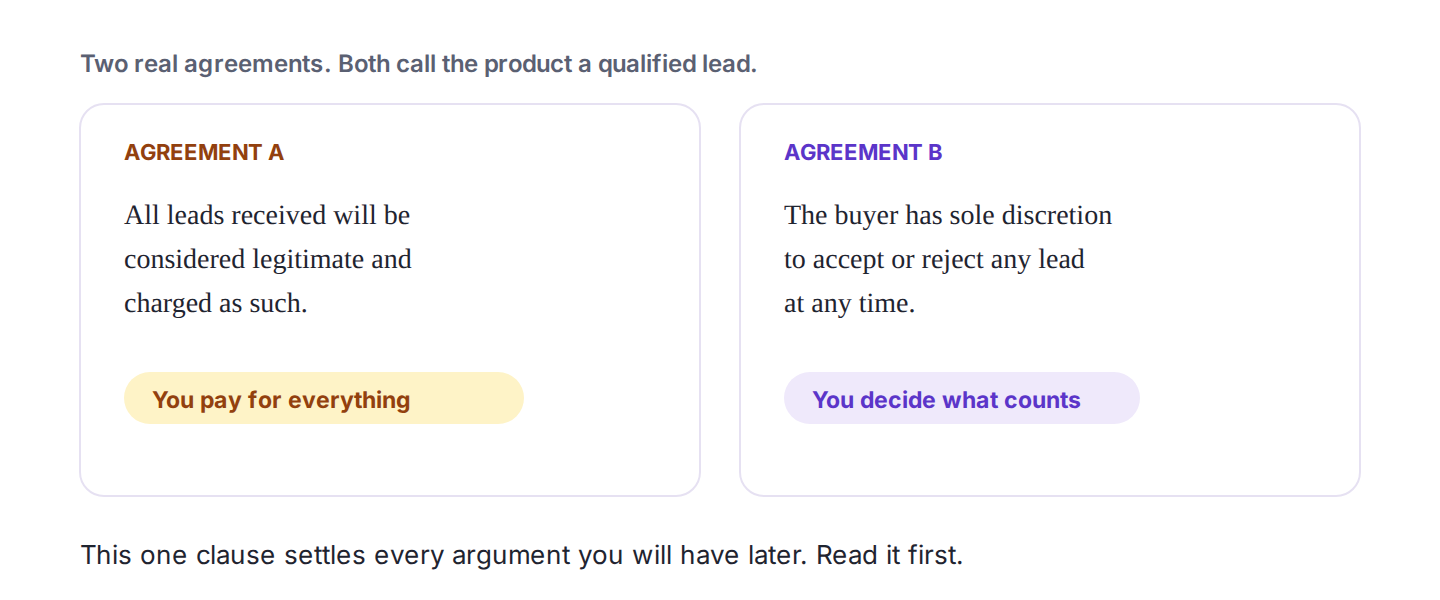
I read that clause first now, because it decides every argument you will have later.
The last risk shows up months in, when you stop.
A retainer at least leaves you with meetings held and a market you understand better than you did. Pay per lead leaves you with a list of names and no idea which message produced them.
The week you stop paying, the calls stop too.
Most clients compare pay per lead against four other options.
Paying per appointment moves you one step up the quality ladder. The agency only gets paid when a meeting happens. It now has a reason to care whether people turn up.
Prices run from around $150 a meeting for small business targets to $900 or more for mid-market. You pay more than you would for a lead, and you get a better unit for it.
The gap it does not close is fit. A held meeting with the wrong company is still a wasted hour.
A retainer pays for the agency's time whether results arrive or not, which is why most experienced marketing agencies still prefer hourly or retainer billing.
On paper, the pay per lead model can look more profitable than a traditional retainer when volume is strong, but weak conversion rates and squeezed profit margins can erase that advantage fast. That is the part buyers hate.
What it buys you is control. You see the list, you approve the messaging, and you keep the data when the contract ends. Most retainers run between $2,500 and $15,000 a month depending on scope.
I moved my own clients to retainers for exactly that reason. The work is the same, but we argue about targeting instead of invoices.
Running outreach yourself costs the least and gives you the most. This is where I moved my own clients.
You need domains, mailboxes, a sequencer and contact data. All of that comes to a few hundred dollars a month. The cheapest retainer starts at $2,500, and a single lead can cost $300.
The reason this wins is that every part of it stays yours. You pick the companies, so nobody sells you a prospect who was never going to buy. You write the first line, so nobody promises an informational chat on your behalf. You keep the list, the replies and the message that worked.
It also compounds. A retainer buys you meetings this month and nothing next month.
After running outreach for 3 months, you'll automatically learn which job titles reply and which subject lines work. You also learn which companies to stop emailing. This will help you identify on what to double down and scale your efforts.
I have argued against pay per lead throughout this article, so it is only fair to say where it works. There are four situations.
Every one of those is temporary. Pay per lead buys you time or tests an idea, and it does both well. It will not build you a pipeline you can rely on next year.
If you are going ahead anyway, these are the questions I would put in an email before signing anything. The answers belong in the contract.
An agency that answers all eight in writing is probably worth working with. One that will only answer them on a call is telling you something.
I recommend this option to most clients, and it costs less than anything else in this article.
You need four things, and none of them are hard to buy.
Here is what a founder running this alone actually pays, on annual billing.
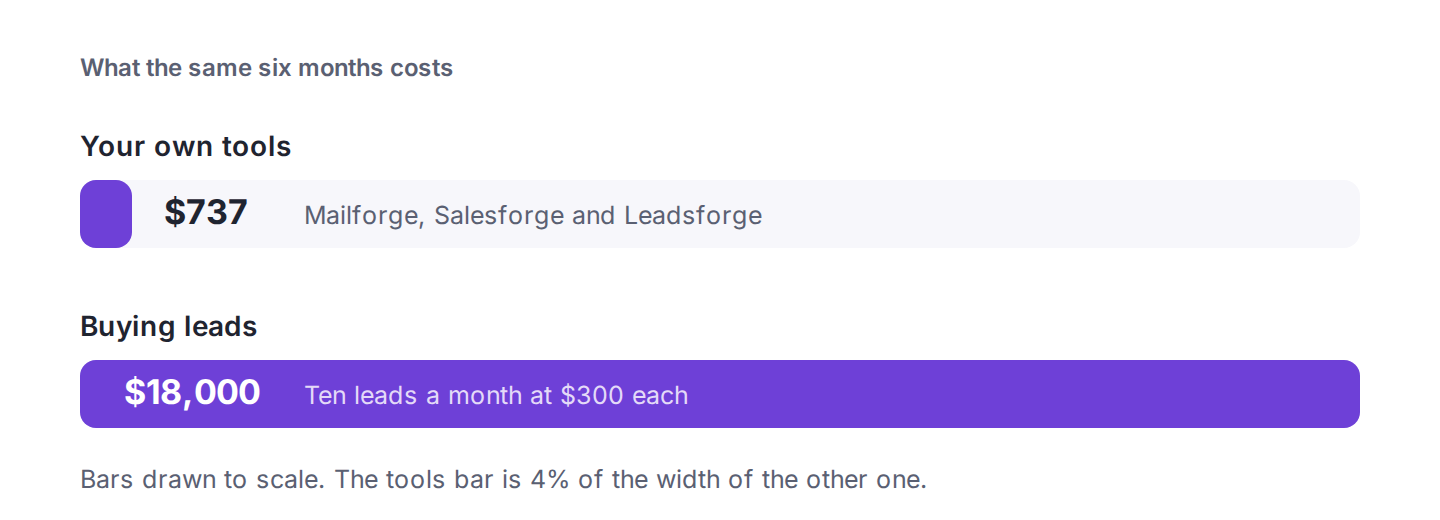
Mailforge charges $3 per mailbox per month with a ten slot minimum. Domains cost about $15 a year each on top. Salesforge Pro is $40 a month on annual billing and includes warmup. Leadsforge Essential is $49 a month for 2,000 credits. The bottom row assumes ten bought leads a month.
This is the part that decides it for me.
An agency leaves you with a spreadsheet. Your own setup leaves you with the domains and the warmed mailboxes. It also leaves you the list, every reply and the message that worked.
You also keep the thing nobody invoices for. After six months you know which job titles answer and which opening line gets read. You know which industries never reply.
An agency that learned all of that on your budget takes it to its next client.
Pay per lead is not a scam, and the agencies selling it are not villains. The model simply pays them for something other than what you need, and everything else follows from that.
Buying leads makes sense when you are testing a market. It also makes sense when you need pipeline faster than you can build it. I would read the definition clause carefully. I would also want the buyer count and the dispute window in writing.
Anything you plan to rely on next year is worth owning. The tools cost a few hundred dollars a month, and what you learn in the first six months stays with you.
Salesforge runs the email and LinkedIn side of that, with warmup included on every plan. The trial runs 14 days and needs no card.
If you would rather someone else operated it while you keep the system, that is what my agency does.
There is no single figure, because it depends on what you close. First Page Sage put 2026 averages at $249 for B2B SaaS and $682 for legal services. Your own number comes from the lead price divided by your close rate, measured against gross profit per customer.
Sometimes, and mostly as a short-term move. It works when you are testing an unfamiliar market or need meetings faster than you can build them. It works badly as a permanent arrangement.
Pay per lead is a pricing model and cost per lead is a measurement. You buy on a pay per lead basis, then calculate cost per lead afterwards. Your own ads and outreach have a cost per lead too.
Build it if you will still be selling to this market next year. Tools run a few hundred dollars a month against $18,000 for six months of bought leads, so if you worry about long-term costs, building your own pipeline also means you keep the list and the message that worked. If you build your own pipeline, tools like GetLeadForms can help create multi-step forms for lead qualification and generate qualified leads. A free consultation or call can help you decide whether buying leads or building a pipeline is the better fit.