
Personalized Outbound Strategy
Get The Right Outbound Strategy In Minutes
Enter your email to get a custom plan & stack recommendation for your business
It's being carefully crafted by AI
Please check your mailbox in 5 minutes
Vereigen Media says its content syndication campaigns are built around first-party data, minimum engagement thresholds, and human verification before any leads are sent to clients. That sounded promising, so I decided to take a closer look. But if you’re searching for Vereigen Media reviews, there’s one thing worth knowing upfront:
I couldn’t find customer reviews on G2, Trustpilot, or Capterra. That makes it harder to see how its leads actually perform for real customers.
So, to get a clearer picture, I reviewed Vereigen Media’s lead generation process, services, pricing information, and published case studies.
In this review, I’ll walk through the seven main things I found, including how Vereigen Media qualifies leads, what results it reports, how pricing works, and what you should ask before starting a campaign.
I went through Vereigen Media's lead generation, content syndication, ABM, event registration, and advertising services. Here are the seven things that stood out.
Vereigen Media does not simply sell a database of B2B contacts. It runs managed demand generation campaigns across email, content syndication, paid ads, SEO, and ABM. It also offers event registration and programmatic advertising.
This makes it more relevant for marketing teams looking to run a complete demand generation campaign rather than buy a list and handle outreach themselves.
Vereigen Media says it uses first-party data to build account and contact lists. For content syndication, it can narrow the audience by industry, job role, company size, and buying intent.
That gives you more control over who receives your content instead of paying for broad distribution that may bring in irrelevant leads.
This was one of the more interesting parts of its Verified Content Engagement (VCE) service. Vereigen Media says every lead must meet a minimum engagement threshold before being delivered. In other words, the prospect needs to meaningfully interact with your content rather than simply appear in its database.
Vereigen Media says its content syndication leads go through human verification before they reach your marketing or sales team.
You then receive a clean, verified lead list that can be moved into your nurture process. This is useful because your team is not expected to start with completely unfiltered contacts.
Vereigen Media is not limited to generating individual leads. Its ABM service can target selected accounts using firmographic data, technographic data, intent signals, and behavioral insights.
Campaigns can then reach different stakeholders through content syndication, personalized content, display advertising, and other channels. This makes the service more relevant for companies selling into larger accounts with several people involved in the purchase.
Vereigen Media also runs campaigns for webinars, virtual conferences, online product demos, and workshops.
It targets attendees by factors such as job title, industry, location, and buying signals. Vereigen Media says registrations are human-verified and the resulting contact data can be delivered for CRM follow-up.
This is where I would be cautious. Vereigen Media makes several strong claims about lead quality, pipeline growth, engagement, and revenue impact. But there are no meaningful independent user reviews available on major review platforms to show how those claims hold up across real customer campaigns.
Pricing is also not clearly published. So before signing, I would ask for results from a similar campaign, sample leads, exact qualification rules, cost per lead, and the lead replacement policy.
The service itself looks detailed on paper. The bigger question is whether Vereigen Media can produce the same lead quality and results for your ICP, and that is something its public information alone cannot prove.
I think Vereigen Media is worth considering if your goal is to generate B2B demand from a clearly defined ICP, rather than just buy a list of contacts.
What stands out most is its focus on lead quality. Vereigen Media says its content syndication campaigns rely on first-party data, require leads to meet a minimum engagement threshold, and include human verification before leads are delivered.
That said, the biggest drawback is the lack of independent proof. I couldn’t find customer reviews for Vereigen Media on G2, Trustpilot, or Capterra. The company also doesn’t publish clear pricing, which makes it harder to assess the real cost or understand the customer experience before speaking with their sales team.
Overall, Vereigen Media could be a good fit for B2B teams that already have content to promote and want a managed partner to help reach and qualify relevant buyers. But I wouldn’t rely on the company’s claims alone.
Before making a decision, ask for sample leads, exact qualification criteria, pricing, replacement terms, and results from campaigns targeting an ICP similar to yours.
I didn’t run a paid campaign with Vereigen Media, so this review is based on what a potential customer can realistically verify before signing up. I looked at Vereigen Media’s service pages to understand how its demand generation, content syndication, ABM, event registration, and programmatic advertising services work.
I also reviewed its lead generation process to see how prospects are targeted, engaged, qualified, and verified before being delivered as leads.
I paid particular attention to its data and targeting approach, including how it uses first-party data, ICP criteria, intent signals, and human verification. I also checked whether pricing information is available, since buyers need some way to estimate campaign costs before contacting the company.
Overall, I focused on lead quality, targeting, transparency, and independent proof. These are the main things I would want to verify before paying for a B2B lead generation campaign.
Vereigen Media covers more than standard B2B lead generation. Its services range from content syndication and demand generation to ABM, event registration, and programmatic advertising. Here is what each service actually does:
Together, these services let Vereigen Media support different campaign goals, whether you want to generate leads from existing content, target specific accounts, fill a webinar, or reach in-market buyers through paid advertising.
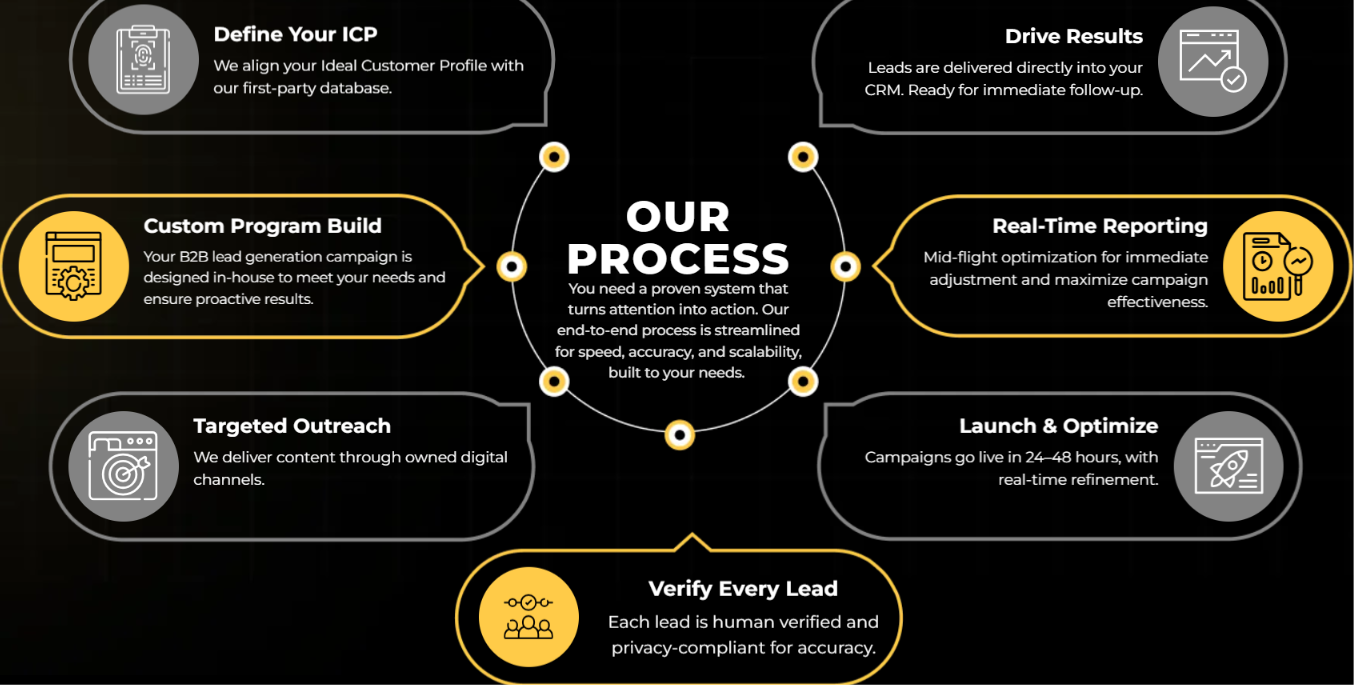
Vereigen Media does not describe its process as simply finding contacts and sending you a list. For its Verified Content Engagement (VCE) campaigns, it starts with your ICP, distributes your content to relevant prospects, tracks engagement, and then delivers verified leads.
Here is how the process works:
The campaign starts by defining the buyers you want to reach. Vereigen Media can target prospects based on factors such as industry, role, company size, and buying intent.
Next, Vereigen Media selects the content assets, channels, and budget based on your campaign goals. This could involve assets such as whitepapers, reports, webinars, or other B2B content.
Your content is then distributed to vetted prospects using Vereigen Media's database and digital outreach methods. The company says this work is managed by its internal team.
When prospects interact with the content, their information can be captured through gated forms or engagement tracking. Vereigen Media says every lead must meet a minimum engagement threshold before becoming a lead.
Vereigen Media says leads are human-verified before they are delivered to your marketing or sales workflow. This adds another quality check before the contacts reach your marketing or sales team.
Once qualified and verified, Vereigen Media delivers a clean lead list that your team can use for nurturing and sales follow-up.
The main thing I like about this process is that Vereigen Media puts targeting, engagement, and verification before lead delivery. However, the company does not publicly explain the exact engagement threshold a prospect must meet, so I would ask for those qualification rules before starting a campaign.
Vereigen Media does not publish standard pricing for its services. You need to contact the company for a custom quote. Its content syndication campaigns are customized around your ICP, goals, budget, content, and channels.
There is also no publicly available information on standard cost per lead, minimum campaign spend, contract length, or lead replacement terms.
Before signing, ask for these details in writing so you know the total cost, commitment, deliverables, and lead replacement terms.
Vereigen Media publishes case studies covering campaigns for ServiceNow, AnyDesk, and a cybersecurity company. The strongest proof comes from ServiceNow and AnyDesk, where the company shares specific lead quality and engagement results.
These results are reported by Vereigen Media in its own case studies, so I would still ask for recent results from a campaign targeting an ICP similar to yours before signing.
You should consider Vereigen Media if you are a B2B marketing or demand generation team that already knows its ICP and wants a managed partner to reach and qualify relevant buyers.
Vereigen Media is a better fit for:
Vereigen Media may not be the right fit if you:
Vereigen Media focuses on B2B demand generation, content syndication, ABM, event registrations, and programmatic advertising. If your main goal is more directly tied to outbound prospecting, qualified meetings, or building a repeatable sales pipeline, these certified Forge Experts are worth comparing.
Best for: B2B companies that want a managed outbound process focused on qualified meetings.
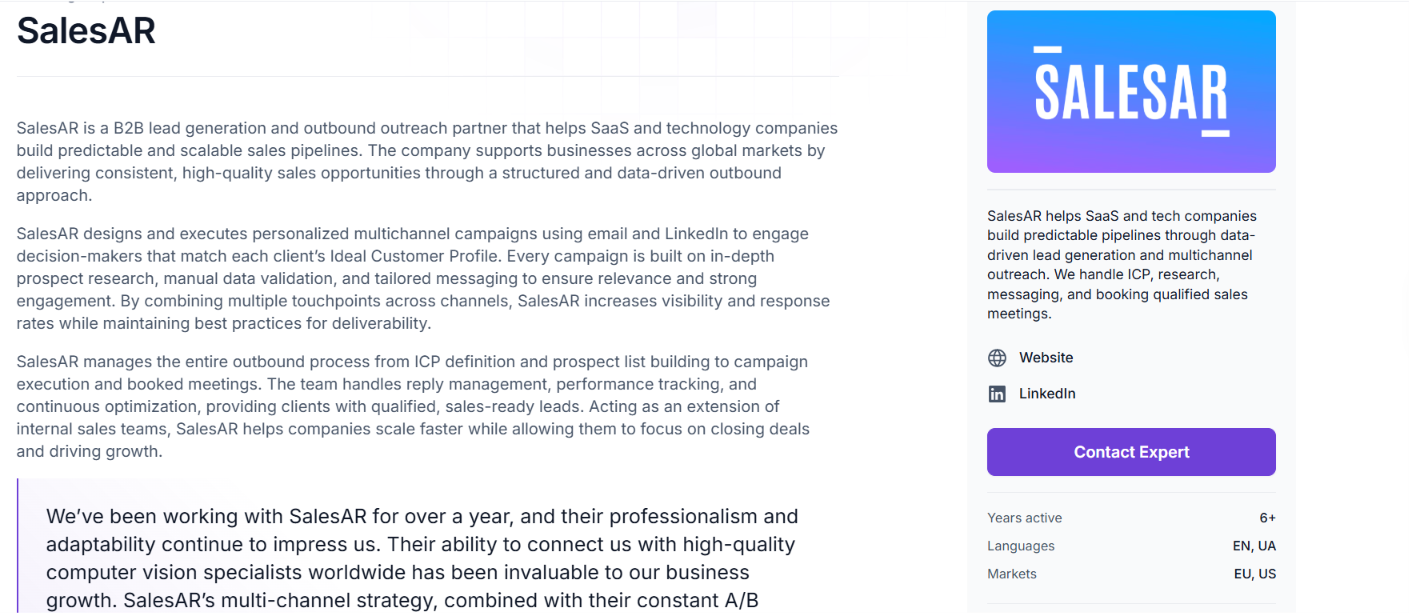
SalesAR helps SaaS and technology companies with ICP definition, prospect research, messaging, email and LinkedIn outreach, reply management, and meeting booking. Its Forge profile says pricing starts at $2,500 per month.
Compared with Vereigen Media, SalesAR is a better fit if you want an agency focused more directly on prospecting and booking sales meetings, rather than content syndication and broader demand generation.
Best for: B2B companies that want multichannel outbound combined with GTM and RevOps support.
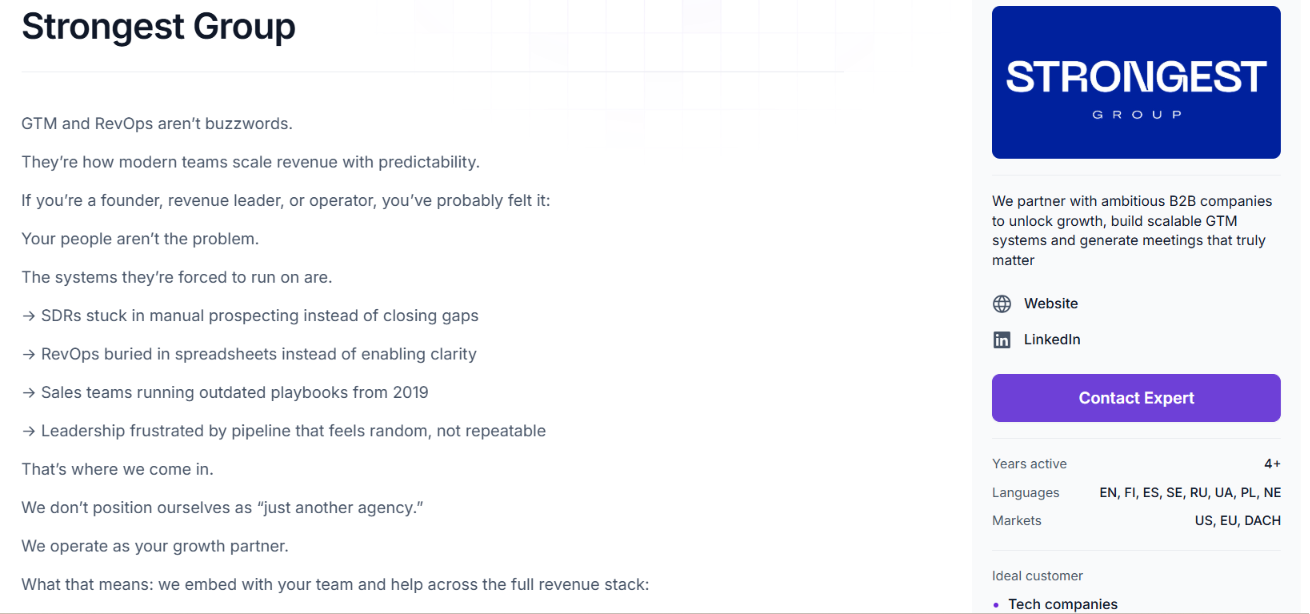
Strongest Group combines cold calling, email, LinkedIn, retargeting, and other outbound channels. It also helps companies improve GTM strategy, RevOps infrastructure, sales processes, and outbound workflows.
Compared with Vereigen Media, Strongest Group makes more sense if you need a partner to build a repeatable outbound pipeline system across multiple channels. Its Forge profile also lists pay per realized meeting as its pricing model.
Best for: B2B companies that need broader GTM and revenue infrastructure alongside demand generation.
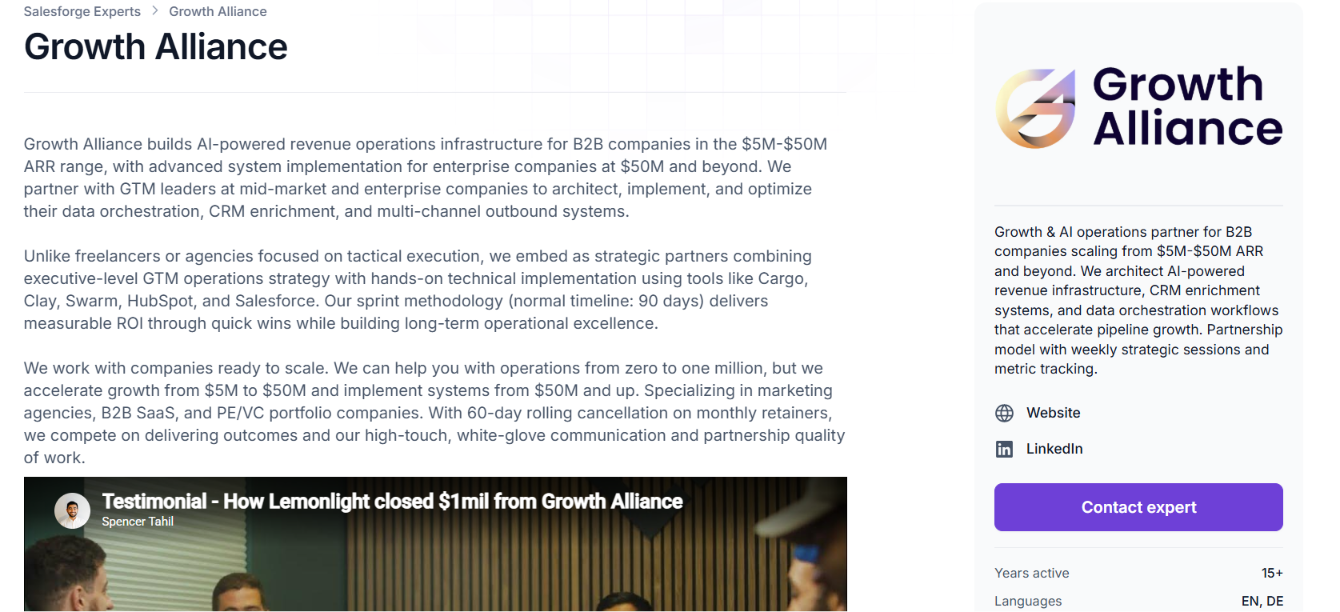
Growth Alliance works on CRM enrichment, data orchestration, ABX, demand generation, and multichannel outbound. Its main programs start at $10,000 per month, while some demand and visibility solutions start at $2,500 per month.
It is worth considering over Vereigen Media if your problem goes beyond generating leads and you also need help building the data, CRM, automation, and revenue systems behind your GTM motion.
The choice depends on what you actually need. Vereigen Media is more aligned with content-led demand generation and ABM, SalesAR focuses on managed outbound and meetings, Strongest Group combines multichannel prospecting with GTM support, and Growth Alliance goes deeper into revenue infrastructure.
Enter your email to get a custom plan & stack recommendation for your business
Please check your mailbox in 5 minutes
Vereigen Media makes the most sense for B2B teams that already have a clear ICP and want to turn existing content into pipeline through managed campaigns.
Its strongest use case is not simply finding contacts. It is helping companies reach relevant buyers through content syndication and account-based campaigns, then passing engaged leads into the sales process.
If your actual goal is sales meetings rather than content engagement, a Forge Certified Partner may be the better route. You can compare specialists that handle prospect research, email, LinkedIn, cold calling, and meeting booking, and choose one based on the outbound motion you need.
.jpg)

.jpg)

.jpg)
