When comparing cold email software, the pricing page doesn’t tell you everything.
I’ve spent ten years in sales, running cold email and LinkedIn campaigns. Over the years, I’ve tested more than 50 outreach tools. But once I moved beyond the trial, I kept running into the same problems:
Finding key features locked behind expensive plans.
Paying extra for warmup, additional users, and workspace setup.
Using multiple tools to manage outreach.
Struggling with limited AI features for email writing, personalization, and reply management.
Missing key CRM integrations and automation.
Managing replies across multiple inboxes.
Spending too much time setting up campaigns.
After testing 50+ tools, I recommend 10 cold email software platforms for 2026. For each, I’ll explain who it’s best for and what each plan includes before any add-ons.
By the end, you’ll know which cold email software best fits your needs and budget.
Salesforge: Best for GTM teams and agencies that want cold email and LinkedIn outreach in one sequence. You get AI personalization across 21+ languages, free premium warmup, and MCP/CLI and API access.
Instantly: Best for solo senders and small agencies that want to start cold email outreach at a low monthly price.
Hunter: Best for startup sales teams that want to find verified emails and send cold campaigns from one tool.
Smartlead: Best for agencies that run cold email for several clients and want each client in its own workspace.
Apollo.io: Best for outbound teams that need a large contact database to feed their cold email campaigns.
Lemlist: Best for small teams that want to personalize cold emails with custom images and videos for each prospect.
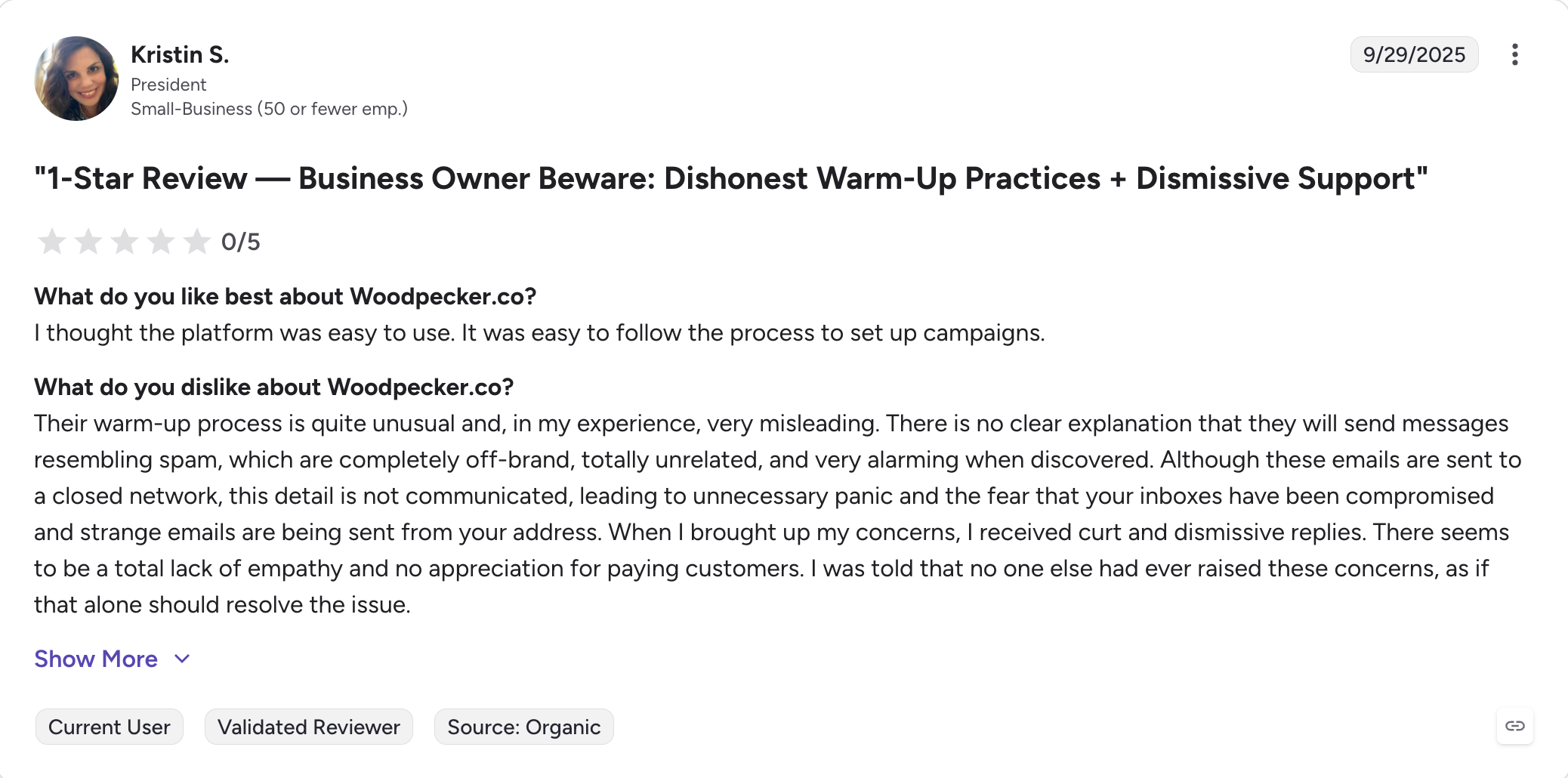
Woodpecker: Best for consultants whose cold email volume changes each month and who only want to pay for the prospects they contact.
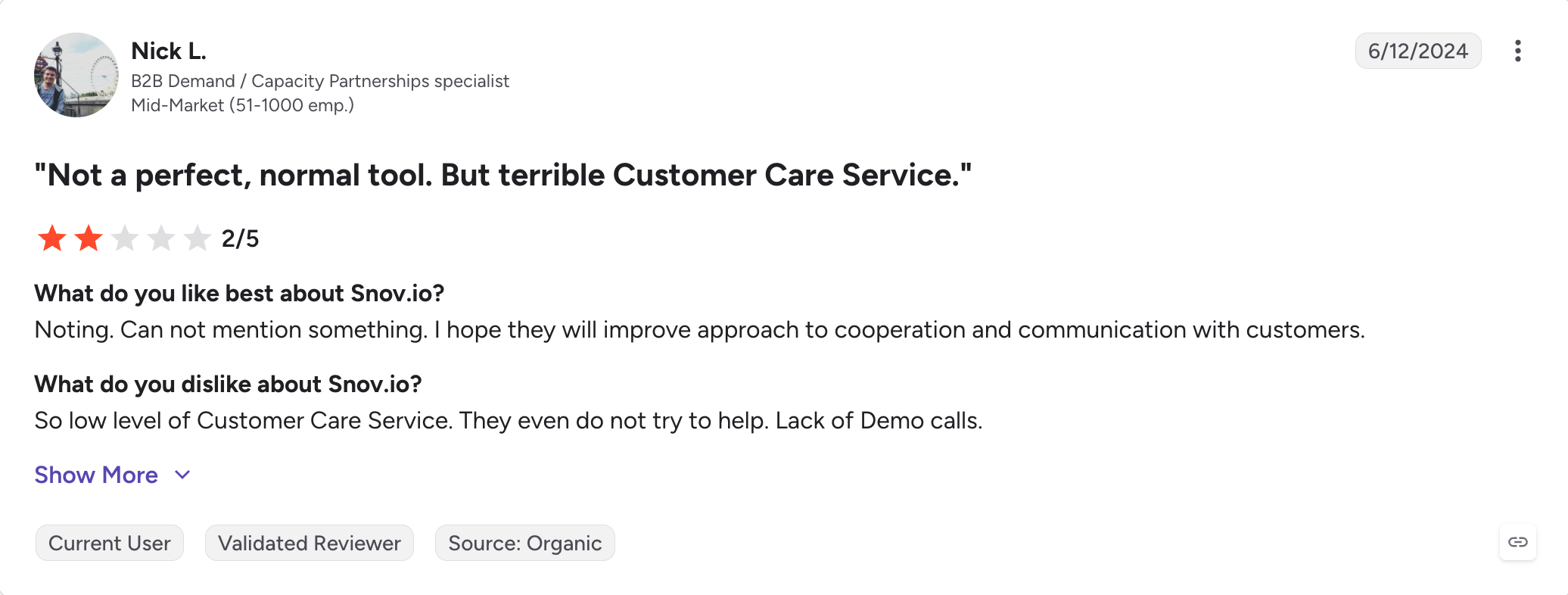
Snov.io: Best for solo founders on a tight budget who want to find, verify, and email leads in one place.
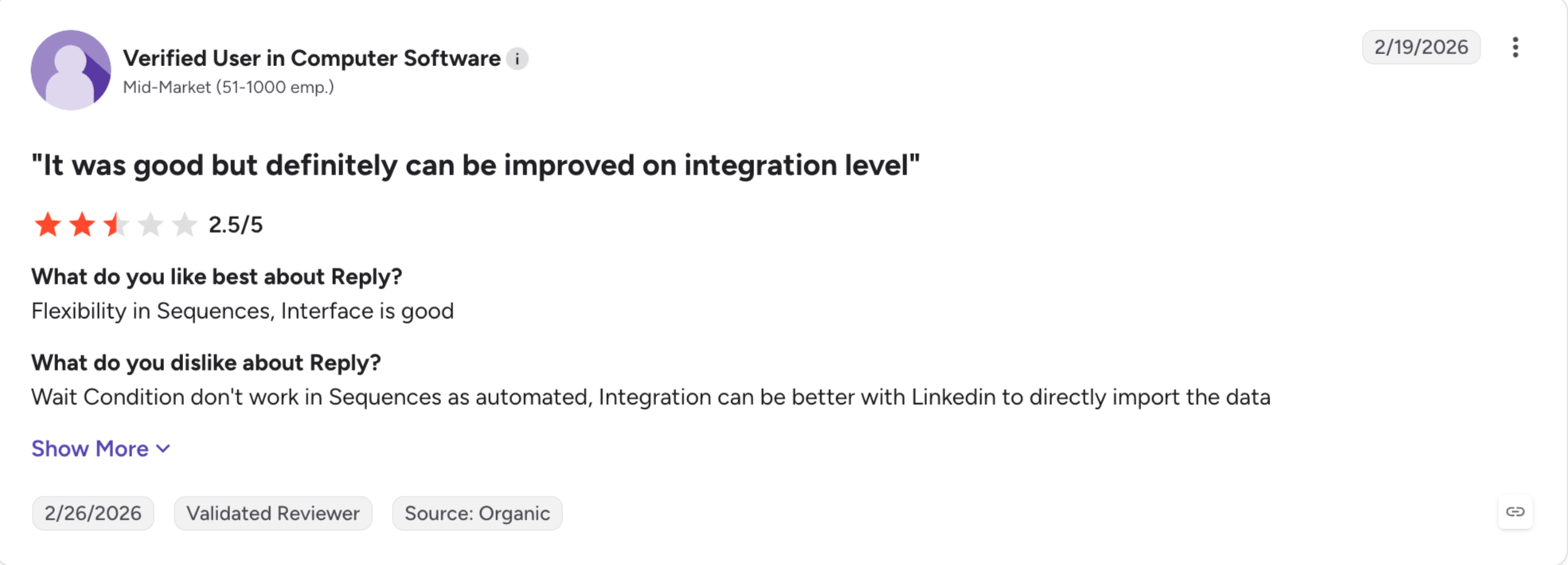
Reply.io: Best for inside sales teams that follow up cold emails with calls, LinkedIn messages, and SMS.
Klenty: Best for SDR teams that want to run cold email from inside their CRM without switching tools.
Six LinkedIn actions in one sequence, with 1 LinkedIn sender on the Pro plan
Email only
Email only
Email only
LinkedIn steps are manual tasks only, with no LinkedIn automation
LinkedIn on the Multichannel plan at $87/user/month annually
LinkedIn add-on at $29/month per account
LinkedIn add-on at $69/month per slot ($62 annually)
LinkedIn add-on at $69/month per account on Email Volume
Email, calls, and LinkedIn from the Growth plan
Prospect Data
Leadsforge with 500M+ contacts as a separate subscription
450M+ leads on a separate Credits plan from $47/month
B2B database, Email Finder, and Domain Search
SmartProspect add-on at $59/month on the Base and Pro plans
275M+ contact database
650M+ lead database with paid contact reveals
400 Lead Finder credits a month
Email finder and verifier
B2B database and up to 200 website visitor reveals a month
Contact credits on the Plus plan
Managed Mailboxes
Mailforge, Infraforge, and Primeforge under one login
Done-for-you mailboxes available
$6/month per mailbox
From $3.99/month per mailbox
Not listed
Not listed
Google and Microsoft mailboxes at $6/month each
Done-for-you mailbox setup
Google and Microsoft mailboxes sold in-app
Bring your own mailboxes
Premium Warmup
Free unlimited premium warmup through Warmforge
Unlimited warmup on every Outreach plan
Inbox Protection at $7.50/month per mailbox ($6 annually)
Included, with the premium pool from the Unlimited Smart plan
Built-in warmup in the Deliverability Suite
lemwarm included
2 mailboxes free on the entry tier, then $5/month per inbox
3 slots on Starter, unlimited on Pro
Included through MailToaster
Domain and inbox auto-warmup
Mailbox Rotation
Smart mailbox rotation and dynamic IPs
Yes
Yes, based on each account’s daily limit
Yes
Yes
Yes
Yes
Yes
Yes
Auto-inbox rotation
Sender Health Monitoring
Bounce Shield, ESP matching on the Growth plan, and Warmforge health checks
Deliverability AI Agent on the Hypergrowth plan
Health scores plus authentication and reputation checks
SmartDelivery placement tests from $49/month
Deliverability Suite with domain and mailbox health
Deliverability Hub
Adaptive sending, domain audit, and free catch-all verification
Deliverability Check with blacklist detection
Health Checker and ramp-up mode
Domain and inbox health monitoring
AI Features
AI personalization and sentiment analysis, with 21+ languages and Primebox™ AI on the Growth plan
AI features run on Instantly Credits
AI Writing Assistant in English, French, Spanish, and German
Campaign AI writing and SmartAssistant
AI writing on the Professional plan and above
lemAgent and AI agents
AI email writer and interest detection
AI Email Writer and sentiment analysis
AI sequence and variable generation
AI variables and waterfall email validation
AI SDR
Agent Frank, from $499/month billed quarterly
AI Reply Agent on Instantly Credits
No
SmartAssistant runs outbound tasks
AI Assistant runs agentic workflows
lemAgent included
No
No
Jason AI from $500/month
AI agents on the Plus plan
Unlimited Users
Yes, on the Growth plan
Team members start on the Hypergrowth plan
Yes, on every plan including Free
Yes, with no seat charge
No, priced per seat
Yes on the Email plan, per user on Multichannel
Yes, on every plan
Yes, on every plan
No, priced per user
Starter is flat, Growth and Plus are per user
MCP, CLI, and API
MCP, CLI, and API on the Growth plan
Official MCP server, CLI, and API
Remote MCP server and API on every plan including Free
Official MCP server and CLI, with API from the Pro plan
Official MCP connector, CLI, and API
Official MCP server, CLI, and API
MCP server, CLI, and API with the $20/month integrations add-on
Official MCP server and API
Official MCP server, CLI, and API
API and third-party MCP tools
Data and Sending in One Place
Leadsforge lists move into sequences with no CSV export
Data on a separate subscription
Data and sending share one credit pool
Data included on the Unlimited plans
Data and sequences in one tool
Data and outreach in one tool
Lead Finder credits feed campaigns
Credits cover finding and verifying, recipients cover sending
Data and sequences in one tool
Contact data on the Plus plan
Credits
300 validation, personalization, and social credits on Pro, 1,000 each on Growth
Credits plans from $9 for 150 credits
1 credit per email found and 0.5 per verification
Verification packs from $32
Credits vary by plan
About $0.01 per credit
Lead Finder credits at $10 per 500
1,000 credits on Starter
Not listed
Not listed
CRM and Integrations
HubSpot and Pipedrive on the Growth plan
CRM sold separately from $47/month
Connects through its API and custom workflows
CRM access from the Pro plan
Salesforce, HubSpot, Pipedrive, and more
CRM integrations and API on the Email plan
HubSpot, Pipedrive, and Salesforce with the $20/month add-on
Built-in CRM plus HubSpot and Pipedrive
Not listed
Salesforce, HubSpot, and Pipedrive from the Growth plan
Agency Support
Unlimited mailboxes and workspaces on every plan
Workspaces start on the Hypergrowth plan
Unlimited team members with one shared credit pool
Client workspaces at $29/month each from the Pro plan
Not listed
Not listed
Agency panel at $27/month per active client
Not listed
Agency plan from about $166/month
Not listed
Key Limitation
No major channel limitation
Team members, workspaces, and webhooks start on the Hypergrowth plan
Email accounts capped at 3, 10, or 20 by plan and no LinkedIn
No API, CRM access, or client workspaces on the Base plan
Per-seat pricing with a 3-seat minimum on the Organization plan
The Email plan caps sending at 50,000 emails a month and has no LinkedIn
LinkedIn, integrations, and the agency panel are paid add-ons
Only 3 warmup slots on the Starter plan
LinkedIn costs $69 per account on the Email Volume plan
CRM sync starts on the per-user Growth plan
How I Picked These 10 Cold Email Tools
I compared each tool across six areas to see what you get for your money and where extra costs can come in.
What each plan includes: I checked whether warmup, contact data, LinkedIn features, and client workspaces come with the plan or cost extra.
Access to premium warmup: Some tools include basic warmup on their entry-level plans but reserve better warmup pools for higher-tier plans.
How pricing adds up: I looked at whether costs increase with sending volume, team size, or the number of users.
LinkedIn outreach: I checked whether you can run LinkedIn actions within the same sequence as your emails, rather than relying on manual tasks or browser extensions.
The cost of add-ons: I considered how much the total setup costs once you add the extra features you need.
Critical G2 reviews: I read reviews rated three stars or below to understand where users run into problems and which limitations to consider.
1. Salesforge: Best Multichannel Cold Outreach Tool
Best for: GTM teams and agencies who want to scale cold email campaigns with LinkedIn outreach in one conditional sequence, rather than running two separate campaigns.
G2 Rating: 4.6 out of 5 (140+ reviews)
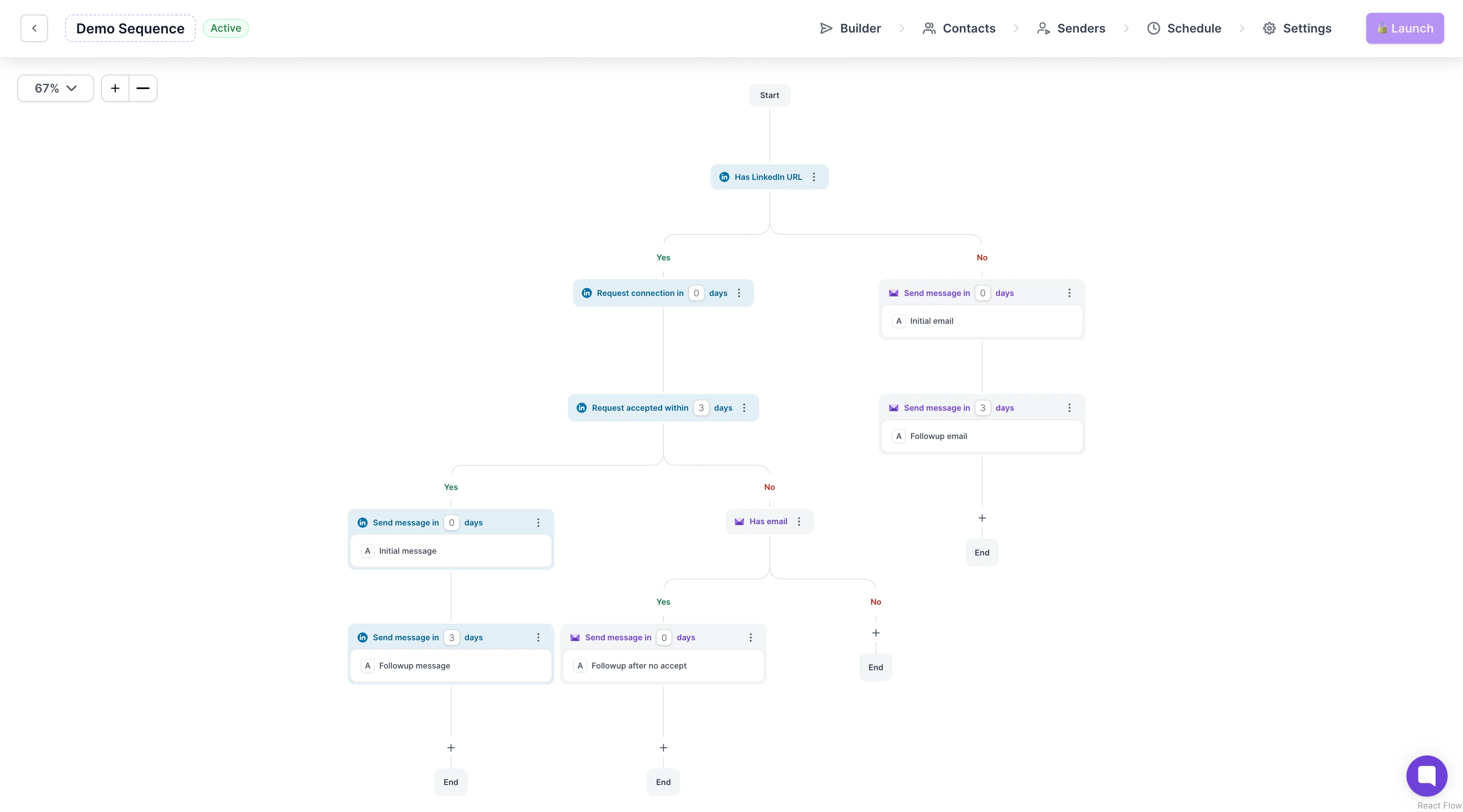
Multichannel sequence dashboard of Salesforge
Feature
Details
G2 rating
4.6/5 (140+ reviews)
Starting price
$40/mo (annual billing)
Free trial
14-day
Standout deliverability feature
Free Warmforge included on every plan
Salesforge brings cold email and LinkedIn outreach together in one platform. You can connect unlimited mailboxes on any plan, while the Growth plan lets you connect unlimited LinkedIn senders.
You can also add six LinkedIn actions to a sequence and set rules for what happens next. For example, if a prospect accepts your connection request, Salesforge can send them a LinkedIn message. If they don’t, you can continue the conversation through email.
Salesforge also makes it easier to reach prospects in different markets. Its AI personalization works across 21+ languages, and the Growth plan lets you write sequences in your prospects’ own languages with local greetings.
Email warmup is part of every plan. Salesforge gives you unlimited premium warmup through Warmforge on both the Pro plan and the Growth plan, so every mailbox you connect gets warmed at no extra cost.
Salesforge also offers Forge MCP, which lets you work with every Forge product through your AI assistant. On the Growth plan, you can build sequences and set up mailboxes without opening each dashboard. You can also check warmup status and pull contact data the same way.
Salesforge Key Features
Unlimited senders and mailboxes: Connect every mailbox you own on either plan with no per-mailbox fee.
Multichannel with conditional sequences: Real conditional branching. An accepted connection request triggers a LinkedIn message, and one that goes nowhere falls back to email.
Six native LinkedIn actions: Connection requests, messages, InMails, post likes, follows and withdraw requests, all as sequence steps.
Sender rotation: Volume spreads across mailboxes and domains automatically so no single mailbox absorbs it all.
Primebox™ with Auto-Pilot and Co-Pilot: Auto-Pilot handles replies end to end. Co-Pilot drafts them for you to approve first.
AI personalization: Sequences write natively in the prospect's language (21+ languages supported with localized greeting) rather than translating after the fact.
LinkedIn Email Finder Chrome Extension: Free to install, and lookups draw on Leadsforge credits. New Leadsforge signups get 100 free credits.
Free unlimited warm-up: Every connected mailbox warms continuously against a pool of SMTP, Google Workspace and Microsoft 365 mailboxes via Warmforge. Both plans include unlimited slots.
Text-only content: Emails go out plain, without heavy HTML or tracking pixels.
Bounce Shield: Blocks sends to addresses likely to bounce before they damage your sender score.
Built-in email validation: Every contact gets checked before the sequence reaches it. 300 credits a month on Pro, 1,000 on Growth.
Dynamic ESP matching: Sends route so a Google recipient hears from a Google mailbox. Growth plan.
Integrations: HubSpot, Pipedrive, Zapier and webhooks, with open API on Growth.
MCP and CLI: Claude, Cursor or your own agent can build sequences and manage contacts directly. Growth plan.
What I Liked About Salesforge
Adding mailboxes and LinkedIn senders does not change what you pay, because the plans meter active contacts and volume instead.
MCP/CLI supported so you can launch campaigns with your AI assistant/agent.
Warm-up arrives with the plan rather than as a second invoice.
Co-Pilot means nothing sends without approval, which makes the AI easier to trust in the first week.
Support is available around the clock rather than during one timezone's working hours.
What Are the Cons of Salesforge
No free plan. After the 14-day trial you pay.
Salesforge Pricing
Salesforge's pricing plans are designed to scale with your team size and client volume, making it easier to choose the right fit as your needs grow.
Plan
Price (Annual)
Active Contacts
Emails per Month
LinkedIn Senders
Key Features
Pro (Basic Plan)
$40/month
1,000
5,000
1
Unlimited mailboxes, free Warmforge, AI sequences, Primebox, smart mailbox rotation
Growth
$80/month
10,000
50,000
Unlimited
Pro features plus 21 languages, A/B testing, ESP matching, API, priority support, unlimited users
Agent Frank
$416/month ($499/month billed quarterly)
Up to 1,000 included; $0.25 per contact beyond 2,000/month
About 6,000–7,500
Included
Autonomous AI SDR with 500M+ contact search, dedicated account manager
The unusual thing about this pricing: unlimited mailboxes and workspaces on every plan, including the $40 basic plan, which provides an affordable entry point for individuals or small teams looking to test and scale their outreach.
The Growth plan also adds unlimited users, which means agencies can invite their full team and manage multiple client accounts from a single subscription.
Per-workspace billing, not per-user. Pro (the basic plan) suits solopreneurs starting cold email.
Growth covers most agencies and sales teams running multichannel and multilingual outreach.
Does Salesforge Meet the Cold Email Software Criteria?
Criteria
Salesforge
Deliverability tools
Yes. Free Warmforge access on every plan, dynamic ESP matching on Growth, SPF/DKIM/DMARC support, smart mailbox rotation, dynamic IPs.
AI personalization
Yes. AI generates full sequences in 21 languages with prospect-level variable injection. Agent Frank takes this further with autonomous outreach.
Automation and multichannel
Yes. Email and LinkedIn touchpoints in one sequence, behavioral triggers, Primebox unifying replies from both channels.
Data enrichment and validation
Yes. Built-in email validation, plus access to Leadsforge for a chat-based lead search engine with 100 free credits to start.
Analytics and reporting
Yes. Open rates, reply rates, sequence performance, sentiment analysis on replies, deliverability monitoring via Warmforge.
Pricing and scalability
Yes. Starts at $40/month on annual billing. Unlimited mailboxes on every plan, supporting multiple email accounts for high-volume outreach and scalable campaign management. Flat pricing, not per-user: Pro covers one user and Growth includes unlimited users.
The product isn't just a cold email tool on its own. It's the front end of an outbound stack that handles every layer most teams stitch together with third-party subscriptions.
Mailforge runs shared distributed email infrastructure under cold sends.
Primeforge spins up real Google Workspace and Microsoft 365 inboxes with US-based IPs, ready in 30 minutes.
Infraforge provides private dedicated email infrastructure with multi-IP provisioning and pre-warmed mailboxes for teams that need full control.
Warmforge handles deliverability monitoring and warm-up. Free with every Salesforge subscription.
Leadsforge is the chat-based lead generation engine with a large B2B contact database.
Agent Frank is the AI SDR that can run all of the above with minimal manual oversight.
Choose the #1 Cold Email Software
Salesforge runs email and LinkedIn steps in one conditional sequence.It connects unlimited mailboxes with unlimited premium warmup, and every reply lands in Primebox™.
Connect unlimited email accounts with unlimited warm-up on every paid Outreach plan
Instantly is a sending engine. It exists to push high volumes of cold email through a lot of mailboxes cheaply, and nothing else here does that for less.
I connected as many mailboxes as I wanted on the cheapest paid plan, and Instantly warmed every one of them for free.
Warm-up means the tool sends friendly emails between your mailboxes to build trust with inbox providers before your real campaigns go out.
What you do not get is contact data or a CRM. Instantly sells both as separate plans on the same page, so a full setup lands you three bills.
Sequences here take email steps and nothing else. If you want LinkedIn in the same flow, you buy a second tool and answer replies in two places.
Instantly Key Features
Unlimited email accounts: You can connect every mailbox you own on any paid plan without paying per mailbox.
Unlimited warm-up: Warming starts on its own once a mailbox connects, and it runs on every paid tier.
Sender rotation: Instantly spreads the daily volume across your accounts so no single mailbox carries it all.
Unibox: Replies from every connected mailbox land on one screen, which saves logging into each account.
AI sequence writer: It drafts a complete sequence from your offer and audience. A/Z testing unlocks at Hypergrowth.
Lead database: 450M+ contacts, available as a separate Instantly Credits subscription.
Built-in CRM: Also a separate subscription rather than part of any Outreach plan.
What I Liked About Instantly
Unlimited mailboxes and unlimited warm-up on the cheapest paid tier is more than anyone else gives away at that price.
Mailboxes connect in bulk, and I did not have to touch DNS to get them running.
The interface is the one I would hand to someone who has never sent a cold email before.
What Are the Cons of Instantly
The sending plan, the data and the CRM bill separately, so the price you compare is not the price you pay.
Growth stops at 1,000 uploaded contacts, which one list fills before you have really started.
Sequences run email only, and LinkedIn replies never reach the Unibox because LinkedIn never enters the sequence.
Integrations and A/Z testing both wait until Hypergrowth, which more than doubles the monthly cost.
Instantly offers three core subscriptions, each with its own tiers.
The pricing plans are structured to accommodate different outreach volumes and team sizes, allowing businesses to select the plan that best fits their needs. Outreach is the sending engine, while Lead Database (Instantly Credits) and CRM are separate optional subscriptions.
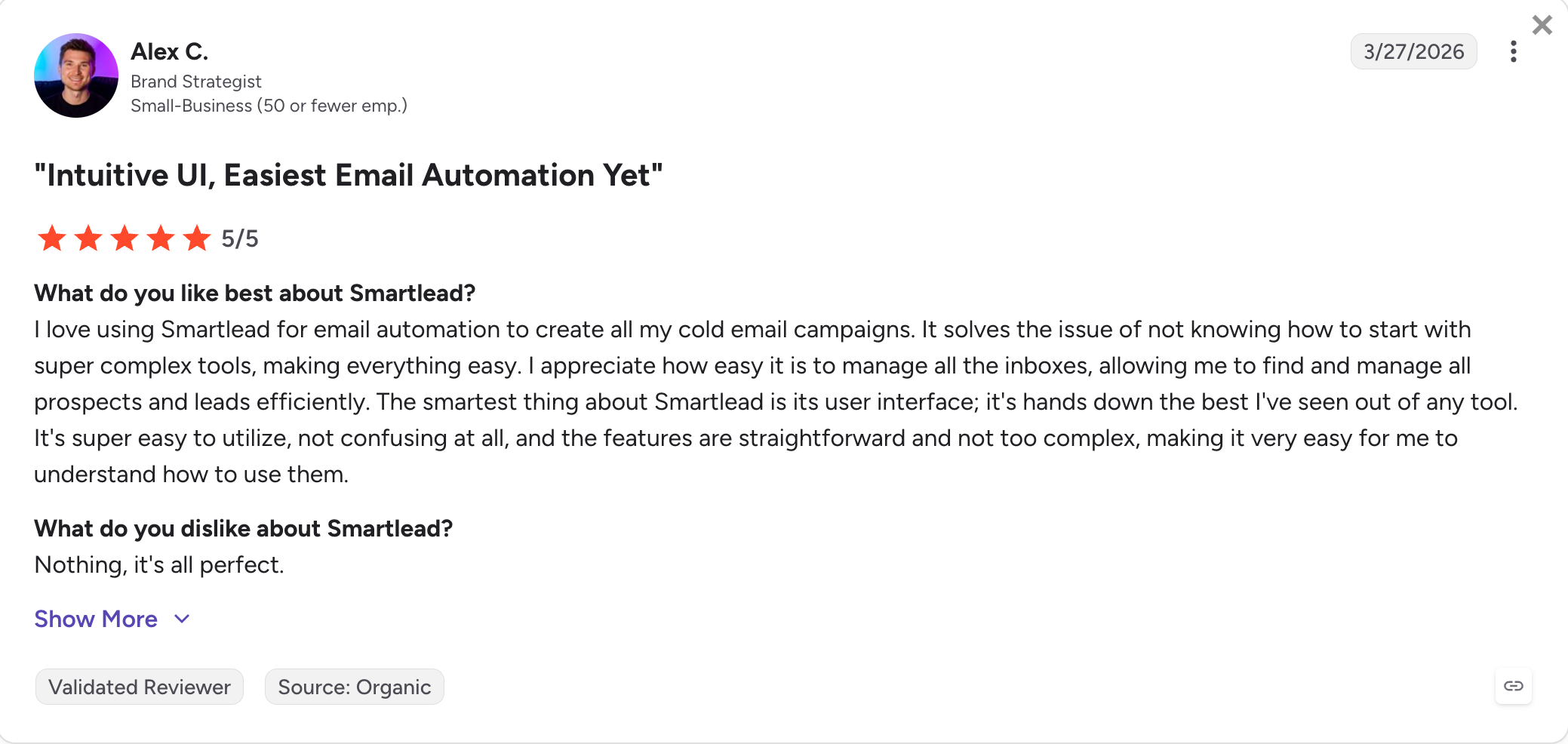
3 Hunter: Best for Cold Email Built on Verified Data in One Subscription
Best for: Small sales teams that want to build a verified prospect list and launch cold email sequences without paying for a separate data tool.
G2 Rating: 4.4 out of 5.0 (650+ reviews)
Cold email sequence dashboard of Hunter.io
Feature
Details
G2 rating
4.4/5 (600+ reviews)
Starting price
$34/mo annual, $49/mo monthly (Starter)
Free trial
Free plan, no credit card (50 credits/month)
Standout feature
Auto-verified data, sending, and managed mailboxes on one bill
Hunter has been indexing company email data since 2015 and now counts over 7 million users.
Most tools on this list started as a sending engine and added lead data later. Hunter went the other way. The email database came first, the sequencer came second, and verification sits in between.
That order shows up in bounce rates. Every paid plan verifies addresses automatically before they enter a sequence, so lists get cleaned without a second subscription.
In April 2026 Hunter closed the gap on the email infrastructure that was missing. You can now buy domains and create mailboxes inside the platform with SPF, DKIM, and DMARC already configured, then warm them automatically before the first send.
Hunter.io Key Features
Auto-verification before sending: Hunter checks email syntax, domain records, mail server responses, and its B2B database. Verification costs 0.5 credit and runs automatically on every paid plan.
Managed email accounts inside the platform: Buy a domain and create preconfigured mailboxes from $6/month per account, with SPF, DKIM, and DMARC set up. Accounts are typically ready within an hour.
Inbox Protection for automated warm-up: Warm up accounts over 30 days using real replies and positive engagement signals, then switch to maintenance mode. Track engagement and spam placement. It's a paid add-on billed per email account.
Email Accounts Center with health scoring: Monitor account status, daily sending progress, and health scores from one screen. Review authentication and reputation reports, and run health checks and Inbox Protection in bulk.
Send through your own Gmail, Outlook, or SMTP/IMAP account: Send emails through your own infrastructure, keeping sender reputation tied to your domain.
Email account rotation across a sequence: Distribute sending volume based on each account's daily limit. Accounts still in warm-up stay out of rotation.
AI Writing Assistant inside the sequence builder: Draft sequences on paid plans using your audience, goal, tone, and an optional framework like AIDA or PAS. Write in English, French, Spanish, or German.
MCP server on every plan, including Free: Connect Hunter to AI agents and custom workflows without building against the API first.
Unlimited team members on every plan: Add team members without extra seat costs. Everyone shares one credit pool.
Pros of Hunter
At 0.5 credit per address, with auto-verification included on all paid plans, keeping a list clean costs less here than on tools that charge full prospecting credits to verify.
Unlimited team members on every plan, including Free. A five-person team pays the same as one person, which is where per-seat tools like Lemlist and Apollo start hurting.
Domains, mailboxes, warm-up, and health monitoring now sit in the same subscription as the data and the sequencer, which means no separate mailbox provider or warm-up subscription to buy.
MCP support on all plans is rare in this category. Most competitors offer API access only.
The free plan covers 50 credits a month, one connected email account, and 500 recipients per sequence, with no credit card required.
Cons of Hunter
Email accounts are capped by plan at 3, 10, and 20. Extra slots start at $10/month. Flat-fee competitors like Instantly and Smartlead include unlimited inboxes.
Inbox Protection costs extra per email account and isn't bundled into any plan. Turning it off wipes warm-up progress, and re-enabling starts the 30 days over.
No native LinkedIn automation or dialer. Email is the only channel.
One shared credit pool covers Email Finder, Email Verifier, and Domain Search, so heavy prospecting months eat into the verification budget.
Hunter Pricing
Four plans plus Enterprise, all with unlimited team members. Annual billing saves 30%. Prices below show both cycles.
Plan
Monthly Price
Annual Price
Credits/Month
Email Accounts
Recipients per Sequence
Free
$0
$0
50
1
500
Starter
$49/mo
$34/mo
2,000
3
2,500
Growth
$149/mo
$104/mo
10,000
10
5,000
Scale
$299/mo
$209/mo
25,000
20
15,000
Enterprise
Custom
Custom
Custom
Custom
Custom
Credits work out to 1 per email found through Email Finder or Domain Search, 0.5 per verification, and 1 per 10 emails through Bulk Domain Search. Failed lookups cost nothing. Add-ons cover extra email account slots from $10/month, managed mailboxes from $6/month per account, Inbox Protection per account, and credit packs. The AI Writing Assistant and advanced Discover filters start at Starter.
What Real Users Say About Hunter
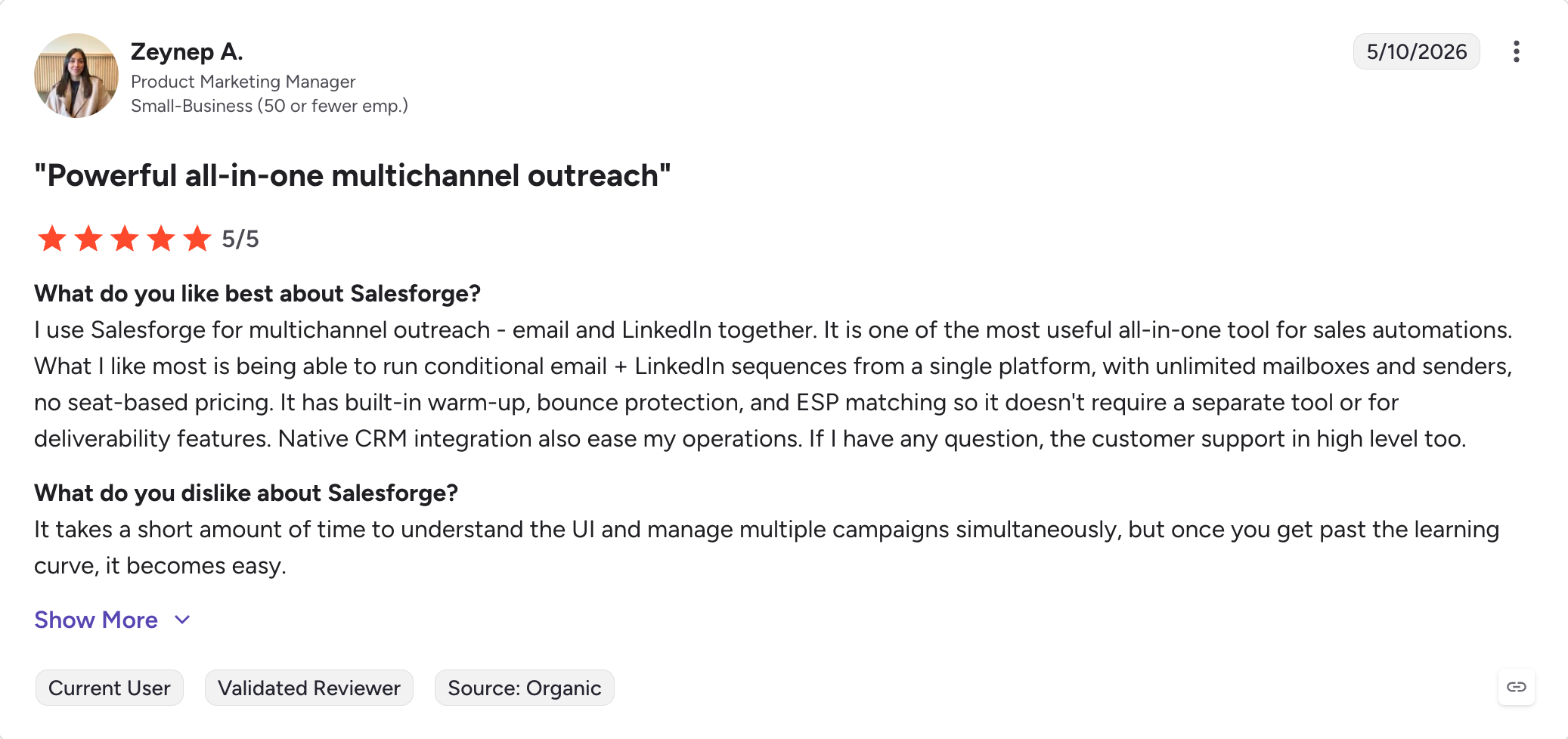
"It's super reliable, user-friendly, and almost invisible, which is a huge benefit."
If you've already tried this platform, you can check out Hunter.io alternatives to pick the best platform for your cold outreach needs.
4. Smartlead: Best for Agencies Running Many Client Inboxes
Best for: Agencies managing several client accounts who want per-mailbox control and white-label reporting.
G2 Rating: 4.5 out of 5 (421 reviews)
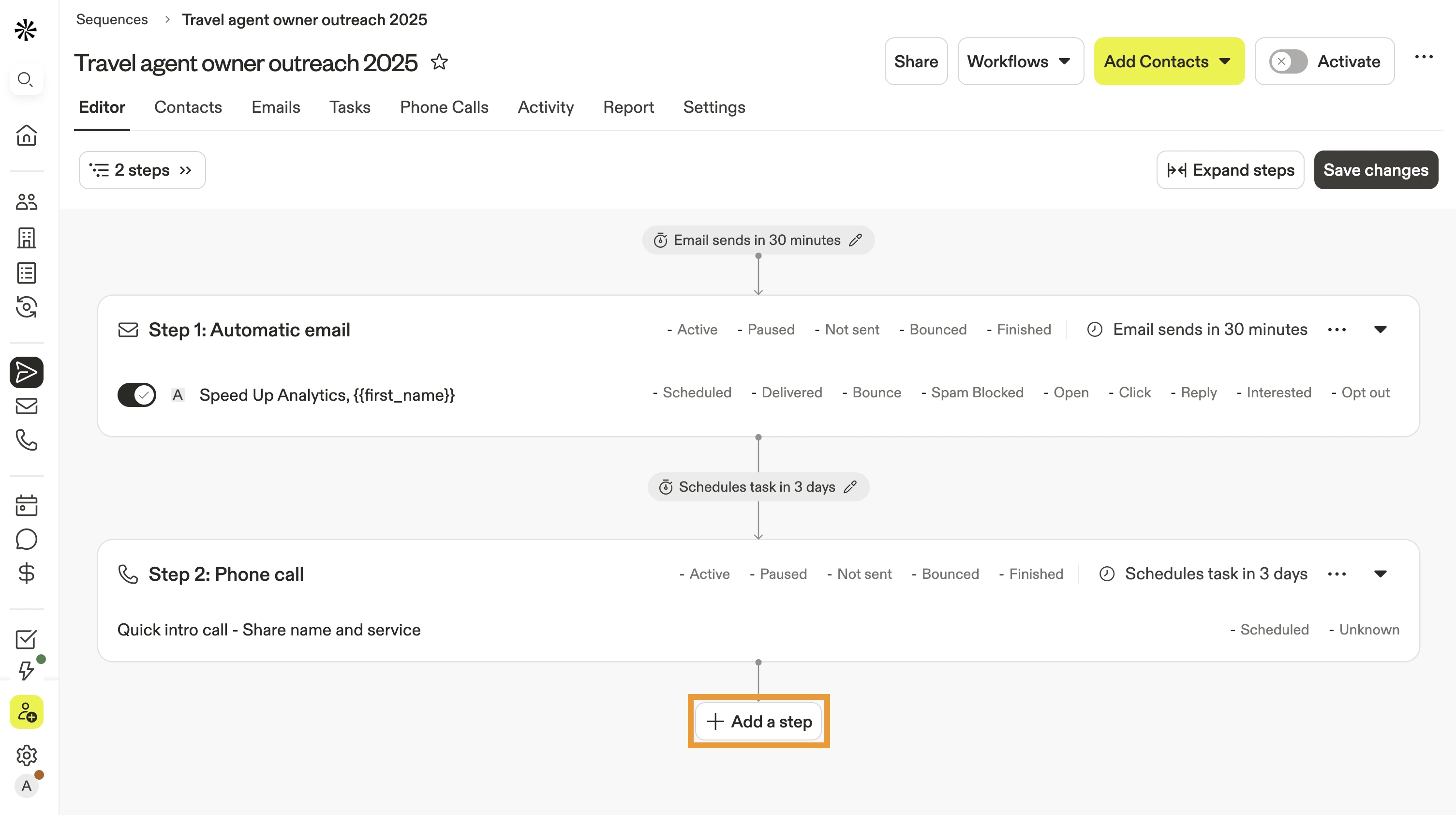
This is cold outreach dashboard of Smartlead
Feature
Details
G2 rating
4.6/5 (300+ reviews)
Starting price
$39/mo monthly, $32.50/mo annual (Base)
Free trial
Free trial, no credit card (length not published)
Standout feature
Unlimited email accounts on every plan, plus white-label client portals from the Pro plan ($29 per client/month)
Smartlead is a sending platform built for agencies. You buy the sequencer as the core product, then add the pieces around it one at a time. Dedicated IP servers, inbox testing, the lead database and extra client accounts all cost more.
Agencies pick it for exactly that reason.
Nothing else here keeps clients this separate. Every client gets their own workspace, and the reports they see carry your brand rather than Smartlead's. You can buy mailboxes inside the tool too, which took one company out of my setup.
Buying in pieces is also how the bill grows, and I found the extras add up faster than the plan itself.
Smartlead Key Features
Unlimited email accounts: Connect as many sending accounts as the volume needs, on every plan.
Client workspaces: Each one costs $29 a month and keeps that client's campaigns and reporting separate.
White-label reporting: Your clients log in and see your branding rather than Smartlead's.
Mailboxes in-platform: You can buy them from $3.99 per mailbox a month, with domains from $13 a year.
SmartServers: Dedicated IP servers run $39 per server a month for teams that want their own sending infrastructure.
SmartDelivery: Placement testing from $49 a month shows where a campaign will land before you send it.
SmartProspect: The lead database costs $59 a month on top of your plan.
Subsequence branching: Follow-ups split based on how someone replied rather than running one fixed path.
What I Liked About Smartlead
Client separation and white-label reporting are stronger here than in any other agency setup on this list.
Buying mailboxes inside the tool took a whole vendor out of my stack.
The sending controls go further than anywhere else here, down to rules per mailbox.
What Are the Cons of Smartlead
You will add four or five separate components before the product does what the marketing describes.
Base allows 2,000 contacts and 6,000 sends, which is thin for the money.
Sequences are email only, so LinkedIn stays outside the tool entirely.
Copy generation needs your own OpenAI key, because Smartlead does not ship a writer of its own.
Four plans plus a stack of modular add-ons. Annual billing saves roughly 17% across tiers.
Plan
Monthly Price
Annual Price
Active Leads
Emails/Month
Base
$39/mo
$32.50/mo
2,000
6,000
Pro
$94/mo
$78.30/mo
30,000
90,000
Unlimited Smart
$174/mo
$144.50/mo
Unlimited
150,000
Unlimited Prime
$379/mo
$314.60/mo
Unlimited
500,000
Add-ons: SmartProspect $59/month, SmartServers $39/server/month, client workspaces $29 each, SmartDelivery from $49/month, mailboxes from $3.99 each per month, domains from $13 per year. Pro with the database, one server and five workspaces lands near $320 a month.
5. Apollo.io: Best for Teams Whose Real Gap Is Contact Data
Best for: SDR teams who already send fine but keep running out of good contacts to send to.
G2 Rating: 4.7 out of 5 (9,600+ reviews)
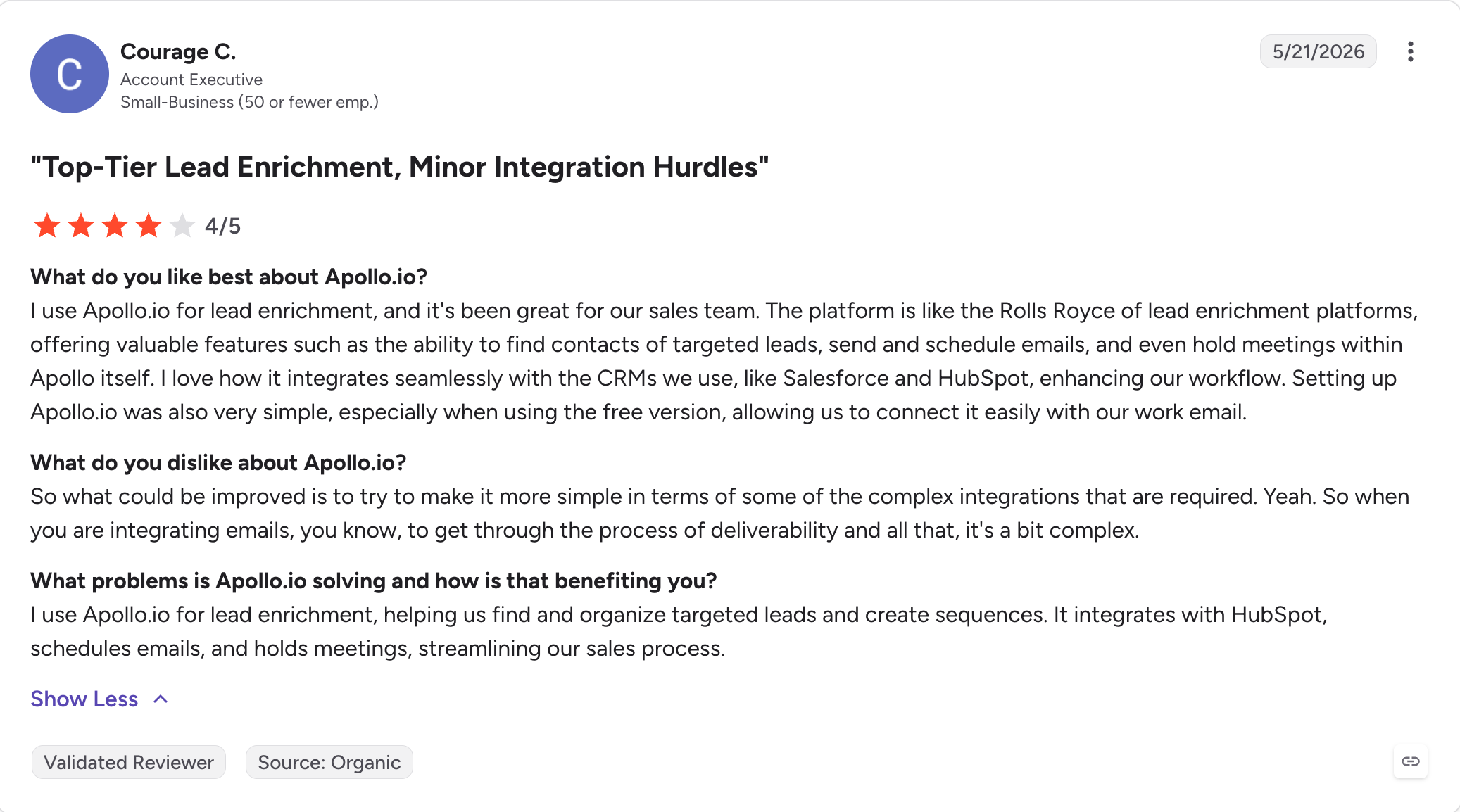
This is cold outreach sequence dashboard of Apollo.io
Feature
Details
G2 rating
4.7/5 (9,600+ reviews)
Starting price
$49/user/mo annual, $59/user/mo monthly (Basic)
Free trial
Free plan available, no credit card
Standout feature
275M+ contact database built into the sequencing engine
Apollo.io is a B2B contact database with a sequencer attached. Apollo built the database first and added the sending later, and you can tell.
If you cannot find enough of the right people, this is the answer on this list. I have not found better B2B data anywhere.
You can feel that order in the good way. The search filters go deeper than anything else here and the records stay fresh. The sync with HubSpot and Salesforce beats every competitor on this page.
You can also feel it in what is missing. I could not find a warm-up product or inbox testing anywhere on Apollo's pricing page. If deliverability is your weak spot, this tool does nothing for it.
LinkedIn automation ended on 30 January 2026.
Apollo.io Key Features
The biggest contact database here: More filters, and records that go stale more slowly than any competitor on this list.
Unlimited email addresses: Apollo's pricing FAQ confirms it. You pay by seat, not by mailbox.
Deep CRM sync: HubSpot, Salesforce and Outreach connect natively and write back both ways.
A free plan that never expires: You can prospect, send and test without paying anything.
AI email writer: It drafts and personalises on the higher plans.
Sequences attached to the data: You can go from a saved search to a live campaign without exporting a CSV.
What I Liked About Apollo.io
I have not found better B2B contact data at this price anywhere.
The free plan is generous enough to prove the data quality before you commit.
Going from a search result to a running sequence takes no export step at all.
What Are the Cons of Apollo.io
No warm-up and no inbox testing, so you will buy a second tool if deliverability is your problem.
LinkedIn automation is gone as of January 2026, which leaves email as your only channel.
You pay per seat, so a five-person team on Professional costs $495 a month before credits.
Credits meter the data, and heavy prospecting months mean buying more.
6. lemlist: Best for Personalization That Looks Handmade
Best for: Small teams selling into markets where a generic email gets ignored.
G2 Rating: 4.6 out of 5 (2,069 reviews)
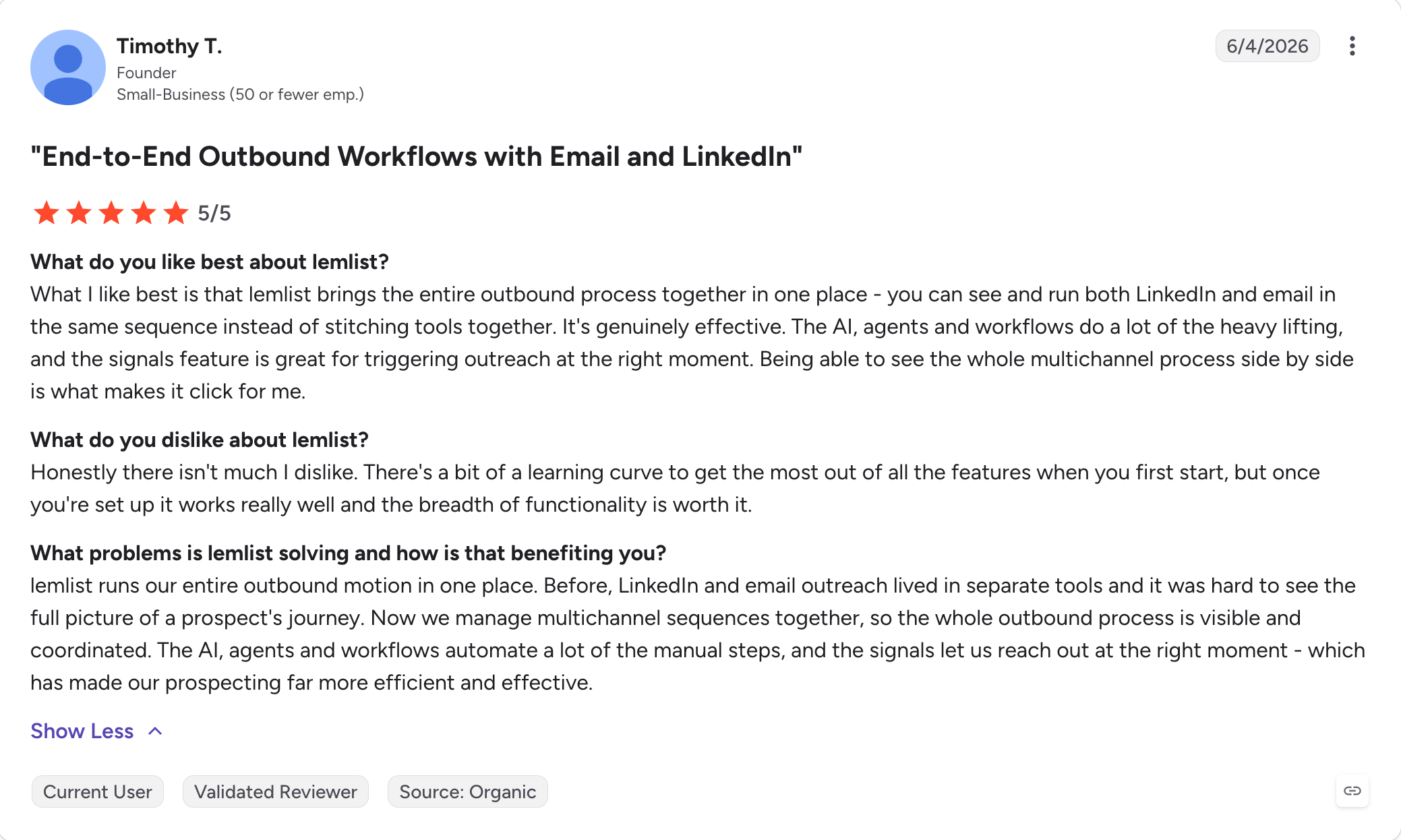
This is cold outreach sequence dashboard of Lemlist
Feature
Details
G2 rating
4.6/5 (1,400+ reviews)
Starting price
$69/mo monthly, $55/mo annual (Email plan, per team with unlimited users)
Free trial
14-day, no credit card
Standout feature
Dynamic image and video personalization
lemlist decided years ago that the way to get replies is to make each email look like somebody actually made it for you, and it is still the best tool here at that job.
Nothing else on this list drops a prospect's company logo inside an image, or their name onto a landing page built for them alone.
That focus earns real loyalty. Of its 2,069 G2 reviews, 1,562 are five-star, and reviewers tag ease of use and the LinkedIn features more than anything else.
Smartlead and Instantly both cost a third of what lemlist does once you count seats, and neither charges you per user. lemlist starts at $55 per user a month and holds LinkedIn back for the $87 plan, which is why 140 of those reviews tag it as expensive.
lemlist Key Features
Images and video built per prospect: Their logo, their website, their name, generated for each recipient.
Personal landing pages: Every prospect can get a page addressed to them.
LinkedIn steps: Connection requests and messages run in the sequence on the Multichannel plan.
lemwarm: lemlist's own warm-up product, run as part of the platform.
Contact database: Included, and metered with credits at a cent each.
Reply detection: It spots real replies and pauses the sequence for that person.
What I Liked About lemlist
The personalization does not look automated, and almost nothing else manages that.
Reviewers keep calling it easy, and using it I understand why.
Reply handling is careful. It stops sequences when it should.
What Are the Cons of lemlist
You pay per user, so a three-person team on Multichannel costs $261 a month.
The cheaper plan is email only. LinkedIn means moving up to $87 per user.
Credits run down fast on big campaigns, and 140 reviewers name price as the problem.
208 reviewers tag missing features, and 125 mention how long it takes to learn.
Three plans, all priced per user per month. Annual billing saves roughly 20% over monthly.
Plan
Monthly Price
Annual Price
Sending Capacity
LinkedIn Automation
Lead Database
Email
$69/mo (per team)
$55/mo (per team)
50,000 emails/month, unlimited users
No
650M+ leads; no credits included
Multichannel
$109/user/mo
$87/user/mo
5 senders per user
Yes (plus calls and SMS)
650M+ leads; 400 credits/user/month
Enterprise
Custom
Custom
Custom
Yes
Yes
A 14-day free trial is available on the Multichannel Expert plan without a credit card. Additional sending addresses cost $9/month each beyond plan limits.
Credits cost a cent each, so 1,000 of them come to about $10.
7. Woodpecker: Best for Teams With Uneven Sending Months
Best for: Agencies and consultants whose sending volume changes a lot from month to month.
G2 Rating: 4.5 out of 5 (105 reviews)
This is cold outreach sequence dashboard of Woodpecker
Feature
Details
G2 rating
4.5/5 (105 reviews)
Starting price
$35/mo monthly, about $23/mo annual (500 contacted prospects)
Free trial
14 days or 100 cold emails, whichever comes first, no credit card
Standout feature
Adaptive sending and free catch-all email verification on every plan
Woodpecker charges $7 for every 100 prospects you actually contact, which works out to $35 a month at 500 prospects. Nobody else here prices it that way.
Every other tool on this list bills you for capacity you might not use.
For a consultant who sends hard in January and barely at all in July, that difference is real money. You are never paying for 30,000 contacts in a month where you touched 800.
The saving disappears when you add the pieces. LinkedIn costs $29 a month per account, the agency panel costs $27 a month per active client, integrations cost $20 a month, and a dedicated server costs $59.
Woodpecker Key Features
You pay for what you contact: $7 per 100 prospects reached, so quiet months cost less.
Deliverability focus: The product has always been built around landing in the inbox rather than sending fast.
Agency panel: $27 a month per active client, for teams running outreach on behalf of others.
LinkedIn steps: Available at $29 a month per LinkedIn account.
Dedicated servers: $59 a month for teams that want their own sending setup.
Integrations: $20 a month connects it to the rest of your tools.
What I Liked About Woodpecker
The billing is the fairest on this list. You pay for work done rather than for spare capacity.
A slow month costs you almost nothing, which no other tool here can say.
The deliverability focus is old and consistent rather than a recent addition.
What Are the Cons of Woodpecker
Almost everything beyond sending is an add-on, including LinkedIn and integrations.
Only 105 G2 reviews, which is the thinnest evidence base in this comparison.
Busy months cost more than a flat plan would, so heavy senders pay a premium.
Per-client billing on the agency panel adds up faster than a flat workspace fee.
Best for: Solo founders and freelancers who need to find contacts, check them and email them without paying for three tools.
G2 Rating: 4.5 out of 5 (499 reviews)
This is cold outreach sequence dashboard of Snov.io
Feature
Details
G2 rating
4.5/5 (470+ reviews)
Starting price
$29.25/mo annual, $39/mo monthly (Starter)
Free trial
Free Trial plan with 50 credits that renew every 30 days
Standout feature
Email finder, 7-tier email verifier, drip campaigns, warm-up, and CRM bundled into one subscription
Snov.io runs finding, checking and sending off one pool of credits. Search for a contact and it costs credits. Verify the address and it costs credits. Send the sequence and that costs credits too.
One balance covers the whole job, which is why the entry price is the lowest here.
For one person, that design makes sense. You are not paying a sending plan, a data plan and a verification plan when your whole month might be 400 emails.
Watch what falls outside that pool. Email accounts cost $5 a month each, LinkedIn automation costs $62 a month per slot on annual billing, and domains start at $12 a year.
Snov.io Key Features
One credit pool for everything: Finding, checking and sending all draw from the same balance.
Email finder and verifier: Both are part of the platform rather than a separate purchase.
Five plan sizes: You can start small and step up without changing tools.
Warm-up included: Connected mailboxes warm without a separate subscription.
LinkedIn automation: Available at $62 a month per slot on annual billing.
Mailboxes and domains for sale: $5 a month per email account, domains from $12 a year.
What I Liked About Snov.io
The cheapest real starting point on this list, at $29.25 a month on annual billing.
One balance for finding and sending is simpler to reason about than three separate allowances.
Stepping up a plan does not mean learning a new tool.
What Are the Cons of Snov.io
Credits drain from two directions at once, so a heavy prospecting week eats your sending budget.
Email accounts cost $5 each per month, which adds up fast if you run twenty mailboxes.
LinkedIn costs $62 a month per slot on top of your plan.
The tool spreads itself thin. Nothing here is the best version of itself.
Built-in dialer with email, LinkedIn, calls, SMS, and WhatsApp in one sequence (Multichannel plan)
Reply.io is the tool people move to when email on its own stops being enough. Calls, SMS, LinkedIn and WhatsApp all run as steps in the same sequence, and reviewers keep coming back to the dialer as the reason they stayed.
The dialer is the part people stay for.
Reply.io also does something none of the other tools here do on its email plan. It charges by how many contacts you are working, not by how many people are on your team, so the plan comes with unlimited users and unlimited mailboxes.
Look closely at which plan carries which channel. The $159 email plan gives you unlimited seats but sells LinkedIn at $69 a month per account and calling at $29 a month per account, while the $89 plan includes every channel and charges per user.
Reply.io Key Features
A real dialer: Calling is built in rather than handed off to another tool.
Five channels: Email, LinkedIn, calls, SMS and WhatsApp all run as sequence steps.
Unlimited users on the email plan: Headcount does not change what you pay.
Unlimited mailboxes on the email plan: Connect as many as your volume needs.
Warm-up included: On both plans, with a deliverability toolkit alongside.
Website visitor reveals: Up to 200 a month, showing which companies visited you.
10. Klenty: Best for SDR Teams Working Inside a CRM
Best for: SDR teams whose day already runs in Salesforce or HubSpot and who want outreach to live there too.
G2 Rating: 4.6 out of 5 (390+ reviews)
This is cold outreach sequence of Klenty
Feature
Details
G2 rating
4.6/5 (390 reviews)
Starting price
$50/month billed annually (Starter); Growth and Plus are priced per user
Free trial
14-day free trial
Standout feature
Two-way CRM sync that keeps prospecting, sequences, dialing, and follow-ups inside Salesforce or HubSpot (Growth plan and up)
If your reps work in the CRM all day and resent every tool that drags them out of it, Klenty is built for them. It describes itself as a sales engagement platform with a strong focus on calling, and the two-way CRM sync goes deeper than anything else on this list.
Klenty is the only tool here that treats the CRM as the centre of the day.
Prospecting, sequences, AI dialing and follow-ups all write back where your reps already work, which means no exports and no reconciling two systems at the end of a week.
That design rules out a whole set of buyers. Klenty prices per user, starts at $50 a month per seat, and contact data comes as an add-on, so a solo operator or a volume sender will find better value almost anywhere else on this page.
Klenty Key Features
Two-way CRM sync: Deeper than any other tool here, across the major CRMs.
AI-powered dialing: Calling is a first-class part of the sequence, not a bolt-on.
Call coaching: Managers can review and coach from inside the platform.
Multichannel sequences: Email, calls and LinkedIn steps run together.
Built for SDR teams: The whole product assumes several reps working shared accounts.
What I Liked About Klenty
The CRM sync is the best on this list, and for a Salesforce team that matters more than price.
Calling and coaching in one place makes a real difference when you are managing reps.
It never pretends to be a cheap volume sender, and I respect that.
What Are the Cons of Klenty
$50 per user a month means a five-person team starts at $250.
Contact data is an add-on rather than part of the plan.
Only 390 G2 reviews, so the evidence base is thinner than the big names here.
Wrong tool entirely for a solo sender or a high-volume agency.
Klenty Pricing
Plan
Price (billed annually)
Key Inclusions
Starter
$50/month
Email only, 15,000 contacts and 75,000 emails per month
Picking the right cold email software depends less on feature lists and more on which criteria actually break campaigns in the wild.
Cold email is a fundamentally different motion from email marketing software like Mailchimp or ConvertKit. Bulk sending kills it. Personalization, deliverability infrastructure, and behavioral automation are what make the rest work.
Here are the six key features and criteria I check first when buying or recommending a cold email platform, with the specific failure modes each one addresses.
Deliverability Infrastructure (The Non-Negotiable)
Email deliverability is the criterion that decides whether the rest of the tool matters. If emails don’t land in the primary inbox, the AI personalization, the sequence builder, and the CRM integrations are all decorative.
The features to check: built-in email warm-up that scales across every connected mailbox, inbox rotation that spreads sending volume so no single account burns out, SPF/DKIM/DMARC support, and an inbox placement test that shows where emails land across Gmail, Outlook, and Yahoo before campaigns go live.
These deliverability features, especially warm-up and inbox rotation, are crucial for preventing your emails from ending up in the spam folder.
Custom tracking domains are an underrated bonus that protects sender reputation when link tracking is in use.
Tools like Salesforge bundle Warmforge free on every plan, which is the model worth looking for.
AI Personalization That Goes Beyond Merge Tags
Every cold email tool in 2026 says it’s “AI-powered.” The phrase is mostly meaningless without context.
The real question is whether the AI writes a full multi-step sequence worth sending, or just shuffles around a subject-line variant.
My test is to feed each tool the same prompt and judge whether the output is something I’d actually send.
If sequences need 60 to 80 percent rewriting before launch, the AI isn’t saving time. It’s adding a step.
Strong personalization also includes prospect-level variable injection (not just first name and company), advanced mail merge functionality for personalized outreach at scale, liquid syntax for branching by role or industry, and multilingual support that reads naturally in German, French, or Spanish.
Tools that score high here: Salesforge for full sequence generation in 21 languages and Lemlist for visual personalization with dynamic images.
Multichannel Automation and Behavioral Triggers
Email-only outreach is becoming less effective, as modern campaigns increasingly rely on multi channel outreach—including phone calls—to maximize engagement and conversion rates.
Most B2B buyers expect a mix of email, LinkedIn, and sometimes phone touchpoints, with the sequence branching based on engagement rather than rolling out the same follow ups regardless of what the prospect did.
The features to check: native LinkedIn outreach inside the same sequence builder (not as a separate add-on), connection requests, messages, and profile views as sequence steps, and conditional logic that branches on opens, replies, or LinkedIn engagement.
Automated follow ups should stop automatically when someone replies, which sounds obvious but isn’t universal.
LinkedIn is where most tools fall short. Salesforge include LinkedIn touchpoints natively. Saleshandy and Instantly don’t. Apollo and Snov.io require add-ons or higher tiers.
Data Accuracy and Lead Enrichment
A cold email tool is only as good as the prospect data feeding it.
High bounce rates from outdated email addresses tank sender reputation faster than any other single mistake, and bounce rates above 5% will move a sending domain into spam folders within a week.
The features to check: built-in email verification with real-time validation, a contact database for finding prospects without exporting to a separate tool, and ideally waterfall verification that pulls data from multiple providers before sending.
Some tools also offer the ability to identify and analyze website visitors, allowing you to track visitor activity and convert them into potential leads, which can significantly improve lead generation and outreach strategies.
Salesforge’s Forge Stack includes Leadsforge to generate leads inside the same ecosystem, so the data and the sending engine talk to each other natively rather than through brittle CSV exports.
Pricing Model That Scales With the Team
Cold email pricing splits into two camps.
Per-user models charge per seat, which makes total cost balloon as the team grows.
Flat-fee models charge per workspace, which keeps the bill stable regardless of how many people log in.
Traditional outreach tools tied to per-seat licensing don't scale well past three or four reps.
Per-user pricing wins for solo operators and teams of two or three; the cost stays low and the integrations are usually tighter.
Flat-fee wins at five or more users, and the math tilts harder in favor of flat-fee the larger the team gets. A 10-person team on a per-user $79 tool pays $790 per month. A flat-fee competitor at the same volume often costs under $100.
For agencies scaling cold email outreach across multiple client accounts, the right cold email software needs to handle unlimited workspaces without per-client surcharges. Salesforge do this on its standard plan. Other cold email platforms either charge per client or bury workspace limits in fine print.
Team and Agency Features
Agency panels that centralize multiple client workspaces under one login are essential once a team manages more than three accounts.
For agencies, the ability to add unlimited clients and manage multiple clients efficiently is crucial, as it allows seamless handling of multiple client accounts without extra charges.
The fastest test is whether a tool charges per additional client, per workspace, or per seat.
Platforms that bill flat per subscription regardless of seats and clients scale predictably. Platforms that charge per client or per seat add hidden cost as the agency grows, which often forces renegotiation or migration within 12 to 18 months.
Final Verdict: Pick the Cold Email Software That Matches Your Job
After going through all eleven, one thing stands out.
Nobody here built a bad product.
Apollo owns the data. Smartlead owns the agency layer. Reply.io owns the phone. lemlist owns personalization.
The mistake is buying one of them for a job it was never designed to do, then blaming the tool when replies do not arrive.
Salesforge covers the widest version of the job. The sequencer, cold email, LinkedIn, the reply inbox and premium warm-up all come on one plan. Mailboxes and LinkedIn senders cost nothing extra, so your bill grows with contacts and volume rather than with the size of your team.
That is why it comes first on this list. Not because it beats Apollo or Reply.io, but because for teams running email and LinkedIn together it is the only option that does not need a second purchase to work.
You can start with a 14-day free trial at Salesforge.ai, no credit card required.
Frequently Asked Questions
1. What is the best cold email software?
Salesforge is the best cold email software for teams that want email and LinkedIn in one sequence without paying per mailbox or per seat. Instantly is the cheapest if you only send email. Saleshandy is the best value if you need contact data included.
2. What are the best cold email software tools in 2026?
The eleven above: Salesforge, Instantly, Smartlead, Saleshandy, Apollo.io, lemlist, Woodpecker, Snov.io, Reply.io, Klenty and Mailshake. They split into sending engines, contact databases with sequencers attached, and sales engagement platforms built around a dialer.
3. Is there free cold email software?
Mailshake gives you a free Starter plan with one email address, and Apollo has a free plan that never expires. Instantly lists a free tier too. Free plans cap mailboxes and volume hard, so they suit learning rather than running campaigns.
4. What is the cheapest cold email software?
Snov.io at $29.25 a month on annual billing, followed by Smartlead at $32.50 and Saleshandy at $34. Snov.io then charges $5 per email account, so twenty mailboxes make it the more expensive option.
5. How do you use cold email software?
You connect your mailboxes, warm them up for two to three weeks, upload a verified contact list, build a sequence of three to five emails, and let the tool send on a schedule while it rotates across mailboxes. The tool then pauses anyone who replies.
6. Do I need warm-up, or is that a feature I can skip?
Warm-up matters most on new mailboxes and new domains, where inbox providers have no history to judge you on. Most tools here include it. Apollo does not offer it at all, and Klenty leaves it to you.
7. Is cold email legal?
Cold email is legal in the US under CAN-SPAM and in the EU and UK under GDPR and PECR, provided you have a legitimate business reason to contact someone, identify yourself honestly, and honour opt-outs immediately. Rules differ by country, so check the ones covering your recipients rather than your own location.
8. What is the difference between cold email software and email marketing software?
Cold email software sends plain, one-to-one-looking emails from your own mailboxes to people who have not subscribed, and it rotates across mailboxes to protect deliverability. Email marketing software sends designed bulk campaigns to lists that opted in. Sending cold email through a marketing tool is the fastest way to get an account suspended.
9. Can cold email software run LinkedIn outreach too?
Salesforge, Saleshandy, lemlist, Reply.io and Klenty all run LinkedIn steps inside a sequence, though lemlist and Reply.io gate it behind a higher plan or a paid add-on. Instantly, Smartlead and Mailshake are email only. Apollo removed LinkedIn automation in January 2026.
Book more meetings on autopilot
Set up in minutes. No per-seat pricing. No commitment.
Compare 5 AI inbox managers for cold email and sales outreach. See how Salesforge, Smartlead, Instantly, Reply.io, and Saleshandy handle replies, AI features, and pricing.


.webp)
.webp)

.webp)


.jpg)

.jpg)