Nobody takes a sales email seriously when it comes from a gmail.com address.
Business email on your own domain fixes that. Your mail also reaches the inbox more often. Spam filters trust a real domain more than a free account.
Most people then buy one email host and ask it to do two jobs.
The first job covers the inbox your team opens every morning. That one carries invoices, contracts and replies to customers. The team barely sends anything from it.
The second job covers cold outreach. You send hundreds of emails a week to people who never asked to hear from you.
I have been in sales for over a decade. I have watched what happens when both jobs share one domain.
Your emails land in promotions. Then they slide into spam. Your reputation drops, and buying a fresh domain starts to look cheaper than fixing the old one.
So you need two setups. Your team works in one mailbox, and you send outreach from the others.
In this blog, I share the eleven email hosting services I always recommend. Each one handles one job or the other.
Mailforge: Best shared email infrastructure for cold outreach on a budget. The pre-warmed mailboxes cost the same as fresh ones, which nobody else on this list matches. You buy them in the app or through the API and send that day.
Infraforge: Best private email infrastructure for agencies and high-volume senders. Your mailboxes run on dedicated IPs, so no other sender can damage your reputation. Agencies can white-label the whole platform and resell it under their own brand.
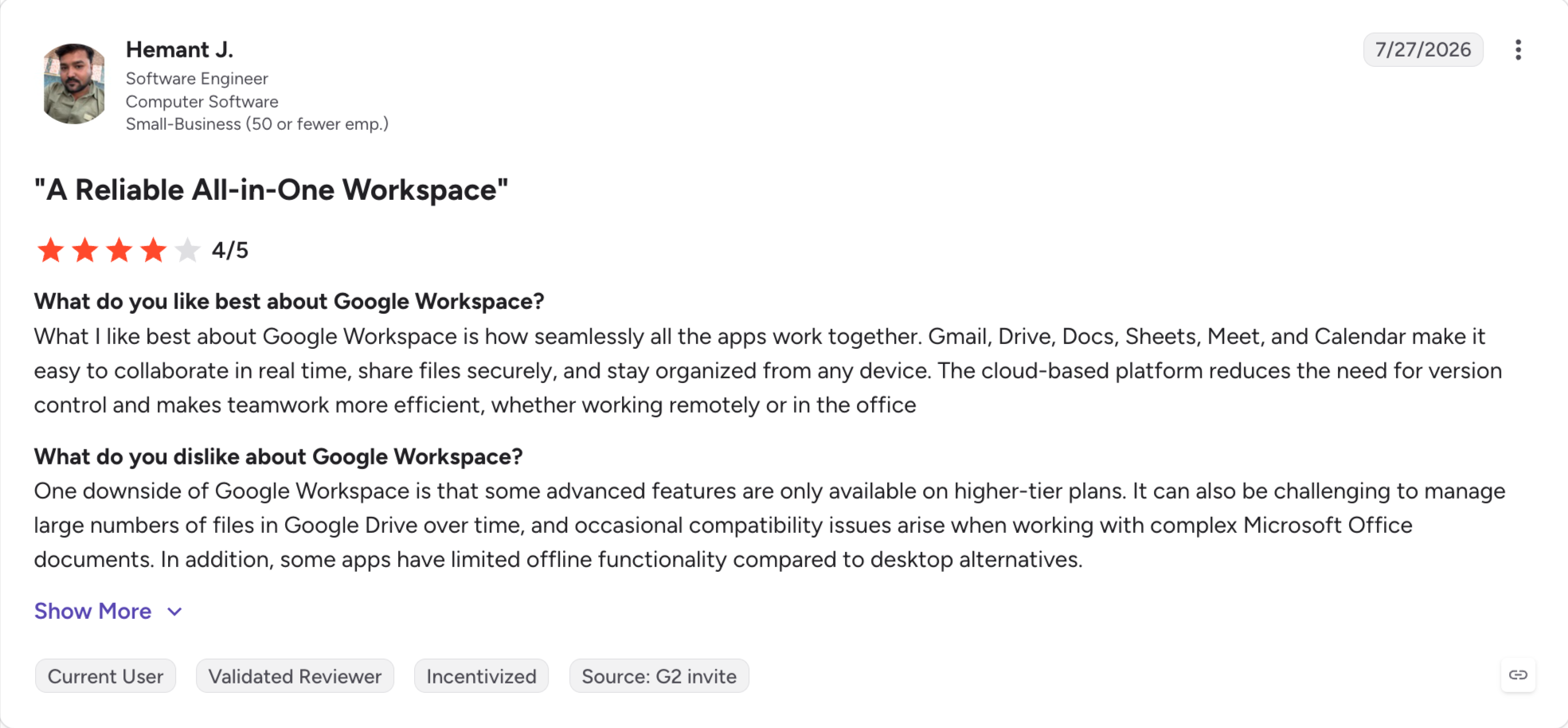
Google Workspace: Best email hosting for most teams. Nothing here filters spam better and nobody needs training to use Gmail. The storage on the entry plan covers Gmail, Drive and Photos together, so heavy users run out of space first.
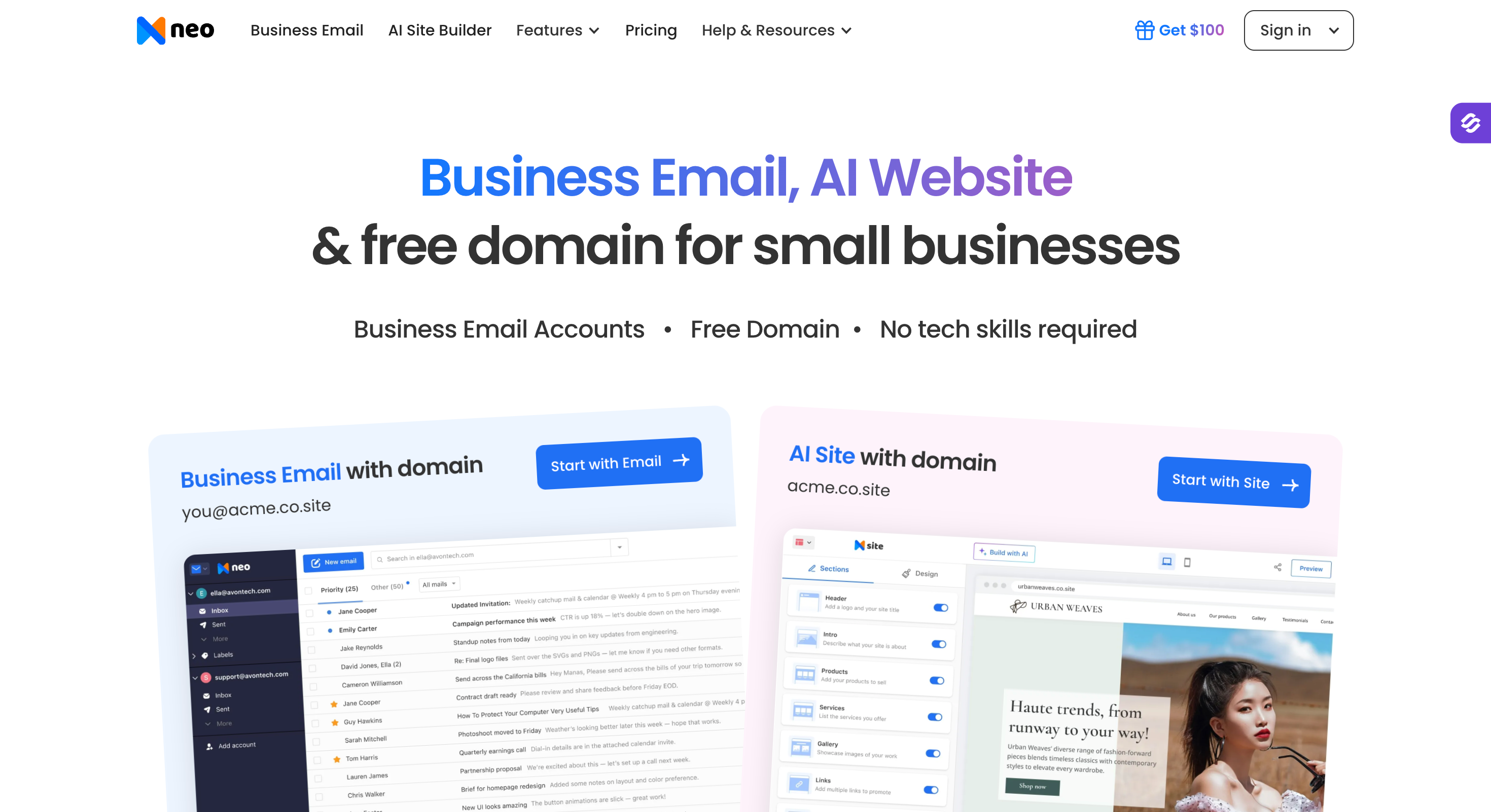
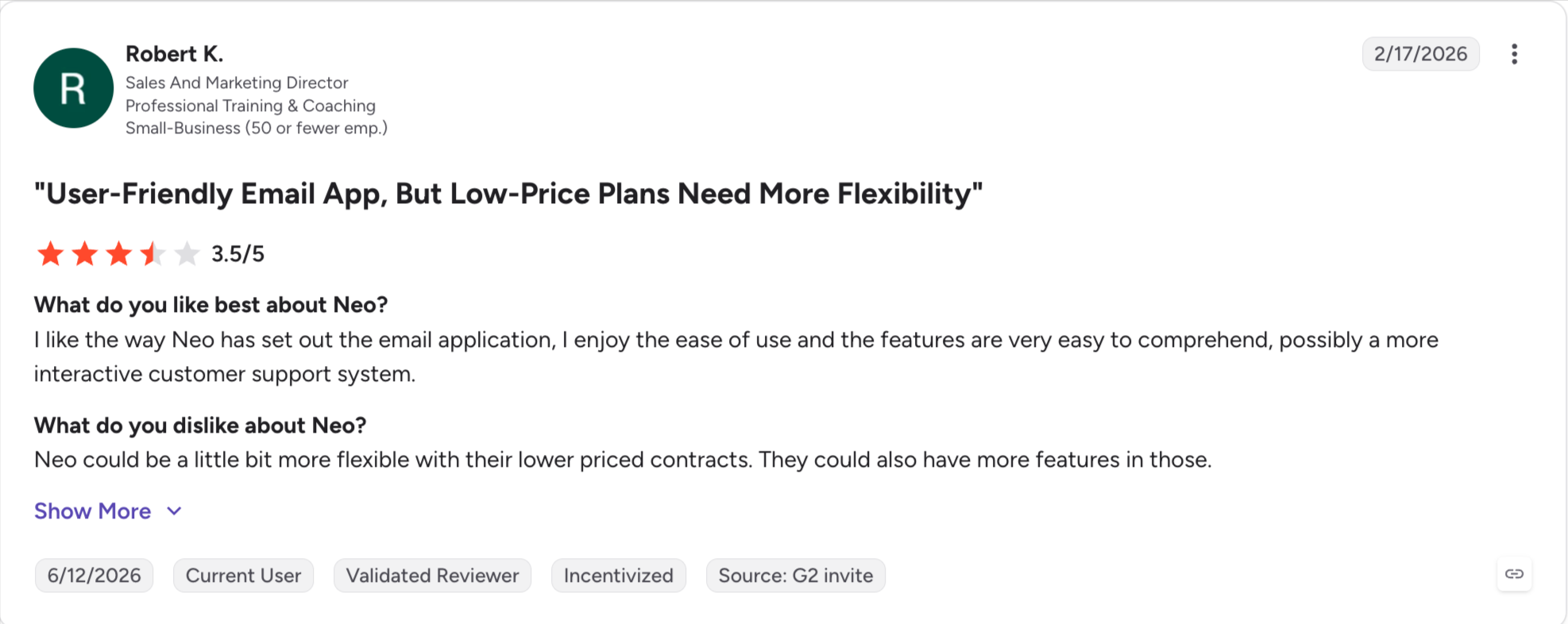
Neo Mail: Best email hosting for people starting with nothing. Neo hands you a domain, a mailbox and a site builder from one signup. The free domain ends in .co.site, so most people connect their own instead.
Microsoft 365: Best email hosting for teams already in Outlook and Excel. Microsoft gives you three times the mailbox storage Google does for the same money. The pricing page shows Copilot plans before it shows the one you want.
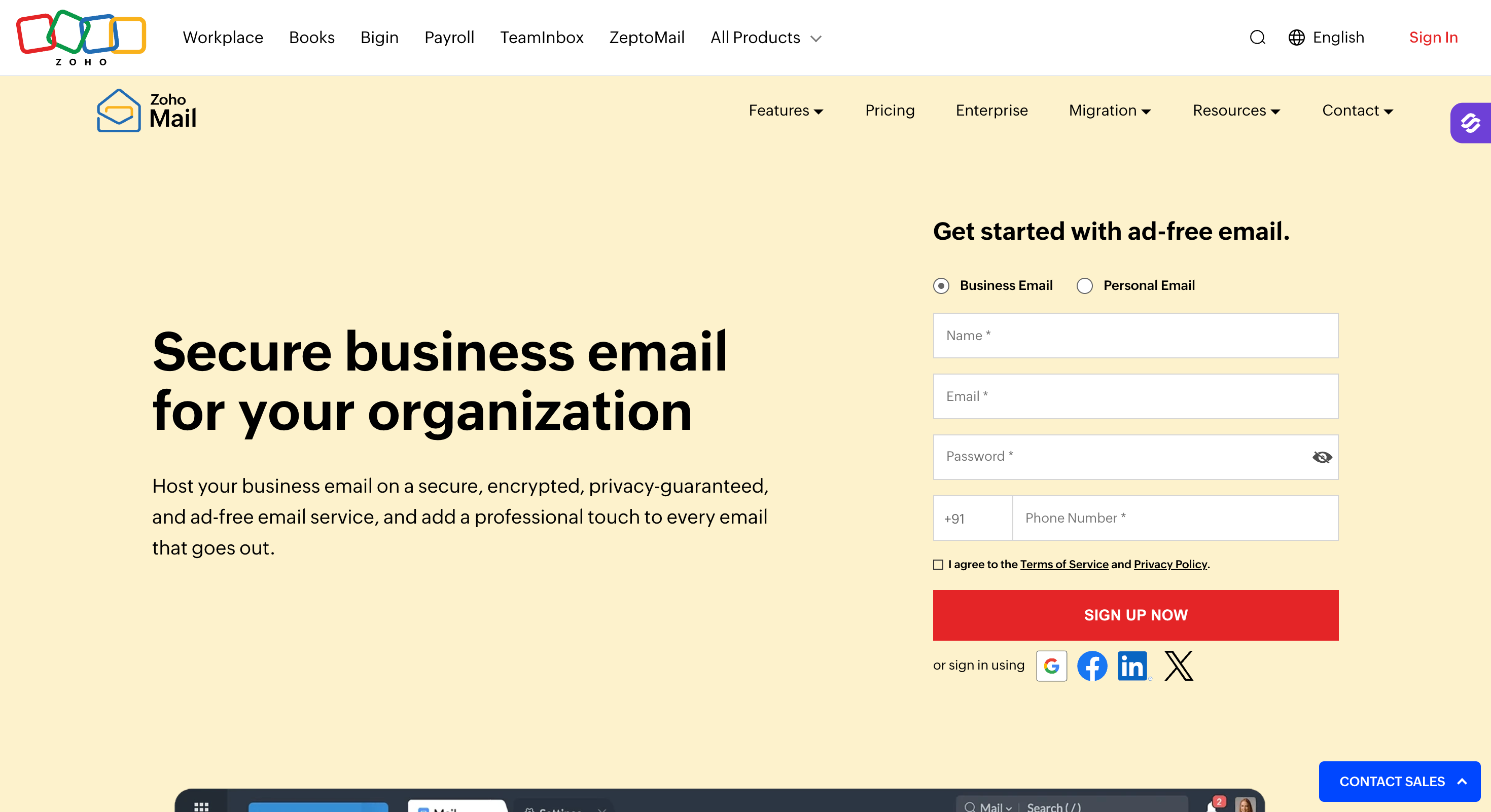
Zoho Mail: Best cheap email hosting for small teams. The free plan covers five people on your own domain, which nobody else here offers.
Proton Mail: Best encrypted email hosting for work with sensitive records. Proton locks your mail so nobody at Proton can read it either. Worth the higher price if a leak would hurt you, and beside the point if it would not.
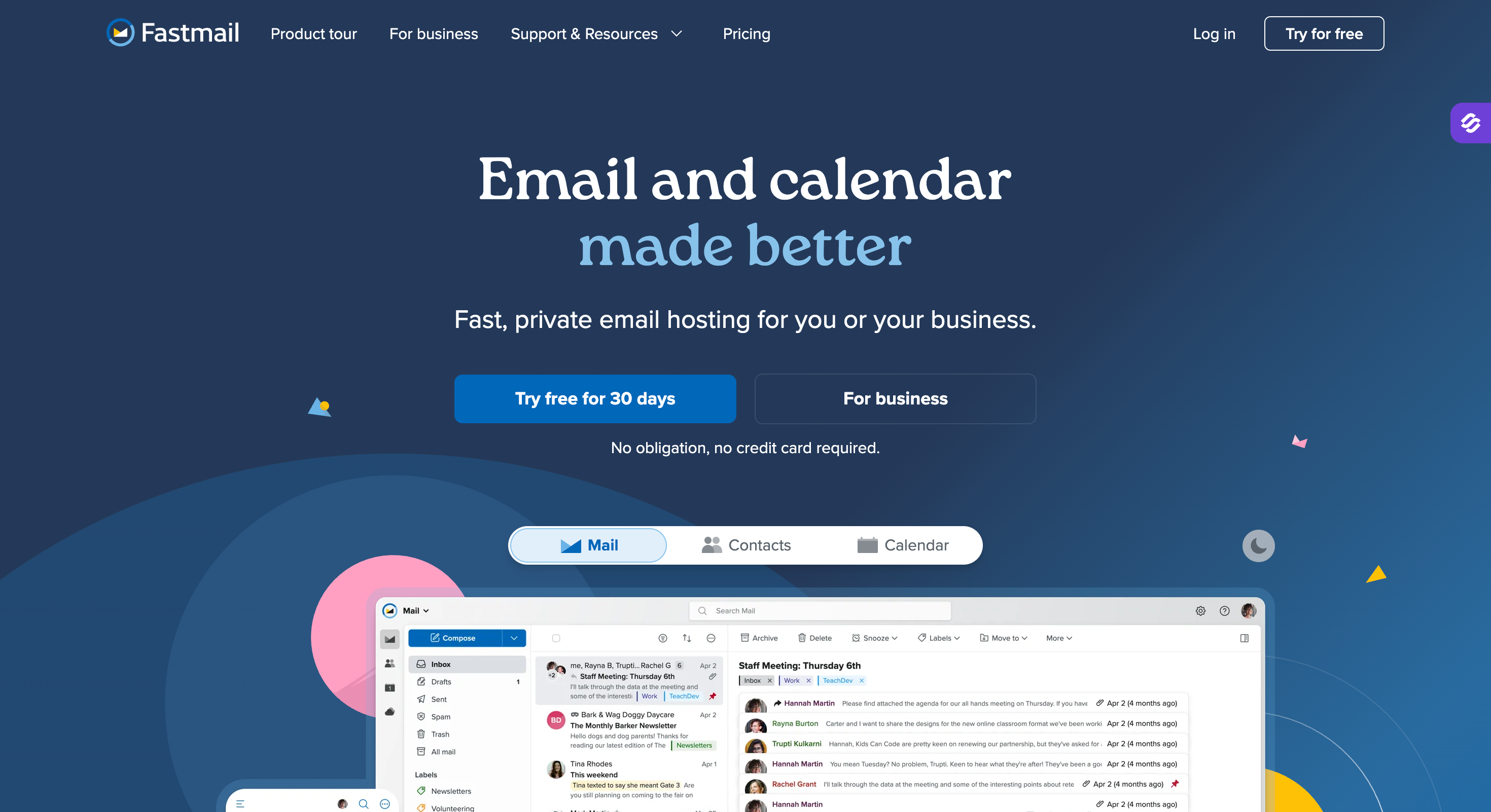
Fastmail: Best email-only hosting for people who want nothing else attached. You get a mailbox, a calendar and contacts, done properly. Masked Email hands every site a throwaway address, so you cut off spam at the source.
Namecheap: Best email hosting to buy alongside your domains. Launch covers one mailbox, Expand covers three and Scale covers five. You buy a plan that fits the team instead of paying per person.
Hostinger Email: Best email hosting on year-one price, with the sharpest renewal jump on this list. Every plan covers a single mailbox, so a team of five pays five times over.
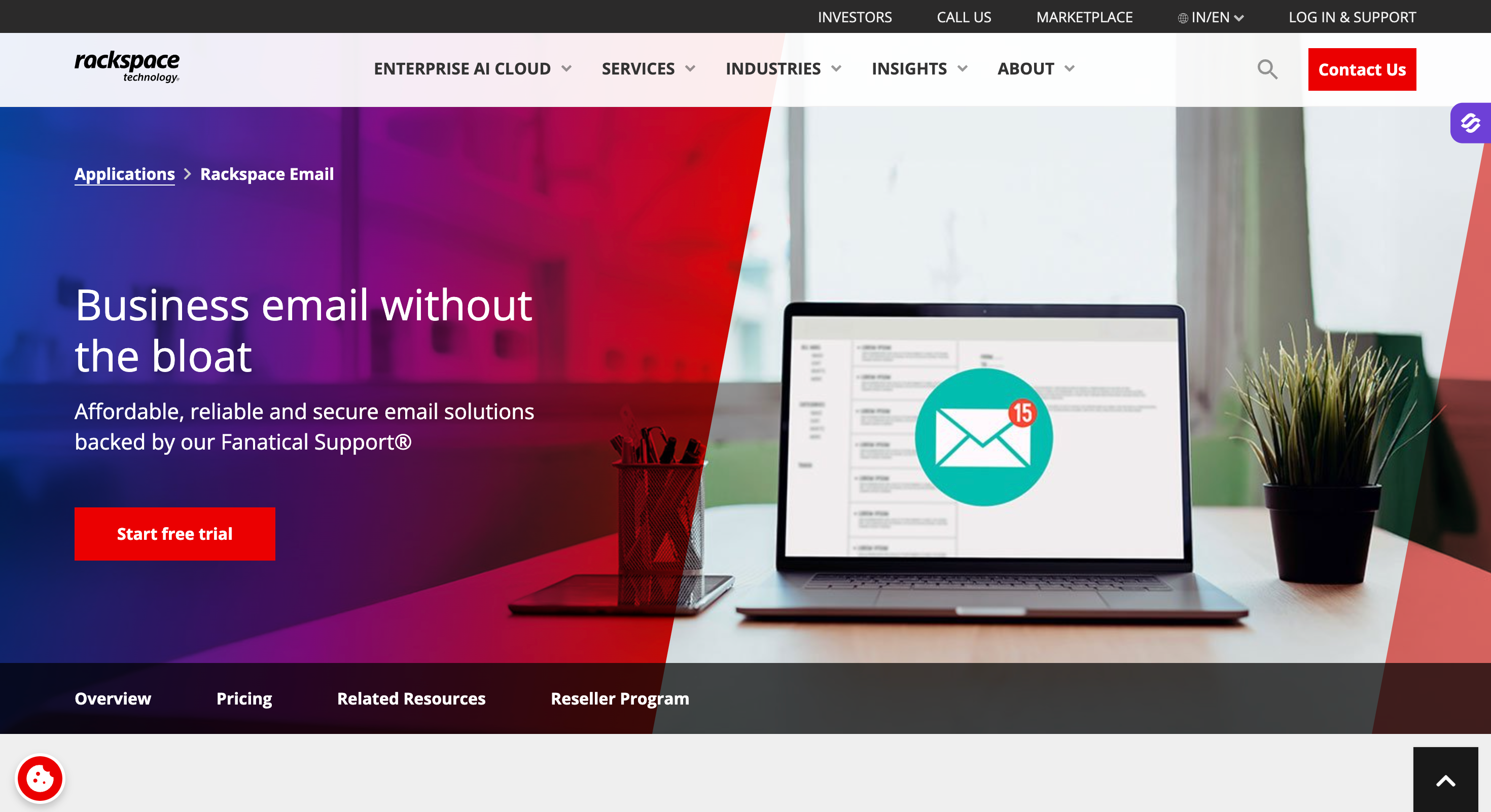
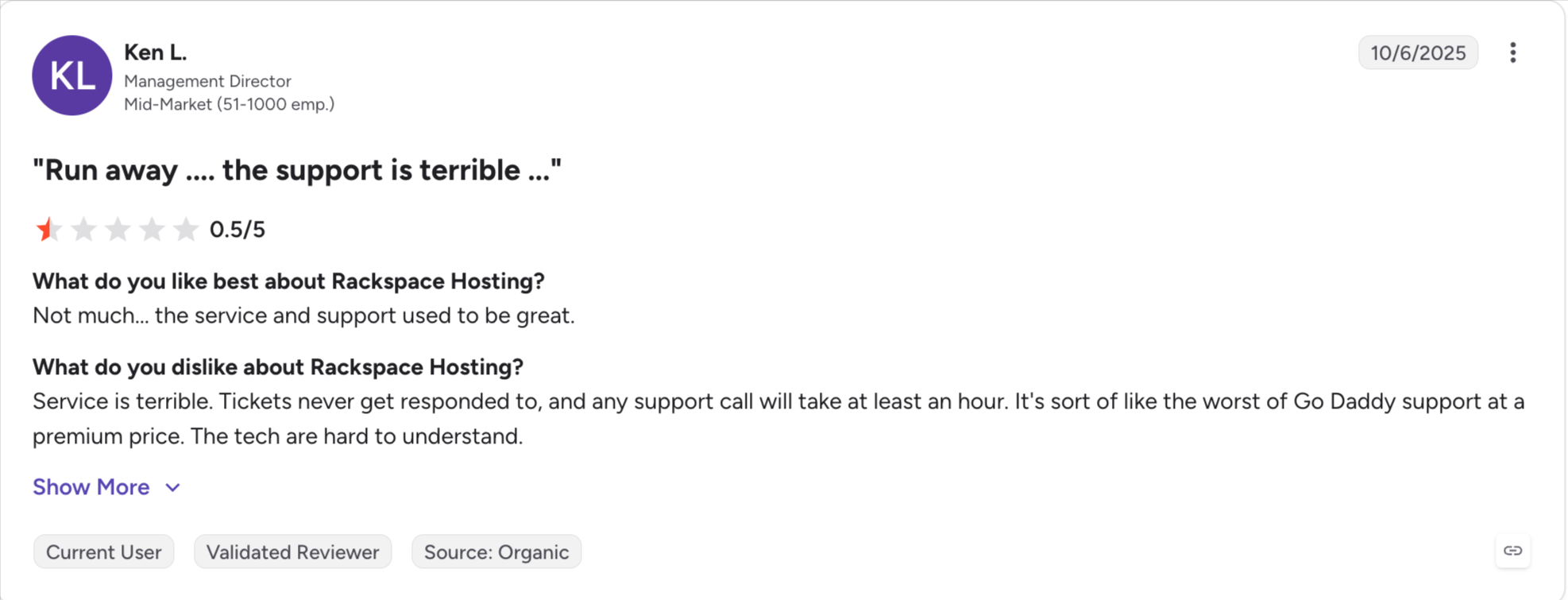
Rackspace Email: Best email hosting for round-the-clock support, and the hardest to justify now. Rackspace tripled its price in March 2026. Most customers stayed because moving years of mail costs more than the increase does.
Feature Comparison: Top 3 Email Hosting Services at a Glance
Agencies and outbound teams running dozens of sending mailboxes
High-volume senders who want dedicated IPs
Most teams, with almost no admin
Teams already in Outlook and Excel
Small teams on a tight budget
People starting with no domain or site
Work with sensitive client records
People who want email and nothing else
People whose domains sit at Namecheap
Solo operators on the lowest entry price
Existing customers deciding whether to stay
Price (annual)
$3 to $2 a mailbox a month
$4 to $3 a mailbox a month
$7, $14 or $22 a user a month
$7, $14 or $22 a user a month
Free, then $1 to $4 a user a month
$1.99 to $7.99 a mailbox, year one
$6.99 to $19.99 a user a month
$3 to $9 a user a month
$11.88 to $47.88 a year, year one
$0.59 to $2.99 a mailbox, promo rate
$10 a mailbox a month
Mailboxes included
Unlimited, ten-slot minimum
Unlimited, ten-slot minimum
One per user, 300 users max
One per user, 300 users max
One per user, five free
One per plan, 50 maximum
One per user
One per user, tiers can mix
1, 3 or 5 by plan
One per plan
One per mailbox bought
Storage
Built for sending, not storing
Built for sending, not storing
30 GB, 2 TB or 5 TB pooled
100 GB plus 50 GB archive
5 GB free, up to 50 GB paid
15, 50 or 100 GB
15 GB, 1 TB or 3 TB
6, 60 or 150 GB
5, 30 or 75 GB
5, 20 or 50 GB
25 GB plus 30 GB files
Setup time
Bulk domains and mailboxes in minutes
About five minutes for the first one
Verify the domain, then add DNS by hand
Create a tenant, verify, assign licences
Verify the domain, then add DNS
One signup covers domain, mail and site
Verify the domain, then add DNS
Verify the domain, then add DNS
Automatic, records written for you
Verify the domain, then add DNS
Verify the domain, then add DNS
DNS written for you
Yes, SPF, DKIM, DMARC and tracking
Yes, SPF, DKIM and DMARC
No
No
No
Yes on a Neo domain
No
No
Yes, SPF, DKIM and DMARC
No
No
Daily sending limit
Built for outreach at scale
Built for outreach at scale
Around 2,000 a day
Around 10,000 a day
Varies by plan
Not published
Not published
Not published
Not published
1,000 to 3,000 a day
10,000 recipients a day
Warm-up included
Free through Warmforge, no slot cap
Free through Warmforge, no slot cap
None
None
None
None
None
None
None
None
None
Pre-warmed mailboxes
Yes, priced like fresh ones
Yes, priced like fresh ones
No
No
No
No
No
No
No
No
No
Running many domains
A workspace per client, bulk DNS
A workspace per client, bulk DNS
One at a time in the console
One at a time in the admin centre
Multiple domains on paid plans
One domain per account
3, 15 or 20 by plan
Multiple on Standard and above
Up to 20 before custom pricing
One per plan
Multiple per account
Works with Outlook and Apple Mail
Any sending tool, IMAP and SMTP
Any sending tool, IMAP and SMTP
Yes
Yes
Paid plans only
Yes, on every plan
Yes
Standard and above
Yes
Yes
Yes
API, MCP and CLI
Forge MCP server, CLI and API
Full API, MCP server and CLI
Admin SDK and APIs, no MCP
Graph API and PowerShell, no MCP
API, no MCP
No public API
API, no MCP
API, no MCP
API, no MCP
No public API
API, no MCP
Free trial
None, ten slots to start
None, ten slots to start
14 days
One month, card required
Free plan, kept for good
15 days
14 days, 30-day refund
30 days, no card
30 days, no card
30-day refund
None published
How I Picked These 11 Email Hosting Services
I checked every service against six things, including the key features that most affect long-term value:
Setup time: I timed how long each one takes from signing up to a mailbox that sends. Unlike broader web hosting services, email hosting plans often require domain mail setup even when the inbox itself is quick. Some hand you a working inbox in five minutes. Others make you verify a domain, edit DNS records at your registrar, and then wait.
Year two cost: I priced what you pay after the first-year rate ends, not what you pay to sign up. Three services here advertise a cheap opening price and renew much higher, so I list both numbers.
Storage and security: I checked how much space each mailbox gets and what happens when it fills up. I also looked at security features such as spam filtering, two-factor authentication, and encryption.
Deliverability help: I looked at whether the provider writes your sending records for you and lets you control the address you send from. This matters when choosing the right email hosting provider for your use case, since some hand you a mailbox and leave the rest to you.
Support: I read recent reviews to find out whether a person answers when mail stops arriving. Marketing claims did not count.
Sending limits: I found out what happens when you send more than a normal working day. This is often what separates the right email hosting service from one that looks fine on paper. Some services slow you down, some switch the account off, and two are built for exactly that.
1 - Mailforge
Best for: GTM outbound teams, lead gen agencies, and small and medium businesses who need dozens of sending mailboxes across many cold email domains, fast and cheap, kept well away from company email.
Mailforge is shared email infrastructure built for cold outreach at scale. Nothing else here runs a large sending setup for less.
Every other service here sells you an inbox to work in. Mailforge sells you mailboxes to send from. That one difference changes the price, the setup and what it protects.
You can also buy them pre-warmed. A fresh mailbox cannot send cold email at volume for two to four weeks. Gmail treats a mailbox with no history as a likely spammer. Mailforge sells pre-warmed domains and mailboxes at the same price as fresh ones, so you skip that wait.
I watch agencies pick it on price. Forty mailboxes cost a fraction of forty Google Workspace licences, because you pay per mailbox and not per person.
Core Features
Bulk domains and mailboxes: A guided setup works out how many of each your sending volume needs, then builds them together.
Pre-warmed and ready: Buy pre-warmed domains and mailboxes in the app or through the public API and send the same day, at the same price as fresh ones.
Automated DNS setup: Every domain gets SPF, DKIM, DMARC and custom tracking set up automatically, which are the records that tell Gmail your mail really came from you.
Bulk DNS changes: Push a record change across every domain in a few clicks.
Domain forwarding: Point a sending domain at your main site from inside Mailforge, without opening your registrar.
No lock-in: Bring domains in or move them back out whenever you want.
Workspaces: Run a separate space per client or project and move domains between them.
SSL and domain masking: Show a branded site on a sending domain so your primary one stays hidden. Sold as an add-on.
Works with any sending tool: Mailforge shares a login with Salesforge, so domains flow into sequences with no export step.
Connect with Any AI Assistant: Point Claude, Cursor or your own script at Mailforge and it builds domains and mailboxes for you.
Pros and Cons
✅ Pros
❌ Cons
Pre-warmed mailboxes cost the same as fresh ones, so you send the same day
No dedicated IP option available
Automated DNS configuration and setup streamline mailbox onboarding
Configuration typically takes around 5 minutes from start to finish
Includes MCP CLI for AI agent and developer workflows
Works with virtually any cold email platform rather than locking you into a single sending tool
Mailforge writes SPF, DKIM and DMARC on every domain registrar
Works with any sending tool, not just Salesforge
Pricing
What you pay for
Price
Mailboxes
$3 to $2 per mailbox a month, billed annually. Ten slots minimum
Domains
Priced by ending, around $14 a year for a .com
SSL and domain masking
$2 per domain a month, or $6 a year
Pre-warmed mailboxes
The same price as fresh ones
What Users Say
Mailforge holds 4.7 out of 5 on G2 from 90+ reviews.
Best for: GTM outbound teams, lead gen agencies and high-volume senders who want dedicated IPs for their emails.
Infraforge is private email infrastructure for cold outreach. Your mailboxes run on their own servers with their own IP address.
This is important because Gmail and Outlook judge the IP address before they judge you. On a shared pool, that address belongs to everyone using it. A stranger sends badly and the address picks up a reputation for it. Your mail then lands in spam for reasons you cannot see or fix.
So buy this if you send at volume, several days a week. If you do not, Mailforge above will serve you better and cost you less.
You can buy the mailboxes pre-warmed at the same price as fresh ones. That skips the two to four week wait before a new mailbox can send at volume.
Core Features
Dedicated IPs: Every mailbox runs on its own IP address, so your sending reputation belongs to you alone.
Pre-warmed and ready: Buy pre-warmed domains and mailboxes at the same price as fresh ones and send from day one.
Several IPs in one account: Split clients or campaigns across separate IPs, so one campaign's problem never touches another.
Unlimited domains and mailboxes: Set up as many as you want, with DMARC, SPF and DKIM configured on every domain.
Bulk generators: Create a batch of domains in one click, then a batch of mailboxes to sit on them.
Sender rotation: Infraforge spreads your sending across mailboxes, IPs and domains, and slows anything climbing too fast.
Live deliverability alerts: You get warned about a mailbox before it burns a domain.
Primebox (Masterinbox): Read every email across every account in a workspace from one place. Charged per workspace.
White-label: Agencies rebrand the whole platform, run it as their own, and earn a share as resellers.
API, MCP and CLI: Build and manage mailboxes from Claude, Cursor or your own script.
Pros and Cons
Pros
Cons
Your IP address, so no other sender can hurt you
No shared infrastructure option
Pre-warmed mailboxes cost the same as fresh ones
Includes MCP CLI for AI agent and developer workflows
White-label and a revenue share for agencies
Several IPs keep clients apart
Pricing
What you pay for
Price
Mailbox slots
$4-$3 per slot a month, or $3.33 billed annually. Ten slots minimum
Dedicated IP addresses
$99 per IP a month, billed quarterly
Masterbox
$7 per workspace a month annually, $9 quarterly
SSL and domain masking
$2 per domain a month, or $6 a year
Domains
Around $14 a year for a .com
Pre-warmed mailboxes
The same price as fresh ones
What Users Say
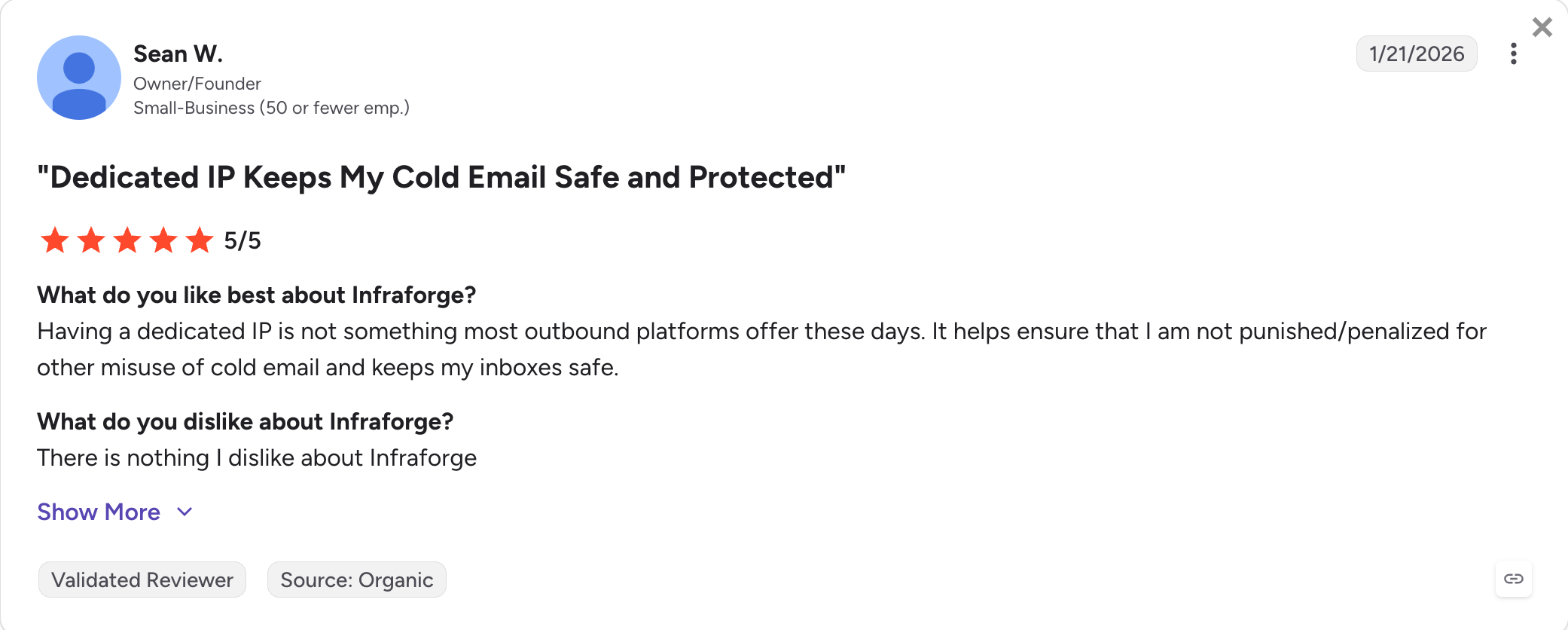
Infraforge scores 4.8 out of 5 on G2 from 60+ reviews.
Dedicated. Your sending reputation belongs only to you.
Shared with other Mailforge customers.
Mailbox Price
$4 down to $3 per mailbox/month (billed annually)
$3 down to $2 per mailbox/month (billed annually)
Time Until You Can Send
Day one with optional pre-warmed mailboxes (sold separately)
Typically 2–4 weeks to build reputation, or use Warmforge to accelerate warm-up
Who Can Affect Your Deliverability
Only your own sending activity
Your activity plus any other sender sharing the same infrastructure
Reading Replies
Masterbox aggregates replies from every mailbox into one workspace (priced per workspace)
Replies are managed one mailbox at a time
White-label / Reselling
Yes, supports full white-label reselling
No
Free Trial
No
No
3 - Google Workspace
Best for: Teams who want one reliable inbox for daily work, on their own domain, with almost no admin.
Google Workspace is a professional email hosting service for teams that want Gmail on a custom email domain, with Google Docs, Drive, Calendar and Meet attached.
Most people reading this already use it, or nearly did.
I would put a team on this over anything else here. Gmail needs no training, the spam filter beats everything else on the list, and you can add someone in two minutes from the admin console. Teams also pick it for the built-in collaboration tools, and many users are already coming from a gmail account.
I would not send a single cold campaign through it.
Google caps a Workspace mailbox at 2,000 emails a day and locks sending for a full day if you go over. Long before you reach that number, Google watches whether people open and reply to your mail. When they stop, your delivery drops.
That mailbox sits on the same domain as your team's business communication, so a burnt sending reputation follows you into your invoices and your customer replies.
One thing changed in 2026 that most comparisons still miss. Gemini now comes with every paid plan. Google used to sell it as a $20 a user add-on and stopped in early 2025.
Starter gets Gemini in Gmail. Standard gets it across Docs, Sheets, Slides and Meet.
Core Features
Gmail on your custom email domain: The same inbox everyone already knows, with your company name after the @ and a more professional custom email address for client-facing communication.
Gemini included: Every paid plan now carries it. Starter covers Gmail, Standard covers the rest of the apps, with access through web apps and dedicated mobile apps on phones and tablets.
Pooled storage: 30 GB per user on Starter, 2 TB on Standard, 5 TB on Plus. Google pools it across the company, so a heavy user borrows from a light one.
Spam filtering: Google filters more mail than anyone on earth and it shows. Very little junk reaches your team and very little of your real mail goes missing.
Two-factor authentication and device controls: Turn on two-step verification across the company and wipe a lost laptop from the console.
Admin console: Add people, set rules across every domain you own, and control who shares what.
Migration: Bring mail across from your old provider without asking everyone to rebuild their inbox by hand.
Pros and Cons
Pros
Cons
The best inbox placement of anything here
The 30 GB on Starter covers Gmail, Drive and Photos together
Nobody needs training to use Gmail
No shared drives or meeting recording until Standard
Gemini now comes with every paid plan
Around 2,000 emails a day, and delivery drops well before that
Two minutes to add or remove someone
Business plans stop at 300 users
Migration tools that do not break inboxes
Cold outreach through it puts your company domain at risk
Pricing
Plan
Price a user
Storage a user
Business Starter
$7 a month, billed annually
30 GB pooled
Business Standard
$14 a month, billed annually
2 TB pooled
Business Plus
$22 a month, billed annually
5 TB pooled
Enterprise
Priced on a call
5 TB and up
Paying monthly instead costs about 20% more. Business plans cap at 300 users and the trial runs 14 days.
One more thing worth knowing. Authorised resellers sell the same Starter plan for around $3 a user for teams under 300. Same product, less than half the list price.
Best for: People starting a business with no domain, no website and no email address, who want all three from one place.
Neo Mail is a business email hosting option bundled with a free domain and a one-page website.
Most services here assume you already own a domain. Neo assumes you own nothing.
You sign up and get all three at once, which helps you launch a professional address fast because the domain, mailbox and site all come from one signup.
For anyone turning a side project into a business, that clears three decisions in a morning.
Starter gives you 15 GB, which beats Hostinger, Namecheap and Fastmail at their entry prices. Outlook and Apple Mail connect from the cheapest plan.
I would weigh two things first. The free domain comes as a .co.site address, which reads as a placeholder, though you can later connect your own domain for custom business email addresses. The features worth having sit behind Max at $7.99, four times the entry price. Campaign mode, booking, the AI writer and invoices all live up there.
Core Features
Free .co.site domain: Neo hands you a domain at signup, and some plans also include free email addresses for getting started, or you connect one you already own.
Site builder: Build a one-page website next to the mailbox, with templates and AI writing help for basic online services if you want email plus a simple site.
15 to 100 GB a mailbox: 15 GB on Starter, 50 GB on Standard, 100 GB on Max.
Works with normal mail apps: Outlook and Apple Mail connect on every plan.
Priority inbox and labels: Neo sorts the important mail to the top and lets you tag threads, from Standard up.
Read receipts and send later: See when someone opens your mail and schedule messages ahead. Starter caps you at 50 receipts.
Campaign mode: Send one personal message to a list without exposing everyone's address. Max only, and it is not email marketing software for large campaigns.
Appointment booking and invoices: Take bookings and raise invoices inside the mailbox. Max only.
Pros and Cons
Pros
Cons
A domain, a mailbox and a website from one signup
The free domain is a .co.site address, which looks temporary
15 GB on the entry plan beats most budget rivals
Campaign mode, booking, invoices and the AI writer all sit on Max
Outlook and Apple Mail work from the cheapest plan
Prices rise about 25% when the first year ends
Two and four-year terms cut the price sharply
Starter allows one template and 50 read receipts
15-day trial before you commit
Fifty mailboxes maximum, and few connections beyond IMAP
Pricing
Plan
First year a mailbox
Renews at
Storage
Starter
$1.99 a month
$2.49 a month
15 GB
Standard
$3.99 a month
$4.99 a month
50 GB
Max
$7.99 a month
$9.99 a month
100 GB
Committing to two years cuts about 40% and four years cuts about 50%. Worth it only if you are sure.
Best for: Teams already working in Outlook, Excel and Teams.
Microsoft 365 is business email on your domain, with Outlook, Word, Excel and Teams attached.
It is also a practical secure business email option for teams already embedded in Outlook and Teams. It does the same job as Google Workspace for teams who already live in Microsoft's apps.
Microsoft changed three things on 1 July 2026, and most comparisons still miss them.
Basic went from $6 to $7 a user and Standard went from $12.50 to $14 a user, though many comparisons still cite Microsoft 365 at $12.50 per user with 100 GB. Premium held at $22, so the gap between the two closed from $9.50 to $8. If you were weighing those two, the answer changed while nobody was looking.
Mailbox storage doubled to 100 GB. Microsoft rolled it out tenant by tenant through 30 September. I would check your own quota before counting on it.
Like Google, I would not send cold outreach through it. Microsoft throttles you long before its 10,000 a day limit. That mailbox also sits on the domain your invoices go out from.
Core Features
Outlook on your custom email domain: The mail client most office workers already know, with your company name after the @.
100 GB mailbox: Every business plan carries it since July 2026, with 50 GB of archive on top.
Copilot Chat built in: Business plans now include a baseline version that reads your inbox and calendar. The full Copilot costs $21 a user on top.
Security features: Microsoft includes junk filtering, phishing protection and malware screening before anything reaches your team.
Link checking: Business Basic and Standard now check a link at the moment someone clicks it, not just when the mail arrives.
Admin centre: Add people, assign licences, set rules across your domains and lock down devices.
Versions with or without Teams: Skip Teams and pay less per user if you do not need the extra collaboration tools, web apps and mobile apps access.
Migration tools: Move mail in from another provider without asking everyone to rebuild their inbox.
Pros and Cons
Pros
Cons
100 GB of mailbox, over three times what Google gives on Starter
Basic and Standard both rose in price on 1 July 2026
Premium held at $22 while Standard rose, so the gap narrowed
The 100 GB rolled out tenant by tenant, so check your own quota
Outlook needs no training for most office workers
The pricing page pushes Copilot bundles ahead of the cheaper plans
Strong spam and phishing filtering built in
Business plans stop at 300 users
Up to 10,000 recipients a day
The trial asks for a card and renews unless you cancel
Pricing
Plan
Price a user
Mailbox
Business Basic
$7 a month, billed annually
100 GB plus 50 GB archive
Business Standard
$14 a month, billed annually
100 GB plus 50 GB archive
Business Standard with Copilot
$23.50 a month
100 GB plus 50 GB archive
Business Premium
$22 a month, billed annually
100 GB plus 1.5 TB archive
Business Premium with Copilot
$32 a month
100 GB plus 1.5 TB archive
Paying monthly costs about 20% more. Business Basic is the basic plan for teams that mainly need hosted email and lightweight Office access. Business plans cap at 300 users, and the one-month trial asks for a card.
Existing subscriptions keep their old price until the first renewal after 1 July, so your bill may not have moved yet.
Best for: Small teams and solo operators who want proper business email on their own domain for about a dollar a month.
Zoho Mail is a professional email hosting option for small businesses that want business email on their own domain without Google Workspace pricing.
Mail Lite costs $1 a user against $7 for Google Workspace Business Starter.
The gap raises the obvious question of what you give up. You give up less than you would think, even if pricier rivals include more advanced features. I have recommended Zoho to founders who were about to pay Google $7 a seat for mailboxes nobody would fill.
The free plan covers five people on your own domain, which nobody else here offers. It blocks Outlook and Apple Mail though, so everyone works in the browser.
Two limits catch people out. Zoho has no free-for-the-first-five model, so a sixth hire moves the whole team onto a paid plan. Five gigabytes also holds only about 500 messages.
Core Features
Mail on your domain from $1: The cheapest paid business email in this article, billed annually, and still positioned as a professional email hosting service.
A free plan that works: One of the few usable free email hosting plans with your own domain: five users, 5 GB each, one custom domain. Most free plans will not let you use your own domain at all.
Calendar, contacts and tasks: All in one tab, which reviewers mention more than any other feature.
Admin console: Add people, set policies, and quarantine or reject mail that breaks your rules.
Attachments that scale with the plan: 25 MB on free, 250 MB on Lite, 1 GB on Premium.
Archiving and legal search on Premium: 50 GB of mailbox plus 50 GB of archive, with rules for how long mail sticks around.
Message encryption on Premium: Sign and encrypt individual messages if your industry asks for it.
Ad free on any plan: Zoho does not sell advertising against your inbox on the free or paid tiers.
Pros and Cons
Pros
Cons
A dollar a user, against seven at Google and Microsoft
Mail Lite gives you 5 GB, or about 500 messages
The free plan covers five people on your own domain
The free plan blocks Outlook and Apple Mail
Calendar, contacts and tasks from the cheapest paid tier
Hiring a sixth person moves everyone onto a paid plan
Archiving and legal search cost $4, far less than rivals
Reviewers say the spam filter lets junk through
No advertising anywhere in the product
Search slows noticeably on mailboxes past 50 GB
Pricing
Plan
Price a user
Storage
Free
$0
5 GB each, five users, one domain, no Outlook or Apple Mail
Mail Lite 5 GB
$1 a month
5 GB
Mail Lite 10 GB
$1.25 a month
10 GB
Mail Premium
$4 a month
50 GB mailbox plus 50 GB archive
Workplace Standard
$3 a month
30 GB, plus Zoho's apps
Workplace Professional
$6 a month
100 GB, plus 1 TB of WorkDrive
Zoho’s Mail plans are paid email hosting, while the Workplace tiers add more apps around the mailbox.
Zoho bills Mail plans annually and there is no monthly option on those.
What Users Say
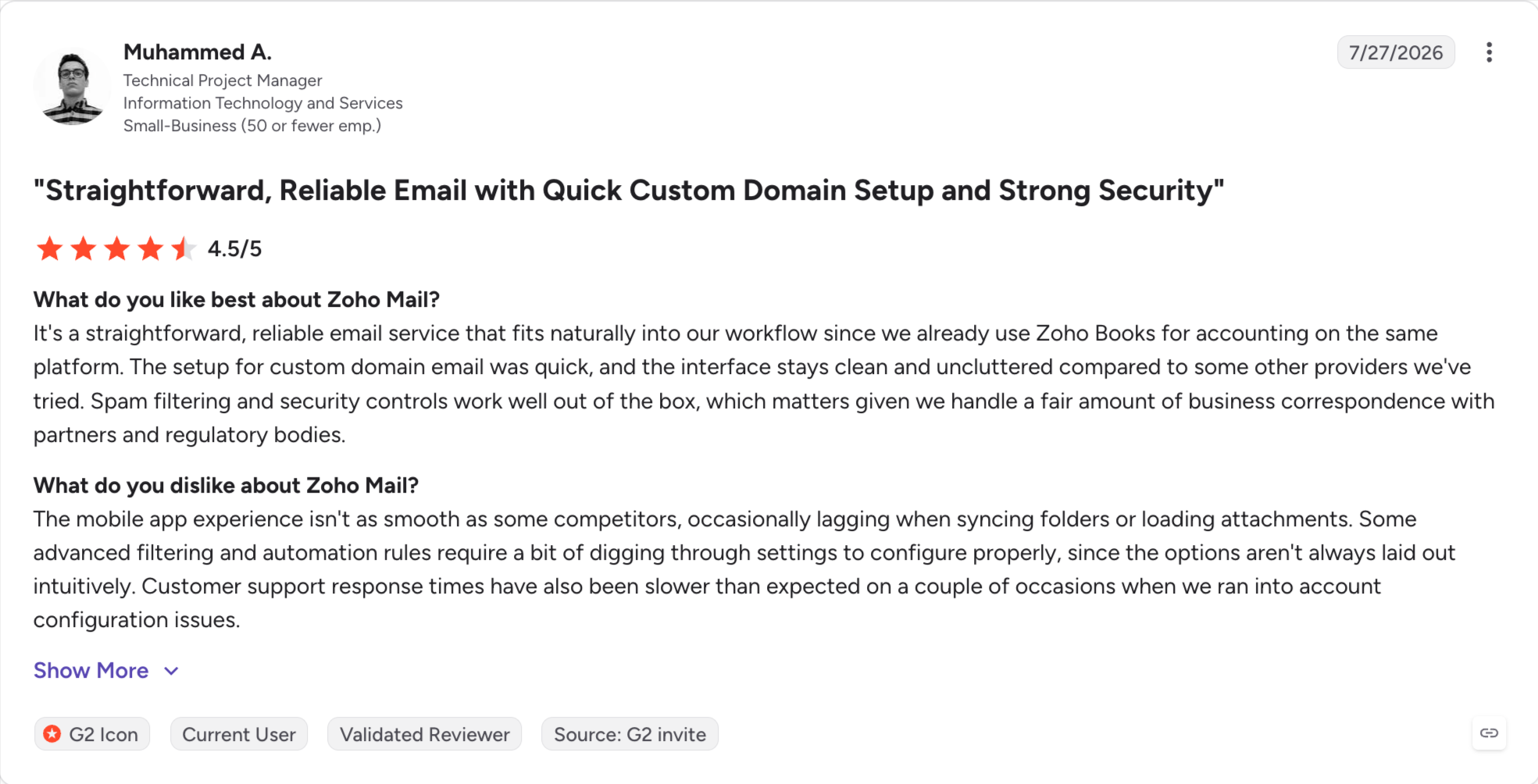
Zoho Mail holds 4.4 out of 5 on G2 from 683 reviews.
Best for: Businesses handling client information they cannot afford to leak, and anyone who wants their provider unable to read their mail.
Proton Mail is a secure email service for businesses handling sensitive information, with encrypted business email under Swiss law.
Every provider here scrambles your mail while it travels. Proton goes further and locks it so that Proton itself cannot open it.
That either answers exactly what you need or misses the point entirely.
A law firm, a clinic or anyone under GDPR or HIPAA pressure gets a serious answer here. It's a secure business email choice for regulated teams. Swiss privacy law puts your data outside US jurisdiction.
Proton handles the boring things properly too. Outlook, Thunderbird and Apple Mail all connect, and outside tools can send through your mailbox on every business plan.
I would check one thing before buying a seat. A solo operator can run a custom domain on Proton's personal Mail Plus plan for far less. You only need Business once you want a second mailbox and an admin console.
Core Features
Mail only you can read: Proton cannot open your messages because it handles the email server side without access to message contents. Mail between Proton users scrambles automatically, and you can password-protect what you send outside.
Swiss jurisdiction: Your data sits under Swiss privacy law rather than US law, which is why most regulated businesses look at Proton at all.
Outside tools can send through it: Connect Proton to another tool and send from it, even on the cheapest tier. Plenty of encrypted providers block this.
Works with normal mail apps: Outlook, Thunderbird and Apple Mail all connect.
Ten addresses a user: Mail Essentials gives each person ten multiple email addresses as aliases, which covers most alternate addresses without moving up a tier.
Custom domains: Three on Mail Essentials, 15 on Workspace Standard, 20 on Workspace Premium.
Catch-all addresses: Mail sent to any address on your domain lands somewhere rather than bouncing. On every plan.
Proton Sentinel: Extra protection against account takeover, from Workspace Standard up.
Easy migration: Bring mail in from your old provider without rebuilding inboxes.
Pros and Cons
Pros
Cons
Proton cannot read your email, unlike every mainstream rival
$6.99 a user is the highest entry price in this comparison
Swiss privacy law rather than US jurisdiction
Mail Essentials gives 15 GB, half of Google's Starter
Outside tools can send through it on every paid plan
VPN and the password manager only come with Workspace tiers
Storage jumps to 1 TB on the middle tier
Far fewer third-party connections than Google or Microsoft
A 14-day trial and a 30-day money-back guarantee
Proton renamed its business plans in 2026, so older reviews mislead
Pricing
Plan
Price a user
Storage
Domains
Mail Essentials
$6.99 a month annually, $7.99 monthly
15 GB
3
Workspace Standard
$12.99 a month annually, $14.99 monthly
1 TB
15
Workspace Premium
$19.99 a month annually, $24.99 monthly
3 TB
20
Most teams hit the domain ceiling before the storage one, so count your domains before you pick a tier.
What Users Say
Proton Mail for Business holds 4.4 out of 5 on G2 from 131 reviews.
Best for: People who want email done properly, with nothing else attached to the bill.
Fastmail is independent email, a calendar and a contact list on your own domain, making it a strong professional email hosting choice for users who want mail, contacts and calendars without a broader office suite.
You get no documents, no video calls and no chat app.
I like this one more than its price suggests I should.
When I want an address that works and nothing else on the invoice, this is where I look, especially for people comparing email providers rather than full productivity bundles.
Masked Email keeps me here. Every site gets its own throwaway address, which you switch off when it starts selling your details.
The pricing catches people out though. Basic looks like the entry point at $3 a user, but a custom domain only arrives on Standard at $5. Basic seats can only borrow a domain someone else set up, so $5 is the real starting price.
Core Features
Mail, calendar and contacts on your domain: Three things, done properly, with nothing bolted on, giving you a professional email address tied to your brand.
Masked Email: Hand a unique throwaway address to every site you sign up to. When one starts sending junk, switch that address off and your real address stays clean.
Works with normal mail apps: Outlook and Apple Mail connect on Standard and Professional.
Shared addresses and calendars: Run support@ or hello@ that the whole team reads, and layer everyone's calendar into one view for basic collaboration tools.
Shared company address book: One contact list the team keeps together.
Scheduled Send and Snooze: Write now, send later, and push a message out of your inbox until you want it back. Standard and above.
Retention archive: Hold mail for a fixed period when the law asks you to. Professional only.
Offline access: Read, write and search your mail with no connection.
Mix tiers across the team: Put light users on Basic and the rest on Standard, rather than buying one plan for everyone.
Pros and Cons
Pros
Cons
Fast and light, with no oversized suite attached
A custom domain needs Standard, so Basic is not really the entry price
Masked Email kills spam at the source
Basic gives 6 GB, the smallest allowance here
Storage jumps from 6 GB to 60 GB for $2 more a user
Outlook and Apple Mail need Standard as well
A 30-day trial with no card required
Support runs by email only, with no phone or chat
24 and 36-month terms cut the rate further
No documents, spreadsheets or video meetings if your team needs them
Pricing
Plan
Price a user
Storage
Basic
$3 a month annually, $4 monthly
5 GB mail plus 1 GB files
Standard
$5 a month annually, $6 monthly
50 GB mail plus 10 GB files
Professional
$9 a month annually, $10 monthly
100 GB mail plus 50 GB files
Longer terms cut it further. Standard drops to $4.75 on 24 months and $4.67 on 36.
Best for: People whose domains already sit at Namecheap and who want mail on the same bill.
Namecheap Private Email is a business email hosting add-on for people who already keep domains there, and it’s priced like one. Launch renews at $14.88 a year, the lowest running cost here.
Namecheap writes your SPF, DKIM and DMARC records, and a 30-day trial runs without a card. It also fits the same-account setup many buyers use for domain registration, billing, and mailbox management, so the setup holds up better than the price suggests.
The mailbox count catches people. Launch covers one, Expand three and Scale five, so a five-person team buys a tier instead of five seats.
Extra mailboxes then work backwards from everyone else here. One costs $8.88 a year on Launch, $25.88 on Expand and $39.88 on Scale. The bigger your plan, the more each extra costs.
Core Features
Mail on your own domain, cheap: From $14.88 a year on renewal, the lowest running cost here for custom business email addresses.
Automatic sending records: Namecheap configures SPF, DKIM and DMARC for you.
Webmail and calendar: A browser inbox and calendar on every plan.
Aliases: 10 on Launch, 50 on Expand, unlimited on Scale. Extra addresses that all land in one mailbox, with unlimited email addresses only in the sense of Scale aliases rather than paid mailboxes.
Anti-spam filtering: On every plan.
Two-factor authentication: On every plan.
Add mailboxes as you grow: Buy extra mailboxes on top of any plan instead of moving up a tier.
30-day trial without a card: Launch allows five trials per account, Expand and Scale one each.
Pros and Cons
Pros
Cons
The lowest annual running cost in this comparison
Launch covers one mailbox, so teams pay for every extra person
Namecheap writes your sending records automatically
Extra mailboxes cost more on higher tiers, not less
Email and domains land on the same bill
Storage runs thin at 5 GB on Launch and 30 GB on Expand
A 30-day trial with no card required
Promotional pricing never applies to extra mailboxes
Fifty mailboxes and twenty domains before custom pricing
One subscription per domain, and slow support per Trustpilot
Pricing
Plan
First year
Renews at
Mailboxes
Storage
Extra mailbox
Launch
$11.88 a year
$14.88 a year
1
5 GB
$8.88 a year
Expand
$29.98 a year
$41.88 a year
3
30 GB
$25.88 a year
Scale
$47.88 a year
$71.88 a year
5
75 GB
$39.88 a year
Past 50 mailboxes or 20 domains, Namecheap quotes you directly.
Best for: Solo operators and very small teams who want the lowest entry price and will read the renewal terms.
Hostinger Email is business email hosting from a web host that sells everything cheap. Starter advertises at $0.59 a mailbox a month.
Unlike web hosting plans that store website files, this product is for mailboxes and messages.
Three numbers sit behind that headline. The $0.59 needs a 48-month term, so you prepay about $47 for four years of one mailbox. It renews at $1.59. And every plan covers exactly one mailbox, so a five-person team pays five times.
Once you know all three, it is still cheap. Premium throws in a free domain for the first year, and Standard bundles AI for searching, replying and summarising.
I would not send outreach through it. Starter caps you at 1,000 emails a day per mailbox. The shared infrastructure underneath suits ordinary business mail, not campaigns.
Core Features
Mail on your domain from $0.59: One of the lowest starting prices among Hostinger’s email hosting plans, on a 48-month term.
One mailbox per plan: Every tier covers a single mailbox. More people means more plans.
Storage that climbs quickly: 5 GB on Starter, 20 GB on Standard, 50 GB on Premium.
Daily sending limits: 1,000 emails a day on Starter, rising to 3,000 on Premium.
Forwarding rules: 5, 20 or 50 by tier, so mail to one address lands somewhere else automatically.
Aliases: 5, 10 or 30 extra addresses feeding one mailbox.
AI built in: Standard and above let you search, reply, summarise and write with AI.
Free domain name for a year: On Premium.
Link and file tracking: Premium tells you when someone clicks a link or opens a file you sent.
Free with web hosting: Most Hostinger web hosting plans bundle free email service for the first year, at 1 GB a mailbox, which is separate from its standalone email hosting.
Pros and Cons
Pros
Cons
The lowest entry price in this comparison
The $0.59 needs a four-year prepayment of about $47
Premium gives 50 GB, more than Google Starter for less
Renews at $1.59, nearly three times the opening rate
AI writing and summaries from the Standard plan up
Each plan covers one mailbox, so costs rise with headcount
Free email bundled with most web hosting plans
Starter gives 5 GB, which fills quickly
30-day money-back guarantee
Support averages two to six hours, with no phone line
Pricing
Plan
Promo price a mailbox
Renews at
Storage
Aliases
Starter
$0.59 a month
$1.59 a month
5 GB
5
Standard
$1.39 a month
$2.79 a month
20 GB
10
Premium
$2.99 a month
$3.99 a month
50 GB
30
Promotional rates need the longest term. Check what the same plan costs on twelve months before you commit to forty-eight.
Best for: Almost nobody starting fresh in 2026. Existing customers working out whether to stay or move.
Rackspace Email is a plain business mailbox with support answering around the clock. In January 2026 the price went from $2.99 a mailbox a month to $10. The new invoices landed on 1 March.
The add-ons moved too. Email Plus doubled to $2 and Archiving doubled to $6, so a fully loaded mailbox went from $7 to $18.
Rackspace had no annual contracts, so the rise hit everybody at once. The product itself did not change. You get the same 25 GB mailbox, file storage and uptime guarantee as before.
Most comparisons stop there and miss the reseller route. Authorised resellers buy Rackspace mailboxes in volume. At least one sells the identical service at around $2.95, below the old retail price.
Moving to a reseller is a billing change, not a migration. You keep the same servers and webmail with no DNS switch. If you are sitting on a $10 invoice, I would price that before anything else here.
Core Features
A plain, reliable mailbox: Webmail, calendar and contacts, with spam and virus filtering. Nothing fancy, nothing broken.
25 GB of mailbox storage: Plus 30 GB of file storage on the standard plan.
Support around the clock: Rackspace built its name on answering the phone, and that has not changed.
A 100% uptime guarantee: The strongest commitment on this list.
Archiving as an add-on: Keep mail for compliance reasons, now $6 a mailbox a month.
Email Plus as an add-on: File storage, mobile sync and Office-compatible apps, now $2.
Migration help: Rackspace has always helped people move mail in. That same help now mostly moves people out.
Pros and Cons
Pros
Cons
Support answers around the clock, which built the brand
$10 a mailbox beats Google's $7 while giving you far less
A 100% uptime guarantee, the strongest here
The price more than tripled with about eight weeks' notice
25 GB a mailbox plus 30 GB of file storage
Archiving doubled to $6 and Email Plus to $2
Resellers still sell the same service near the old price
A fully loaded mailbox now runs $18 against $7 before
Straightforward to set up and maintain
Sending caps at 10,000 recipients a day
Pricing
What you pay for
Price now
Price before
Rackspace Email
$10 a mailbox a month
$2.99
Email Plus add-on
$2 a mailbox a month
$1
Archiving add-on
$6 a mailbox a month
$3
Authorised resellers sell the same product at volume rates. One lists it around $2.95 a mailbox.
Final Verdict: Which Email Hosting Service Should You Pick?
If you are here, you are choosing the right email hosting service for two different jobs, not one. A mailbox your team works in is one product. Mailboxes you send cold outreach from are another.
For the first job, any of the nine above will run a company inbox.
If you are comparing the best email hosting providers for that business-inbox role, your best pick is whatever your team already uses.
None of them can do the second job. Google caps a mailbox at 2,000 emails a day and Microsoft throttles you well before its 10,000. Both sit on the domain your invoices go out from.
For outreach, Mailforge is where I would start. That is a different setup from a professional email hosting service used for internal company mail. Forty mailboxes across ten domains take minutes, and Mailforge writes the DNS for you. Pre-warmed ones cost the same as fresh, so you send the same day. Warmforge warms every mailbox free on any Salesforge plan.
Infraforge gives you your own IP instead of a shared pool. That matters once you send enough to keep one warm. Below roughly 50,000 emails a month, Mailforge wins.
I built both, so weigh that however you like. Most teams reading this want Mailforge.
Start with Mailforge. You buy ten mailbox slots to begin, and domains cost extra.
FAQs
1. What is email hosting?
Email hosting runs the mailboxes on a domain you own, so you send and receive at [email protected] instead of a gmail.com address. The provider keeps the servers, filters the spam and stores your mail. You point your domain at them and they handle the rest.
2. How is email hosting different from web hosting?
Email hosting runs the mailboxes on your domain and web hosting runs the website at the same address. Web hosting services store website files and content, while email hosting stores messages and mailboxes. They are separate services that often arrive on one bill, which is why people assume they are the same thing.
3. What is the difference between email hosting and an email service provider?
Email hosting gives your team mailboxes to work in, and an email service provider sends campaigns to a list. Mailchimp is an ESP. Google Workspace is email hosting. Confusing the two is how people end up sending newsletters from a mailbox that was never built for it.
4. Is cloud-based email the same as email hosting?
Yes, in almost every case. Every service in this article runs in the cloud, which means your mail sits on someone else's servers rather than a machine in your office. Anyone still running their own mail server knows they are doing it.
5. How much does email hosting cost?
Anywhere from nothing to $32 a person a month. Budget plans run $1 to $4, Google and Microsoft both start at $7, and the outreach mailboxes on this list run $3 to $4 each. A free email service can work for personal use, but paid email hosting is what businesses buy for custom domains and more control. Always check the renewal price, because several providers here advertise a first-year discount that ends.
6. Can I get email hosting for free?
Zoho's free email hosting plan covers five people on your own domain, which is the only free option here I would use. It blocks Outlook and Apple Mail, so everyone works in the browser. Most other free services either put ads in your inbox or refuse to let you use your own domain, which is why they are a weak fit for business use.
7. What is the best email and web hosting combination?
Hostinger, if you want both from one company on one bill. Email starts at $0.59 a mailbox on a four-year term and renews at $1.59, and Premium adds a free domain for the first year. Check what email your web hosting plan already covers before you buy it separately.
8. What is the best email hosting service for sales teams?
For the team's own inbox, Google Workspace or Microsoft 365 are the email providers most teams will recognize, both at $7 a user. For the mailboxes the team sends outreach from, I would use Mailforge at $3 a mailbox. Those need to sit away from your company domain.
9. What is the cheapest email hosting for new agency owners?
Zoho Mail's free plan covers five people on your own domain for nothing, though it blocks Outlook and Apple Mail. If you need those, Zoho Mail Lite costs $1 a user, and Namecheap Scale covers five mailboxes for $71.88 a year on renewal.
10. Does email hosting work with Outlook and Apple Mail?
Most of it does, through IMAP. Zoho's free plan is the exception on this list, and Fastmail puts custom domains on Standard rather than Basic. If your team lives in Outlook, check that before you buy.
11. What uptime should I expect?
Rackspace publishes a 100% uptime guarantee, which is the strongest commitment here. Google and Microsoft both run at the kind of reliability you only notice when it breaks. Budget providers publish less and promise less, which is part of what you are trading away.
12. Can I switch email hosting providers without losing mail?
Yes, if you plan it. Pick the right email hosting provider before you migrate so you do not have to switch twice. Set up the new mailboxes first and copy your mail across with the provider's migration tool. Then point your domain at the new host, and keep the old mailboxes running until everything settles. Pointing the domain is the part that takes hours rather than minutes.
Book more meetings on autopilot
Set up in minutes. No per-seat pricing. No commitment.
Boardy is an AI superconnector that makes double opt-in introductions from its own network of more than 248,000 people. I run it next to an AI SDR and both work from the same ICP. This review covers how to set Boardy up and what its intro emails look like. It also covers Boardy Pro pricing and where Boardy falls short. It ends with how I hand each intro pattern to my AI SDR for outbound at volume.









.png)

.jpg)

.png)