Every few weeks on LinkedIn, a cold email screenshot lands in my feed and takes off.
Red arrow on the subject line. Caption calling it the worst outreach anyone has ever received.
That's what cold email content on LinkedIn looks like in 2026.
But not all viral cold emails go viral for the same reason. Some do because a recipient replied, took the meeting, and posted the email as clever craft. Others do because the recipient was appalled.
I've been on both sides. In December 2025, someone sent a cold email to my inbox with the subject line "Your Pornhub 2025 recap." I posted the screenshot to LinkedIn.
Two months later, a "Saw your name in the Epstein Files" subject line spread across LinkedIn until the sending company apologized publicly.
And Finn Mallery's January 2025 tweet showing "Your mother just passed away. Funeral arrangements attached." hit 1.6 million views.
All three sends make the same mistake: they confuse "weird" with "funny."
I've been running cold email for years, and the difference is simple.
Weird cold emails get screenshotted. Funny cold emails get replies.
This article opens with five that made me laugh AND booked meetings, then works through twelve you'll want to keep out of your sequences.
Nobody sends a cold email hoping it goes viral on LinkedIn.
Every sender behind every screenshot in this article thought their email would work. They thought the subject line was clever.
They thought the shock would convert to a reply.
The pattern I see across two years of watching cold emails circulate is that "weird" and "funny" get treated as the same thing. They aren't. Weird cold emails try to substitute shock for research. They lean on subject lines like "Your mother just passed away" because the sender couldn't find anything specific to say.
Funny cold emails do the research first, then let the humor come from the specifics.
Weird gets you a screenshot. Funny gets you a reply.
Seventeen examples follow across four categories. The first five are cold emails I'd actually recommend copying.
The next twelve are the ones you'll want to keep in your drafts folder.
Every email below has a documented reply or a public breakdown from the recipient explaining why the humor worked.
Each one uses a different humor pattern. None of them substituted shock for research.
Mia Pugh, a BDR at Chili Piper, sent a cold email to Rob Charlebois at LastPass in early October 2022.
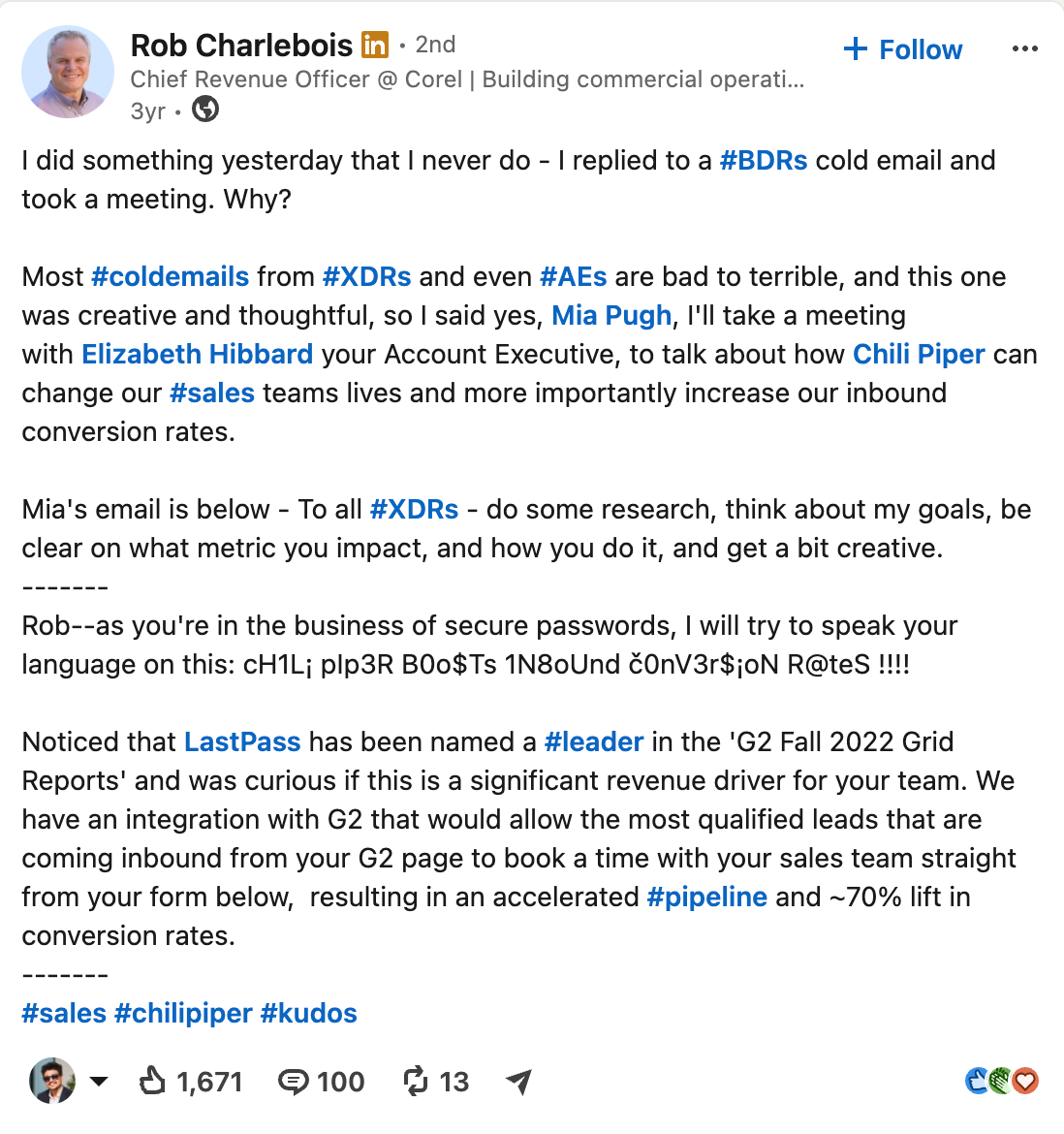
Look at what she did. The pitch line "Chili Piper Boosts Inbound Conversion Rates" is scrambled into leetspeak to mimic a strong password, because she's writing to a password-management company.
The joke IS the value proposition. She isn't adding humor on top of a pitch. The humor delivers the pitch.
Charlebois posted his reply publicly on LinkedIn: "I did something yesterday that I never do - I replied to a #BDRs cold email and took a meeting… so I said yes, Mia Pugh, I'll take a meeting with Elizabeth Hibbard your Account Executive."
My take: This is the standard I set every SDR against at Salesforge. The joke is persona-matched to the buyer, the pitch sits inside the joke, and the whole email fits under fifty words. If your humor can be lifted and dropped into any other prospect's inbox, it isn't funny. It's decoration. Mia's could only ever be sent to LastPass.
Sam Hyatt, an Enterprise SDR at Gong, sent Drew Bickers an actual piñata (with gum inside) before writing the follow-up email.
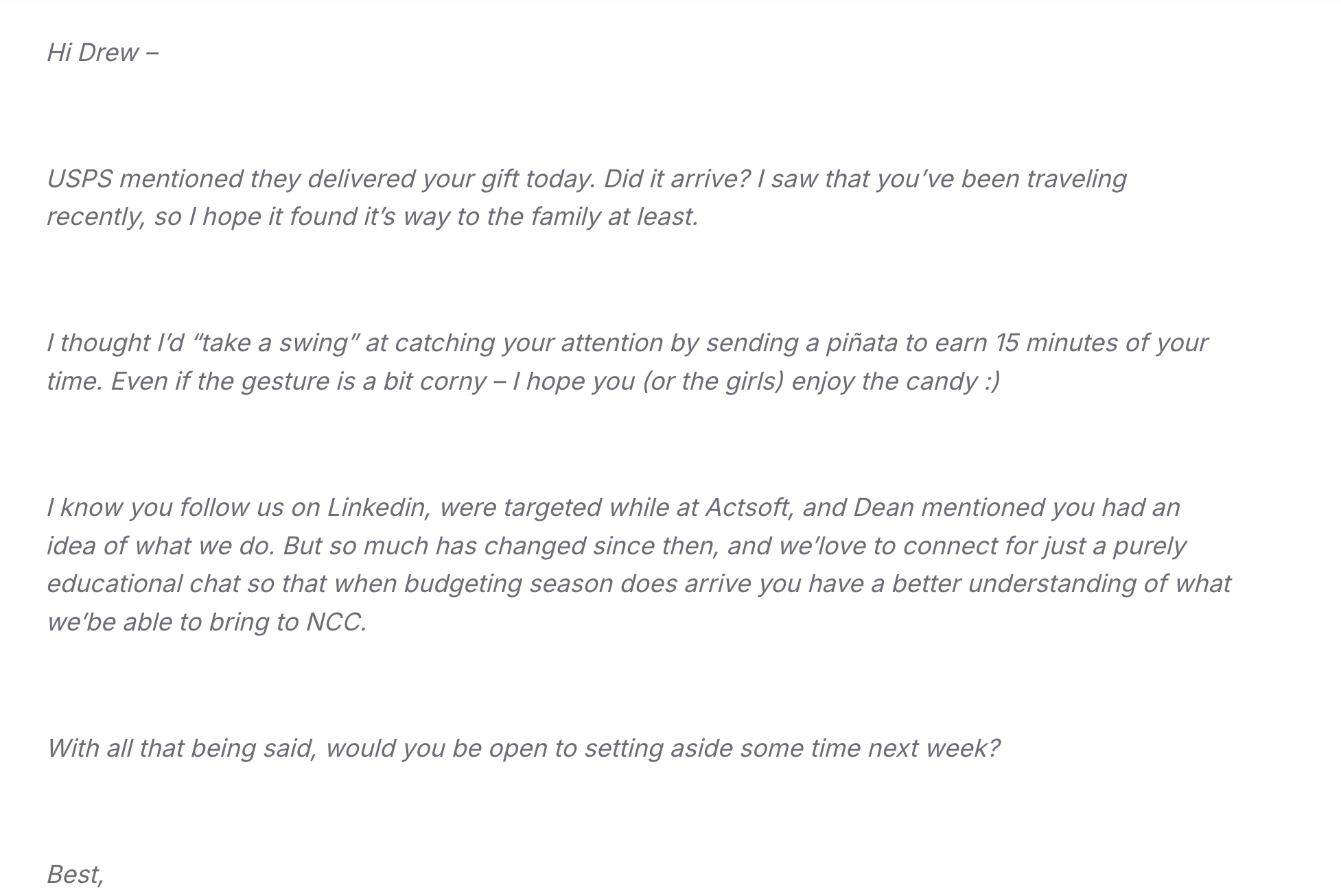
Three things earn made this cold email approach work.
The gift is real (not the promise of one), the "take a swing" pun is grounded in the piñata theme rather than dropped on top of an unrelated pitch, and the sender names her own corniness before the reader has a chance to. The email closes with a specific fifteen-minute ask, not an open-ended meeting request.
Bickers posted a photo on LinkedIn of himself holding the piñata in one hand and the candy in the other, blowing a bubble from the gum. The meeting happened.
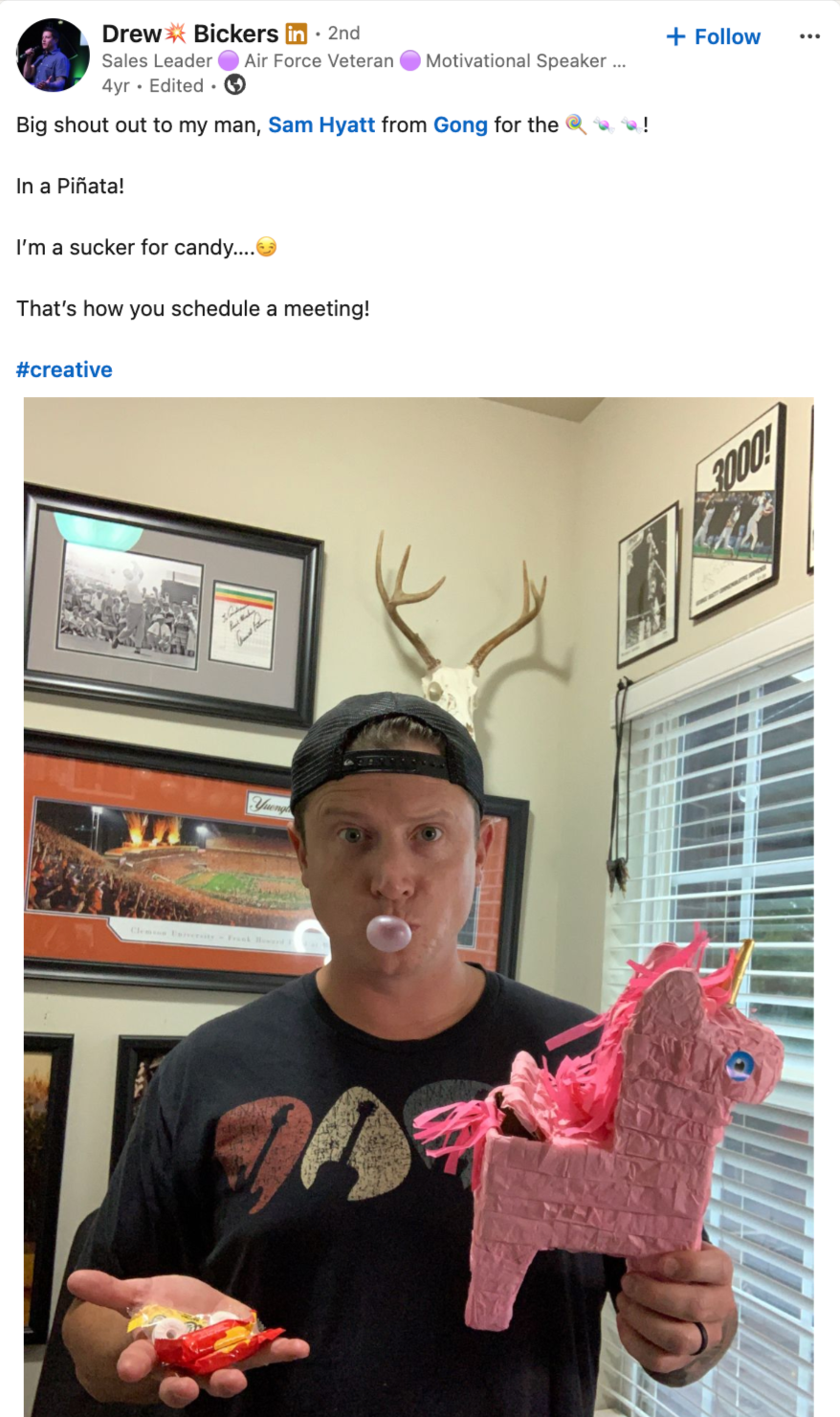
The lesson is that reciprocity works, but only when the gift is real, the theme is coherent, and the sender is honest about the marketing calculation.
My take: Reciprocity works. I've sent gifts to prospects and had them convert, and I've sent gifts to prospects and had them ignored. The variable is coherence. A random Starbucks gift card gets shrugged off. A piñata with a "take a swing" line rewards the recipient's attention with a story they'll tell in their next team meeting. If the gift and the copy don't reference the same idea, save the money.
Around 2015, Jon Buchan (later founder of the outbound consultancy Charm Offensive) got drunk one night and wrote what he calls "a completely absurd cold email."
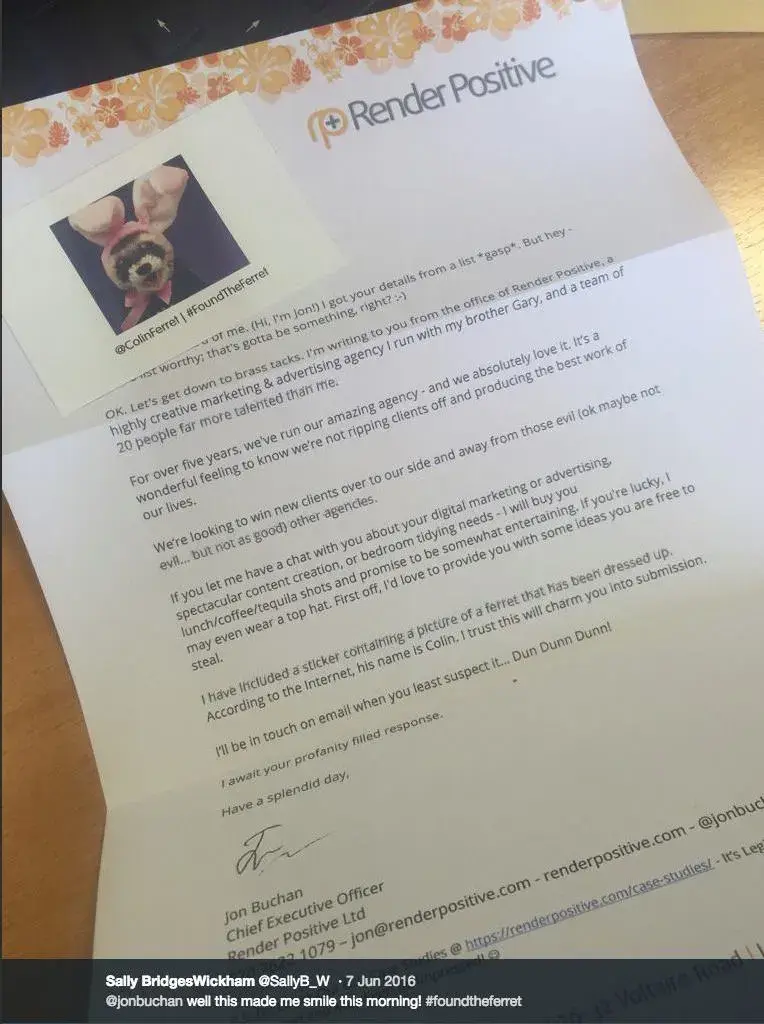
The full breakdown lives on Look Here Writing.
Buchan's own account of what happened next: "To my astonishment, it worked. I've met with senior decision makers at RedBull, Pepsi, Symantec, Hewlett-Packard, HSBC, Barclays and countless other global brands."
One recipient replied: "congratulations, this is the worst sales and marketing email I've ever received… but the irony is not lost on me that I replied to you."
My take: I think of this as the godfather of the funny cold email, and it works precisely because it doesn't try to sell anything in the opener. Buchan's tone is "I'm sending you something weird, we both know this is weird, let's just acknowledge that together." That posture is almost impossible to fake. Don't try this if you can't commit fully. A half-committed absurdist email is just a bad email.
Marketing exec Justin Topliff wrote a public tribute on LinkedIn to a cold email he'd received from Ian Jackson at PitchHero.
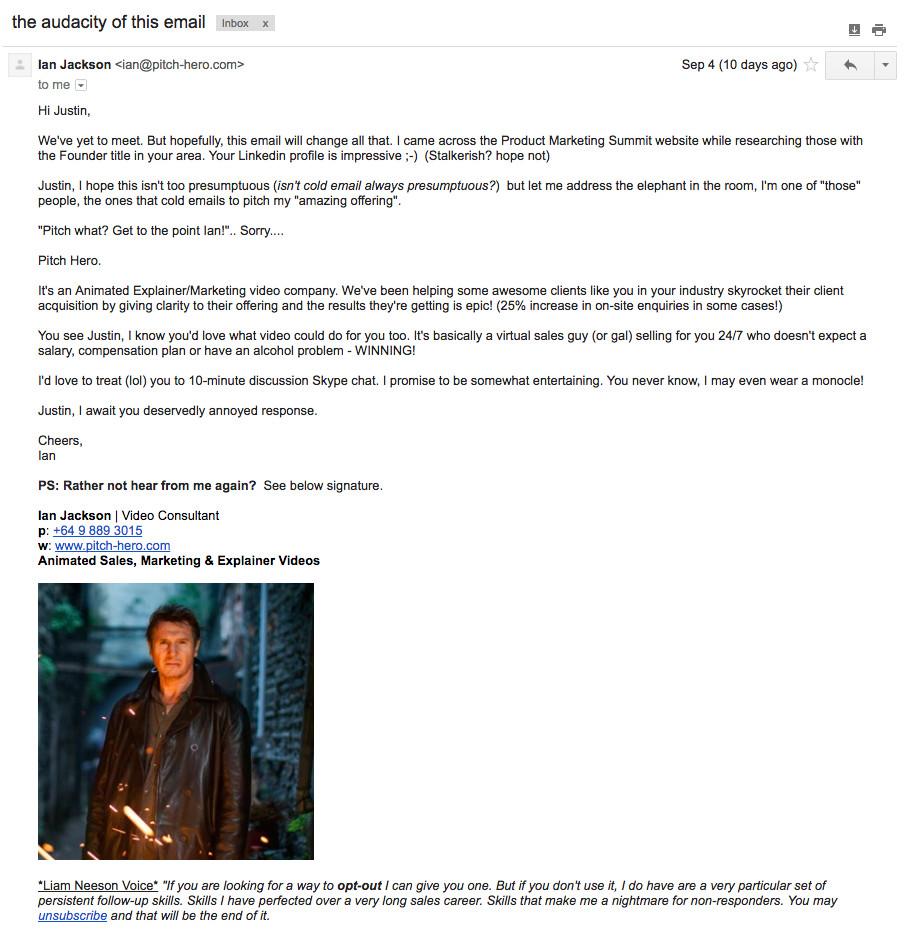
He called it "the best cold sales email I've ever seen." A few fragments Topliff quoted:
"(isn't cold email always presumptuous?)" is the sender parenthetically acknowledging the awkwardness of what he's doing.
"(It's basically a virtual sales guy (or gal) selling for you 24/7 who doesn't expect a salary, compensation plan or have an alcohol problem)" is where the parenthetical lands. The throwaway aside is the line that lands.
The email closes with a Liam Neeson / Taken parody: "if you don't use it, I do have are a very particular set of persistent follow-up skills. Skills I have perfected over a very long sales career. Skills that make me a nightmare for non-responders." Topliff's conclusion: "kudos to you, Ian. For bringing the humanity back to cold emails."
My take: The pattern I keep coming back to is that the sender never breaks character. The whole email is one sustained tone: dry, self-aware, low-status. That takes real writing discipline. A single sentence in the wrong voice ("I'd love to hop on a quick call!") would collapse the entire thing. If you're going to commit to a comic tone, commit to it across every line.
Sometimes the funniest cold email is the last one in the sequence.

The prospect (called "Matt") replied: "Steve. First I was busy. Then you irritated me. Then you made me laugh. So let's speak sometime next week or the week after. Best wishes Matt."
Sopro documented the exchange on their blog.
My take: The best breakup emails don't beg. They acknowledge the situation with a small joke and give the recipient an easy way to end the sequence with dignity intact. Steve's second sentence ("not that I'm calling you a tree") is the whole trick. A deadpan aside that turns the ask into a wink. I've closed deals with breakup emails structured exactly like this.
The 2025 wave of LLM-powered outreach tools promised hyper-personalization at scale.
What it delivered, in a lot of cases, was templated flattery with weird tokens filled in from LinkedIn photos and bios. The results read like an AI trying too hard to prove it did research.
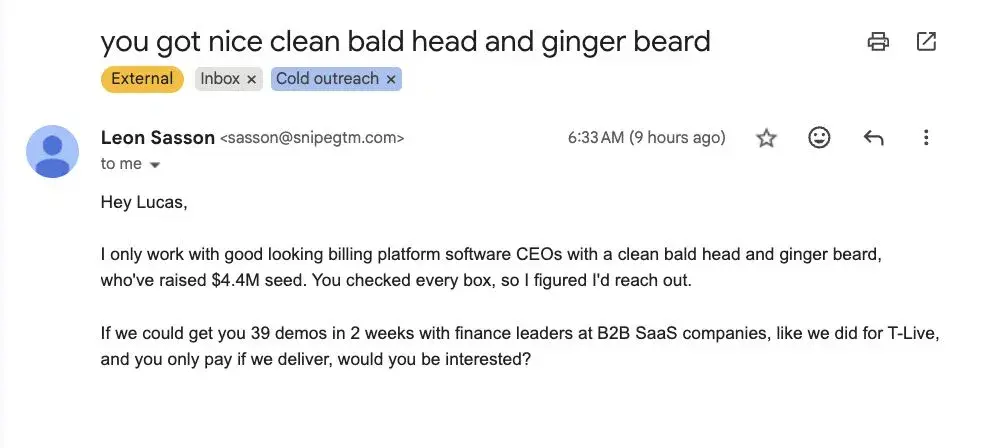
One widely circulated screenshot shows a cold email from a sender at snipegtm.com to a prospect named Lucas.
The body reads: "I only work with good looking billing platform software CEOs with a clean bald head and ginger beard, who've raised $4.4M seed. You checked every box, so I figured I'd reach out."
An LLM was fed a LinkedIn photo, told to "extract distinctive features and use them for a personalized opener," and returned "clean bald head and ginger beard" as a résumé bullet. The rest of the body is the same template dozens of GTM agencies were running that year.
My take: Personalization has to be about the buyer's business, not the buyer's face. When an LLM personalizes on physical traits, the prospect doesn't feel flattered. They feel inspected. And they can tell the whole email came from a template, because no human would open a sales email that way.
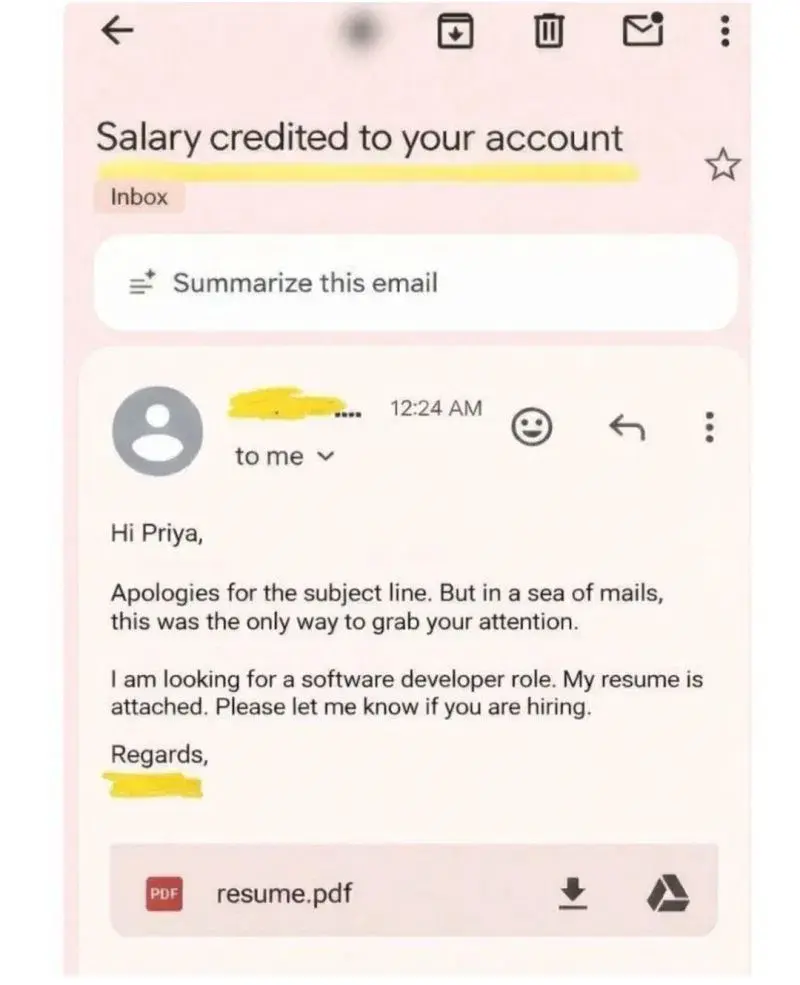
Not every AI-slop cold email is from a sales rep. This one is a candidate-side version.
Priya, a hiring manager, received a message with the subject line "Salary credited to your account" that opened: "Apologies for the subject line. But in a sea of mails, this was the only way to grab your attention.
I am looking for a software developer role. My resume is attached."
The subject line is clickbait dressed up as a payroll notification, and the apology in the first sentence is the tell. The sender knows the subject line is misleading.
The sender's calculation is that the open is worth more than the trust burned to get it.
My take: I hire at Salesforge and I've seen a version of this email at least a dozen times. Every one has ended up in the folder I don't look at. If a candidate can't send an honest subject line to me, I have to assume they can't write an honest one to their next hiring manager either. Or their next customer.
This is the category that dominated cold-email Twitter and cold-email LinkedIn across 2025 and 2026.
The formula is simple. Announce something catastrophic in the subject line, defuse it in the first sentence, then pivot to the pitch.
Open rates on these emails run north of 70 percent.
Reply rates and reputation damage tell the other side of the story.
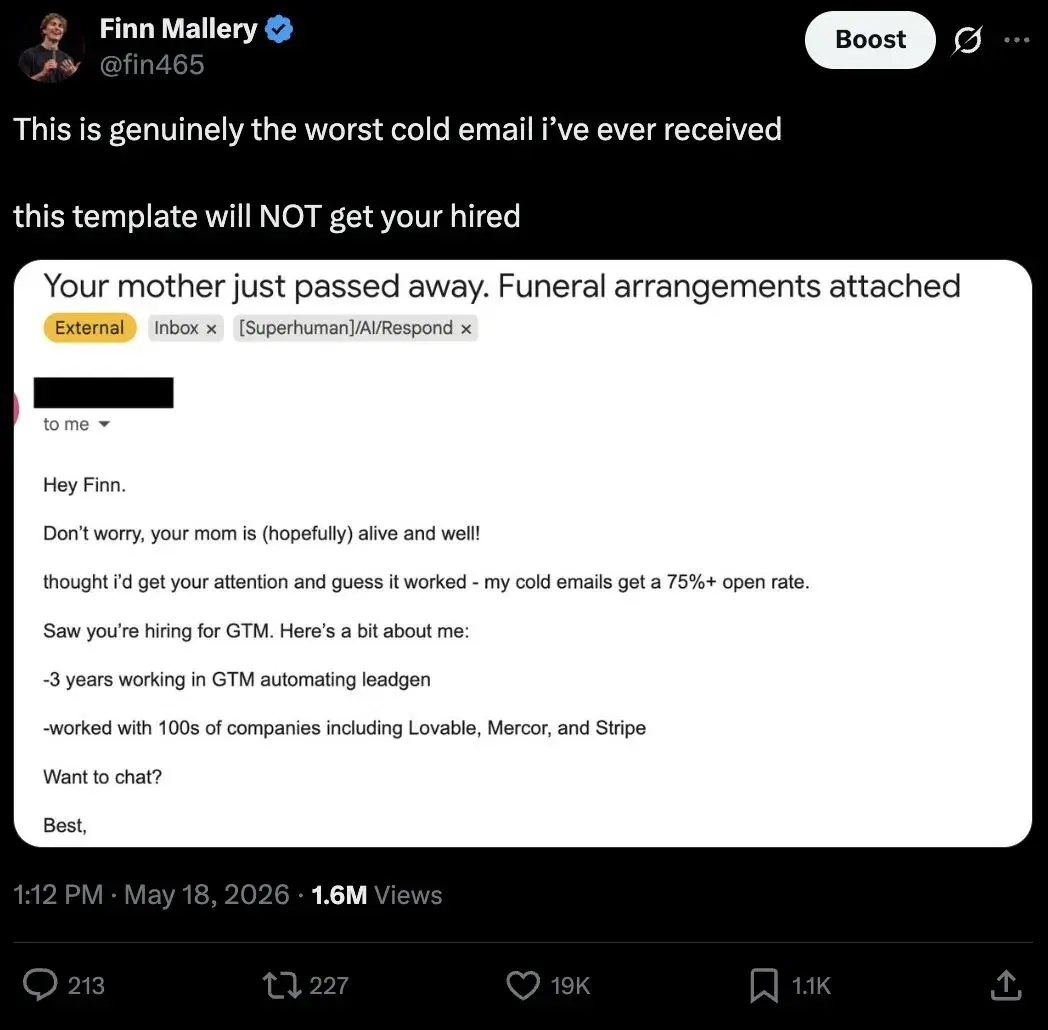
In January 2025, a version of this email surfaced on X in a post by Finn Mallery, co-founder of the outbound firm Origami Agents, with the caption "This is genuinely the worst cold email I've ever received."
The tweet hit 1.6 million views and 19,000 likes.
Two things about this email are worth naming.
First, it went viral because it was posted by a founder with a large audience calling it out publicly, not because it was clever.
Second, the sender is running a job-application funnel, which means every hiring manager who received a version of this email now associates the sender with the subject line for the rest of their career.
My take: Finn's tweet accidentally taught the market to escalate. Every rep who saw the reach numbers on his post decided this was a template worth copying. Within six months I was getting variants in my own inbox weekly. Virality isn't a validation signal. It's a warning that a tactic has already been played too many times to work.
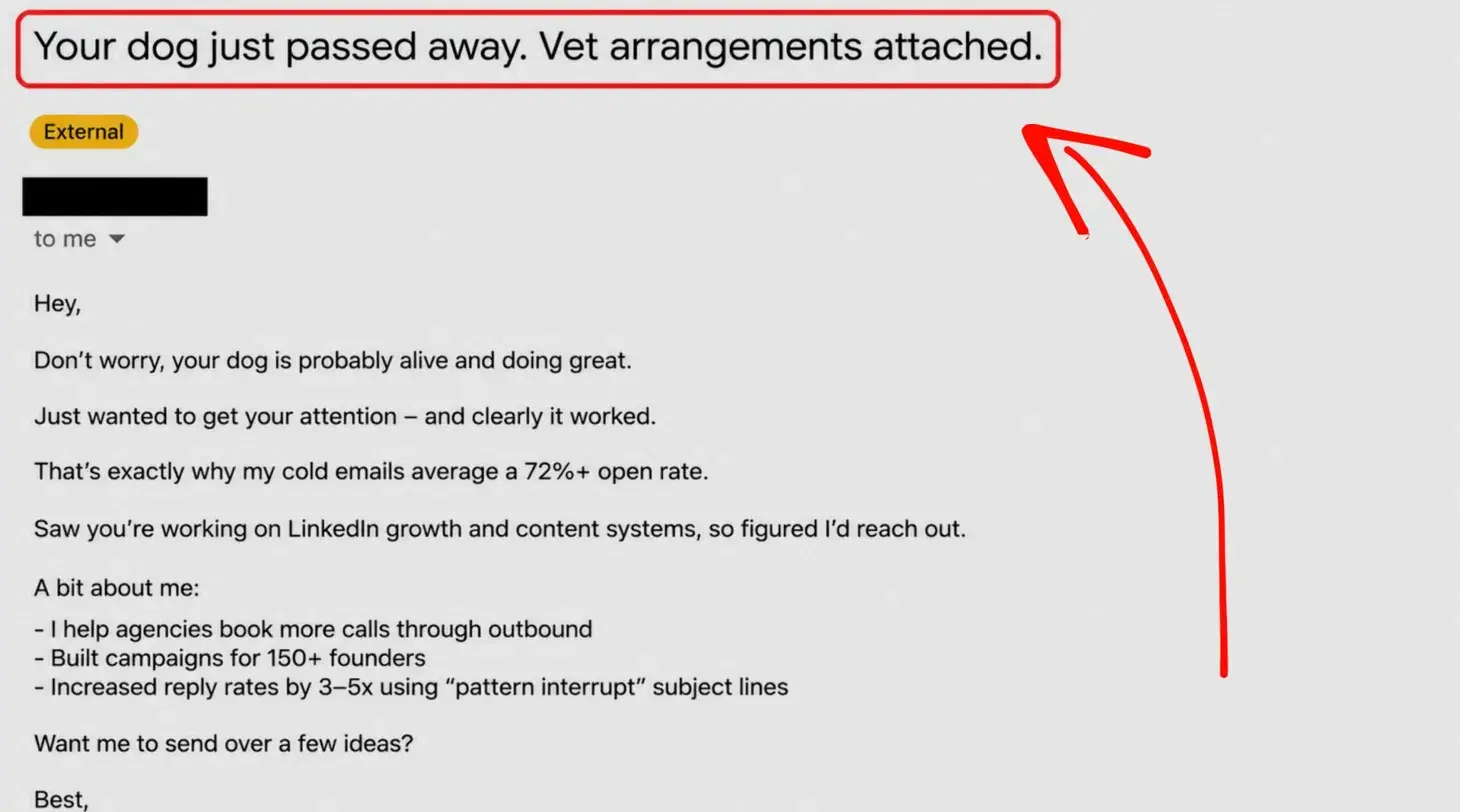
A version of the same template with the pet substituted for the parent.
The body defuses ("Don't worry, your dog is probably alive and doing great. Just wanted to get your attention, and clearly it worked. That's exactly why my cold emails average a 72%+ open rate.") before pivoting to a pitch about LinkedIn growth and content systems.
The template inheritance is the point. Once one version of the "family member just died" subject line goes viral, twenty other reps copy it with different substitutions across the following six months.
The dog version, the sibling version, the spouse version, and eventually the family-genocide version all appear in inboxes throughout 2025.
What every copy of this template misses is that virality is not repeatability.
The first person who tried it had novelty on their side, and even they got dragged.
Every subsequent copy is running the same play on a market that has already seen it, which means the shock lands as annoyance and the pitch never gets read.
My take: When you see multiple senders running the same shock template with substituted nouns, the trend has peaked. Every subsequent send trains the recipient's spam filter and their annoyance filter at the same time. By the time you copy a viral template, you're competing with everyone else who did the same math a month earlier.
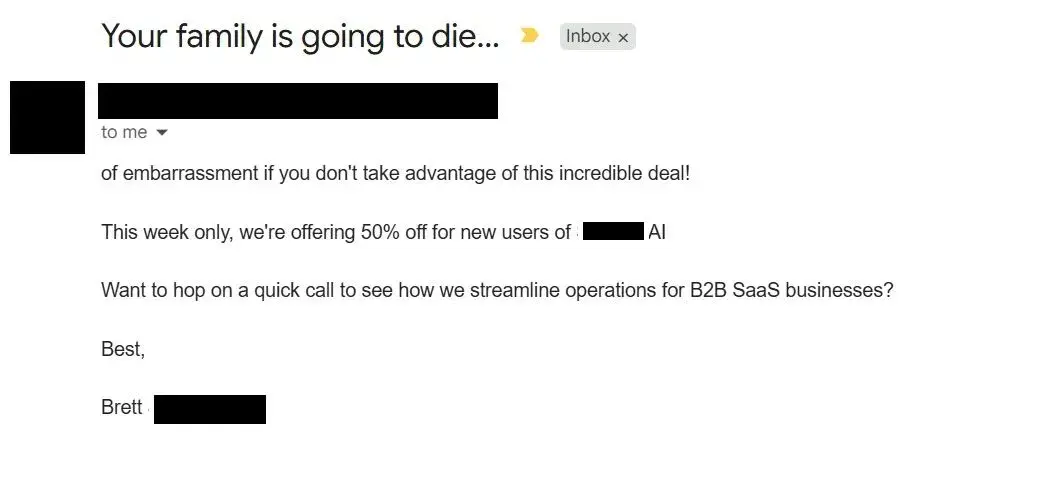
Somewhere on the escalation curve, one sender decided the death of a single family member was insufficient.
This email opens mid-sentence: "of embarrassment if you don't take advantage of this incredible deal! This week only, we're offering 50% off for new users of [redacted] AI. Want to hop on a quick call to see how we streamline operations for B2B SaaS businesses?"
The mid-sentence subject line is doing double duty.
It bypasses the reader's disbelief for the first quarter-second (long enough to open) and then reveals itself as a bait-and-switch about a discount.
It also reveals what the sender values, which is the open, not the reader.
There is no defusion sentence, no acknowledgement that the subject was manipulative, and no pretense of research.
My take: This is where the tactic starts eating itself. No defusion, no research, no acknowledgement. Just a subject line designed to open and a body designed to close. Once your sending gets to this point, the domain is on borrowed time. Bounce rates rise, spam classifiers catch on, and the reps sitting next to the sender start losing inbox placement they never even asked for.
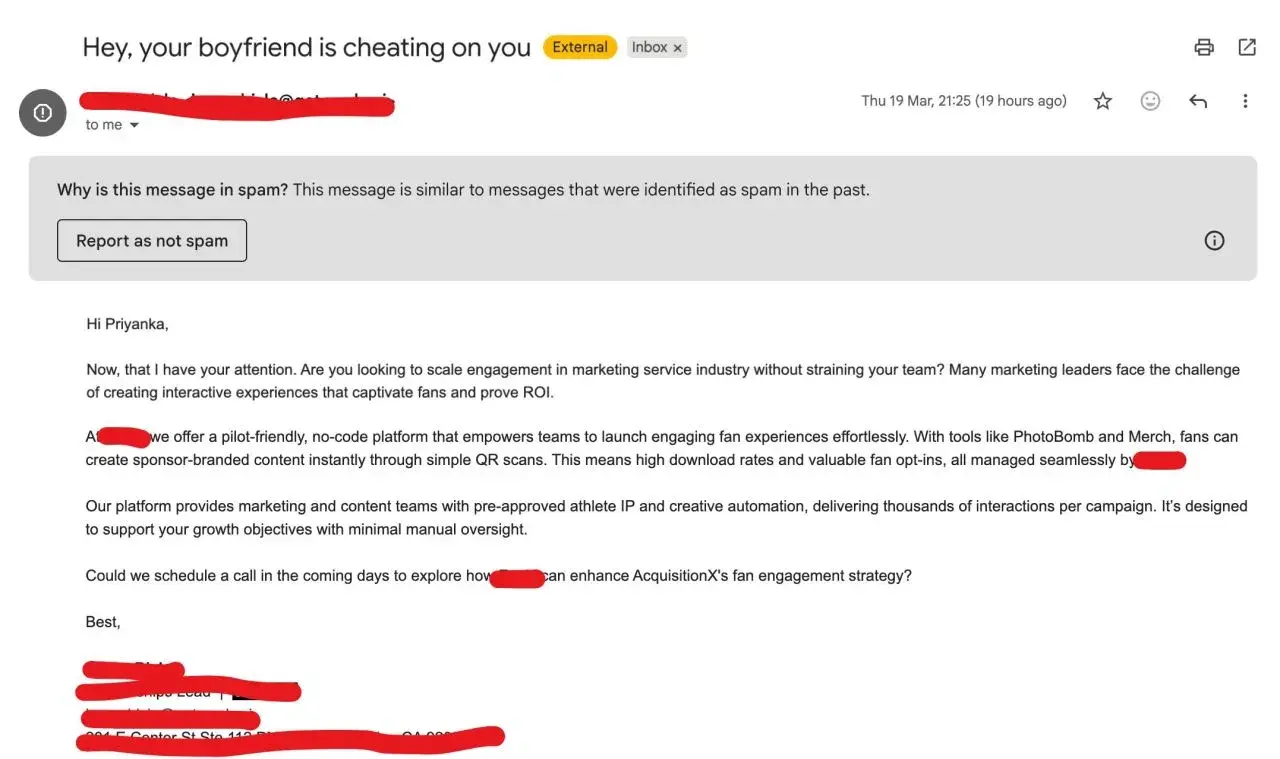
This one was flagged by Gmail as spam ("This message is similar to messages that were identified as spam in the past") before it was even opened.
The body pivots into a pitch about "engagement in marketing service industry" with buzzwords like "pilot-friendly, no-code platform that empowers teams to launch engaging fan experiences effortlessly."
Two things are happening in the same screenshot.
The subject line is doing the shock work, and the body copy is doing every AI-slop giveaway simultaneously: "empowers," "effortlessly," "seamlessly by," "with minimal manual oversight."
The email is a small ecosystem of bad decisions.
My take: Gmail flagged this as spam before the recipient even opened it. That's the classifiers doing exactly what they're built to do. If your creative tactic is one Google can pattern-match after seeing a thousand instances, it stops being creative around send number ten.
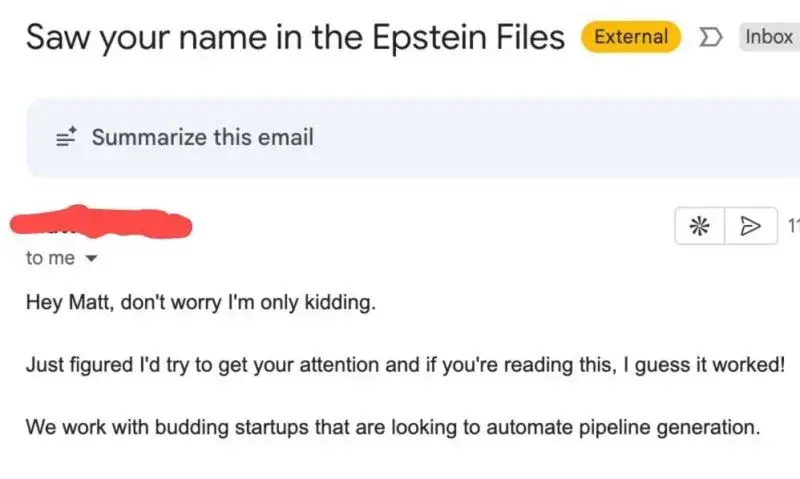
The 2026 entry that broke through the noise for the wrong reasons.
In February 2026, the software company Clustox sent a cold email with this subject line as part of an outbound sales campaign.
The recipient was Simran Whitham, founder of the Manchester events and marketing agency FORMAT Group.
The body opened "Hey Matt, don't worry I'm only kidding" (the name mismatch is another tell, a mail-merge template that had misfired) before pivoting to "Just figured I'd try to get your attention and if you're reading this, I guess it worked! We work with budding startups that are looking to automate pipeline generation."
Whitham posted the email publicly on LinkedIn, writing that he was "beyond appalled" at what he had found in his inbox and accusing the sender of exploiting "one of the most diabolical cases of child and human exploitation in modern history" to drive engagement.
The story was picked up by Prolific North on February 12, 2026. Clustox issued a public apology on LinkedIn, acknowledging that a member of its outreach team had fallen significantly short of the company's professional standards.
My take: I use this one when I want to explain to newer reps what "reputation risk" means in real terms. Clustox lost their entire outbound program in a week and spent months rebuilding. Every rep on their team now has "that Epstein-files company" next to their LinkedIn profile. There is no version of a subject line invoking child sexual abuse that's worth that outcome.
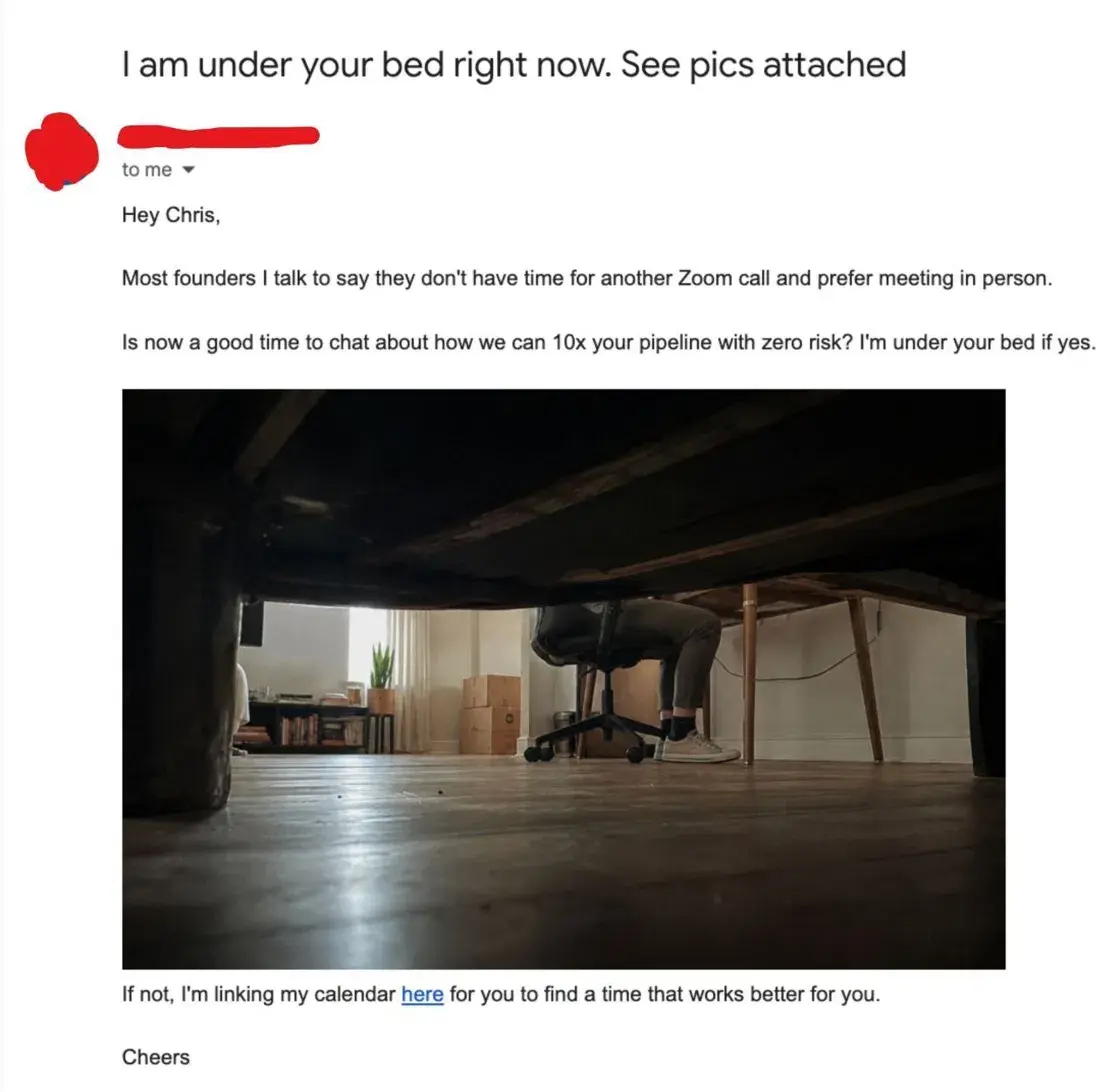
The physical-threat variant, and one of the strangest cold emails in the category because of the attached photo.
The email includes a real image of what appears to be under a bed, with the caption "Most founders I talk to say they don't have time for another Zoom call and prefer meeting in person. Is now a good time to chat about how we can 10x your pipeline with zero risk? I'm under your bed if yes."
The image is the difference. Every other death-and-disaster email is a text pattern the reader has seen before.
This one commits the bit far enough to be memorable, which is why it circulated. It is also the email most likely to result in a call to the police in jurisdictions where "I know where you live" carries different legal weight, and one of the emails most likely to end a career if it is traced back to the sender's employer.
My take: Someone actually took a photo of the underside of a bed and used it as a cold email attachment. That's the level of commitment to a bad idea I'm seeing in 2026. When I see this kind of send, I don't wonder about the tactics anymore. I wonder about the manager who approved the sequence.
The other half of the shock category is profanity used as its own pattern interrupt.
The theory is that a subject line no professional would send is a subject line every professional will open. The theory is not wrong on the first metric.
It is catastrophically wrong on every other metric.
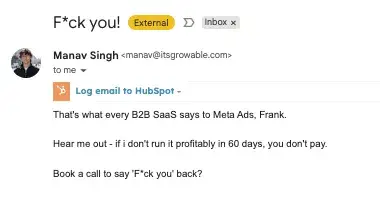
Manav Singh at Growable sent this to Frank.
The body reads: "That's what every B2B SaaS says to Meta Ads, Frank. Hear me out, if I don't run it profitably in 60 days, you don't pay. Book a call to say 'F*ck you!' back?"
Two things about this email are notable.
First, the sender is a real founder posting his outbound results publicly on LinkedIn, which means he is willing to defend the send.
Second, the email is technically a pattern-interrupt that resolves cleanly into a risk-reversal offer ("if I don't run it profitably in 60 days, you don't pay").
If you strip out the subject line, the pitch itself is well-constructed.
My take: Manav's is the only email in Category 3 or 4 I have any grudging respect for. The subject line gets the open, the risk-reversal gets the read, and the callback in the last line makes the ask feel like a joke rather than a demand. It's a real pattern-interrupt with a real payoff. But it works exactly once per market segment. Manav can't send it again.
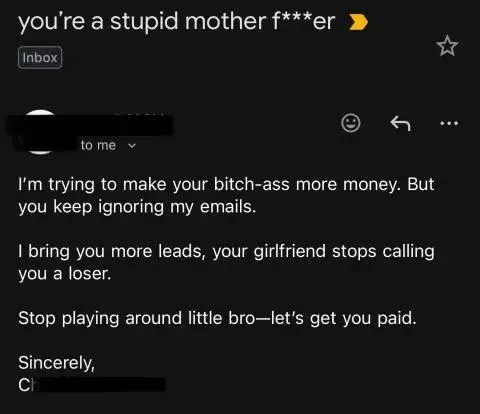
The email opens "I'm trying to make your bitch-ass more money. But you keep ignoring my emails. I bring you more leads, your girlfriend stops calling you a loser. Stop playing around little bro, let's get you paid."
This is what happens when a rep decides the risk-reversal in example 9 is unnecessary and the profanity itself is the pitch.
There is no offer, no research, no acknowledgement that the sender and recipient have never spoken.
There is only escalating profanity and an assumption that aggression is a substitute for a value proposition.
My take: This is what happens when someone reads Manav's email and copies the profanity without copying the offer. Pattern interrupt without payoff is just aggression. Aggression from a stranger isn't a pitch. It's a threat, and the buyer's inbox filter is going to treat it that way whether or not the recipient does.
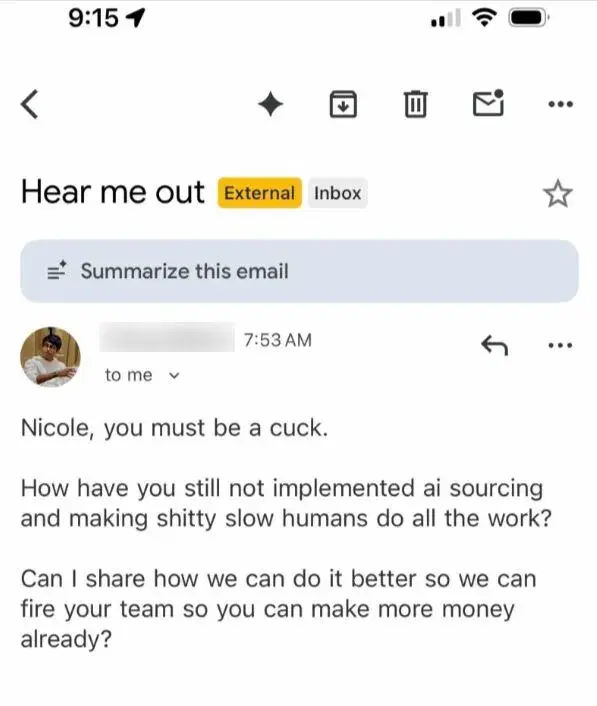
The email opens with the personal insult and then continues: "How have you still not implemented ai sourcing and making shitty slow humans do all the work? Can I share how we can do it better so we can fire your team so you can make more money already?"
The email combines every failure mode in one message. Physical/sexual insult in the opener, insistence that the recipient is professionally deficient, and a value proposition ("fire your team") that is actively hostile to the buyer's interests.
The sender has assumed that a buyer will respond to being called incompetent, told to fire their team, and pitched an AI tool as the replacement.
My take: A subject line calling the buyer a cuck, followed by a pitch to fire their team. Every part of the email is a value destroyer. And every part of the structure assumes the buyer will thank the sender for the insult. I've never seen a version of this pattern generate a single reply. Not one.
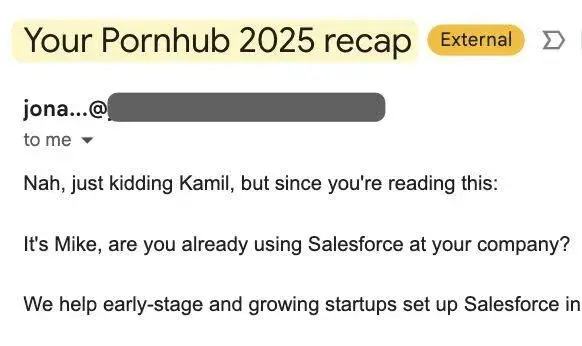
Our CEO's-own-inbox example. In December 2025, Salesforge CEO Frank Sondors posted a screenshot to LinkedIn of a cold email he had received in his own inbox.
The subject line was "Your Pornhub 2025 recap."
The body opened: "Nah, just kidding Kamil, but since you're reading this: It's Mike, are you already using Salesforce at your company? We help early-stage and growing startups set up Salesforce in..."
Everything about the send is wrong in a way worth cataloguing.
The subject line is a shock tactic that borrows attention from a porn-tracker parody. The greeting name is not Frank's, a mail-merge template that misfired.
The sender's stated first name ("Mike") does not match the email address the message was sent from. The pitch itself, once the manipulation is stripped away, is a services offer to help set up Salesforce.
My take: I run a cold email company. I understand why senders reach for shock tactics. The open rate looks good in a screenshot. But my whole audience saw this email when I posted it. Every sender running the same template lost trust with a market segment they can never re-earn. The tactic still gets opens. The cost of the open is now measurable in the amount of trust the sender has burned across every prospect who saw the callout.
The pattern across the two emails that actually work is not "be funny"; relevance and personalization matter more than humor in cold emails.
It is closer to "be specific, self-aware, and honest about the awkwardness of what you are doing." Tests on humorous outreach have shown lifts, including 30-50% response ranges and a 46% gain when the joke is relevant to the target audience.
Five rules from the examples above.
The dominant conversation around funny cold emails is about open rates.
That is the wrong metric.
The right conversation is about what an aggressive subject line does to the four numbers that decide whether a sending domain still functions in six months.
This is where cold email infrastructure choices actually matter, and where the trade between "cheap open-rate hack" and "system that compounds over quarters" gets settled.
Teams should test humorous send emails on a small sample before rolling them out across the full cold outreach program.
Salesforge runs AI personalization on real business signal (job change, funding, hiring, tech-stack change) rather than on physical traits pulled from photos. Warm-up runs in-house through Warmforge, included with the subscription, targeting heat scores above 85.
Bounce Shield pauses any mailbox that crosses a bounce threshold before the reputation damage compounds. Primebox unifies replies across email and LinkedIn so the reps who send well-crafted emails do not lose replies to inbox fragmentation.
None of that fixes a bad subject line.
It does mean the reps writing careful, specific, well-researched cold emails have the infrastructure to run their sequences at scale without their entire domain going dark because of one experiment that went sideways.
The market for outrageous cold-email screenshots is bigger than the market for cold emails that book meetings.
Screenshots are free content for the person posting them.
Meetings require research, specificity, and a reputation the sender has spent months earning.
The trade every rep faces is between the short-term open-rate hack and the long-term system that makes a brand memorable enough to win new business, not just a temporary open.
Shock subject lines get opens in the first quarter. They also get flagged, reported, apologized for, and eventually banned by the platforms that decide whether a company's email reaches inboxes at all.
The reps who compound do the boring version, because funny sales only works when the humor supports the business case instead of replacing it. Research the account. Personalize on business signal, not physical traits. Send from warmed mailboxes on domains with clean reputations. Follow up like Justin Chagin. Defuse like Nate Andorsky. Keep the shock subject lines in the drafts folder where they belong.
Salesforge is where the compounding version runs.
Real AI personalization, Warmforge warm-up included, Bounce Shield on every mailbox, Primebox for every reply. Salesforge Pro at $40/month (billed annually), Growth at $80/month (billed annually), and a 14-day free trial with no credit card required.
Rarely, and never the way LinkedIn screenshots suggest. Fewer than five percent of "funny" cold emails circulating online generate real reply rates. The ones that do share three traits: specific research about the recipient, a self-aware tone, and an ask small enough to feel like a favor.
Specificity, self-awareness, and proportionality. A subject line that references a real, verifiable detail about the recipient's role or company, delivered in a tone that acknowledges the sender is writing a cold email, lands as funny. A subject line that references a made-up catastrophe lands as spam. The safest way to balance humor is to avoid dark humor, politics, and other polarizing topics.
Yes, and often faster than senders expect. Shock subject lines trigger user "report as spam" clicks, which drop Google Postmaster and Microsoft SNDS reputation scores. Once reputation drops below a threshold, the entire sending domain loses inbox placement, including for legitimate replies and internal communication.
Start with research. Reviewing a prospect's social media can surface details that make the humor relevant instead of random. If you know a specific fact about the recipient's role or business, humor works as commentary on that fact, tied to a real pain point or business context and supported by specific ideas. If you do not know a specific fact, the "funny" instinct is a substitute for the research you have not done. Fix the research problem first and the humor problem takes care of itself.
Templated AI personalization on physical traits is. AI personalization on business signal (job change, funding, hiring, tech-stack change) is doing the opposite, because it lets one rep run the level of research that used to require an entire SDR team. The distinction is what the AI is personalizing on, not whether AI is involved, and it works best when it helps identify the right person and whether the account is a good fit.
Funny cold emails punch up or across (at the awkwardness of the interaction itself, or at a shared industry frustration). A little humor should usually earn a smile or brief moment of recognition, not a laugh-at-all-costs reaction. Unhinged cold emails punch down (at the recipient's competence, family, appearance, or safety). The line is not about tone. It is about who the joke is on. Adding humor works best when it stays light-hearted, fits the office context, and reflects your brand voice and business needs; a well-placed meme or GIF can boost engagement when it feels natural. It can also help performance: humor has been tied to 46% higher open rates and, in some conversations, 15% larger profits in negotiations.
.jpg)

![How to Build a Grok Bot for Sales Outbound [Step-by-Step Guide]](https://cdn.prod.website-files.com/6436c3ac9f9fd0594d00b9fc/6ac9208bfdd0ee5ed557ffbe_Duplicate-me-open-graph%20(60).jpg)

.jpg)