

Personalized Outbound Strategy
Get The Right Outbound Strategy In Minutes
Enter your email to get a custom plan & stack recommendation for your business
It's being carefully crafted by AI
Please check your mailbox in 5 minutes
I spent a day going through everything FullFunnel has published, and I came away with fewer answers than I expected.
Well, in my opinion their website explains the method pretty well: people, process, platform etc. What it doesn’t explain is what any of it costs, or what actually changed for the clients who hired them.
I also read their latest G2 reviews and case studies. They describe the work in careful detail, but they stop short of sharing a single outcome number.
To be clear, I’m not saying you shouldn’t hire them. Two reviewers basically said the audit alone was worth the fee, and their client list includes Airbnb and a company with more than $30 million in ARR.
But before signing, I’d want more. And I’d bet you would too.
Here’s what I found, and what I’d ask them on the call.
A short version of the review, so you can judge whether the rest is worth your time.
FullFunnel has four G2 reviews, all from 2025. Three are five-star reviews, and one is four-star. Every reviewer is listed as a small business with 50 or fewer employees.
FullFunnel also features eight named testimonials on its own site. I’ve included those below, but I’m treating them differently from the G2 reviews because FullFunnel chose them and they don’t include any criticism.
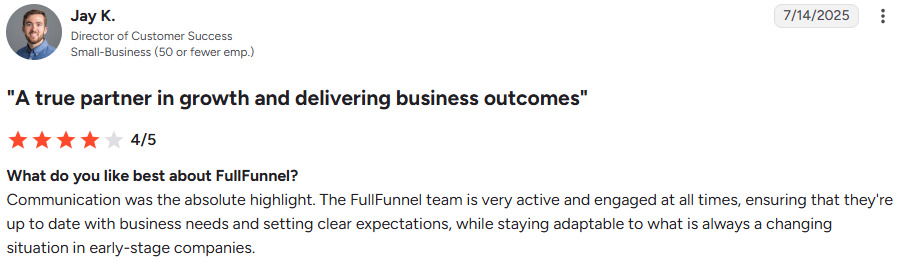
Jay K., it was the highlight of the engagement. He said the team set clear expectations even as conditions kept changing.

Jeff K., said the audit feedback alone was worth the engagement.
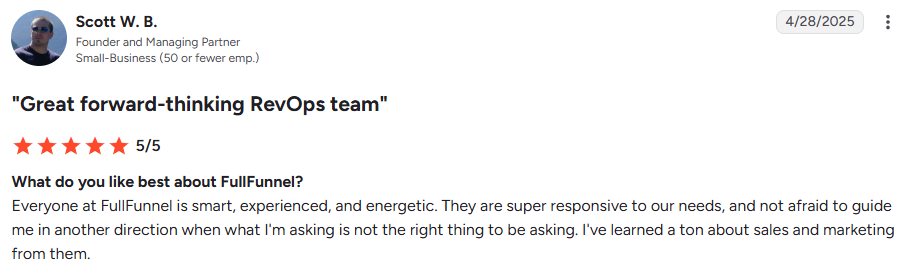
Scott W. B. said the team redirects him when he asks for the wrong thing.
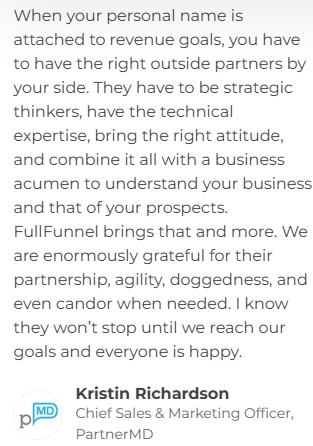
Kristin Richardson, Chief Sales and Marketing Officer at PartnerMD, made a similar point in a testimonial on FullFunnel’s site, highlighting the team’s candor.

Jeff K. said FullFunnel took over most of his RevOps operations and reported that more prospects were entering the funnel.
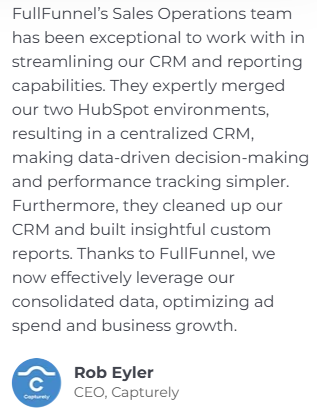
Rob Eyler, CEO of Capturely, said that FullFunnel merged two HubSpot environments into a single CRM, cleaned the data, and built custom reports.

Jay K. said there was an early gap around greater technical skills. In his view, the team is mostly made up of product experts and admins, not developers.

Scott W. B. purchases a monthly time block. In busier months, extra support is not always available unless FullFunnel brings in people who are less familiar with his project.

Fletcher T. said report and task customization could be more visual.
Hire FullFunnel if you’re a B2B company with fewer than 50 employees, no internal RevOps team, and a need for someone to build the system not just run campaigns.
Two things make that recommendation feel fair.
First, the audit seems to be the part clients value most. Two G2 reviewers brought it up on their own, without being asked directly.
Second, at least one client says FullFunnel helped them become self-sufficient. Jeremy Gurwitch at Spara said his team was running Clay without FullFunnel within a few months.
So I’d treat this as a conditional yes. Take the audit, ask for tiered pricing, and get two written references from companies your size. Only sign if you get those answers.
And if the answers don’t come, or your real problem is building software rather than fixing process, or you already have RevOps in-house, I’d look at other agencies first.
FullFunnel rents you a GTM and RevOps team. Their offer breaks into four service areas, and the order matters: the audit finds the gaps, a pilot tests one channel, engineering builds the systems, and a retainer or placed hire runs them afterward.
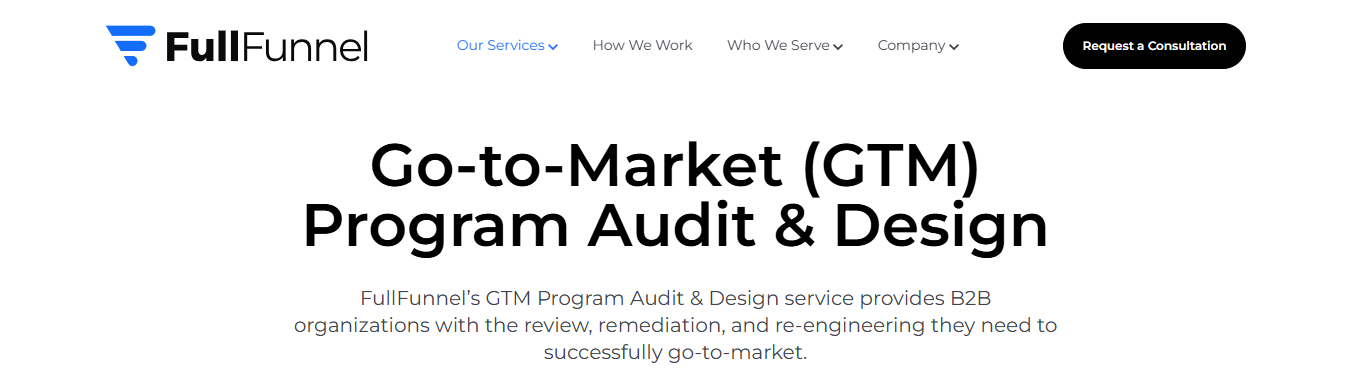
FullFunnel’s method covers people, process, and platform. The listed deliverables include current- and ideal-state process flow diagrams, channel recommendations, tech stack design, and audience and messaging research.
Outbound pilots pair GTM engineers with senior SDRs. Inbound pilots run paid search, paid social, and display across Google, LinkedIn, X, and Reddit.
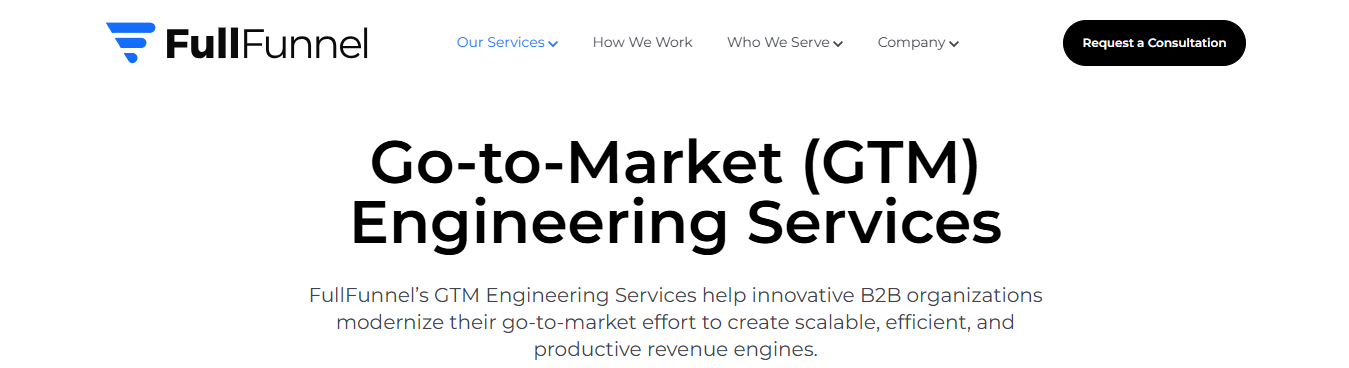
Their four stated steps are mapping the current process, automating it, finding leverage points, and running short feedback loops. The published stack includes Clay, HubSpot, Salesforce, Apollo.io, Instantly, n8n, Otter.ai, Trellus, and Triple Session.
The managed service retainer is tiered monthly with a 60-day floor. Staffing applies only to SDR and AE outsourcing, with dedicated reps managed by FullFunnel. Placement means FullFunnel recruits a GTM engineer who joins your payroll instead.
Salesforge certifies agencies through the Forge Expert Network. Each profile lists the agency’s channels, tech stack, and named clients, so it’s worth comparing them side by side before you build a shortlist.
Everything in the FullFunnel column comes from their site or a signed G2 review. Ask them to verify it in writing.
FullFunnel describes the audit and engineering phases separately on its site. I’ve mapped both onto the five stages you would move through as a client, with the question I’d ask at each stage.
Every engagement starts here. FullFunnel assesses people, processes, and platforms, then produces current- and ideal-state process maps.
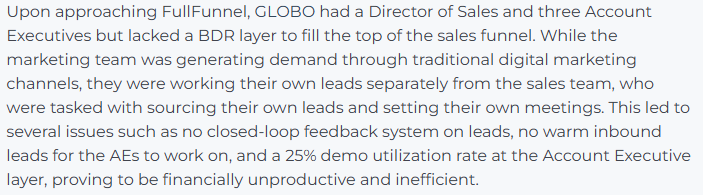
In the GLOBO case study, the audit found no BDR layer, a CRM with no pipeline or forecasting, and AEs spending only 25% of their time on demos.
Ask what the audit costs on its own, and whether you keep the deliverables if you stop there.
The audit leads to recommendations, and someone has to decide what gets built first. FullFunnel says it helps prioritize initiatives, build an implementation plan, and assign resources.
Ask who owns that decision. If the same agency writes the roadmap and gets paid to execute it, you’ll want your own view of what matters most.
From there, the path splits. A pilot tests a single channel on a shorter timeline with defined KPIs. GTM engineering goes straight into building: mapping the process, then automating it.
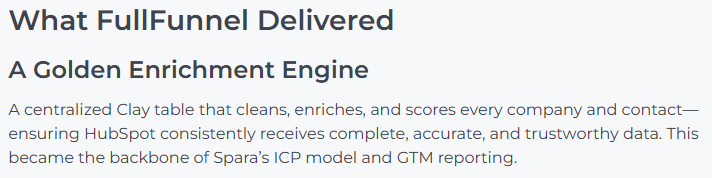
At Spara, that meant a central Clay table feeding enriched and scored records into HubSpot, plus intent tracking to re-rank accounts.
Ask which path they’re recommending, and why. A pilot limits your exposure. A build commits you before anything has been proven.
FullFunnel says it runs stakeholder alignment sessions and uses change-management practices to ensure the new workflows are actually adopted.
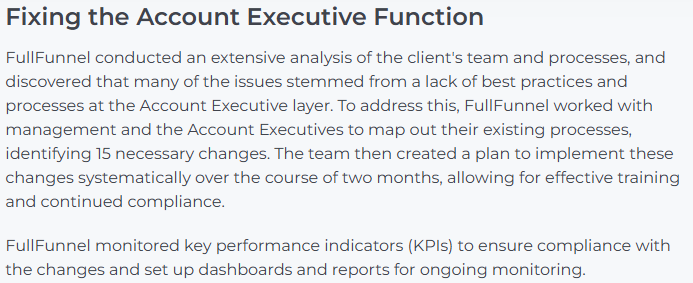
At GLOBO, that meant two months to roll out 15 process changes at the AE layer, plus a training diagnostic that graded reps on recorded calls.
Ask how much time this will require from your team. Adoption work happens inside your company, not theirs, and those sessions cannot be fully outsourced.
After the build, you either keep FullFunnel on retainer, move to placed headcount, or run the system yourself.
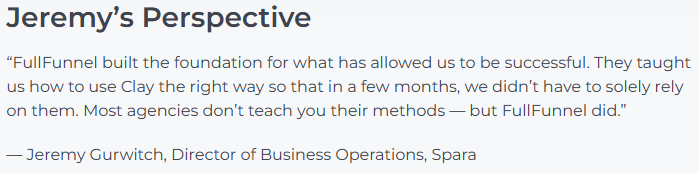
Jeremy Gurwitch at Spara said his team was operating Clay independently within a few months.
Ask whether they train your team to take over, and get that answer before you sign. It decides whether this is a project or a permanent line item.
FullFunnel does not publish rates. Every engagement starts with a consultation request. Its site names three models, but prices none of them: a tiered monthly retainer with a 60-day minimum, flat-fee projects on a fixed term, and staffing for SDR and AE outsourcing.
The retainer buys capacity, not a finished deliverable. Scott W. B. on G2 describes it plainly: he buys a monthly block.
Based on its published work, FullFunnel looks like a good fit if:
Skip them, or at least compare harder, if:
If your gap is cold outreach rather than revenue operations, an agency may be more than you need. Running Salesforge yourself covers sending, sequencing, andwarm-upp without a retainer.
I found three case studies on FullFunnel’s site. Here’s what stood out in each one, using the figures FullFunnel reported.
Two things stand out to me.
First, the scope is wide. FullFunnel’s published work ranges from an early-stage startup to a company doing more than $30 million in ARR to Airbnb.
Second, the detail is real, especially in the GLOBO case study. That’s where the audit found a 25% demo utilization rate against a 75% norm.
But every number here describes the input or the problem. None of them describes the outcome. GLOBO’s demo utilization rate is never restated after the fix. Airbnb’s “thousands” has no timeline or baseline. Spara’s case study has no figure at all.
I trust a line like “287 leads, 52 meetings, €28,000 in 40 days” much more, because I can actually check it.
FullFunnel won’t be the right fit for every company. And the first agency you find in search results is not always the one that deserves a spot on the shortlist.
One place I’d look is the Forge Expert Network, Salesforge’s directory of certified agencies.
To get listed, agencies must complete Salesforge’s cold email training and meet its eligibility requirements. Each profile also shows the stack upfront, which makes comparison easier.
It’s a smaller directory than the older review sites, so I’d use it to build a shortlist rather than survey the whole market.
I picked these three because, like FullFunnel, they sell systems rather than meeting volume.
Best for: Founders who want the systems fixed, not just another campaign run.
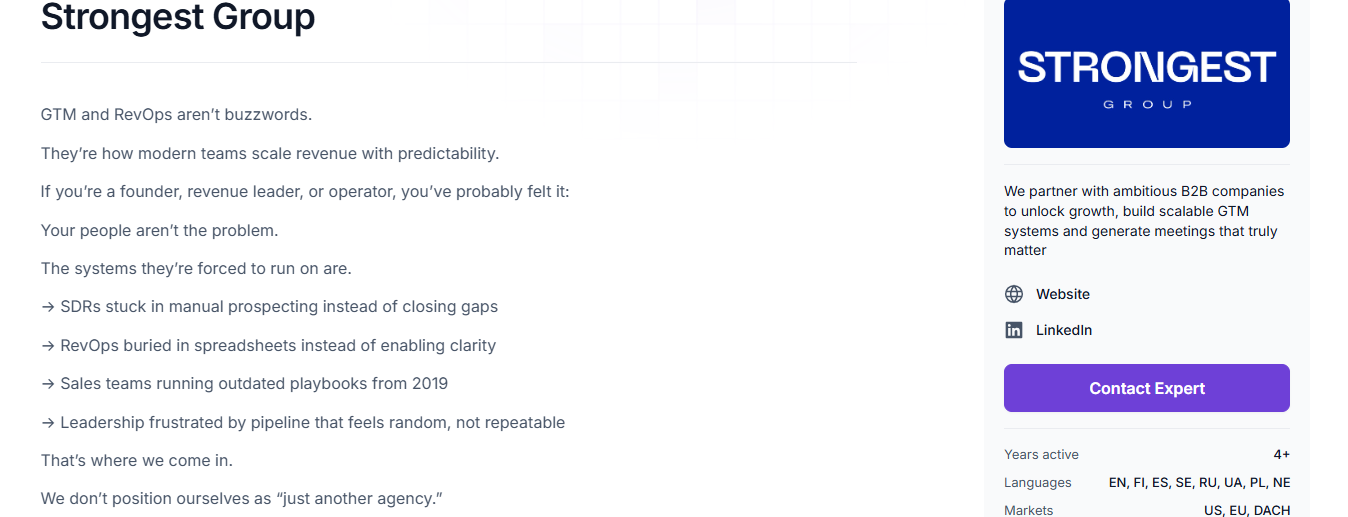
Strongest Group embeds with your team across GTM strategy, Clay-powered outbound workflows, RevOps infrastructure, and sales enablement.
Their profile frames the problem the same way FullFunnel does: the people are not broken; the systems they work in are.
I’d shortlist both and let the discovery calls separate them.
Best for: Companies with $5M-$50M in ARR that want contract terms published upfront.
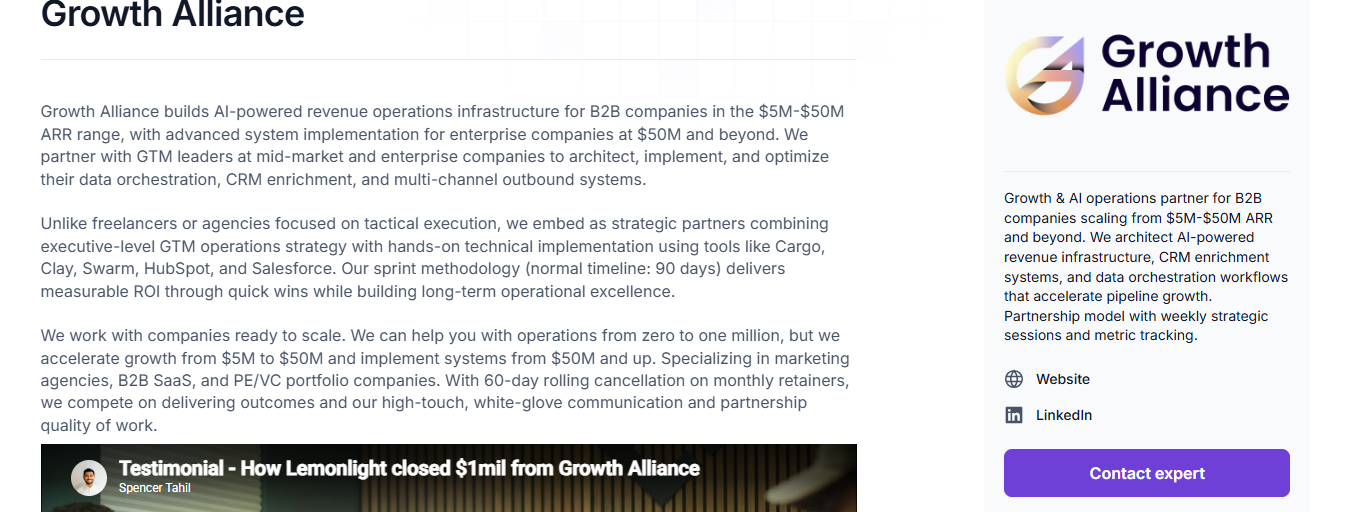
Growth Alliance builds RevOps infrastructure across data orchestration, CRM enrichment, and multichannel outbound. Its stack includes Cargo, Clay, Swarm, HubSpot, and Salesforce.
It runs a 90-day sprint and has a 60-day rolling cancellation policy for retainers.
That detail matters. FullFunnel publishes a 60-day minimum but says nothing about what happens after that.
Best for: Technical verticals that want reported numbers before committing.
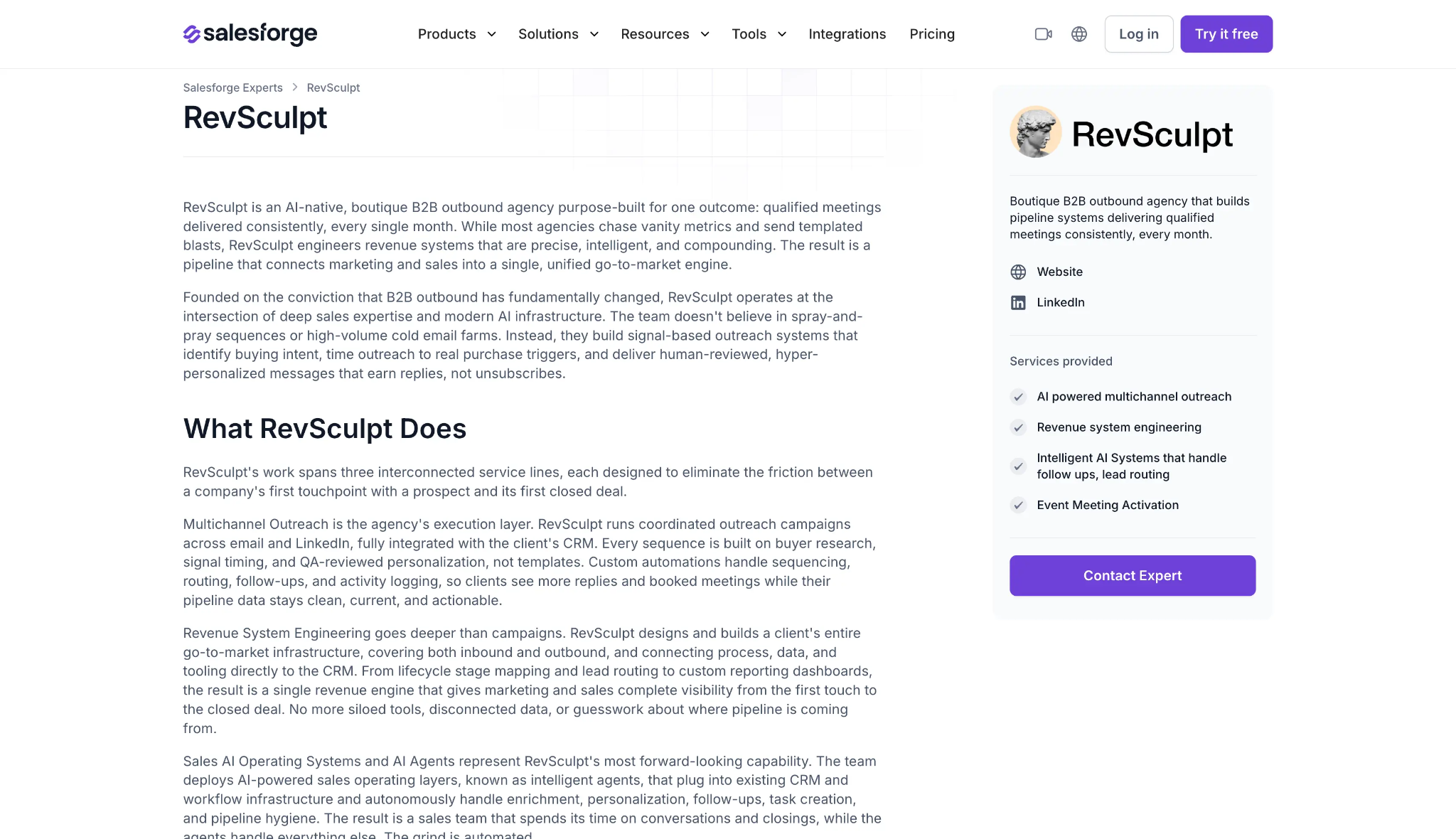
RevSculpt works in three phases: GTM audit and setup, signal-based outreach, and ongoing optimization.
Its Revenue System Engineering offer covers lifecycle mapping, lead routing, and reporting dashboards. That overlaps closely with FullFunnel’s engineering work.
RevSculpt’s profile reports more than 6,000 qualified meetings across 15+ verticals, plus a 14x return on outbound spend for one client.
Those numbers are still self-reported, but they are at least countable. That is more than FullFunnel’s case studies offer.
Bring these to the consultation. Their answers will tell you more than any review, mine included.
Enter your email to get a custom plan & stack recommendation for your business
Please check your mailbox in 5 minutes
My take: buy the audit, not the retainer — at least not yet.
The audit is the one part reviewers consistently praise, and it is the lowest-risk way to see whether FullFunnel understands your business before you commit to a monthly block.
I haven't verified pricing, outcome numbers, and the broader review base.
Get those answers in writing, then decide.
If you’d rather compare agencies that publish more detail upfront, I’d start with the Forge Expert Network.
.jpg)

.jpg)

.jpg)
