Email localization outreach means adapting outbound messages to the prospect's language, region, and business context before the email lands in their inbox.
Not just translating the body copy.
A localized outbound email changes the greeting, phrasing, proof point, CTA, send time, and follow-up logic based on who the prospect is and where they operate. For an English-speaking VP in New York, that might mean a direct commercial opener. For a German operations leader, it might mean a more formal greeting, tighter proof, and a less casual ask. For a French founder, it might mean opening with "Bonjour" and keeping the message in the same language as their public company presence.
The point is simple: if your outbound looks like it was written for the wrong market, the prospect does not need to read the rest.
Salesforge now gives Human Path users a direct way to fix the first visible part of that problem with the {{localized_greeting}} variable inside Multichannel sequences. When inserted into a message, it generates a greeting that fits the recipient's language and locale, such as Hello, Hi, Bonjour, Hola, or Guten Tag. It costs 1 personalization credit per sent message that uses the variable.
That sounds small.
It is not. The greeting is the first signal that tells the prospect whether the rest of the email was built for them or blasted at them.
Email localization outreach improves replies because it removes the fastest trust-breaker in global outbound: a message that technically says the right thing, but feels like it came from the wrong market.
For expert outbound teams, the goal is not "send every email in every language." The goal is to run a controlled localization system:
Most 2026 cold email benchmarks put average reply rates in the low single digits, usually around 1-5% depending on segment and methodology. Strong campaigns clear 5-8%. Excellent campaigns reach 10%+ when targeting, timing, follow-up, and personalization all work together.
Localization helps because it compounds relevance. It will not save a bad list or weak offer. It will make a good outbound system harder to ignore.
Most teams confuse localization with translation.
Translation changes words. Localization changes the buying context around those words.
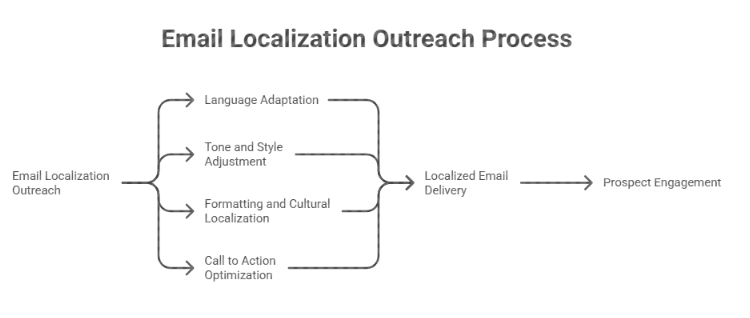
A translated cold email still breaks when it keeps the wrong greeting, the wrong idiom, the wrong proof point, the wrong CTA, or the wrong level of formality. That is why high-volume global outbound often looks competent in the sender's CRM and awkward in the buyer's inbox.
Email localization outreach changes five layers:
The greeting alone is not the strategy. But it is the entry point.
If the first word is wrong, the rest of the personalization has to fight uphill.
A greeting is not just decoration. It is the first pattern match.
Prospects decide quickly whether an email is relevant, automated, or worth ignoring. A mismatched greeting tells them the sender did not bother to understand the market. A localized greeting does not close the deal, but it reduces the first moment of friction.
This matters most when your outbound crosses languages and regions:
The problem is not that reps forget how to say "Bonjour."
The problem is that manual localization does not survive volume. Reps start with care, then copy-paste takes over. Ops adds more segments. Managers ask for more sends. Suddenly every market gets the same English opener with a different first name.
That works until you scale.
Salesforge has brought localized greetings to the Human Path in Multichannel sequences, giving human-led outbound teams the same personalization capability already available in Agent Frank.
The new variable is {{localized_greeting}}.
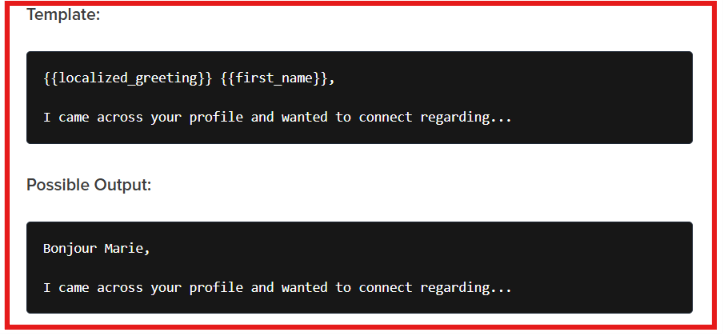
You add it from the personalization picker inside a message. When the message is sent, Salesforge dynamically generates a greeting that fits the recipient's language and locale. Examples include Hello, Hi, Bonjour, Hola, and Guten Tag.
Cost: 1 personalization credit per sent message that uses {{localized_greeting}}.
This is useful because Human Path teams still want control. They do not always want a fully autonomous AI SDR. They want their operators to own the message, the sequence logic, the review process, and the account strategy, while Salesforge handles the parts that should not be manual.
Localized greeting is one of those parts.
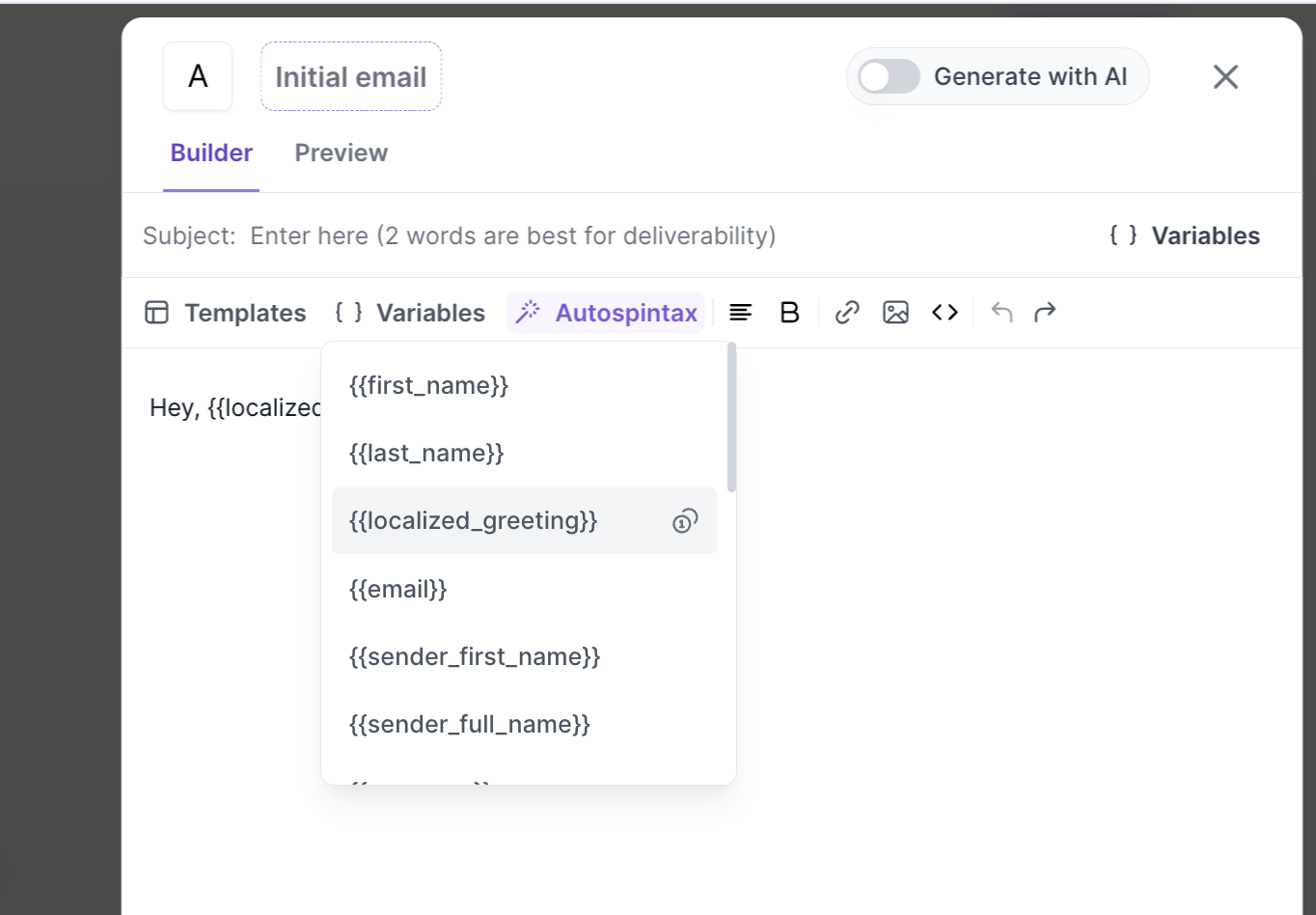
If your team sends 3,000 emails across four regions, manually checking every greeting is low-value work. You want reps focused on account logic, problem hypotheses, and replies. The system can handle the greeting.
That is the right division of labor.
Localization increases replies when it improves relevance without damaging deliverability or message quality.
There are four mechanisms behind it.
A prospect can ignore a cold email for many reasons. Bad timing. Weak offer. No problem fit. Full inbox.
Do not add "this sender clearly does not understand my market" to the list.
Localized greetings and language-aware openers remove that early objection. The email feels closer to the buyer's operating context before the pitch begins.
Personalization fails when it looks assembled from fields.
Hi {{first_name}}, saw {{company}} is hiring is not enough anymore. Buyers have seen the template. They can smell the merge tags.
Localization adds a different kind of relevance. It says the sender understands not just the account, but the environment around the account: language, location, business rhythm, and communication style.
That makes the next line easier to believe.
Global outbound teams often measure one blended reply rate.
That hides the truth.
If France replies at 7%, Germany replies at 3%, and Spain replies at 1.5%, the average does not tell you what to fix. You need market-level reporting so you can separate list quality, language fit, offer fit, and deliverability issues.
Localized outreach forces better segmentation. Each language and re gion becomes a testable operating lane, not a footnote inside one giant campaign.
Salesforge runs email and LinkedIn inside multichannel sequences. Localization matters there too.
If an email opens in the prospect's language but the LinkedIn step reads like generic English automation, the sequence loses coherence. The workflow needs one localization logic across channels: greeting, opener, CTA, and follow-up tone.
That is where connected workflows beat disconnected tools.
The better question is not "Can we translate this campaign?"
The better question is "Can we operate localized outbound without losing control of data, deliverability, and measurement?"
Here is the workflow.
Input: company domain, country, language signal, job title, seniority, LinkedIn URL, email address, and buying context.
Your localization quality is capped by your data quality. If the CRM says a prospect is in Spain because the company HQ is in Madrid, but the actual buyer works in London, the message can still feel off.
Use Leadsforge when you need B2B contact data and market segmentation before the sequence starts. The point is not just finding more contacts. The point is giving the sequence enough context to avoid lazy localization.
Bad input creates expensive personalization.
Trigger: a prospect enters a sequence with a known or inferred market.
Do not let every rep invent their own language logic. Define the rule upfront:
This is where most teams get messy. They think localization is a copy task. It is actually an operations rule.
Processing: Salesforge generates the greeting at send time based on the recipient's language and locale.
Use the variable in the first line of the message. Then make sure the next sentence earns it.
Weak version: {{localized_greeting}} {{first_name}}, I wanted to reach out because we help companies improve sales.
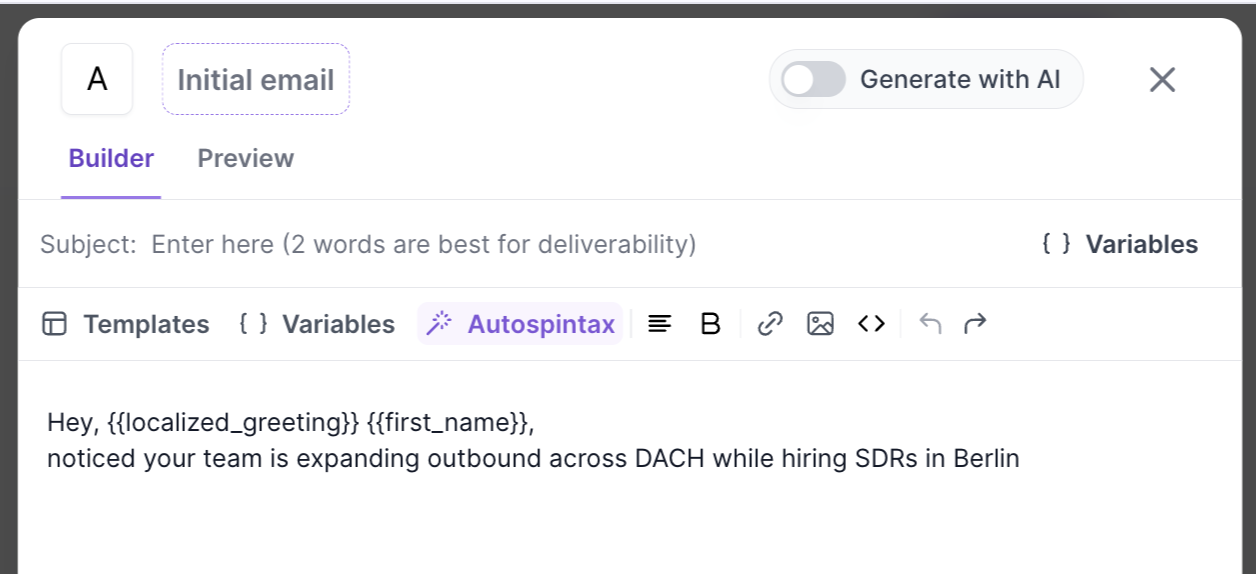
Better version: {{localized_greeting}} {{first_name}}, noticed your team is expanding outbound across DACH while hiring SDRs in Berlin.
The variable fixes the greeting. It does not fix an empty opener.
Processing: copy variants, proof points, CTA options, and follow-up timing change by region.
For expert teams, localization should be modular. Keep the structure consistent, but adapt the parts that affect trust:
You do not need 40 completely different sequences. You need a controlled set of market lanes.
Output: emails sent from healthy mailboxes with controlled sending patterns.
Localization will not matter if you land in spam.
Use Mailforge or Primeforge when your sending infrastructure needs dedicated mailboxes built for outbound. Use Warmforge to warm up and monitor deliverability before volume increases. Use Infraforge when you need private infrastructure, dedicated IPs, SSL, and domain masking.
The Forge send order matters: infrastructure first, warmup second, list third, copy fourth, volume last.
Most teams reverse that order.
Then they blame the copy.
Owner: sales reps, growth operators, or RevOps. Feedback loop: reply outcomes update the campaign, CRM, and next sequence version.
Track:
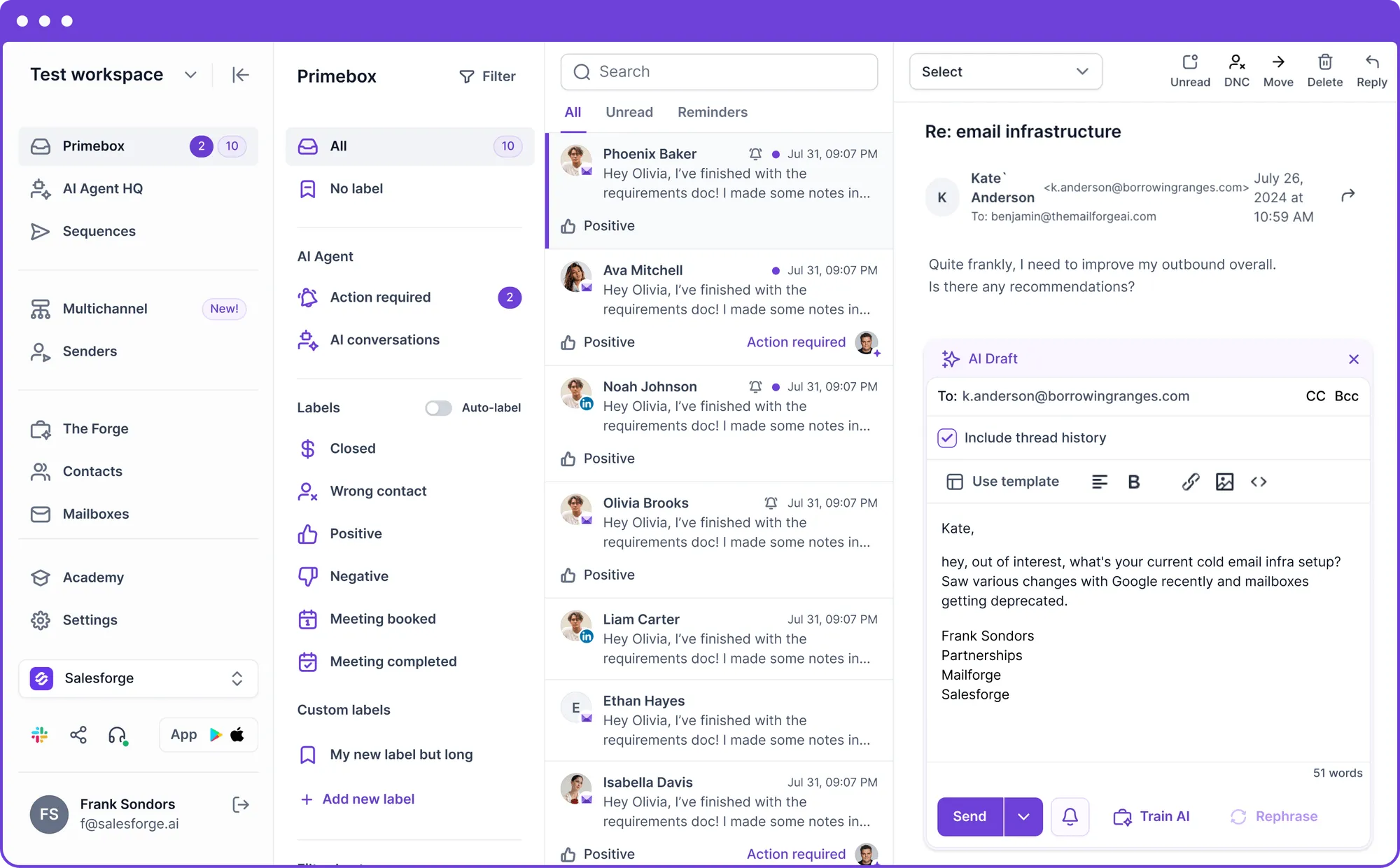
Salesforge's Primebox™ helps teams review replies in one place, while AI reply analysis can tag thread sentiment. That matters because localization does not end when the email is sent. The reply still needs routing, classification, and follow-up discipline.
The localized greeting is the first win. Do not stop there.
For high-intent outbound, localize the parts that change how the buyer interprets the message.
The opener should connect to a market-specific business condition.
For example:
A localized greeting with a generic opener feels cosmetic. A localized greeting with a market-aware opener feels intentional.
Do not use proof that only makes sense in your home market.
If the buyer sells into Europe, explain the workflow in terms of multilingual coverage, mailbox control, and compliant opt-out handling. If the buyer sells into the US, tie the proof to speed, pipeline coverage, and rep productivity.
Same product. Different proof angle.
The CTA is where a lot of translated outbound breaks.
Some markets tolerate direct meeting asks. Others respond better to a lower-friction question first. The CTA should match both buyer stage and market norm.
Examples:
Do not localize the greeting and then force the same aggressive CTA into every market.
Follow-up discipline matters. Over-persistence hurts more when the message already feels culturally off.
Set different follow-up spacing by region when performance data supports it. Watch unsubscribes and spam complaints, not just replies. A market with lower replies and higher complaints is not asking for more follow-ups. It is telling you the sequence is wrong.
Localization is not magic. It breaks in predictable places.
If country, language, or role data is wrong, the greeting can be wrong too. That is worse than staying neutral.
Use localization when the signal is strong. Fall back to a universal greeting when it is not.
Technical buyers notice sloppy wording. A translated sentence can be grammatically correct and commercially weak.
Keep the message simple. Localize the greeting, opener, proof, and CTA before trying to rewrite every paragraph into every language.
{{localized_greeting}} costs 1 personalization credit per sent message that uses it.
That is cheap when it improves reply quality. It is wasteful when used on low-fit lists, weak offers, or markets where the language signal is unreliable.
Track cost per positive reply by segment. If a lane burns credits without improving replies, fix the lane or turn the variable off there.
Do not use Salesforge if you only need a simple newsletter tool, a basic one-off mail merge, or a team that sends 50 manual emails a month from one inbox.
Salesforge makes more sense when outbound has become an operating system: multiple mailboxes, multiple markets, human-reviewed sequences, LinkedIn steps, reply classification, warmup, and performance feedback.
There is also a cost tradeoff. Salesforge starts at $48/mo for Human Path plans, includes unlimited mailboxes and unlimited LinkedIn senders rather than seat-based pricing, and offers a 14-day free trial. But the Forge stack is modular. Salesforge, infrastructure, and Agent Frank are separate subscriptions. If you want the absolute lowest single-tool setup, a lighter sequencer can be easier to justify.
That is the honest line.
Human Path is for teams that want operator control.
Agent Frank is for teams that want the AI SDR to handle prospecting, outreach, follow-ups, and meeting booking across 20+ languages. It starts at $599/mo billed quarterly, supports 1,000 active contacts at a time, and is demo-gated with no self-serve free trial. Email infrastructure is bought separately.
Use Agent Frank when your bottleneck is not just localized copy, but the whole SDR workflow:
Use Human Path with {{localized_greeting}} when your team still wants to write and control the sequence, but does not want reps manually adjusting greetings across every market.
Both paths can work.
The difference is ownership.
If your team wants to test email localization outreach this week, do not rebuild the entire outbound motion.
Run a controlled test.
A good first test does not need 20 languages. It needs clean segmentation and enough volume to see whether localization changes behavior.
If the localized lane improves replies but meeting quality stays flat, your opener worked but your offer did not. If opens stay low, fix deliverability. If replies rise in one market and fall in another, split the sequence logic.
That is how operators learn.
Email localization outreach helps you get more replies because it makes your outbound feel built for the buyer's market instead of translated from yours.
The greeting is the first visible cue. The sequence, proof, CTA, deliverability setup, and reply loop decide whether that cue turns into pipeline.
Salesforge's {{localized_greeting}} variable gives Human Path teams a simple way to localize the first moment of the email without turning reps into manual translation operators. Pair it with segmented contact data from Leadsforge, mailbox infrastructure from Mailforge or Primeforge, warmup from Warmforge, and reply management inside Salesforge, and you get a system your team can improve over time.
Tools are not the strategy. The workflow is the strategy.
If your global outbound still depends on reps manually adjusting greetings, copying translated templates, and guessing which markets are working, Salesforge helps you turn that into a controlled localization workflow your team owns: clean data, localized messaging, deliverability-aware sending, and reply feedback in one operating layer.



.png)