
Personalized Outbound Strategy
Get The Right Outbound Strategy In Minutes
Enter your email to get a custom plan & stack recommendation for your business
It's being carefully crafted by AI
Please check your mailbox in 5 minutes


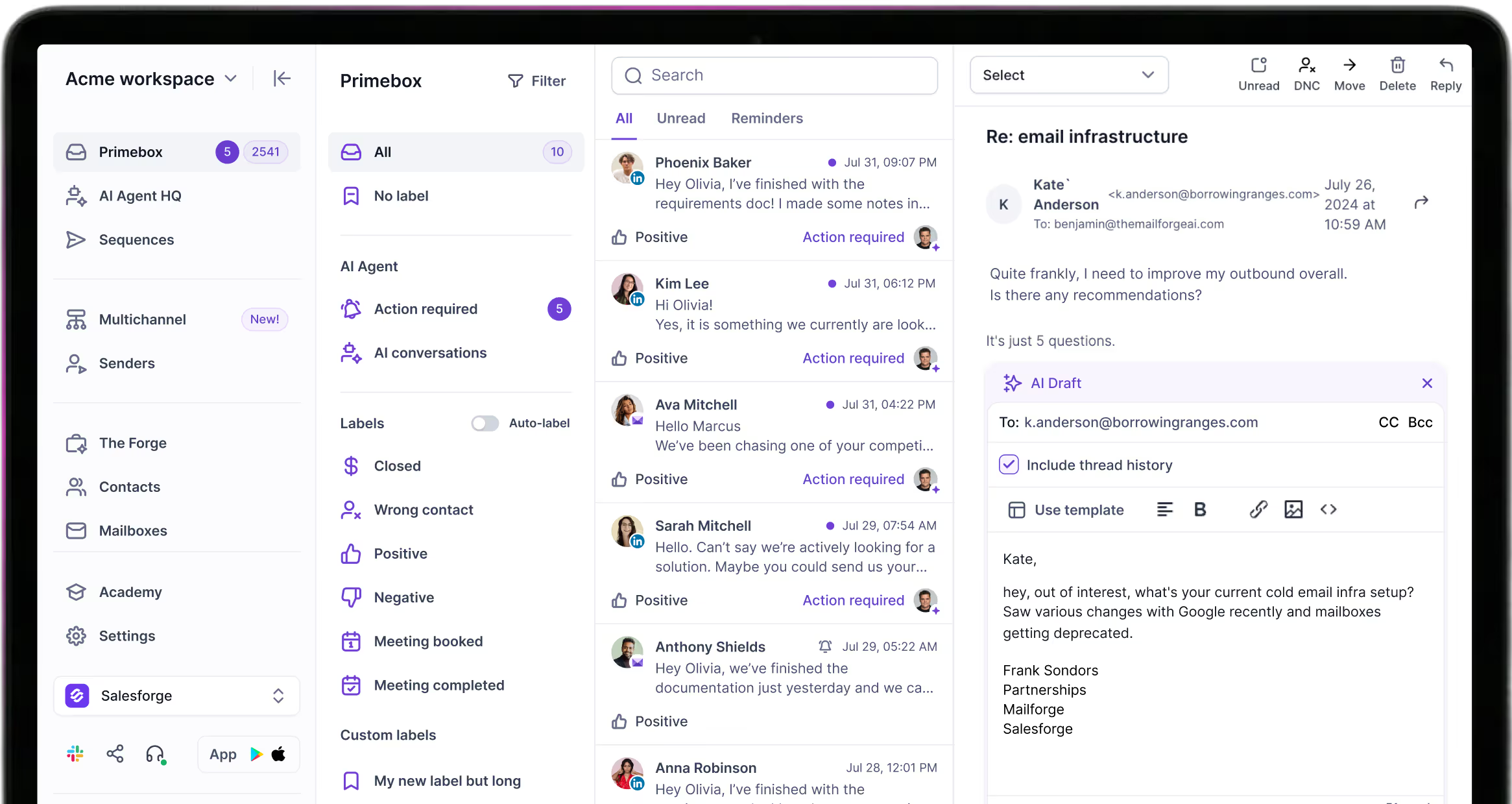
Salesforge, built by a former Googler and VP of sales, positions itself as a multi-channel outreach sending platform that's part of a suite of tools, all dedicated to streamline the sales outreach process.
Salesforge emphasizes unlimited LinkedIn senders, unlimited mailboxes and even unlimited seats - an approach that aims to remove per-user barriers for quickly scaling teams scale.
Salesforge bundles deliverability tooling and a unified inbox (Primebox) so replies across LinkedIn and email are captured and managed centrally.
Dux Soup, by contrast, markets itself as a mono-channel tool. Dux Soup's LinkedIn automation product scales from individual users to teams and agencies, but, unlike with Salesforge, the steeper the scale - the steeper the pricing.
Dux Soup’s strength is in LinkedIn prospecting: it supports a vast array of LinkedIn actions (endorse, follow, InMail, connect, message, visit) and drag-and-drop campaign steps. Otherwise, all its features can be found in Salesforge as well.
If you're a small team with low ambitions targeting solely the LinkedIn channel and prefer using a Chrome extension, Dux Soup is a fairly straightforward, low-cost path. If you need full multi-channel sequences with email infrastructure, deliverability, consolidated replies, robust integrations and hyper-personalization out of the box, Salesforge is architected for that problem.
Feel free to let Salesforge's results speak for themselves:

Salesforge provides 2 plans oriented around outreach scale, as well as a 14-day free trial.
The plans are as follows (with 2 free months granted when using annual billing):
Dux Soup provides 3 plans for individuals and smaller teams, and a 4th option for agencies.
The plans are oriented around LinkedIn automation scale with a 14-day free trial available for the individual and smaller team plans and reduced monthly rates when billed annually:
When evaluating a LinkedIn automation tool, channel breadth matters.
This means Salesforge attempts to combine LinkedIn lead generation and robust email campaigns under one roof to provide generally stronger outreach functionality and greater results, while Dux Soup focuses on generating leads efficiently through LinkedIn specifically, with CSV export and CRM integration for downstream multi-channel follow up.
For teams specifically seeking a Dux Soup alternative because they want to optimize their stack with integrated LinkedIn and email outreach capabilities in one product, Salesforge is purpose-built to reduce the friction of tying LinkedIn leads to email follow-ups and pipeline management.
Those features are prime for everyday LinkedIn prospecting workflows - particularly when paired with the Dux-Soup csv file export capability to moving ove lead data into CRMs or other tools.
If you need granular LinkedIn action automation, Dux-Soup’s campaign builder and action queue give a fine level of control. If your goals include building complex multi-channel campaigns that seamlessly transition from LinkedIn connection invitations to email sequences and reply management in a single environment, Salesforge’s multi-channel orientation and Primebox centralized inbox are designed to reduce handoffs and keep metrics contained in one place.
Salesforge bundles deliverability tooling as part of the Forge Stack - Warmforge (free, unlimited warm up), Mailforge, Infraforge and Primeforge - all designed to improve inbox placement, warm up domains and manage DKIM/SPF/DMARC setup.
Beyond that, Salesforge offers further deliverability options to guarantee no emails land in spam, such as dynamic IPs, ESP matching, mailbox rotation and detailed deliverability analytics.
For anyone attempting to achieve the best cold outreach results by coupling LinkedIn outreach with email follow-ups, robust deliverability capabilities greatly reduce wasted sends and improve pipeline conversion.
Dux-Soup does not provide integrated email infrastructure; it focuses on LinkedIn actions, CSV export and CRM integration for downstream email campaigns. If you care about keeping messages out of spam folders, Salesforge’s integrated approach the way to go.
That approach is attractive for agencies and teams that want multiple team members to run outreach without paying per LinkedIn account or mailbox.
Dux-Soup’s model often makes sense for individuals who want a low entry price for basic LinkedIn automation, but scaling to more team members means quickly increasing per-seat costs.
For companies that want centralized prospect management and predictable scaling without multiplying seat costs, the Salesforge model can be more economical.
Both vendors enable campaign sequencing but they approach it differently.
For teams pursuing multi channel strategies, Salesforge’s integrated sequences typically reduce the need to stitch together a separate email platform and LinkedIn automation - which helps with maintaining consistent campaign statistics and central control via the Primebox.
Enter your email to get a custom plan & stack recommendation for your business
Please check your mailbox in 5 minutes
Dux-Soup has explicit team features:
All tuned for shared LinkedIn prospecting.
Salesforge leans into a different promise. It seeks to eliminate seat friction by offering:
All within a single hub (Primebox) for managing consolidated replies across channels. That centralization supports centralized prospect management and (along with whitelabel) is particularly appealing for agencies managing multiple client outreach efforts across many LinkedIn accounts.
Both tools support multiple team members, but the administrative model differs: Dux-Soup uses per-seat team licenses and shared campaigns, while Salesforge’s unlimited-sender model + whitelabel options aims to make scale operationally simpler for agencies and resellers who want to share campaigns across client workstreams without seat churn.
Both platforms recognize that LinkedIn outreach rarely exists in isolation.
Dux-Soup lists native major CRM integrations and Zapier/Make libraries for downstream automation. It supports exporting LinkedIn data as CSV files and to third-party systems, and can automatically update CRMs and store LinkedIn messages.
Salesforge takes integrations to the next level. Just to name a few:
And many more. Salesforge is built to play cleanly with existing pipelines while keeping inbox and sender infrastructure consolidated.
If you want all the campaign statistics for LinkedIn actions only, Dux-Soup’s dashboard and dux dash style reporting deliver the core insights you need. If you care about properly detailed analytics that correlate email deliverability, domain health, and LinkedIn performance within the same pipeline, Salesforge’s stack is designed to connect those dots so you can see how inbox placement impacts reply rates and conversion.
For high-volume outreach where email reputation is a variable, being able to pull campaign statistics across channels in one place is a real operational advantage - and that’s where Salesforge’s consolidated reporting and Primebox play to scale.
Dux-Soup provides help center resources, webinars, blog content and case studies. Their emphasis on accessible pricing and onboarding for individuals and teams makes initial ramp straightforward.
Salesforge, despite being an easy to learn tool with a user-friendly interface, nonetheless puts a lot of emphasis on support and education: Salesforge Academy, video tutorials, an active Slack community, detailed documentation and 24/7 customer support that helps users solve issues and optimize their outreach strategy.
Salesforge’s support ecosystem is stronger when your outreach crosses into email deliverability and you need assistance with infrastructure - a common pain point for less experienced teams when sending customized messages via email and LinkedIn in coordinated campaigns.
Agencies and whitelabel resellers should consider both feature sets and the operational model.
Salesforge offers whitelabel and agency capabilities and showcases case studies where agencies ran multi-domain outreach with strong results. For agencies that want to be hands-off with email infrastructure while running both LinkedIn and email outreach at volume, the Forge Stack reduces the need to provision and manage separate email providers and warm-up arrangements for each client.
If your outreach is primarily LinkedIn automation and you’re a solo operator or small team that needs a cost-effective Chrome extension-focused option, Dux Soup is a good tool for you. Dux Soup has several LinkedIn-specific features like connection requests, InMails, action queues, and CSV export for downstream workflows.
If your priority is a cohesive multi-channel strategy where email deliverability, unlimited sender capacity, consolidated replies and an integrated inbox matter - especially for agencies or growth teams running many campaigns - Salesforge is a perfect option that reduces operational headaches and improves long-term ROI.
Salesforge’s unlimited LinkedIn senders & mailboxes, free built-in deliverability capabilities, and consolidated reply management are powerful levers for scaling pipeline while protecting sender reputation.
Salesforge is a coordinated multi-channel platform (LinkedIn + email) built to convert new leads into qualified LinkedIn leads by pairing LinkedIn touches with deliverability-aware email follow-ups. Dux-Soup focuses on LinkedIn-only prospecting (connection requests, messages, visits) and exports for downstream lead generation.
Yes - Salesforge advertises unlimited LinkedIn senders, mailboxes and workspaces to simplify team management and clever team prospecting without per-seat barriers. Dux-Soup scales by seat/plan (Pro/Turbo/Cloud) so team costs usually rise with more LinkedIn accounts.
No - Salesforge centralizes outreach and reply handling (Primebox) without relying on a browser extension for core multi-channel sequencing. Dux-Soup is commonly used as a Chrome extension (with a Cloud option for always-on automation).
Salesforge captures replies across channels in Primebox, applies conditional/intelligent campaign logic and can AI-assist replies or route prospects into the next best step. Dux-Soup detects responses and pauses LinkedIn sequences to avoid overmessaging, which is ideal for single-channel flows.
For multi-channel outreach where optimal safety and deliverability matter, Salesforge bundles deliverability tooling (Warmforge warm-up, mailbox rotation, domain/IP features) to protect sender reputation. Dux-Soup focuses on safe LinkedIn actions but doesn’t include integrated email deliverability infrastructure. Evaluate needs: single-channel LinkedIn growth vs multi-channel, deliverability-focused scaling.