The Vice President of Sales is a senior leader responsible for aligning business goals with sales execution to drive revenue growth. Reporting to the CEO or CRO, this role requires managing client relationships, developing sales strategies, leading teams, and overseeing budgets and performance metrics. With an average of 12 years of sales experience, VPs must balance leadership, data-driven decision-making, and cross-department collaboration.
Key takeaways:
The VP of Sales role is essential for revenue growth, requiring a mix of experience, leadership, and technological expertise.
A VP of Sales wears many hats, focusing on client relationships, crafting sales strategies, and managing financial operations. These responsibilities work together to drive revenue and fuel the company's growth.
One of the most impactful roles a VP of Sales takes on is executive sponsorship. By stepping into high-stakes meetings for large, complex deals, they can remove obstacles and show the company's full commitment. This hands-on approach often seals six- or seven-figure contracts.
Another key focus is strategic account planning. VPs work with their teams to uncover opportunities for cross-selling and upselling within existing high-value accounts. They also map out key stakeholders to deepen relationships and expand revenue streams. Through customer feedback loops, like quarterly business reviews and surveys, VPs can advocate for customer needs internally and address potential churn before it becomes a problem.
These efforts not only strengthen client relationships but also lay the groundwork for building effective sales strategies and leading high-performing teams.
At the core of a VP of Sales' role is crafting a robust go-to-market (GTM) strategy. This involves defining target markets, planning geographic expansion, and positioning the company to stand out against competitors. As Bardeen puts it, "A VP of Sales plays a critical role in driving a company's revenue growth and success".
Equally important is talent development. VPs identify the ideal traits for sales team members, mentor their teams, and use role-playing exercises to fine-tune skills like sales discovery. They also collaborate with marketing to create sales enablement materials - such as case studies, promotional content, and webinars - that help guide prospects from initial contact to closing the deal.
By combining strategic planning with team development, VPs ensure their sales organizations are equipped to perform at the highest level.
Financial oversight is another major responsibility. VPs manage budgets, set quotas, and design compensation plans that align with profitability goals. Using sales forecasting and analytics, they provide senior leadership with insights into revenue trends, pipeline health, and conversion rates. As MAFSI highlights, "The VP of Sales must be well-versed in sales techniques, operations, and data-driven insights in order to effectively manage and analyze sales performances".
To boost efficiency, VPs identify process bottlenecks and implement tools like CRM systems and automated prospecting solutions. They monitor key performance indicators (KPIs) across four main categories:
(function(d,u,ac){var s=d.createElement('script');s.type='text/javascript';s.src='https://a.omappapi.com/app/js/api.min.js';s.async=true;s.dataset.user=u;s.dataset.campaign=ac;d.getElementsByTagName('head')[0].appendChild(s);})(document,372145,'tu1or50rqqejh816h1cm');
(function(d,u,ac){var s=d.createElement('script');s.type='text/javascript';s.src='https://a.omappapi.com/app/js/api.min.js';s.async=true;s.dataset.user=u;s.dataset.campaign=ac;d.getElementsByTagName('head')[0].appendChild(s);})(document,372145,'tu1or50rqqejh816h1cm');
The role of a VP of Sales is no walk in the park. It takes a mix of sharp leadership, analytical prowess, and strong interpersonal skills to succeed. With the average tenure being just 17 months, the pressure to deliver results is high, making these skills absolutely essential.
A great VP of Sales knows that emotional intelligence is at the heart of effective leadership. By understanding their team’s perspectives, they can build trust and create a positive, productive environment - especially when managing diverse or remote teams [20,21,23].
The difference between managing and leading often comes down to mentorship. While managers focus on assigning tasks, leaders invest in coaching their teams, helping them grow professionally [21,24]. As John C. Maxwell famously said:
Leadership is Influence, nothing more, nothing less.
Spending time directly with managers and sales reps also gives VPs a real sense of what’s happening on the ground.
What sets exceptional VPs apart is their ability to make strategic decisions. They analyze complex situations, focus on long-term priorities over immediate distractions, and align sales strategies with the company’s broader goals [21,22]. Zorian sums it up well:
A Sales Leader (or any executive) is hired to make decisions that achieve results.
This requires the flexibility to adapt - whether it’s adjusting strategies during economic shifts or evolving leadership styles as the company grows.
Another key aspect of leadership is building a high-performing team. This means mastering the art of hiring top talent. Tools like a Skillset Matrix can streamline the hiring process, cutting screening time by as much as 85% [22,25]. Setting SMART (Specific, Measurable, Achievable, Relevant, and Time-bound) goals ensures the team stays focused and accountable. These practices not only strengthen the team but also support the execution of broader sales strategies.
In addition to leadership, today’s VPs must be skilled at using data to guide their decisions. With the rise of AI-powered analytics, sales leaders can now forecast trends and optimize team performance more effectively. As Thomas Ross, a VP of Sales, puts it:
A data-driven VP of Sales doesn't just react to market changes - they anticipate them.
Data analysis allows VPs to create accurate forecasts, guide executive decisions, and set realistic targets [1,2]. By examining market trends and customer behavior, they can identify growth opportunities and allocate resources where they’ll have the most impact [1,8,26]. The ultimate goal? To build a "revenue engine" that drives consistent growth by refining sales processes and maximizing revenue per lead.
Here are some tools that help VPs stay ahead:
Tool Category
Examples
CRM Platforms
Analytics & Insights
Customer Success
Sales Intelligence
AI-powered outreach tools
Ensuring widespread adoption of CRM systems is critical for maintaining a clean, actionable sales pipeline. Regular performance reviews, using data-driven scorecards, also allow for targeted coaching and ongoing improvement [2,26].
On top of leadership and analytical skills, strong communication is key to bridging strategy and execution. Clear communication keeps everyone aligned, ensuring teams understand and work toward shared goals [8,26]. VPs play a crucial role in translating executive objectives into actionable steps for their teams and stakeholders [1,26].
For enterprise sales, relationship-building is at the core of the job. As Dan McDermott, Chief Marketing Officer at Vouris, explains:
The VP of Sales is responsible for building and maintaining relationships with clients and stakeholders.
This often involves negotiating major contracts and managing high-profile accounts. A consultative approach - where the VP addresses each client’s unique needs - can make all the difference.
Strong interpersonal skills are essential for fostering long-term loyalty. According to 4CornerResources:
Developing and maintaining strong client relationships involves regular communication, understanding their unique needs and challenges, and providing value-added solutions.
Regular check-ins and staying on top of market trends ensure that VPs continue delivering value over time.
Collaboration is another critical aspect of the role. VPs must work closely with marketing, finance, and product development teams to align efforts and ensure the product meets market demands [2,8,26]. Increasingly, companies are placing a higher priority on soft skills - like communication, leadership, and relationship-building - over purely technical expertise.
Expanding professional networks by joining organizations like the National Association of Sales Professionals (NASP) or the Sales Management Association (SMA) can also open doors to new opportunities. Finally, creating a feedback loop - where both the sales team and customers feel heard - encourages innovation and helps the organization adapt quickly to market changes.

Becoming a VP of Sales is often the result of a 12-year journey through sales and management roles. This career path typically starts with entry-level sales positions, moves through mid-level management and sales director roles, and ultimately leads to the VP level.
Most VPs of Sales begin their careers in roles like Sales Development Representatives (SDRs), Business Development Representatives (BDRs), or junior Account Executives (AEs). These positions provide a strong foundation in key sales skills, such as prospecting, cold outreach, lead qualification, and pipeline management. For instance, Sam Blond, former Chief Revenue Officer at Brex, started as the company’s first SDR, while Matt Plank, CRO at Rippling, began as a junior Account Executive. Both used these early roles to refine their sales expertise and quickly rise to leadership positions.
The fastest path from entry-level to VP can take as little as 5 to 6 years, but for enterprise-level roles, it often spans over a decade. Inside Sales Representatives focus on mastering digital tools like CRMs and video conferencing, while Outside Sales Representatives hone interpersonal skills through in-person meetings and presentations. At this stage, consistently exceeding quotas - not just meeting them - is critical for showcasing ambition and the ability to think strategically.
Once you’ve proven yourself as an individual contributor, the next step is moving into leadership roles like Sales Manager or Regional Manager. Here, the focus shifts from closing deals to coaching team members and overseeing pipelines. The Sales Director position is often the final step before advancing to VP.
As a Sales Director, responsibilities expand to include strategic planning, cross-department collaboration with teams like marketing and product development, and managing multiple teams across different regions.
At this stage, it becomes just as important to clearly communicate your leadership impact as it is to build it, and understanding how to present your experience as a sales director can make a real difference when positioning yourself for VP-level roles.
While Directors focus on tactical execution and immediate team results, VPs take on broader responsibilities like long-term revenue planning and direct reporting to the CEO or CRO. Some professionals opt to work at smaller companies to speed up their career progression, where the scope of responsibilities and compensation can vary.
To reach the VP level, certain milestones and qualifications are essential. Typically, candidates need at least 8 years of managerial experience. Educational credentials, such as a Bachelor’s or Master’s degree, are common, and advanced qualifications like an MBA or certifications such as the SMEI Certified Sales Executive can set you apart.
Beyond formal education, measurable results are what truly matter. Successful sales leaders often achieve revenue growth of 12–15% year-over-year. A proven ability to meet or exceed aggressive growth targets is a must. As sales becomes increasingly tech-driven, modern VPs are addressing the growing demand for AI skills. By 2026, 71% of B2B buyers are expected to favor AI-enhanced sales interactions. Certifications in AI tools, such as Salesforce Einstein or HubSpot AI, can demonstrate readiness for this evolving landscape.
Networking also plays a crucial role in advancing your career. Joining organizations like the National Association of Sales Professionals (NASP) or the Sales Management Association (SMA) can offer valuable insights and connections. Building a strong LinkedIn presence by sharing expertise on topics like AI in sales, revenue operations, and leadership strategies can further distinguish you in the field. According to the Bureau of Labor Statistics, employment for top executives, including VPs of Sales, is projected to grow by 3% through 2032.
Each stage of this career path is designed to develop the leadership and strategic vision necessary for a VP of Sales. These experiences also prepare leaders to integrate tools like Salesforge into modern sales strategies effectively.
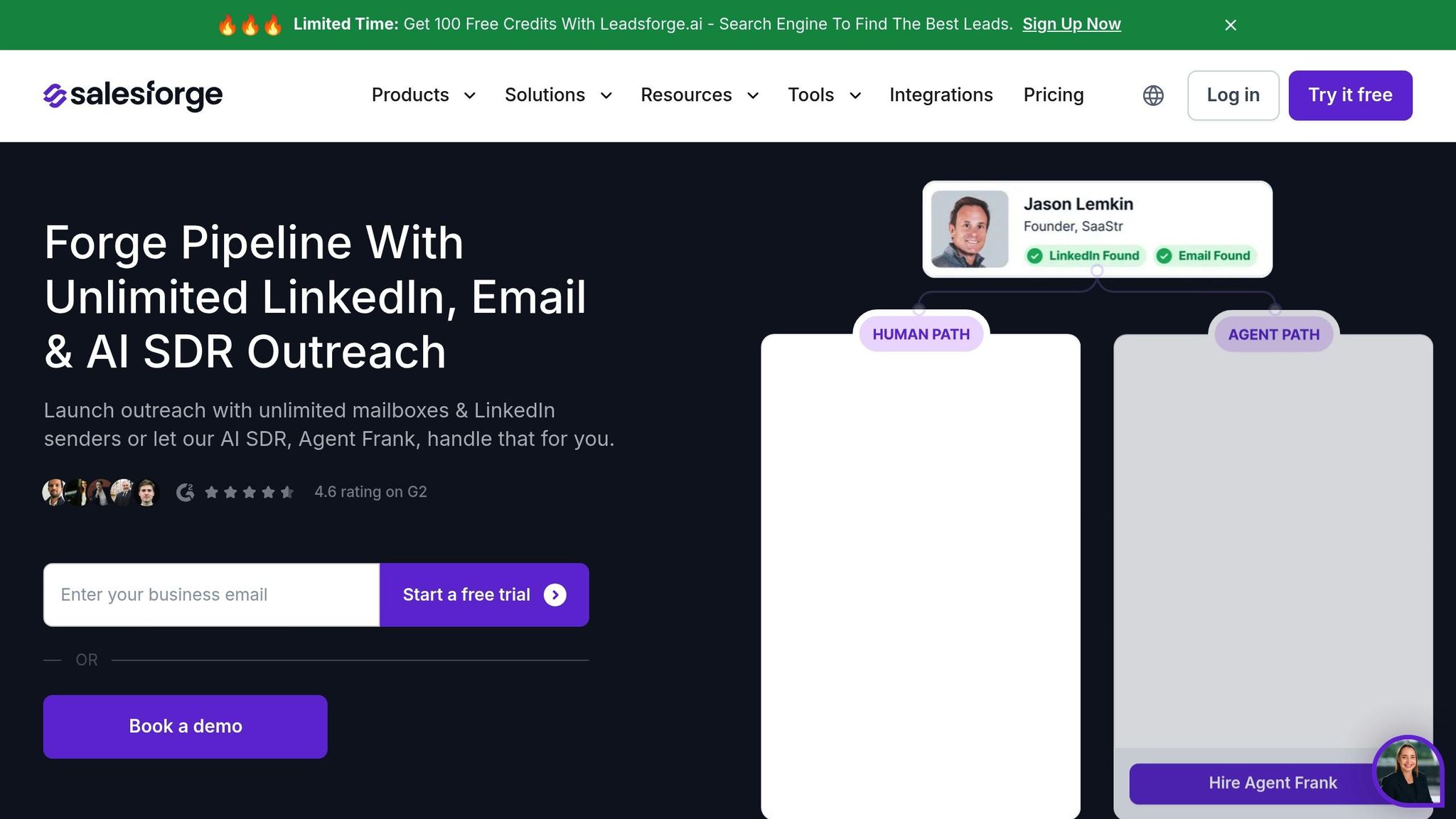
In the fast-paced world of sales leadership, balancing growth with limited resources is a constant challenge. Tools like Salesforge are stepping in to help VPs of Sales achieve more without increasing headcount or stretching budgets. By combining automation with personalization, platforms like this streamline operations while maintaining the human touch. Kyle Vamvouris, CEO of Vouris, highlights the impact of AI, noting that an AI agent can slash marketing expenses by up to $100,000 and bring outreach management time down to under two hours per week.
This level of efficiency allows sales leaders to adopt more dynamic strategies, such as multi-channel outreach, to scale revenue effectively.

Relying on a single communication channel is no longer enough. Today’s customers expect engagement across multiple platforms, with 70% preferring messaging apps over traditional methods like phone calls or email. Salesforge helps VPs of Sales meet these demands by managing outreach across platforms like email and LinkedIn from one centralized tool. This approach expands reach without adding to the team’s workload.
What sets Salesforge apart is its ability to analyze prospect data - such as job titles, company size, challenges, and recent news - to craft messages that resonate on a personal level. Companies using AI-driven personalization have seen ROI improvements of 10-20%, while traditional mass messaging often struggles with response rates of just 1-2%. As Jenny Romanchuk puts it:
Outreach works best when it doesn't feel like outreach. Relevance beats volume every time.
This blend of personalized messaging and multi-channel coordination gives sales teams a competitive edge. But the benefits of AI don’t stop there.
AI isn’t just about doing more - it’s about doing better. By automating repetitive tasks like lead research, account list building, and follow-up drafting, platforms like Salesforge free up sales teams to focus on high-value activities. For example, Salesforge’s Agent Frank handles everything from identifying leads to booking meetings, allowing sales professionals to concentrate on building meaningful relationships.
This shift from manual labor to strategic thinking reflects a broader trend in the industry. Eric Law, CRO at Outreach, explains:
Outreach is taking what were once manual processes and is making them digitalized, and it's beginning to allow much more time and energy to be focused externally, helping our customers solve their problems.
For VPs tasked with managing forecasts and pipeline health, AI tools offer even greater value. Predictive analytics powered by AI can forecast deal closures with 81% accuracy, providing the insights needed for smarter resource allocation and planning. Additionally, tools like Primebox ensure that outreach efforts maintain both personalization and data accuracy, even as they scale.
The VP of Sales role is a dynamic blend of strategic vision, data-driven decision-making, and strong leadership. From setting ambitious revenue goals to building high-performing teams, managing budgets, and driving collaboration across departments, this position plays a pivotal role in steering an organization's growth.
Reaching this level of leadership requires a dedicated career journey - starting in entry-level sales, advancing through management, and ultimately stepping into senior roles. Along the way, professionals must sharpen both technical skills, like financial acumen and CRM expertise, and essential soft skills, including resilience, emotional intelligence, and strategic thinking.
Today’s sales leaders must also embrace technology to stay competitive. As 4CornerResources notes:
A VP of Sales who uses data to make decisions will help their company stay ahead.
Mastering tools like analytics platforms, predictive forecasting systems, and AI-powered solutions has become critical. These technologies not only automate repetitive tasks but also enable personalized, scalable outreach. For example, AI-driven platforms like Salesforge streamline outreach efforts, allowing sales leaders to focus on what matters most - building relationships and driving strategic initiatives.
While the path to becoming a VP of Sales is challenging, the rewards reflect the role’s significance. With average base salaries of $157,772 and total compensation in top markets ranging from $360,000 to $500,000, this position offers both financial incentives and the opportunity to make a lasting impact for those who excel in its demands and embrace modern tools to deliver results.
To thrive as a VP of Sales, you need a well-rounded blend of strategic insight, leadership prowess, and analytical expertise. At the core of the role lies the ability to craft and implement sales strategies that not only boost revenue but also align seamlessly with the company’s broader objectives. Being data-focused is key - you’ll need to dive into metrics, set clear targets, and present measurable results to stakeholders.
Equally important are strong communication and interpersonal skills. Whether it’s motivating your sales team, working closely with other departments, or nurturing relationships with clients and partners, your ability to connect with people is essential. A deep understanding of the sales process, effective pricing strategies, and customer-first selling techniques is also a must.
Leadership is another cornerstone of this role. From hiring and mentoring top-tier sales talent to creating an environment where high performance thrives, your leadership shapes the team’s success. And don’t overlook the importance of staying current with modern sales tools like CRM systems and analytics software - they’re indispensable for streamlining operations and scaling growth efficiently.
AI tools like Salesforge give VPs of Sales a powerful edge by turning raw data into actionable insights and streamlining essential processes. By analyzing information from CRM systems, marketing campaigns, and financial reports, Salesforge provides real-time forecasts, pinpoints high-value leads, and highlights trends that make setting quotas and planning territories more efficient. This means sales leaders can make smarter decisions faster, freeing up time to focus on driving strategic growth.
On top of that, Salesforge takes care of time-consuming tasks like prospecting, personalizing emails, and managing follow-ups. With these repetitive duties automated, sales leaders can concentrate on building strong relationships and speeding up the sales process. Its AI-driven features not only improve conversion rates but also enhance visibility into the sales pipeline, allowing VPs to pivot strategies and allocate resources with precision.
Another standout feature of Salesforge is its ability to unify data across teams. By integrating insights from sales, marketing, and customer success into a single dashboard, it ensures alignment between sales strategies and the company’s larger goals. This kind of cross-functional visibility helps VPs stay ahead in today’s competitive landscape, driving both efficiency and revenue growth.
The path to becoming a VP of Sales often begins with entry-level sales roles like Sales Development Representative (SDR) or Account Executive (AE). These roles are where professionals hone essential skills such as prospecting, managing pipelines, and closing deals. Success in consistently meeting or surpassing sales targets can open doors to leadership positions, such as Sales Manager or Team Lead. At this stage, the focus shifts to responsibilities like hiring, coaching, and overseeing team performance.
As leaders grow in their careers, they often step into Director-level roles. Here, the scope expands to include shaping sales strategies, driving departmental growth, and collaborating with other key departments like marketing and finance. Reaching the VP level requires a proven ability to deliver revenue growth, make strategic decisions, and lead effectively across different business functions.
Some key milestones on this journey include:
Many aspiring VPs strengthen their qualifications by pursuing formal education, such as a bachelor’s degree in business, or earning certifications in leadership and sales management. Additionally, cultivating a robust professional network and seeking guidance from mentors can significantly accelerate career advancement.
{"@context":"https://schema.org","@type":"FAQPage","mainEntity":[{"@type":"Question","name":"What are the key skills needed to excel as a VP of Sales?","acceptedAnswer":{"@type":"Answer","text":"<p>To thrive as a VP of Sales, you need a well-rounded blend of strategic insight, leadership prowess, and analytical expertise. At the core of the role lies the ability to craft and implement sales strategies that not only boost revenue but also align seamlessly with the company’s broader objectives. Being <strong>data-focused</strong> is key - you’ll need to dive into metrics, set clear targets, and present measurable results to stakeholders.</p> <p>Equally important are strong communication and interpersonal skills. Whether it’s motivating your sales team, working closely with other departments, or nurturing relationships with clients and partners, your ability to connect with people is essential. A deep understanding of the sales process, effective pricing strategies, and customer-first selling techniques is also a must.</p> <p>Leadership is another cornerstone of this role. From hiring and mentoring top-tier sales talent to creating an environment where high performance thrives, your leadership shapes the team’s success. And don’t overlook the importance of staying current with modern sales tools like CRM systems and analytics software - they’re indispensable for streamlining operations and scaling growth efficiently.</p>"}},{"@type":"Question","name":"How can AI tools like Salesforge help a VP of Sales drive growth and improve strategy?","acceptedAnswer":{"@type":"Answer","text":"<p>AI tools like <strong>Salesforge</strong> give VPs of Sales a powerful edge by turning raw data into actionable insights and streamlining essential processes. By analyzing information from CRM systems, marketing campaigns, and financial reports, Salesforge provides real-time forecasts, pinpoints high-value leads, and highlights trends that make setting quotas and planning territories more efficient. This means sales leaders can make smarter decisions faster, freeing up time to focus on driving strategic growth.</p> <p>On top of that, Salesforge takes care of time-consuming tasks like prospecting, personalizing emails, and managing follow-ups. With these repetitive duties automated, sales leaders can concentrate on building strong relationships and speeding up the sales process. Its AI-driven features not only improve conversion rates but also enhance visibility into the sales pipeline, allowing VPs to pivot strategies and allocate resources with precision.</p> <p>Another standout feature of Salesforge is its ability to unify data across teams. By integrating insights from sales, marketing, and customer success into a single dashboard, it ensures alignment between sales strategies and the company’s larger goals. This kind of cross-functional visibility helps VPs stay ahead in today’s competitive landscape, driving both efficiency and revenue growth.</p>"}},{"@type":"Question","name":"What is the career path to becoming a VP of Sales?","acceptedAnswer":{"@type":"Answer","text":"<p>The path to becoming a <strong>VP of Sales</strong> often begins with entry-level sales roles like Sales Development Representative (SDR) or Account Executive (AE). These roles are where professionals hone essential skills such as prospecting, managing pipelines, and closing deals. Success in consistently meeting or surpassing sales targets can open doors to leadership positions, such as Sales Manager or Team Lead. At this stage, the focus shifts to responsibilities like hiring, coaching, and overseeing team performance.</p> <p>As leaders grow in their careers, they often step into Director-level roles. Here, the scope expands to include shaping sales strategies, driving departmental growth, and collaborating with other key departments like marketing and finance. Reaching the VP level requires a proven ability to deliver revenue growth, make strategic decisions, and lead effectively across different business functions.</p> <p>Some key milestones on this journey include:</p> <ul> <li> Achieving and surpassing sales goals consistently </li> <li> Building and leading high-performing sales teams </li> <li> Crafting and implementing effective sales strategies </li> <li> Delivering measurable revenue growth </li> </ul> <p>Many aspiring VPs strengthen their qualifications by pursuing formal education, such as a bachelor’s degree in business, or earning certifications in leadership and sales management. Additionally, cultivating a robust professional network and seeking guidance from mentors can significantly accelerate career advancement.</p>"}}]}
.png)

.jpg)

.jpg)