How to Use AI for Dynamic Content in Outreach

AI is transforming cold outreach by enabling personalized, dynamic content that drives higher engagement and reply rates. Instead of using outdated templates, AI tailors messages based on real-time data like job titles, company updates, and LinkedIn activity. This approach delivers measurable results, such as reply rates exceeding 85% and reduced customer acquisition costs.
Key Takeaways:
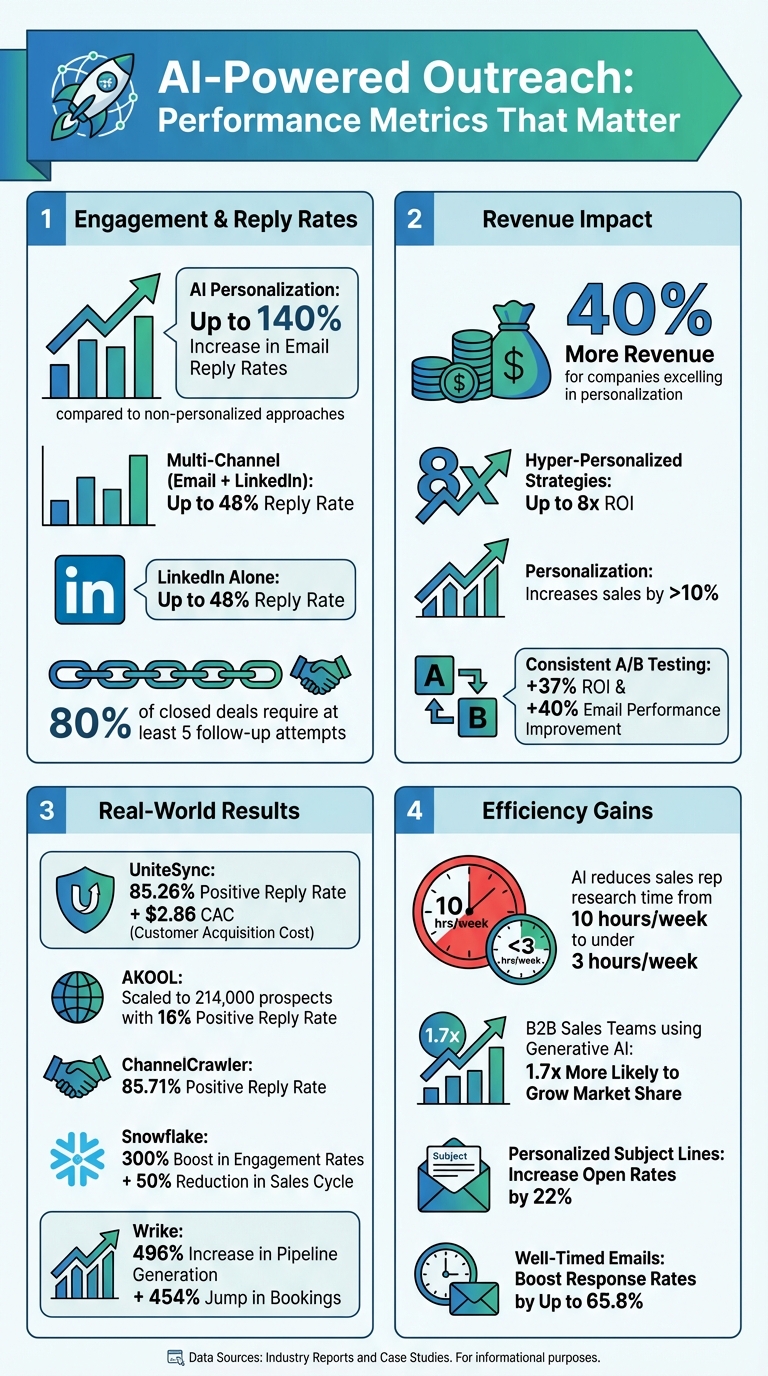
- AI personalization boosts email reply rates by up to 140%.
- Multi-channel outreach (email + LinkedIn) can achieve reply rates as high as 48%.
- Companies like UniteSync lowered customer acquisition costs to $2.86 using AI tools.
- AI streamlines workflows, saving sales teams hours each week. Many organizations also explore top agencies to further optimize their outreach strategies.
AI-Powered Outreach: Key Statistics and ROI Metrics
What Dynamic Content Is and Why It Matters
Dynamic content takes personalization to the next level by tailoring messages based on a recipient’s role, industry, recent updates, or even their LinkedIn activity. Unlike basic mail-merge tactics, it digs deeper to address each prospect’s unique situation.
In the past, outreach strategies often involved sending generic templates to massive lists, hoping something would stick. Dynamic content flips this approach, focusing on precision and relevance rather than sheer volume. Take Snowflake, for example. By leveraging the Terminus ABM platform to create content tailored to specific enterprise industries and their pain points, they saw a 300% boost in engagement rates and managed to cut their sales cycle in half.
Now, let’s break down how static and dynamic content differ when it comes to cold outreach.
Static vs Dynamic Content in Cold Outreach
Static content relies on basic placeholders like {{First_Name}} or {{Company}} to create a one-size-fits-all message. While this approach might save time, it lacks the flexibility to truly engage recipients and often ends up triggering spam filters.
Dynamic content, on the other hand, takes a smarter approach. AI tools analyze each prospect's activity - such as recent funding announcements, job changes, or LinkedIn posts - and craft messages that feel genuinely personalized. For example, UniteSync used Salesforge's AI platform to identify music creators with unclaimed royalties. By combining automated workflows with personalized audit lead magnets, they achieved an 85.26% positive reply rate and kept their Customer Acquisition Cost at just $2.86. As their CEO Carlos Palop Moliner noted:
"Our tech identifies music creators with unclaimed royalties... but cold email only works when it lands. That's where Salesforge and Mailforge have made the difference".
Dynamic content also improves email deliverability. While static templates often get flagged as spam, dynamic approaches create unique variations in greetings, calls-to-action, and body text, making it easier to bypass spam filters.
This shift highlights the growing role of AI in maximizing personalization and its benefits.
Benefits of Using AI for Dynamic Content
Hyper-personalization isn’t just a buzzword - it’s a proven revenue driver. Companies that excel in tailored outreach can generate 40% more revenue from these efforts compared to their competitors. AI makes this possible by quickly researching and crafting personalized messages for thousands of prospects, a feat that would be nearly impossible to achieve manually. This efficiency allows teams to scale their outreach without sacrificing quality.
AI also streamlines workflows. Tasks that might take sales reps 10 hours a week can be reduced to under 3 hours with AI-powered tools. This frees up time for sales teams to focus on meaningful conversations with high-value leads. The results speak for themselves: hyper-personalized strategies can deliver up to 8x ROI and increase sales by more than 10%. For instance, Wrike used an AI chatbot to qualify leads, which led to a 496% increase in pipeline generation and a 454% jump in bookings.
How to Generate Personalized Email Content with AI
AI can transform bland, generic emails into meaningful, tailored conversations. By providing AI with precise data - like job titles, company updates, or LinkedIn activity - you enable it to craft messages that address specific challenges instead of sending out one-size-fits-all pitches.
Tools like Salesforge use dynamic tags such as #{{first_name}} and #{{company}} to automatically personalize emails with recipient details. For deeper customization, AI can analyze signals like recent funding announcements, job changes, or social media posts. The results speak for themselves: personalized AI-driven emails have been shown to increase reply rates by 140%. With that in mind, let’s explore how to refine subject lines and openers to maximize engagement.
Creating Personalized Subject Lines and Openers
Subject lines are the gateway to your email - they determine whether it gets opened or ignored. AI can analyze prospect data to create subject lines that resonate with specific audiences, moving beyond generic hooks.
Start by segmenting recipients based on job title or industry. This allows AI to tailor subject lines to their unique priorities. For example, executives might respond to subject lines focusing on ROI or strategic goals, while managers may be drawn to topics about improving efficiency or team productivity. AI can even incorporate recent LinkedIn activity or company milestones into the subject line, such as: "I noticed your recent post about #{{topic}}", creating the impression of a personalized, well-researched email.
Technical setup plays a critical role here. Use dynamic fields to seamlessly insert prospect-specific details and generate multiple variations of the same message to avoid spam filters that flag repetitive templates. This strategy has proven effective - ChannelCrawler achieved an 85.71% positive reply rate by running small, highly targeted campaigns with Salesforge’s spintax and inbox management tools. Once you’ve nailed the subject line, it’s time to focus on the email body.
Writing Dynamic Email Body Content
AI can craft email body content that connects on a personal level by analyzing a prospect’s pain points and interests. A proven approach is the SPARK Method: reference specifics, connect personally, add insights, include social proof, and maintain a conversational tone.
Keep your email body concise - aim for 50-70 words to maximize impact. The call-to-action should align with the recipient’s role. For decision-makers, suggest scheduling a call, while managers might prefer reviewing a case study. For example, UniteSync applied similar strategies and achieved an 85.26% positive reply rate through automated, personalized outreach.
Timeliness is key. Use intent signals - like funding announcements, job changes, or recent LinkedIn activity - to ensure your outreach feels relevant. Data enrichment tools like Clearbit or Lusha can provide AI with detailed insights, such as company revenue or recent achievements, enabling you to add context that generic templates simply can’t match. By refining your email content with these tactics, you’ll lay the groundwork for expanding your outreach across multiple channels.
How to Execute Multi-Channel Outreach with AI
Using AI to personalize email outreach is just the beginning. To truly connect with prospects, you need to engage them across multiple platforms. Why? Because people don’t stick to just one channel. AI can help you synchronize your messaging across platforms like email and LinkedIn, ensuring your outreach feels like a seamless conversation.
Multi-channel outreach works by creating sequences where every interaction builds on the previous one. AI analyzes prospect behavior and triggers messages at the right moments. For example, LinkedIn outreach, when done effectively, can yield reply rates as high as 48%. Plus, B2B sales teams using generative AI are 1.7 times more likely to grow their market share. Let’s break down how AI customizes messaging and makes the most of each platform.
AI-Driven Multi-Channel Sequencing
AI doesn’t just send messages - it decides the when and where based on your prospect’s actions. It picks up on intent signals like job changes, funding announcements, or profile views, and triggers messages at the most relevant times. For instance, if a prospect gets a promotion, AI could send a congratulatory LinkedIn message followed by a targeted email offering solutions tailored to their new role.
Timing is critical. Research shows that 80% of closed deals require at least five follow-ups, and a well-timed email can boost response rates by up to 65.8%. To avoid overwhelming prospects with too many triggers, AI can prioritize high-value signals, like profile views, while holding off on less urgent ones. Tools like Salesforge streamline this process with features like Primebox, which consolidates responses from email and LinkedIn into one inbox. The AI even categorizes replies as positive, neutral, or objections, helping you focus on the most promising leads.
"Outreach at our scale requires speed, segmentation, and precision - Salesforge gave us the infrastructure to do it all at once." - AKOOL Team
Now that we’ve covered sequencing, let’s look at how AI can refine your LinkedIn outreach.
Applying Personalization to LinkedIn Outreach
LinkedIn outreach requires a personal touch. Connection requests and messages should feel genuine and conversational, not like a sales pitch. Just as AI tailors email content, it can also create LinkedIn messages that feel relevant and timely. By analyzing a prospect’s recent activity - like posts, job changes, or mutual connections - AI crafts messages that reference specific details instead of generic templates.
One effective framework is the SPARK Method:
- Specific reference: Mention something like a recent post or achievement.
- Personal rapport: Build a connection by addressing shared interests or goals.
- Add value: Share insights or offer help that’s relevant to them.
- Relevant social proof: Highlight examples of similar success stories.
- Keep it conversational: Avoid sounding overly formal or pushy.
For example, instead of saying, “I’d love to connect,” you could write: “I noticed your post about scaling outbound efforts - we helped another client achieve great results with personalized sequences. I’d love to share what worked.”
Salesforge takes LinkedIn outreach a step further by enabling unlimited senders, so you’re not restricted by seat-based pricing. A great example is UniteSync, which achieved an 85.26% positive reply rate and a $2.86 customer acquisition cost (CAC) by combining Salesforge’s email and LinkedIn capabilities to target music creators with unclaimed royalties. According to CEO Carlos Palop Moliner, this approach helped them onboard 4-5 new creators daily by automating multi-channel outreach. Similarly, VAI Consulting used Agent Frank to generate three qualified calls in one week by running automated tests across both channels.
To keep your outreach effective, sync your messaging across platforms. If a prospect replies on LinkedIn, use conditional logic to pause or adjust the email sequence, avoiding redundant follow-ups. This ensures your communication stays coordinated, relevant, and responsive to real-time interactions.
How to Optimize Dynamic Content with AI Insights
Creating dynamic content is just the beginning - ongoing optimization is what keeps your outreach effective and relevant. The real strength of dynamic content lies in its ability to evolve, driven by real-time performance data. For instance, consistent A/B testing can lead to a 37% increase in ROI and a 40% improvement in email performance.
Think of optimization as a continuous process. AI tools analyze how prospects respond to different elements - like subject lines, email copy, or CTAs - and provide actionable insights almost instantly. Instead of waiting weeks for results, you can fine-tune your campaigns in as little as 24–72 hours based on real engagement data. This is especially impactful for high-volume campaigns, where even minor tweaks can lead to significant cumulative gains. This sets the stage for precise A/B testing and quick adjustments.
A/B Testing Dynamic Content Variations
AI-powered A/B testing helps you refine key elements like subject lines, CTAs, and even timing. For example, comparing a straightforward CTA like "Book a call" with a softer one like "Worth a chat?" can help you identify which approach resonates better with your audience. Similarly, testing subject lines that highlight benefits versus those designed to spark curiosity can increase engagement by about 7%.
For reliable results, aim for test groups of at least 1,000 to 5,000 prospects. Smaller sample sizes can produce misleading data, where random patterns might seem like trends. Additionally, give your tests 24–72 hours to capture a full response cycle before drawing conclusions.
AI also allows you to experiment with personalization. For instance, simply using a prospect’s name versus referencing a recent achievement can boost open rates by 22%. Platforms like the Growth Plan offer scalable A/B testing tools while ensuring deliverability through features like Warmforge integration.
But testing variations is just one part of the equation. Real-time performance monitoring can take your strategy to the next level.
Using Real-Time Performance Data
AI doesn’t just test - it monitors and adjusts in real time. Tools like Salesforge use sentiment analysis to identify high-intent leads, ensuring your team focuses on prospects who are ready to engage rather than wasting time on low-priority responses like "out of office" replies.
Take AKOOL, for example. They scaled their outreach to over 214,000 prospects while maintaining a 16% positive reply rate, thanks to Salesforge’s AI-driven segmentation and real-time monitoring. Their team shared:
"Outreach at our scale requires speed, segmentation, and precision - Salesforge gave us the infrastructure to do it all at once".
When analyzing performance, prioritize metrics that matter, such as positive reply rates, inbox placement rates, bounce rates, and meeting booking rates. AI also enables cross-channel synchronization. For example, if a prospect visits your LinkedIn profile after receiving an email, you can trigger a same-day LinkedIn message to stay top-of-mind. This kind of real-time adaptability turns data into action, ensuring your outreach remains timely and effective.
How to Ensure Email Deliverability for AI-Generated Content
Creating dynamic, AI-driven content is only half the battle. If your emails don’t make it to the inbox - or worse, get buried in spam - your efforts won’t pay off. The real success lies in bridging the gap between "delivered" and "seen", ensuring your emails are not just sent but actually read.
To achieve this, you need a solid sender reputation and proper technical setup. In 2024, UniteSync, under CEO Carlos Palop Moliner, showcased the power of these fundamentals. They achieved an impressive 85.26% positive reply rate and a $2.86 Customer Acquisition Cost (CAC) by ensuring their emails consistently landed in the primary inbox.
"Cold email only works when it lands. That's where Salesforge and Mailforge have made the difference."
Building a strong technical and reputational foundation is the cornerstone of making AI-generated email campaigns effective.
Email Warm-Up and Reputation Management
Before diving into full-scale campaigns, warming up your email accounts is crucial. Over a span of 2–4 weeks, gradually increase email volume - from as few as 4 emails per day to around 50. This slow buildup signals high engagement to email service providers (ESPs). A continuous warm-up process is essential to maintain a healthy sender reputation. Ideally, limit each mailbox to about 50 daily emails, split between 20 warm-up emails and 30 cold outreach emails.
Salesforge’s Warmforge simplifies this process with automation. Unlike tools that rely on external SMTP vendors, Warmforge uses a closed-loop system with a premium pool of healthy mailboxes. This ensures a stable environment for warming up accounts. It also monitors domain health, runs inbox placement tests, and alerts you to potential issues before they affect performance. To maintain a strong reputation, conduct inbox placement tests weekly or monthly. If bounce rates exceed 5%, replace the domain immediately. Keeping bounce rates below 2% is ideal for optimal deliverability.
Technical Setup for Deliverability
Once your reputation is in good shape, the next step is nailing the technical setup. Without proper configuration, your emails risk failing authentication checks, making them more likely to be flagged as spam. Focus on setting up SPF, DKIM, and DMARC records correctly - these are non-negotiable. For instance, ensure your domain has only one SPF record, as multiple records can lead to authentication errors.
While manual setup can be tedious, tools like Mailforge make this process much simpler. With features like one-click DNS record updates, Mailforge reduces setup time to just a few minutes, saving you both time and effort.
To further protect your domain’s reputation, use a custom tracking domain for monitoring opens and clicks instead of relying on your sending platform’s default domain. Additionally, stick to plain text or minimal HTML formatting, as overly complex designs can negatively impact deliverability.
Another effective tactic is ESP matching. Tools like Primeforge can match your email provider to your recipient’s (e.g., sending from Google to a Gmail user), increasing the chances of landing in their primary inbox.
Conclusion
AI-driven dynamic content has changed the game for cold outreach. By using real-time data - like job changes, company updates, and prospect behavior - you can transform generic messages into personalized, meaningful conversations at scale across email and LinkedIn. Here’s a key stat to keep in mind: 80% of closed deals require at least five follow-up attempts.
To truly stand out, take AI personalization a step further. Combine multiple data points - such as job titles, company announcements, and LinkedIn interactions - to create outreach that feels relevant and human. Tools like Salesforge make this seamless by managing everything from AI-powered personalization and multi-channel sequencing to ensuring your emails land in inboxes, all within one platform.
The results speak volumes. In 2024, AKOOL scaled their outreach to over 214,000 prospects using Salesforge's system, maintaining a positive reply rate of over 16%. UniteSync achieved an 85.26% positive reply rate while slashing their Customer Acquisition Cost to just $2.86. Meanwhile, VAI Consulting booked three sales calls in just one week with Agent Frank, Salesforge's AI SDR that autonomously handles prospecting and personalized messaging. These numbers highlight the power of AI in driving smarter, more efficient outreach.
FAQs
How can AI enhance email deliverability for outreach campaigns?
AI brings a new level of precision to email deliverability by crafting unique and personalized content tailored to each recipient. This approach reduces the risk of triggering spam filters often associated with repetitive templates. It also fine-tunes critical elements like subject lines and sending schedules while regularly validating email lists to maintain their accuracy.
Beyond that, AI tools help by warming up domains and mailboxes, keeping your sender reputation in check, and aligning with ever-evolving best practices. These capabilities work together to ensure your emails land in inboxes, making outreach campaigns more dependable and impactful.
What’s the difference between static and dynamic content in outreach?
Static content is like sending the same message to everyone, regardless of who they are. It might include a basic touch of personalization, like adding the recipient's name to a template, but that’s about it. The result? It often feels impersonal or generic, which can lead to lower engagement rates and even flagging by spam filters.
Dynamic content flips the script. Powered by AI, it adapts each message in real time, drawing on details like a prospect’s LinkedIn activity, their industry, or recent actions. This means every outreach feels tailored specifically to the recipient. Tools like Salesforge make this process seamless by adjusting tone, value propositions, and follow-ups automatically. The result? Higher open and response rates, all while keeping personalization scalable.
To put it simply, static outreach may be easier, but dynamic outreach leverages AI to make every interaction feel personal and relevant, delivering far better outcomes.
How does AI-driven multi-channel outreach improve engagement rates?
AI-powered multi-channel outreach enhances engagement by providing a smooth, personalized experience across platforms like email and LinkedIn. Instead of sending out generic messages, AI leverages data - such as LinkedIn activity and previous interactions - to create customized content for each platform. Emails come across as personal and direct, while LinkedIn messages add a conversational touch, building a cohesive and engaging narrative.
What’s more, AI fine-tunes timing by predicting when prospects are most likely to respond. This ensures follow-ups remain relevant and timely without overwhelming recipients. By combining the broad reach of email with LinkedIn’s higher response rates, teams can see a noticeable improvement in overall engagement. Tools like Salesforge make this process even easier, automating personalized messaging, scheduling, and deliverability management, so teams can achieve better results with less effort.