The Head of Sales Enablement ensures sales teams are equipped with the right tools, training, and resources to boost performance and revenue. This role bridges sales, marketing, and product teams while focusing on streamlining workflows, reducing inefficiencies, and driving measurable outcomes. Companies with formal sales enablement programs report higher win rates, shorter ramp times, and better quota attainment.
Sales enablement leaders play a critical role in transforming sales teams into revenue drivers. Let’s explore the details.
The Head of Sales Enablement plays a crucial role in driving sales success by focusing on training, refining technology, and establishing performance metrics. These efforts ensure that sales teams spend more time selling and less time navigating inefficiencies.
Successful training programs begin with a clear revenue goal - like increasing deal size by 20% or reducing ramp times - and are designed to address specific skill gaps. To identify these gaps, the Head of Sales Enablement conducts thorough needs assessments using sales call reviews, performance data, and direct feedback from sales reps.
Modern training methods prioritize bite-sized, CRM-integrated modules delivered at the moment of need. For example, if a rep moves a deal into the negotiation phase, they might instantly access a short video on handling pricing objections. This "learning in the flow of work" approach ensures that training is practical and immediately applicable.
Beyond onboarding, companies with advanced enablement strategies are 36% more likely to reduce ramp-up times through data-driven training. Ongoing coaching frameworks - such as structured playbooks for front-line managers - help transform one-off training sessions into continuous skill development.
"Enablement in leading organizations is tasked with true capability building - and not simply relegated to onboarding and training." - Harvard Business Review
Choosing the right sales tools starts with identifying a clear revenue goal. Integrating these tools into the CRM allows reps to seamlessly access training, content, and coaching without switching systems. With 81% of sales executives citing content search and usage as major productivity challenges, enablement leaders tackle this by implementing platforms that organize materials based on the buyer’s journey and track the impact of assets on deal closures. Regular audits ensure that content libraries remain relevant and efficient.
To streamline operations, many enablement leaders consolidate their tech stacks, opting for unified platforms that combine training, content management, and engagement tools. For instance, platforms like Salesforge automate routine tasks while keeping buyer interactions personalized. Conversation intelligence tools such as Gong analyze sales calls, highlighting coachable moments that help teams proactively address skill gaps.
Defining clear KPIs transforms enablement from a support function into a revenue driver. The Head of Sales Enablement establishes metrics that directly link enablement efforts to business outcomes, such as quota attainment, win rates on forecasted deals, average deal size, and time-to-productivity for new hires.
Companies with formal enablement programs see a 49% win rate compared to 42.5% for those without, and turnover rates drop by 59%. These results not only highlight the value of enablement but also help justify increased budgets - Gartner predicts sales enablement budgets will grow by nearly 50% between 2024 and 2028.
In addition to revenue-focused KPIs, tracking leading indicators like program adoption rates, content engagement, and certification completion provides insights into how effectively resources are being used. For example, if a new sales playbook isn’t being utilized, the Head of Sales Enablement can investigate barriers and adjust the delivery to boost engagement.
<script>(function(d,u,ac){var s=d.createElement('script');s.type='text/javascript';s.src='https://a.omappapi.com/app/js/api.min.js';s.async=true;s.dataset.user=u;s.dataset.campaign=ac;d.getElementsByTagName('head')[0].appendChild(s);})(document,372145,'tu1or50rqqejh816h1cm');</script>
Being a Head of Sales Enablement goes far beyond managing a sales team. It requires a strategic mindset, sharp analytical skills, and a solid grasp of technology. This role serves as the "connective tissue" that aligns sales, marketing, product, and operations teams around shared revenue objectives. Simply put, success means driving collaboration and ensuring everyone is working toward the same goals.
One of the most important traits for this role is the ability to build alignment among senior leaders. Turning high-level business goals into actionable sales strategies requires clear communication and the ability to unite different teams. For instance, when rolling out a new sales methodology, involving sales reps early on can secure their buy-in and make the transition smoother.
Another critical skill is emotional intelligence. Great leaders use empathy and active listening to navigate the challenges that come with change. Whether introducing new tools or processes, they focus on explaining the "why" behind the changes and implementing them in stages to show quick wins and build momentum.
"The Head of Sales Enablement is not just a leadership role, but a catalyst for change and growth within an organization." - FullEnrich
This leadership style naturally extends into data-driven decision-making and long-term planning.
Data-driven decision-making is what turns sales enablement into a true revenue driver. Leaders in this role set measurable goals - like increasing the average deal size by 20% - and then reverse-engineer the steps needed to achieve them. This often involves digging into CRM data, analyzing call recordings, and reviewing performance metrics to understand what sets top performers apart.
Technology plays a huge role here. Companies that use modern tools for sales training are 50% more likely to improve quota attainment. Effective leaders focus on initiatives that deliver the most impact, such as shortening the onboarding period for new hires or making it easier for reps to find sales content. The big question shifts from "What are we teaching our reps?" to "What measurable business value does our training provide?" Regularly reviewing data ensures that enablement efforts are tied to actual revenue outcomes.
This focus on data and results naturally ties into mastering the tech tools that drive modern sales enablement.
At the heart of sales enablement technology is the CRM - platforms like Salesforce and HubSpot are indispensable for managing customer data. But today's enablement leaders need to go beyond the basics. They should be familiar with a full tech stack, including AI-driven tools that automate repetitive tasks while keeping interactions with buyers personal. The sales enablement platform market is expected to grow from $6.38 billion in 2025 to $29.18 billion by 2035, driven by advancements in AI and analytics.
Tools like Salesforge allow for large-scale, multi-channel outreach without losing the personal touch, while conversation intelligence platforms analyze sales calls to uncover coaching opportunities. The goal is to create an integrated system where all tools connect seamlessly with the CRM, reducing inefficiencies. After all, disorganized content can cost sales reps up to 440 hours annually. To avoid this, leaders should regularly audit their tech stack by gathering feedback from reps and ensuring that tools are both effective and actively used, rather than sitting idle.

Career Path to Head of Sales Enablement: Timeline and Salary Progression
The journey to becoming a Head of Sales Enablement typically spans over a decade, transitioning from hands-on roles to strategic leadership. Many professionals begin by honing their skills in sales, operations, or marketing before moving into specialized enablement positions. The reward? Executive-level roles in this field often come with salaries ranging from $160,000 to $200,000 per year. Let’s take a closer look at the starting roles that lay the groundwork for these high-level positions.
Early roles like Sales Representatives (SDRs or Account Executives) and Sales Operations Analysts provide invaluable experience. These positions develop frontline expertise and analytical abilities. Others may start their journey in Marketing or Content Creation, where they build complementary skills.
After gaining 3 to 5 years of experience in these foundational roles, many professionals transition into positions like Sales Enablement Coordinator or Specialist. At this stage, the focus shifts to tasks such as delivering training, curating sales content, and supporting the rollout of sales tools. Tracking measurable impacts becomes critical - whether it’s how a new pitch deck boosts win rates or how process adjustments shorten the sales cycle. This data-driven approach is essential, as companies with formal sales enablement functions report an average 6.7% increase in sales quota attainment.
With 5–8 years of experience, professionals often step into Sales Enablement Manager roles. These positions involve managing onboarding programs, shaping content strategies, and overseeing operational tasks, with salaries ranging from $80,000 to $110,000 per year. To ensure these critical onboarding workflows are supported by the best infrastructure, enablement leaders often coordinate with Workday recruiters to staff their teams with experts capable of managing complex HRIS integrations. While the work remains somewhat tactical, managers start to oversee cross-team projects and contribute to broader strategic initiatives.
After 8–12 years, many advance to Director-level roles. Here, the focus shifts to strategic planning and fostering alignment across departments to achieve shared revenue goals. Salaries at this level typically range from $120,000 to $150,000 per year. Key skills include mastering change management and overcoming resistance to new processes - essential abilities for those aiming to move into executive leadership.
The final step is reaching the Head or VP of Sales Enablement level. This role requires a shift from tactical execution to a broader strategic vision. Leaders at this stage build and manage teams, oversee budgets, and report directly to C-suite executives like the CEO, CRO, or CSO. Notably, organizations with well-established enablement functions report 12.5% higher revenue growth.
To make this leap, focus on demonstrating measurable business outcomes. Instead of just tracking metrics like training completion rates, highlight how your initiatives have directly impacted win rates, deal sizes, or ramp-up times. Earning certifications and cultivating strong relationships across departments can also strengthen your executive presence and showcase your expertise.
A well-rounded tech stack is the backbone of effective sales enablement. Sales engagement platforms play a pivotal role by amplifying pipeline impact and simplifying workflows. These modern tools integrate multi-channel outreach, connecting with buyers across email, phone, video, LinkedIn, and SMS. The challenge lies in choosing platforms that simplify processes rather than complicate them.
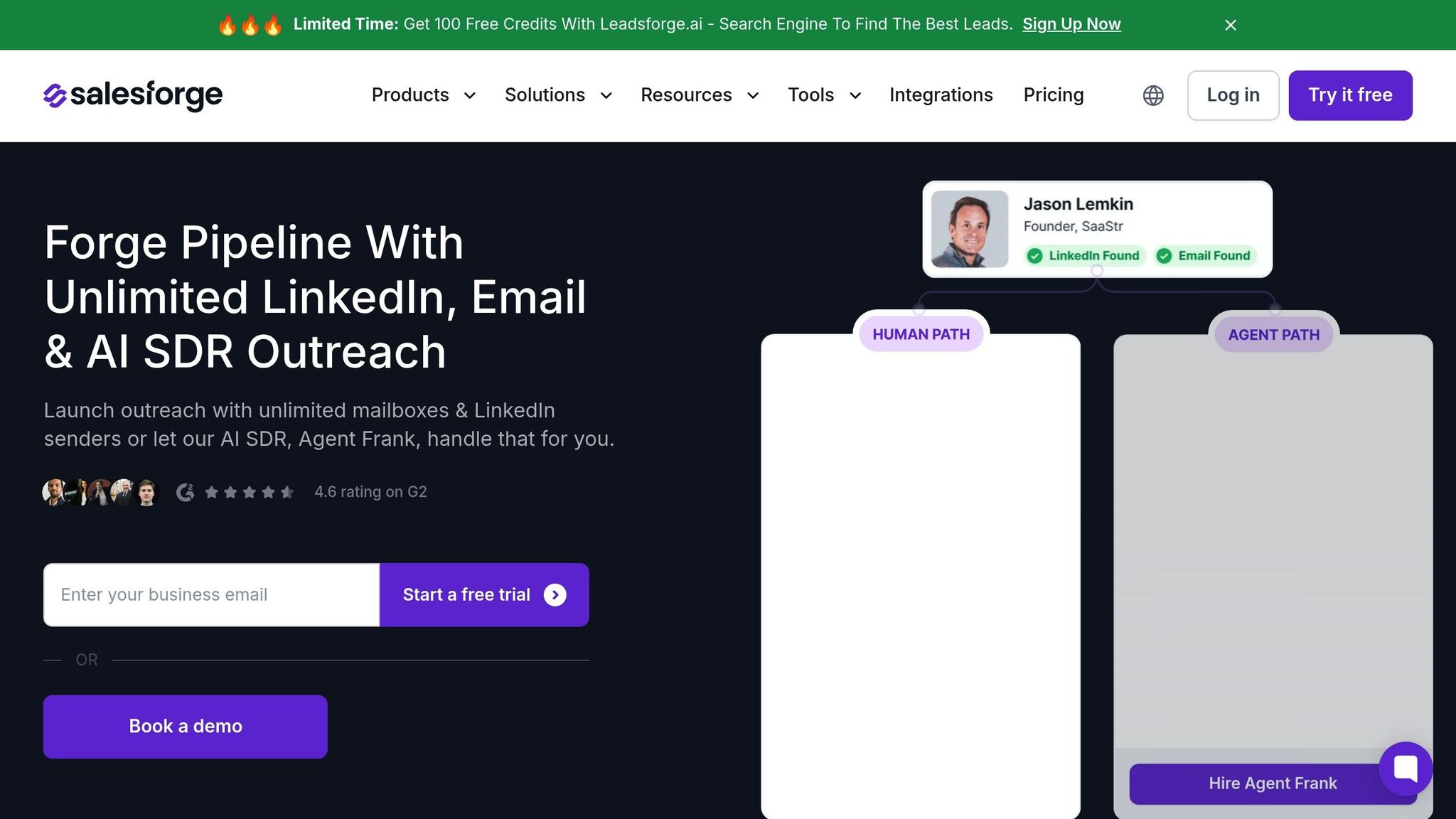
Salesforge is a standout solution in this space, leveraging AI to transform outreach efforts. It combines email and LinkedIn outreach with AI-driven hyper-personalization, enabling scalable, unique messaging. At the heart of this platform is "Agent Frank", an AI Sales Development Representative (SDR) that automates the entire sales process - from identifying leads to scheduling meetings. This automation addresses a major bottleneck, as sales reps often spend 72% of their time on non-selling tasks.
Salesforge’s Forge Stack tackles one of the most frustrating issues in outreach: email deliverability. With features like Infraforge (private email infrastructure), Mailforge (distributed sending), and Warmforge (email warm-up), the platform ensures emails land in inboxes rather than spam folders. This eliminates the need for external deliverability tools often required by traditional CRM systems. Pricing starts at $48 per month for email-only outreach or $96 per month for multi-channel capabilities. For those looking to maximize automation, Agent Frank costs $599 per month (billed quarterly) for managing 1,000 active contacts, equating to about $0.25 per contact processed.
Salesforge’s capabilities shine when compared to traditional CRM systems like Salesforce or HubSpot. CRMs are primarily designed as centralized data hubs to manage customer profiles and track sales activities. While they excel at organizing information, they often require extensive manual data entry and are not built to execute outreach campaigns. Salesforge, on the other hand, automates key processes like prospecting, deliverability, and outreach execution.
| Feature | Salesforge | Traditional CRM Systems |
|---|---|---|
| Primary Focus | Multi-channel outreach and pipeline growth | Centralized data management |
| Personalization | AI-driven hyper-personalization | Manual segmentation with basic templates |
| Data Entry | Automated lead identification | Requires significant manual input |
| Deliverability | Built-in warm-up and private infrastructure | Often needs third-party tools |
| Analytics | Real-time campaign insights | Historical sales metrics reporting |
| ROI Driver | Scales outreach without increasing headcount | Improves efficiency and data accessibility |
Businesses using Salesforce report a 44% boost in sales productivity, while companies adopting AI-driven personalization see revenue growth of 5–15%. The key distinction is that Salesforge focuses on initiating cold outreach, while CRMs are better suited for managing established relationships.
While Salesforge excels at outreach and automation, other tools round out a comprehensive sales enablement strategy. Platforms like Highspot organize sales collateral, training materials, and coaching resources. Email validation tools ensure clean contact data, reducing bounce rates before campaigns even begin. Analytics tools provide insights into the effectiveness of content and messaging, helping teams refine their approach.
To maximize efficiency, leaders should aim to consolidate their tech stack. Research shows that sellers using a unified platform for content, training, and coaching are 50% more likely to hit their quotas. The ultimate goal is to reduce the mental load on sales reps, ensuring they can focus on what they do best - selling.
The Head of Sales Enablement plays a critical role in driving revenue by connecting strategic goals with actionable execution. This position involves crafting a strategic enablement plan that aligns with the company’s revenue objectives, refining technology stacks to eliminate inefficiencies, and setting data-driven KPIs to track success. Organizations with well-established sales enablement functions often outperform others, with 76% of sales leaders attributing improved performance to their enablement investments.
A major shift in sales has occurred, with 74% of sellers now working in a consultative rather than transactional manner. To stay competitive, leaders must focus on continuous skill development through methods like bite-sized learning, AI-powered content tools, and fostering collaboration across departments - not just within the sales team.
These insights provide a strong foundation for those looking to step into sales enablement leadership roles.
If you’re aiming to lead in sales enablement, focus on creating measurable impact and embracing strategic technology integration.
To break into this leadership role, plan your career intentionally and aim for 5–10 years of cross-functional experience in areas like sales, marketing, or training. Build a portfolio that highlights your results - such as reducing ramp times, improving win rates, or shortening sales cycles.
Become adept with tools that power modern sales enablement. Beyond traditional CRMs, explore AI-driven platforms like Salesforge for automating outreach, conversation intelligence tools like Gong, and content management systems like Highspot.
Consider earning certifications such as the Certified Sales Enablement Professional (CSEP) to validate your expertise. Networking through industry events and professional organizations can also open doors to new opportunities.
Lastly, shift your perspective from a tactical mindset to a strategic one. Instead of focusing solely on what content or training is being delivered, ask, “What business value are we creating?” Transitioning to a Head of Sales Enablement role requires stepping away from day-to-day tasks and embracing a broader vision - managing budgets, aligning with long-term goals, and reporting directly to C-level executives. Companies that adopt this strategic approach often see productivity gains ranging from 15% to 31%.
A Head of Sales Enablement plays a crucial role in improving how a sales team operates. Their job revolves around providing the right tools, delivering meaningful training, and fine-tuning sales processes to help the team succeed. They also act as a bridge between sales, marketing, and product teams to ensure everyone is working toward shared revenue goals.
Some of their main responsibilities include managing tools like CRM systems, creating training programs to sharpen team skills, and streamlining workflows to make operations more efficient. This position calls for strong leadership, strategic planning, and a knack for using data to make decisions, all aimed at building a well-integrated, high-performing sales team.
To thrive as a Head of Sales Enablement, you’ll need a blend of strategic insight, data-driven thinking, and strong leadership. This role is all about uniting teams - sales, marketing, and product - around shared goals while boosting overall performance. A big part of the job involves crafting scalable enablement programs that can grow alongside the organization.
Key skills include data analysis for assessing performance metrics and refining processes, as well as coaching and communication to design effective training initiatives. Proficiency with sales tools, such as CRM systems and platforms like Salesforge, is crucial for keeping workflows efficient. On top of that, expertise in change management is essential to ensure teams smoothly adapt to new tools and processes. Together, these skills lay the groundwork for success in this pivotal leadership position.
The path to becoming a Head of Sales Enablement often begins with hands-on roles such as Sales Enablement Coordinator, Specialist, or Training Analyst. These early positions are all about creating content, managing onboarding programs, and equipping sales teams with the tools and resources they need to succeed. From there, many professionals step into a Sales Enablement Manager role, where responsibilities expand to include designing comprehensive training programs, using data insights to coach sales reps, and rolling out tools like CRM systems or platforms such as Salesforge.
Strong performance in a managerial role - demonstrated through improved sales rep productivity, higher adoption rates for tools, and measurable revenue growth - can open doors to senior or director-level positions. At this level, the focus shifts to more strategic work, such as collaborating with marketing and product teams, managing enablement budgets, and driving alignment across departments. Those who excel in these areas, combining leadership, strategic planning, and data-driven decision-making, often find themselves promoted to Head of Sales Enablement, where they are responsible for overseeing the entire enablement strategy and ensuring sales teams operate at peak efficiency.
What helps accelerate this career progression? Key factors include gaining expertise in a leading enablement platform like Salesforge, delivering clear and measurable ROI from enablement efforts, fostering strong cross-departmental relationships, and continuously sharpening leadership and analytical abilities.