I am seeing how AI is changing sales in real time, and the shape of the change matters.
Between the start of 2025 and the middle of 2026, the category crossed from AI that suggests things (draft this email, score this lead, summarize this call) to AI that actually does them (prospect, qualify, book meetings, and hand off the ones worth a human).
The tools built around that shift are running away with the market, and the ones that added a chatbot to a legacy product are falling behind.
You can see the shakeout in the news cycle:
Apollo removed native LinkedIn automation on January 30, 2026
Clay tore up its pricing on March 11, 2026 to split data credits from platform actions
Salesforce signed a definitive agreement in June 2026 to acquire Intercom's Fin for roughly $3.6 billion
That is the backdrop for this list.
I tested thirteen AI sales tools against real outbound workflows, pulled fresh G2, Trustpilot, and Capterra ratings, standardized every price to annual billing, and read the Reddit threads that keep showing up in the SERP.
The 13 tools below are ranked by how far up the "AI that acts" curve they land, and grouped so you can build a working sales stack instead of chasing a single tool.
TL;DR
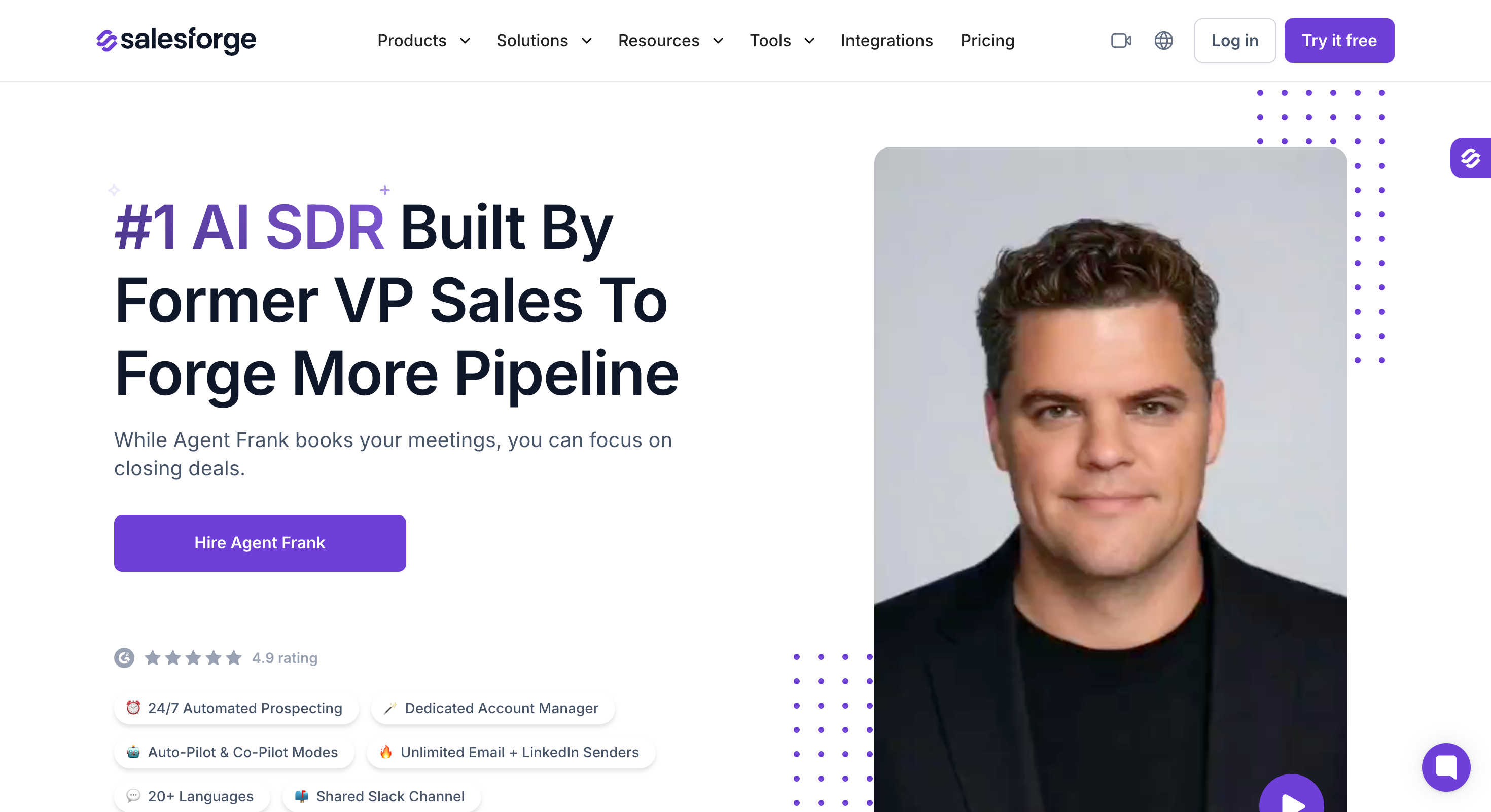
Agent Frank: Best AI SDR out there. Runs the full outbound loop autonomously across email and LinkedIn, sources prospects from a 500M+ contact search engine, writes personalized outreach in 20+ languages, sends from your mailboxes, and follows up on replies. Auto-Pilot for hands-off running, Co-Pilot for human approval before send. Every account includes a dedicated Account Manager. $499/month (billed annually); demo required to start.
Salesforge: Best AI multichannel outreach platform for email + LinkedIn together. Unlimited mailboxes and LinkedIn senders (no per-seat pricing), AI personalization with the Localized Greeting variable across 21+ languages, Primebox unified inbox for replies, and free premium warm-up via Warmforge included in every plan. Pro $40/month, Growth $80/month (both billed annually); 14-day free trial, no credit card required.
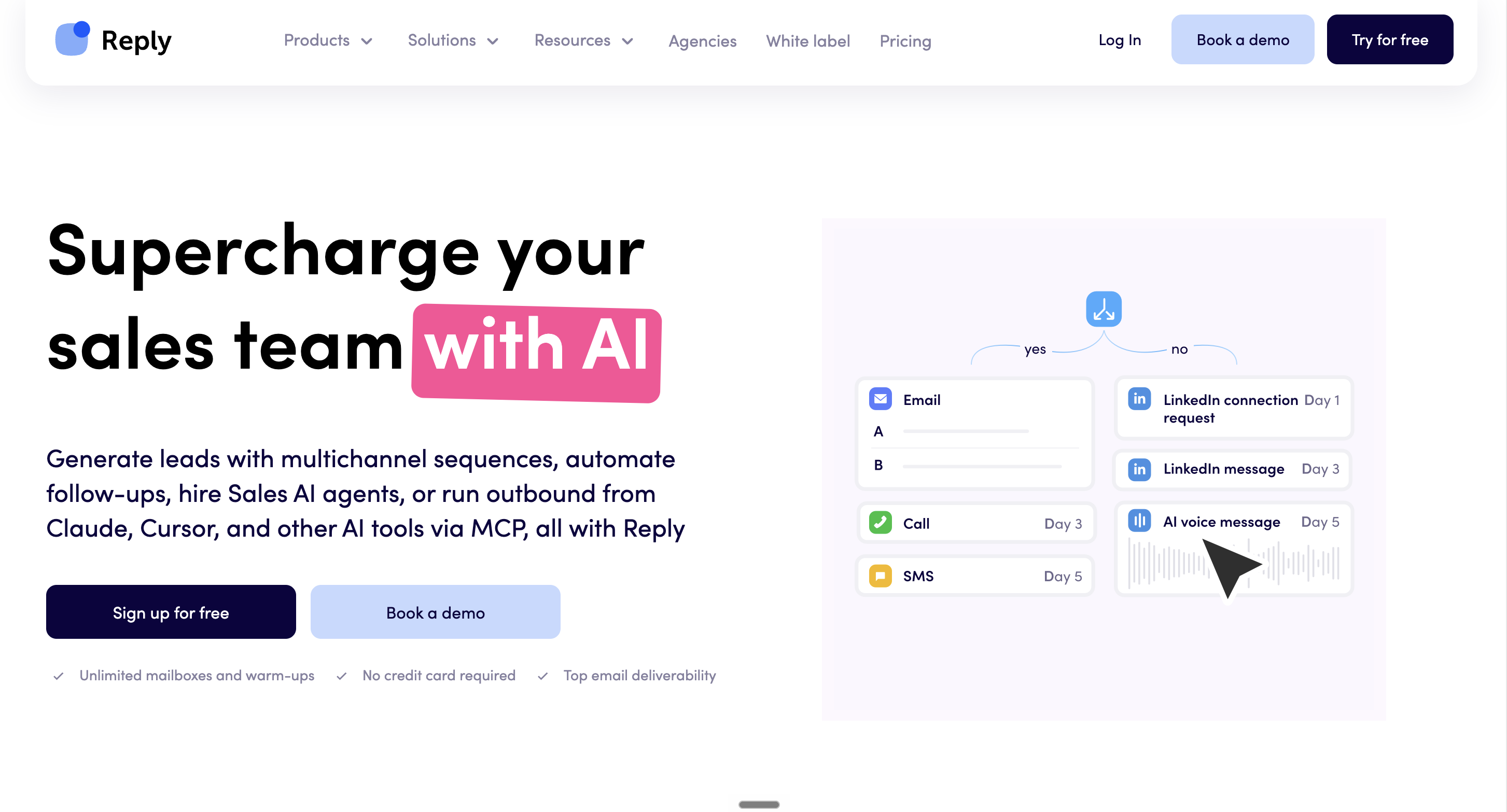
Reply.io: Best AI sales tool for multichannel outreach. Combines email, LinkedIn, calls, SMS, and WhatsApp in one sequence, while Jason AI SDR can find prospects, personalize messages, handle replies, and run outreach automatically. Email Volume from $49/user/month (billed annually).
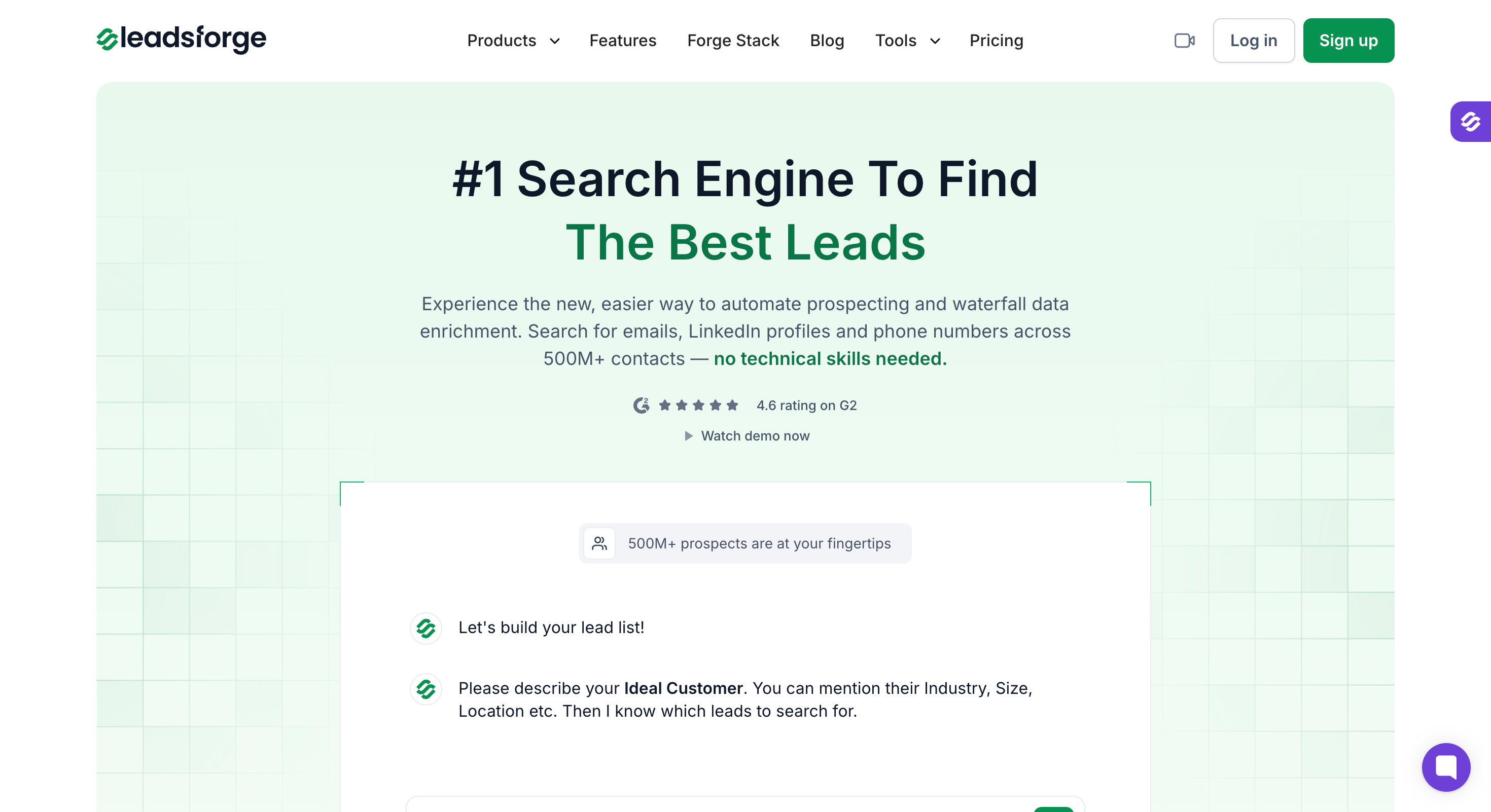
Leadsforge: Best AI B2B lead database with intent signals. Chat-based AI lead finder over 500M+ contacts, waterfall enrichment, and event-based Signals sourcing across four types (Job Change, Acquisition, Funding, Investor). Essential $49/month monthly or $588/year (billed annually); 100 free credits on signup, no credit card required.
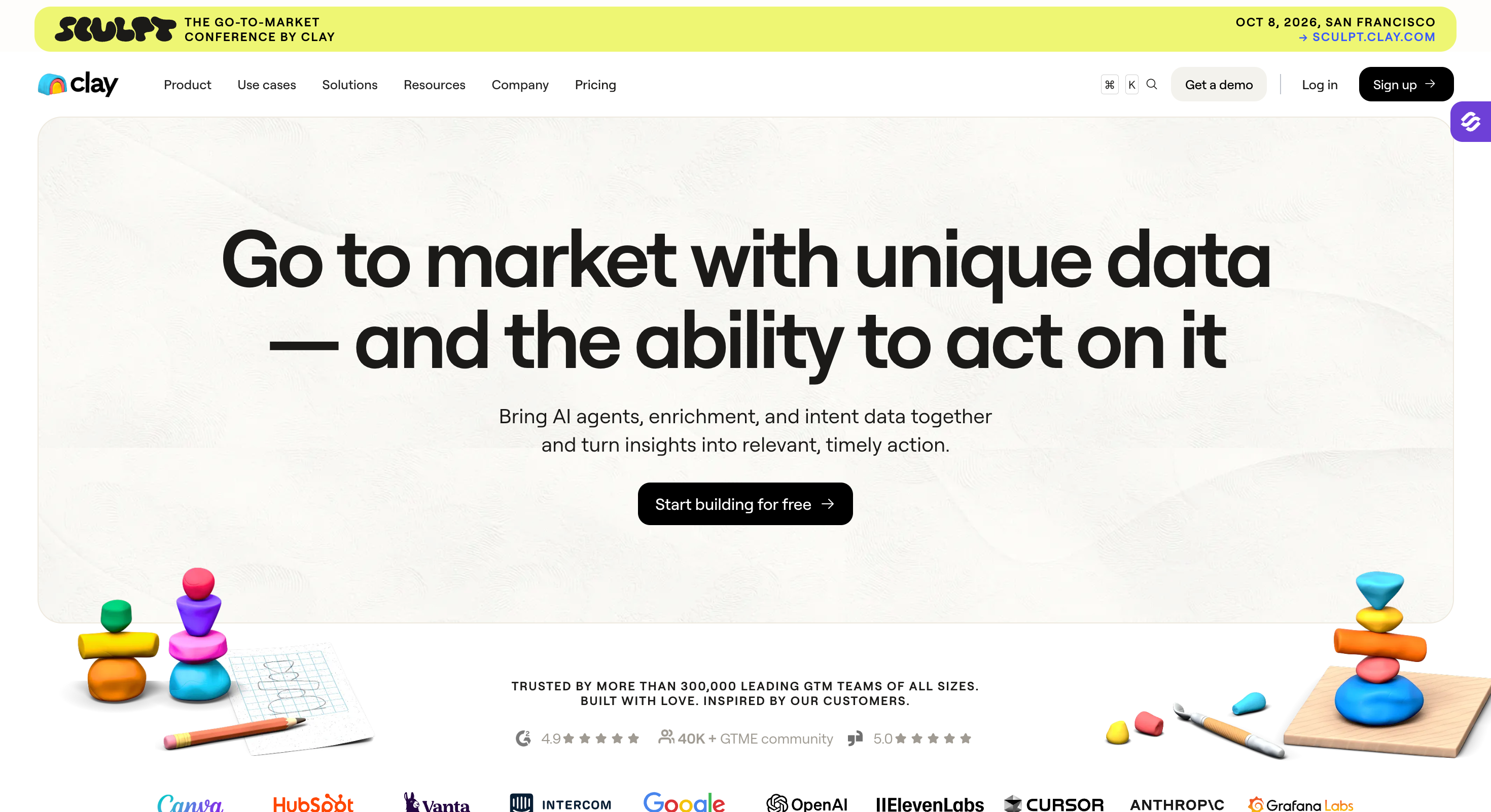
Clay: Best AI data enrichment tool for teams that want to build custom workflows. Pulls from 100+ providers and runs the Claygent AI research agent against results; steep learning curve. Launch tier $185/month monthly or $167/month billed annually.
Dialpad: Best AI cold calling tool. AI-enabled sales dialer with live Real-Time Assist coaching cards, sentiment scoring, and AI recaps built on 6+ billion minutes of conversation data. Essentials $39/user/month (billed annually, third-party reported).
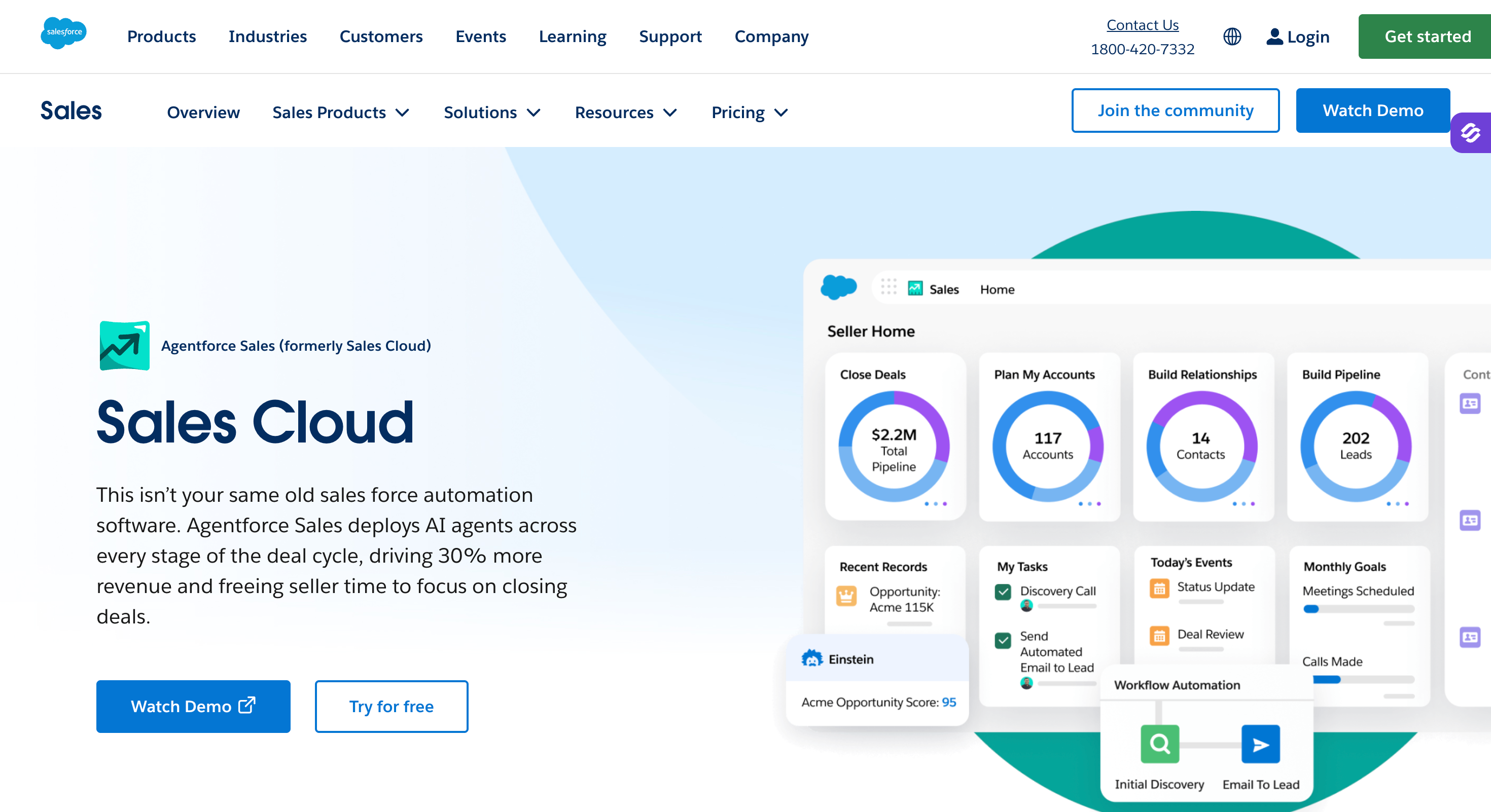
Salesforce Sales Cloud: Best CRM with AI agents for enterprise sales. The Agentforce autonomous Prospecting Agent ranks accounts by close propensity, and Agentforce 3 added native MCP client support. Starter Suite $25/user/month (billed annually).
Gong: Best AI revenue intelligence platform for post-call analytics at scale. Conversation intelligence and deal risk signals built on a Revenue Graph indexed across 5,000+ companies. Custom pricing, sales contact required.
Calendly: Best AI meeting scheduling tool. AI-powered routing pulls firmographic data before assigning a rep, plus round-robin distribution and the Calendly Notetaker beta for meeting summaries. Standard $10/seat/month (billed annually).
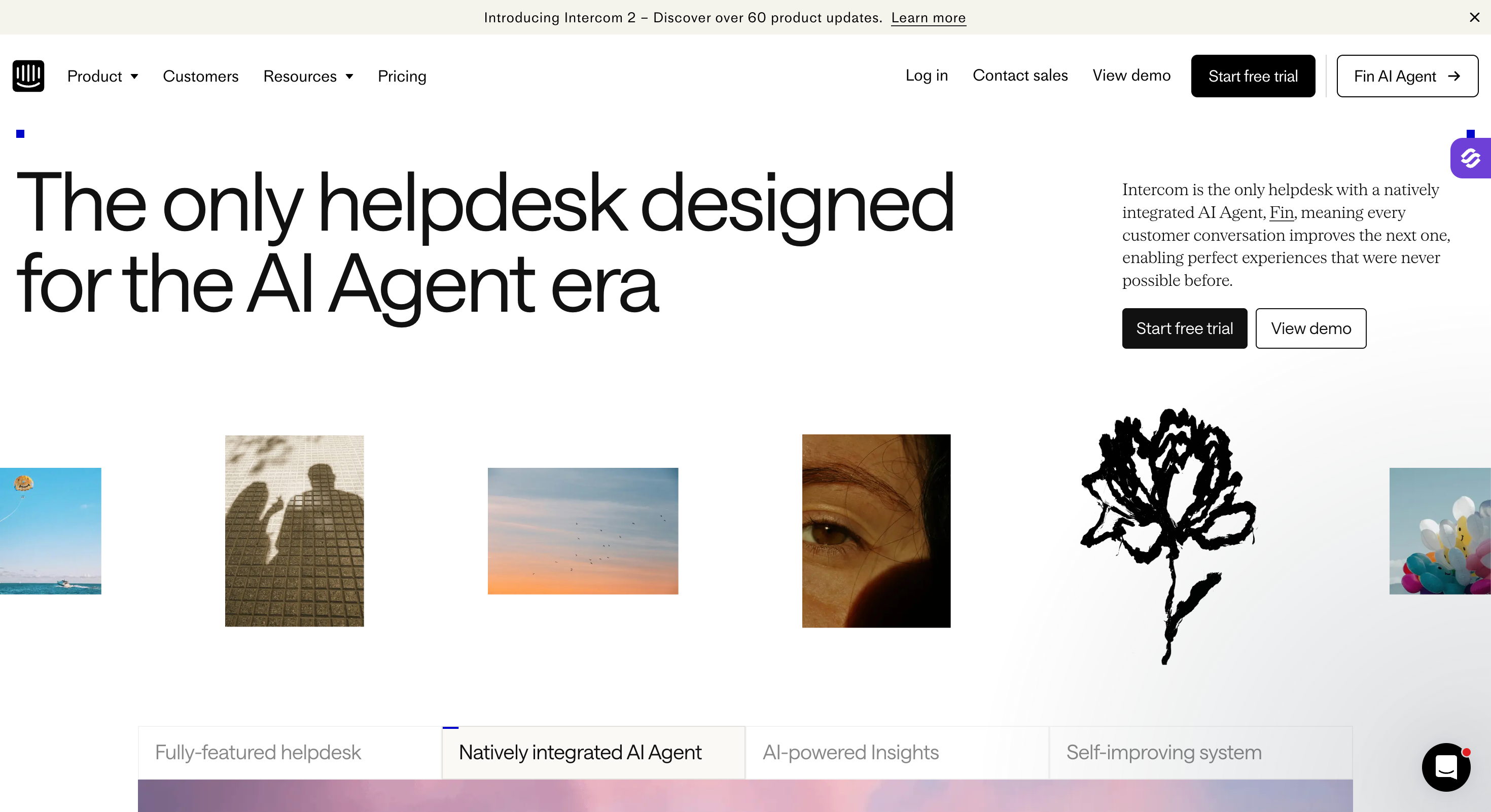
Intercom: Best AI inbound qualification chatbot. Fin AI Agent qualifies conversations across email, chat, voice, and social in 45+ languages, priced at $0.99 per resolution and $9.99 per qualification outcome. Essential $29/seat/month (billed annually).
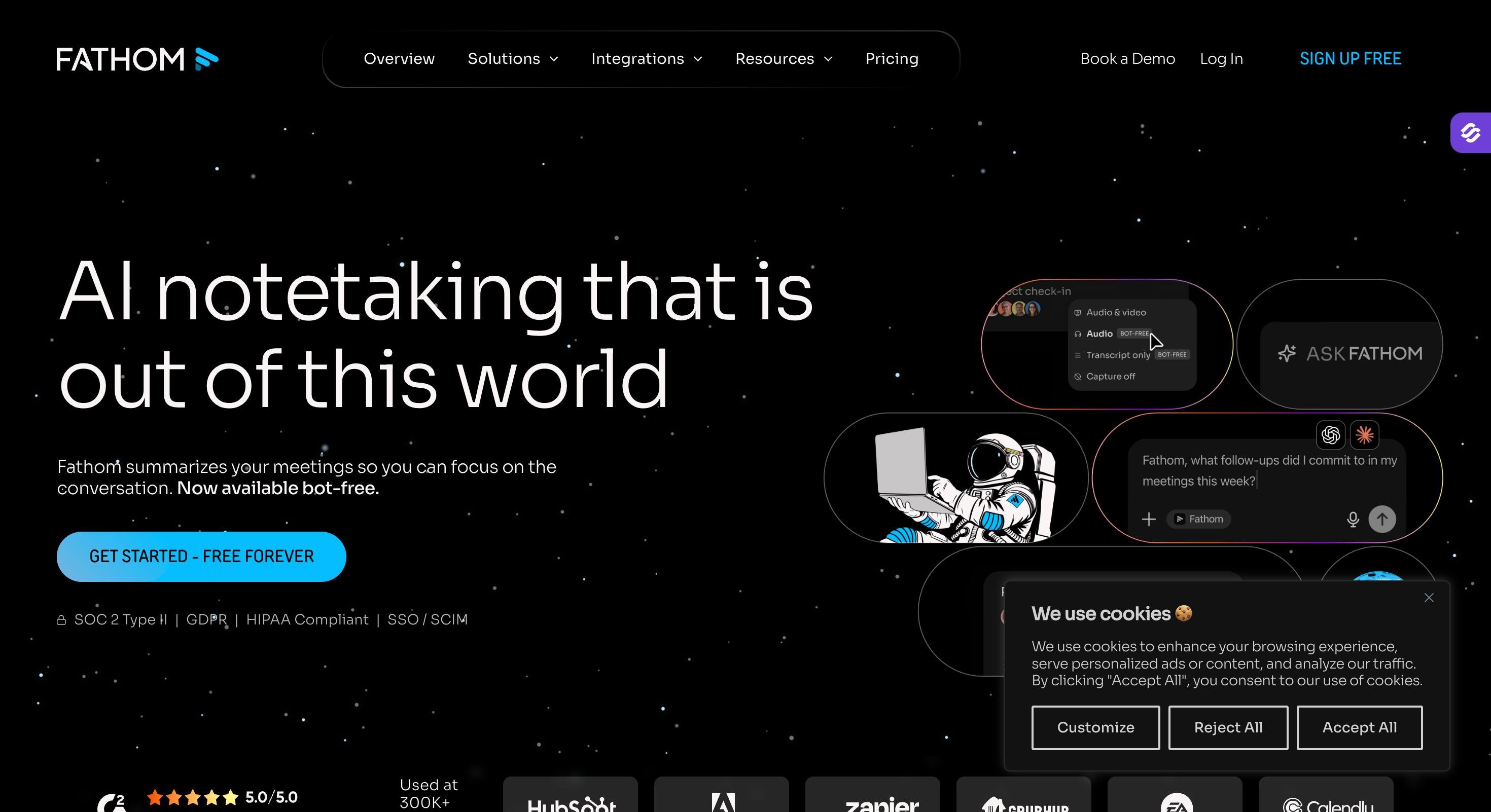
Fathom: Best AI meeting note taker (5.0 on G2 across 6,602 reviews). 30-second AI summaries across 15+ methodology templates plus the Ask Fathom conversational AI for querying your entire meeting library. Free forever with a 5-summaries-per-month cap; Premium ~$15/month (billed annually).
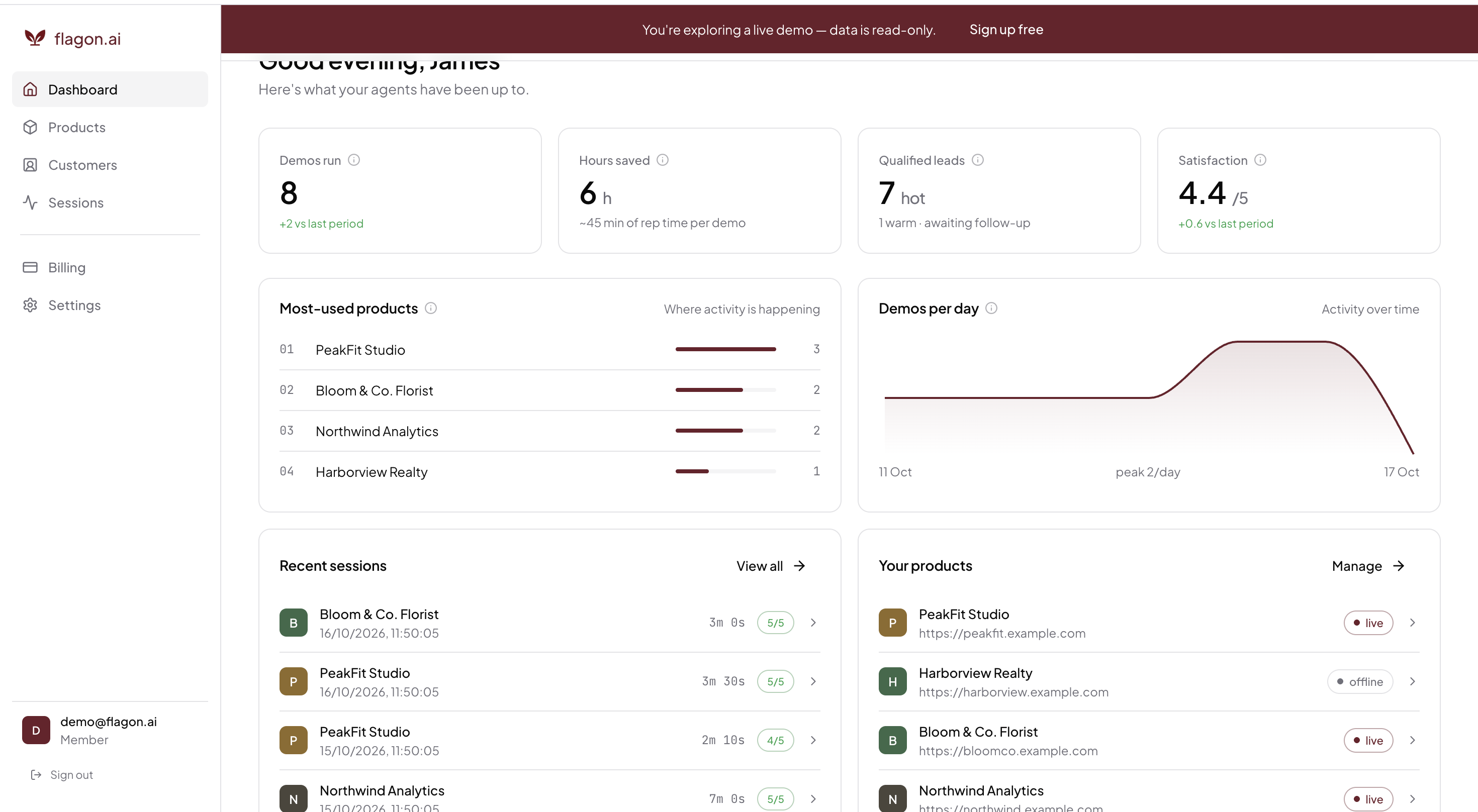
Flagon: Best AI interactive demo platform. Gives every prospect a personalized product demo without a sales call. Runs inside your website or app or through a shared link and scores each lead hot, warm or cold. Leads and full demo sessions sync to HubSpot, Salesforce, Slack or a webhook. Free trial with 100 demo minutes in your first month
Creatio: Best AI-powered CRM and sales automation platform. Combines CRM, workflow automation, forecasting, and AI agents for sales in a single platform. Features include lead and opportunity scoring, next-best-action recommendations, meeting preparation, AI Twin personal agents, and no-code workflow automation. Supports OpenAI, Anthropic, Gemini, and custom models through Creatio AI Studio. Starts at $40/user/month, with AI included.
How I Tested and Scored These 13 Tools
I ran each tool against real sales work, not a demo dataset.
For outbound tools (Agent Frank, Salesforge, Leadsforge, Clay), that meant connecting real mailboxes and LinkedIn accounts and running short live campaigns on small prospect lists.
For calling, scheduling, and note-taking tools (Dialpad, Calendly, Fathom), it meant using them on live sales conversations across a week of my own meetings and calls.
For tools where a hands-on test at scale wasn't practical (Salesforce Sales Cloud, Gong, Intercom's Fin, Creatio), I paired what I could test with 20+ verified G2, Trustpilot, and Capterra reviews and multiple Reddit threads on each tool.
Every price in this article is quoted in annual billing with "(billed annually)" notation, pulled from the vendor's live pricing page in the same week the article was written.
Where a vendor offers only monthly billing, the article says so.
Where a vendor uses custom pricing with no public rate card (Gong, Salesforce Sales Cloud at the enterprise tier), the article states "Custom pricing, sales contact required" and clearly labels any third-party estimates.
Ratings and review counts were pulled fresh from G2, Trustpilot, and Capterra during research. Because those numbers move, they get a re-verify pass right before publish.
The Forge Stack products (Agent Frank, Salesforge, Leadsforge, Warmforge) are ours, and I say so up front.
They are ranked where they are because AI SDR, AI multichannel outreach, and AI-powered lead data are the three categories where the agentic shift is furthest along, and because I have used them daily.
I also include the tools I would actually pair them with, which is what the "how to build an AI sales stack" section at the end does.
AI CRM and sales automation platform combining AI sales agents, AI Twin personal agents, forecasting, and no-code workflows
Agentic Sales CRM
AI sales agents, AI Twin, predictive lead scoring, forecasting, and next-best actions
$40/user/month (Growth, AI included)
4.6/5
Ranking rationale: Agent Frank and Salesforge sit at the top because they are the AI-native anchors of a modern outbound motion. Reply.io follows as the strongest option for teams that want email, LinkedIn, calls, SMS, and WhatsApp in a single sequence, and Leadsforge completes the top four as the AI-native data layer.
Agent Frank runs the outbound loop end-to-end without a human touch. Salesforge and Leadsforge are AI-native tools that compound what a human operator can produce across outreach and prospecting.
1. Agent Frank: AI SDR (Best Overall)
Agent Frank is the only tool on this list you hire rather than install.
He is an AI SDR you bring onto the team to run prospecting, first-touch outreach, and follow-up so a human can focus on closing.
What Agent Frank Does
Agent Frank runs the outbound motion end-to-end.
He sources contacts against your ICP from a 500M+ contact search engine built on verified contact records, drafts personalized emails in one of 20+ languages using your knowledge base (product brochure, case studies, positioning docs), sends them from your mailboxes, and follows up on replies across the outbound sales process from prospecting through follow-up.
Two modes control autonomy:
Auto-Pilot runs the whole loop without human review
Co-Pilot drafts everything but pauses for approval before send
Every account gets a dedicated Account Manager and a shared Slack channel, which is unusual at this price point and closer to how enterprise SDR outsourcing works than how AI SaaS usually works.
Why Agent Frank is AI-Native (not AI-Washed)
There are three reasons.
First: He sends without a human in the loop when you want him to, using artificial intelligence to act autonomously rather than just suggest next steps.
Second: He ingests new data, including customer data, your knowledge base, meeting outcomes, and reply sentiment, and adjusts.
Third: He exposes the Forge MCP server so other AI systems (Claude, Cursor, custom agents) can call him programmatically.
All three of those are the shape of AI-native infrastructure, not a generative button on top of a legacy sequencer.
Agent Frank pricing (annual)
Plan
Price
What's Included
Agent Frank
$499/month (billed annually)
1,000 active contacts, roughly 2,000 to 2,500 new leads/month, and 6,000 to 7,500 personalized emails/month across up to 3 sends per contact. Onboarding, dedicated Account Manager, and shared Slack included.
Dualboot Partners, a software development consultancy, tripled monthly reply volume after rolling out Agent Frank, with 42% more replies in a single month post-launch and 183% reply volume growth overall.
Juan Chavarro, GTM Manager at Dualboot Partners, describes the outcome plainly: "Agent Frank gave us a way to generate real conversations with prospects with highly personalized outreach at scale... I would recommend it for teams looking to automate outreach, free up time for higher-impact work, and scale their pipeline."
Who Agent Frank is for
Sales teams that want an AI SDR and don't want to increase headcount. Not a fit for enterprise motions with long RFP cycles and six-figure ACVs.
Enterprise motions with long RFP cycles and six-figure ACVs. Teams choosing an AI SDR here are prioritizing more deals through consistent top-of-funnel execution, not complex enterprise workflows.
2. Salesforge: AI Multichannel Outreach (Best for Email + LinkedIn)
Most sales engagement platforms charge per user or per mailbox, which is how a $40/month headline turns into $400/month by the time you are running real volume.
Salesforge inverts that.
Unlimited mailboxes and (on Growth) unlimited LinkedIn senders are the default on both tiers, which means the price is the same whether you send from 5 mailboxes or 50.
What Salesforge Does
Salesforge supports AI-powered multichannel sales outreach across email and LinkedIn in a single flow.
You can branch a sequence based on whether a prospect replied, connected, or engaged, automate follow ups so missed replies do not depend on manual rep work, run A/B (and A/Z) tests, personalize every message with AI, and route replies into Primebox, a unified inbox that pulls email and LinkedIn threads across every mailbox into one view.
Primebox has two modes:
Co-Pilot drafts replies for human approval
Auto-Pilot continues conversations autonomously
The 12 Features That Matter
Unlimited senders and mailboxes: No per-seat pricing, ever. The price stays the same whether you send from 5 mailboxes or 50, which changes the math on outbound scale versus platforms that cap mailboxes or charge per seat.
Multichannel conditional sequences: Email and LinkedIn steps in the same sequence with branching logic. Sequences fork based on whether a prospect replied, connected, or engaged, and support A/B (and A/Z) tests at each step.
AI personalization across 21+ languages: Includes the Localized Greeting variable that dynamically generates a locale-appropriate greeting per recipient at 1 credit per send. Human Path outreach reads native in the recipient's language rather than defaulting to English.
Six LinkedIn actions: Connection requests, messages, InMails, post likes, follows, and withdraw requests. Enough surface area to run a full LinkedIn motion inside the same sequence as email, not as a bolt-on module.
Primebox unified inbox with Auto-Pilot and Co-Pilot: An AI assistant that manages replies across email and LinkedIn in a single view. Co-Pilot drafts replies for human approval; Auto-Pilot continues conversations autonomously across every mailbox and sender.
LinkedIn Email Finder via Chrome Extension: The Salesforge-branded extension is free to install; email and phone lookups consume Leadsforge credits (1 per email, 10 per mobile number). Push contacts straight into a sequence without leaving the LinkedIn profile.
Integrations: Native HubSpot, Salesforce, Pipedrive, Attio, Slack, Zapier, Make, webhooks, and the public API. Everything a modern sales team already runs plugs in without middleware, so teams can integrate AI into their existing workflows.
MCP CLI: The Forge MCP Server connects Salesforge to Claude, Cursor, and other AI clients. Agents can search, enrich, and launch sequences programmatically without a UI in the middle.
Dynamic ESP matching: Sends automatically route across ESPs to match the recipient side, Google to Google and Microsoft to Microsoft. This lifts inbox placement compared to sending everything from a single ESP.
Sender rotation: Automated distribution across mailboxes protects individual sender reputation and keeps daily send volume under threshold on every account.
Bounce Shield: Any mailbox crossing a bounce threshold is automatically paused before its reputation compounds. One bad day cannot take down a whole domain.
Text-only content: Plain-text-first sending reads cleaner in inbox placement than HTML-heavy templates, and gets flagged less often by content filters.
Free premium warm-up via Warmforge (included with every Salesforge plan)
Warmforge is the deliverability side of the Forge Stack.
Standalone warm-up tools run $15 to $30 per inbox per month, which on 20 mailboxes is $300 to $600 per month before you have sent a single email.
Warmforge is included at no extra cost with both Salesforge Pro and Growth, with unlimited slots. The pricing page lists "Unlimited Premium Warm Up powered by Warmforge" on both tiers, and it is not an upsell later. It just runs.
If you cancel Salesforge, you can still buy Warmforge as a standalone product, but for teams already inside Salesforge there is nothing to add.
Salesforge pricing (annual)
Plan
Price
What's Included
Pro
$40/month (billed annually)
1,000 active contacts, 5,000 emails/month, 1 LinkedIn sender, unlimited mailboxes, 1 user
14-day free trial, no credit card required. Annual billing gives 2 months free vs monthly.
G2 and Trustpilot
G2 4.5/5 across 127 product reviews.
Named #45 on G2's 2026 Top 100 Fastest Growing Products.
Who Salesforge is for
Agencies and GTM teams running outreach at scale across email and LinkedIn.
It is also a strong fit for teams trying to close more deals without per-seat platform sprawl.
3. Reply.io: AI Sales Outreach (Best for Multichannel Sales Outreach)
Reply.io is built for one practical job: help sales teams find prospects, contact them, and book more meetings without doing every step manually.
You can run outreach yourself or hand much of the work to Jason AI SDR. Reply also supports MCP, so AI tools like Claude Code, Codex, and Cursor can work with your outbound setup directly.
What Reply.io Does
Find prospects: Search a database of 1+ billion contacts and build targeted prospect lists.
Run multichannel outreach: Contact prospects through email, LinkedIn, WhatsApp, SMS, and calls from the same sequence.
Personalize messages with AI: Use AI to create sequences and personalize individual messages.
Use Jason AI SDR: Jason can search for prospects, personalize outreach, generate responses, and run sales outreach automatically.
Book meetings: Prospects can schedule meetings directly from your outreach sequences.
Connect AI agents through MCP: Reply works with Claude Code, Codex, Cursor, and other MCP clients, letting you run outbound tasks from AI tools without opening another dashboard.
Handle email setup: You can buy domains and mailboxes, configure them, warm them up, and send outreach from Reply.
Reply.io pricing (annual)
Plan
Price
Best for
Email Volume
From $49/user/month (billed annually)
Email outreach
Multichannel
From $89/user/month (billed annually)
Email + LinkedIn + calls + SMS + WhatsApp
Jason AI SDR
From $500/month
Automated AI-led outreach
LinkedIn add-on
$69/account
LinkedIn automation
Calls & SMS add-on
$29/account
Calling and SMS outreach
Who Reply.io is for
Reply.io is a good fit for sales teams, SDRs, founders, and agencies doing outbound sales.
It makes the most sense if you want prospect data, email outreach, LinkedIn, calls, follow-ups, meeting booking, and AI automation in one place instead of connecting a long chain of separate sales tools.
The biggest difference in 2026 is that Reply can work both as a regular sales platform and as infrastructure for AI agents. Your team can work inside Reply, let Jason AI SDR handle outreach, or connect tools like Claude Code, Codex, and Cursor through MCP.
4. Leadsforge: AI B2B Lead Database with Intent Signals (Best for AI-Powered Prospecting)
Most lead databases in 2026 are still boolean filter forms with an AI wrapper.
Leadsforge is opposite: you describe your ICP in natural language ("VP of Engineering at Series B fintech companies in NYC"), and it returns a verified list from a 500M+ contact database.
That is the difference between a search box and a search agent.
What Leadsforge Does
Nine capabilities you'll actually use:
AI Lead Finder with 500M+ contacts. A chat-based ICP search that reads job titles, industries, geography, headcount, revenue bands, and keywords from a natural-language prompt and returns verified emails, LinkedIn URLs, and mobile numbers.
Company Lookalikes. Feed it your best customers or a seed company and it returns matching companies by industry, size, revenue, and tech stack. Charged per company (1 credit).
Competitor Followers Search. Pull the LinkedIn followers of a competitor's company page, filter by job title, seniority, and geography. A cleaner intent proxy than a cold firmographic filter.
Waterfall Enrichment that cascades through multiple data sources per lookup, falling back until a verified match is found. Email validation is a separate step that consumes additional credits.
Signals (event-based sourcing path). The freshest feature in Leadsforge, and the one most relevant to how modern outbound actually converts. Four signal types are supported: Job Change (people who recently changed roles), Acquisition (recently acquired companies), Funding (companies that recently raised), and Investor (companies and people actively investing). Each has provider-specific filters and returns event-scoped lead lists with per-match evidence.
API + MCP + CLI. A Leadsforge API key, the Forge MCP server, and a CLI connect Leadsforge to Claude, Cursor, and other AI clients for chat-driven search, enrichment, and lookalikes.
Chrome Extension (free to install). The Salesforge-branded B2B email and phone finder is shared across the Forge Stack. Free to install from the Chrome Web Store; email and phone lookups consume Leadsforge credits.
Integrations (Forge Stack + third-party). One-click export to Salesforge sequences under a shared login, plus native HubSpot; the wider stack adds Salesforce, Pipedrive, Clay, Slack, Zapier, and webhooks.
AI-Prompt Qualification. This is separate from the event-based Signals above. Write a custom qualification prompt and Leadsforge scans public sources for buying signals and trigger keywords, returning a yes/no per lead with reasoning. Use it to filter or qualify a list, not to source one.
Leadsforge pricing
Plan
Price
Credits
Free signup
$0
100 free credits on signup, no credit card required; credits never expire
Essential (Monthly)
$49/month
2,000 credits/month
Essential (Annual)
$588/year (billed annually), a 14%+ saving
28,000 credits granted upfront
Per-unit credit costs (verified on the live Leadsforge pricing page):
Action
Credits
1 Email
1 credit
1 LinkedIn profile URL
1 credit
1 Mobile Number
10 credits
1 Company Follower + LinkedIn URL
1 credit
1 Company Lookalike (per company)
1 credit
Who Leadsforge is for
Teams tired of paying enterprise prices for legacy lead databases, agencies that want a chat-based interface their operators can pick up in a day, and any outbound motion focused on lead generation that wants to trigger sequences off funding rounds or job changes rather than static firmographic pulls.
It also fits teams using buyer intent data or trigger events to prioritize who enters the queue first.
5. Clay: AI Data Enrichment (Best for Custom Enrichment Workflows)
Clay does not sell data. Clay sells a workflow builder that lets you assemble data.
That distinction is the whole business model, and it explains both why Clay works so well for the right team and why teams who buy it expecting a lead database end up frustrated.
What Clay Does
Clay is an AI-powered platform with a spreadsheet-style workflow builder for assembling and enriching sales data across 100 to 150+ providers, running AI agents against the results, and outputting a ready-to-use lead list.
Claygent is Clay's AI research agent that answers questions about a company or person by scraping public sources.
Sculptor is an AI co-pilot that helps you build the workflow itself.
The full offering sits between an ETL tool and a lead database, which is a useful category if you have the technical patience to build in it and want more detailed analytics from custom enrichment workflows, not just a ready-made list.
The March 2026 Repricing (the story)
Clay overhauled its pricing on March 11, 2026.
The old three-tier structure (Starter $149, Explorer $349, Pro $800) collapsed into two:
Launch at $185/month billed annually ($167/mo with annual discount) with 2,500 Data Credits and 15,000 Actions
Growth at $495/month billed annually ($446/mo with discount) with 6,000 Data Credits and 40,000 Actions.
Enterprise is custom (roughly $30,000+/year)
The change is that credits are now split into Data Credits (buying enrichment data) and Actions (using the platform), and marketplace data costs dropped 50 to 90%.
Legacy Starter/Explorer/Pro customers can stay on their old plans indefinitely, but switching between legacy tiers closed on April 10, 2026.
Clay pricing (annual)
Plan
Price
What's Included
Free
$0
100 Data Credits + 500 Actions/month
Launch
$185/month monthly, $167/month billed annually
2,500 Data Credits, 15,000 Actions
Growth
$495/month monthly, $446/month billed annually
6,000 Data Credits, 40,000 Actions, native CRM sync
Enterprise
Custom (roughly $30,000+/year per third-party estimates)
200,000+ Data Credits
The Honest Limitation
Clay is not a sequencer or full sales software. It enriches data; it does not send email, warm mailboxes, manage deliverability, execute outreach, or handle booking.
If you want the outcome without building the workflow, Leadsforge covers the same job (chat-based ICP search + waterfall enrichment + one-click export) with a much shallower learning curve, and teams that want an ai powered sales tool rather than a workflow builder will usually find it easier to operate.
If you want Clay's flexibility for weird custom workflows and you have someone who enjoys building spreadsheets, Clay is the correct choice.
6. Dialpad: AI Cold Calling (Best for AI-Coached Phone Outreach)
Real-time coaching is the feature that separates modern AI cold calling from a phone system with a transcript. Dialpad is where that category actually works.
What Dialpad Does
Dialpad Sell is AI-enabled sales assistant software for phone-led teams, with the coaching baked into the call flow.
LiveReal-Time Assist cards and battle cards pop up mid-call when a keyword hits.
Sentiment analysis runs live on the transcription.
AI Recaps deliver a post-call summary within seconds.
AI Playbooks and AI Scorecards (Premium tier) score reps against a rubric automatically.
It can analyze sales calls in real time and turn them into valuable insights for coaching.
Everything is built on Dialpad's proprietary AI model trained on over 6 billion minutes of conversation.
Dialpad Sell pricing (annual)
Dialpad publishes Sell pricing on the Sell tab of its pricing page, with a monthly/annual toggle. Annual pricing shown below.
Plan
Price (per user/month, billed annually)
What's Included
Essentials
$39
Call recording, transcription, CRM integrations, coaching team setup, monitor/whisper/barge calls, and AI Recaps that sync to your CRM.
Advanced
$95
Everything in Essentials, plus local presence dialing, real-time coaching guidance, trigger-and-log for specific CRM moments, and voicemail drop.
Premium
$150
Everything in Advanced, plus AI Playbooks for rep consistency, AI Scorecards for quality management, and queue-and-route for inbound calls.
Who Dialpad is for
Sales teams and sales managers whose motion is primarily phone-led, or hybrid teams that want AI coaching on top of their calling channel.
It is strongest when sales calls are a major part of the sales cycle.
Dialpad is complementary to any AI sales stack; it does not compete with the Forge Stack, which handles email and LinkedIn.
Salesforce's most quotable 2026 number is not a feature.
It is $1.2 billion in annual recurring revenue for Agentforce reported in the most recent quarter, which tells you where Salesforce is putting its engineering budget and where enterprise sales orgs are actually spending.
What Salesforce Does (in 2026)
Agentforce, The autonomous Prospecting Agent ranks accounts by propensity to close and delivers ranked lists to reps in CRM and Slack.
The Engagement Agent qualifies leads and books multi-stakeholder meetings without human touch.
The Atlas Reasoning Engine is the shared brain.
Agentforce 3 added native MCP client support, which means Salesforce can now call third-party AI tools directly.
On top of Agentforce sit the classic Einstein features: predictive lead and opportunity scoring, activity capture, forecasting, natural-language call search, and one-click AI account and opportunity summaries.
Salesforce Sales Cloud pricing (annual, per user/month)
Plan
Price (per user/month, billed annually)
Notes
Starter Suite
$25
Free for up to 2 users; 30-day trial
Pro Suite
$100
—
Enterprise
$165
Some sources list $175 after the ~6% August 2025 price increase
Unlimited
$330
Some sources list $350
Einstein 1 / Agentforce 1 Sales
$500
Some sources list $550
Agentforce conversation
~$2 per conversation
Billed on top of the license
Premier Success Plan
+~30% of license
Additional support plan cost
Who Salesforce is for
Enterprise sales organizations with dedicated CRM admins, teams already inside the Salesforce ecosystem (Marketing Cloud, Service Cloud, Slack), and any org that chooses Salesforce for sales forecasting and pipeline management.
This is because the sales motion depends on a system of record more than a system of engagement, especially if they want AI insights directly inside the CRM rather than in a separate layer.
Salesforge integrates natively with Salesforce, so the Forge Stack and Salesforce are complementary, not competitive.
8. Gong: AI Revenue Intelligence (Best for Post-Call Intelligence)
Every Gong buyer eventually learns the same thing: the license price is not the price.
Between platform fees, onboarding, and multi-year auto-renewal uplifts, the total cost of ownership can double the sticker price, which is why this section leads with the pricing structure instead of the features.
What Gong Does
Gong records, transcribes, and analyzes sales conversations at scale, then layers a "Revenue AI Operating System" on top.
The Revenue Graph indexes call data across 5,000+ companies, conversation intelligence surfaces deal risk signals in real time, natural-language call search lets a rep ask "show me every call where the prospect mentioned pricing," and specialized agents handle forecasting and coaching.
If you have 30+ AEs and need post-call analytics as a management layer, Gong is the category leader.
Gong pricing (custom, third-party estimates only)
Gong publishes no rate card. Every figure below is a third-party estimate.
Line item
Price (third-party estimate)
Notes
Foundations license (per user/year)
~$1,300 to $1,600
Billed annually only; often negotiated to ~$1,000–$1,349 at larger volumes
Mandatory platform fee (per year)
~$5,000 to $50,000
One flat fee before per-seat costs
Onboarding fee (one-time)
~$7,500 to $65,000
—
Forecast add-on (per user/year)
~$700
Optional add-on
Engage add-on (per user/year)
~$800
Requires a Foundations seat
Auto-renewal uplifts
5% to 15%
Standard on renewal; annual or multi-year contracts only
Who Gong is for
Sales orgs with 30+ AEs that need conversation intelligence as a management layer and use it for sales performance monitoring, especially in enterprise motions where the CFO already accepted the platform-fee model.
It is strongest for teams that want actionable insights after calls, not for teams still trying to generate top-of-funnel pipeline.
Skip Gong for teams under 15 AEs; Fathom at $15/user/month covers the post-call summary use case, and Salesforge covers the pipeline generation Gong does not.
9. Calendly: AI Meeting Scheduling (Best for Automated Booking)
Scheduling is not a category anyone talks about at conferences, which is exactly why it belongs on this list.
Every AI sales tool eventually hands its output to a booking link, and Calendly is where 20 million users hand it.
What Calendly Does
The core product is the booking link everyone knows.
The AI features that promote Calendly onto a 2026 AI sales tools list are
AI-powered routing that assigns inbound leads to the right rep via qualification forms and CRM lookup, helping automate follow up tasks after qualification and assignment
Round-robin distribution with fair-share and priority weighting
Calendly Notetaker (beta), which joins meetings to record, transcribe, and summarize with action items
Native integrations with Salesforce, HubSpot, and Marketo mean the routing logic can pull firmographic data before it assigns, though CRM lookup depends on syncing the right crm data before routing.
Calendly pricing (annual)
Plan
Price
Notes
Free
$0
1 event type
Standard
$10/seat/month (billed annually)
$12/seat/month with monthly billing
Teams
$16/seat/month (billed annually)
$20/seat/month with monthly billing; volume pricing above 30 seats (seats 31+ drop to about $14.50/seat/month)
Enterprise
Custom from ~$15,000/year
Custom pricing based on organization requirements
Annual billing saves ~16 to 20% versus monthly.
Who Calendly is for
Every sales team. This is a utility, not a differentiator.
The interesting decision is whether to use Calendly Standard ($10/seat) or upgrade to Teams ($16/seat) for round-robin routing.
If you are running any team-based sales motion, the routing feature pays for itself in the first week.
10. Intercom: AI Sales Chatbot for Inbound Qualification (Best for Inbound Qualification)
Intercom is a strange entry to make in mid-2026 because the company itself is mid-acquisition.
Salesforce signed a definitive agreement on June 15, 2026 to acquire Intercom's Fin business for roughly $3.6 billion, with the deal expected to close in Q4 of Salesforce's fiscal 2027.
Pricing has not changed at announcement, but the product roadmap will inevitably orient toward Agentforce integration.
What Intercom's Fin Does
Fin AI Agent is an ai powered conversational platform for inbound qualification and the pioneer of outcome-based pricing in the AI category.
Instead of paying per conversation or per seat, you pay $0.99 per outcome (resolution, procedure handoff, or disqualification) or $9.99 for a qualification outcome, with a 50-outcome monthly minimum, which is a big reason inbound teams use it to improve customer engagement without overpaying for volume.
Fin resolves conversations across email, chat, voice, and social in 45+ languages. Standalone Fin (which is the version most sales orgs deploy for inbound qualification) integrates with Salesforce, HubSpot, and Zendesk without requiring the full Intercom platform.
Intercom pricing (annual)
Plan
Price (per seat/month, billed annually)
Notes
Essential
$29
35% new-customer promotion currently brings the effective price to about $19/month
Advanced
$85
—
Expert
$132
—
Copilot add-on
+$29 to $35 per agent/month
Optional AI assistant add-on
Fin AI Agent
$0.99 per outcome
Charged per resolution, handoff, or disqualification; qualification outcomes cost $9.99 each. Minimum 50 outcomes per month.
Monthly billing is higher; billed in USD only.
The Freshness Signal
If your organization is standardized on Salesforce, waiting three to six months for the integration story to solidify may be worth it.
If you are not on Salesforce, Fin's standalone deployment is unchanged and continues to work with HubSpot and Zendesk.
Who Intercom is for
Inbound-heavy sales motions where inbound qualification is a major stage of the sales pipeline, product-led-growth companies with high inbound volume, and support/sales hybrid teams that want conversational AI to filter inbound before a human touches it, especially if they want an AI sales assistant handling initial inbound triage before a human rep steps in.
Intercom is complementary to any outbound stack, not a replacement.
11. Fathom: AI Note Taker (Best for Meeting Notes at Scale)
Fathom has the highest G2 rating of any tool in this list, at 5.0 out of 5 across 6,602 reviews.
That number is legitimate enough to reward Fathom the top note-taker spot, and unusual enough to look at closely.
What Fathom Does
Fathom automatically records, transcribes, and summarizes meetings across Zoom, Google Meet, and Microsoft Teams.
Summaries land in roughly 30 seconds after a call ends across 15+ methodology-specific templates (SPICED, MEDDPICC, BANT, discovery formats, demo formats).
Ask Fathom is the conversational AI that lets you query your entire meeting library ("what did the customer say about pricing last Thursday?"), part of the broader sales AI trend toward searchable meeting intelligence.
Business-tier features add CRM field sync (Salesforce/HubSpot/Close), with synced summaries helping teams generate data-driven insights for coaching and follow-up, AI Scorecards that automatically score calls against predefined criteria, SSO, retention policies, and coaching metrics.
Fathom pricing (annual)
Plan
Price
What's Included
Free
$0
Unlimited recordings, transcription, and storage; capped at 5 advanced AI summaries per month (replacing the earlier unlimited AI summaries tier)
Premium
~$15/month billed annually ($20/month monthly)
Advanced AI summaries and full feature access for a single user
CRM sync, SSO, retention policies, and coaching metrics
Annual billing saves 20 to 26% versus monthly. 90-day money-back guarantee on all paid plans, the most generous in the category.
The Honest Limitation
No in-person meeting recording (no mobile app or offline mode), no audio file upload (roadmap), and the visible bot creates friction on client-facing calls where recording is sensitive.
The free plan's cap at 5 AI summaries per month is a real change from the older "unlimited summaries" positioning, and worth planning around if you run 10+ meetings weekly.
Who Fathom is for
Anyone who runs meetings and does not need to log the AI notes in a CRM (free plan).
Sales teams that need Salesforce or HubSpot field sync ($25/user/month Business).
Fathom is complementary to the outbound stack; it does not generate pipeline, it captures what happens once pipeline exists.
12. Flagon: AI Interactive Demo (Best for Inbound Product Demos)
Flagon is an agentic demo platform that gives every prospect a personalized product demo without a sales call. It runs inside your website or app or through a shared link and qualifies each lead as it goes.
What Flagon Does
Flagon puts an AI agent in front of your prospects that runs your real product and answers their questions in plain English around the clock.
Personalized demos: Each visitor gets a walkthrough built around their role and needs.
Always-on parallel demos: One agent runs unlimited demos 24/7 instead of waiting on your team's calendar.
Runs on your playbook: Train it on product pages, qualification questions and off-limits topics so every demo stays on message.
Lead scoring: A few questions during the demo mark each lead hot, warm or cold.
Handoff and CRM sync: Ready buyers can book a call inside the demo. The lead and full session sync to HubSpot, Salesforce, Slack or a webhook.
Setup takes about ten minutes.
Why Flagon is AI-Native
It passes the same test as Agent Frank. It runs the demo and scores the lead and hands ready buyers to your team without a human in the loop.
Flagon pricing (monthly)
Plan
Price
What's Included
Free trial
$0
100 demo minutes in your first month. Every feature included. No credit card required.
Starter
$99/month
250 demo minutes/month. Unlimited products and demos. Custom branding. Lead capture and scoring.
Pro
$189/month
500 demo minutes/month. Everything in Starter plus HubSpot, Salesforce and Slack integrations.
Scale
$369/month
1,000 demo minutes/month. Everything in Pro.
Who Flagon is for
Any business with a product to show:
SaaS companies turning site traffic into qualified pipeline
Founders who want a demo channel that runs while they sleep
Marketing teams running demos at scale without adding headcount
Sales teams that want reps on ready buyers only
RevOps teams that want demo sessions in the CRM
It is not a fit for service businesses with no product UI to show.
Flagon is complementary to the outbound stack. Outbound brings prospects to your site and Flagon turns those visits into qualified pipeline.
13. Creatio: Agentic Sales CRM (Best for AI-Powered CRM and Sales Automation)
Creatio is an AI CRM and sales automation platform designed to help sales teams increase productivity, improve forecasting accuracy, and close deals faster. The platform combines CRM, workflow automation, predictive AI, and AI agents for sales in a single solution, allowing teams to automate repetitive work and focus on building customer relationships.
Powered by Creatio AI Studio, sales teams can build and deploy AI agents that support lead qualification, opportunity management, meeting preparation, forecasting, and customer engagement. The platform also includes AI Twin, which enables employees to create personal AI agents using natural-language instructions to automate routine tasks and assist with day-to-day sales activities.
What Creatio Does
Qualify leads with AI: Score and prioritize leads based on engagement, customer attributes, and buying signals.
Manage opportunities: Track deals through the pipeline with AI-powered opportunity scoring and risk analysis.
Get next-best-action recommendations: Receive guidance on the most effective steps to move deals forward.
Prepare for meetings automatically: Generate meeting briefs, account summaries, stakeholder insights, and recommended talking points.
Create sales content with AI: Draft personalized emails, follow-ups, and sales communications in seconds.
Forecast revenue accurately: Analyze pipeline health, deal progress, and historical trends to improve forecasting.
Build a 360° customer view: Consolidate customer data, interactions, activities, and relationship insights in one place.
Automate sales workflows: Eliminate manual tasks such as CRM updates, lead routing, notifications, and approvals.
Deploy AI agents for sales: Use AI agents for sales to support account research, opportunity insights, follow-ups, forecasting, and other sales activities.
Create personal AI assistants with AI Twin: Build individual AI agents using natural-language instructions to automate routine work and boost productivity.
Choose your AI model: Creatio AI Studio supports OpenAI, Anthropic, Gemini, and custom models.
Connect your tech stack: Integrate with business systems, data sources, and third-party applications through APIs, marketplace connectors, and automation tools.
Creatio pricing
Plan
Price
AI Credits
Growth
$40/user/month
AI included
Enterprise
$75/user/month
AI included
Unlimited
Custom
AI included
Creatio's Unlimited plan removes traditional per-user licensing constraints, enabling organizations to scale users, AI agents, applications, and workflows on a single consumption-based platform. This gives enterprises the flexibility to expand AI adoption without adding seat-based costs.
G2 and Customer Feedback
G2 4.6/5 based on 370+ reviews across Creatio products.
Capterra 4.7/5 based on 300+ reviews.
Users frequently praise Creatio's flexibility, no-code customization, workflow automation capabilities, and ability to combine CRM, AI agents, and process automation on a single platform.
Creatio was recognized as a Visionary in the 2025 Gartner® Magic Quadrant™ for Sales Force Automation Platforms.
Who Creatio is for
Creatio is ideal for mid-market and enterprise sales organizations looking to combine CRM, sales automation, AI agents, and workflow orchestration in a single platform.
It's particularly well-suited for teams that want to deploy AI across the sales cycle while enabling individual reps to build and use personal AI agents through AI Twin.
How to Build an AI Sales Stack in 2026 (How the Pieces Fit)
No single tool on this list runs a modern sales motion end-to-end, and the vendors saying otherwise are misrepresenting their own product.
What actually works is a stack of three to five tools that hand off to each other with clean interfaces.
Here is how the thirteen tools above map to a working outbound stack.
Data layer
Leadsforge handles the sourcing and enrichment work: chat-based ICP search over 500M+ contacts, waterfall enrichment for emails and mobile numbers, Signals for event-based sourcing (funding, acquisitions, job changes, investor activity), and one-click export to Salesforge.
Clay is the alternative if you want to build custom enrichment workflows and have someone on the team who enjoys building in a spreadsheet interface.
Outreach layer
Salesforge runs multichannel sequences across email and LinkedIn with unlimited mailboxes and unlimited LinkedIn senders, free premium warm-up via Warmforge included with every plan, and Primebox unifying replies from both channels to remove repetitive tasks from day-to-day execution.
Agent Frank is the autonomous overlay for teams that want an AI SDR to run the whole loop 24/7 without human touch, which is where other AI sales tools usually stop at assistance while Agent Frank executes. Agent Frank + Salesforge is a separate subscription combo under one login, but the two products are designed to be run together.
Reply.io is the alternative for teams whose outreach also runs through calls, SMS, and WhatsApp, with Jason AI SDR as its autonomous layer and MCP support for running outbound from AI tools.
Calling layer
Dialpad handles the phone channel with real-time AI coaching and post-call recaps.
If your motion is calling-first, Dialpad slots in cleanly next to Salesforge on the email + LinkedIn side.
CRM and revenue intelligence layer
Salesforce Sales Cloud (Agentforce) is the system of record for enterprise motions. Salesforge integrates natively, which means activity pushes into Salesforce as it happens.
Creatio is the alternative CRM for mid-market and enterprise teams that want CRM, no-code workflow automation, and AI agents in a single platform.
Gong analyzes the calls that happen inside that motion and reports risk signals back to the pipeline. HubSpot and Pipedrive are the smaller-team alternatives to Salesforce.
Scheduling, notes, and inbound layer
Calendly handles booking.
Fathom handles the notes for the meetings that happen after the booking.
Intercom's Fin handles the inbound side of the funnel, qualifying and disqualifying conversations before a human touches them.
Flagon turns site and app visitors into qualified leads with personalized AI demos and passes ready buyers to your team.
The realistic stack for a 5-person outbound team
Leadsforge for data, Salesforge for outreach (with free Warmforge premium warm-up), Agent Frank for the autonomous overlay on top of Salesforge, Calendly for scheduling, Fathom (free or Premium) for notes—a stack designed to support revenue growth for a lean outbound team.
Total monthly cost at annual billing lands around $680 to $720/month all-in, a fraction of what an equivalent seat-based enterprise stack costs, and it is aimed at sales growth without enterprise seat-based overhead.
Add Salesforce Sales Cloud if you need the enterprise CRM, or a lightweight alternative if you do not.
Final Verdict: The AI Sales Stack That Wins Multichannel Outreach
If you strip away the category tour and ask which stack actually uses AI powered sales software to drive pipeline creation in 2026, the answer keeps landing on the same combination: the Forge Stack.
Leadsforge covers the data layer, Salesforge runs AI multichannel outreach across email and LinkedIn, Agent Frank adds the autonomous AI SDR overlay, and Warmforge premium warm-up runs free in the background.
That is where the agentic shift shows up in a working motion, at a price point that does not require enterprise procurement.
Salesforge starts at $40/month (billed annually) for Pro (1,000 active contacts, 5,000 emails/month, unlimited mailboxes). Growth at $80/month (billed annually) unlocks unlimited LinkedIn senders, 10,000 active contacts, and 50,000 emails/month.
Leadsforge adds the data layer for $49/month or $588/year (billed annually), and Agent Frank layers on autonomous SDR work at $499/month (billed annually). One login across all four products, and the stack works because these are connected ai powered tools, not isolated features.
Salesforge offers a 14-day free trial, no credit card required.
Leadsforge grants 100 free credits on signup, no credit card required.
There is no single best AI sales tool because AI sales tools cover eight or more sub-categories, from AI SDRs to AI note takers. The right fit depends on how you choose AI sales tools for your sales process, not just which brand is biggest. If you need one autonomous tool that handles prospecting, outreach, and follow-up end-to-end, Agent Frank leads the AI SDR category at $499/month (billed annually). If you want an AI multichannel outreach platform that handles email + LinkedIn together with free warm-up baked in, Salesforge starts at $40/month (billed annually).
2) What is an AI SDR?
An AI SDR (Sales Development Representative) is an autonomous AI agent that handles the outbound sales development motion end-to-end: it finds prospects matching an ICP, drafts personalized outreach, sends it across email and sometimes LinkedIn, and follows up on replies. Agent Frank is the AI SDR at #1 in this list.
3) What's the difference between an AI SDR and AI sales automation?
AI sales automation typically means workflow triggers with generative AI mixed in, and many teams still use AI tools for sales this way: for example, an automated email sequence with an AI-drafted first message. An AI SDR is autonomous. It decides who to reach out to, what to say, when to follow up, and when to hand a hot reply to a human. Automation is deterministic; an AI SDR is agentic, and a sales agent goes further by executing outreach decisions, not just triggering workflows.
4) How much do AI sales tools cost?
Prices range from free (Fathom free tier, Calendly free tier, Leadsforge 100 free credits on signup) to $500+/month per user (Salesforce Einstein 1, Gong custom pricing). A realistic five-person outbound team stack (Leadsforge + Salesforge Growth + Agent Frank + Calendly + Fathom) lands around $680 to $720/month all-in at annual billing.
5) Are AI sales tools worth it?
For most outbound sales teams in 2026, yes, provided you buy AI-native tools where the AI does the job rather than AI-washed tools where the AI drafts something a human still has to do. The test in Section 3 of this article (does the AI take an action end-to-end, does it adapt to new data, does it expose an interface for other AI systems) separates the two.
6) Do AI sales tools replace sales reps?
No, but they change what the job looks like. Autonomous AI SDRs like Agent Frank handle the top-of-funnel prospecting and first-touch outreach that used to consume 40 to 60% of a human SDR's time, and much of the 13-15% sales team productivity gain comes from taking manual data entry and other repetitive tasks off their plate. That frees the human SDR to focus on qualification, discovery, and handoff to AEs, which is the work AI still cannot do well.
7) What's the best free AI sales tool?
Leadsforge grants 100 free credits on signup with no credit card required (enough for meaningful ICP searches to test the product). Fathom offers unlimited free meeting recordings and transcription, with 5 AI summaries per month on the free plan. Calendly offers a free tier with 1 event type. Flagon gives you a free trial with 100 demo minutes in your first month and no credit card required. All four are worth signing up for on the day you start.
Book more meetings on autopilot
Set up in minutes. No per-seat pricing. No commitment.



.jpg)