
Personalized Outbound Strategy
Get The Right Outbound Strategy In Minutes
Enter your email to get a custom plan & stack recommendation for your business
It's being carefully crafted by AI
Please check your mailbox in 5 minutes


For a thorough understanding of what each option offers, a simplified comparison table isn't enough to grasp all intricacies that come with each tool, so let's dive deeper into what makes Sendpilot and Salesforge unique.
Salesforge, built by a former Googler and VP of sales, presents itself as a multi-channel outreach platform that tackles both email and LinkedIn. Salesforge puts particular emphasis on inbox placement and LinkedIn account safety: everything from unlimited free warm-up (via Warmforge), dynamic IPs, ESP matching and mailbox rotation, to safe sending limits and human-like cadences to ensure cold emails reach primary inboxes and senders go under LinkedIn’s radar.
That focus is crucial since ROI in outbound depends on message deliverability more than clever copy - a message that never arrives can’t convert.
Alternatively, you can let Salesforge's results speak for themselves:

Sendpilot is built solely around LinkedIn outbound.
If your main play is LinkedIn-first outreach, Sendpilot’s tooling is aligned with that use case. But if you follow the trend of running LinkedIn sequences coupled with email outreach, Salesforge gets an operational advantage.
Sendpilot provides 4 plans oriented around sender-count / scale and a free trial too (with 2 free months granted when using annual billing):
Salesforge provides 2 plans oriented around outreach scale and a 14-day free trial too (with 2 free months granted when using annual billing):
Deliverability isn’t one checkbox - it’s warm-up cadence, reputation management, mailbox rotation, ongoing deliverability hygiene and much more.
Sendpilot focuses on LinkedIn messages and automation flows. While it handles message cadence and “safe sending volumes” for LinkedIn, it does not lead with email deliverability capabilities.
Salesforge, on the other hand, as well as supporting the same LinkedIn account safety capabilities, also puts a large emphasis on email deliverability:
And that's paired with proprietary infrastructure options:
Building sender reputation gradually while spreading volume across addresses and IPs to avoid single-mailbox throttles or sudden reputation hits is crucial for a scaling business.
An honest pick between these tools starts with channel strategy.
If you want a “single source of truth” to coordinate both LinkedIn and email, Salesforge’s architecture is designed to support that mix more deliberately than solely a LinkedIn-specialist tool.
Personalization is table stakes for cold outreach, but platforms vary in how they implement it.
If your belief is “better personalization = better response,” and you also need deliverability to realize that hypothesis in email channels, Salesforge is the perfect pick here.
Scaling outreach requires confident multi-account management and clear ownership of sending reputation.
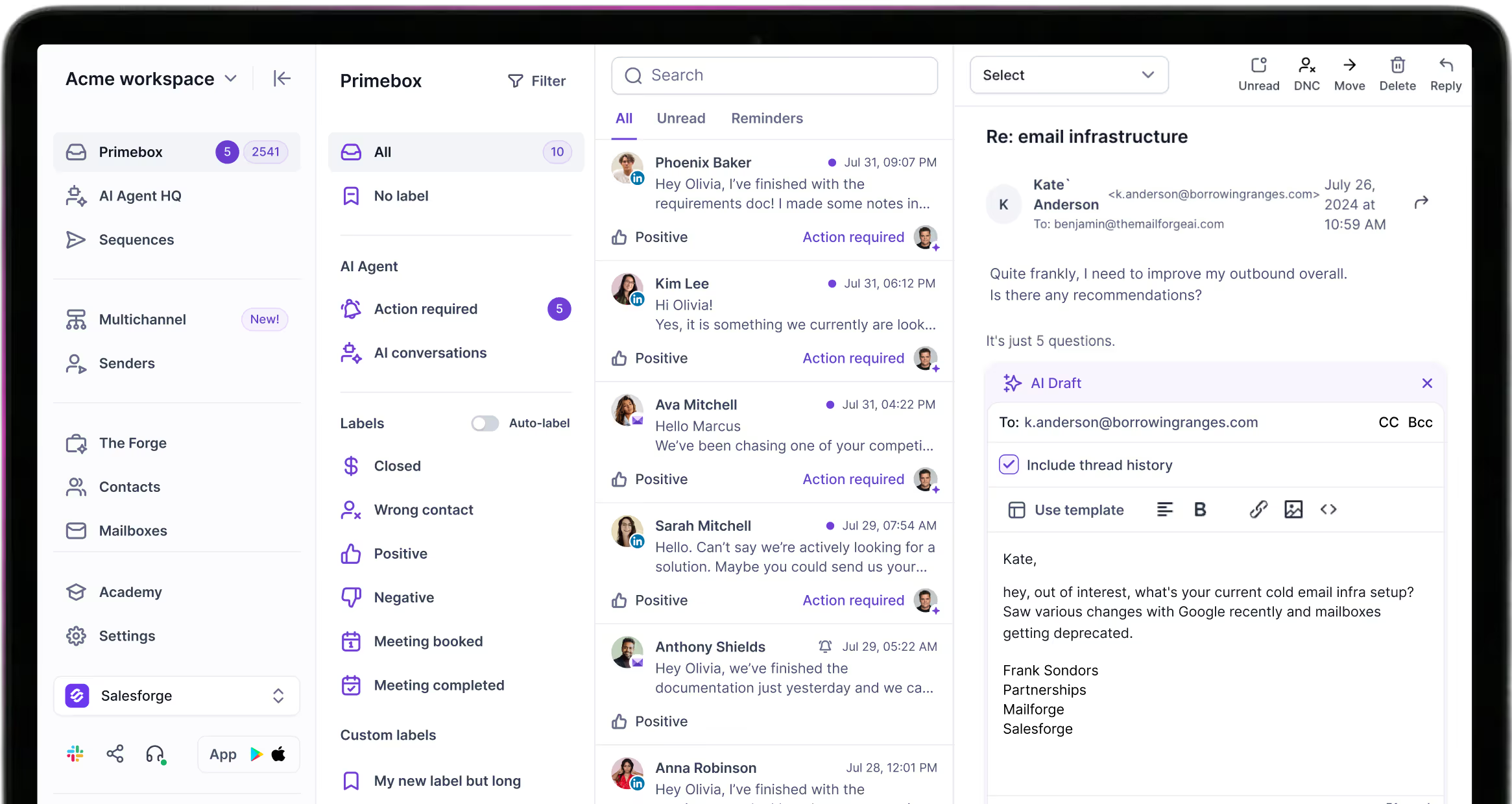
Salesforge’s Primebox and Sendpilot’s Unibox both centralize replies, but they target slightly different workflows.
Salesforge's Primebox explicitly consolidates email + LinkedIn replies and can capture responses even if prospects reply from a different address - built for true multi-channel consolidation.
Both offer AI-assisted reply suggestions and automated inbox handling, but Sendpilot leans LinkedIn-first, while Salesforge layers AI sentiment analysis and prioritization inside the Primebox for faster human follow-up for both email and LinkedIn.
Enter your email to get a custom plan & stack recommendation for your business
Please check your mailbox in 5 minutes
Accurate analytics let you optimize sequences by desired metrics to optimize them to the fullest extent.
If your primary KPI is email reply rate per validated list, Salesforge’s analytics tied to deliverability gives you a clearer causal picture: was a drop in replies due to content or to poor inbox placement? That diagnostic clarity matters when you’re allocating spend or changing creative at scale.
Sendpilot’s analytics are geared toward LinkedIn engagement and content performance, which is good enough if LinkedIn is your only conversion channel.
Both tools provide integrations to fit into existing stacks, but they prioritize different ecosystems.
Sendpilot pushes integrations that help social discovery, CRM syncs, and content workflows that support LinkedIn-first operations.
Salesforge takes native integrations to the next level, but one important distinction is the proprietary Forge Stack, which keeps prospect data, campaign history, and inbox conversations aligned so that when a lead moves to opportunity stage the handover is seamless. Notable Salesforge integrations include:
And many more. If you desire enterprise-scale integrations at smaller-sized sales team pricing, Salesforge will be preferable.
Onboarding speed and quality of support determine how quickly your team can run safe, high-volume outreach.
If your team lacks outreach know-how or runs into issues, Salesforge’s support can generally get your outbound up to par quicker.
Both platforms are strong at what they promise: Sendpilot for LinkedIn-first outreach and Salesforge for multi-channel deliverability-aware hyper-personalized outreach.
If you want an unvarnished recommendation with operational priorities in mind, Salesforge is arguably the safer, more pragmatic pick.
If your team’s KPIs depend on reliable, high quality LinkedIn and email replies with long-term sender health, Salesforge’s built-in deliverability tooling make it the platform to pick. If your primary channel is LinkedIn, Sendpilot remains a great option. Test with both tools and see which one fits your business better - after all, there's no one-size-fits-all outreach automation tool.
Salesforge is a multi-channel platform built for outbound LinkedIn + email sequencing, prioritizing deliverability, mailbox rotation and unified replies. Compared to Sendpilot AI (LinkedIn-first), Salesforge is more powerful for clients managing high-volume outreach, offering advanced inbox placement, AI personalization, and an experience designed to scale campaigns without sacrificing deliverability.
Yes - Salesforge supports LinkedIn actions while consolidating inbound replies in the Primebox. That helps clients manage conversations, follow-ups and nurture prospects so you can grow organic followers and pipeline simultaneously, turning LinkedIn engagement into measurable lead growth.
Signing up is straightforward and the product is designed to make upgrades painless. Founders and clients can sign, trial, then upgrade plans to unlock unlimited mailboxes, advanced deliverability features and API access - a simple path from “easy set-up” to a powerful, enterprise-ready outbound stack.
According to the comparison, clients save time through centralized inboxes, automated warm-up, and integrated personalization. That streamlined experience often leads to stronger reviews from teams balancing LinkedIn and email outreach, since Salesforge reduces manual managing and improves deliverability-driven results.
Salesforge combines deliverability tooling, multi-channel sequencing and AI-assisted reply workflows to create a powerful, cohesive experience. Teams managing outbound campaigns and inbound leads benefit from centralized data, faster follow-ups, and better conversion tracking - all designed to help businesses grow pipeline and revenue.