
Personalized Outbound Strategy
Get The Right Outbound Strategy In Minutes
Enter your email to get a custom plan & stack recommendation for your business
It's being carefully crafted by AI
Please check your mailbox in 5 minutes


For a thorough understanding of what each option offers, a simplified comparison table isn't enough to grasp all intricacies that come with each tool, so let's dive deeper into what makes Apollo and Salesforge unique.
Salesforge, built by a former Googler and VP of sales, offers a comprehensive solution by combining specialized tools that handle different parts of the outbound funnel:
This modular approach lets teams mix-and-match capabilities and pay for precisely what they need while keeping unlimited data access and high deliverability in mind - for example, Salesforge explicitly offers unlimited mailboxes & LinkedIn senders for pipeline scale, which reduces friction when adding users to a sales team.
Apollo, in contrast, is a single sales intelligence tool that bundles a large lead database, enrichment, and outreach automation in one product - appealing for teams that just want an all-in-one sales engagement and lead generation workflow, albeit with limited mobility.
The stack approach that Salesforge uses separates infrastructure (deliverability, domains, mailbox slots) from the engagement experience (outreach workflows, campaign management). That matters when deliverability and phone verified mobile numbers or domain-level reputation become the limiting factor in scaling outbound.
In short: Apollo is convenient as a single product. The Salesforge stack is intentionally composable. That composability is a strategic advantage for teams that care about reliable fine-grained control over global coverage and deliverability.
The Forge Stack is a tightly integrated suite of outbound tools designed to run every step of modern cold outreach - from finding targets to sending high-deliverability email and managing replies. Built to replace dozens of point tools, the Forge stack emphasizes deliverability, infrastructure choice, and end-to-end orchestration so teams can scale reliably.
Together the Forge stack competes by offering a composable stack - prospecting, warmup, infrastructure choices, outreach orchestration and AI - that reduces tool friction and prioritizes deliverability and scale.
Salesforge provides 2 plans oriented around outreach scale and a 14-day free trial (with 2 free months granted when using annual billing):
Mailforge publishes a pricing calculator rather than a single flat plan:
Infraforge also uses a usage-driven pricing model and provides a pricing calculator that charges by domains and mailbox counts (pricing starts at $4/month per mailbox).
Primeforge also offers a per-mailbox pricing model (and a pricing calculator). Mailbox pricing ranges from $3.50–$4.50 per mailbox/month and include automated setup, DNS automation, and bulk mailbox management.
Warmforge’s (just like the aforementioned Forge products) pricing is per-mailbox with volume discounts (and being completely free for every Salesforge subscriber). Otherwise, pricing starts at $12/slot and can get as low as $3/slot.
Leadsforge offers an Essential plan (includes 2000 export credits) which starts at $49/mo, as well as using a credit-based model (1 email = 1 credit, 1 phone number = 10 credits).
Apollo provides 4 plans oriented around outreach scale + a Free plan with limited credits (discounted annual billing):
Because Leadsforge is built to be a connector-first prospecting tool, it emphasizes data enrichment and fast list-building and lends integrations that let teams export enriched leads into the rest of the stack.
The practical difference is how teams get from a target company to the key decision makers and their accurate email addresses:
For buyers worried about data accuracy and lead data freshness, the multi-source enrichment path that Leadsforge offers is often more transparent about where contact fields come from, which matters for maintaining data integrity and avoiding bounced campaigns.
Enter your email to get a custom plan & stack recommendation for your business
Please check your mailbox in 5 minutes
Accuracy Matters: false positives waste outreach bandwidth and hurt deliverability.
The Salesforge stack splits enrichment and verification into distinct steps:
Salesforge users can run stricter verification pipelines before exporting to a CRM or running a campaign - minimizing bounce rates and preserving sender reputation. If your priority is minimizing data decay and keeping accurate email addresses in CRM fields, the stack’s staged verification tends to reduce surprises during a ramp-up.
Understanding buyer intent data and intent signals is central to prioritizing outreach and aligning marketing efforts with sales outreach.
Leadsforge’s ability to convert tracking and public activity into targeted lists creates a practical path from intent tracking to contact enrichment. Combined with the stack’s campaigning features, this can produce prioritized outreach campaigns directed at target accounts that are already showing interest.
Because Salesforge separates the pipeline into discrete tools, teams can layer intent signals with advanced deliverability (e.g. via Warmforge) before firing campaigns - reducing wasted sends to low-intent contacts and emphasizing lead scoring and target companies with higher conversion potential.
Apollo does this inside a single platform, but the Salesforge arrangement tends to give more fidelity when you must combine multiple intent sources or apply bespoke lead/deliverability scoring models.
Apollo provides an “emails hub” (you can link mailboxes, view/respond to emails in-app, run sequences, and tie LinkedIn steps into sequences) but its product framing centers on sequencing, analytics and CRM integration rather than a single, prioritized multi-channel reply workspace.
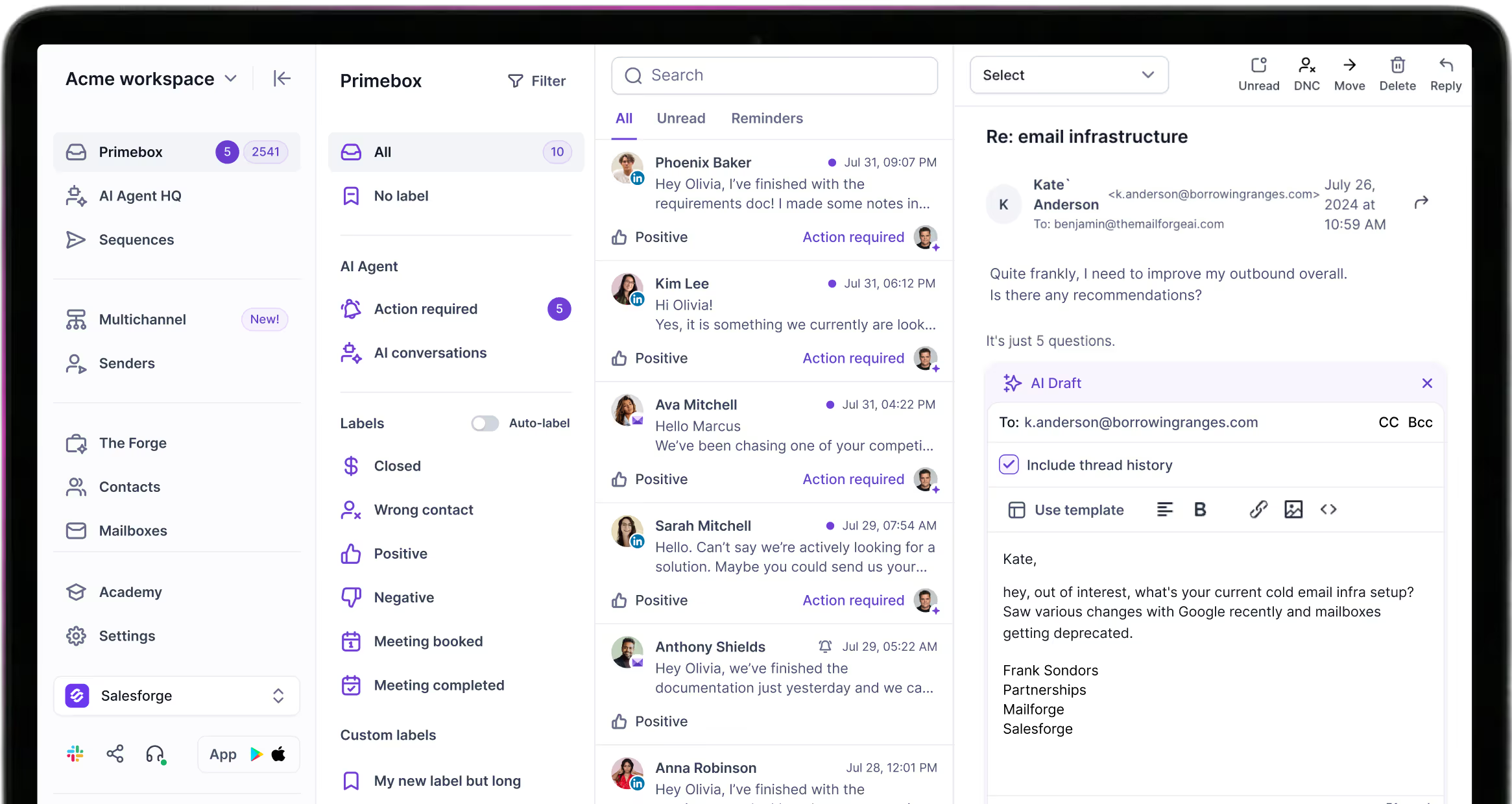
Salesforge approaches inbox management to the next level with the Primebox - a unified inbox that consolidates replies across email and LinkedIn into a single place and captures responses even if prospects reply from different addresses.
The practical benefit here is not just convenience: Primebox adds AI analysis and smart tools to help you reply faster, aggregate replies across mailboxes, and avoid losing prospects when replies land on alternate addresses.
For teams running multi-channel outreach campaigns, landing replies in one consolidated system simplifies pipeline updates, CRM syncs, and handoffs to account teams - and makes campaign performance signal clearer because reply attribution (which message and which channel drove the response) is easier to measure.
Salesforge’s infrastructure trio - Mailforge, Infraforge and Primeforge - is built as a stack for teams that know to treat inbox placement as a crucial strategic advantage. Where many outreach platforms bundle sequencing and prospecting, Salesforge deliberately separates and owns the sending layer so teams can choose technical control they need.
Apollo, by contrast, is a powerful all-in-one engagement and intelligence platform that focuses on prospecting, sequences and “mailbox linking”. That model is good if you want everything in one UI and are willing to manage DNS, IP reputation and warm-up yourself.
If your core KPI is predictable inbox placement at scale, owning the sending stack matters: shared vs private IPs, pre-warming, multi-IP provisioning, ESP matching and a deliverability engine are concrete controls that reduce surprise deliverability failures.
Salesforge packages those as purpose-built products you can mix-and-match.
Warmup is often an afterthought until reputation problems spike.
While Apollo has features to monitor opens, clicks, and engagement, as well as a basic warm-up tool, it doesn’t advertise a dedicated deliverability center in the same way that Salesforge does via Warmforge.
With a Salesforge subscription, you get:
And more. Building sender reputation gradually while spreading volume across addresses and IPs to avoid single-mailbox throttles or sudden reputation hits is crucial for a scaling business. And that's paired with proprietary infrastructure options:
Those infrastructure features reduce the risk of landing in spam and make multi-channel outreach more reliable, especially when you have a leads database and want to integrate email at scale.
For teams scaling outreach campaigns that require many sending identities, Salesforge's level of deliverability and infrastructure support reduces the operational burden of setting up domains, warming mailboxes, monitoring inbox placement, and gambling on emails landing in the primary inbox.
Both Apollo and Salesforge support campaign automation and outreach workflows, but they approach automation differently.
The practical benefit of the Salesforge route is that automation runs on top of independently managed infrastructure and data - so when a campaign misfires (high bounces, blacklisting risk), teams can pause infrastructure or swap domains without losing campaign logic.
That operational separation is powerful for sophisticated teams running many concurrent sequences: it lets you automate outreach while still controlling sender reputation, managing leads, and adjusting campaign management knobs independently.
Search tooling, such as available search filters, boolean queries, and domain-based searches, define how quickly a rep can find key decision makers at target companies.
The advantage for Salesforge users is combining Leadsforge’s flexible search with the ability for rapid workspace and inbox provisioning so that once a list is identified, it flows immediately into a warmed sending pipeline.
Apollo integrates with various major CRMs and outbound platforms, connectors such as Zapier, webhooks and Make, and offers an API.
Salesforge takes native integrations to the next level. Besides being part of the Forge Stack, which keeps prospect data, campaign history, and inbox conversations aligned so that when a lead moves to opportunity stage the handover is seamless, Salesforge also natively includes integrations with:
And recently Salesforge even launched its own Chrome extension for teams that prefer working with it. If you desire enterprise-scale integrations at smaller-sized sales team pricing, Salesforge will be preferable.
There’s a tradeoff between power and ease.
Apollo’s UI is mature, data-dense and built around discovery of contacts + sequences. Salesforge trades some of that database-first polish for single-pane flows that surface deliverability and inbox health tools directly in the campaign flow, which makes critical actions (set up DNS, run placement tests, warm mailboxes) highly discoverable to non-technical users.
If you prioritize fast, low-friction outreach with built-in deliverability, the Forge Stack is the more accessible choice.
If you need over the top CRM/automation breadth, Apollo remains a top pick but expect more setup and dependency on best-practice execution to hit the same deliverability outcomes.
Salesforge offers:
All signposts of proactive, human help and onboarding resources.
Apollo offers:
Great for predictable SLAs and asynchronous problem tracking, since Their public support/contact pages and submit-a-request flow emphasize KB-first troubleshooting and ticketing.
Both platforms deliver analytics and lead scoring options, but their design philosophies differ.
The net effect is that Salesforge users gain more granular telemetry across the stack, enabling separate lead scoring signals (engagement + intent + deliverability) to be combined into richer prioritization models.
For B2B sellers who use multi-signal scoring to allocate sales calls and prioritize key decision makers, Salesforge's multipoint analytics afford more sophisticated playbooks.
If your priority is a single sales intelligence tool, and a generous free plan to pilot outreach, Apollo is a good choice.
Its unified lead database and multi-channel sequences make it fairly frictionless for small teams.
However, if you wish to run high-volume outbound, care deeply about email deliverability, need multi-source AI hyper-personalization, require modular data enrichment, desire robust analytics, or even operate an agency or enterprise with complex sales processes or a need for whitelabel, the Salesforge Stack is the more reliable, operationally sound bet.
Doubtful of Salesforge's capabilities? Feel free to let the results speak for themselves:

The Salesforge stack’s modular design - separating lead generation, deliverability, infrastructure, and orchestration - gives teams finer control over campaign management.
Salesforge combines intent data and website visitor tracking with contact search (by job title or behavior) to surface high-priority prospects. Visitor tracking and intent signals feed into sequences so sales engagement and email outreach target buyers showing interest. This enables users to prioritize outreach, tailor messaging, and feed CRM data for follow-up without switching multiple tools.
Yes - Salesforge’s global database and extensive lead database let you search by job title, company, domain, or custom filters. Built-in enrichment and verification improve data accuracy before export, and contact search results can sync to CRM data or other tools, reducing bounce risk and saving outreach time.
Key features include managed sending infrastructure, warmup and deliverability checks, mailbox rotation, placement tests, and campaign orchestration. These advanced features keep email outreach and email campaigns healthy, improve inbox placement, and let teams scale safely while integrating with sequence and analytics tools.
Salesforge layers multi-source enrichment, verification workflows, and monitoring to boost data accuracy. Verified contacts and activity sync to your CRM and other tools via native integrations, webhooks, or API. This pipeline minimizes false positives, preserves sender reputation, and keeps CRM data actionable for reps.
Salesforge offers tiered plans (basic-style starter options and professional/advanced features) so teams can start simple and add capabilities. While the stack approach can feel like multiple tools at first, onboarding, templates, and enablement resources reduce the steep learning curve - enabling users to adopt advanced features (deliverability, intent data, global database searches) at their own pace.