
Personalized Outbound Strategy
Get The Right Outbound Strategy In Minutes
Enter your email to get a custom plan & stack recommendation for your business
It's being carefully crafted by AI
Please check your mailbox in 5 minutes


For a thorough understanding of what each option offers, a simplified comparison table isn't enough to grasp all intricacies that come with each tool, so let's dive deeper into what makes Salesforge and Kaspr unique.
Salesforge, built by a former Googler and VP of sales, positions itself as an advanced multi-channel cold outreach platform:
Alternatively, you can just let Salesforge's results speak for themselves:

Kaspr is principally a contact data and lead-enrichment product delivered through a browser experience:
That difference is fundamental. Kaspr is optimized to enrich lead lists and give SDRs contact data. Salesforge is optimized to engage leads efficiently across channels with state-of-the-art personalization, advanced deliverability and incredible ease of use.
Salesforge provides 2 plans oriented around outreach scale and a 14-day free trial (with 2 free months granted when using annual billing):
Kaspr provides 3 plans oriented around contact-data access and a free plan (annual billing saves ~25%):
Kaspr’s product narrative is built around instant access to contact details while prospecting on LinkedIn.
Salesforge's emphasis is less on being the contact data provider and more on orchestrating outreach with reliable infrastructure - that job goes to Leadsforge.
Leadsforge (starting at $49/mo) reduces manual work by seamlessly integrating with Salesforge, just like every other Forge Stack product, and by automating ICP-based discovery and verifying contacts across datasets, so ops teams can scale prospecting without hopping between LinkedIn, CSVs, and extensions.
Lead generation workflows differ depending on whether you prioritize browser-driven discovery or centralized list management.
Where Kaspr streamlines contact data retrieval, Salesforge streamlines the actual contact outreach.
LinkedIn is the common ground for many outbound teams, but Kaspr and Salesforge approach LinkedIn differently.
That makes Kaspr good for LinkedIn-driven prospecting where the immediate goal is to get contact details for a set of decision makers and then run outreach from a separate stack.
Salesforge supports LinkedIn as part of its robust multi-channel campaign engine.
If your team primarily needs to extract contact data in the moment, Kaspr is a good option, but if you need to coordinate LinkedIn touches with synchronized email sequences, thorough deliverability safeguards, and centralized reply handling, Salesforge’s multi-channel sequencing is perfectly suited.
The technical side of cold outreach is often the difference between messages being seen or being lost. This is where Salesforge leans into a demonstrable advantage.
Salesforge emphasizes email deliverability extensively with:
And more. Building sender reputation gradually while spreading volume across addresses and IPs to avoid single-mailbox throttles or sudden reputation hits is crucial for a scaling business. And that's paired with proprietary infrastructure options:
Those infrastructure features reduce the risk of landing in spam and make multi-channel outreach more reliable, especially when you have a lead database and want to integrate email at scale.
Kaspr’s value proposition is LinkedIn contact data, therefore Kaspr does not offer any built-in email infrastructure or email deliverability capabilities.
Enter your email to get a custom plan & stack recommendation for your business
Please check your mailbox in 5 minutes
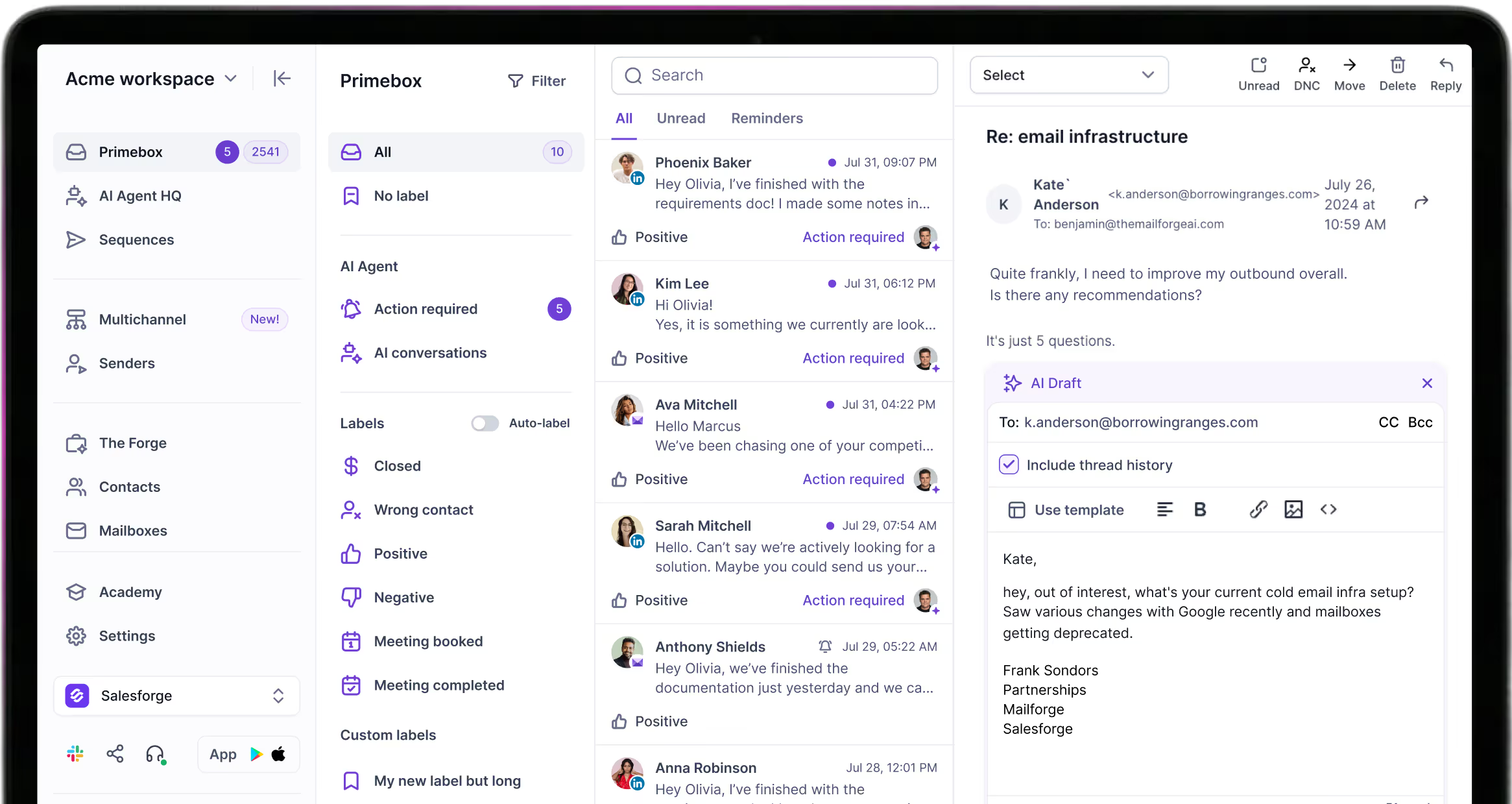
Running campaigns is only half the battle - you must capture replies and manage follow-ups without losing prospects in the noise.
This kind of inbox consolidation is crucial when you run multiple outreach sequences or when prospects reply from different addresses than the one you sent from.
For teams that need a reliable place to triage thousands of replies across email and LinkedIn, Salesforge’s consolidated reply and workflow features are a substantial advantage.
Kaspr highlights easy integration with some major CRMs, export capabilities, an API, and explicit Sales Navigator compatibility.
The Kaspr Chrome extension is designed to work in tandem with LinkedIn and Sales Navigator views so you can extract contact data quickly and push it into your CRM or the Kaspr dashboard.
Salesforge makes sure there's nothing lacking with a robust array of integrations, with one important offering being the proprietary Forge Stack, which keeps prospect data, campaign history, and inbox conversations aligned so that when a lead moves to opportunity stage, the handover is seamless. Notable Salesforge integrations include:
And many more. If you desire enterprise-scale integrations at smaller-sized sales team pricing, Salesforge is the perfect option.
Kaspr repeatedly touts its ease of setup: the Kaspr Chrome extension can be installed quickly, and some customers report minimal onboarding to start pulling contact details and enriching lead lists.
For teams that need prospect contact details as fast as possible, Kaspr’s low friction is a real advantage, but if issues arise, Kaspr's support is fairly standard: decently sized knowledge base with email and live chat support.
Salesforge has many more moving parts - domains, mailboxes, warm-up, multi-mailbox management, etc. - but manages to wrap it all neatly into a user-friendly interface.
Salesforge additionally offsets that complexity with resources: an Academy, video tutorials, prebuilt templates, an active Slack community and much more. If issues or questions arise Salesforge also offers 24/7 email and live chat support to lend a hand as quickly as possible.
If your immediate need is to grab contact details - accurate email addresses, phone numbers and quick data enrichment while browsing LinkedIn or Sales Navigator - Kaspr is a good pick.
Kaspr is purpose-built for that moment-to-moment prospecting task. However, for teams that intend to operate high quality outreach - where advanced deliverability capabilities, consolidated replies, multi-source AI hyper-personalization, easy sequence orchestration and robust integrations matter - Salesforge becomes the go-to choice.
Salesforge centralizes campaign execution, offers proprietary infrastructure and free unlimited warm-up, and consolidates replies via the Primebox, which means fewer lost replies and fewer deliverability surprises as you scale.
Practically, the best stacks I see pair the two: use Kaspr to enrich lists and capture phone numbers and emails, then import those lead lists into Salesforge to run deliverability-safe, multi-channel outreach while maintaining robust reply handling and long-term mailbox health.
More optimally, pair Salesforge with Leadsforge to seamlessly streamline high quality lead generation with state-of-the-art lead outreach.
Salesforge focuses on outreach and deliverability, not a Chrome extension email finder. For accurate data and phone numbers you can use Kaspr or Leadsforge (part of the Forge Stack) to enrich a database, then import that verified data into Salesforge to run multichannel campaigns targeting decision makers and prospects.
Salesforge itself doesn’t center on a Kaspr-style Chrome extension. Instead, it connects with tools and services (Kaspr, APIs, Zapier) or Leadsforge to pull data from LinkedIn Sales Navigator, websites, and CRMs, then syncs that one-click or bulk export data into Salesforge’s campaign database.
Salesforge relies on integrated data services and Leadsforge for enrichment and verification. It validates emails, cross-checks phone numbers and company info, and maintains a centralized database so sales teams have accurate contact and company data before launching outreach campaigns to prospects.
Yes. Salesforge ingests exports from email finder tools (Kaspr, Leadsforge), APIs, or one-click integrations, then maps that data (emails, phone numbers, company, decision makers) into sequences and CRMs so sales teams can contact prospects across channels with campaign-ready data.
Kaspr excels at instant contact capture (Chrome extension, LinkedIn Sales Navigator) and accurate data. Salesforge excels at turning that data into high-performance outreach: multi-channel campaigns, deliverability, reply handling, and integrations. Together they connect data capture and outbound execution for scalable sales results.