It helps identify which companies are visiting your website, even if they don’t fill a form.
I used it to understand incoming traffic and see which businesses are showing interest.
It shows company details, pages visited, and visit behavior.
The focus is on company-level identification, not individual contacts.
So it is more useful for analysis than direct outreach.
Why Lead Forensics is a Better Alternative to RB2B?
Lead Forensics is better when the goal is to identify and understand website visitors at the company level.
Here’s where it felt different in real use:
Company-level identification: It focuses on showing which companies are visiting your site.
Visitor behavior insights: I could see which pages companies viewed and how often they returned.
Traffic understanding: It helped me understand which pages and campaigns bring visitors.
Inbound-focused workflow: The tool is built more for tracking and analyzing visitors.
Simple use for marketing teams: It fits teams that want visibility into website traffic without complex setups.
Pros of Lead Forensics
Identifies anonymous website visitors at company level
Shows pages visited and visit behavior
Helps understand traffic and campaign performance
Simple way to see which companies are visiting
Cons of Lead Forensics
No direct person-level contact data
Needs other tools for outreach or enrichment
Data is company-focused, not lead-ready
Limited use for direct outbound workflows
Lead Forensics Pricing
This image shows the Lead Forensics pricing
Lead Forensics does not show fixed pricing publicly.
Pricing is custom and depends on:
Website traffic
Features required
Business size
It is usually positioned for teams that want deeper visibility into website traffic.
3. 6sense
This image shows the 6sense homepage
6sense is a revenue intelligence and ABM platform.
It helps identify which accounts are showing buying intent across different channels.
I used it to understand which companies are more likely to convert, not just visit.
It combines intent data, account insights, and AI predictions.
The focus is on account-level intelligence and prioritization, not just website visitors.
Why Is 6sense a Better Alternative to RB2B?
6sense is better when the goal is to find and prioritize accounts that are already showing buying intent, not just identify visitors.
Here’s where 6sense is better in real use:
Broader intent signals beyond your website: I could see buying signals from multiple sources, not just my own traffic.
With RB2B, signals mostly depend on website visits.
Account prioritization with AI scoring: 6sense ranked accounts based on likelihood to buy.
RB2B shows activity, but prioritization is more limited.
Earlier visibility into buyer journey: I could identify accounts researching before they filled a form or converted. RB2B works after a visit is identified.
Full GTM execution support: 6sense connects signals to workflows across ads, email, and sales.
RB2B focuses more on identifying and routing visitor data.
Better for ABM workflows: I could build and act on target account lists directly. RB2B depends on existing website traffic.
Pros of 6sense
Strong intent data across multiple sources
AI-based account scoring and prioritization
Supports ABM and full funnel GTM workflows
Connects marketing, sales, and data in one system
Helps identify accounts showing buying intent
Cons of 6sense
Focused more on account-level than individual visitor identification
More complex compared to simple visitor tracking tools
Requires setup across multiple workflows
Not built for quick lead capture from website traffic alone
6sense Pricing
This image shows the 6sense pricing
6sense does not provide fixed pricing publicly.
Pricing depends on:
Features and modules used
Data volume and integrations
Company size and use case
It is generally used by mid-size to enterprise teams running ABM strategies.
4. Leadfeeder
This image shows the Leadfeeder homepage
Leadfeeder (now part of Dealfront) is a website visitor tracking and lead generation tool.
It helps identify which companies visit your website and how they behave.
I used it to understand which companies are engaging with my site and which pages they view.
It combines visitor identification, company data, and basic intent signals from behavior.
The focus is on turning website traffic into company-level leads, not outbound prospecting.
It is built for teams that want to capture and act on inbound website traffic.
Why Is Leadfeeder a Better Alternative to RB2B?
Leadfeeder is better when the goal is to identify more companies and act on website traffic with more context.
Here’s where Leadfeeder felt better in real use:
Higher company identification coverage: It identified a larger share of website visitors at the company level.
RB2B can miss some visitors depending on tracking depth.
Clear visitor behavior insights: I could see pages visited, time spent, and engagement patterns.
RB2B focuses more on identifying visitors than analyzing behavior deeply.
Built-in lead scoring and prioritization: Leadfeeder helped prioritize companies based on activity and fit.
RB2B shows data, but scoring is more limited.
Audience building and targeting: I could create lists based on ICP, behavior, and filters.
RB2B is more focused on raw visitor identification.
Stronger marketing + sales alignment: Data could be used for campaigns, retargeting, and CRM workflows.
RB2B is mainly used for lead identification and routing.
Pros of Leadfeeder
Identifies companies visiting your website
Shows visitor behavior and engagement data
Helps prioritize leads based on activity
Supports audience building and targeting
Cons of Leadfeeder
Focused on company-level, not always person-level data
Depends fully on website traffic
Limited outbound prospecting features
Requires additional tools for enrichment or outreach
Can miss smaller or anonymous visitors
Leadfeeder Pricing
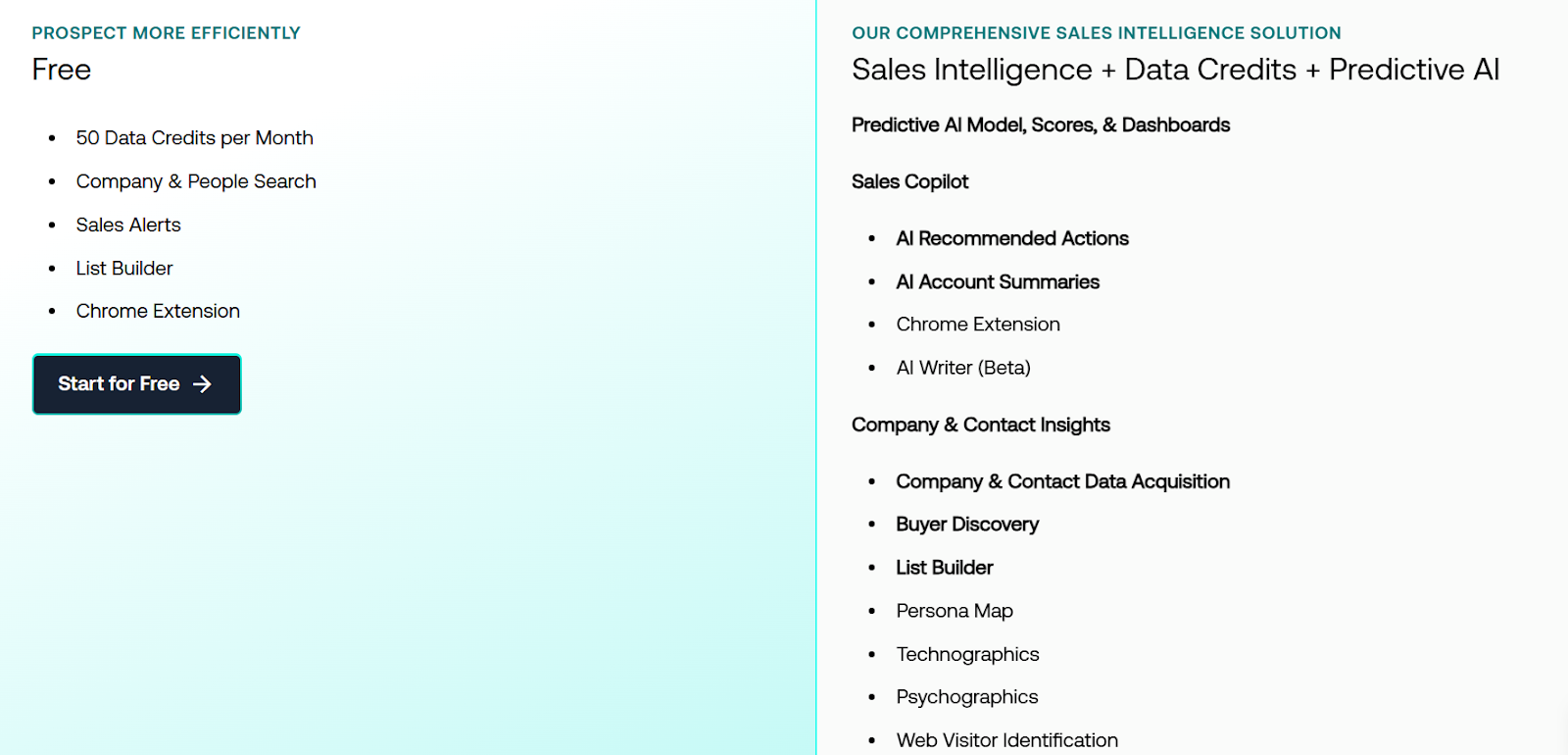
This image shows the Leadfeeder pricing
Leadfeeder offers multiple plans:
Free plan: Up to 100 company identifications per month, Basic company data and limited history
Paid plans: Start around €141/month (based on identified companies), include unlimited company identification, scoring, CRM sync, and integrations
Advanced platform plan: Starts around €519/month, includes prospecting, AI enrichment, and full data access
5. Warmly
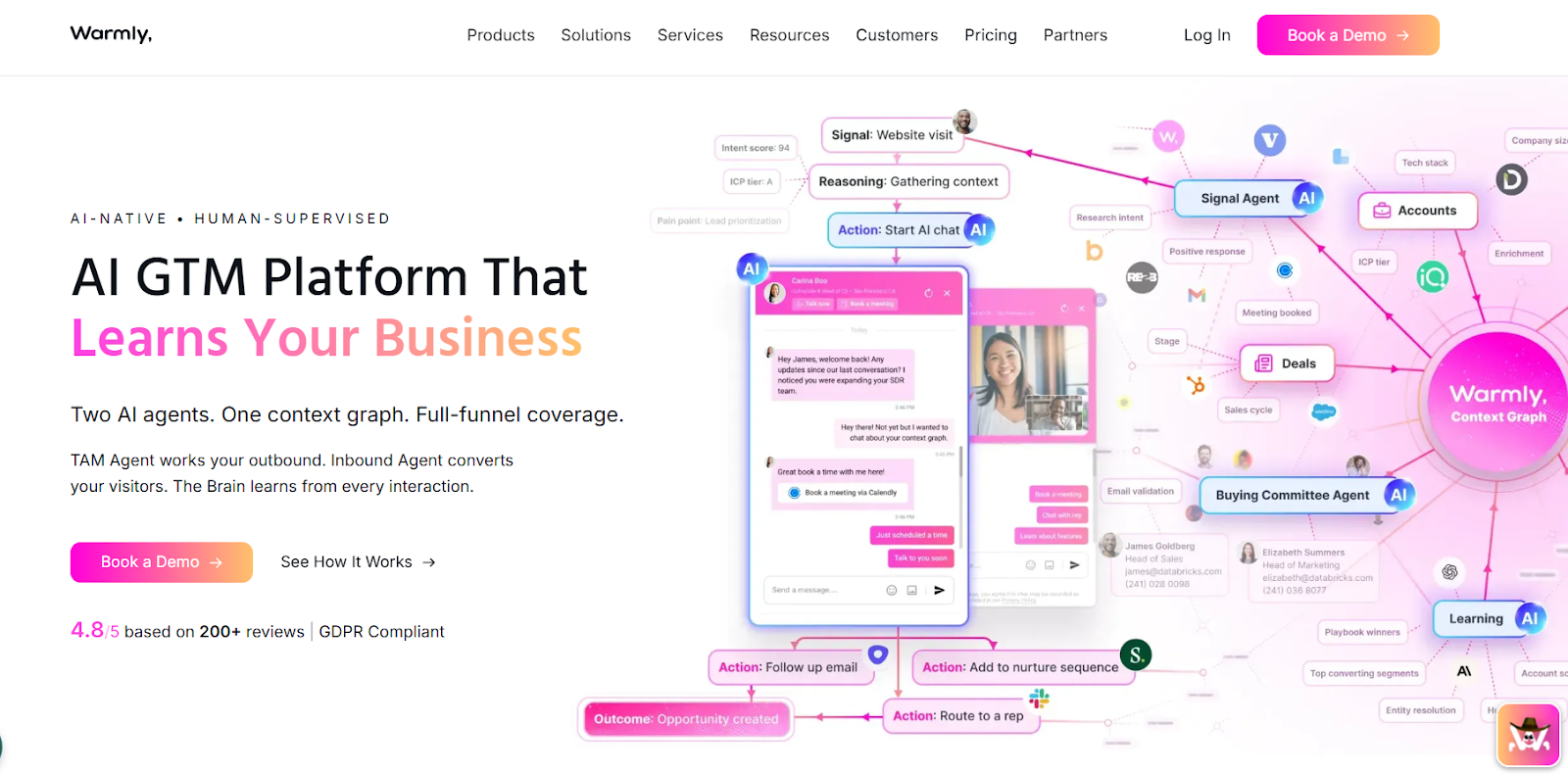
This image shows the Warmly homepage
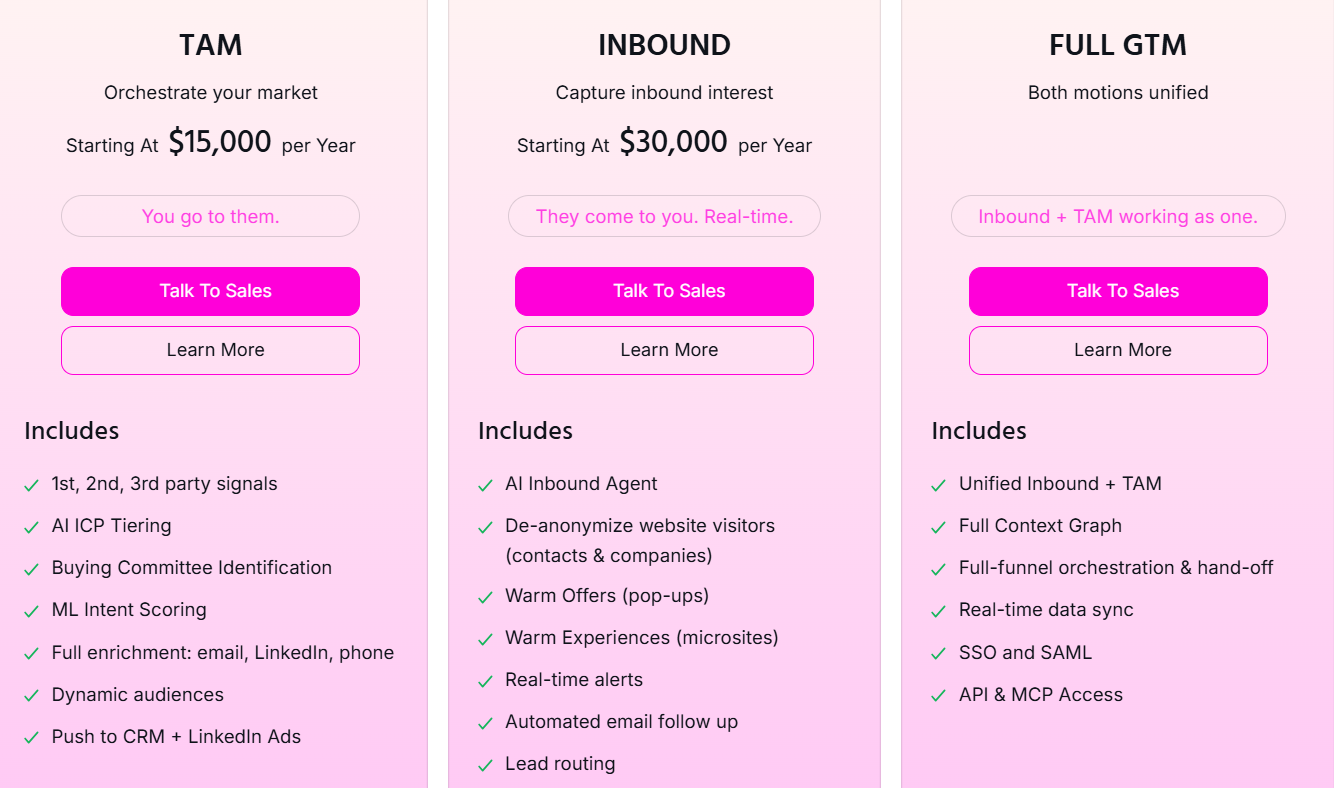
Warmly is an AI GTM platform.
It combines intent data, visitor identification, and automation in one system.
It uses two main parts:
TAM Agent for outbound
Inbound Agent for website visitors
I used it to track visitors, identify contacts, and engage them in real time.
It combines person-level identification, AI chat, intent signals, and automation workflows.
The focus is on turning both inbound and outbound signals into pipeline, not just tracking visitors.
Why Is Warmly a Better Alternative to RB2B?
Warmly is better when the goal is to not just identify visitors, but engage and convert them in real time.
Here’s where Warmly felt better in real use:
Person-level identification + engagement: I could identify visitors and engage them instantly with AI chat.
RB2B focuses more on identifying visitors, not engaging them.
Real-time conversion workflows: Warmly could trigger chat, book meetings, and route leads automatically.
RB2B requires manual follow-up after identification.
Inbound + outbound in one system: I could handle both website visitors and outbound targeting together.
Discover the best sales acceleration softwares of 2026. Compare features, pricing, pros, cons, and find the right tool to grow your sales pipeline faster.








.jpg)